
TL;DR: Tech hiring in 2026 is growing and shrinking at the same time. US tech occupations added 86,000 workers in August while tech companies cut 14,700 jobs, and layoffs.fyi counts 129,288 tech layoffs so far this year. The openings that are growing ask for AI skills or senior experience.
US software development job postings grew almost 15% between Claude Code's launch in February 2025 and July 2026, while job postings overall fell 7%.
Indeed's Hiring Lab traced most of the rise to experience: 71% of the growth from May 2025 to May 2026 came from senior roles.
- 1Software postings on Indeed are still about a quarter below their February 2020 level, even after a year of recovery.
- 2Employment of 22 to 25 year olds in the most AI-exposed jobs is 19% below trend, Stanford researchers found in August 2026.
- 3Workers with AI skills earn a 62% wage premium on PwC's 2026 count, up from 57% a year earlier.
- 4India's 2,117 global capability centers employ about 2.36 million people, and their hiring grew 10% in August.
8 Tech Job Market Trends Shaping 2026
1. Tech jobs are growing outside tech companies
The August jobs data split in two. Employment in tech occupations across all industries rose by 86,000, while tech companies themselves cut about 14,700 positions, CompTIA's analysis of the Bureau of Labor Statistics release found.
The information sector, which includes software publishers, telecoms and media, lost 23,000 jobs in August after averaging losses of 8,000 a month for a year.
Tech postings show where the hiring went instead: manufacturing advertised 31,552 tech jobs in August and finance and insurance 17,696, CompTIA found.
CompTIA's State of the Tech Workforce 2026 expects net tech employment to grow 1.9% this year, to nearly 9.8 million workers, after a 0.3% fall in 2025.
2. Layoffs hit fewer companies, but cut deeper
Block announced in February that it would shrink from over 10,000 people to just under 6,000, a cut of more than 40% disclosed in its SEC filing. That is the shape of 2026: cuts that go deeper at each company.
Layoffs.fyi has logged layoffs at 308 tech companies so far this year, against 1,194 in 2023 and 551 in 2024.
By our division of its totals, the average layoff in 2026 affected about 420 employees, close to double the 2023 average of about 220.
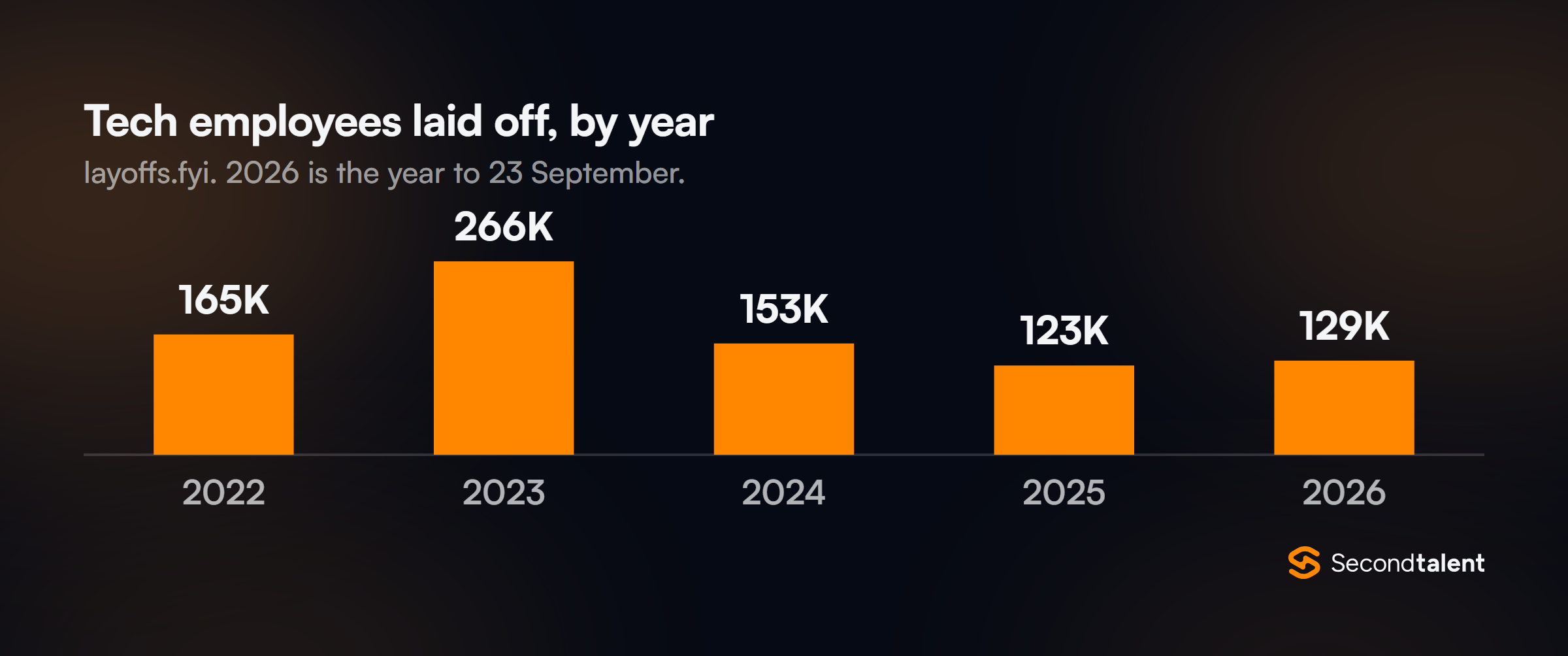
The largest cuts announced so far this year:
Challenger, Gray & Christmas uses a different count and gets a bigger number. Its August report puts announced technology job cuts at 155,126 through August, up 52% on the same months of 2025.
Technology accounts for 29% of all cuts this year, more than any other industry. August's 6,103 tech cuts were the lowest monthly total of the year.
Our tech layoffs statistics page breaks the 2026 cuts down by company and month.
3. AI became the most-cited reason for job cuts
From March to July 2026, employers named artificial intelligence as the reason for more job cuts than any other cause, every month.
Across all industries, AI was cited in 116,175 announced cuts through August, about 22% of the total, and it remains the leading reason for the year.
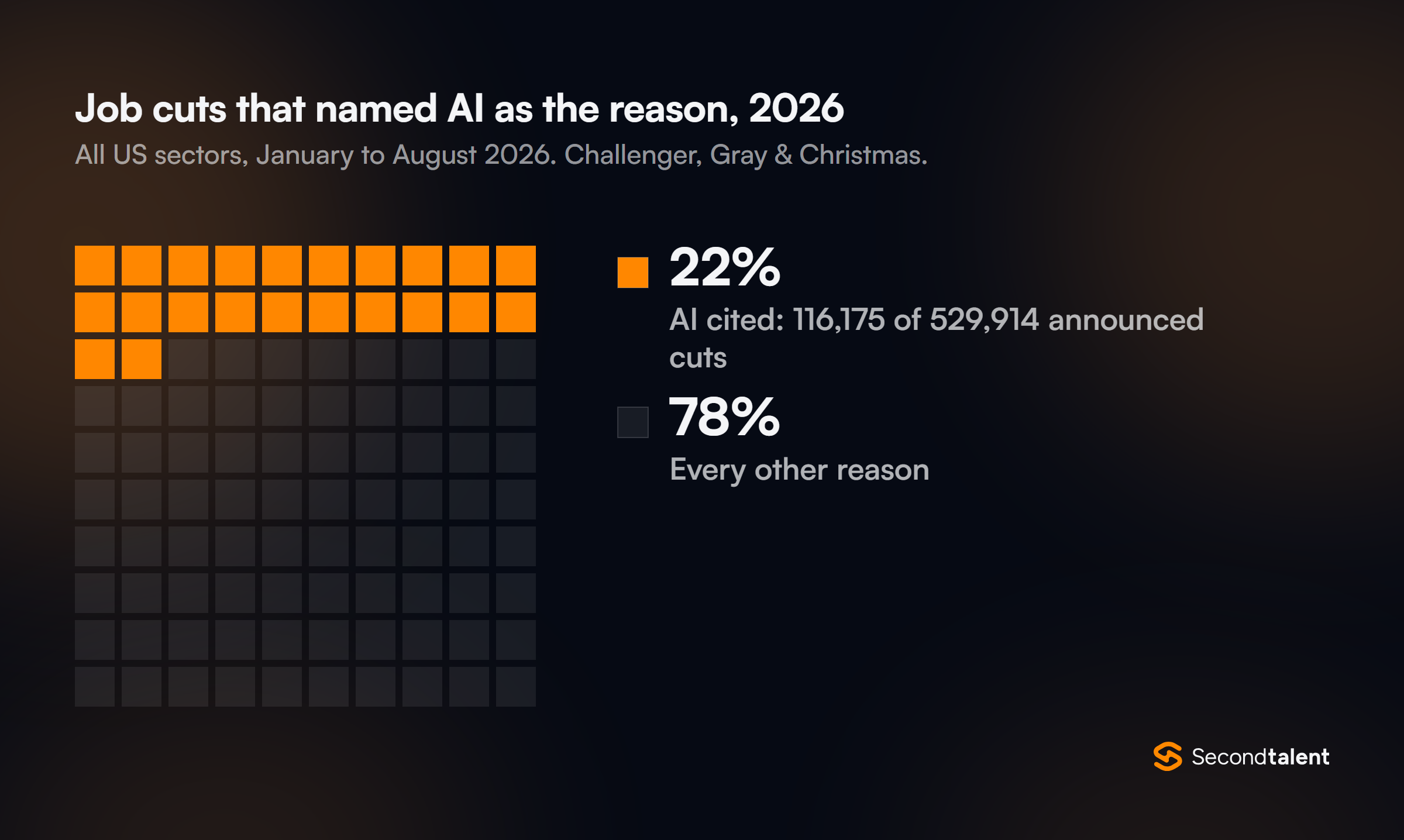
The streak broke in August. AI fell to the fourth most-cited reason, with 3,462 cuts, its lowest monthly total since December 2025, according to the same Challenger report.
Company filings are starting to say the same thing.
Oracle's annual report for the year to May 2026 states that "the adoption and deployment of AI technologies across our operations have resulted, and may continue to result, in reductions to our workforce."
A stated reason is not proof of cause, though. Challenger records the reason employers give in their announcements, not whether AI took over the work.
For the broader picture across industries, see our analysis of AI's impact on the job market in 2026.
4. Software postings are recovering, led by senior and AI roles
At the May 2022 peak, software development postings on Indeed ran at more than double their February 2020 level. By May 2025 they had fallen to 61.1% of it, the low point of the cycle.
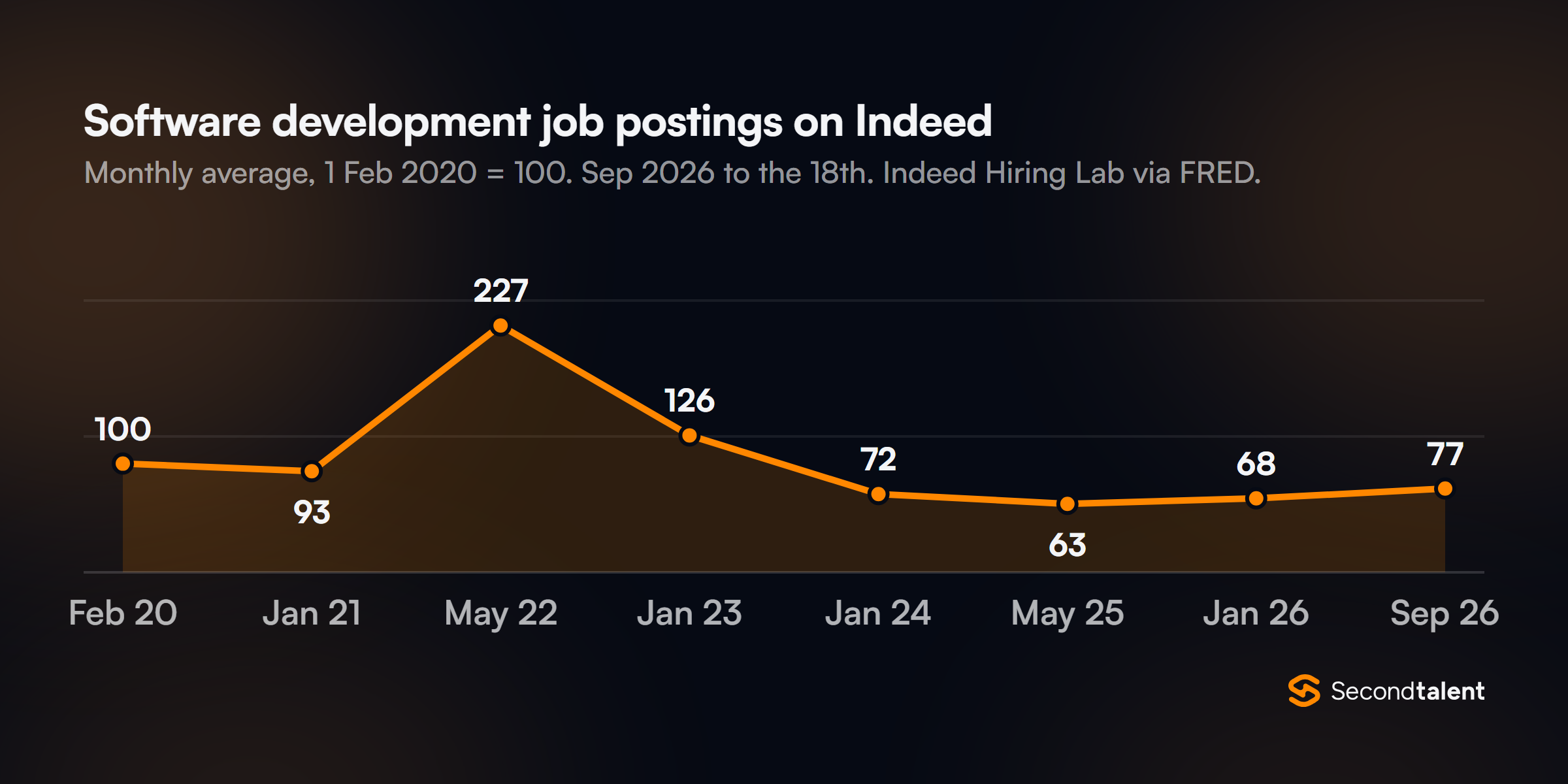
The recovery since then is real but partial. The index stood at 74.4 on August 14, Hiring Lab's August snapshot reported, while Indeed's postings across all jobs sat 1.8% above their pre-pandemic level.
The daily series reached 77.3 on September 18.
Other trackers see the same direction. Dice, using Lightcast data, found US tech job postings up 18% year on year in August, with AI and machine learning postings up 101%.
CompTIA counted nearly 600,000 active tech postings in August, 42% of them newly advertised that month.
The Indeed data also shows who the new postings are for. In a July analysis, Hiring Lab found that jobs mentioning AI in the title drove 37% of the growth in software postings between May 2025 and May 2026.
5. Entry-level engineers carry the cost
Senior positions made up 69.3% of software development job postings in the first quarter of 2026, the highest share of any occupation Indeed tracks, its July seniority study found. New-graduate hiring has fallen further still.
SignalFire's 2026 State of Talent report puts new-graduate hiring at the largest tech companies down about 65% from 2019, and down about 76% at early-stage startups.
Top computer science graduates of 2025 were 45% less likely to land a job at a large tech company than the class of 2022, and twice as likely to call themselves a founder.
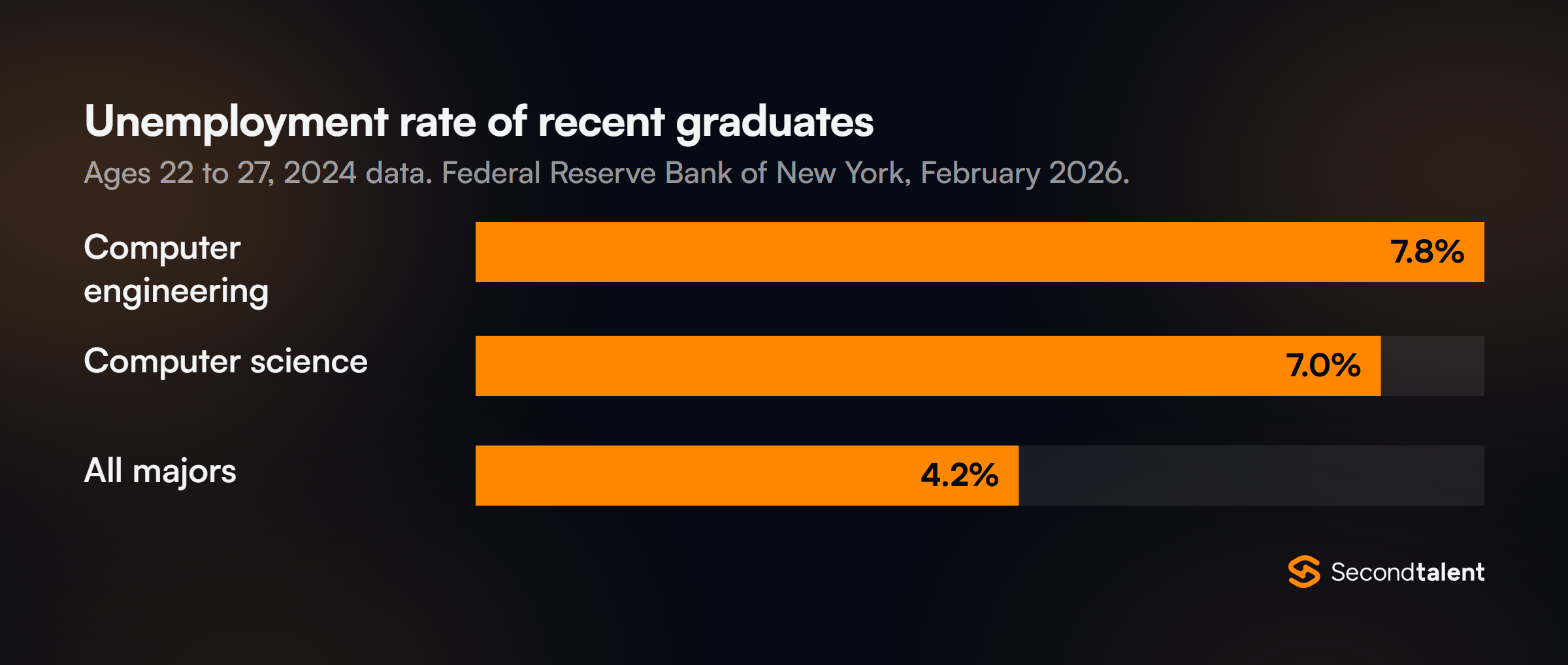
The New York Fed's graduate data shows the result. Recent computer engineering graduates had the second-highest unemployment rate of any major, 7.8%, behind only anthropology. Computer science sat at 7.0%.
Across all recent graduates, unemployment was 5.7% in June 2026, against 4.1% for all workers.
Stanford's Digital Economy Lab has tracked the same group through payroll data. By September 2025, employment of software developers aged 22 to 25 was nearly 20% below its late-2022 peak.
Its August 2026 update found the shortfall for young workers in AI-exposed jobs widening, from 15% to 19%, but no widespread displacement, and pay for young software developers growing somewhat faster than for older ones.
6. Pay rises go to staff engineers, not the whole ladder
Principal engineers in the US took a pay cut in 2025. Their median total compensation fell 6.6% to $551,000 on Levels.fyi's end-of-year report, while staff engineers gained 7.5% to $457,000, the biggest rise of any level.
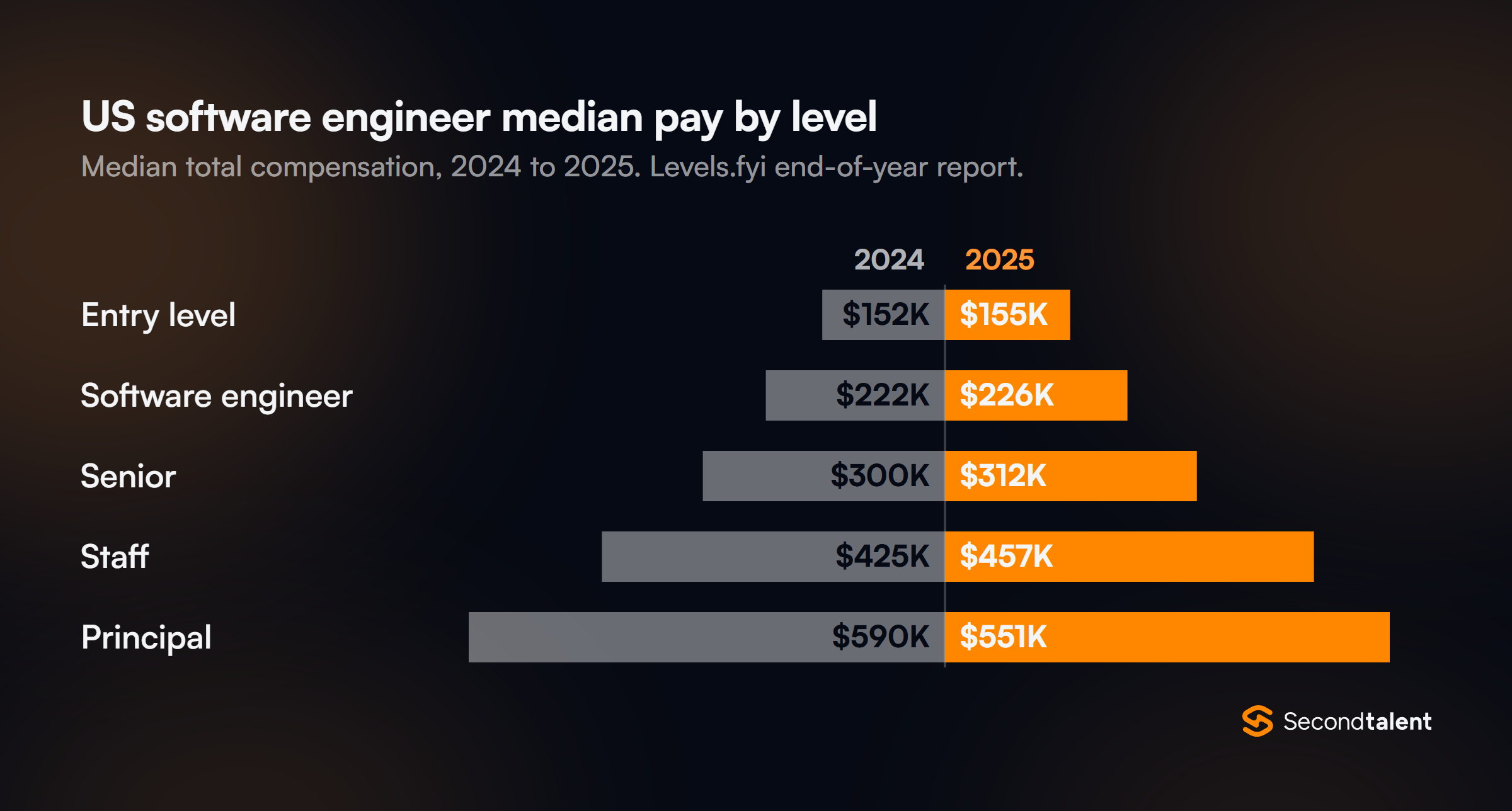
Below staff level, the gains were small: 2% at entry level and 4% for senior engineers. Across all US software engineering levels, Levels.fyi measured median total compensation growth of 3.5%.
Levels.fyi figures are self-reported by its users.
Government data sits far lower because it covers every employer. The Bureau of Labor Statistics put the median annual wage for software developers at $135,980 in May 2025.
The most recent Dice Tech Salary Report, covering 2024, found an average tech salary of $112,521, up 1.2%. In that survey, 59% of tech professionals felt underpaid and 47% were actively looking for a new job.
For pay outside the US, our ranking of countries with the highest software engineer salaries compares 10 markets.
7. AI skills now carry a premium outside tech jobs too
More than half of job postings that ask for AI skills are not tech jobs. Lightcast found that 51% sit outside IT and computer science.
PwC and Lightcast disagree on what those skills pay. PwC's 2026 Global AI Jobs Barometer, built on more than a billion job ads in 27 countries, puts the premium far above Lightcast's estimate.
- Postings with AI skills offer 28% higher salaries
- About $18,000 more a year
- Compares advertised salaries in job postings
- Average premium of 62%, up from 57%
- As high as 118% in consumer markets, 16% in government
- Jobs needing AI skills grew 69%, against 9% for all jobs
In tech itself, CompTIA counted more than 320,000 active postings asking for AI skills in August, up 4.5% from July. AI engineer tops LinkedIn's Jobs on the Rise 2026 list for the US.
The people moving into it had a median of 3.7 years of experience, most often as software engineers, data scientists or full-stack engineers.
Using AI tools is close to universal; trusting them is not. In the 2025 Stack Overflow Developer Survey, 84% of developers used or planned to use AI tools, but 46% distrusted their accuracy against 33% who trusted it.
Our guide to the most in-demand AI skills and salary ranges covers which of those skills employers screen for.
8. Hiring growth is shifting to India and global capability centers
White-collar hiring in India rose 14% year on year in August, and AI and machine learning roles rose 31%, according to the Naukri JobSpeak index.
Naukri notes that festivals falling in September this year, rather than August, flatter the comparison. IT and software services hiring grew 11%.
Global capability centers, the in-house engineering and operations hubs that foreign companies run abroad, keep expanding there. Nasscom and Zinnov count 506 of the Forbes Global 2000 running one in India.
India's wider tech sector is set to pass $315 billion in revenue in FY26, Nasscom estimates.
The model is spreading to Southeast Asia. Our lists of global capability centers in Vietnam and in the Philippines cover who has built there and how large each center is.
In Europe, ICT employment reached 10.45 million in 2025, Eurostat reported, but growth slowed to 2.6% from 4.5% a year earlier.
The Tech Jobs With the Most Openings in 2026
Software developers and engineers still lead US tech postings by a wide margin, even as their postings fell in August. The five most-advertised tech roles, from CompTIA's August Tech Jobs Report:
| Role | Job postings, August 2026 | Change from July |
|---|---|---|
| Software developer or engineer | 43,607 | -2,602 |
| Systems engineer or architect | 33,910 | -739 |
| Tech support specialist | 25,215 | +653 |
| Data analyst | 18,725 | -176 |
| DevOps engineer | 18,067 | +39 |
Tech support and DevOps were the only two of the five to add postings. For the countries with the largest developer populations to hire from, see which countries have the most software developers.
Hiring Senior Engineers in This Market
The roles employers are adding, senior engineers and engineers who build with AI, are the ones that cost most in the US.
We place vetted developers from Asia, including machine learning engineers, at 50% to 70% below US cost for the same seniority.
Compare markets in our Asia Tech Salary Index, or tell us what you are building and we will send profiles within 24 hours.
Frequently Asked Questions
What is the tech unemployment rate in 2026?
2.8% in July 2026 for tech occupations, down from 2.9% in June, according to CompTIA's reading of BLS data. The national unemployment rate was 4.1% in August.
Is software development still a growing career?
Yes, on government projections. The Bureau of Labor Statistics expects employment of software developers, testers and QA analysts to grow 10% from 2025 to 2035, with about 106,100 openings a year.
Which US states will add the most tech jobs in 2026?
Texas, with 32,238 net new tech jobs forecast, then California with 16,949 and Florida with 14,453, according to CompTIA's State of the Tech Workforce 2026.