TL;DR: The largest global capability centers in Vietnam belong to Bosch (4,000+ staff), Samsung (about 2,500 engineers) and National Australia Bank (2,000+). Most of the rest design chips or build AI, for Marvell, Synopsys, Qualcomm, NVIDIA and Renesas. No consultancy publishes a count of GCCs in Vietnam, so we built the list below company by company.
Marvell had five engineers in Ho Chi Minh City in 2013. By September 2025 it had more than 500, and Vietnam was its third-largest R&D hub after the United States and India. Axon started in 2017 with an AI team of eight. Its Ho Chi Minh City office is now the company's largest R&D site outside the US.
15 GCCs in Vietnam at a Glance
| Centre | Parent (HQ) | Cities | Opened | Published headcount |
|---|---|---|---|---|
| Bosch Global Software Technologies | Bosch (Germany) | HCMC, Hanoi | 2010 | 4,000+ (Oct 2025) |
| Samsung R&D Center Vietnam | Samsung (South Korea) | Hanoi | 2012 | About 2,500 (May 2026) |
| NAB Innovation Centre Vietnam | NAB (Australia) | HCMC, Hanoi | 2019 | 2,000+ (2026) |
| LG Electronics Development Vietnam | LG (South Korea) | Hanoi, Da Nang | 2016 | 1,250+ (Jun 2026) |
| Marvell Vietnam | Marvell (US) | HCMC, Da Nang | 2013 | 500+ (Sep 2025) |
| Synopsys Vietnam | Synopsys (US) | HCMC, Da Nang, Hanoi | 2016 | About 500 (Nov 2023) |
| Axon Vietnam | Axon (US) | HCMC | 2017 | About 400 (2025) |
| GoTymeX | Tyme Group (Singapore) | HCMC | 2016 | 300+ (May 2023) |
| Qualcomm Vietnam R&D Center | Qualcomm (US) | Hanoi, HCMC | 2025 | Not published |
| NVIDIA Vietnam R&D Center | NVIDIA (US) | Hanoi, HCMC | 2024 | Not published |
| Renesas Design Vietnam | Renesas (Japan) | HCMC | 2004 | Not published since 2010 |
| Toshiba Software Development Vietnam | Toshiba (Japan) | Hanoi, HCMC | 2007 | Not published |
| Infineon Hanoi development centre | Infineon (Germany) | Hanoi | 2023 | Not published |
| Ampere Vietnam Design Center | Ampere, owned by SoftBank (US/Japan) | HCMC | Not published | Not published |
| Money Forward Vietnam | Money Forward (Japan) | HCMC, Hanoi | 2019 | Not published |
- 1Seven of the 15 design or verify chips. Semiconductors, not back-office work, are what multinationals send to Vietnam.
- 2Software and chip design earn 10% profit tax for 15 years, but a group with EUR 750 million or more in revenue owes a top-up to 15%.
- 3Since March 2026 a foreign investor can register the company first and get the investment certificate within 12 months, reversing the old order.
- 4Only eight of the 15 publish a Vietnam headcount, and two of those figures date from 2023.
The 15 Global Capability Centers, One by One
A global capability center is an offshore unit a company owns and staffs with its own employees, rather than work it contracts to a vendor. The list runs from the largest published Vietnam headcount down, then the centres that publish none. The list leaves out vendors such as FPT Software and TMA Solutions, which appear in our list of software development outsourcing companies in Vietnam.
1. Bosch Global Software Technologies Vietnam
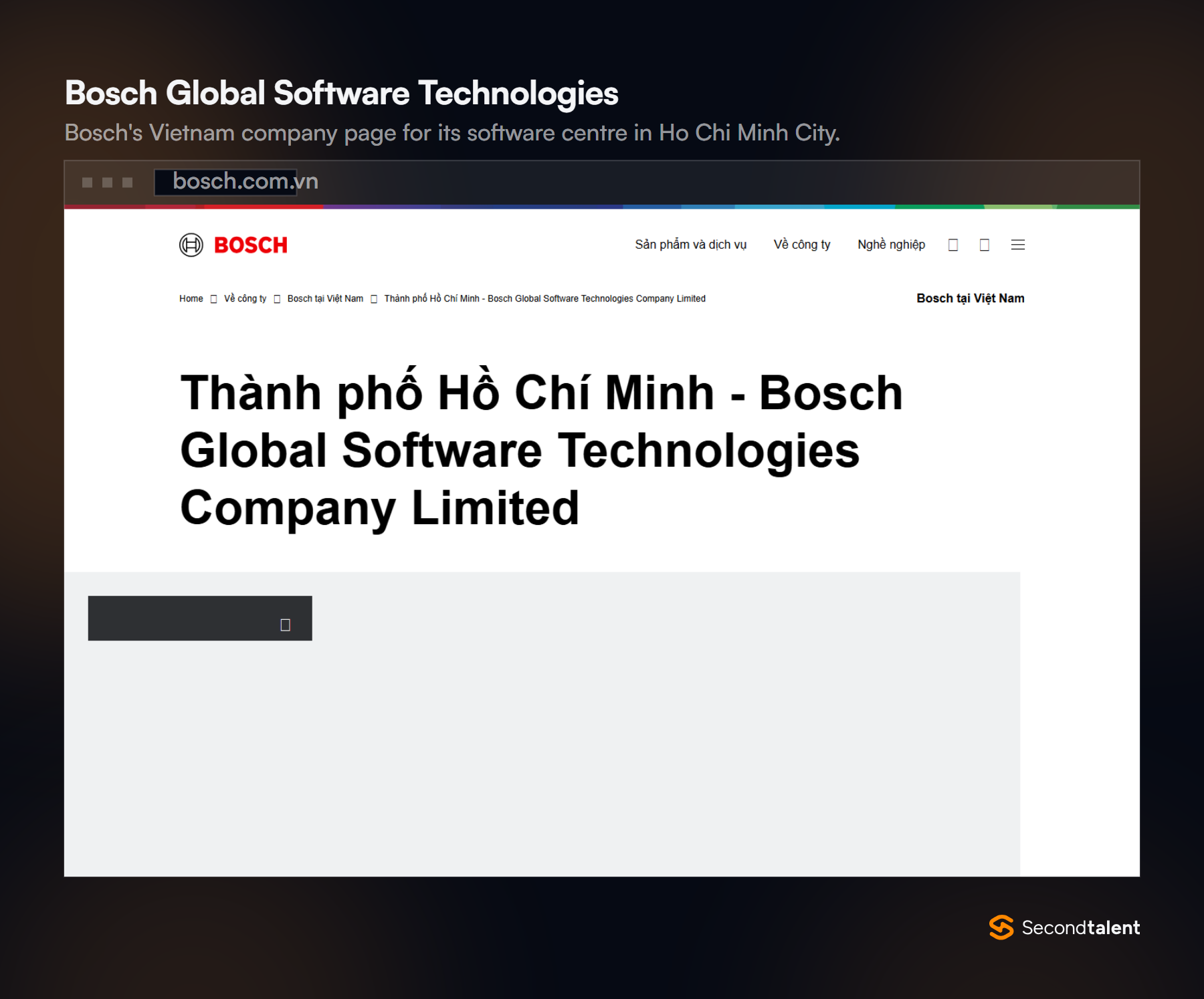
Bosch's Vietnam centre held 81 patents by 2025, mostly in vehicle safety, driver assistance, self-driving and AI. It was Bosch's first software centre in Southeast Asia and marked 15 years in October 2025, according to VnExpress International.
The work spans mobility software, AIoT, SAP and enterprise IT for Bosch divisions worldwide. Vietnamese staff hold 81% of its leadership roles, with a target above 85% by 2026. The centre's innovation budget grew more than eightfold in three years, according to VnExpress.
It is still growing. JLL reported in March 2026 that Bosch took about 10,000 square metres at OfficeHaus in Ho Chi Minh City, the top four floors. Its Vietnam about page gives the same 4,000-plus headcount.
2. Samsung R&D Center Vietnam
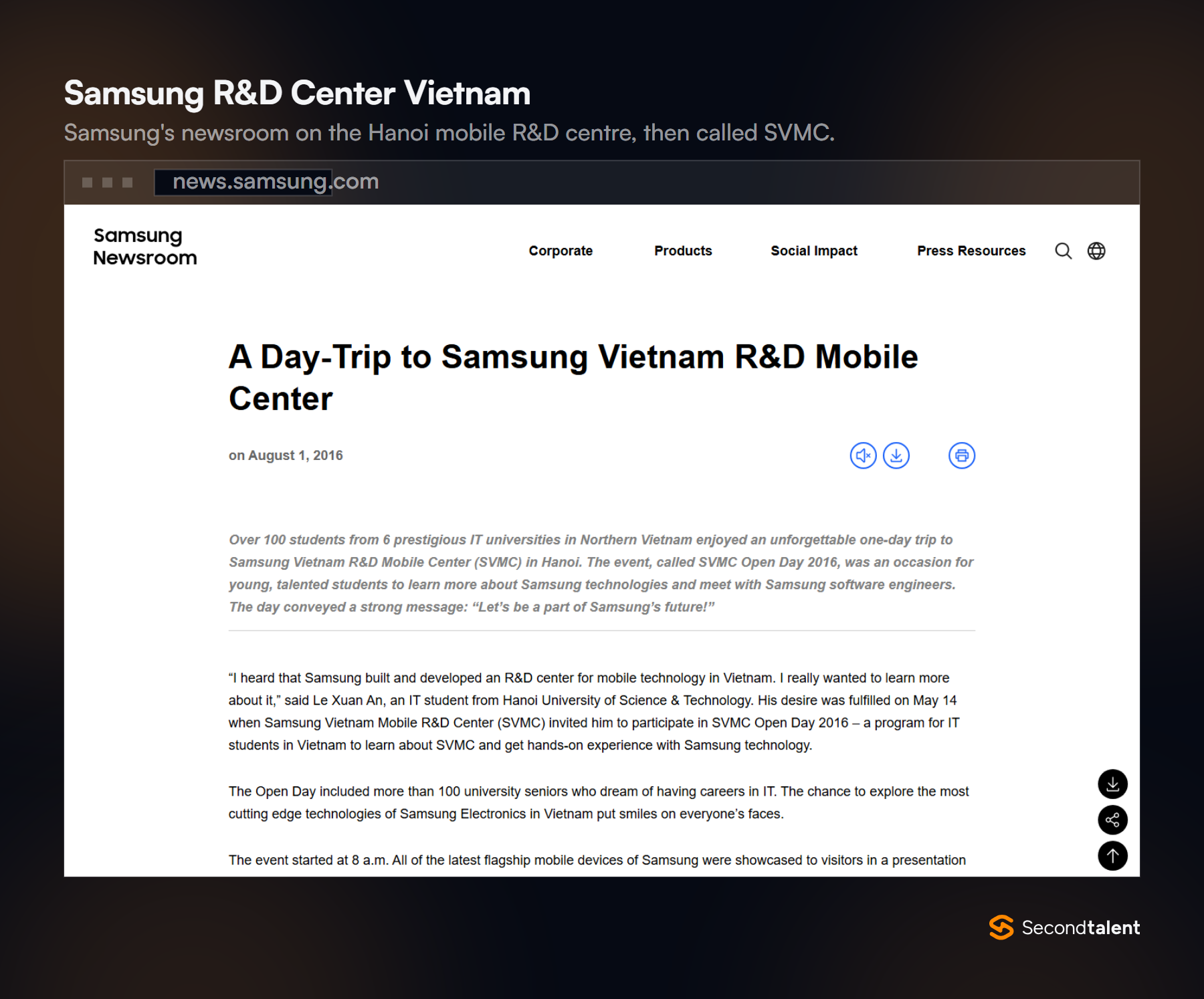
Samsung built a 16-storey, US$220 million R&D building in Hanoi and opened it in December 2022. The Korea Herald described it as Samsung's largest R&D centre in Southeast Asia at the time. The centre started in 2012 as the Samsung Vietnam Mobile R&D Center, working on phones.
The mandate has widened since. In May 2026, Samsung Vietnam's general director Na Ki Hong put the team at about 2,500 Vietnamese engineers working on phones, laptops and 4G and 5G telecom equipment, VietnamNet reported. At the same meeting, the government asked Samsung to help train Vietnam's AI and semiconductor workforce.
Be careful with Samsung figures. Samsung Vietnam's total workforce is mostly factory staff and runs far higher. The R&D centre is the 2,500.
3. NAB Innovation Centre Vietnam
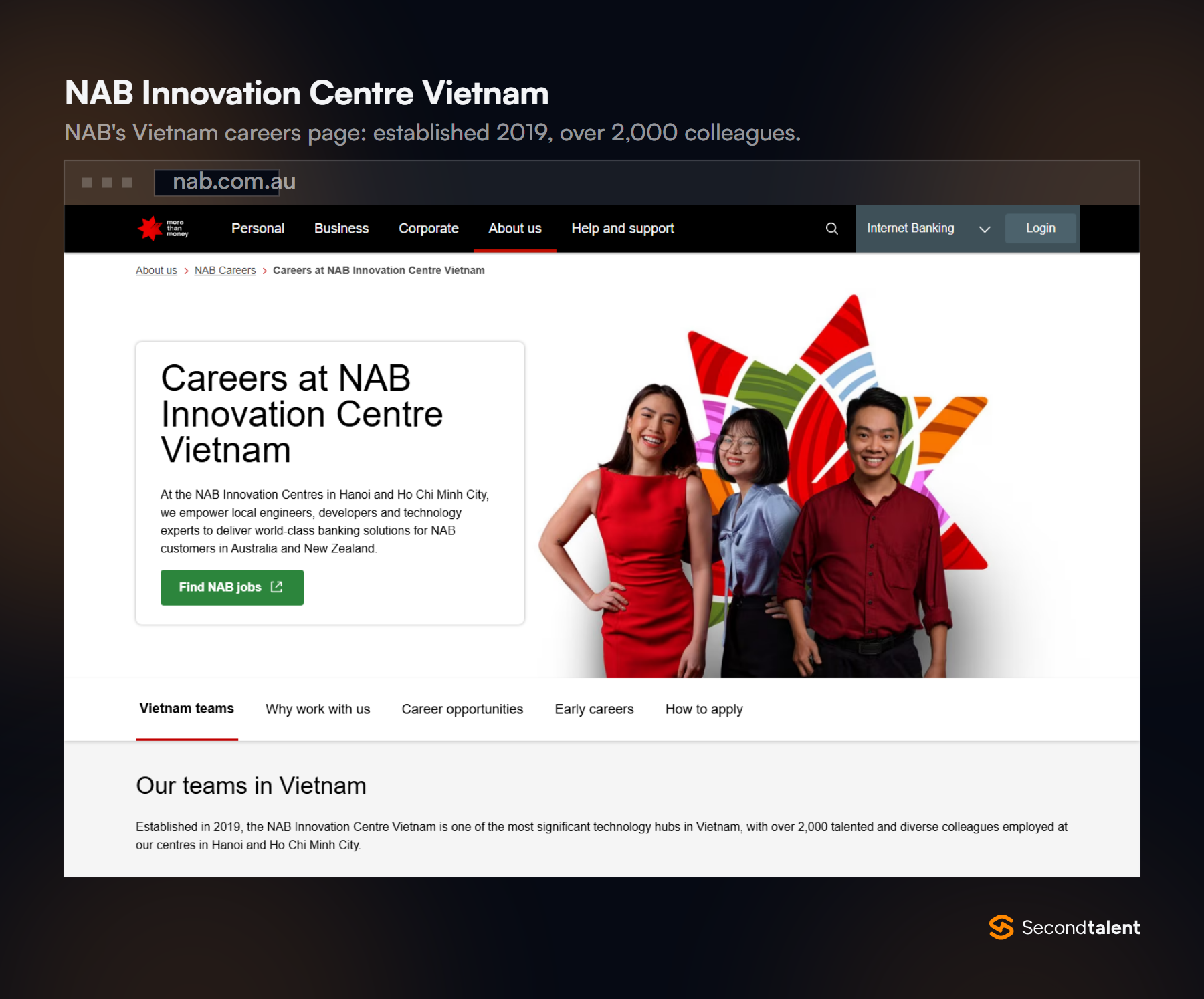
National Australia Bank is the only bank on this list, and its Vietnam centre is one of the largest. It builds digital banking for NAB's customers in Australia and New Zealand, across AI, software engineering, security and data. NAB's Vietnam careers page puts the team at more than 2,000.
The centre opened in Ho Chi Minh City in 2019 and added a Hanoi office in 2022, VnExpress reported. The Hanoi site started as a 2,500 square metre office at Capital Place. JLL's March 2026 note has the centre taking 8,500 square metres at The Hallmark in Ho Chi Minh City.
NAB grows its own pipeline. StarCamp is a 12-week technical bootcamp, and WeCamp runs the same idea for women. NAB says women hold 50% of the centre's leadership roles and more than 30% of its technical roles.
4. LG Electronics Development Vietnam
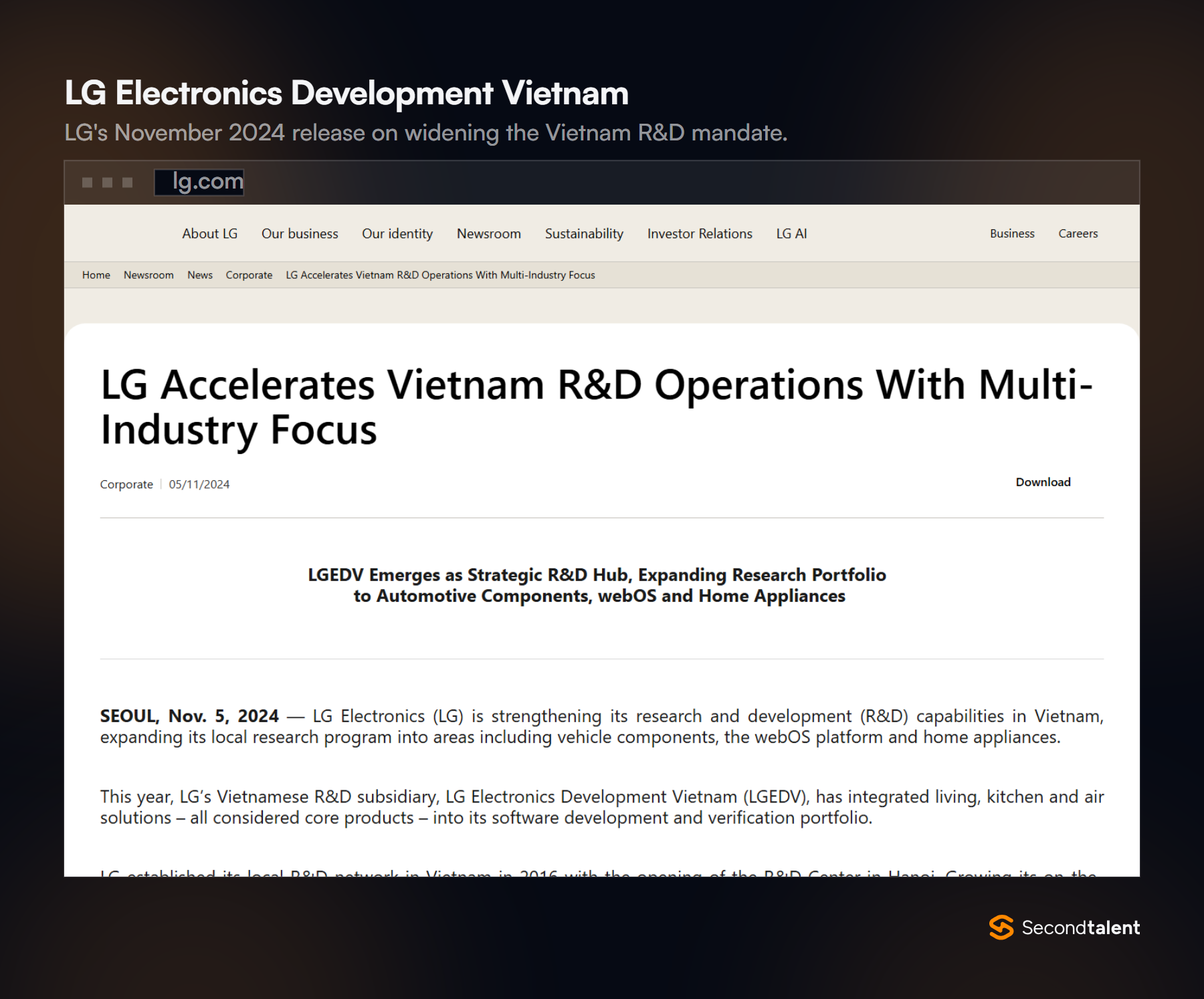
LG's Vietnam centre writes the software for car dashboards: in-vehicle infotainment, telematics and instrument clusters. Infotainment is more than half of LG's vehicle-components revenue, and LG says five of the ten "coding experts" it named in 2023 came from this team.
It opened in Hanoi in 2016 with about 30 staff and became a separate legal entity in 2023. The scope has spread from cars to webOS in 2022 and home-appliance software in 2024. Vietnam Investment Review counted more than 1,250 engineers in June 2026, about 850 in Hanoi and 400 in Da Nang.
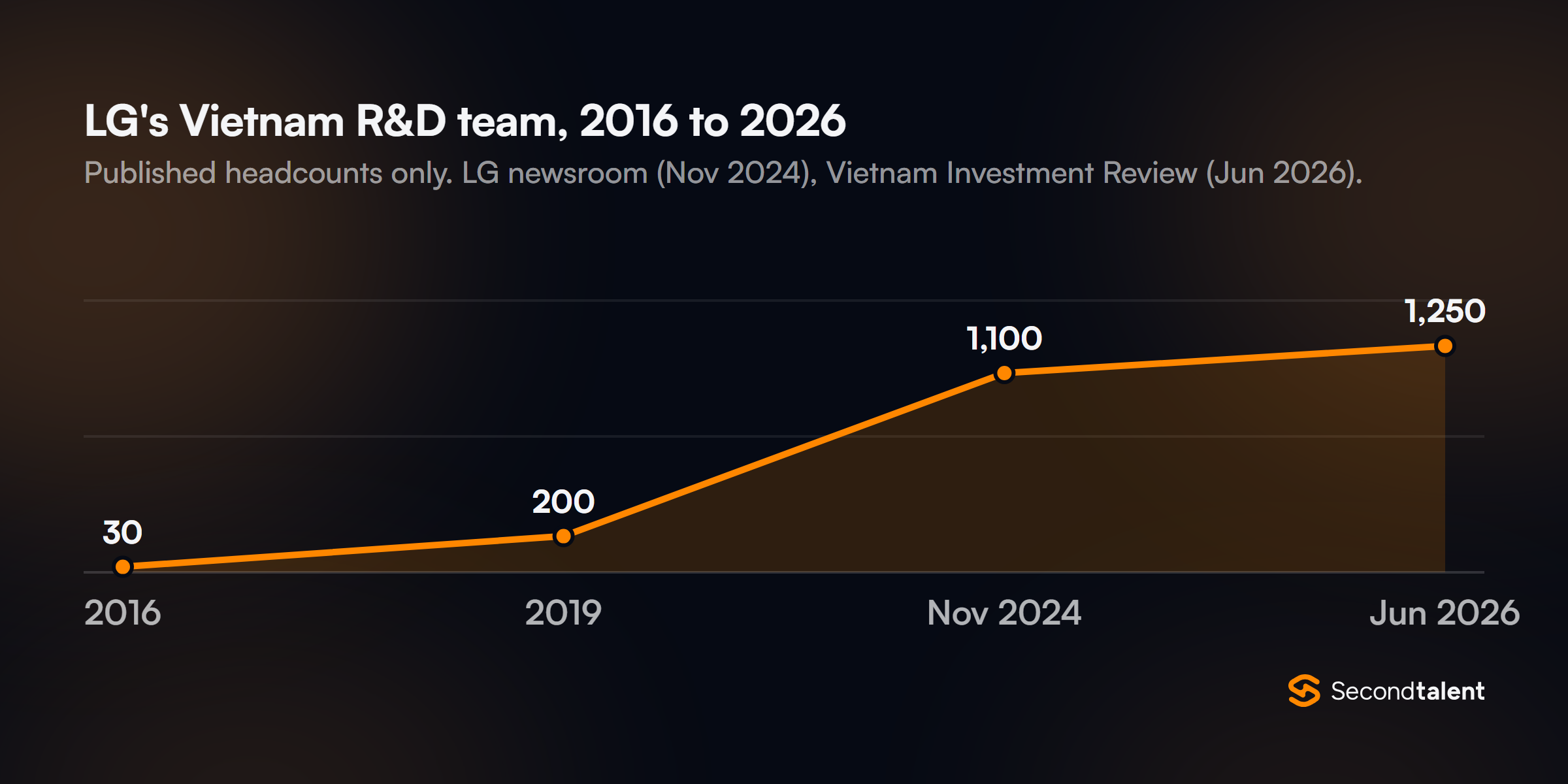
The growth curve is the typical GCC path. A small team proves itself on one product line, then inherits the next. LG went from 30 staff to 200 in its first three years, then past 1,100 by November 2024.
5. Marvell Vietnam
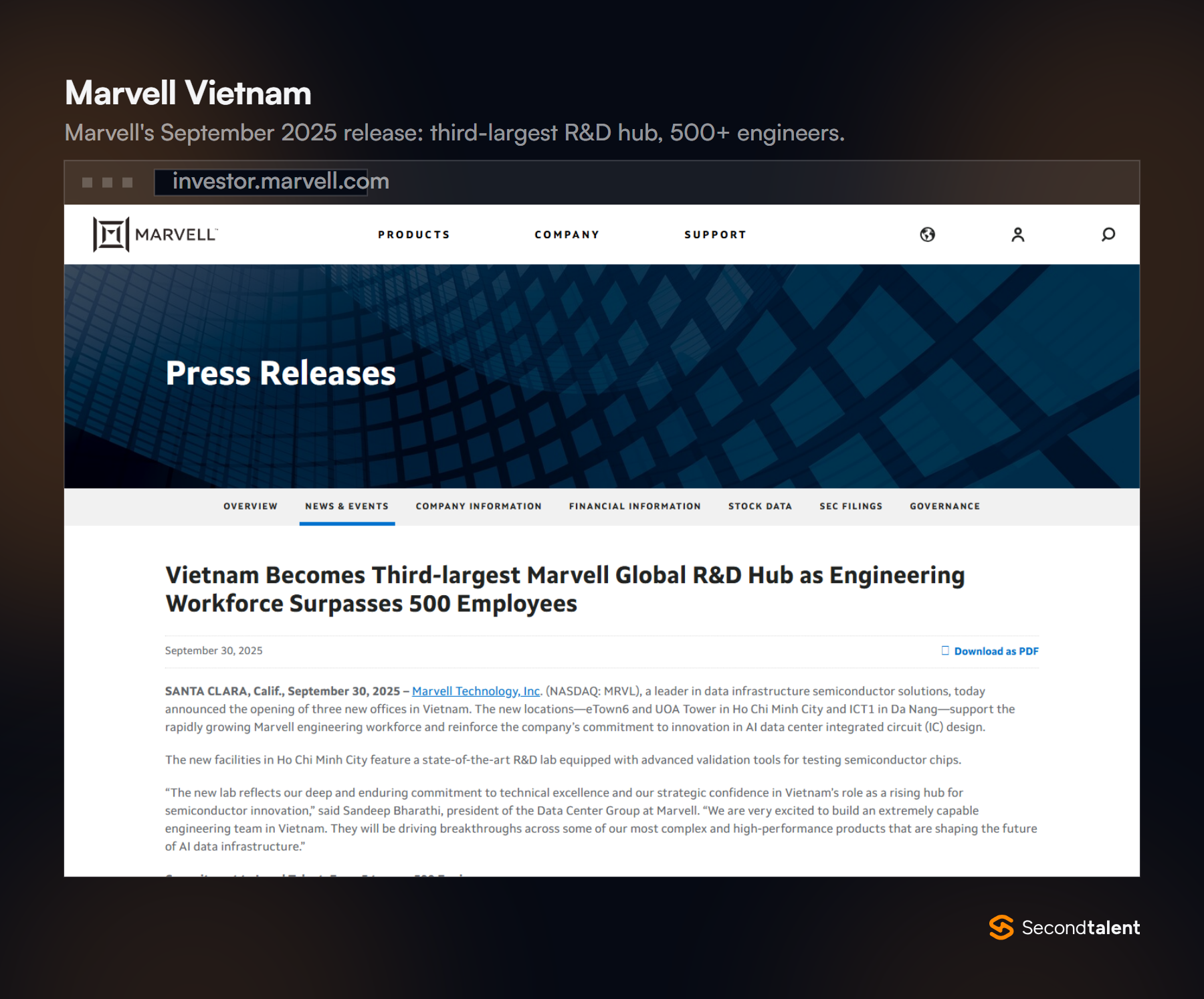
Marvell's Vietnam engineers work on the chips inside AI data centres. The company's September 2025 release names three products the team contributed to: the Alaska A 800G PAM4 DSP for active electrical cables, the Alaska P PCIe Gen6 retimer and the Nova 1.6 Tbps PAM4 DSP.
The team covers the full design flow: architecture, digital design, analog mixed-signal, verification, physical design and firmware. In late 2025 Marvell opened three offices, at eTown6 and UOA Tower in Ho Chi Minh City and ICT1 in Da Nang. The Ho Chi Minh City site includes a lab for chip validation, so testing no longer has to ship abroad.
"We are very excited to build an extremely capable engineering team in Vietnam. They will be driving breakthroughs across some of our most complex and high-performance products that are shaping the future of AI data infrastructure."
Sandeep Bharathi, president of Marvell's Data Center Group, September 30, 2025
6. Synopsys Vietnam
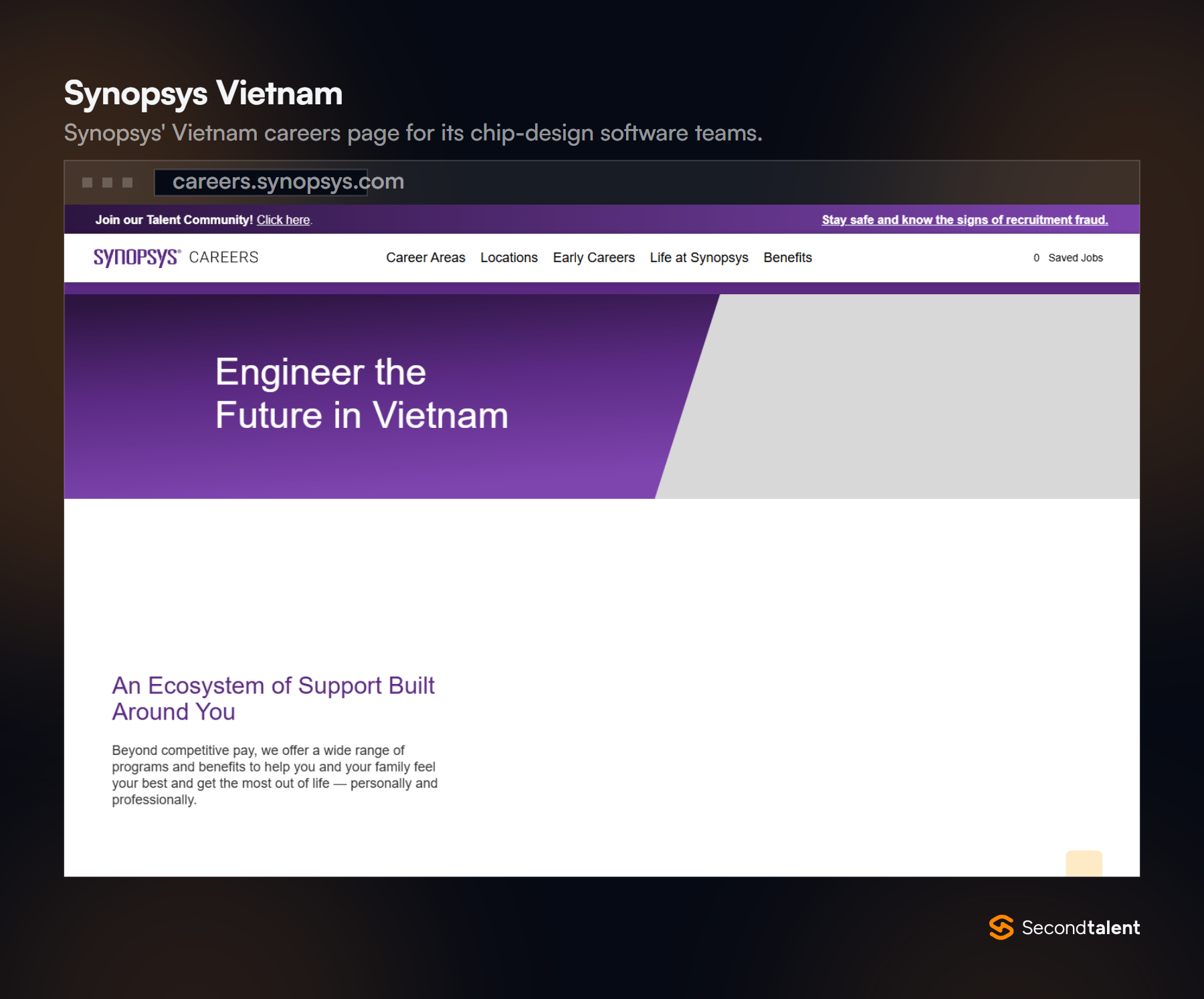
Synopsys sells the software other companies use to design chips, and Vietnamese engineers write part of that software. Its own November 2023 blog put the Vietnam team at about 500, of whom about 400 work in R&D on design tools and IP. Ho Chi Minh City also hosts a global support team.
Synopsys had done business in Vietnam since 2005 before opening its first office in 2016. Hanoi was added in December 2024, The Investor reported, with hiring for embedded-memory layout and analog circuit design. Synopsys has published no newer headcount, so treat 500 as a 2023 floor.
Synopsys also trains its own pipeline. In 2023 it signed IC-design talent agreements with the National Innovation Center, Vietnam's ICT industry authority and the city of Da Nang, and it supplies its University Software Program to the innovation centre's chip design lab.
7. Axon Vietnam
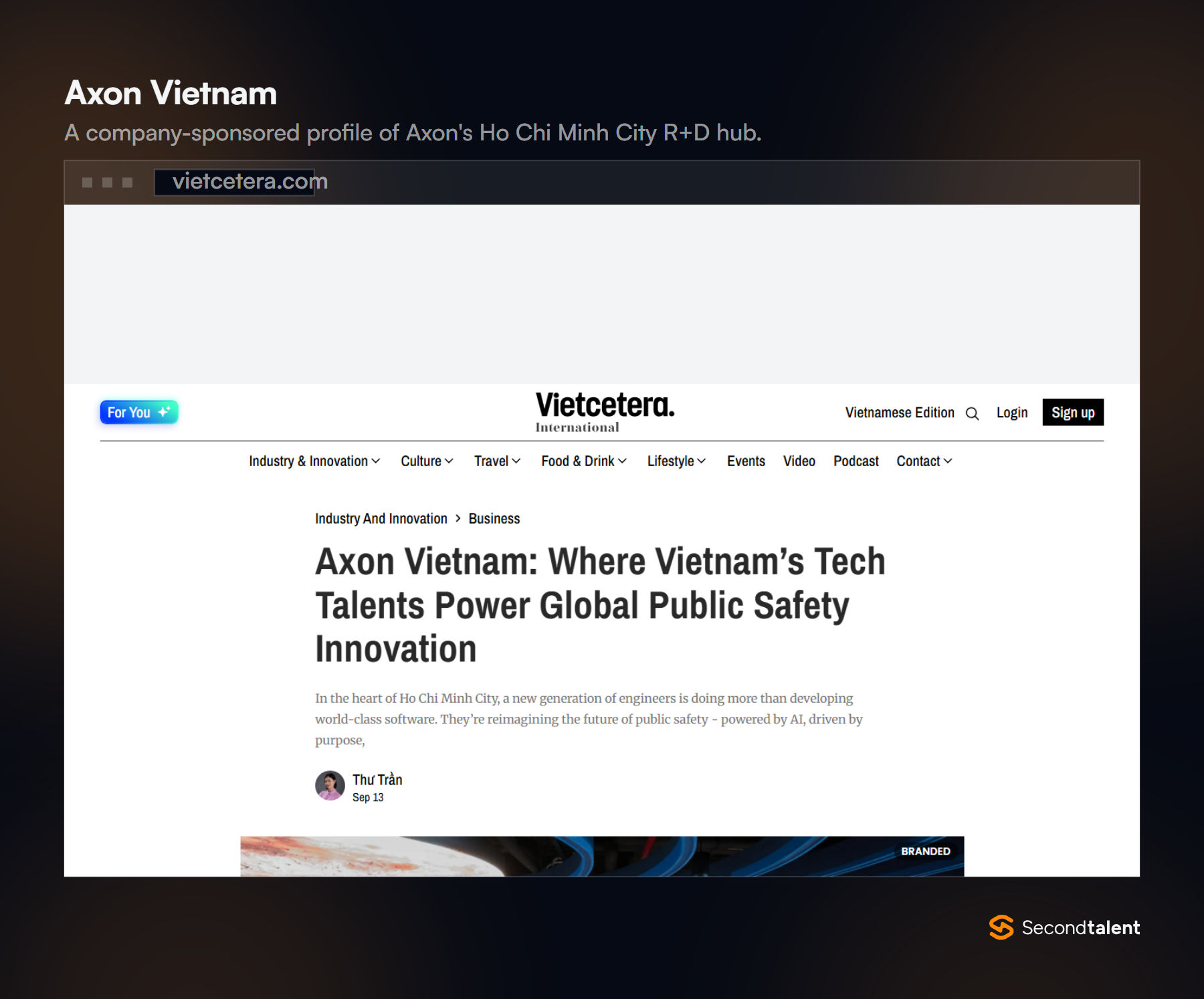
Axon makes body cameras and Tasers for police forces. Its Ho Chi Minh City team works on the digital-evidence platform, AI report writing, live-streaming from body cameras, licence-plate recognition and AI translation. Axon's careers site lists the city as an "R+D Hub".
Axon puts the team at about 400, in a company-sponsored profile on Vietcetera. In that piece, CEO Rick Smith calls it "our most important engineering hub outside the U.S." Staff work on site Tuesday to Friday.
8. GoTymeX (Tyme Group)
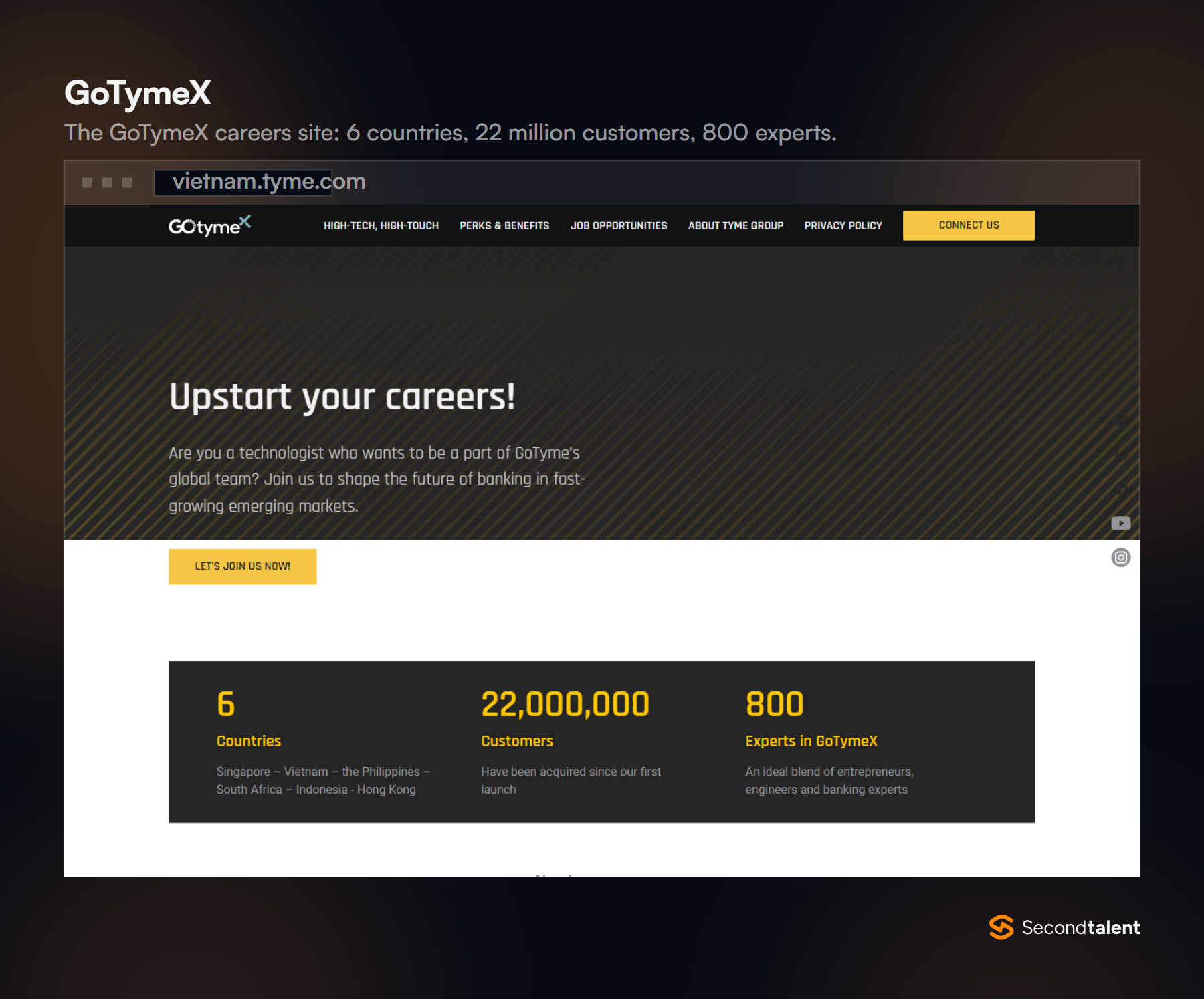
GoTymeX, formerly TymeX, builds the platforms behind two digital banks on other continents: TymeBank in South Africa and GoTyme Bank in the Philippines. Tyme runs no bank in Vietnam. The centre exists purely to build for markets on other continents.
Tyme's May 2023 release counted more than 300 engineers in Ho Chi Minh City. The GoTymeX careers site now counts 800 experts, but it does not say how many of them sit in Vietnam.
9. Qualcomm Vietnam R&D Center
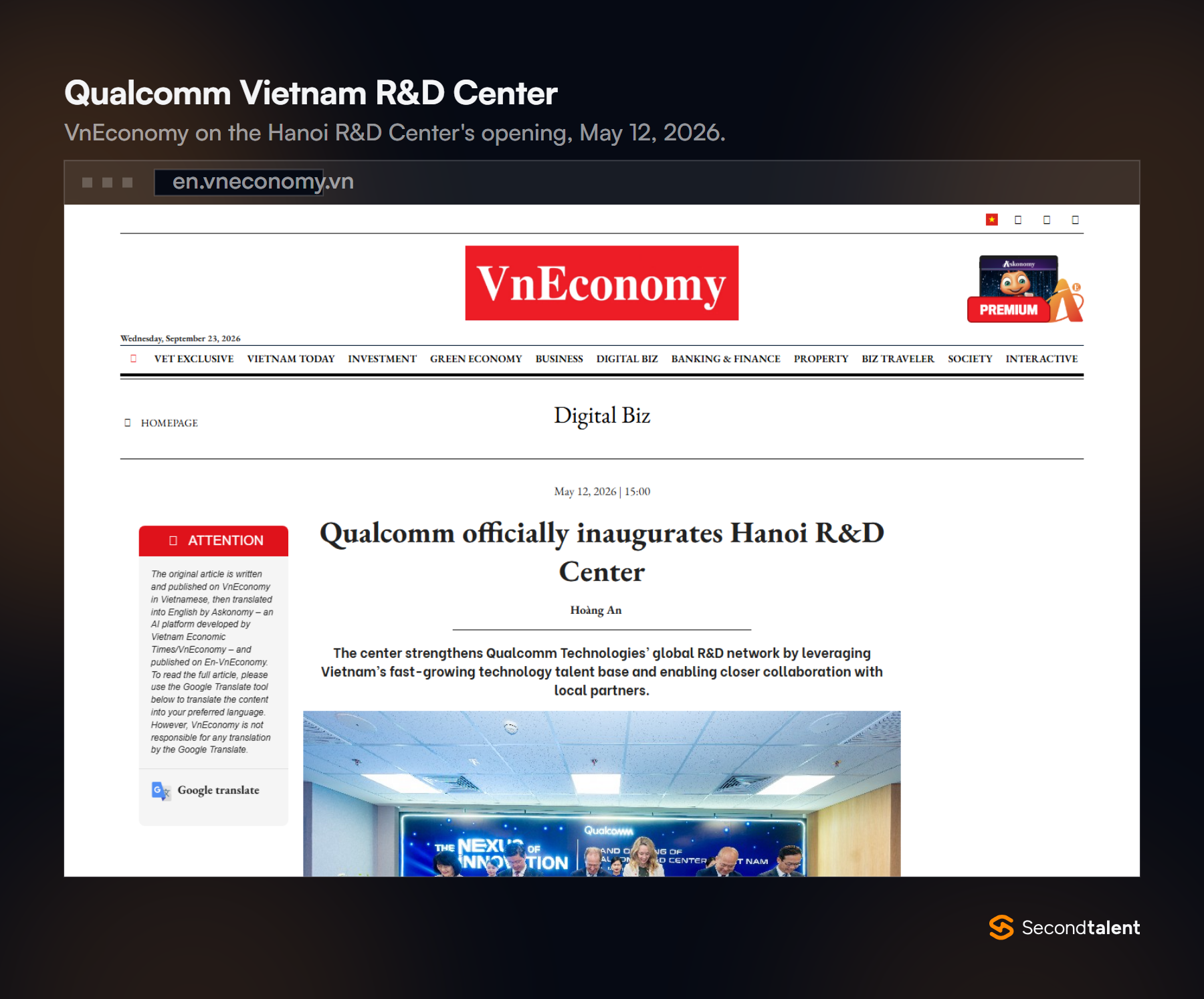
Qualcomm bought its way in. In April 2025 it acquired MovianAI, the generative-AI division of Vingroup's VinAI, and used that team as the base for an AI R&D centre launched that June. Qualcomm said Vietnam would become its third-largest AI R&D centre in the world, after India and Ireland, The Investor reported.
The Hanoi R&D Center was formally opened on May 12, 2026, starting with AI and system-on-chip work and planning to add automotive and IoT, VnEconomy reported. Qualcomm has not published a headcount.
10. NVIDIA Vietnam R&D Center
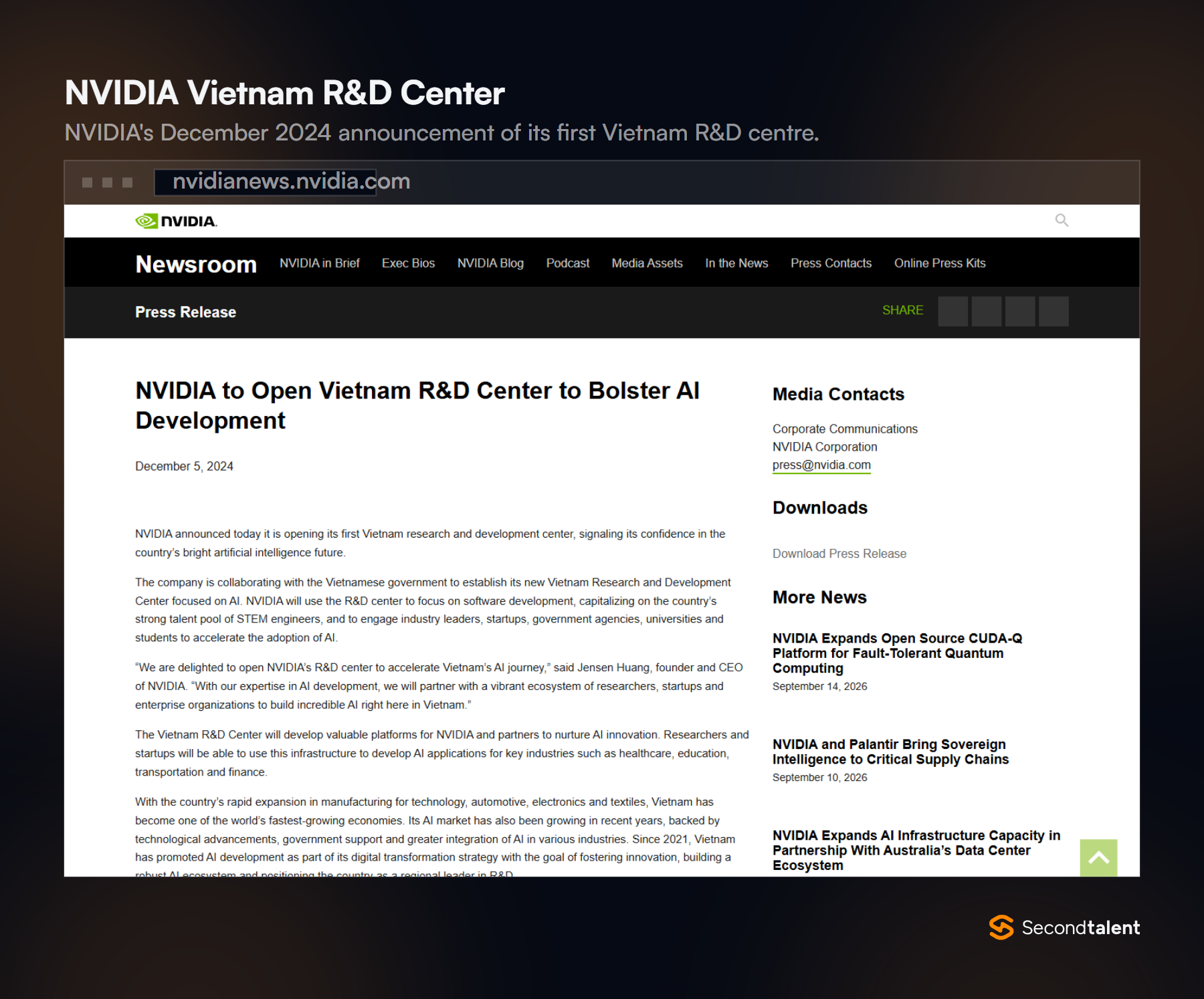
NVIDIA signed its agreement with the Vietnamese government on December 5, 2024, in Hanoi, with Jensen Huang and Prime Minister Pham Minh Chinh present. The NVIDIA announcement paired the R&D centre with the purchase of VinBrain, Vingroup's healthcare-AI company.
In June 2026, NVIDIA vice president Steven Truong said NVIDIA Vietnam grew about 130% from 2025 to 2026, and the R&D centre about 90%, CafeF reported. He said its engineers contribute to Speech AI and Metropolis and are helping build a Vietnamese-language model on NVIDIA's NeMo platform. He gave no headcount. The local company, Nvidia Vietnam, raised its charter capital 11-fold to VND 28.2 billion in 2025, The Investor reported.
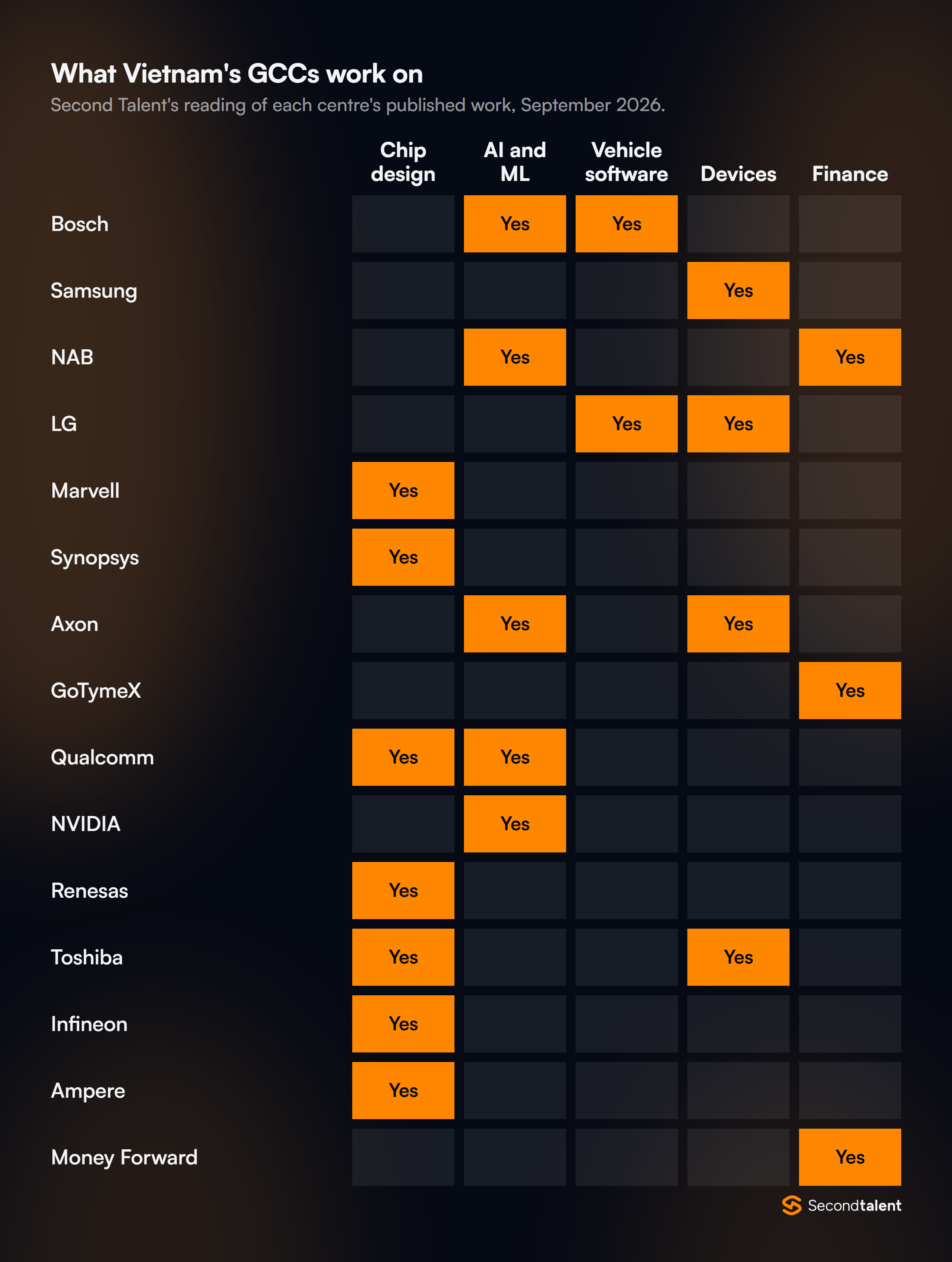
Put the 15 side by side and the pattern is plain: chips and AI dominate, and none of the centres is a finance or HR shared-services hub. For how Vietnam's talent market compares with its neighbours, see our Philippines vs Vietnam vs Indonesia comparison.
11. Renesas Design Vietnam
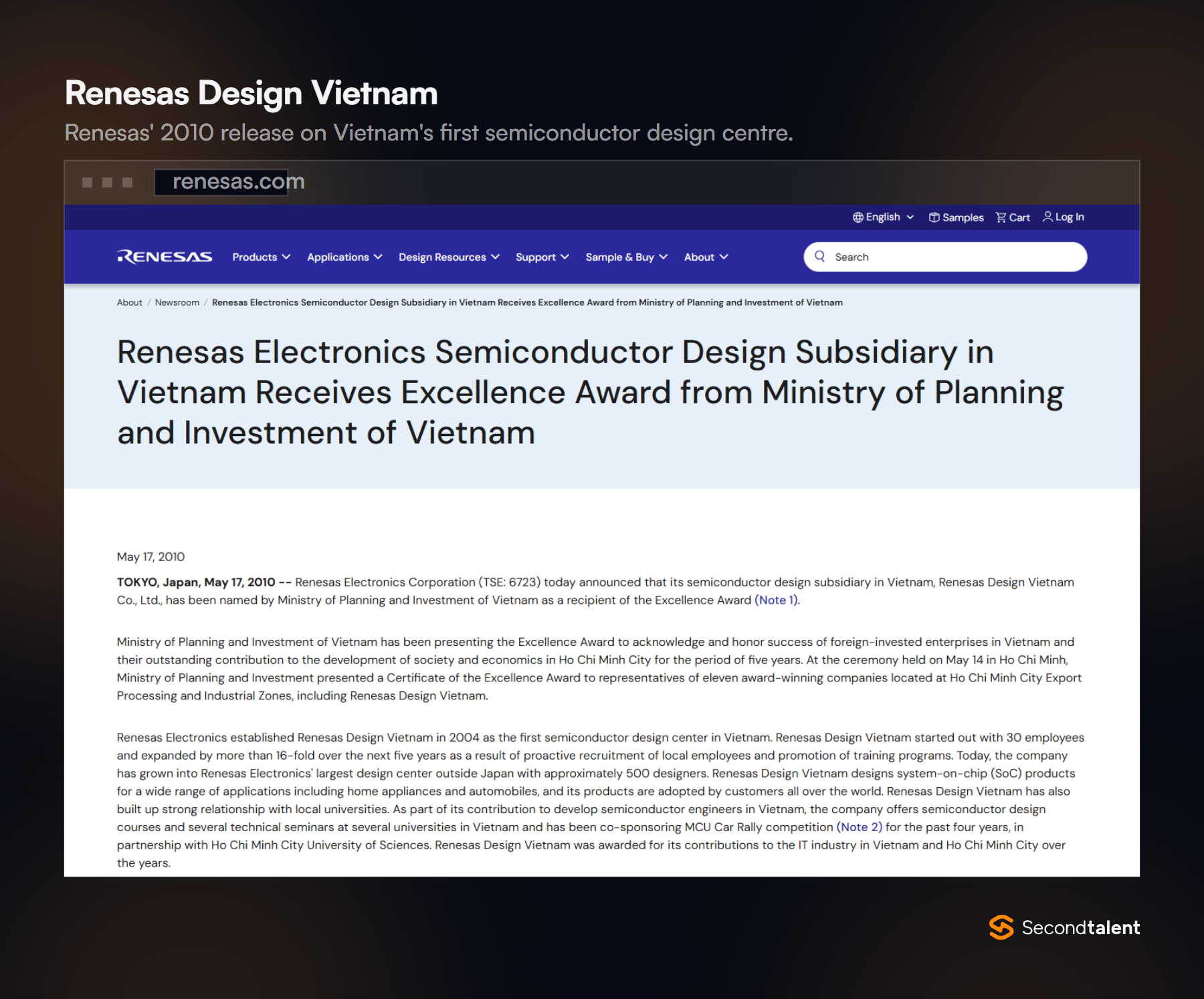
Renesas opened Vietnam's first semiconductor design centre on October 5, 2004, in the Tan Thuan export processing zone. It is the oldest centre on this list. The team designs system-on-chip and system LSI parts for home appliances and cars, covering hardware, software, logic verification and evaluation.
The only headcount Renesas has published is from May 2010: about 500, which made it the company's largest design centre outside Japan, according to a Renesas release. It marked 20 years in October 2024 and was still posting engineering jobs in Ho Chi Minh City in 2026.
The same release shows how a chip design centre is grown from scratch. Renesas Design Vietnam started with 30 employees and grew more than 16-fold in five years by hiring locally and training its own staff. It taught semiconductor design courses at Vietnamese universities and co-sponsored an MCU car rally with Ho Chi Minh City University of Science.
12. Toshiba Software Development Vietnam
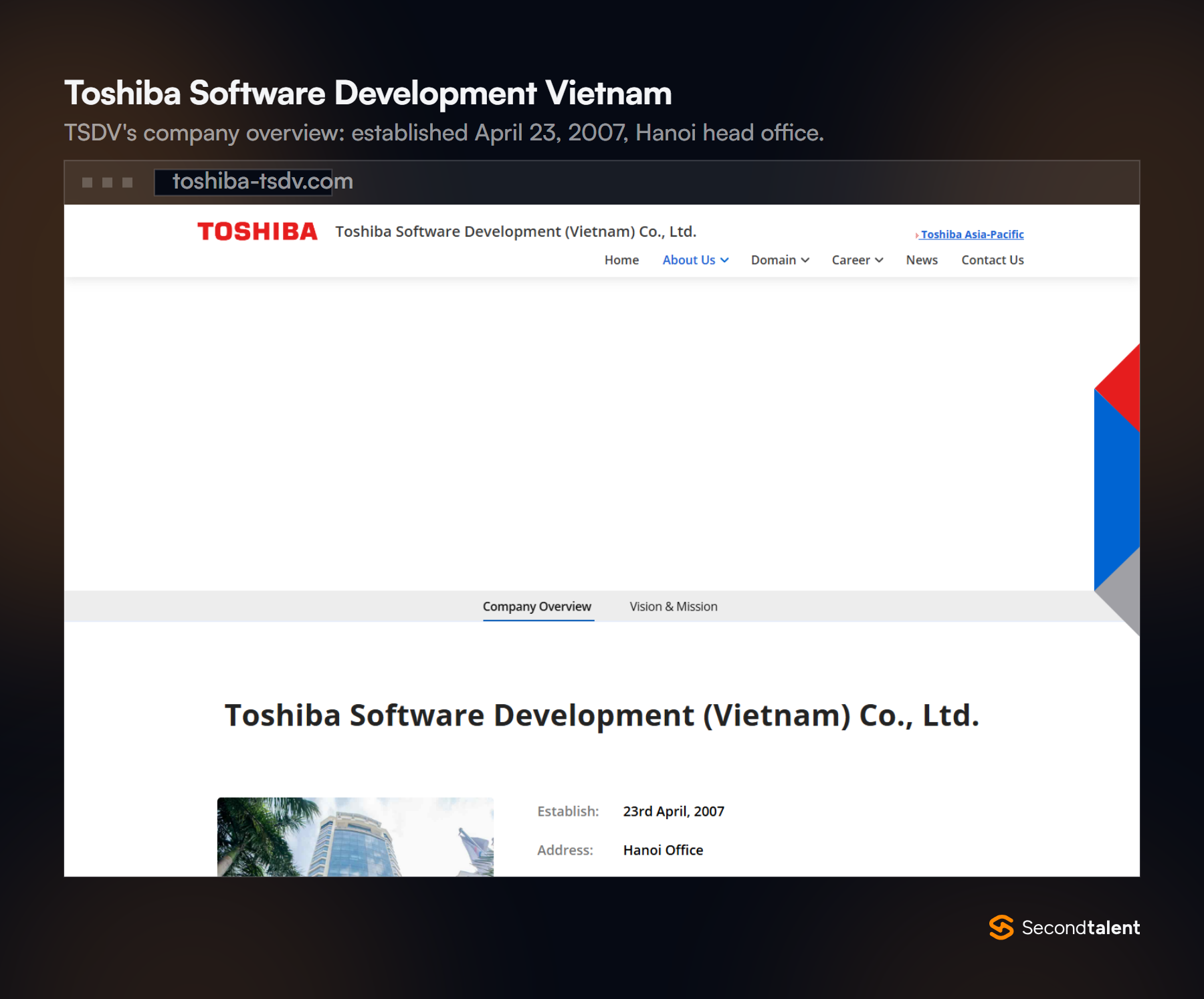
TSDV is wholly owned by Toshiba and reports to its corporate technology planning division, not to a single business unit. It writes embedded and domain software for four divisions: energy, infrastructure, electronic devices and storage, and digital. It also does LSI design and verification, according to its company overview.
Toshiba founded the centre on April 23, 2007. The head office is in VIT Tower on Kim Ma street in Hanoi, with a second site in Ho Chi Minh City. Toshiba does not publish its size.
The chip work is the part most lists miss. TSDV does LSI design and verification alongside its software, which puts a Japanese conglomerate's semiconductor work in Hanoi next to Samsung's and Qualcomm's. It also runs testing and research in advanced IT for the group.
13. Infineon Hanoi development centre
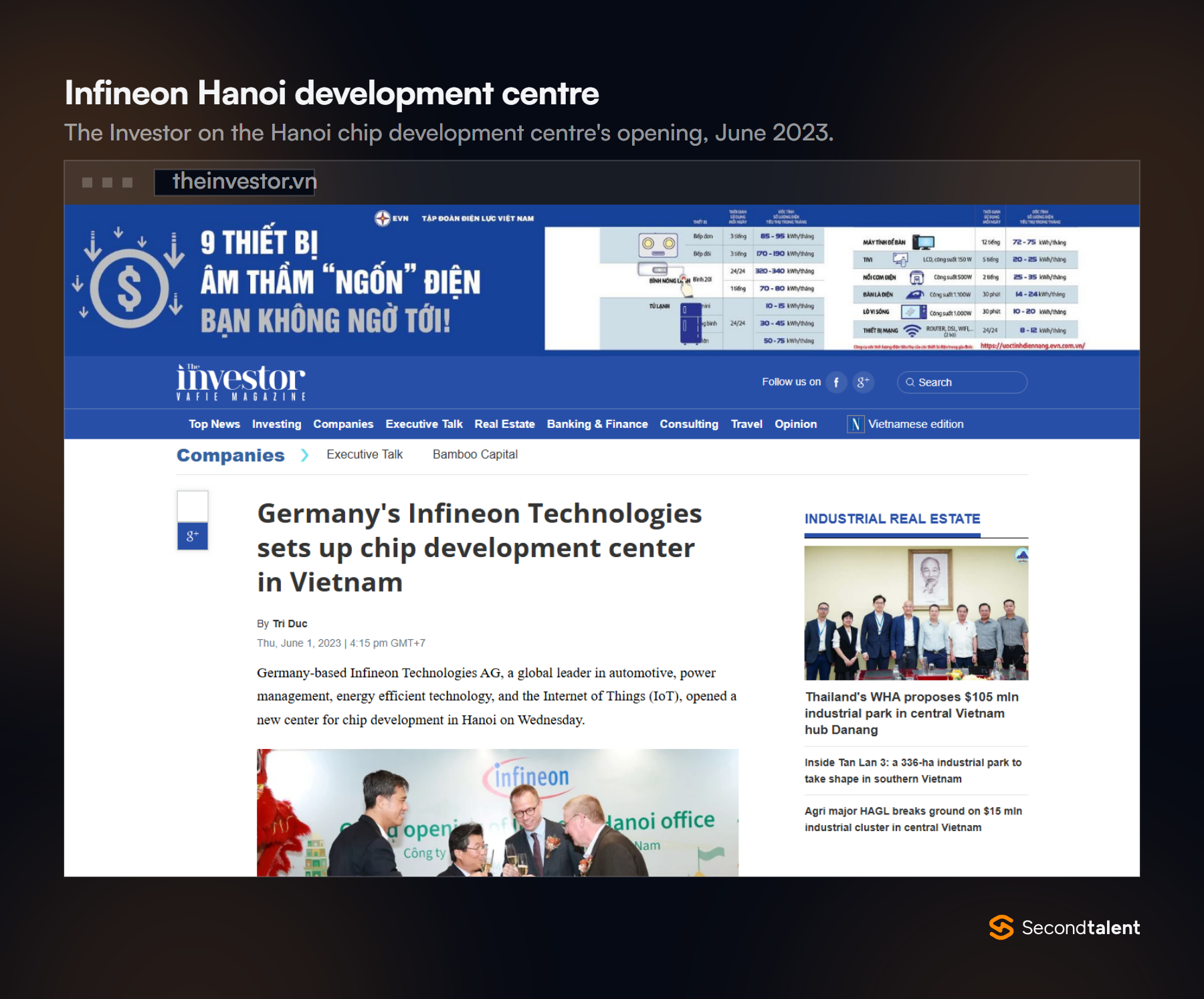
Infineon's Hanoi centre verifies the microcontrollers that go into cars. It also tests and adapts analog, digital and integrated circuits for uses such as battery management and driver assistance. It sits inside Infineon's design and enabling services unit, which supports chip customers with verification and test work rather than selling a product of its own.
It opened on May 31, 2023, with a plan for about 25 technical staff by the end of that year in an office with room for 80, The Investor reported. Infineon's Vietnam careers page dates its presence in the country to 2019 and now lists R&D, finance and HR functions there. The Hanoi centre is a reminder that a GCC can start with a couple of dozen engineers.
14. Ampere Computing Vietnam Design Center
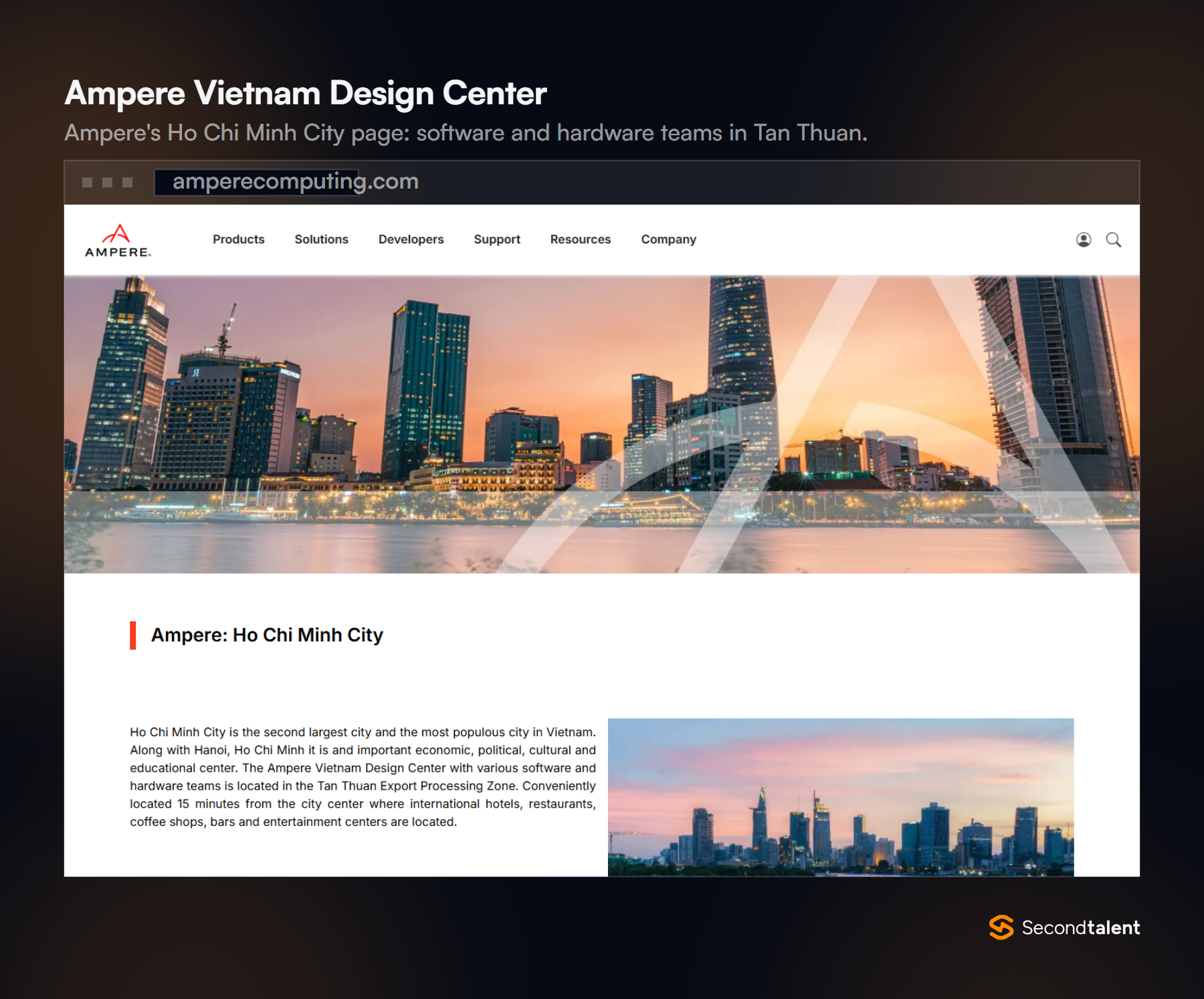
Ampere designs Arm-based processors for cloud servers, and its Ho Chi Minh City centre has hardware and software teams on those chips and the server software around them. The centre sits in the Tan Thuan export processing zone, the same zone as Renesas, per Ampere's location page.
The parent changed hands in 2025. SoftBank Group completed its US$6.5 billion purchase of Ampere in November 2025, and Ampere kept its name. The deal was all cash. Headcount figures of 1,000 or more that circulate online are company-wide, not Vietnam.
15. Money Forward Vietnam
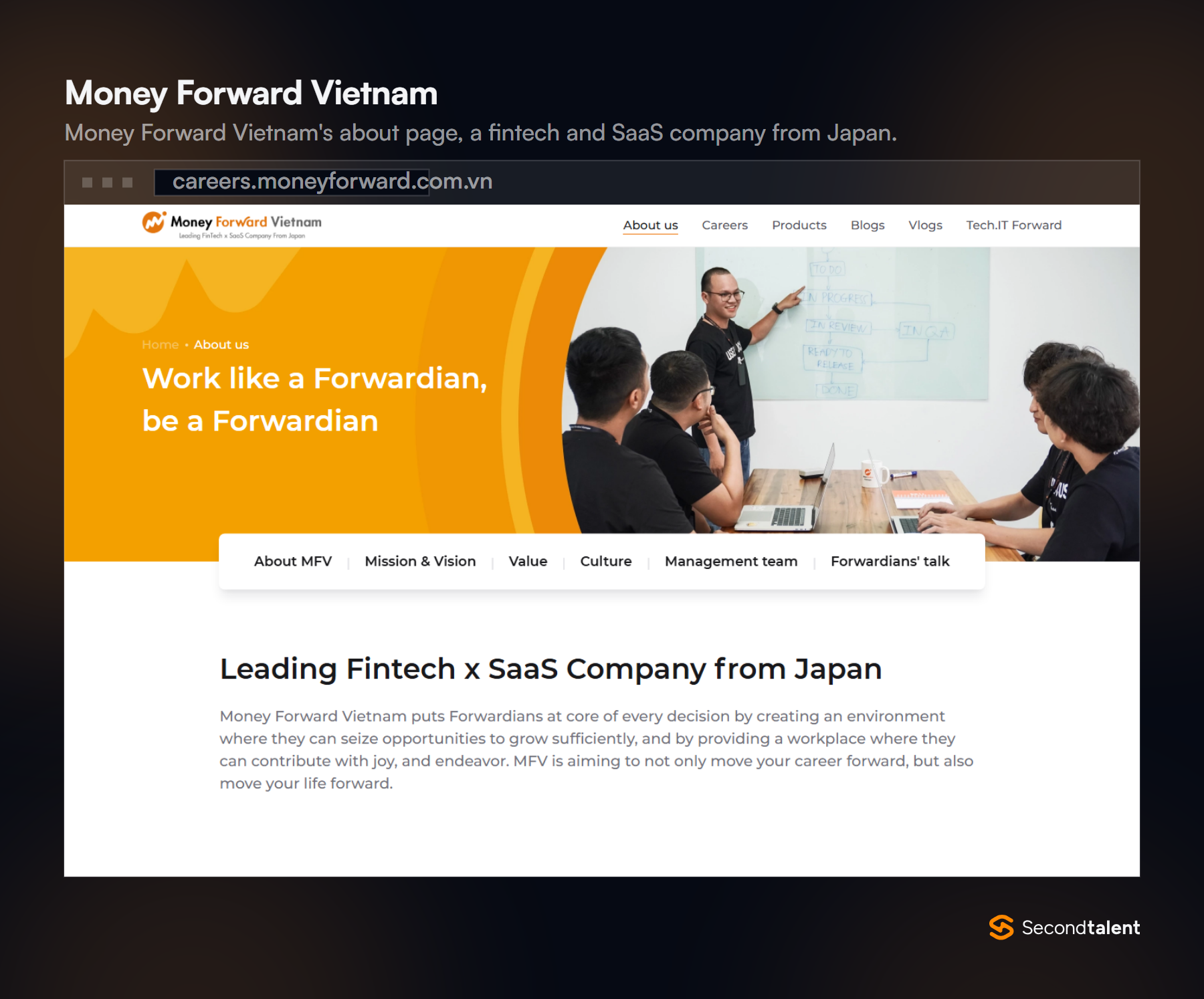
Money Forward is a Tokyo-listed fintech, and its Vietnam team builds products for the Japanese market: its ERP suite, payroll software and banking tools. The working language is English, not Japanese. That choice widens the hiring pool in Vietnam well beyond the engineers who speak Japanese.
The Vietnam subsidiary was set up in 2018 and the Ho Chi Minh City development centre followed in 2019, with a Hanoi office in ROX Tower added in 2022, according to Money Forward Vietnam. It is no longer the parent's only offshore hub: Money Forward opened a development centre in Chennai, India, in January 2025.
Why These Centres Chose Vietnam
The short answer is engineers at a fraction of Singapore's cost. JLL estimates skilled labour in Ho Chi Minh City costs up to 70% less than equivalent talent in Singapore. Kearney's 2023 Global Services Location Index, the latest edition, ranked Vietnam 7th of 78 countries, ahead of Thailand and the Philippines.
The chip cluster in the list above has a policy behind it. Decision 1017/QD-TTg of September 2024 sets a target of at least 50,000 university-trained semiconductor workers by 2030, 15,000 of them in design. Against that, VietnamPlus counted about 7,000 IC design engineers in December 2025. In May 2026 the government asked Samsung to help train chip and AI engineers.
Engineering pay is the other half of the case. ITviec's 2025-2026 survey of 1,839 IT workers gives median monthly gross pay by level. Converted at 25,972 dong to the dollar, a senior back-end developer earns about US$1,540 a month.
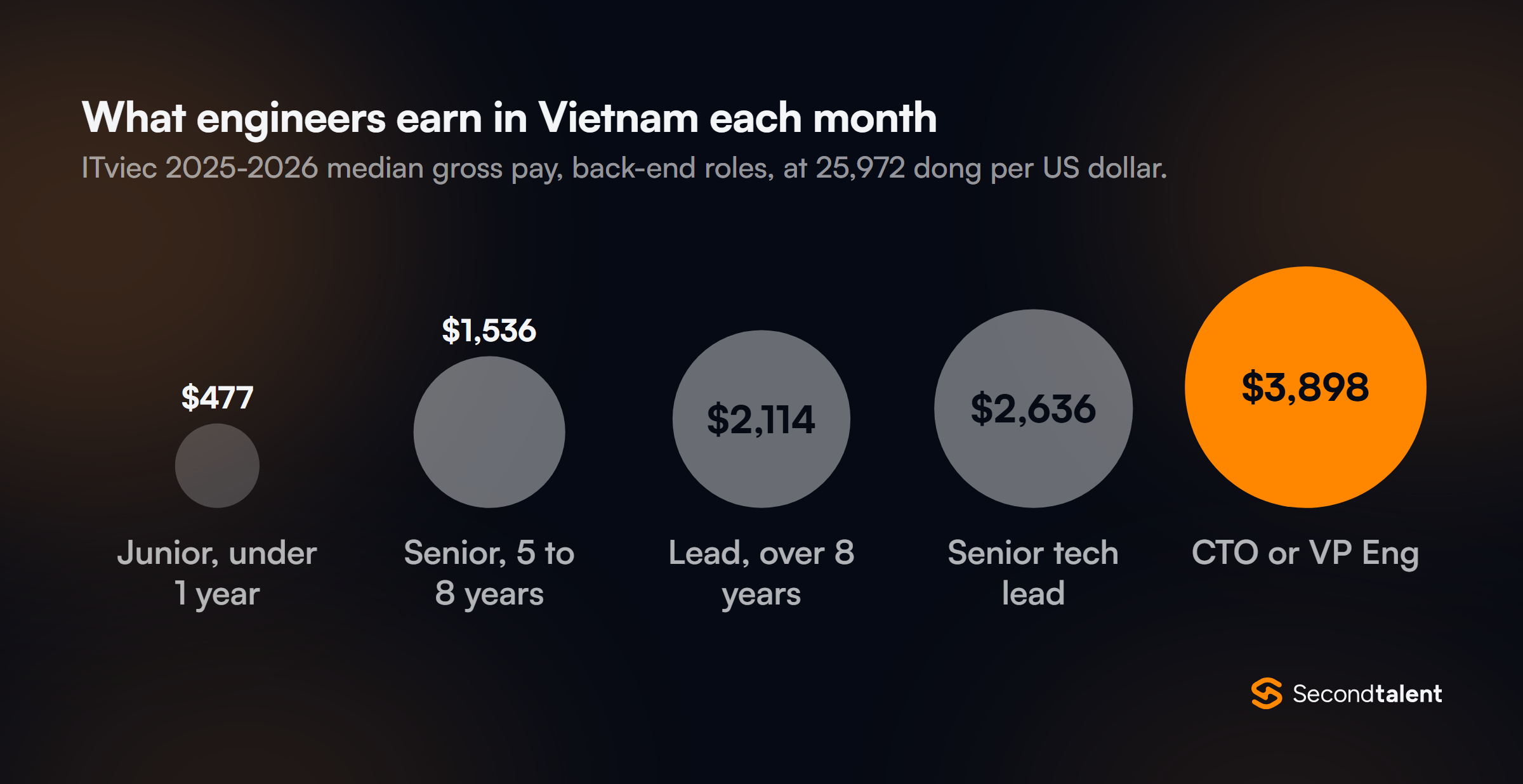
These are salaries; statutory charges come on top, as our Vietnam payroll, benefits and tax guide breaks down. For fully loaded monthly figures by role, see the cost to hire in Vietnam.
The city matters as much as the country. Most centres on this list sit in Ho Chi Minh City, and Savills found IT occupiers took 37% of newly leased office space there in the first nine months of 2025. Hanoi is cheaper for space and scores higher on English.
- US$29.5 per sq m a month, Grade A office (CBRE, Q2 2026)
- 532 on EF's English index
- Samsung, LG, Qualcomm, Toshiba, Infineon
- US$53.2 per sq m a month, Grade A office (Cushman & Wakefield, Q2 2026)
- 508 on EF's English index
- Bosch, NAB, Marvell, Axon, GoTymeX, Renesas, Ampere
The Rules a Vietnam GCC Runs Under in 2026
Most laws that touch a captive centre changed between August 2025 and July 2026.
The tax break is the headline. Under the 2025 Corporate Income Tax Law, software production and semiconductor design qualify for a 10% rate for 15 years against the standard 20%.
Data is the other change a GCC has to plan for. The Personal Data Protection Law requires consent and a transfer impact assessment, filed within 60 days, before personal data leaves Vietnam, DFDL notes. Fines for cross-border breaches reach 5% of the previous year's revenue.
How a GCC Gets Set Up in Vietnam
There are three routes. A wholly foreign-owned company is what every centre on this list runs today. A build-operate-transfer deal has a partner hire and run the team, then hand it over. An employer of record employs the first hires before any entity exists.
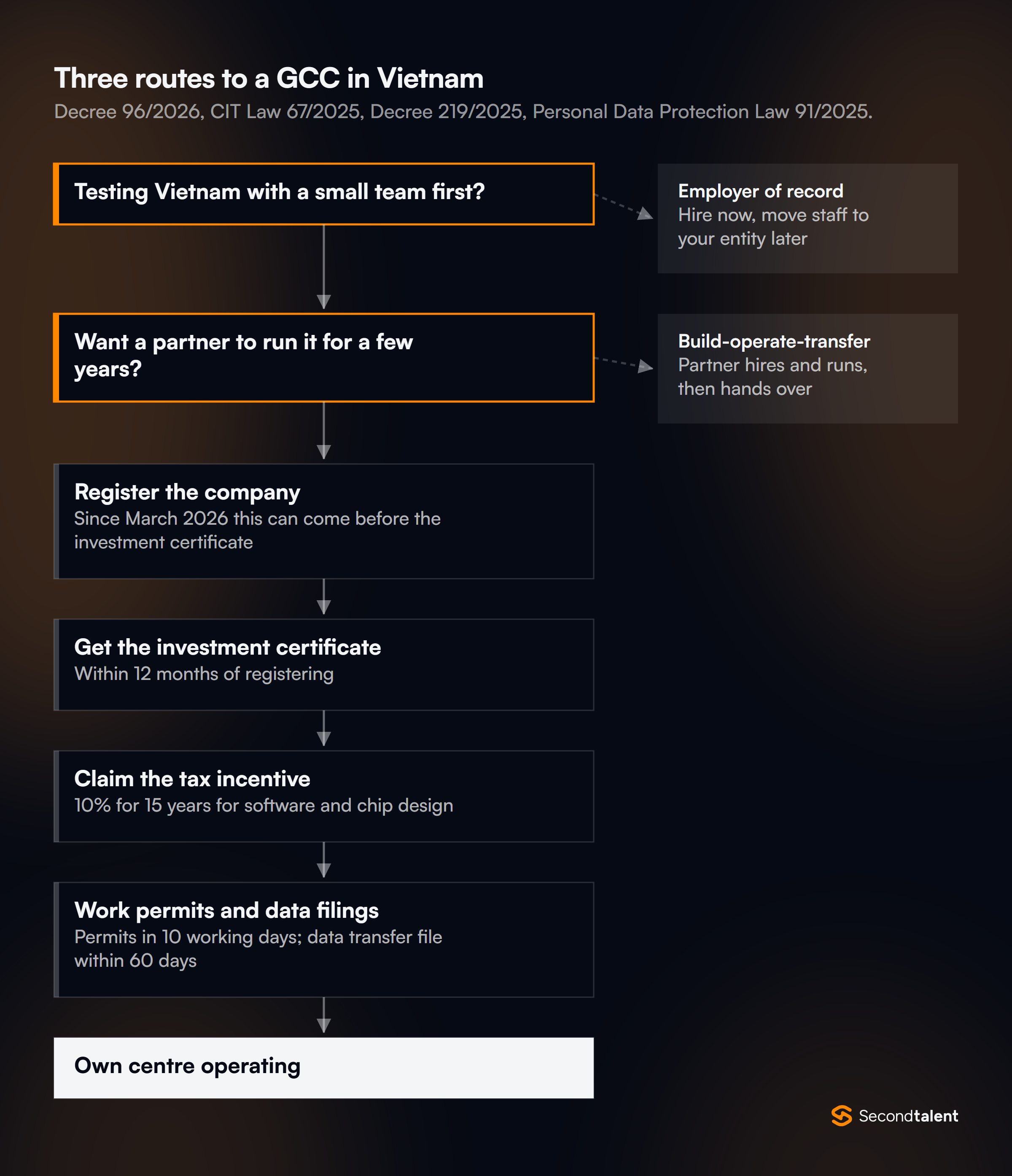
The entity route got faster in 2026. Under Decree 96/2026, a foreign investor can register the company first and has 12 months to obtain the investment registration certificate, Allen & Gledhill explains. Before March 2026 the certificate came first, and the two steps took 30 to 45 working days in practice. There is no statutory minimum capital for a software company, though the authorities check the amount is enough for the plan.
A representative office cannot sign contracts or invoice, so it cannot run a centre. Foreign managers need work permits, which now come from one combined file under Decree 219/2025.
Starting a Vietnam Team Before the Entity
Infineon started with about 25 people. Most companies weighing a Vietnam centre are at that stage, and an entity is a heavy first step for ten or twenty engineers. We employ engineers in Vietnam through our own Vietnam employer of record, so the team is yours from day one and moves into your entity once it exists.
We also find the engineers. Browse vetted developers in Vietnam or check Vietnam AI engineer rates. Then tell us what the centre will build, and we will send profiles within 24 hours.
Frequently Asked Questions
What is a global capability center?
A global capability center (GCC) is an offshore unit a multinational owns and staffs with its own employees to do work for the wider group, such as engineering, R&D or business services. It used to be called a captive centre. India is the largest market, with 2,117 GCCs in the 2026 Nasscom-Zinnov count.
How many GCCs are there in Vietnam?
Nobody publishes a reliable count. Nasscom-Zinnov, Kearney, JLL and Savills all discuss GCCs in Vietnam, but none gives a total. Market-research estimates that do give one tend to count outsourcing vendors such as FPT Software as GCCs, which they are not. The Philippines, by contrast, has about 200 GCCs by IBPAP's count, as our list of GCCs in the Philippines sets out.
What is the difference between a GCC and an outsourcing company?
Ownership. A GCC's staff are employees of the parent's own Vietnamese subsidiary, and the work stays in-house. An outsourcing company employs the engineers and sells their time to many clients. For the vendor side, see our list of AI outsourcing companies in Vietnam.


![Software Development Outsourcing in Vietnam. Top 10 Software Development Outsourcing Companies in Vietnam [2026], by Second Talent.](https://www.secondtalent.com/wp-content/uploads/2026/09/software-development-outsourcing-companies-vietnam-featured-v2-768x403.jpg)
![AI Outsourcing in Vietnam. Top 10 AI Outsourcing Companies in Vietnam [2026], by Second Talent.](https://www.secondtalent.com/wp-content/uploads/2026/09/ai-outsourcing-companies-vietnam-featured-v2-768x403.jpg)

![Tech Startups in Vietnam to Watch. Top 20 Tech Startups in Vietnam to Watch [2026], by Second Talent.](https://www.secondtalent.com/wp-content/uploads/2026/09/tech-startups-in-vietnam-featured-v2-768x403.jpg)
![Hire Developers in Vietnam. 7 Best Platforms to Hire Developers in Vietnam [2026 Guide], by Second Talent.](https://www.secondtalent.com/wp-content/uploads/2026/09/best-platforms-to-hire-software-engineers-in-vietnam-guide-featured-v2-768x403.jpg)