TL;DR: A DevOps engineer builds and runs the pipeline that ships code; a release manager decides what ships, when, and with whose sign-off. At one employer, Accenture Federal Services, the posted US base ranges overlap: $119,900 to $236,800 for an SAP release manager and $130,200 to $265,300 for a DevOps engineer. Tech companies now post release engineers who automate the job, while the release manager title survives where a regulator, an app store or a console maker signs off.
By 2016, Facebook's weekly release branch sometimes carried 10,000 diffs, and engineers requested 500 to 700 cherry-picks a day into three daily pushes. The company replaced that train with pushes every few hours.
On October 5, 2026, I counted 13,126 open postings on 73 tech company job boards, and not one carried the exact title Release Manager.
- 1DORA's research found no evidence that a formal, external change approval lowers change fail rates.
- 2Since January 17, 2025, EU law requires banks and insurers to record, test, approve and verify every ICT change.
- 3GitLab has shipped a monthly release 180 months in a row, while GitLab.com takes several deployments a day.
- 4In the 2025 DORA survey, 90% of respondents used AI at work, and AI adoption still went with less stable delivery.
What is the difference between a release manager and a DevOps engineer?
A release manager plans, coordinates and approves software releases: the calendar, the scope, the go/no-go call and the record of what changed.
A DevOps engineer builds and runs the systems that move code to production: CI/CD pipelines, infrastructure as code, environments and monitoring. One owns the decision to ship. The other owns the machinery that ships.
Our release manager role guide and DevOps engineer role guide cover each job on its own. Two open postings show the split. Epic Games advertises a Senior Release Manager for Fortnite.
A Rockstar Games build and release posting describes the engineering half:
- Own scheduling, quality control and external certification across platforms
- Act as liaison between several development teams
- Run bug triage with QA leads and prioritize must-fix issues
- Coordinate release notes and known issues
- Make sure releases pass all required checks and approvals
- Design and maintain CI/CD pipelines
- Deploy internal tools and public apps to several environments
- Document and automate deployment processes
- Manage test and development environments
- Write code in C# or Java, script in PowerShell, Bash or Python
The coding bar marks the line. Rockstar asks for programming experience in an object-oriented language.
Epic asks for "strong production/project management skills" and experience managing direct reports, plus "a strong understanding of software development". Epic's lead must help resolve build failures.
Rockstar's engineer builds the automation those failures come from.
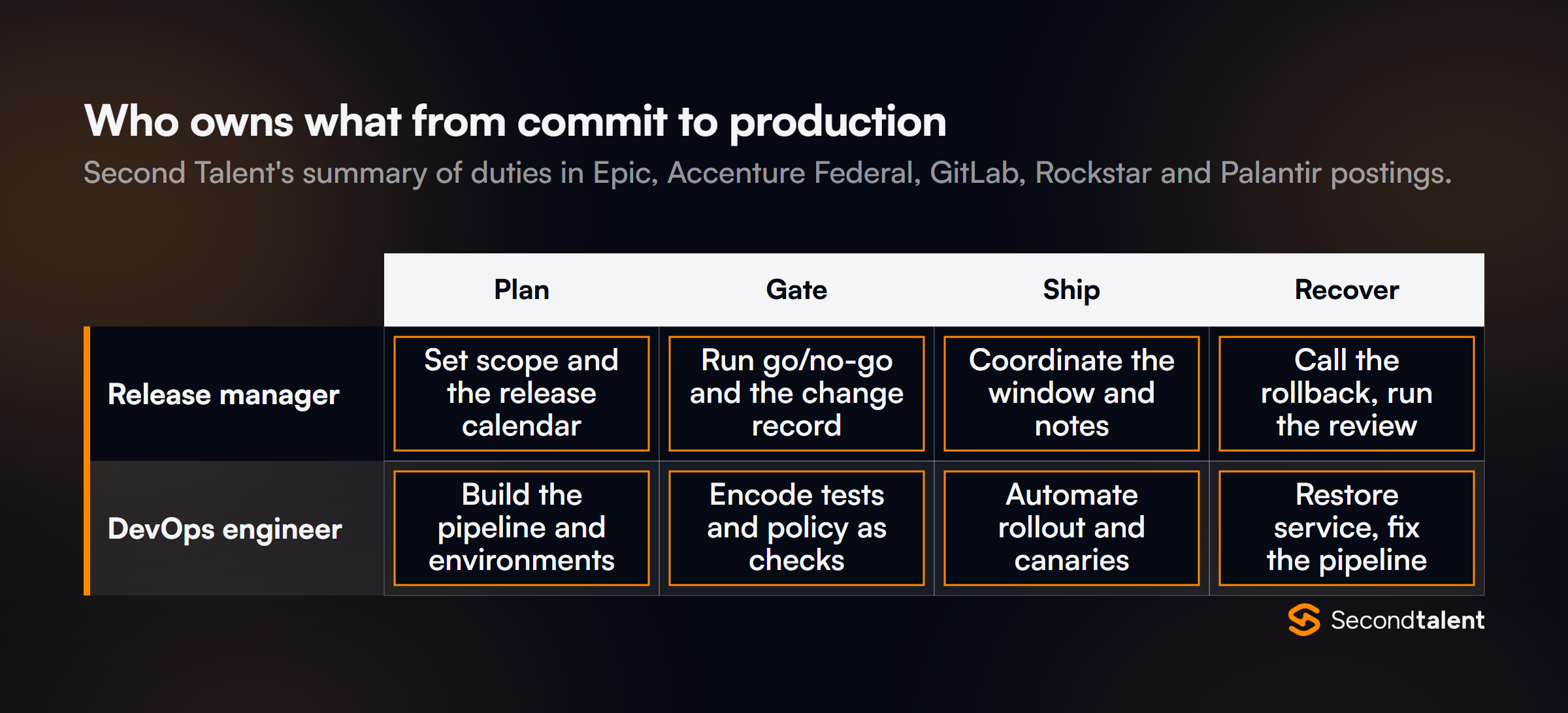
Who owns what from commit to production
Both roles touch all four stages of a release, from different sides. The release manager owns the dates, the decision and the paper trail.
The DevOps engineer owns the pipeline that turns those decisions into deployments, and can turn the paper trail into automated checks.
Kubernetes writes this split into its governance. Each Kubernetes release has a Release Team that does the project management: tracking enhancements, triaging bugs and policing code freeze.
A separate group of Release Managers maintains the release branches, reviews cherry picks and cuts the releases "by using the tools SIG Release provides". Nine contributors held that title when I checked.
Google draws a similar line with a third title.
Its SRE book describes release engineers who work with software engineers and SREs "to define all the steps required to release software", from source control to build rules, testing, packaging and deployment.
In Google's release engineering chapter, some teams build hourly and others "deploy every build that passes all tests". At that point the release decision lives in the test suite.
Change control: the approval board versus the pipeline
Change control is the release manager's oldest job and the one DevOps research has challenged hardest.
DORA's 2019 State of DevOps research found that heavyweight change approval, such as an external change advisory board, hurt software delivery performance.
It found "no evidence" that a more formal, external review process went with lower change fail rates.
DORA's own advice on streamlining change approval is to use peer review for segregation of duties, with approvals "captured in the team's development platform".
That moves the approval out of a meeting and into the pipeline the DevOps engineer runs. ITIL moved in the same direction.
In ITIL 4, change management became change enablement, which AWS's guidance on ITIL describes as "less on control" and open to "decentralization of authority to approve changes".
Regulation pulls the other way. The EU's Digital Operational Resilience Act, also shortened to DORA, has applied to financial entities since January 17, 2025.
Article 9 of the regulation requires documented ICT change management so that "all changes to ICT systems are recorded, tested, assessed, approved, implemented and verified in a controlled manner".
Line management must approve the process itself.
Neither rule says a person must sit in the loop. A pipeline with peer review, an audit trail and automated tests can produce that record.
GitLab's open Senior Release Engineer posting shows the merged job: it asks for "quality gates, automated checks, approvals, audit trails, and policy controls" built into CI/CD.
CI/CD ownership and the numbers each role answers for
The DevOps engineer owns the pipeline, and with it the two speed numbers DORA tracks: how often a team deploys and how long a change takes to reach production.
The release manager answers for what the business sees when a release goes wrong. That covers the change fail rate and the communication around a rollback.
The 2024 Accelerate State of DevOps Report, built on surveys of more than 39,000 professionals over ten years, sorts teams into four clusters. Elite teams change code to production in under a day. Low performers take one to six months.
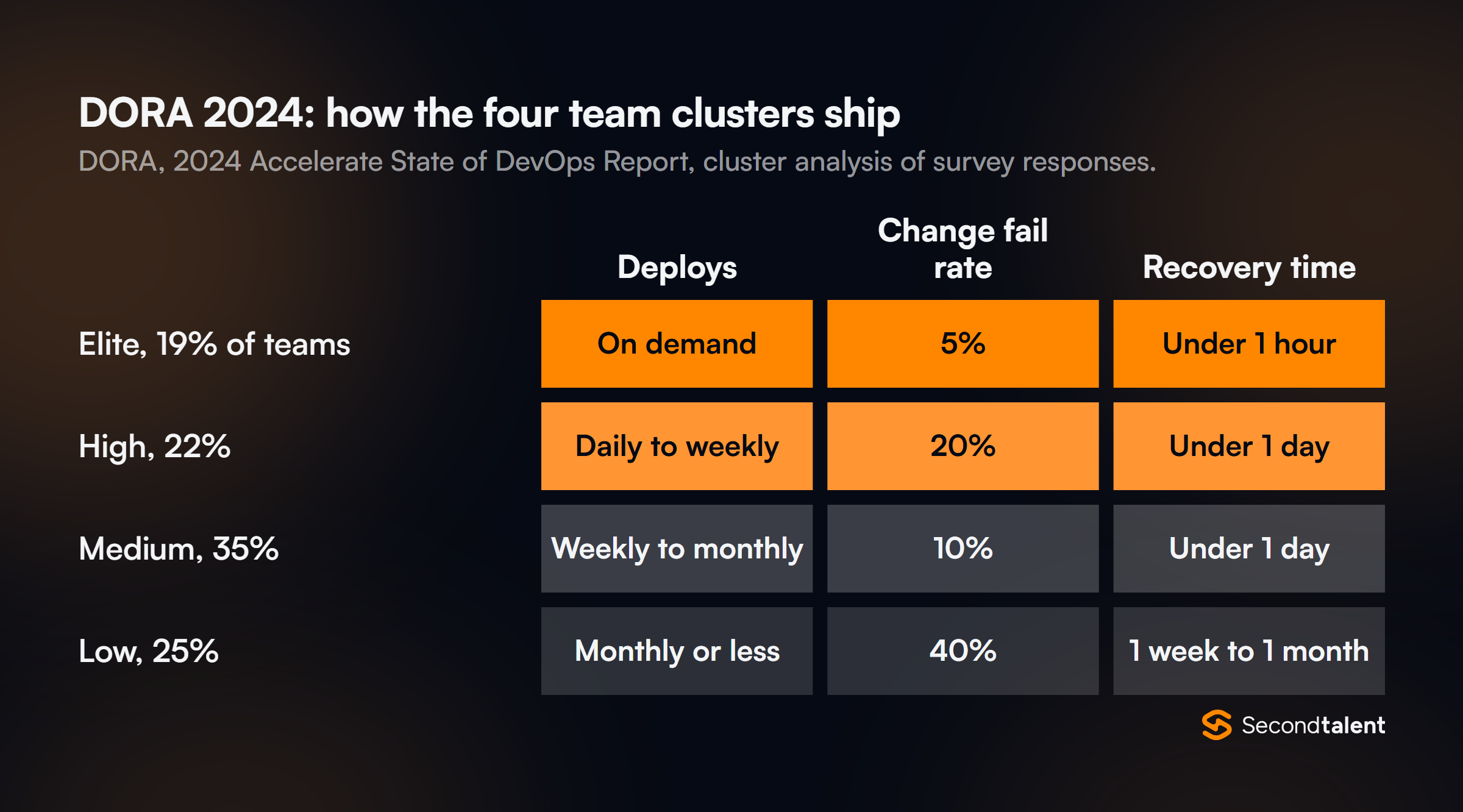
DORA says the metrics "typically move together". The medium cluster is the 2024 exception: it fails 10% of changes, half the high cluster's 20%, while deploying less often.
A team that ships monthly can fail less often than one that ships weekly.
That is the release manager's case in one number. It is also why DORA split delivery into throughput and stability that year.
A team can buy stability with a slow, careful train, or buy both with automation good enough to reach the elite row. Our CI/CD interview questions test for the second.
Release trains: who still runs them
A release train ships on a fixed date, and whatever is ready boards it. The model has not died. It has moved to software that someone else installs.
Facebook's web front end ran a train until 2016: three daily pushes from a release branch, cut weekly.
In a 2017 Engineering at Meta post, Chuck Rossi says the branch model "took a certain amount of human effort in the form of release engineers" and had reached its limit.
Pushes now go to employees first, then 2% of production, then 100%, over a few hours. The mobile apps moved from four-week to weekly releases on the same branch and cherry-pick model.
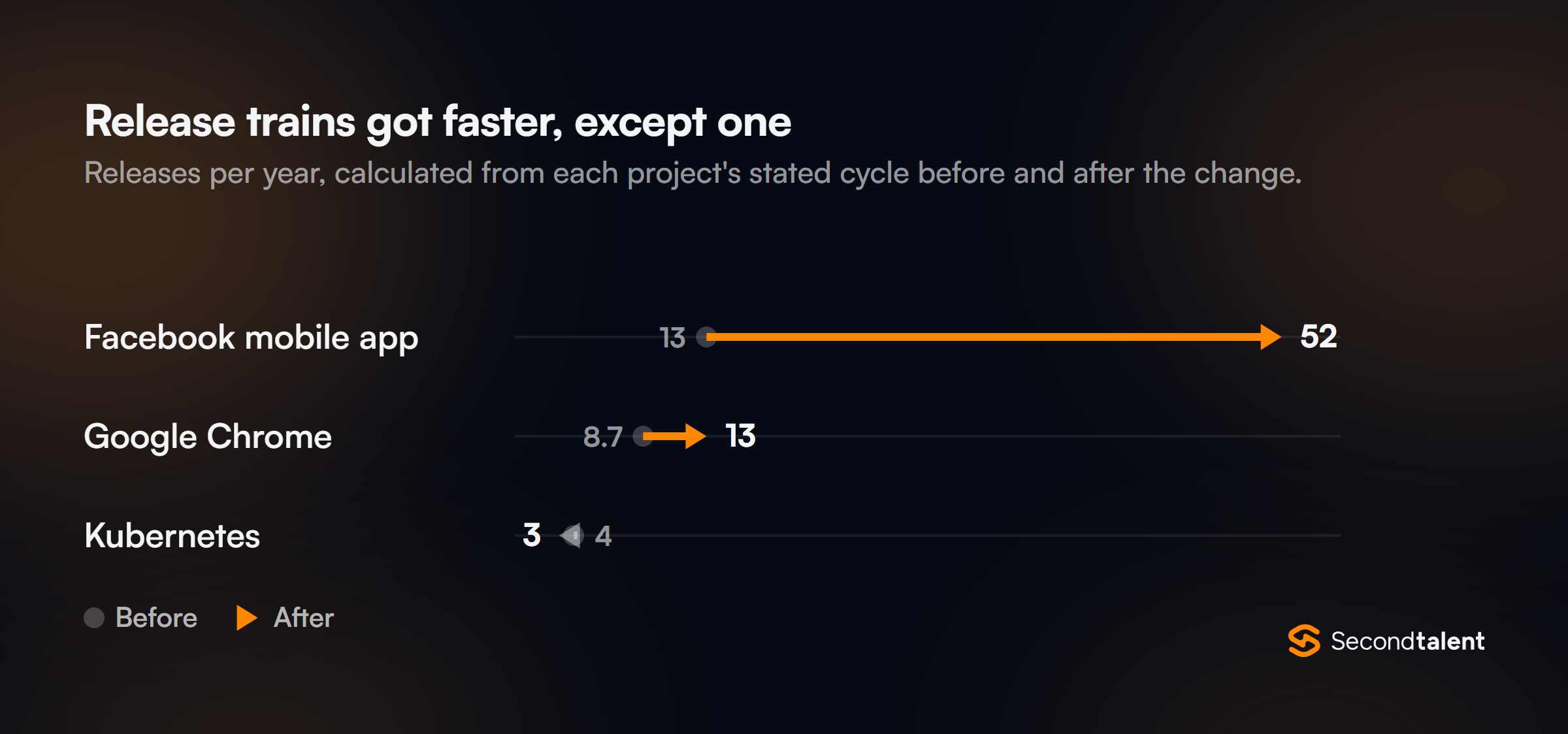
Chrome went from a six-week to a four-week milestone with Chrome 94 in 2021, according to the Chromium Blog, and added an eight-week Extended Stable channel for enterprises. Kubernetes went the other way.
Its release team moved from four releases a year to three, starting with version 1.22. Python moved from an 18-month cycle to an annual October release under PEP 602, where one Release Manager handles two feature releases by convention.
GitLab runs both models at once. GitLab.com takes "multiple deployments per day", and self-managed customers get a monthly package. Its handbook sets out release week:
Large enterprises run trains under another name. The Scaled Agile Framework defines an Agile Release Train as a long-lived team of Agile teams, with 50 to 125 members.
Its Release Train Engineer is a coach who runs the train's events, which makes it closer to a program manager than to a release manager.
Where release managers are still hired
The release manager title holds on where a third party stands between the build and the user. Three places stand out in current postings and platform rules.
App stores and consoles. Apple says App Review handles "at least 50% of submissions in less than 24 hours and 90% in less than 48 hours", per its App Review page. A fix to an iOS app goes back through that review.
Apple's phased release spreads an update across automatic-update users over seven days, and someone has to decide whether to pause it:
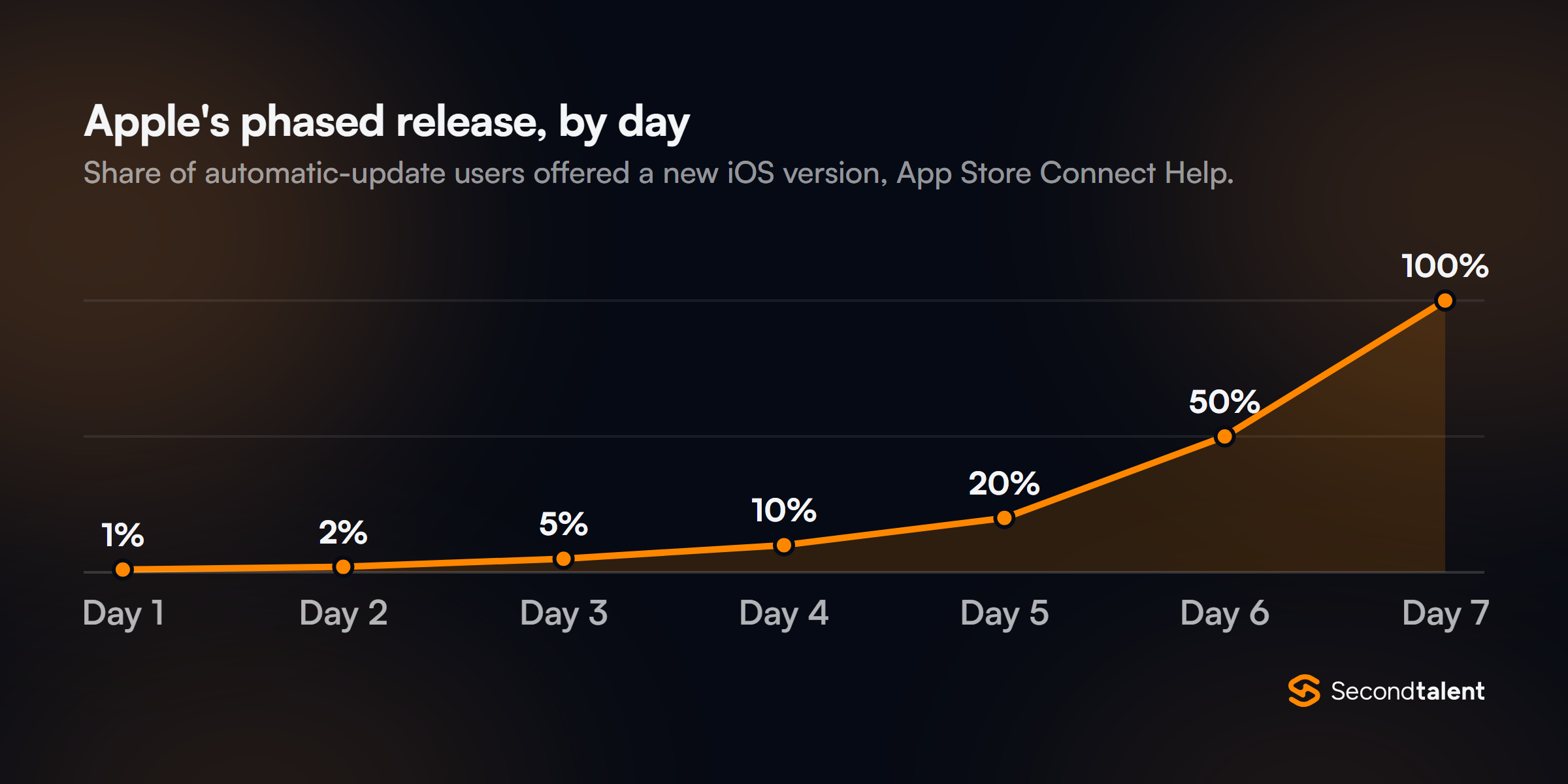
Developers can pause a phased release for up to 30 days in total. Games add console certification. Epic's Release Management Lead posting puts the "external certification process across multiple platforms" in the release manager's hands.
It also asks the lead to manage "a sub-team of release managers".
Regulated and government work. Accenture Federal Services is hiring an SAP Release Manager for a Navy S/4HANA program.
The posting lists transport migration across four SAP environments, change records in SAP Solution Manager and go/no-go meetings, and requires an active Secret clearance.
Packaged enterprise apps. GitLab's release engineer posting names Salesforce and Zuora as the platforms to build CI/CD for, plus "release calendars, change planning, blackout-period coordination".
Tech company job boards look different. I pulled all open postings from 73 Greenhouse, Ashby and Lever boards, from Stripe and Datadog to OpenAI and Palantir:
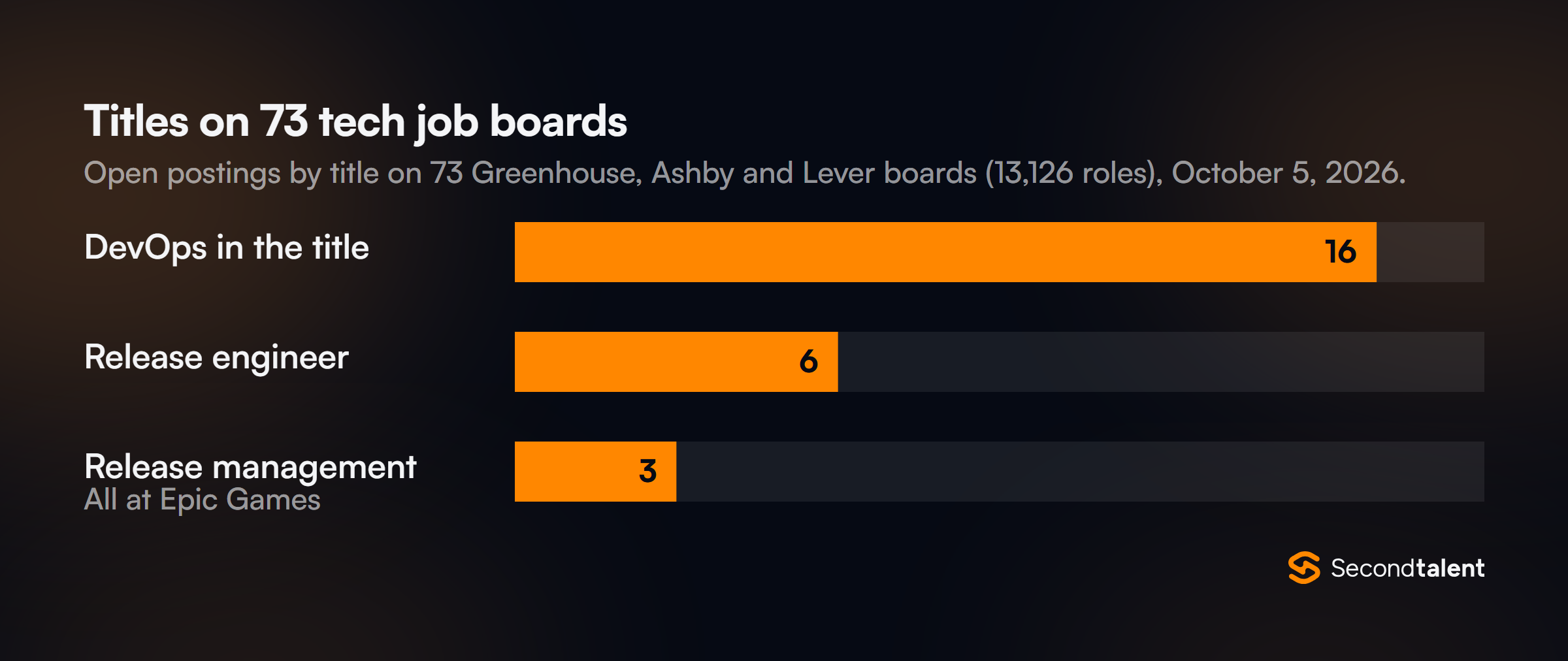
All three release management postings were one Epic role listed in three locations. The six release engineer roles, at GitLab, OpenAI, Riot Games, Toast, Pure Storage and Supabase, write code.
OpenAI's consumer devices posting wants hermetic toolchains, signed firmware and staged over-the-air rollouts with "safe rollback and roll-forward strategies".
Pay: what the postings say
The roles pay in the same band when the employer and seniority match. Accenture Federal Services posts both, with US base ranges for the states that require them:
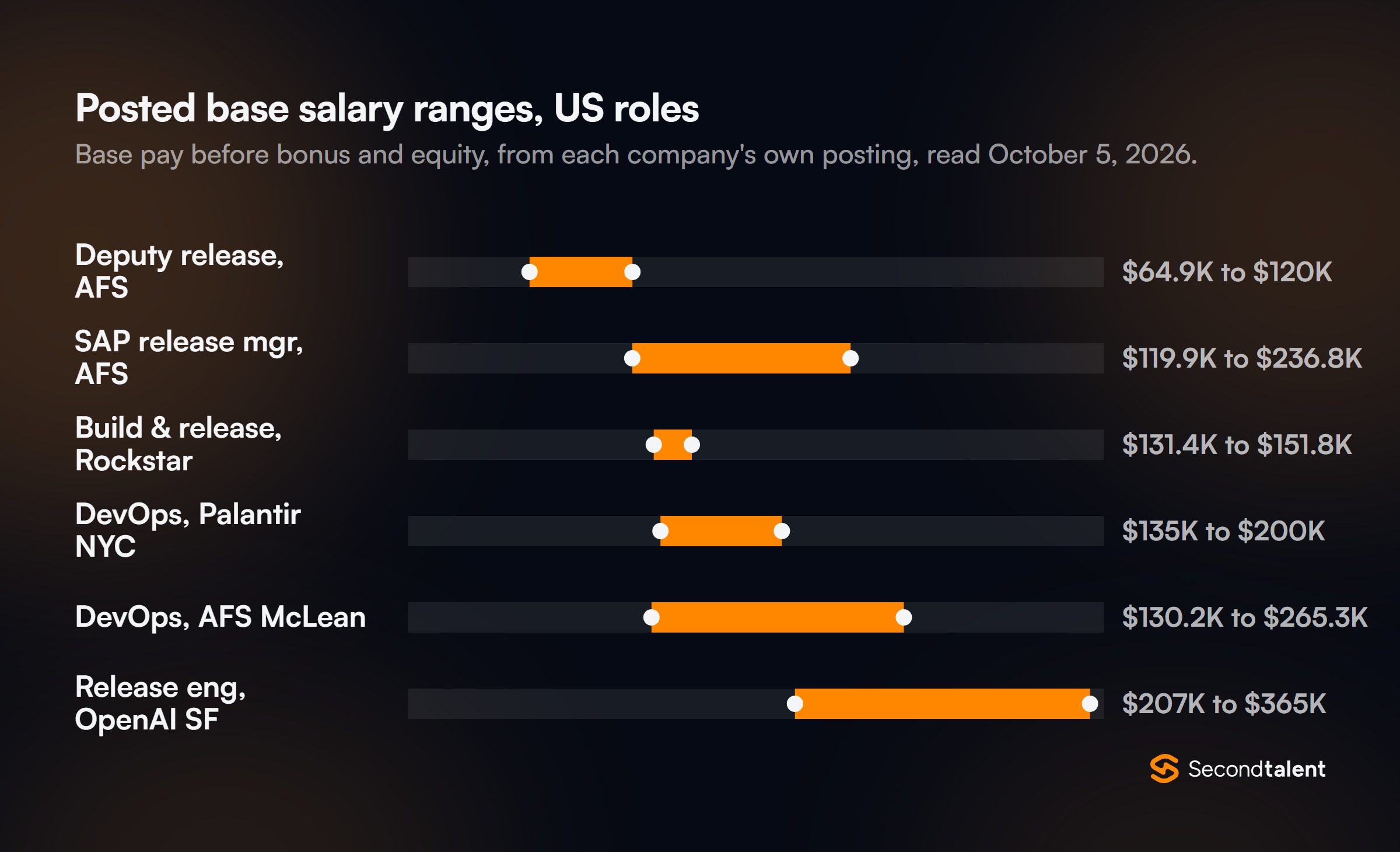
Requirements explain the spread. The SAP release manager role asks for five or more years and a Secret clearance. The McLean DevOps posting asks for eight or more years and a TS/SCI clearance with polygraph.
A Deputy Release Manager role with two years of experience starts at $64,900.
Outside government, Palantir's New York DevOps posting lists $135,000 to $200,000 before stock, and Rockstar's build and release posting lists $131,400 to $151,800. OpenAI's release engineer range runs to $365,000.
In Asia, our rate cards track DevOps pay market by market, including the Philippines, Vietnam and India.
Where the release manager role is heading
AI is pushing more code through the pipeline, and DORA keeps finding that stability suffers. In the 2024 report, more AI adoption went with an estimated 1.5% drop in delivery throughput and a 7.2% drop in delivery stability.
The 2025 DORA report found AI now helps throughput, but its link with instability remained.
Change fail rate is the number a release manager answers for. The postings show who now gets the job. GitLab's Senior Release Engineer must use AI tools such as Claude "every day" for pipeline work and "release analysis".
The same posting covers release governance, rollback standards and root-cause analysis of failed deployments. That combines a release manager's duties with a DevOps engineer's skills.
Three shifts follow from the sources above:
- Approval becomes code. DORA's peer-review advice and ITIL's change enablement both move sign-off into the pipeline, where a DevOps or release engineer maintains it.
- The record still needs an owner. The EU regulation, federal contracts and app store reviews all demand a traceable, approved change. Someone answers for that record when an auditor asks.
- Coordination shrinks to the hard cases. Multi-platform games, SAP programs and monthly self-managed releases still need a person running the date. Facebook's web front end, by contrast, pushes every few hours without a weekly branch.
For a working release manager, the safer path is toward release engineering: scripting, pipeline policy and progressive delivery.
Our DevOps coding challenges show the bar for that move, and our post on AI agents for DevOps covers the tools taking over routine pipeline work.
When you need one, the other, or both
Hire the DevOps engineer first if releases still depend on manual steps. A release manager scheduling manual deployments adds process to a slow pipeline.
Add a release manager when an outside party approves releases, or when several teams ship into one product on one date.
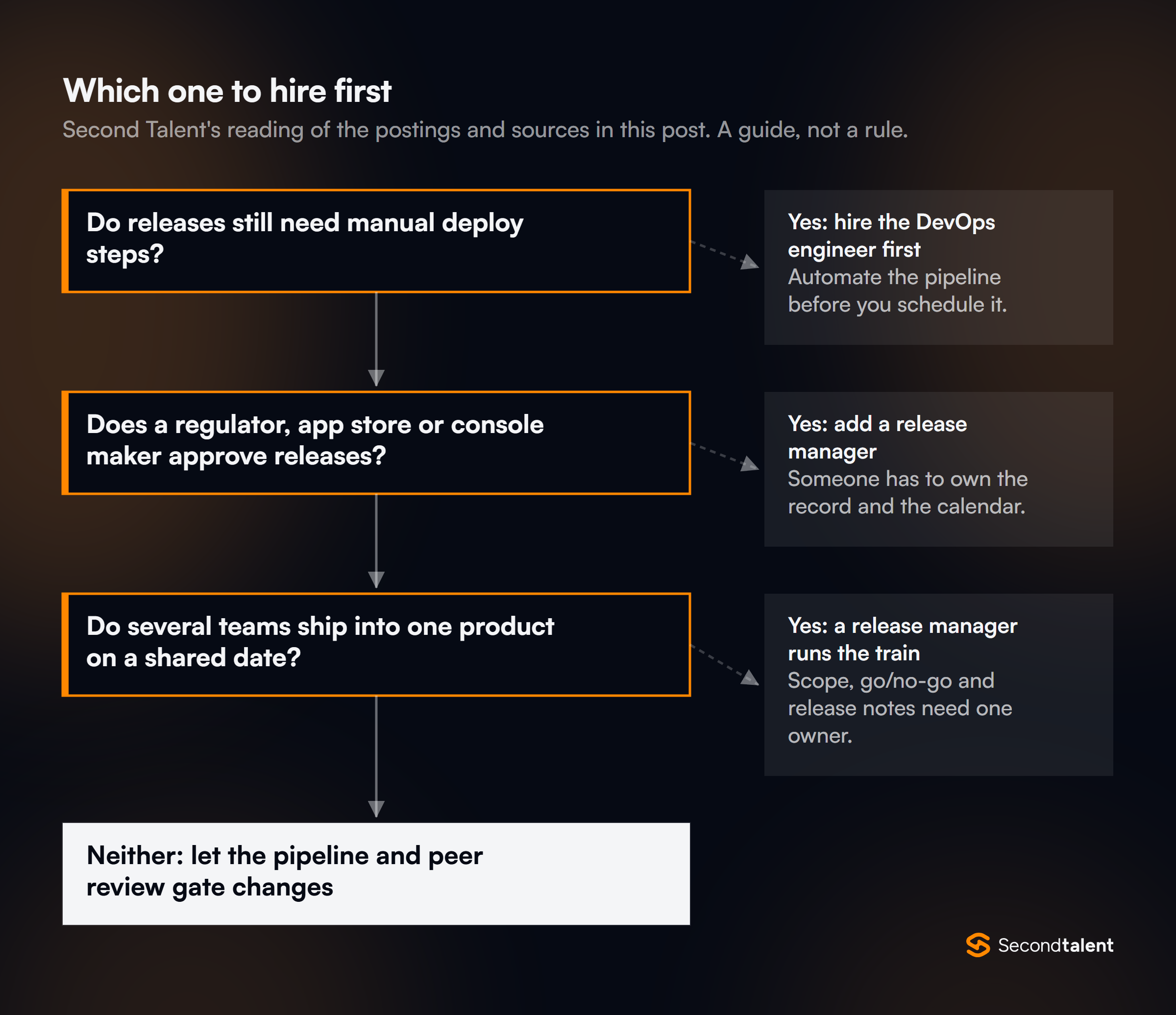
A single web product with automated tests and peer review often needs neither title. DORA's elite teams deploy on demand with a 5% change fail rate, and the approval lives in the pull request.
The deciding question is who signs off, not how often the team ships.
Hire DevOps engineers from Asia
The DevOps engineer is the hire that shortens the release itself. We match you with vetted DevOps engineers in 24 hours, at 50-70% below US cost, with a 90-day, one-time replacement guarantee.
We employ them through our own EOR in 9 Asian markets, including the Philippines and India.
Our monthly plan is $4,999 a month for a senior engineer, all-inclusive. Tell us what your pipeline needs and we will send a shortlist.
Frequently Asked Questions
Is a release train engineer the same as a release manager?
No. In SAFe, the Release Train Engineer is "a servant leader and ART coach" who runs planning and train events. A release manager owns the release itself: scope, approvals and the go/no-go call.
What does a release engineer do?
A release engineer builds the tooling that makes releases repeatable: build systems, versioning, packaging and deployment automation.
Google's SRE book lists source code management, compilers, build configuration languages, package managers and installers as the core knowledge. It sits between the two roles in this post.
Is a DevOps engineer the same as an SRE?
They overlap, but the focus differs. A DevOps engineer focuses on the delivery pipeline, and a site reliability engineer focuses on keeping production services reliable.
In Google's model, SREs rely on release engineers for reproducible builds and then deploy and run the result.