TL;DR: Agent orchestration is the best-paid AI skill in 2026: US developers who build with LangGraph earn a median $209,500, against $154,765 for all US developers in Stack Overflow's 2025 survey. LLM app development, managed cloud AI platforms and vector search follow, each at $190,000 or more.
US developers whose job title is AI/ML engineer earn a median $189,000, about $34,000 more than the average American developer, with four fewer years of experience. Demand is still climbing: Lightcast counts 2.5% of US job postings asking for AI skills, up 55% in a year.
Top 10 Most In-Demand AI Skills and Their Salaries (2026)
| Rank | Skill | Tool measured | US median pay | US respondents |
|---|---|---|---|---|
| 1 | Agent orchestration | LangGraph | $209,500 | 58 |
| 2 | LLM app development | LangChain | $200,000 | 149 |
| 3 | Managed cloud AI platforms | Amazon Bedrock Agents | $200,000 | 83 |
| 4 | Vector search | pgvector | $191,500 | 80 |
| 5 | Data platforms for AI | Snowflake | $190,000 | 280 |
| 6 | AI coding agents | Claude Code | $183,500 | 446 |
| 7 | MLOps and model infrastructure | Kubernetes | $180,000 | 1,032 |
| 8 | Open-weight models | Ollama | $176,800 | 183 |
| 9 | Python | Python | $160,000 | 2,254 |
| 10 | Data science | Data scientist job title | $137,000 | 54 |
- 1Jobs that require AI skills pay a 62% wage premium, according to PwC’s 2026 study of more than a billion job ads.
- 2Singapore has the highest share of job postings asking for AI skills, at 4.77%, ahead of Hong Kong and the US.
- 3US developers who use AI agents daily earn $175,000, against $141,000 for those with no plans to, and the gap holds among seniors.
- 4Data scientists are the one AI role that earns less than the average US developer.
The 10 AI Skills, Ranked by Pay
1. Agent orchestration
Agentic AI skills went from 0.06% of US job postings in 2024 to 0.23% in 2025, nearly 90,000 postings, in Lightcast’s data for the Stanford AI Index 2026. Lightcast added agentic AI as its tenth AI skill cluster this year.
The work is building systems where a model plans steps, calls tools and hands tasks to other agents. Developers who use LangGraph, the agent framework from the LangChain team, earn a median $209,500 in the US, and the middle half earn $160,000 to $271,250, the highest band in the list.
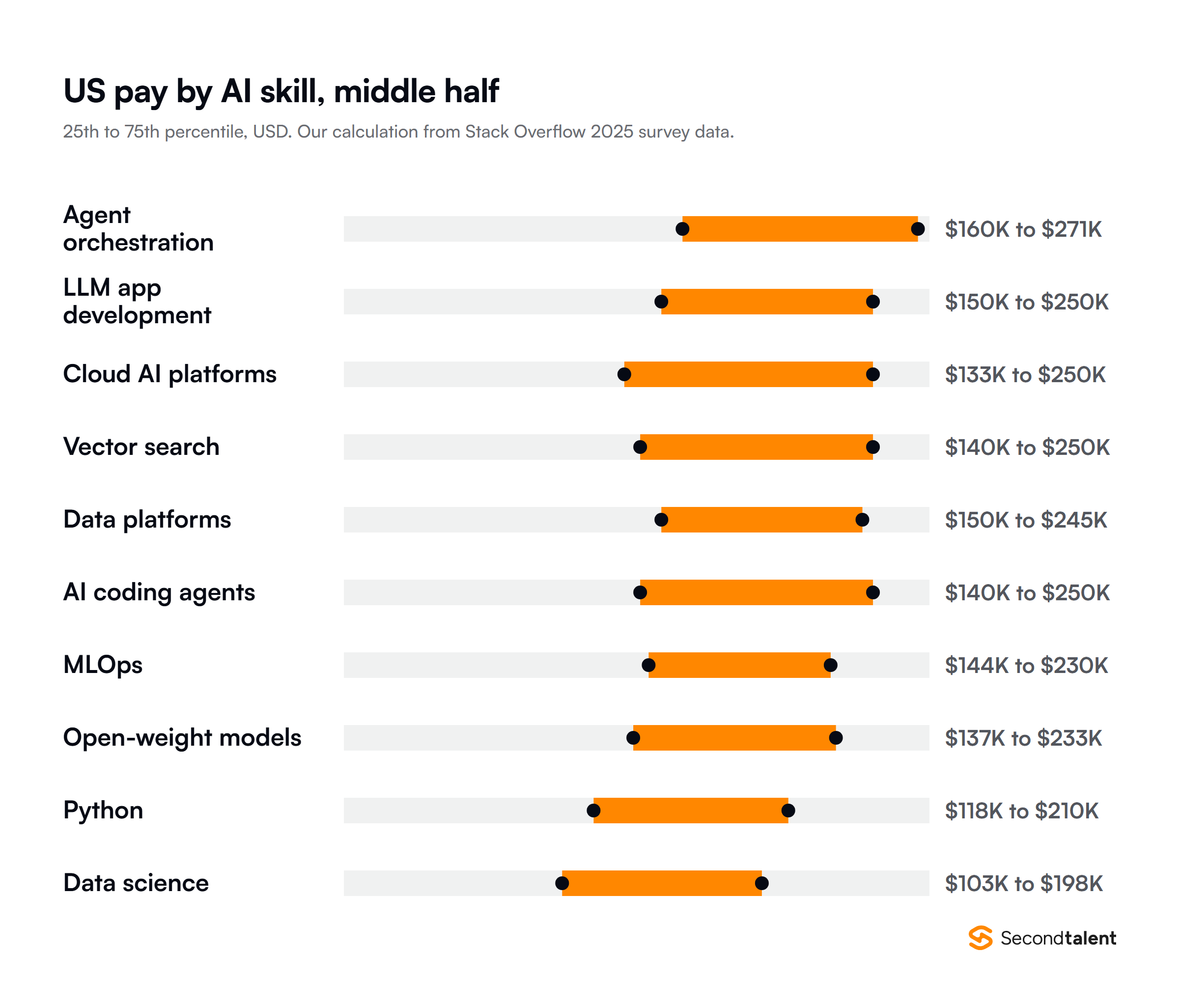
The skill is still rare. Only 13% of AI/ML engineers in the survey use LangGraph, and Microsoft’s AutoGen and CrewAI have too few US users to price, at 38 and 22.
It also pays without seniority. LangGraph users have a median of 12 years’ experience, three fewer than LangChain users, yet they earn $9,500 more.
Agents also need a way to reach company data, and 1,456 respondents already use GitHub’s MCP server, which connects agents to GitHub through the Model Context Protocol. Its US users earn a median $180,000.
2. LLM app development
US job postings asking for large language modeling rose from 5,000 in 2023 to 20,000 in 2024, and generative AI postings from 16,000 to more than 66,000, according to Lightcast’s figures for the 2025 AI Index.
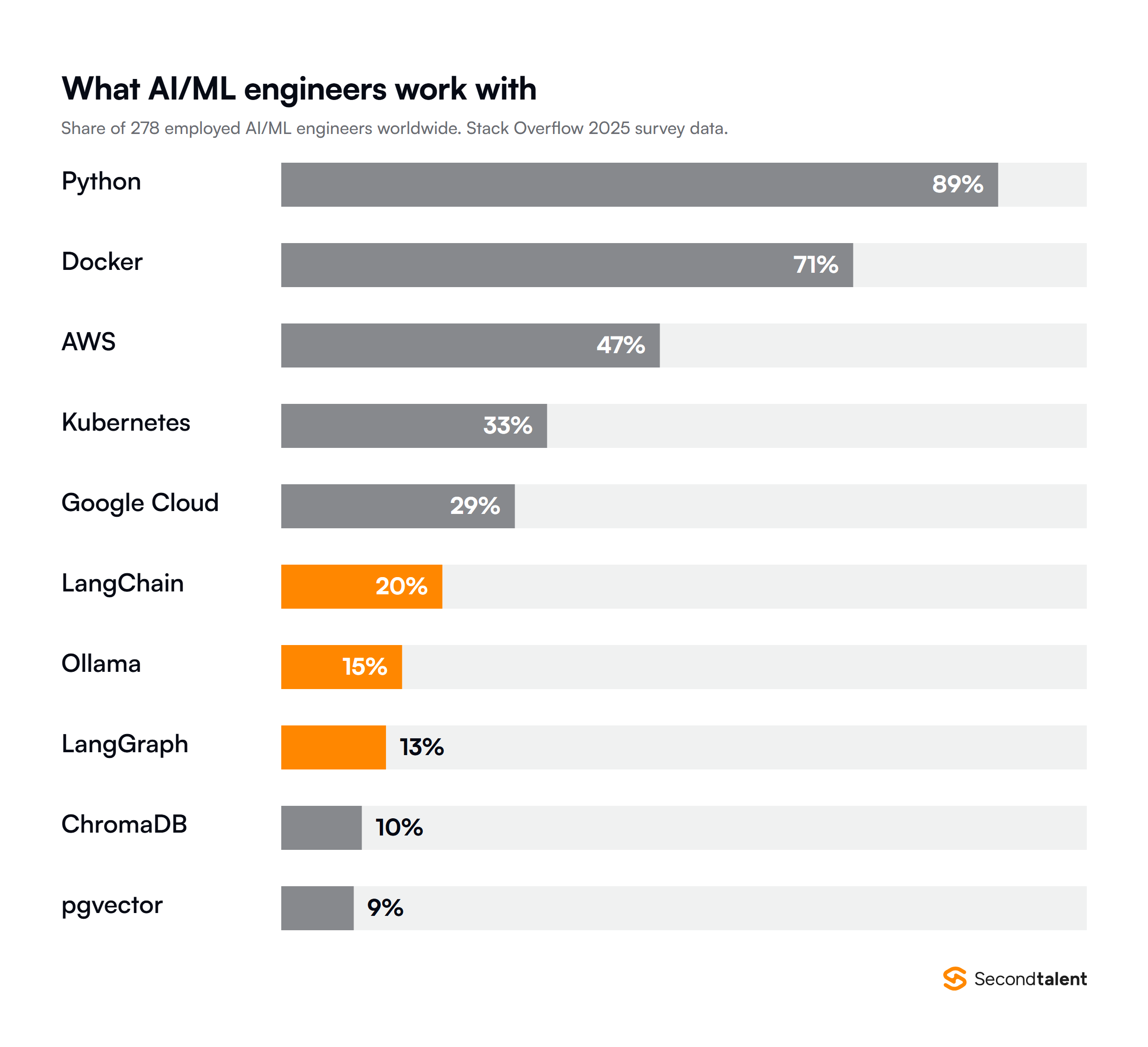
Among AI/ML engineers in the survey, LangChain is the most-used framework for building LLM apps. Its US users earn a median $200,000, with the middle half at $150,000 to $250,000, and LlamaIndex users earn $174,000. The everyday stack still comes first:
Prompt engineering on its own is a smaller market. Postings that named it rose from 1,400 to about 6,300 over the same year, under a third of the demand for large language modeling.
3. Managed cloud AI platforms
Developers who build on Amazon Bedrock Agents earn a median $200,000 in the US, level with LangChain, and Google Vertex AI users earn $181,954. Bedrock’s band starts lower, at $132,500, and Vertex AI’s runs from $130,000 to $250,000. OpenRouter, which sends requests to whichever model provider fits, has 61 US users earning a median $185,000.
AWS is the cloud AI/ML engineers use most, at 47%, with Google Cloud at 29% and Microsoft Azure at 23%. Azure users as a whole earn less, a median $145,500 in the US, but that figure covers all Azure developers, not only those building with its AI services.
4. Vector search
The vector store developers reach for most is one that lives inside Postgres. pgvector, a Postgres extension, has 611 users in the survey against 380 for Pinecone, a standalone vector database.
Vector search is how an AI system finds the right documents before it answers, the retrieval step in retrieval-augmented generation. US developers using pgvector earn a median $191,500, and the middle half $140,000 to $250,000. Among AI/ML engineers, ChromaDB (10%) and pgvector (9%) lead, while Pinecone, Qdrant and Weaviate have too few US users to price.
5. Data platforms for AI
Snowflake and Databricks users earn the same US median, $190,000, which is $30,000 above data engineers as a group. BigQuery users earn $180,000, and Amazon Redshift users the same. The faster analytical engines pay more still: Clickhouse users earn a median $198,000 and DuckDB users $185,000, though both samples are smaller, at 79 and 129.
Models are only as useful as the data pipelines behind them, and these platforms are where companies keep the data they train on and retrieve from. Databricks has the higher floor: its middle half starts at $155,500, against $150,000 for Snowflake. Among AI/ML engineers, 13% work with BigQuery and 10% with Databricks.
6. AI coding agents
US developers who use AI agents at work every day earn a median $175,000. Those with no plans to use them earn $141,000.
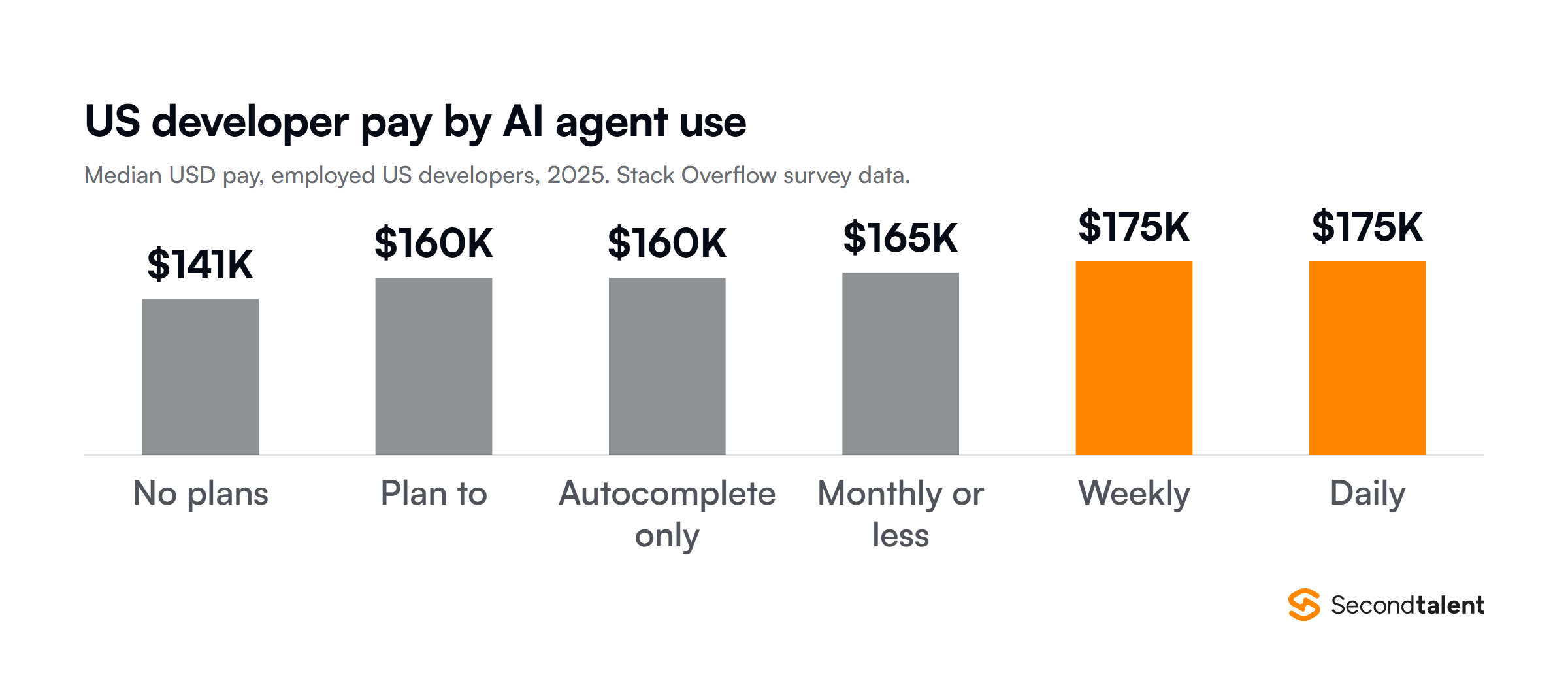
Experience explains part of that, since agent users are more senior. Among US developers with ten or more years, the gap narrows but holds: $187,000 for daily users against $156,000 for non-users. By tool, Claude Code users earn $183,500, Cursor users $180,000 and GitHub Copilot agent users $175,000.
AI/ML engineers adopted agents faster than other developers:
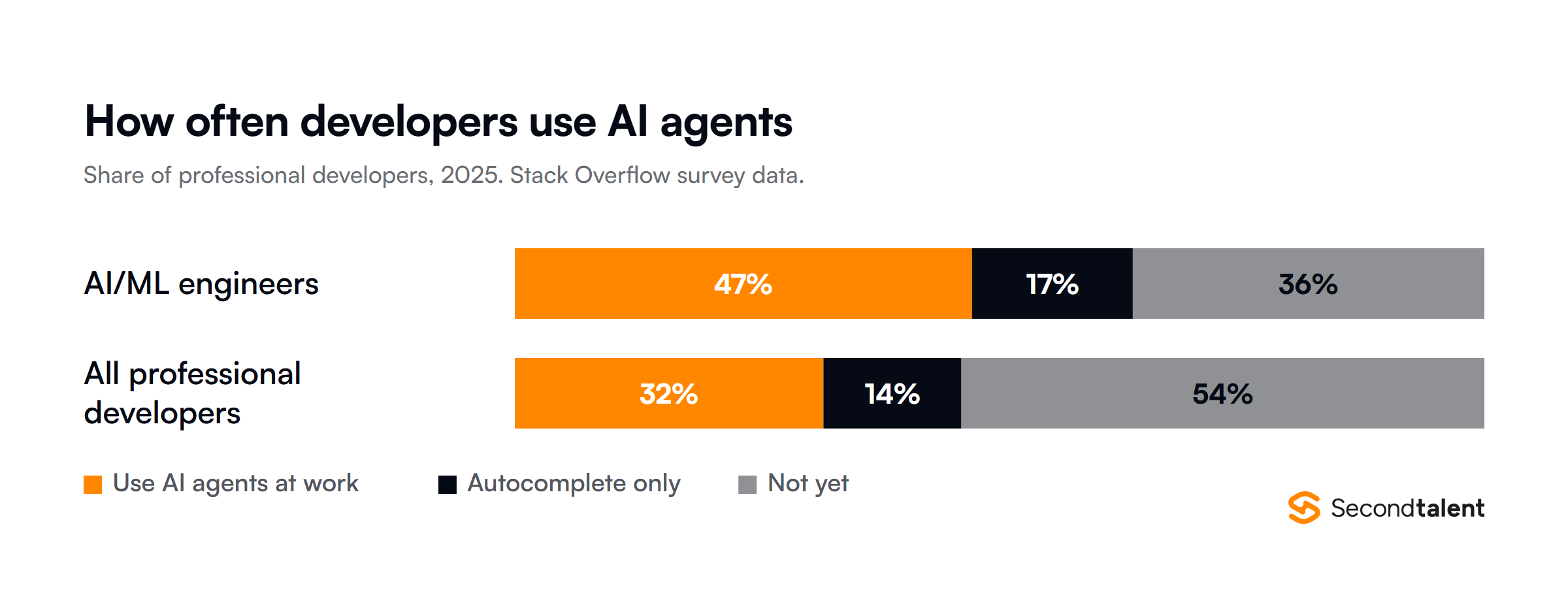
A quarter of AI/ML engineers use agents daily, against 15% of professional developers overall. Our comparison of AI coding agents covers the tools themselves.
7. MLOps and model infrastructure
Seven in ten AI/ML engineers use Docker and a third use Kubernetes, which makes deployment the most widespread skill in the list after Python. Getting a model into production, keeping it running and scaling it is the job of an MLOps engineer.
Kubernetes users earn a median $180,000 in the US, Terraform users $181,000 and Datadog users $188,500. The infrastructure job titles pay even more: cloud infrastructure engineers earn a median $195,500, the best-paid job title in our role comparison, and DevOps engineers $166,000.
Watching models in production is the newest part of the job. General monitoring tools are well established, with Grafana and Prometheus users earning $182,500. LLM-specific observability tools are still small: LangSmith has 337 users in the survey and Langfuse 239, too few in the US to price.
8. Open-weight models
Ollama, which runs open models on a developer’s own machine, is the most-used agent tool in the survey. It has 1,921 users, against 1,239 for LangChain.
Running models on a company’s own hardware matters where data cannot leave the building or API costs add up. US Ollama users earn a median $176,800. Among AI/ML engineers, 32% have worked with Meta’s Llama models, 25% with DeepSeek’s reasoning models and 16% with Mistral’s.
9. Python
Python was the most in-demand specialized skill in Lightcast’s 2026 data, appearing in 258,674 US job postings, up nearly 30% on 2024. Nine in ten AI/ML engineers use it.
That ubiquity is why it pays the least of the tools in this list. US Python developers earn a median $160,000, only about $5,000 above developers as a whole, because Python also runs scripts, web back ends and data analysis.
It is the entry requirement for AI work, and the premium comes from the tools developers add on top of it.
The languages around AI infrastructure pay more than Python does. US developers who write Go earn a median $180,000, Rust developers $173,500 and developers using Scala, the language Apache Spark is written in, $200,000.
10. Data science
Data scientists are the one AI-adjacent role that earns less than the average US developer, a median $137,000 against $154,765. AI/ML engineers, who build and ship models rather than analyse data, earn $189,000.
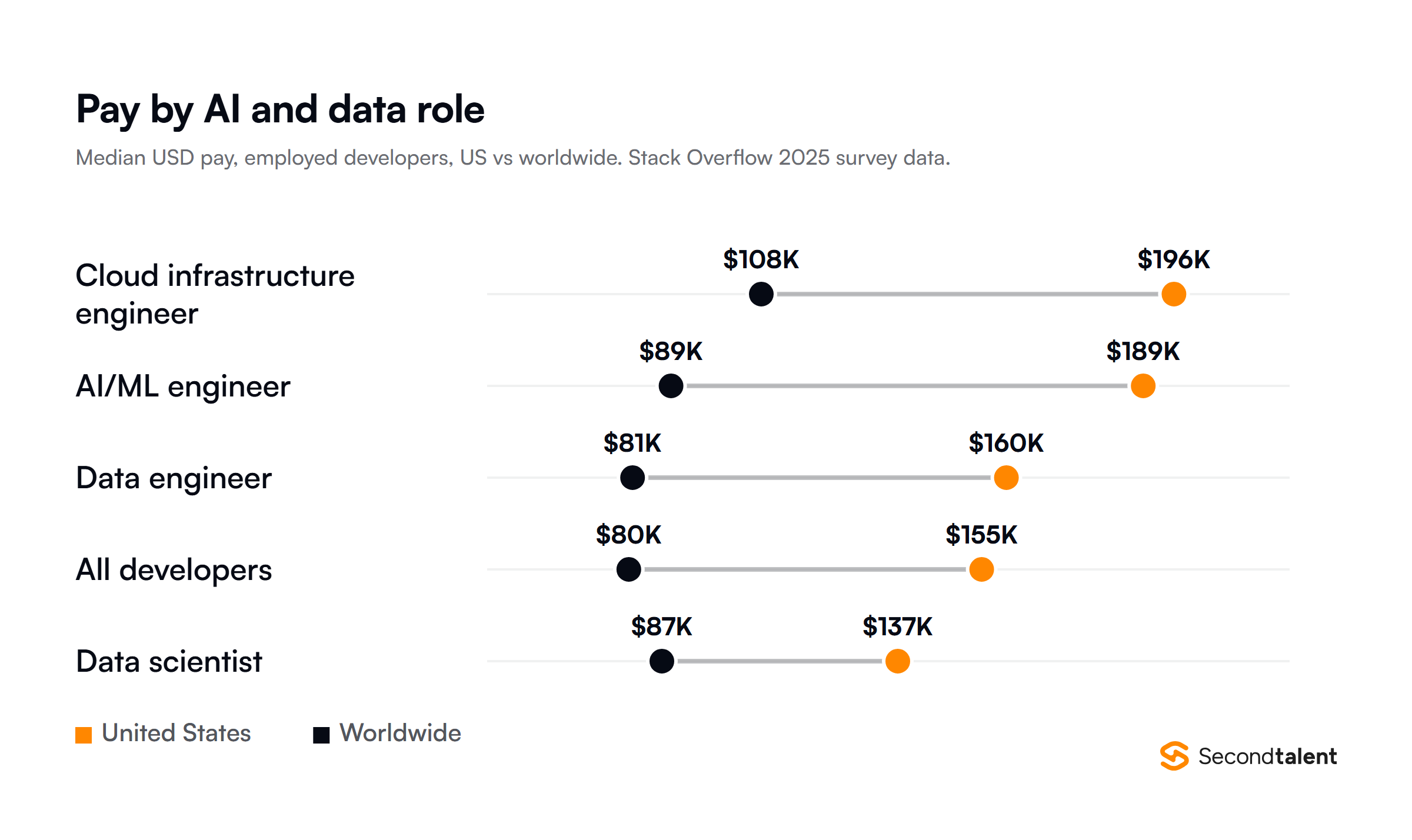
The US data scientist band is wide, from $103,130 to $197,500, and its median experience is nine years, the same as AI/ML engineers.
The gap is a US one. Worldwide, AI/ML engineers and data scientists earn almost the same, $88,960 and $87,011. Classic tooling follows the same pattern in the US: R users earn $143,000 and Jupyter users $165,000, both below every tool in entries one to eight.
Hiring AI Engineers in Asia
AI engineers bill $25 to $85 an hour in the Philippines and S$95 to S$250 in Singapore on our rate cards. We place vetted LLM and AI engineers across nine Asian markets and match candidates within 24 hours.
Tell us the role and we will send vetted profiles.
FAQs
Do AI skills raise pay outside tech jobs?
Yes. In Lightcast’s 2025 study of 1.3 billion postings, jobs listing AI skills offered 28% more, nearly $18,000, and 51% of them were outside IT.
Why do PwC and Lightcast report different AI pay premiums?
They use different samples and years. PwC’s 62% comes from job ads in 27 countries, published in June 2026, and Lightcast’s 28% from 1.3 billion postings in 2025. Neither tells you what one new skill adds to one person’s pay.




![Countries With the Highest Software Engineer Salaries. Top 10 Countries With the Highest Software Engineer Salaries [2026], by Second Talent.](https://www.secondtalent.com/wp-content/uploads/2026/09/countries-with-highest-software-engineer-salaries-featured-v2-768x403.jpg)