TL;DR: Switch from an EOR to your own entity when a country stops being a test: about 10 staff you expect to keep for two to three years, or sooner if local staff sign sales contracts. On our cost model, an entity pays back in about nine months at 10 staff on a $599 EOR fee, and never pays back at five or fewer. Start setup six months before you need it.
German law lets an EOR place one worker with the same client for 18 months at most. Few Asian markets set a clock like that.
In Singapore, Vietnam or the Philippines, the move from an employer of record to your own company turns on headcount, on the work local staff do, and on how long you plan to stay.
- 1Vistra's tax team says six staff for two to three years makes it hard to argue you have no taxable presence.
- 2An EOR can't open a local bank account for you, and usually can't sponsor work visas.
- 3A foreign-owned company in the Philippines that sells locally needs US$200,000 of paid-in capital.
- 4The legal move is the easy part. Payroll, benefits and new contracts take most of the time.
When should you switch from an EOR to your own entity?
Switch when the country moves from a test to a commitment. Safeguard Global's test: you can say with confidence you will still be there in 24 to 36 months, even if growth slows.
Five questions settle most cases. Ask them per country, not for the company as a whole.
- How many hires, and for how long? One or two people on a pilot points to an EOR. A 20-person team you plan to keep for years is where an entity starts to pay off.
- How fast do you need them? If the candidate has another offer, waiting months for a company to be formed can cost you the hire.
- How hard is local compliance? Some markets have heavy payroll, benefits and termination rules, and a mistake is expensive. The harder the market, the more an EOR or a local specialist is worth.
- What work do local staff do? Research and lead generation is one thing. Signing sales contracts is another, and it changes your tax position (see below).
- What is your exit plan? Closing a company takes time and money. Ending an EOR contract is usually a notice period. Plan the exit when you plan the entry.
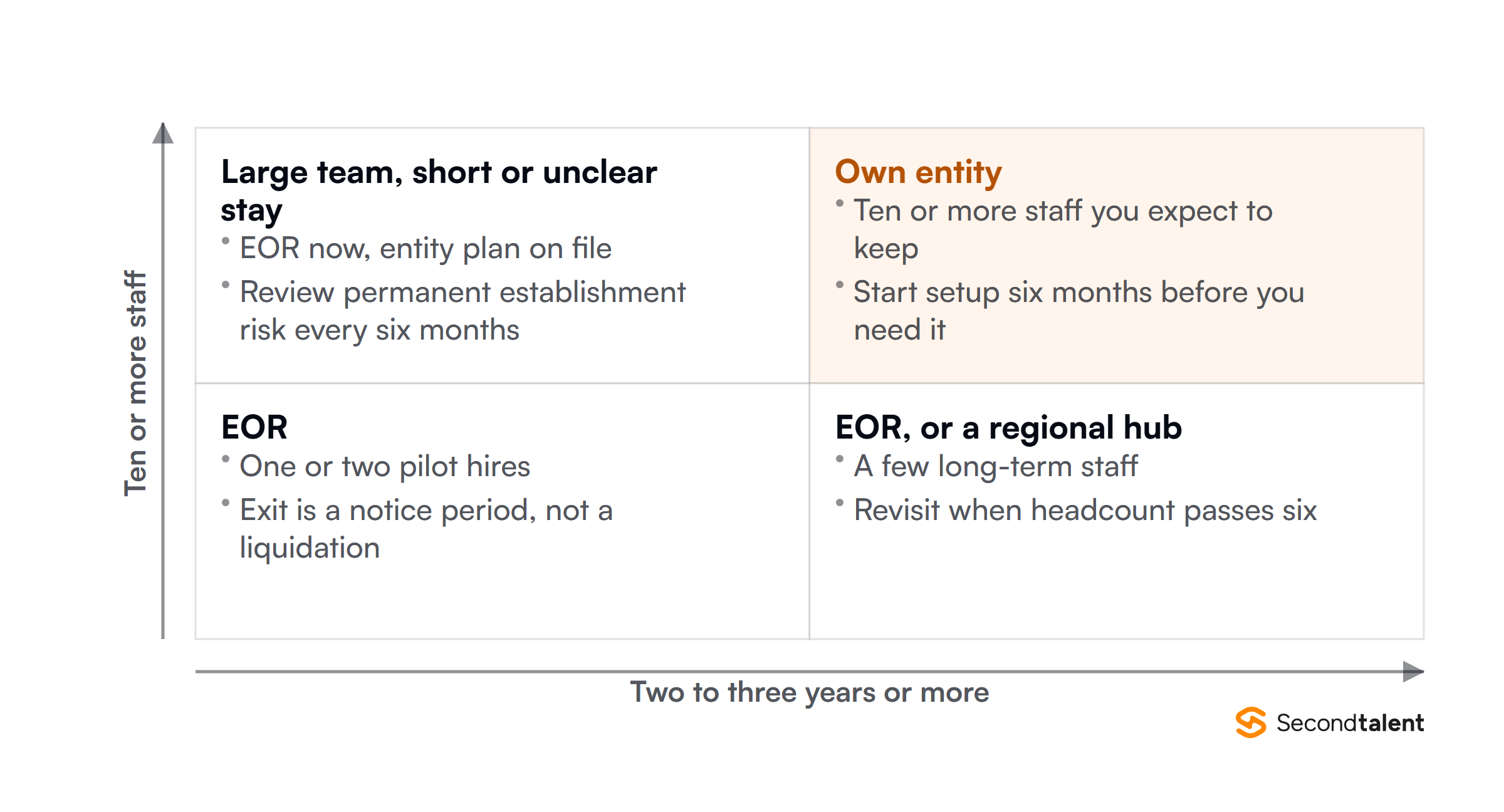
The top-left box is the awkward one. A big team in a market you may leave is where companies stay on an EOR too long. Keep the entity plan written down, so it is ready the day the answer to question 1 changes.
What changes when you move off an EOR
An EOR is the legal employer of your staff in their country. It issues a compliant local contract, runs payroll, withholds tax, pays statutory benefits and handles terminations under local law.
You direct the day-to-day work; the EOR runs the employment machinery behind it.
Your own entity is a company you own in that country. You hold the contracts, run payroll, choose benefits and carry the legal risk. It also tells candidates, clients and regulators that you are there to stay.
- Onboard in days, not months
- A monthly fee per head that grows with the team
- The employment contract sits with a third party
- Leave with a notice period
- Setup cost plus fixed upkeep, whatever the headcount
- Cheaper per head once the team is large
- You hold contracts, payroll and benefit design
- Leaving means closing a company
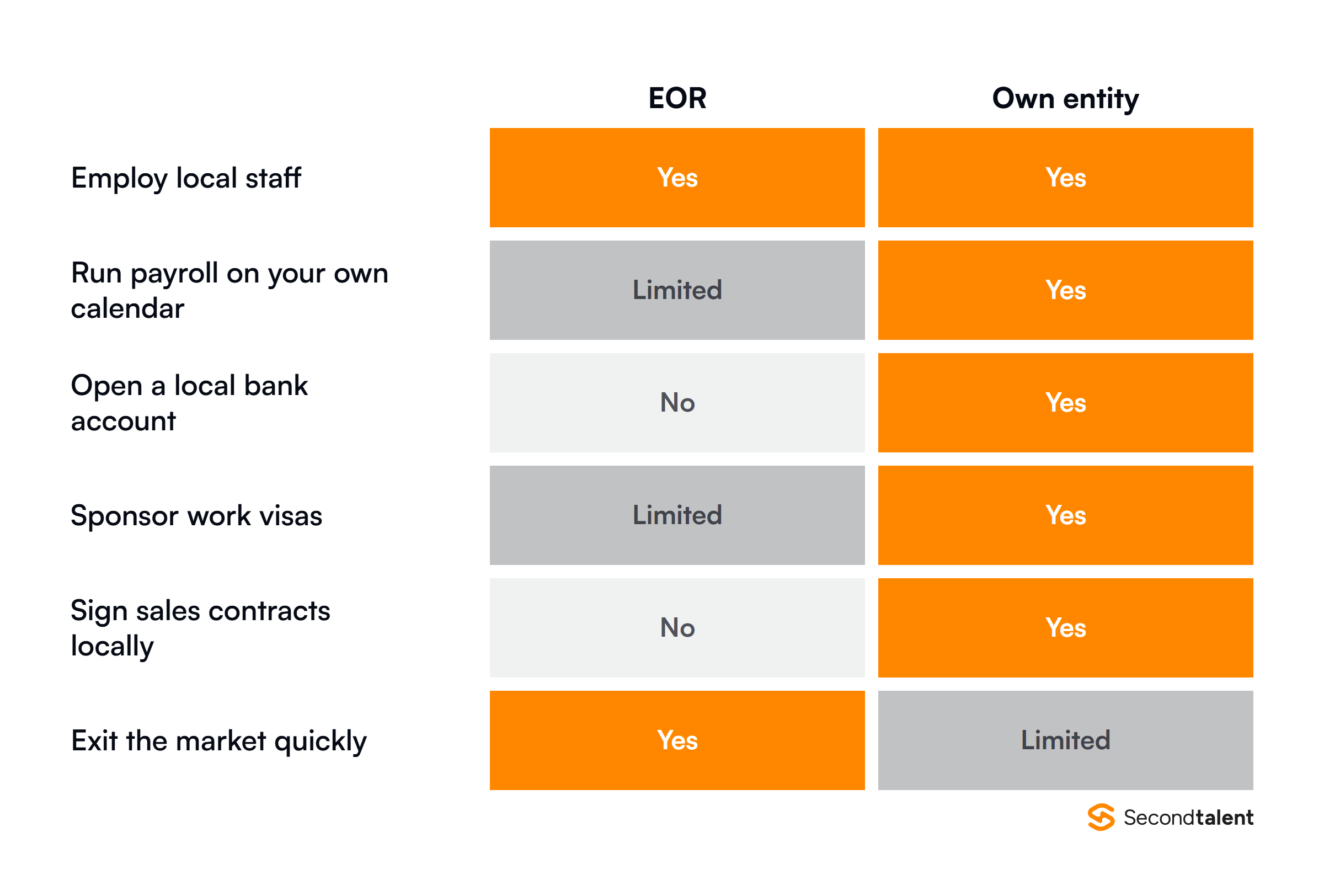
The bigger difference is what the company itself can do. Vistra notes that an EOR typically cannot import or resell goods, open a bank account in your name, or in most cases sponsor visas.
If your plan for the country needs any of those, treat the EOR as a bridge.
For the wider set of options, including PEOs and contractor platforms, see our guide to EOR vs PEO vs contractor management.
The headcount where your own entity pays back
An entity has a fixed cost and an EOR has a per-head cost, so headcount in one country decides it.
Our EOR vs entity cost calculator uses $15,000 to $40,000 to set up a company in our Asian markets and $1,500 to $4,500 a month to keep it running.
Take the midpoints and a $599 monthly EOR fee, the most common list price, and the lines cross at about six staff.
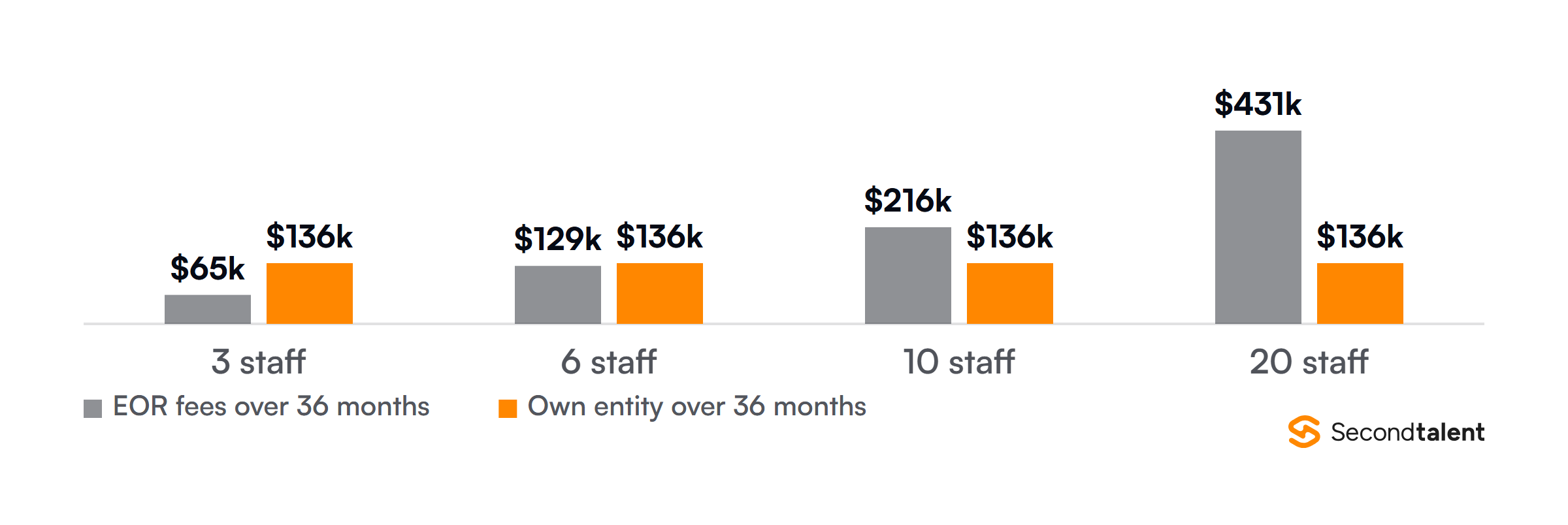
At 20 staff, three years of EOR fees cost about three times what the entity does. At three staff, the entity costs twice as much as the fees.
The model leaves out two things that push the break-even higher: the time your own finance and HR people spend on the entity, and any minimum capital you must lock up.
A cheaper EOR moves the line too. Fees run from $199 to $699 a month in published list prices, so the same team can land on either side. Our employer of record cost guide breaks down the fees by provider and country.
Permanent establishment: the deadline nobody sets for you
Cost is the reason most companies give for switching. Tax is often the reason they should have switched sooner.
A permanent establishment (PE) means a foreign tax office treats your company as doing business in its country, and an EOR does not remove that risk.
"An EOR does not wholly do away with your permanent establishment risk. It's a very real risk."
Tom Lickess, Vistra, 2024
The trigger is what staff do, not who employs them. In Vistra's view, handing out business cards, scoping the market and low-level lead generation may be acceptable. Contracting for sales in the host country is not.
One or two people for six to twelve months is generally fine. Six people for two to three years is hard to defend.
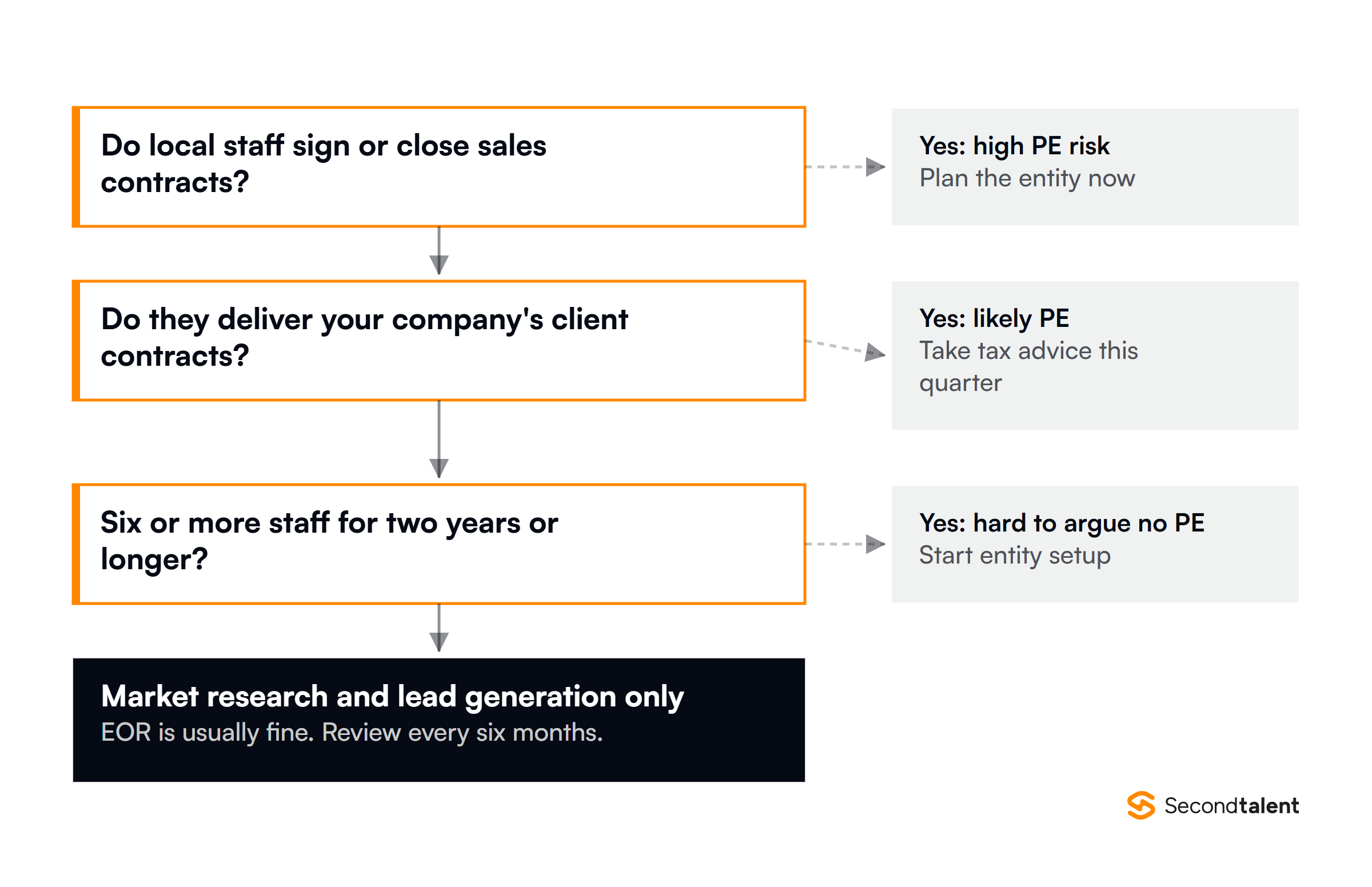
Getting it wrong can mean tax in two countries on the same profit, plus penalties and interest. Vistra reviews PE risk with its clients every six months.
That is a sensible rhythm for any team on an EOR, and the review belongs with your tax adviser as well as HR.
Some countries go further and cap EOR use outright. Germany limits a placement with the same client to 18 consecutive months under its temporary agency work law.
Check whether any of your markets has a rule like it before you plan a long EOR stay.
What an entity takes in four Asian markets
Capital rules, resident officers and bank accounts slow a new company down more than the filing does. The cards show the first hurdle in four markets where we run EOR employment.
Singapore is the fastest. ACRA approves most registrations soon after payment, though complex cases can take 15 working days.
The catch is people: ACRA requires a director who is ordinarily resident in Singapore and a secretary within six months.
Vietnam asks a foreign investor for two licences in sequence. Ascentium puts the investment certificate at about 10 working days from a valid file, with the enterprise certificate 3 to 5 days later.
Preparing that file, and opening the capital account, is where the weeks go.
The Philippines sets the highest bar of the four. Under the 2022 amendments to the Foreign Investments Act, small domestic-market firms under US$200,000 of paid-in capital stay reserved for Filipinos.
For a five-person support team, that capital alone can outweigh years of EOR fees.
Indonesia got cheaper in 2025. BKPM Regulation 5 of 2025 cut paid-up capital to IDR 2.5 billion per business line, effective 2 October 2025.
The investment plan must still exceed IDR 10 billion, so the commitment is smaller in cash but not in scale. Our Asia EOR guide covers the statutory costs in all nine of our markets.
The regional hub option
Some companies don't incorporate everywhere. They set up one entity in a business-friendly jurisdiction that anchors a whole region.
It holds contracts, IP and regional management, while staff in other countries stay on an EOR or move to local companies later.
In the EU, Cyprus is a common example. The standard route is to form a Cyprus company with a registered office and secretary, which gives the business a legal home inside the EU while the team itself can stay distributed.
Budget for the new rates: Cyprus raised its corporate tax rate from 12.5% to 15% on 1 January 2026.
In Asia, Singapore and Hong Kong play the same role. One limit catches teams out: a hub company cannot directly employ staff who live in another country. A Singapore entity does not make your engineers in Ho Chi Minh City its employees.
They still need an EOR in Vietnam or a Vietnamese company of your own.
How to move employees from the EOR to your entity
Run the legal and payroll work side by side, not one after the other. Safeguard Global's transition guide treats the move as a data project and a retention event at once.
Vistra warns that forming the entity alone can take six months or more in some countries, so start well before the EOR becomes a problem.
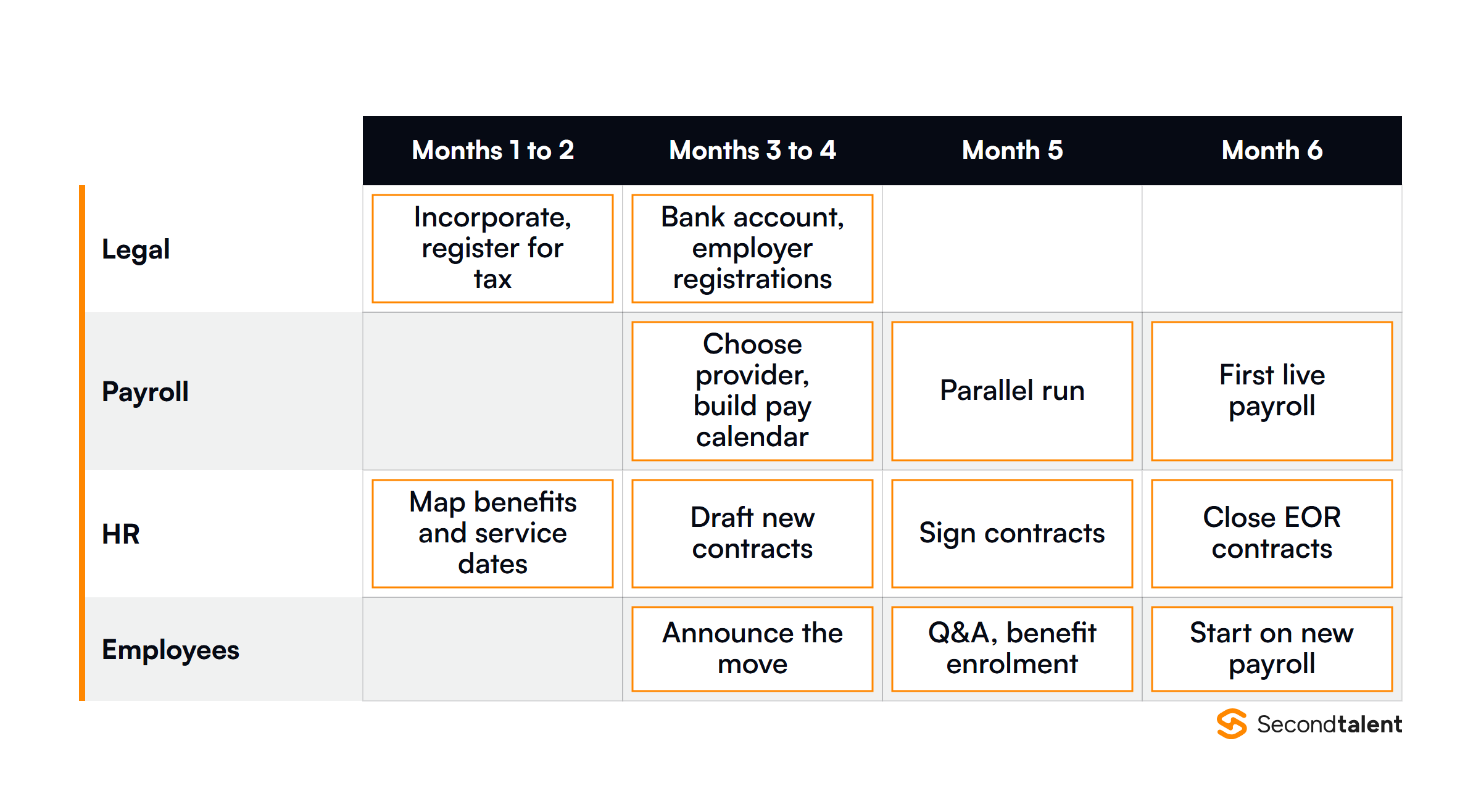
Pick a change date that suits payroll
Quarter-end or the benefits renewal date is usually cleanest. Moving mid-month splits a pay period across two employers, and both will need to file for it.
Write new contracts that keep service dates
Legally, most moves are a resignation from the EOR and a new hire by your company. Carry over each person's original start date in the new contract, so leave, notice and severance build on the full service.
Staff notice quickly if a move resets their tenure.
Match or beat the benefits
The EOR's health plan ends with its contract. Line up the new insurer so cover has no gap, and write down every change to contributions, waiting periods or providers. A worse plan reads as a pay cut, whatever the salary line says.
Run one parallel payroll before going live
Run the new payroll alongside the EOR's for one cycle and compare net pay line by line. Tax tables, social security caps and allowances are where differences hide. Fix them before the first live run, not after a payslip goes out wrong.
Tell people early, once
Announce the move with what changes, what stays the same, what each person must do and who to ask. Safeguard Global's shorthand is "one announcement, one checklist, one escalation path."
Keep the employee experience the same on both routes
Expect to run a mix for a while: an entity where the team is large, an EOR where it is small. HR owns one thing neither route can outsource, which is consistency.
A hire in Manila, a hire in Berlin and a hire at headquarters should all feel like they joined the same company.
- Set role expectations and reporting lines before the contract is signed, so the legal employer never blurs who manages whom.
- Use one onboarding checklist across markets, with local compliance steps added as a layer, not a separate process.
- Review total pay in local terms, not converted salaries. Statutory benefits and leave differ widely between countries.
- Keep one HR calendar for filings, renewals and contract reviews across every market.
Then revisit the mix every six months. Map where the next ten people are likely to sit and group them by country. Markets with one or two people lean EOR, and a growing cluster justifies an entity.
The HR industry statistics we track show pay budgets moving every year, so the break-even moves with them.
Employ in Asia while the entity is being built
We run EOR employment in nine Asian markets through our own local companies, from $129 per employee per month. Teams use it to hire now and move staff onto their own entity once the numbers work, with no lock-in when they do.
See how our employer of record service works in Singapore, the Philippines and Indonesia, or tell us the roles you need to fill.
FAQ
Can you run an EOR and your own entity in the same country?
Yes. Many companies keep a few staff on an EOR while the entity's payroll beds in, then move them in batches. It costs both fees for a few months but lowers the risk of a failed first payroll.
Do employees have to resign to move from an EOR to my entity?
Usually, yes. The EOR contract ends and your entity signs a new one, because the legal employer changes. Agree the dates with the EOR and recognise prior service in the new contract. Check local rules on notice and severance with counsel.
How long does the switch take?
Plan on about six months from the decision to the first live payroll. Registration can take days in Singapore, but bank accounts, employer registrations and benefit contracts take longer.