TL;DR: For government-grade and regulated work, NCS and Temus are the two Singapore-owned integrators. For enterprise transformation, Accenture, Thoughtworks, Zühlke and PALO IT sell local partners with a global bench. ADVANCE.AI, 6Estates, Rezonate and Aicadium sell a working model first and the services around it second.
A senior AI engineer on a local Singapore contract costs $110 to $160 an hour. The same seniority costs $55 to $80 in Vietnam and $45 to $70 in the Philippines. That gap is why most firms here sell a Singapore contract and build somewhere else. The delivery location matters more than the logo on the contract.
- 1Temus, a Temasek joint venture, now owns Thinking Machines, the Manila firm that is OpenAI’s first services partner in Asia Pacific.
- 2Taiger, still listed on rival round-ups, liquidated its Singapore entity and its website no longer loads.
- 3KeyReply has renamed itself Rezonate, so contracts and case studies under the old name need checking.
- 4Only two of the ten are Singapore-owned integrators. The rest are global consultancies or product companies with a local office.
The 10 AI Outsourcing Companies in Singapore, Compared
| Company | What it is | Owner or origin | Strongest for |
|---|---|---|---|
| NCS | National technology integrator | Singtel | Government, defence, transport, healthcare |
| Temus | Digital transformation joint venture | Temasek and UST | Public sector and Smart Nation programmes |
| Accenture Singapore | Global consultancy, local practice | Accenture | Enterprise-wide AI with one supplier |
| Thoughtworks Singapore | Engineering consultancy | Thoughtworks | Reliable AI delivery and platform work |
| Zühlke | Engineering partner | Swiss | Regulated products, medtech, finance |
| PALO IT | AI-first consultancy | French | Agentic delivery, GitHub-centred teams |
| ADVANCE.AI | Identity and risk AI | Singapore | eKYC, anti-fraud, lending workflows |
| 6Estates | Document AI | Singapore | Unstructured documents in finance |
| Rezonate | Conversational AI, formerly KeyReply | Singapore | Healthcare and regulated customer service |
| Aicadium | Corporate AI centre of excellence | Temasek | Computer vision and physical AI |
The 10 AI Outsourcing Companies, One by One
1. NCS: the one with security clearance
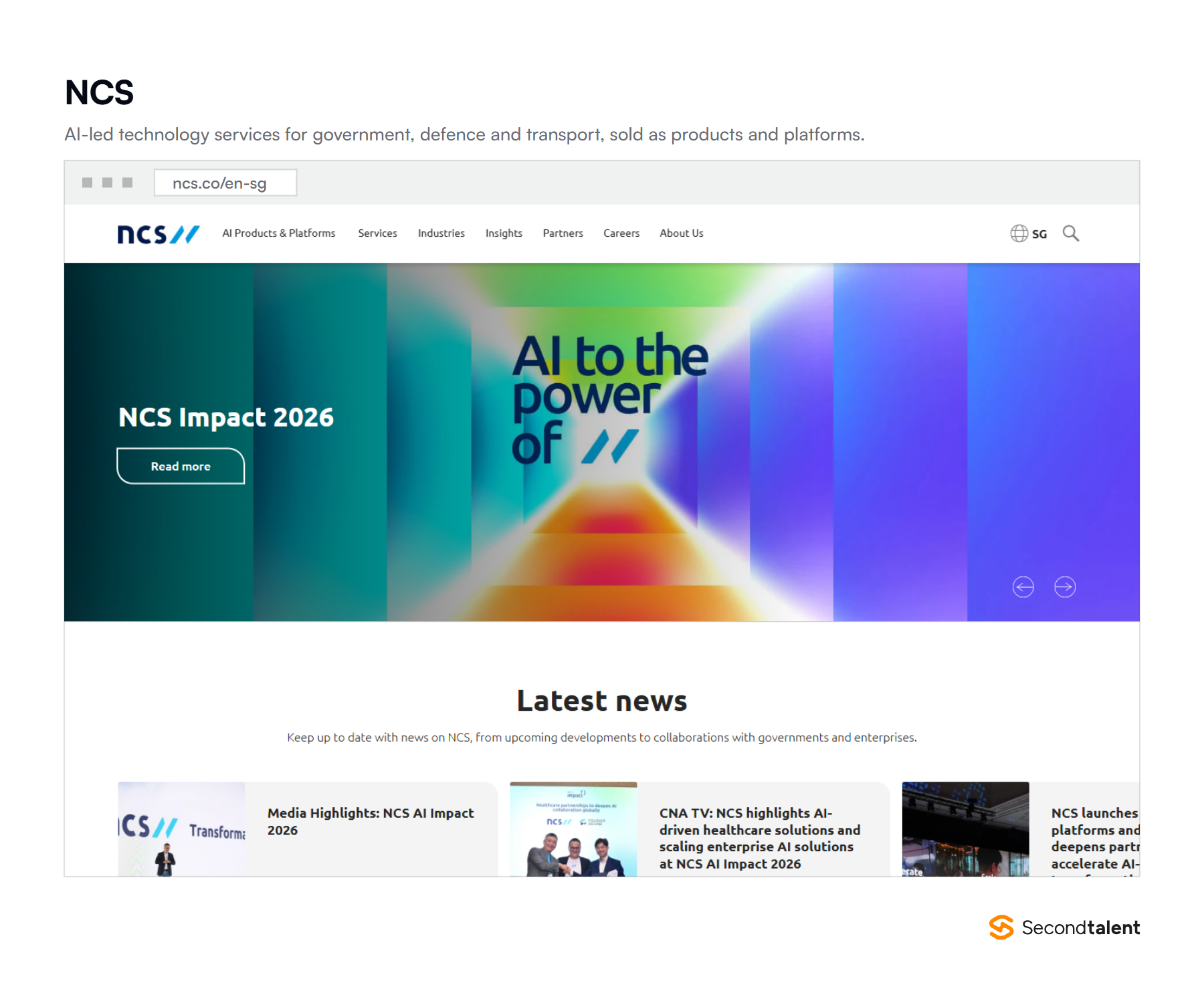
NCS is where Singapore’s public sector buys AI. Its service lines read like a government tender: command and control, video intelligence, physical AI, AI data engineering, and AI-native apps built and run.
The industries it serves make the point again. Central government, public service, defence, homeland security, transport and healthcare all come before the commercial sector in its own menu. If your work touches classified systems or national infrastructure, the shortlist is short and NCS is on it.
It has spent 2026 pushing that position in public. It launched enterprise AI platforms and products and ran its own AI Impact conference. It also deepened a partnership with HTX, the home team science agency, on AI for public safety.
- Best for: government, defence and critical systems work a foreign vendor cannot take.
- Watch out: public sector pace and process, on commercial work too.
- Where it builds: Singapore, with regional delivery across its Asia Pacific centres.
2. Temus: Temasek’s own transformation arm
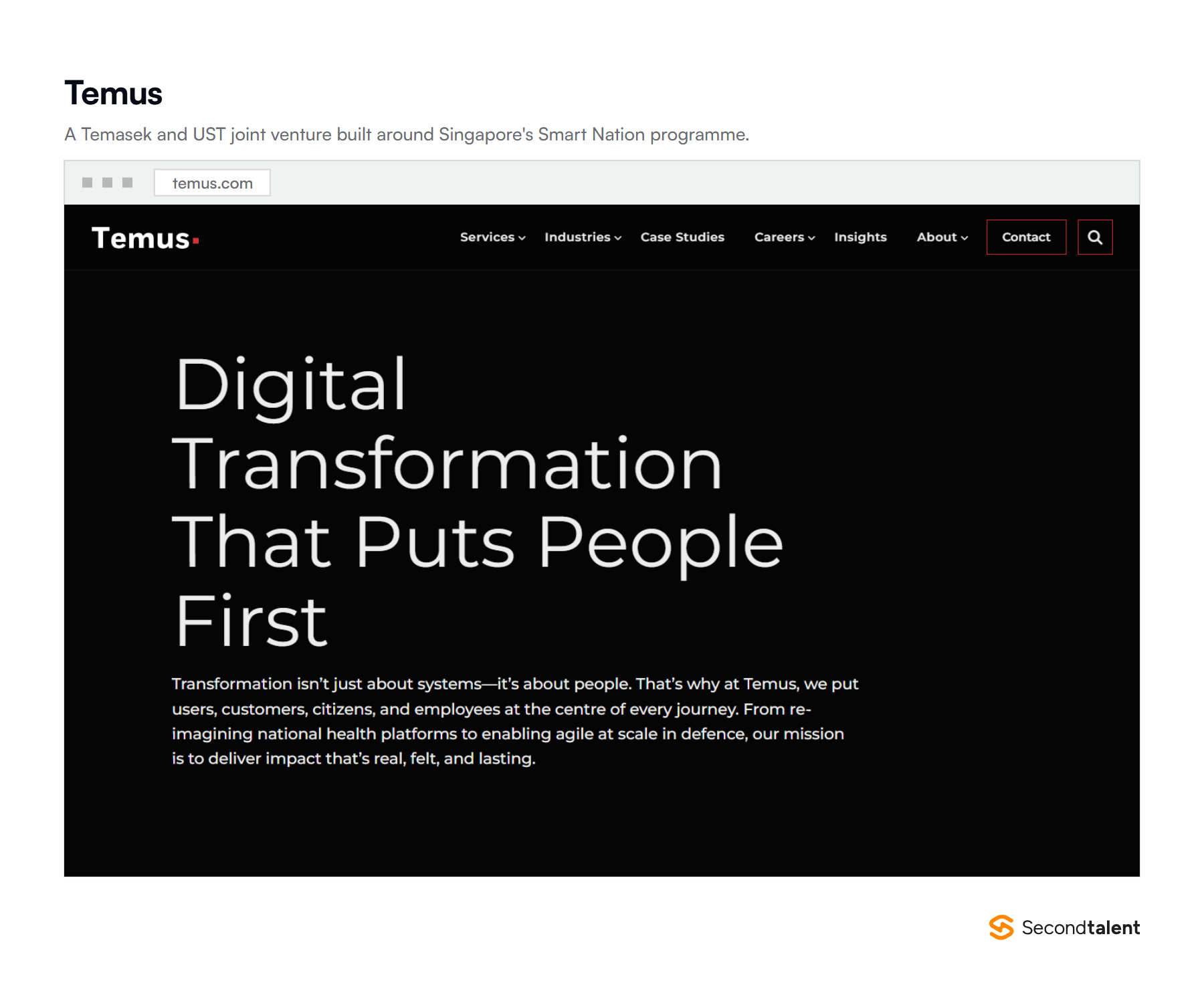
Temus exists to do digital transformation for Singapore, and it says as much: the red square in its logo is a nod to the little red dot. Government agencies and public institutions are the first audience its site names, and Smart Nation is the frame.
Its AI Foundry, opened in Singapore in 2026, is the working half of that pitch, aimed first at banks and health firms. The unit exists to move AI from pilots into production. Temus said it would hire more than 50 AI architects, data scientists and engineers in Singapore to staff it.
The wider group now reaches beyond Singapore. Temus took a strategic investment in Thinking Machines, the Manila consultancy that was OpenAI’s first services partner in Asia Pacific. That gives it a regional delivery arm and the closest frontier-model relationship of anyone here.
- Best for: public bodies and regulated firms that want Singapore ownership and regional delivery.
- Watch out: a young firm by consultancy standards, so ask about the team that ran comparable work.
- Where it builds: Singapore, plus Thinking Machines in the Philippines.
3. Accenture Singapore: the default enterprise answer
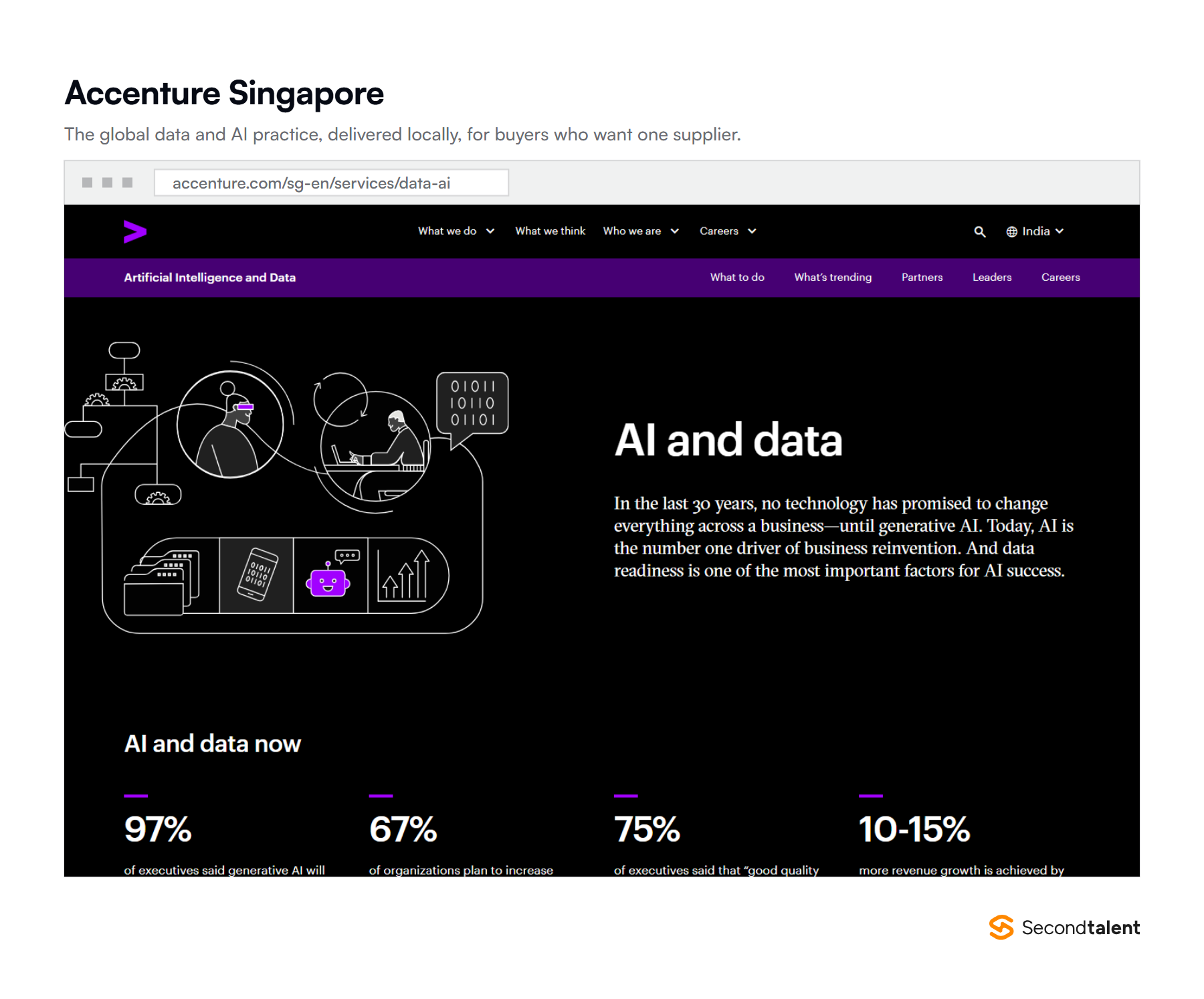
Accenture is here because it wins these deals, not because it is Singaporean. Its Singapore data and AI practice sells the full stack: strategy, data foundations, model build, change management and the operating model afterwards.
Choice is the real product. A pilot that grows into a group-wide platform does not need a new supplier. The same firm can also staff the work in Manila, Bengaluru or Warsaw when Singapore salaries make local delivery unworkable.
The cost is the rate card, plus the distance between the people who pitch and the people who build. Both are workable, but only if the contract names people and caps how much the team can change.
- Best for: group-wide programmes where procurement wants one supplier to answer for it.
- Watch out: the highest rates here, and the team that sold the work may not deliver it.
- Where it builds: its global delivery network, with Singapore for leadership and governance.
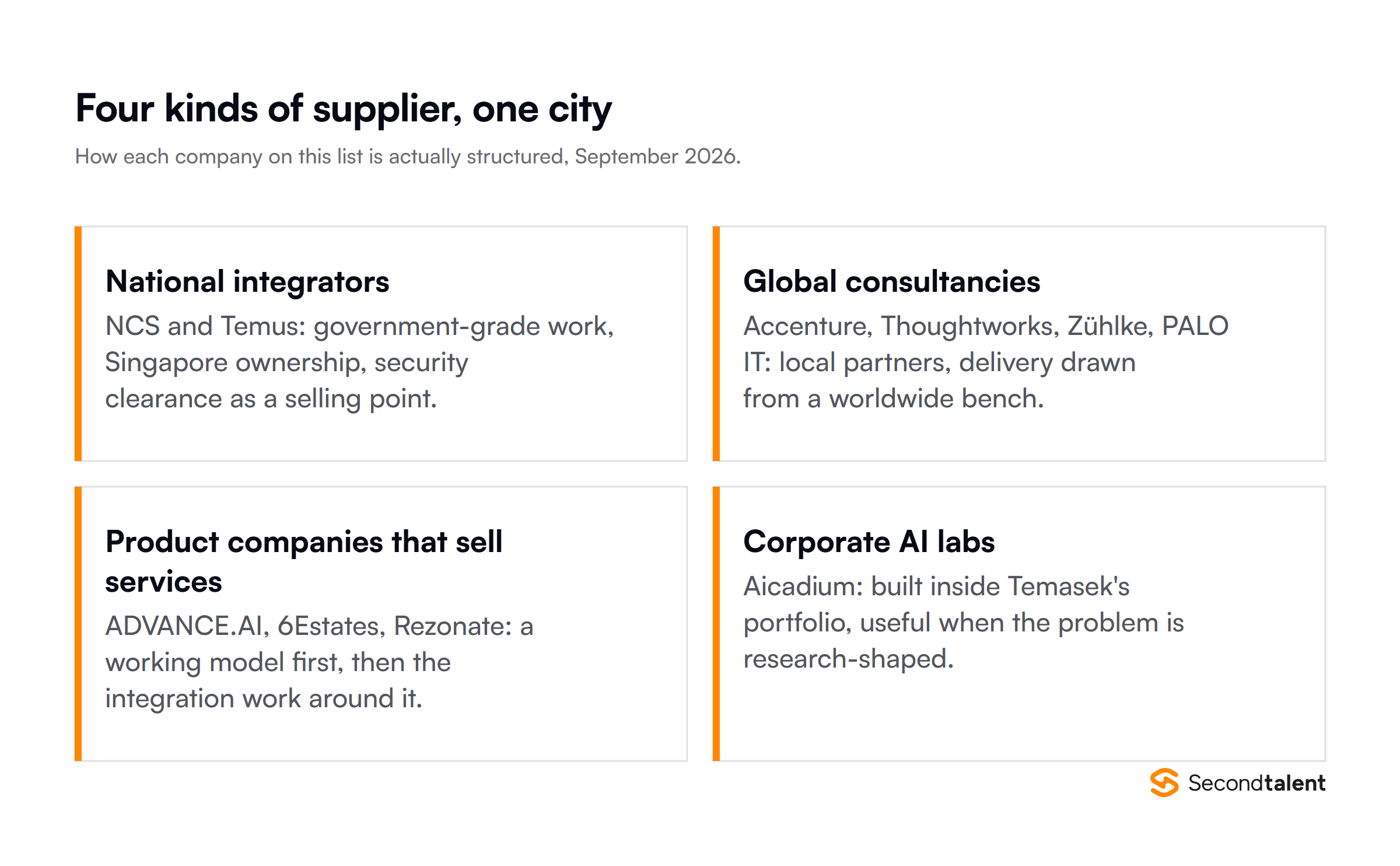
Those first three already sit in different businesses, and the pattern holds down the list. A national integrator, a global consultancy and a product company will each answer the same brief. Only one of them tends to match how you want to buy.
4. Thoughtworks Singapore: engineering discipline for AI that has to work
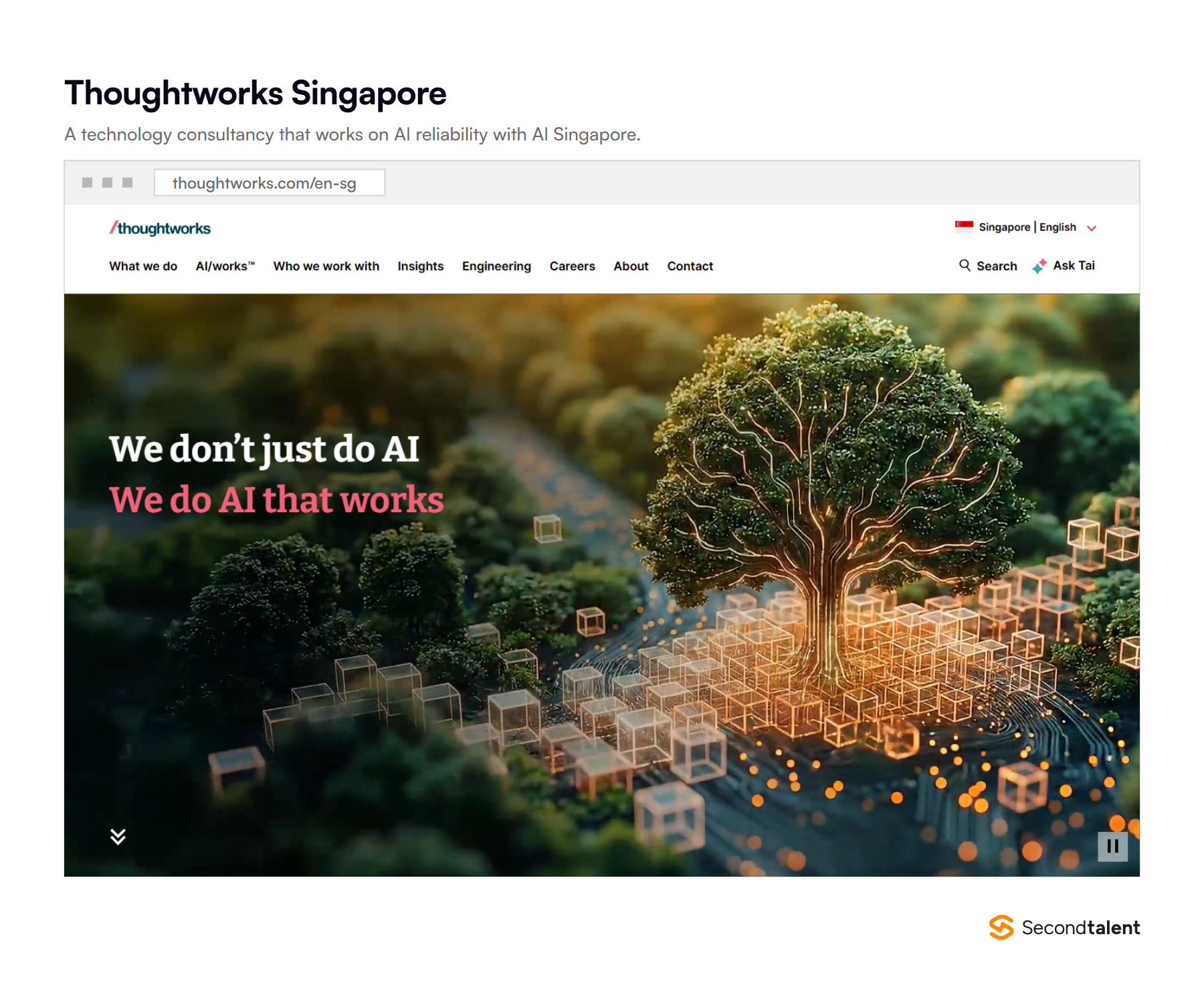
Thoughtworks announced a collaboration with AI Singapore to develop methods and tools for making generative AI reliable. That is a useful signal about where its interest sits. Reliability is the unglamorous half of AI delivery and the half that decides whether a system survives its first quarter in production.
Its reputation comes from engineering practice rather than models: continuous delivery, test discipline, architecture that can change. Applied to AI, that means evals and guardrails built with the feature instead of after the incident.
Singapore is one office in a global network, so the local team shapes the work rather than supplying all the hands. That helps when the job needs rare skills, and hurts when you want the team in one time zone.
- Best for: teams that want AI shipped with real engineering rigour, and want to learn how.
- Watch out: consultancy rates, and a method-first style that suits builders more than buyers.
- Where it builds: distributed across its global offices.
5. Zühlke: for AI that has to pass an audit
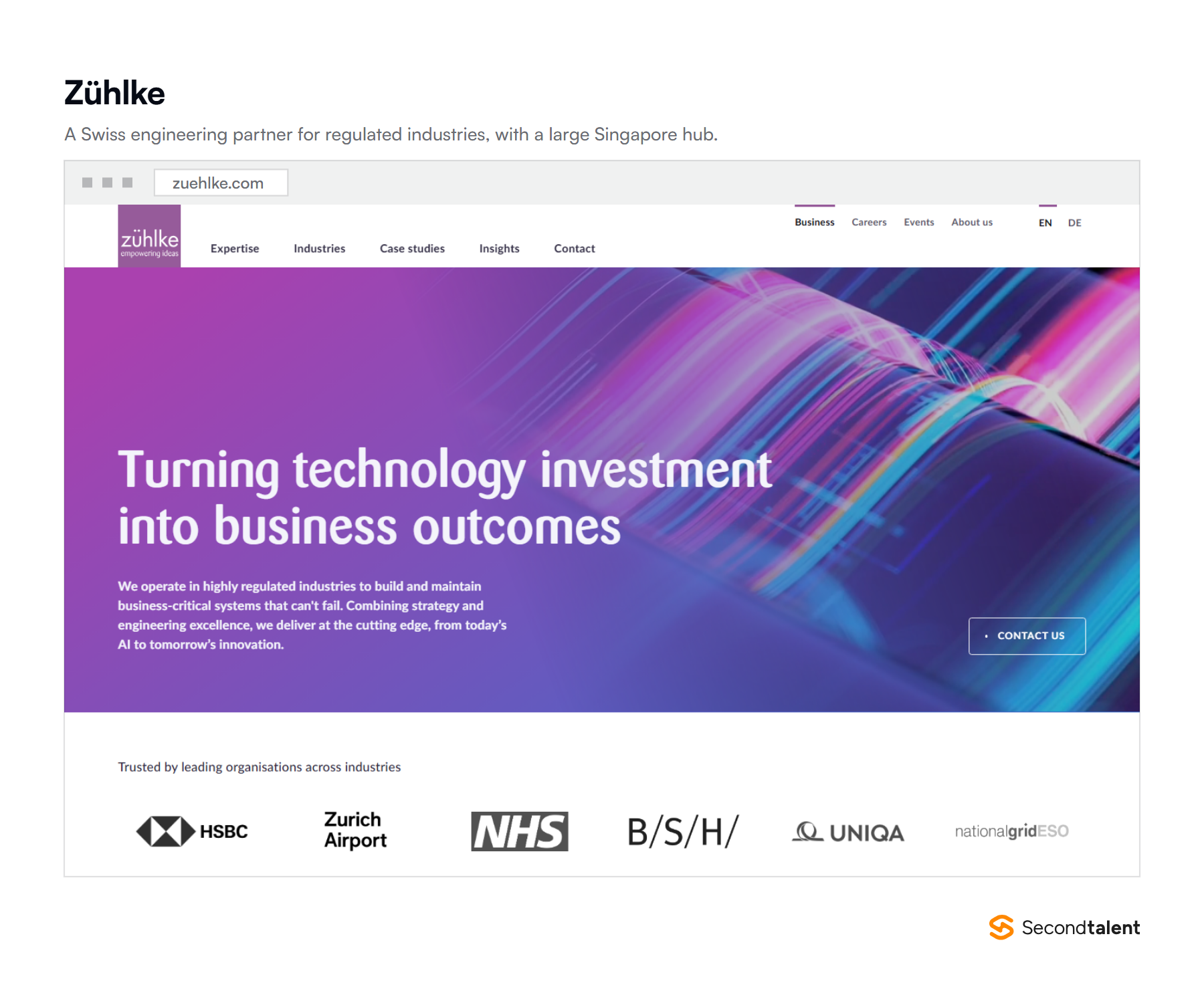
Zühlke calls itself an engineering partner for regulated industries, and that phrase is the whole reason to call it. Medical devices, finance and industrial products carry paperwork and testing rules that most AI shops meet for the first time on your project.
Its Singapore office anchors the Asian business, so you get European quality process through a local team. For a medtech firm putting a model inside a product, that mix is rarer than it sounds.
It is not the firm to call for a quick prototype. The method that earns its place in a regulated build is overhead anywhere else, and the price is European, not regional.
- Best for: AI inside regulated products, where test evidence is part of what you buy.
- Watch out: the most process-heavy option here, and priced to match.
- Where it builds: Singapore and its European engineering centres.
6. PALO IT: agentic delivery with the receipts
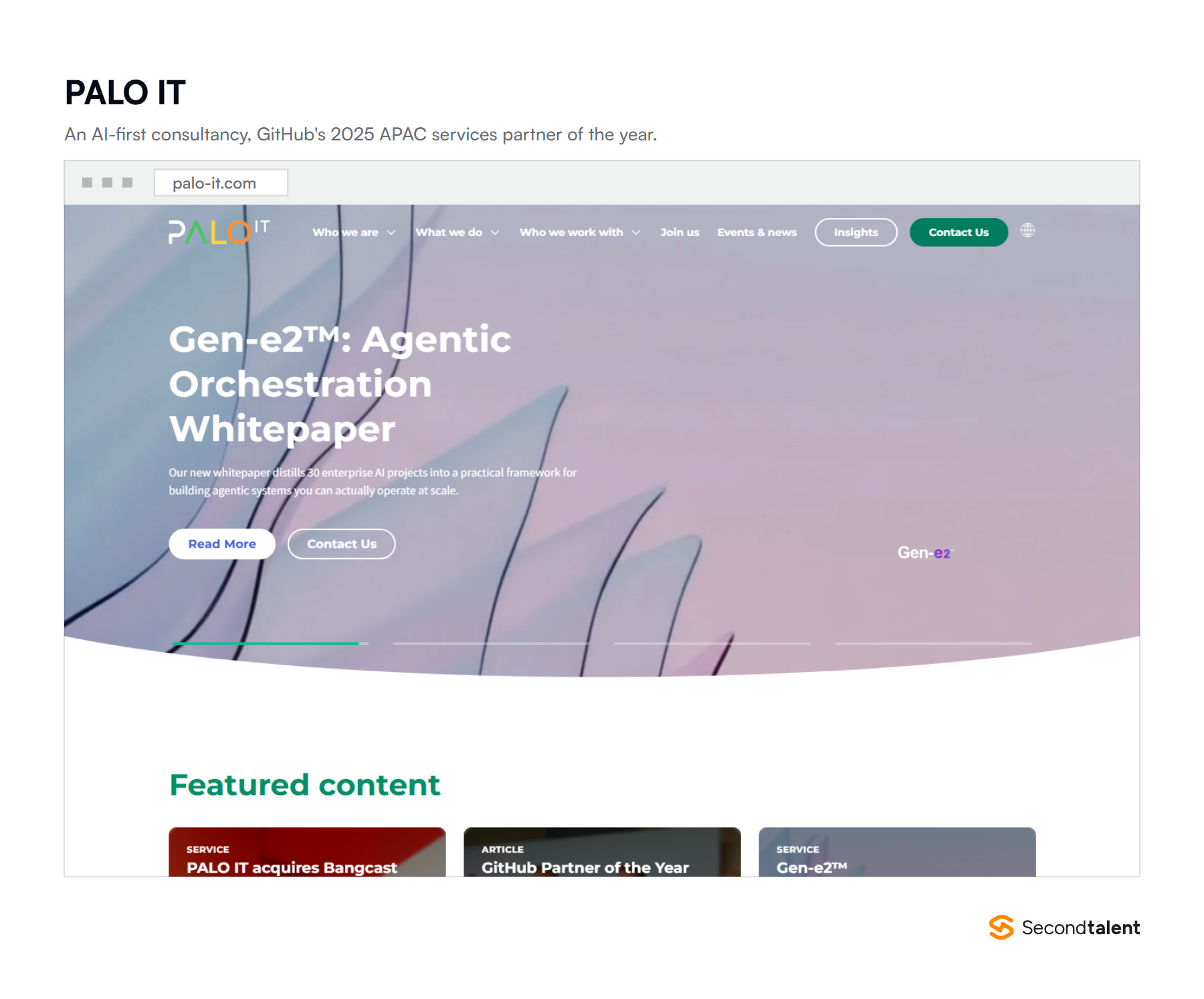
PALO IT calls itself an AI-first technology consultancy and backs it with partner credentials that somebody else awarded: GitHub’s 2025 APAC services and channel partner of the year, and a Microsoft Training Services Partner designation for its academy.
Its published framework distils 30 enterprise AI projects into a method for building agent systems a team can run. The company trademarked the approach as Gen-e2, for generative AI enhanced engineering. Branding aside, a firm that has run 30 of these has met the failure modes already.
Size is the trade. This is a mid-sized consultancy rather than a systems integrator, so it suits a programme where one strong team matters more than a hundred people on a plan.
- Best for: agent builds on the Microsoft and GitHub stack, with training for your own team.
- Watch out: smaller bench than the integrators, so scaling fast needs planning.
- Where it builds: Singapore and its other Asian and European offices.
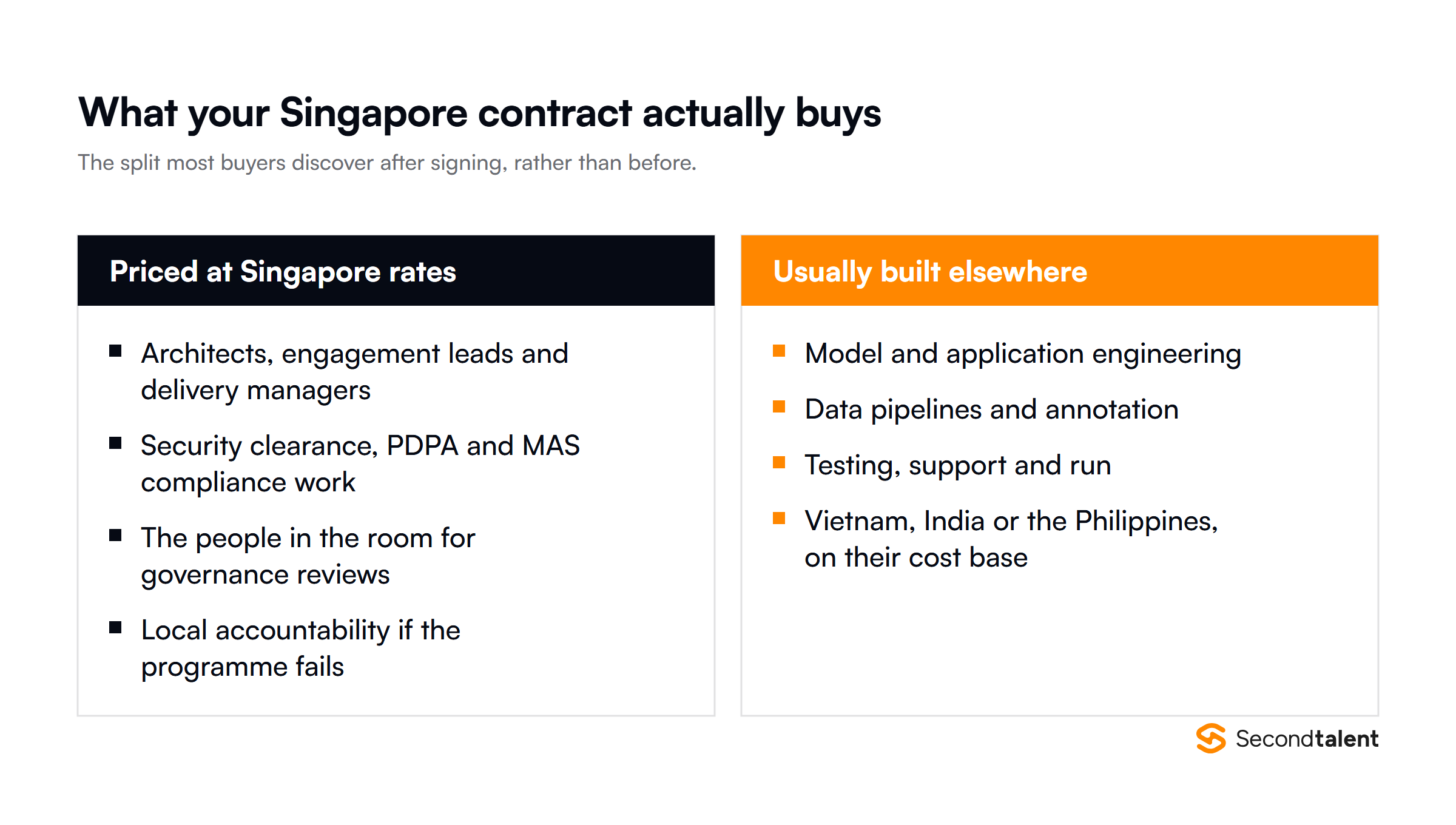
Settle this split before you talk rates. Ask which roles sit in Singapore, which sit offshore, and what the blended rate assumes. A quote built on a 70% offshore mix changes shape the moment the model work comes back.
7. ADVANCE.AI: identity and risk, built in Singapore
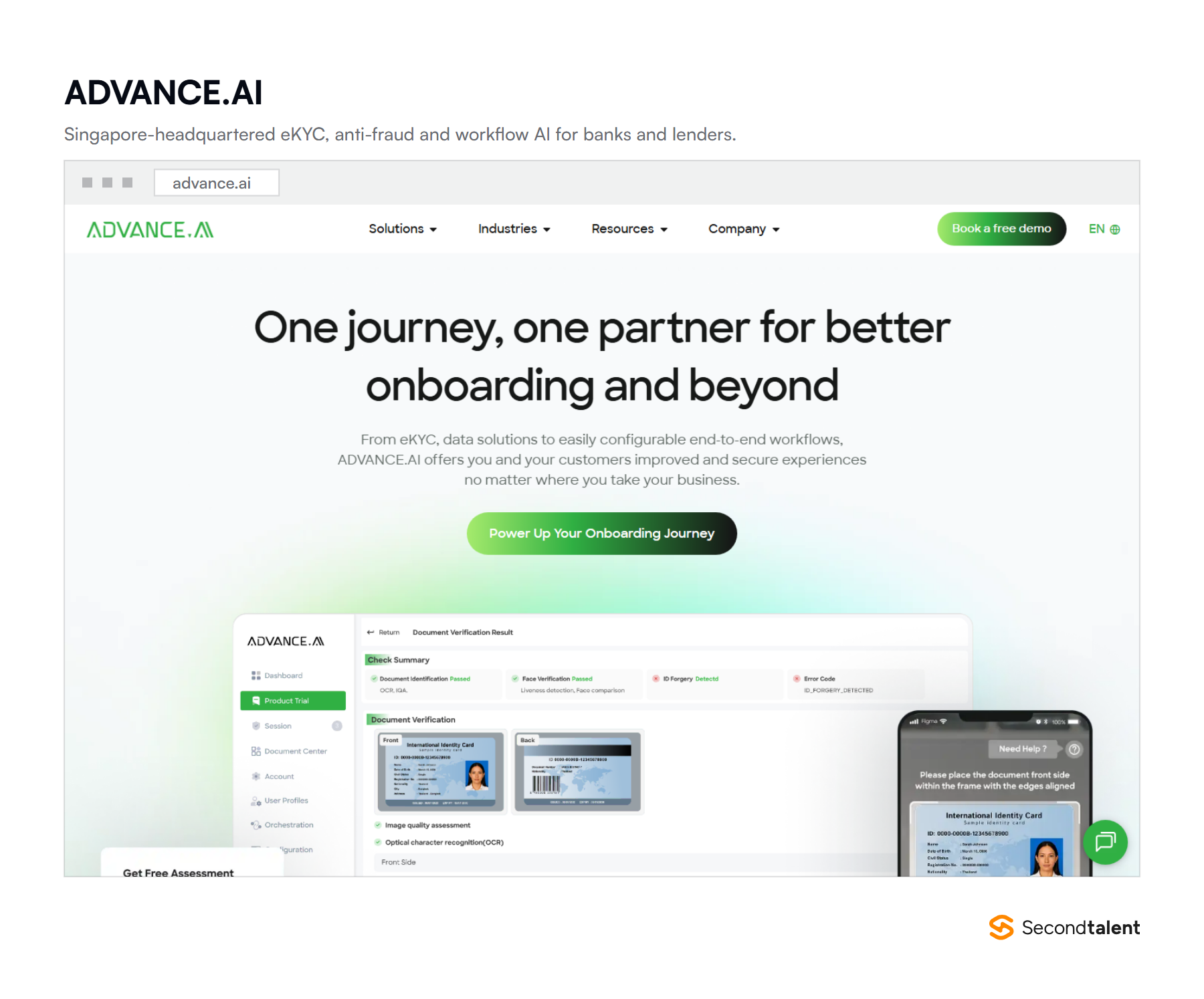
ADVANCE.AI sells a finished capability rather than a team. The list is short: electronic know-your-customer checks, anti-fraud scoring, data services and workflows you can configure, aimed at banks and lenders across Southeast Asia.
That model changes the buying conversation. You are not scoping a build. You test an existing model against your own fraud patterns, then pay for the integration and tuning around it. For a regional lender that beats commissioning the same thing from a consultancy.
The limit is scope. Outside identity, risk and onboarding this is not a general AI supplier, and a company shopping for one platform to cover everything will find the boundary fast.
- Best for: onboarding, identity checks and fraud decisions in Southeast Asian markets.
- Watch out: a product company first, so custom work sits outside the core offer.
- Where it builds: Singapore headquarters with regional engineering and operations.
8. 6Estates: document AI with partners doing the distribution
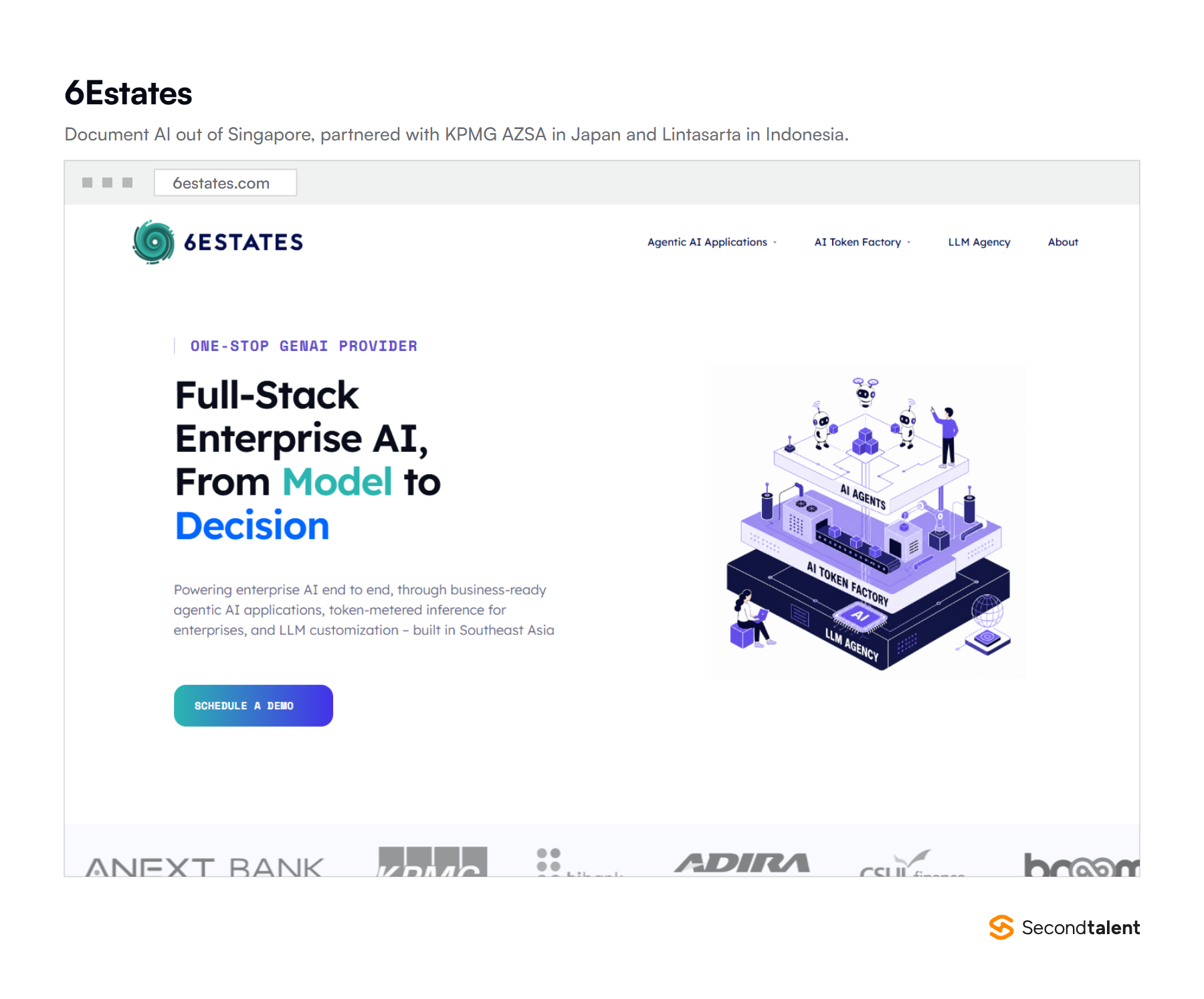
6Estates turns messy documents into decisions. In practice that means the statements, invoices and reports a bank has to read before it can act. Its software is LLM-backed and sold through partners as much as direct.
The partnerships are the credential worth weighing. KPMG AZSA pairs its Japanese client knowledge with 6Estates technology for transformation work. Lintasarta, the AI factory of Indonesia’s Indosat group, runs 6Estates models on its own GPU infrastructure.
For a buyer, that means the firm is happy to sit under someone else’s contract. If you want one supplier who owns the outcome end to end, this is the wrong shape.
- Best for: document-heavy processes in banking, insurance and accounting.
- Watch out: often sold through a partner, so check who carries the duties.
- Where it builds: Singapore, with partner delivery in Japan and Indonesia.
9. Rezonate: the one that changed its name
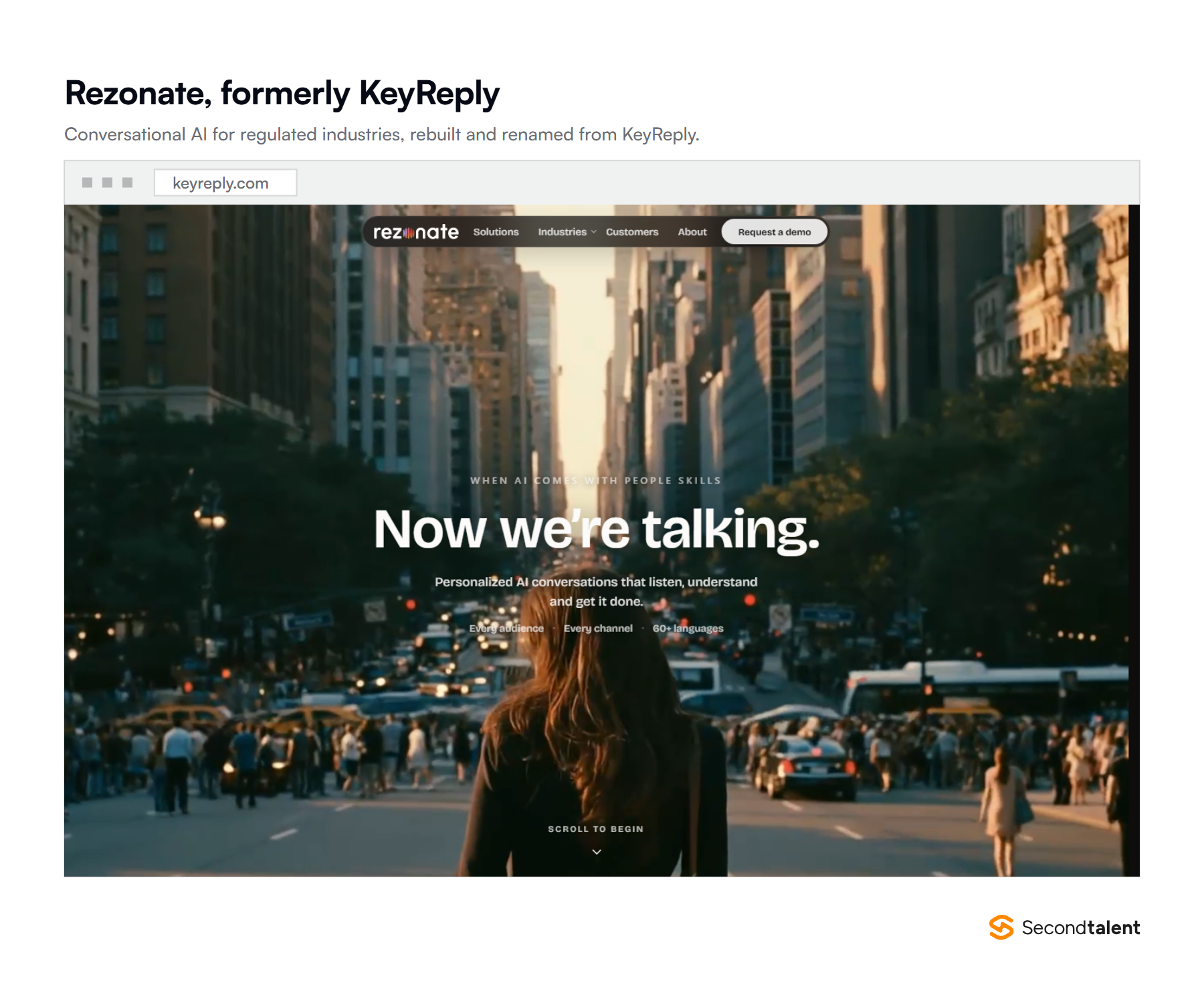
KeyReply now trades as Rezonate, and its own site carries the “formerly KeyReply” line. Round-ups still list both names, sometimes as two companies, which is the sort of error that wastes a week of procurement.
The work is conversational AI for regulated industries, and healthcare is the deepest vertical. One client on its site describes needing a platform rather than a chatbot: something that could add services over time without breaking the governance rules healthcare demands.
That is the right way to judge this category. A demo is easy. The difference between suppliers shows up in year two, when clinical and compliance teams ask for changes the original build did not anticipate.
- Best for: patient and customer chat in healthcare, insurance and public services.
- Watch out: the rename, and the paperwork attached to it.
- Where it builds: Singapore, serving regional deployments.
10. Aicadium: Temasek’s in-house AI lab, open for work
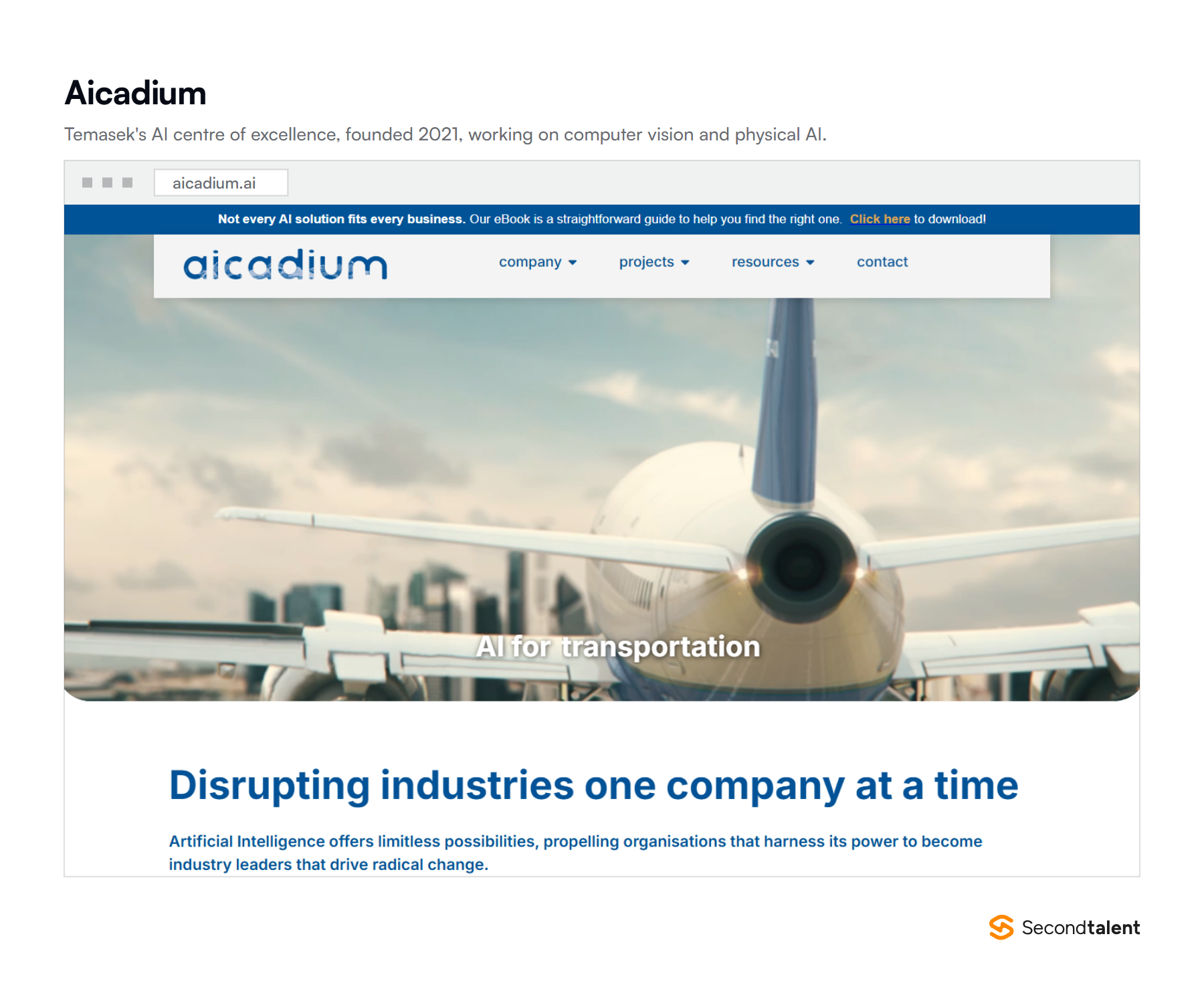
Temasek founded Aicadium in 2021 as the AI centre of excellence inside its portfolio, with teams in Singapore and San Diego. It is the closest thing on this list to a research group you can hire.
Its published services reflect that: AI readiness assessment, AI engine inspection, physical AI and trusted AI research. Engine inspection is a maritime and industrial computer vision problem rather than an enterprise software one, and few consultancies will take it.
Sitting inside an investor group cuts both ways. The portfolio gives it real industrial problems to learn on. It also means your project competes for attention with companies the owner part-owns.
- Best for: computer vision on physical assets, and research problems with no off-the-shelf answer.
- Watch out: a lab rather than a delivery team, so plan who takes the result to production.
- Where it builds: Singapore and San Diego.
What It Costs, and Who Has Already Gone
Singapore prices AI engineering at a level no regional market matches. Our Singapore AI engineer rate card puts mid-level work at $75 to $110 an hour and senior work at $110 to $160. In Vietnam the same bands are $35 to $55 and $55 to $80.
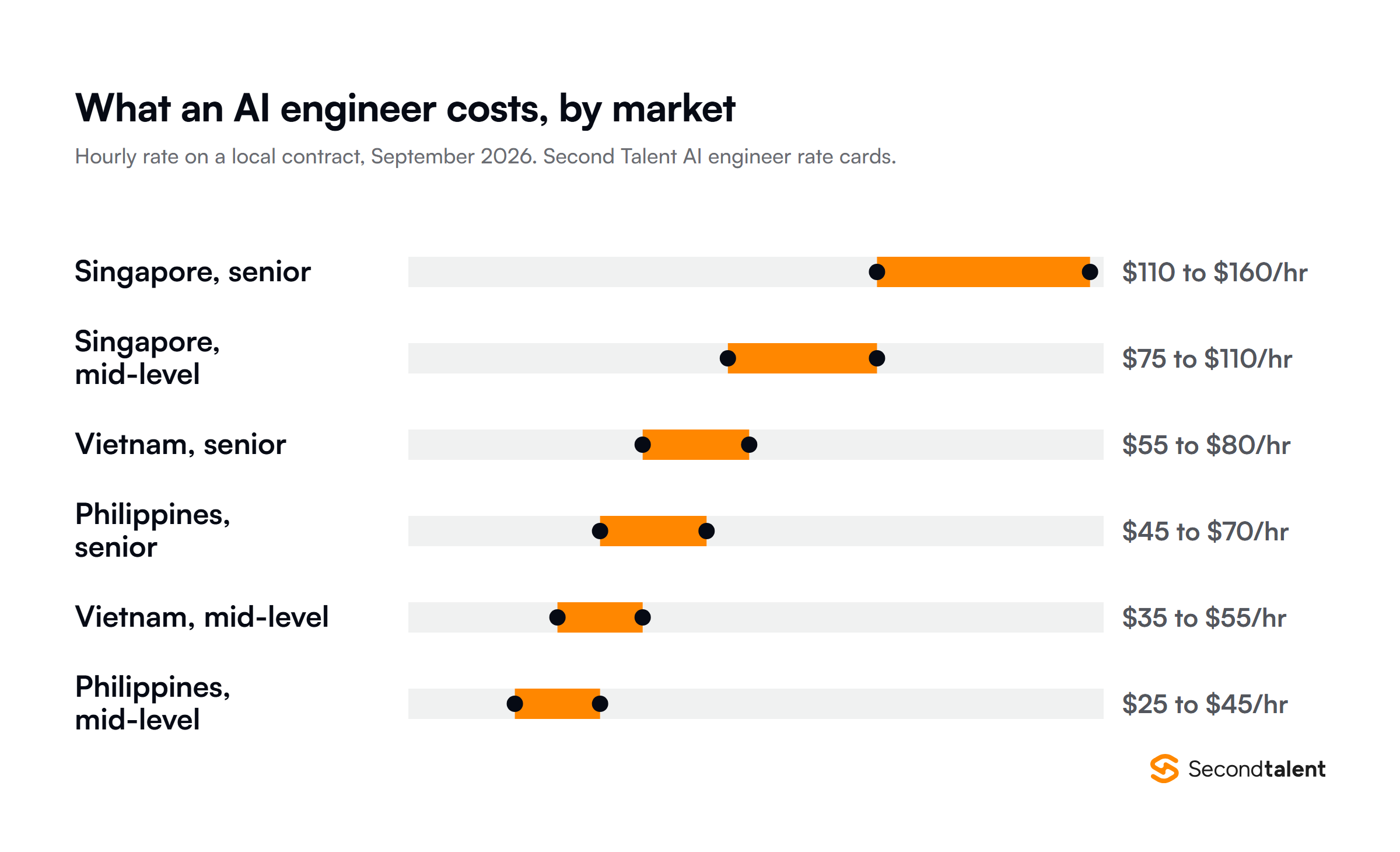
That gap sits behind the blended rates quoted here. Our lists of AI outsourcing companies in Vietnam and the Philippines are worth reading beside this one. Singapore sells the contract, the governance and the accountability. The engineering tends to happen up the coast.
The public sector is the other force shaping this market. AI Singapore, the national programme, works with several firms here. Agencies buy at a scale that makes a public sector record the quickest test of whether a supplier can survive a big procurement.
When Hiring the Engineers Beats Hiring the Vendor
If the AI work runs past the first release, the maths here favours owning the team. We built Second Talent for that case. You hire AI engineers from across Asia as your own staff, at a monthly cost you can set against the bands above.
Our Singapore employer of record handles the paperwork when people need a local contract, and data annotation outsourcing covers the training-data side. For the wider market picture, our Singapore AI trends analysis covers capital, compute and talent. Tell us what you are building and profiles follow within 24 hours.
Frequently Asked Questions
Which is the largest AI outsourcing company in Singapore?
NCS, the Singtel subsidiary, is the largest Singapore-owned technology services firm and the main supplier to government, defence and transport. Accenture is larger globally but delivers here as one office of a worldwide practice.
Is it cheaper to outsource AI work to Singapore?
No. Singapore is the priciest market in the region for AI engineering: $75 to $110 an hour at mid-level, against $25 to $45 in the Philippines. Firms here win on governance, proximity and who carries the risk. Most of them build in cheaper markets nearby.
Should you use a Singapore firm or contract directly in Vietnam or the Philippines?
Use a Singapore firm when the contract, the data residency or the regulator requires it, or when you have no one internally who can manage an offshore team. Contract directly when you do have that capacity, since otherwise you pay a Singapore margin on the same engineers.
Which Singapore AI companies work with the government?
NCS is the main integrator across central government, defence, homeland security and transport. Temus was built around the Smart Nation agenda and works with public institutions, and several others hold AI Singapore relationships.
Do you need a Singapore entity to hire these companies?
No. All ten contract with overseas clients. You need an entity or an employer of record only if you employ the engineers yourself. That is where a Singapore EOR or a regional hiring partner comes in.


![How to Hire Developers in Asia Remotely. How to Hire Developers in Asia Remotely from the USA [2026], by Second Talent.](https://www.secondtalent.com/wp-content/uploads/2026/09/hire-developers-in-asia-remotely-featured-v2-768x403.jpg)
![Workplace Diversity Statistics. Top 100+ Workplace Diversity Statistics [2026], by Second Talent.](https://www.secondtalent.com/wp-content/uploads/2026/09/workplace-diversity-statistics-featured-v2-768x403.jpg)