Five routes put engineers in the Philippines on your team: an employer of record, direct contractors, a dedicated team through a talent partner, a BPO or outsourcing vendor, or your own entity.
The industry that made this market famous is now planning for less of itself.
In July 2026 IBPAP cut its 2028 targets to $50.5 billion and 2.14 million workers, down from the $59 billion and 2.5 million it projected in 2022, and named AI and global competition as the reasons.
That forecast is about scripted, high-volume work. Engineering demand in the Philippines has gone the other way, and the five ways to hire an engineer here differ more in liability than in price.
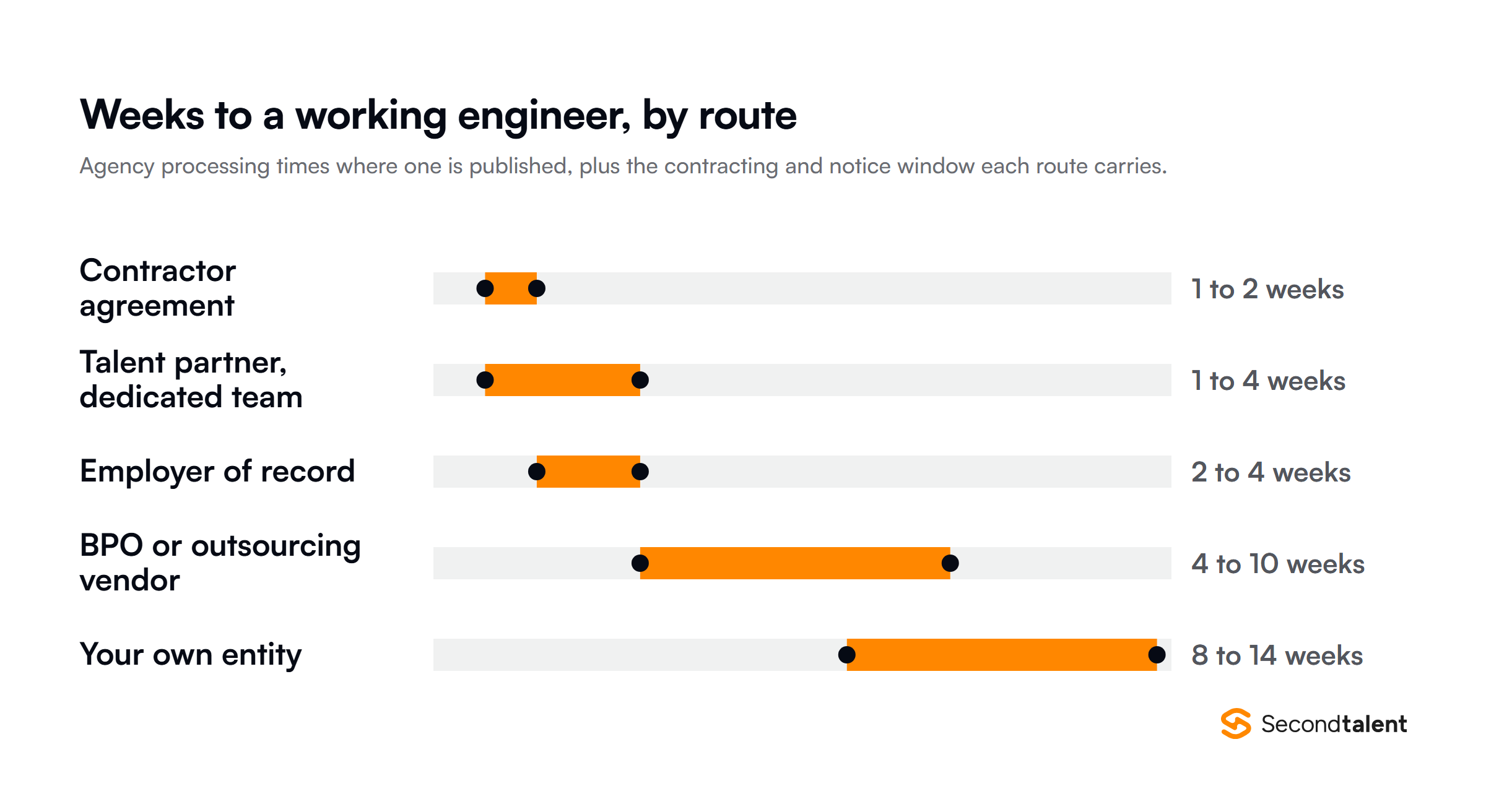
The five routes, side by side
| Route | Who employs the engineer | Working by | What you pay | Fits when |
|---|---|---|---|---|
| Employer of record | The provider’s Philippine entity | 2 to 4 weeks | Salary, around 20% in contributions and 13th month, plus $199 to $699 a month | You want employees rather than vendors, without a company of your own |
| Direct contractors | Nobody. They invoice you | 1 to 2 weeks | Their rate. They file their own BIR returns | Scoped, finite work with an independent specialist |
| Talent partner, dedicated team | The partner, on a Philippine contract | 1 to 4 weeks | One blended monthly rate per engineer | You want vetted engineers embedded in your team and managed by you |
| BPO or outsourcing vendor | The vendor | 4 to 10 weeks | A seat rate per person, or a project price | The scope is defined, or you need volume and have no managers to spare |
| Your own entity | You | 8 to 14 weeks | SEC, BIR and local permits, plus paid-in capital unless you qualify as an export enterprise | A long horizon, PEZA incentives, or revenue you invoice inside the country |
- 1Employer add-ons come to 20.16% of a PHP 40,000 salary but 13.53% at PHP 120,000, because SSS, PhilHealth and Pag-IBIG all cap out while the 13th month does not.
- 2The 13th month is statutory under PD 851: one twelfth of basic annual pay, due on or before 24 December, and tax free within an aggregate PHP 90,000 of benefits.
- 3Metro Manila’s wage floor is contested in court. Wage Order NCR-27 lifted it to PHP 755 on 25 July 2026 and a Pasig judge enjoined it three weeks later.
- 4Control is what turns a contractor into an employee here. The four-fold test asks who directs the method of work, and a written contract does not settle it.
1. Employer of record: a Filipino employee without a Philippine company
An employer of record is a company that already holds a Philippine entity and employs your hire on your behalf.
The person signs a Philippine contract with the provider, appears on that provider’s SSS, PhilHealth and Pag-IBIG filings, and works for you every day.
It is the route for a team that wants employees rather than suppliers, in a country where you have no legal presence and no plan to build one. It is also the fastest way to keep a candidate you have already found.
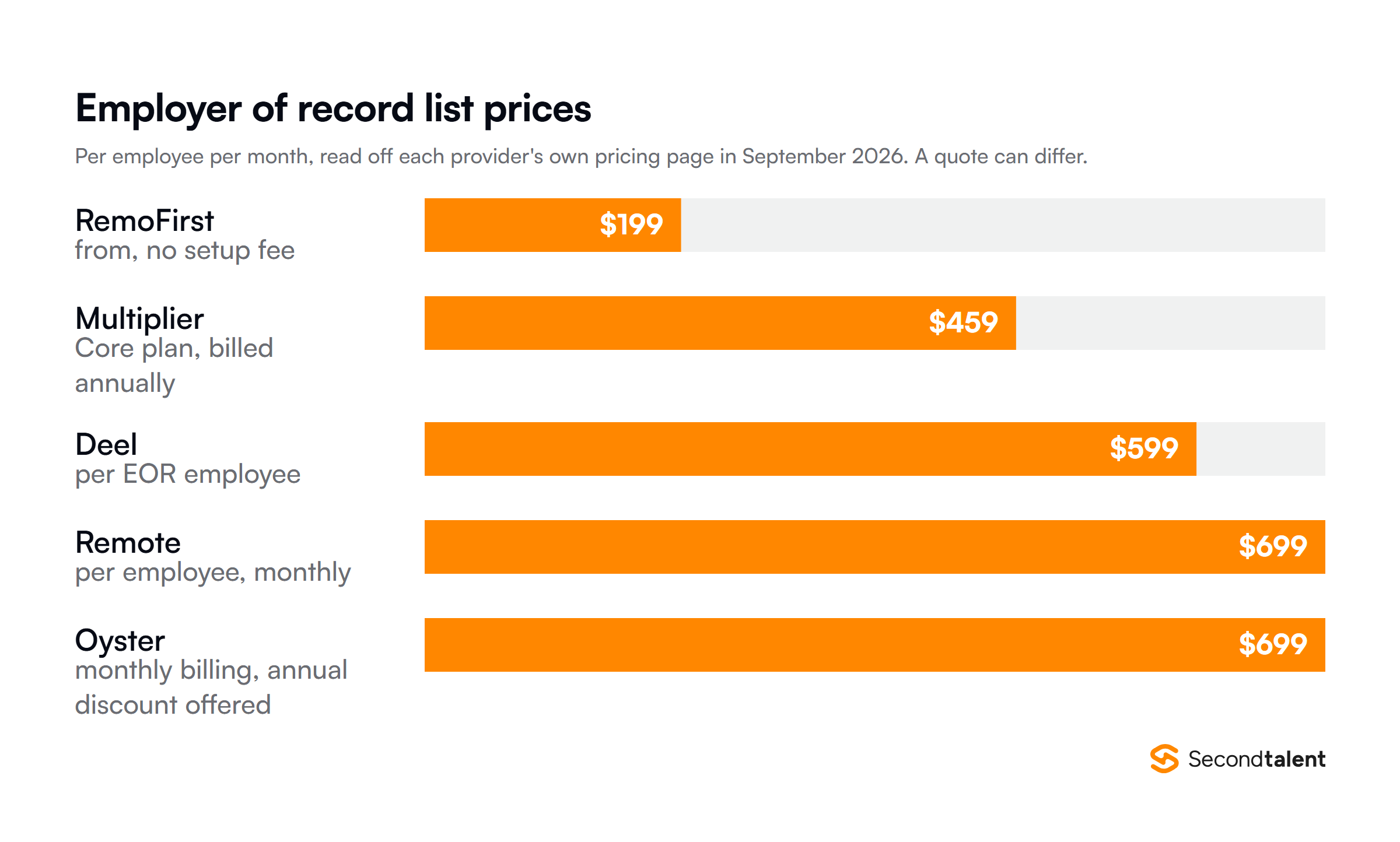
Providers publish their prices and the spread is wide.
Read off each provider’s own page in September 2026, RemoFirst starts at $199 per person a month, Multiplier’s Core plan is $459 billed annually, Deel is $599, and Remote and Oyster both list $699.
The fee is the small number. Philippine employer contributions are SSS at 10% of the monthly salary credit, PhilHealth at half of the 5% premium, and Pag-IBIG at 2%. All three stop at a ceiling, and the ceilings are low.
SSS caps at a salary credit of PHP 35,000, PhilHealth at PHP 100,000, and Pag-IBIG at a fund salary of PHP 10,000, which makes it a flat PHP 200 line for any engineer you are likely to hire.
Then there is the 13th month, which has no ceiling at all.
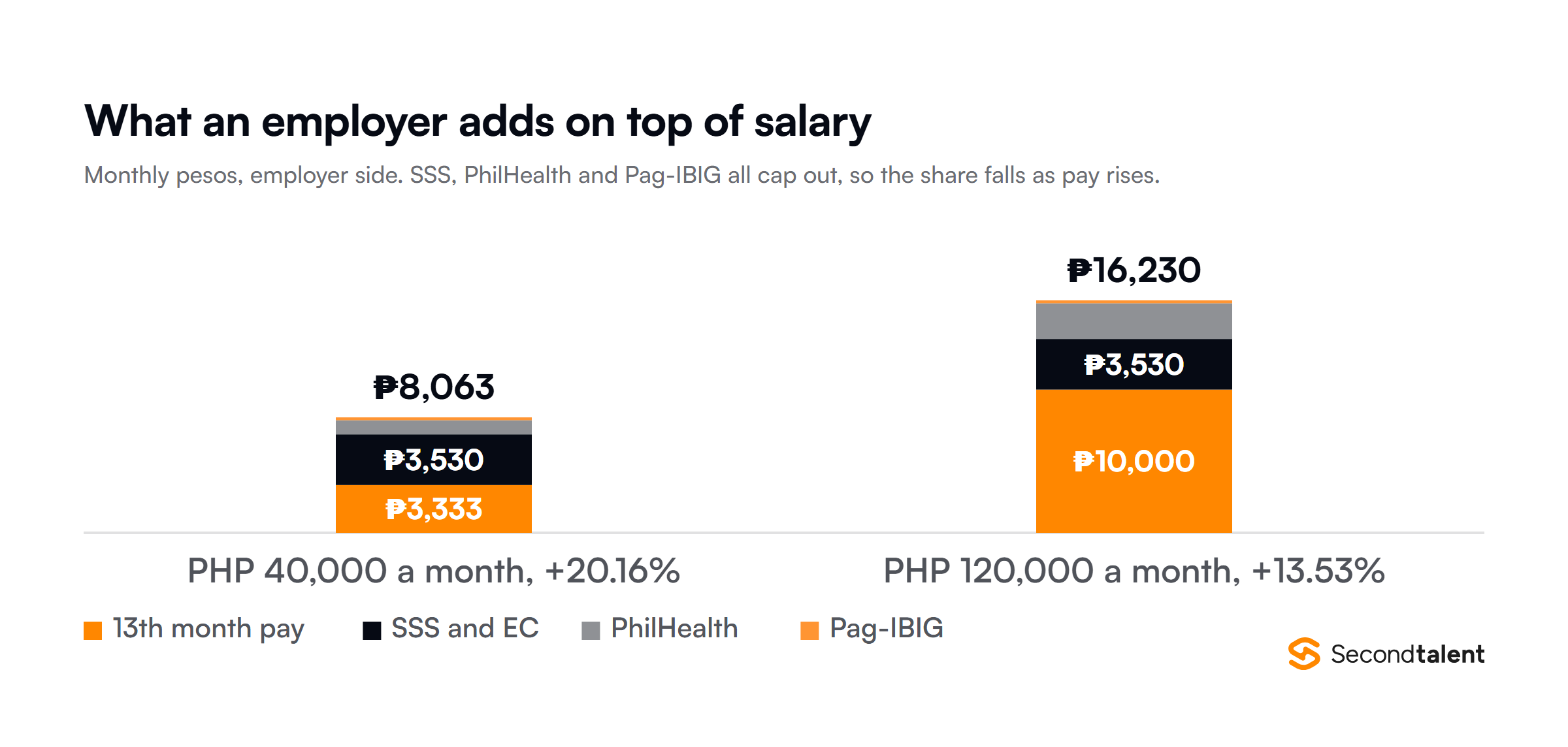
Budget the 13th month as a December cash-flow event, not an accrual you can defer. PD 851 makes it one twelfth of basic annual pay, payable on or before 24 December, and it is the line most first-time employers in this market forget.
The wage floor is worth a check before you sign anything.
Wage Order NCR-27 raised the Metro Manila minimum from PHP 695 to PHP 755 a day on 25 July 2026, then a Pasig court restrained it, so a Philippines hiring guide written in June already quotes a number the courts have suspended.
Engineering salaries sit far above the floor, but overtime and holiday premiums take it as their base.
- Best for: one to fifteen permanent engineers, a first hire in the market, or a person you already found and need to employ next month.
- Where it struggles: the per-head fee does not fall with scale, and providers differ on notice periods, equity handling and who signs the intellectual property assignment. Compare those before the monthly price.
- What it costs: salary, about 20% in contributions and 13th month, plus $199 to $699 per employee per month. Our own Philippine EOR covers the filings and the statutory benefits, and the payroll and tax guide works through the arithmetic line by line.
2. Direct contractors: fastest to start, easiest to get wrong
A contractor agreement is the only route with no third party in it. You sign with the individual, they invoice you, and they register and file their own tax. Nothing needs to exist before you start.
The Philippines has a deep freelance market, so this is easy to arrange and easy to over-use. It suits a defined piece of work with an end date, not a permanent engineer you manage every day.
The tax side is simple.
A self-employed Filipino registers with the BIR and can elect a flat 8% on gross receipts above PHP 250,000, in place of both graduated income tax and percentage tax, as long as gross stays under the PHP 3 million VAT threshold.
The classification side is not. Philippine tribunals apply the four-fold test, and the fourth element, control over the means and methods of the work, decides most cases.
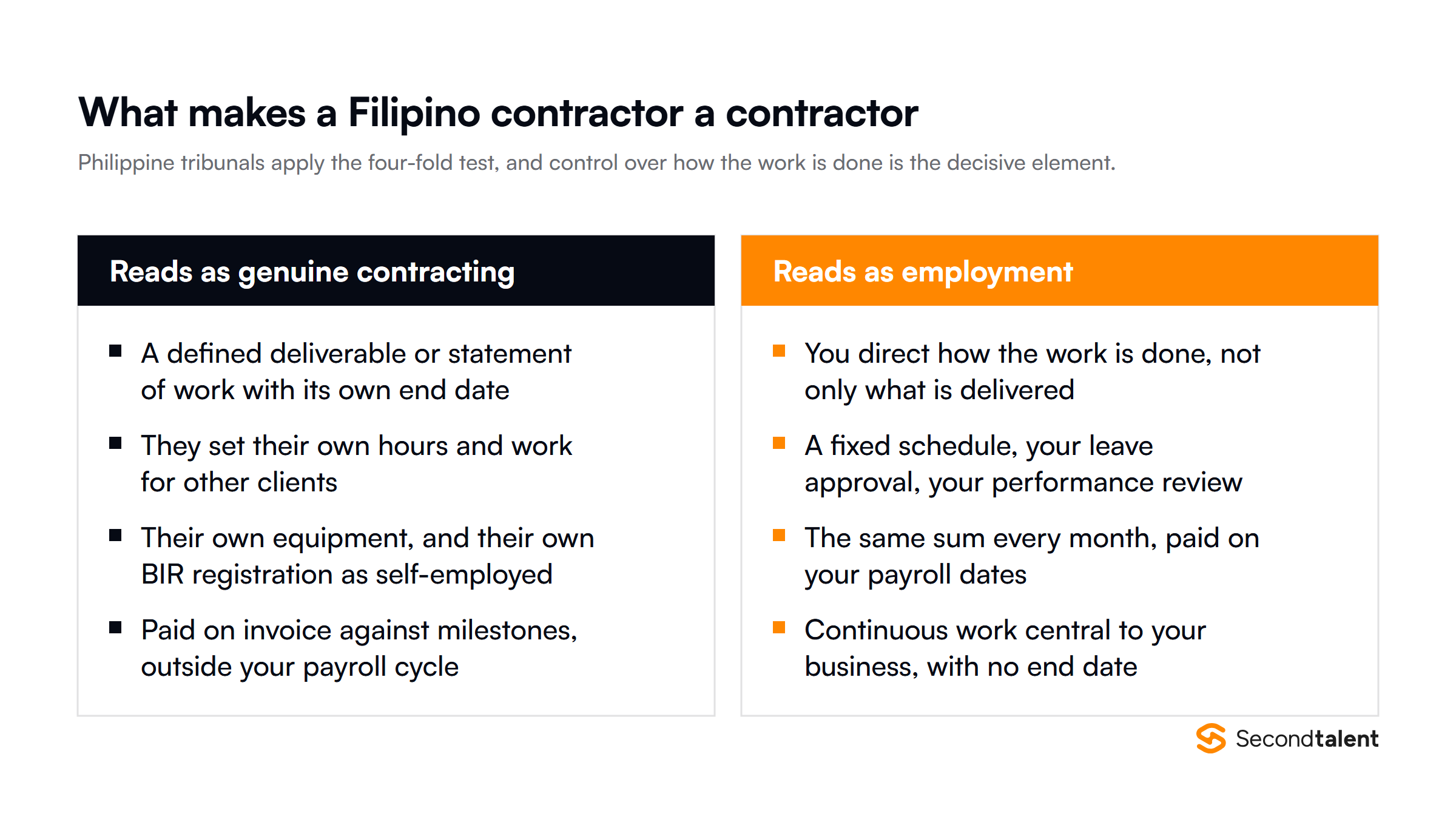
A common misreading is that Department Order 174 settles it. DOLE Circular 01-2017 exempts a professional or individual with unique skills from that order’s registration and capital rules, but the employment tests still apply in full.
Legislation is moving, at its own pace. The Freelance Workers Protection Act has passed the House on third reading and is not yet law.
It would require a written contract for each engagement and a down payment of at least 30% of the contract price on signing.
- Best for: a specialist for a defined deliverable, a pilot before you commit to the market, or a consultant with several clients.
- Where it struggles: permanent work. Six months of daily supervision converts the relationship in substance, and a reclassification brings back wages, contributions and 13th month pay with it. Paying a contractor a 13th month is itself evidence of employment.
- What it costs: their rate and nothing else, which is why the route stays tempting well past the point where it works. The local job boards are the usual place people find these engagements.
3. A dedicated team through a talent partner
This route sits between the employer of record and the vendor. A talent partner sources and vets the engineers, employs or contracts them in the Philippines, and hands you people who work only for you.
You set the roadmap, run the reviews and decide who gets promoted.
The difference from an EOR is the front half of the process. An EOR employs whoever you found.
A talent partner finds them, which matters in a market where the strongest engineers already sit inside the large captives and ignore cold outreach.
Time zones are the reason many teams start here rather than in India.
Manila sits eight hours ahead of London and gives West Coast US companies an overlapping workday on the night shift, which is a working pattern the market is used to, and prices for.
Pricing is a single blended rate rather than salary plus contributions plus a platform fee. Our Philippine rate data puts a mid-level full-stack developer at $22 to $58 an hour, with juniors from $16 and leads to $100.
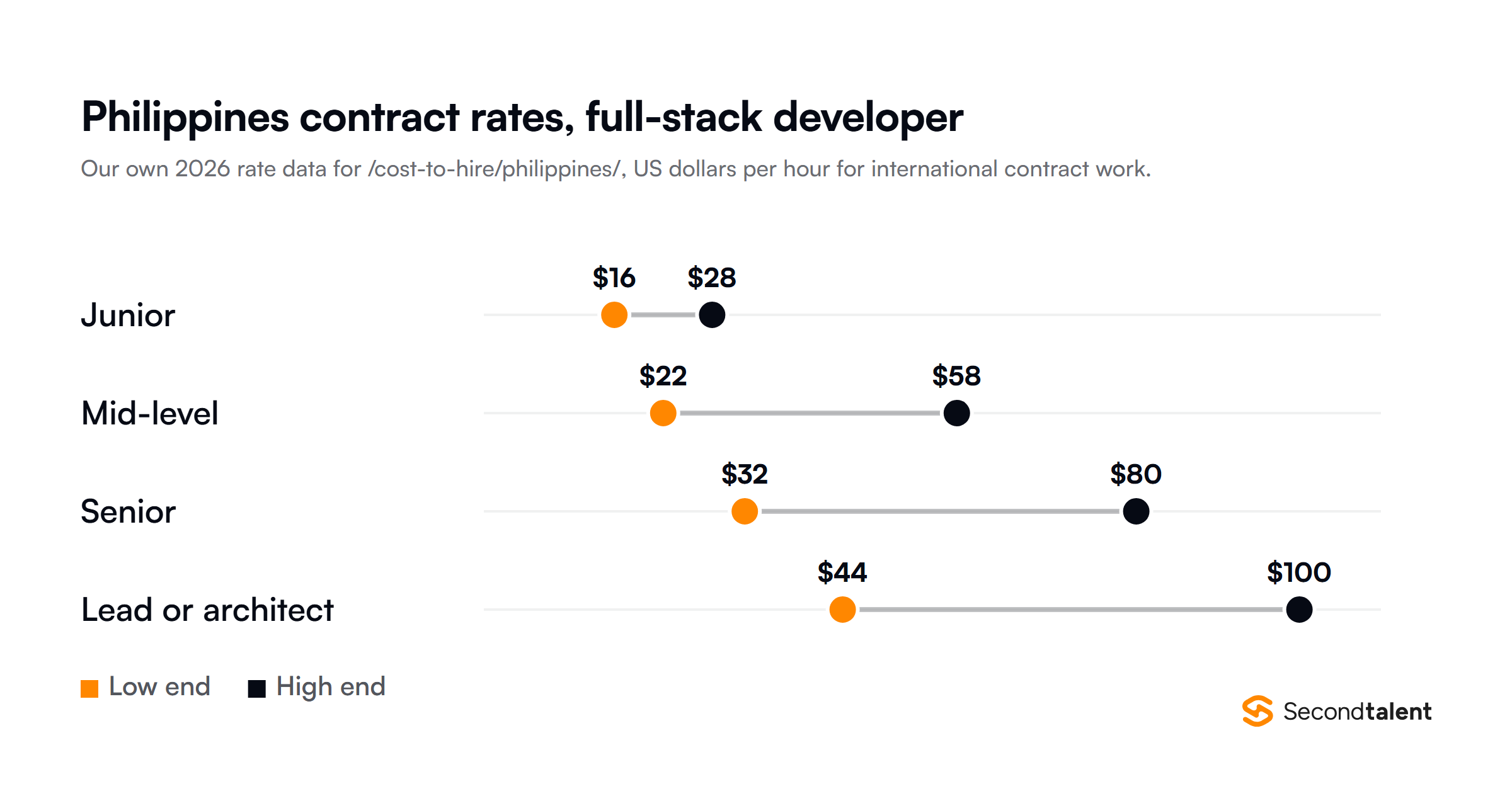
Those rates are not local salaries, and mixing the two is the most common budgeting error we see in this market. A contract rate carries a business, its margin, its bench and its guarantees. A salary carries one person’s pay.
- Junior developer PHP 30,000 to 50,000 a month
- Mid-level PHP 50,000 to 90,000, senior PHP 90,000 to 160,000
- Tech lead PHP 140,000 to 210,000
- Mid-level full-stack $22 to $58 an hour
- Machine learning engineer $31 to $80
- Rate carries vetting, cover and margin
The roles you can fill in a month have shifted. Demand has moved toward cloud, data and AI work, and the in-demand Filipino tech roles now look much like a Western engineering org chart rather than a support function.
Retention is the quiet advantage.
Filipino engineers took to distributed work early, and the working traits local employers point to are the ones that make a remote role stick, so fully remote is not the compromise here that it can be elsewhere.
- Best for: standing up three to fifteen engineers in a quarter when you have engineering management but no local recruiting reach. Compare bands first in the Asia tech salary index and the full-stack rate card.
- Where it struggles: partners differ in how much vetting sits behind the shortlist. Ask how many candidates they screened for the role in front of you, who wrote the technical assessment, and what happens in month two if it is not working.
- What it costs: one monthly rate per engineer with the employment, payroll and statutory filings inside it. See who is available now.
4. A BPO or outsourcing vendor
The Philippine IT-BPM industry employs about 1.9 million people and books roughly $40 billion a year, which is why a vendor can put twenty people on your account in a month. You buy delivery and seats, not headcount.
The industry’s own forecast is the thing to read before you sign a three-year contract. In July 2026 IBPAP cut its 2028 targets, and the cut lands on the work that automates first.
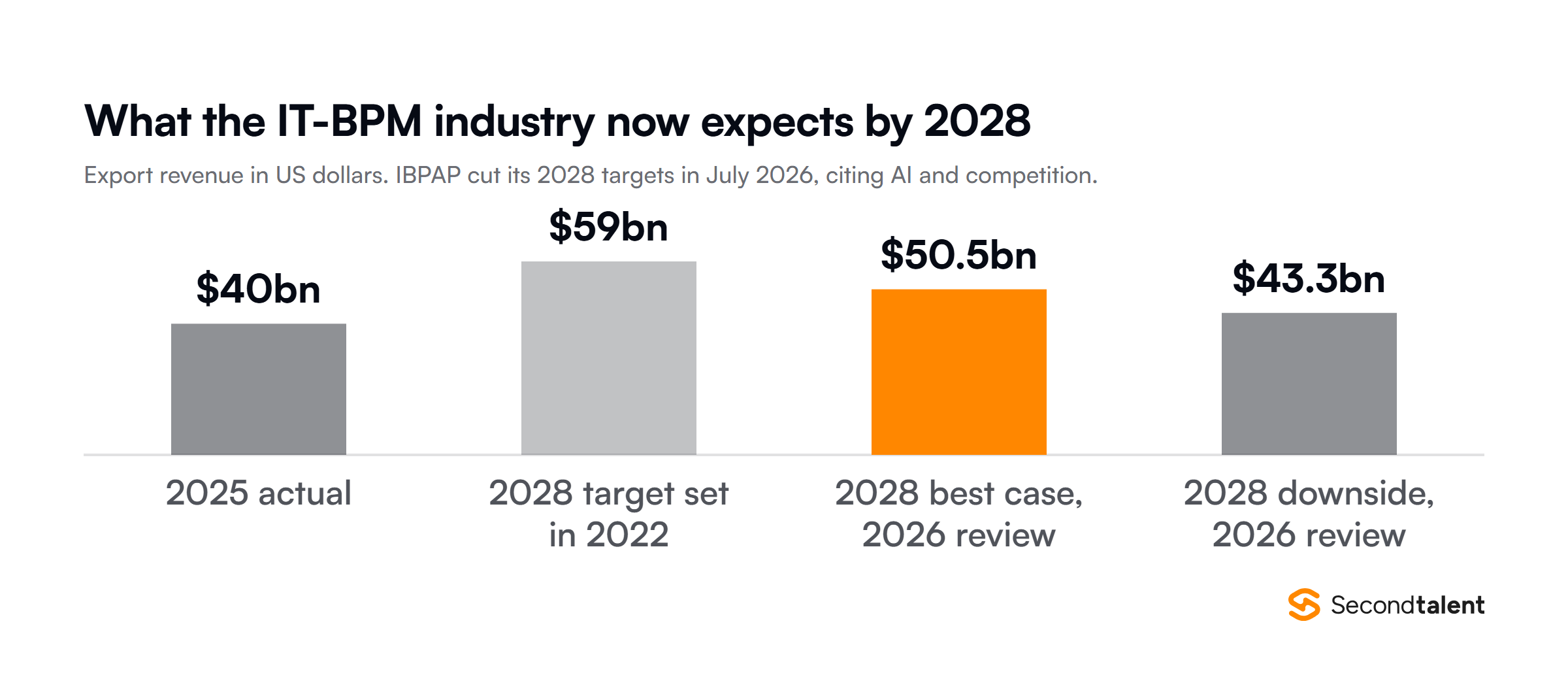
The industry’s answer is to move up the value chain, with a stated target of two million AI-enabled digital workers by 2028 and a push into global capability centres.
Vendor academies and independent generative AI courses have both grown on the back of it.
One rule change matters more than any vendor’s pitch deck.
CREATE MORE let registered enterprises in the ecozones put half their staff on work from home without losing tax incentives, and FIRB Resolution 005-2026, dated 10 April 2026, raised that ceiling to 90% for a year.
That is why a vendor can now offer you a fully remote team without a caveat about ecozone attendance. It also removes the old argument that only an office-based vendor is compliant.
Two clauses decide whether the arrangement ages well. Intellectual property assignment has to be explicit and cover subcontractors, and continuity has to be named, because a vendor earns more by rotating people between accounts.
Our review of Philippine offshore staffing firms goes through who does what.
- Best for: a defined scope, a fixed budget, volume roles, or a shift pattern you do not want to manage yourself.
- Where it struggles: product work with a moving roadmap. Fixed-price contracts punish change, time-and-materials contracts remove the discipline that made fixed price attractive, and a vendor margin of 30% to 50% sits on top of every hour either way.
- What it costs: a seat rate per person or a project price. Neither line is the engineer’s salary, and you will not be told what that salary is.
5. Your own Philippine entity
Owning the entity is the only route where the engineers are your employees, with no fee per head and no third party in the contract. It is also the only one you cannot unwind in a month.
The capital rule is where most plans stall. A foreign-owned company selling into the Philippine domestic market needs US$200,000 of paid-in capital under the Foreign Investments Act as amended by RA 11647.
There are two ways down from that number, and an engineering team often qualifies for one. The threshold falls to US$100,000 if the company uses DOST-certified advanced technology or employs at least 15 direct Filipino staff.
The second way matters more. A company that exports at least 60% of its output or revenue, which is what a development centre serving its overseas parent does, counts as an export enterprise and is not bound by the US$200,000 floor at all.
Registration itself runs on a predictable clock.
SEC incorporation through eSPARC takes seven to fourteen business days, then BIR registration and the local business permits add another three to four weeks, and PEZA or BOI accreditation adds three to five more if you want the incentives.
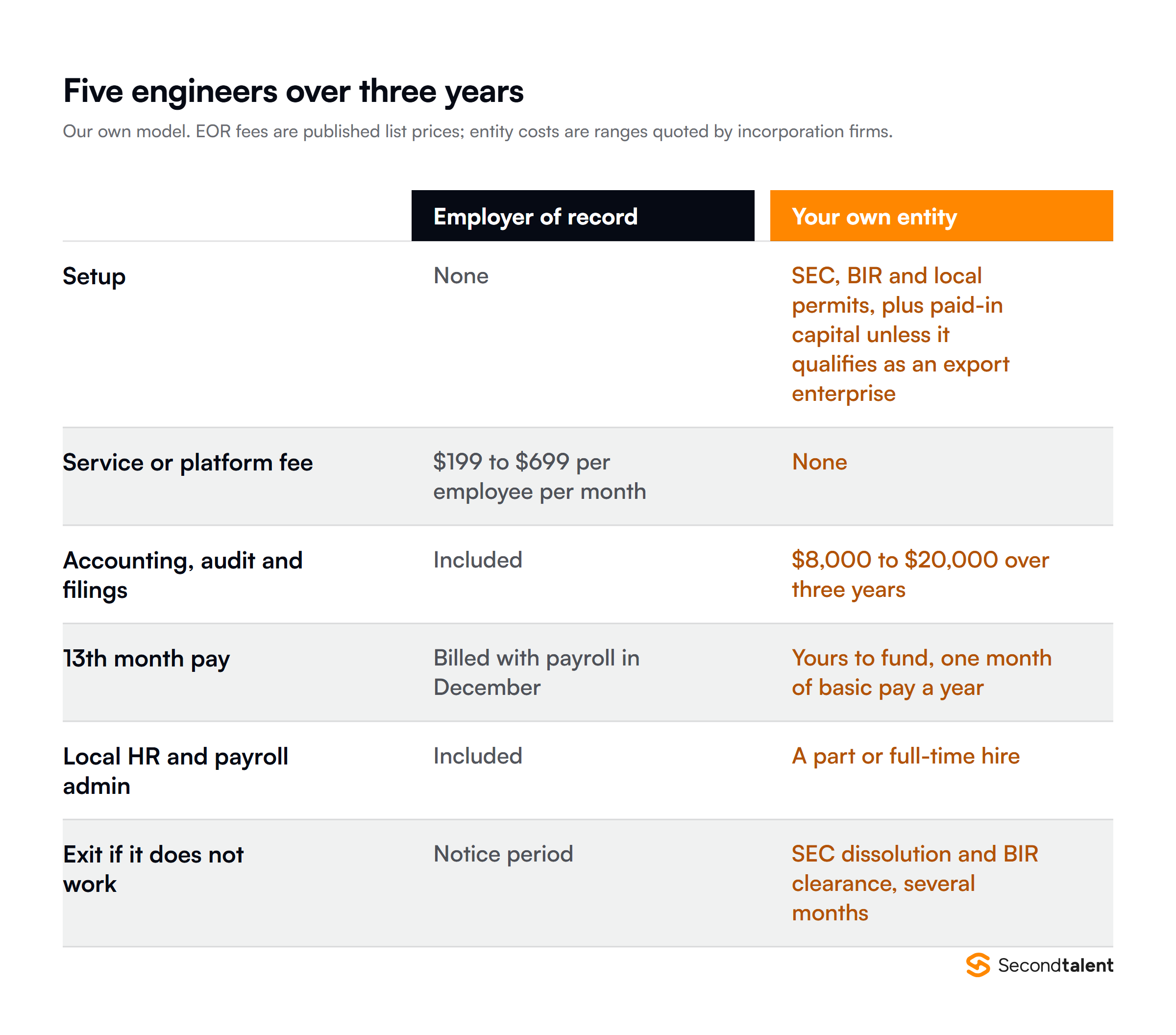
Those incentives are the real argument for the entity.
A registered business enterprise under CREATE MORE gets a reduced corporate income tax rate or an enhanced deduction regime, plus the flexible work arrangements the ecozone rules now allow.
Getting out is slower than getting in. SEC dissolution runs alongside a BIR tax clearance that takes months, and the contributions and 13th month obligations continue until the last employee is properly separated.
Four changes landed in 2026, and each one moves a number that a 2025 hiring plan would have used.
- Best for: fifteen to twenty engineers and up, a plan measured in years, PEZA incentives, or revenue you invoice inside the Philippines.
- Where it struggles: the first hire. Nobody starts work while the SEC and BIR files are open, and the capital has to be in the bank before the company exists.
- What it costs: registration and professional fees, the paid-in capital unless you qualify as an export enterprise, roughly $8,000 to $20,000 of accounting and filings over three years, and a local HR hire once you pass ten people.
Getting the first Philippine hire live
Most teams that come to us have already tried the cheapest version of this: one contractor, found through a referral, working full time on a rolling invoice.
It works until the person matters, and then the arrangement is doing the opposite of what it was chosen for.
Second Talent places pre-vetted engineers across nine Asian markets.
We either employ them ourselves or run them through our Philippine employer of record, so a first hire can start in weeks with no company of your own and no guesswork about the 13th month.
Tell us the role and we will come back with a shortlist within 24 hours, with the rate, the route and the contribution maths already worked out. If you would rather compare providers first, we keep a review of Philippine EOR providers too.
Frequently asked questions
Can I hire in the Philippines without a company there?
Yes. Four of the five routes need no Philippine entity of your own: an employer of record, a contractor agreement, a talent partner and a BPO or outsourcing vendor. Only the fifth requires you to incorporate.
What does a Filipino engineer actually cost an employer?
Salary plus 20.16% at PHP 40,000 a month, and 13.53% at PHP 120,000. The contribution ceilings are low, so only the 13th month keeps scaling with pay. Through an EOR or a talent partner, add the fee or take the blended rate instead.
Do I owe 13th month pay to a contractor?
No. PD 851 covers rank-and-file employees, not genuine independent contractors. Paying it anyway is worse than useless: it is evidence that the relationship was employment all along, which is exactly what the four-fold test looks for.
How do you manage a Philippine team across time zones?
Fix the overlap deliberately rather than expecting it to emerge: a four-hour shared window, written decisions in the tracker, and no meeting that could have been a document.
Practical time zone habits for Philippine teams and notes on managing Filipino remote teams both cover the feedback side, which is where most first-time managers get it wrong.
When should we switch from an employer of record to our own entity?
Model it at fifteen engineers and decide at twenty, and bring the incentives into the model.
If the Philippine unit would serve only your overseas business, the export enterprise route removes the capital hurdle, and PEZA registration changes the tax answer as much as the fees do.