TL;DR: For training data, red teaming and model evaluation, TaskUs runs the largest operation in the country. For AI strategy and enablement, Thinking Machines is an OpenAI Advanced Partner. For building the software, Stratpoint, Exist, Pointwest and Full Scale sell engineers rather than advice.
In July 2026 the Philippine IT-BPM industry cut its own 2028 revenue target from $59 billion to $50.5 billion, and its headcount target from 2.5 million to 2.14 million. It named AI as the reason. The same technology built the vendors below, and the layer you are buying decides which of them to call.
- 1TaskUs sells AI safety and red teaming as a service line, and has been an Everest Group Leader in trust and safety for three consecutive years.
- 2Thinking Machines was OpenAI’s first services partner in Asia Pacific and is now one of about 30 Advanced Partners worldwide.
- 3Only one company here publishes a price. Full Scale lists senior AI engineers from $35 an hour, fully loaded.
- 4The country hosts about 200 global capability centres, adding about ten a year, and they bid for the same engineers these vendors are quoting you.
The 10 AI Outsourcing Companies in the Philippines, Compared
| Company | What it sells | Published scale | Strongest for |
|---|---|---|---|
| TaskUs | AI data services and trust and safety | 63,000+ teammates | Annotation, RLHF, red teaming, evaluation |
| Thinking Machines | AI and data transformation consulting | 150+ clients, NPS 85 | Strategy, GenAI adoption, enablement |
| Cloudstaff | Offshore teams with AI tooling | 1,000+ client companies | Ongoing AI-assisted operations teams |
| Pointwest | Filipino-owned IT and BPO services | Founded 2003, not published | Data engineering, RPA, enterprise ML |
| Stratpoint | Cloud, data and AI engineering | Founded 2005, not published | AWS-based AI, banking and telecom |
| Exist Software Labs | Enterprise GenAI and agentic platforms | Not published | Conversational AI, KYC, data platforms |
| White Cloak | AI transformation and product build | Founded 2014, not published | Regulated apps, process automation |
| Symph | AI transformation, Google partner | 89 engineers | Workflow-level AI adoption, Cebu |
| Full Scale | AI engineers by staff augmentation | $35 an hour and up | LLM apps, RAG, agents, MLOps |
| Annotera | Data annotation across four cities | 12 global locations | Labelled datasets at volume |
The 10 AI Outsourcing Companies, One by One
1. TaskUs: the country’s AI data machine
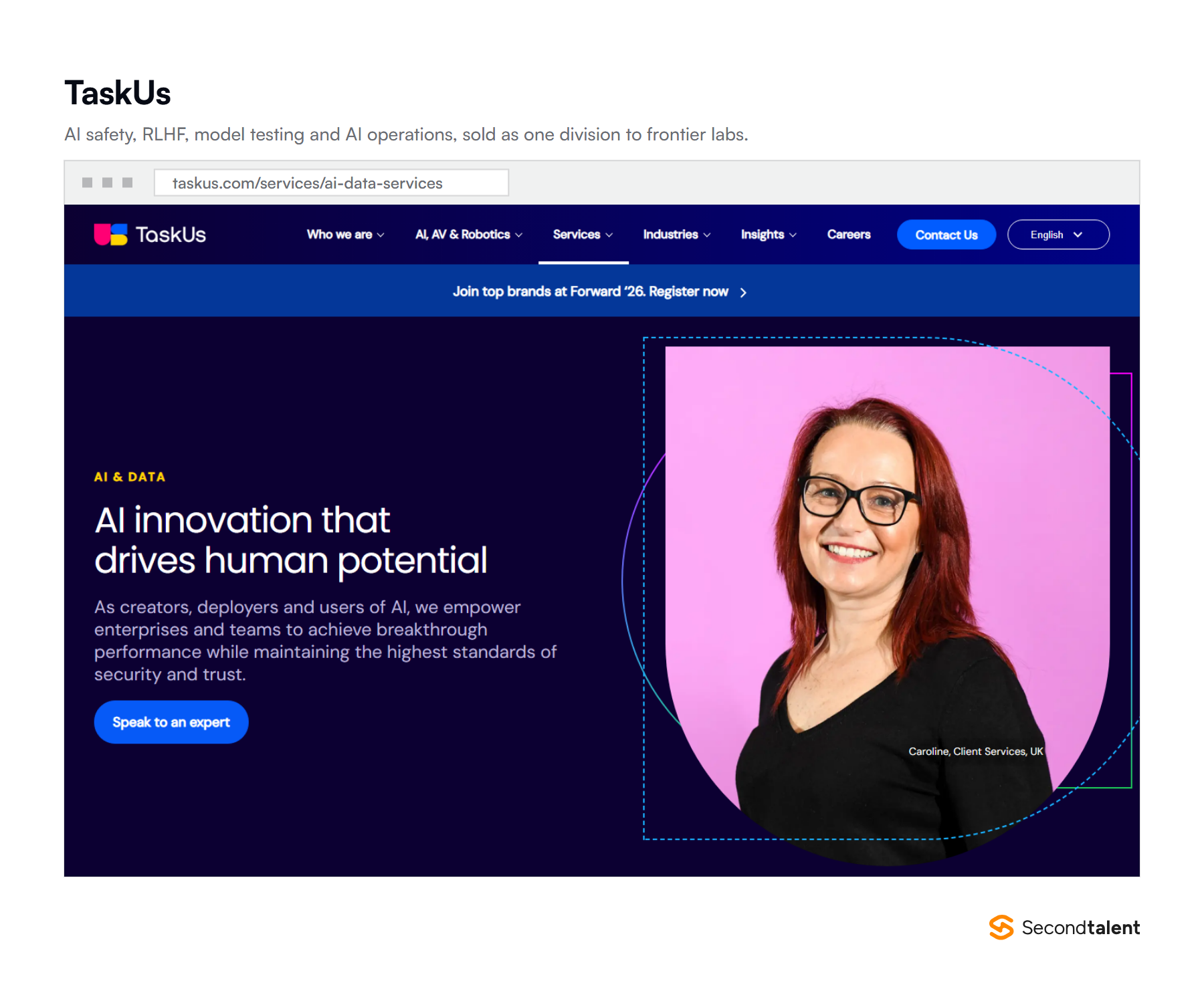
TaskUs is for anyone training or shipping a model who needs humans in the loop at volume. Its AI data services division is split into four lines: AI safety and alignment, data feedback and evaluation, model testing and QA, and deployment support with AI operations.
The work behind those labels is specific: red-team design and policy-driven data for frontier models, global pipelines with RLHF and synthetic augmentation, and benchmark QA before and after launch. Published client outcomes include a 71% cut in harmful responses under stress testing, a 90% quality gain on agentic system training, and 98% average accuracy on smart glasses data.
Scale is the reason it sits first. TaskUs counts more than 63,000 teammates today, and its last public filing put it at about 59,000 across 28 sites in 12 countries.
The Philippines is its largest delivery base and the place the company grew up in. Everest Group has named it a Leader in trust and safety services three years running, which is the closest thing this category has to an audit.
The company has also left the public markets. Its co-founders and Blackstone agreed to take it private in May 2025, so the quarterly filings that made headcount and margins checkable have stopped.
- Best for: annotation, RLHF, model evaluation, content moderation and AI safety work at frontier-lab volume.
- Watch out: a company this size prices for programmes, not for pilots.
- Published scale: 63,000+ teammates, 12 countries, Everest Group Leader three years running.
2. Thinking Machines Data Science: OpenAI’s first partner in the region
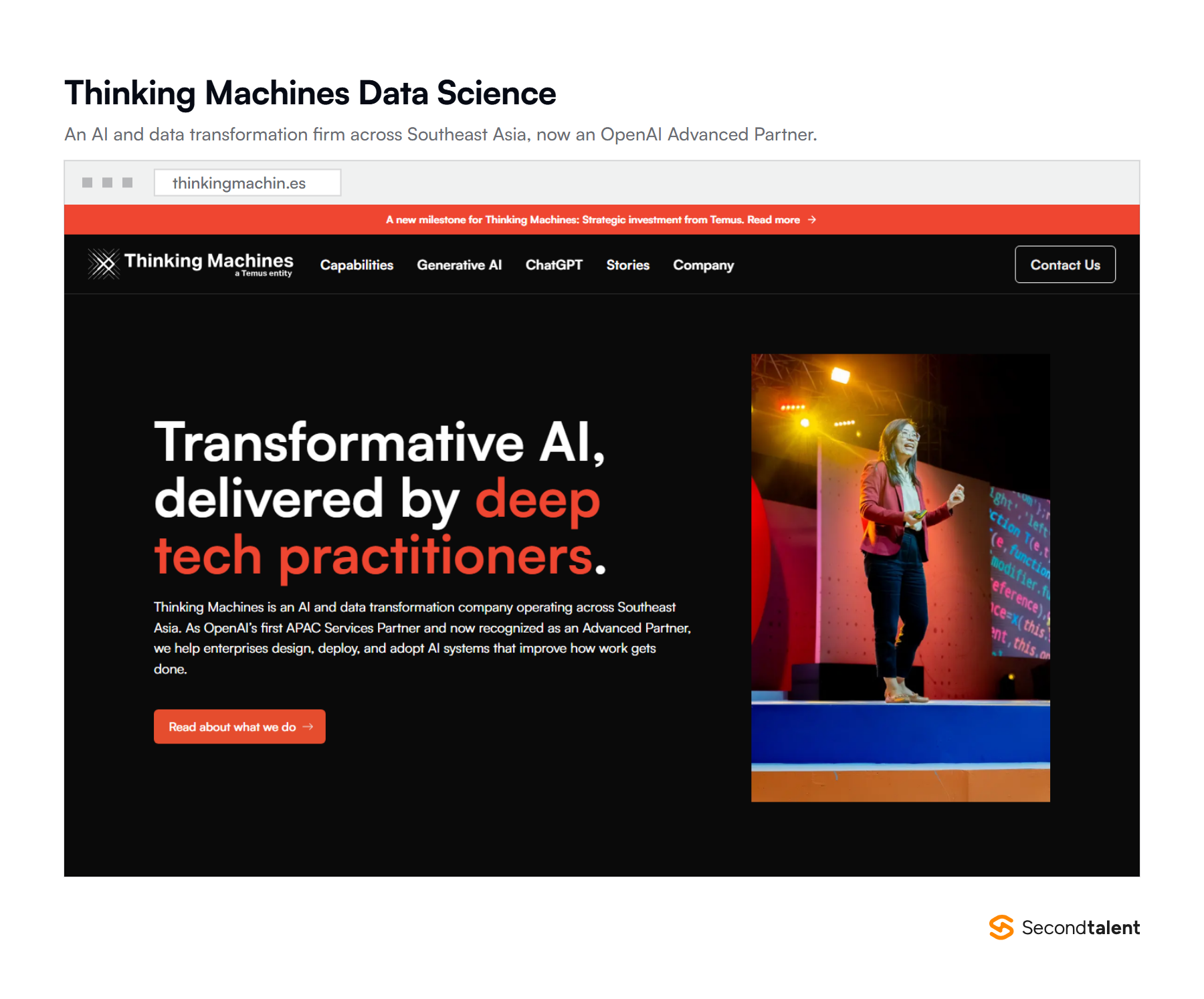
Thinking Machines was OpenAI’s first services partner in Asia Pacific, and now sits among about 30 Advanced Partners worldwide. For a buyer, that is the shortest route in the country to people who have shipped production work on frontier models rather than demos.
It sells transformation rather than headcount: generative AI use cases, data governance, and forward-deployed engineers who sit with client teams. It reports 150 global clients, a net promoter score of 85, and more than 10,000 professionals trained.
Enablement is the unusual part of that mix. The pitch is that your team keeps running the system after the consultants leave, which is the failure point in most first AI programmes.
The published work is checkable. BPI, one of the largest banks in the Philippines, used its generative AI build to help branch officers find policy answers three times faster. A garment manufacturer, NST Apparel, automated purchase order execution to cut delays and material waste.
Ownership has changed too. The company now calls itself a Temus entity after a strategic investment. That brings Singapore backing and a wider regional footprint than a Manila consultancy would otherwise have.
- Best for: enterprises that need the use case, the governance and the internal capability, not only a build.
- Watch out: consulting rates, and no published bench size for delivery work.
- Published scale: 150+ clients, 10,000+ professionals trained, NPS 85.
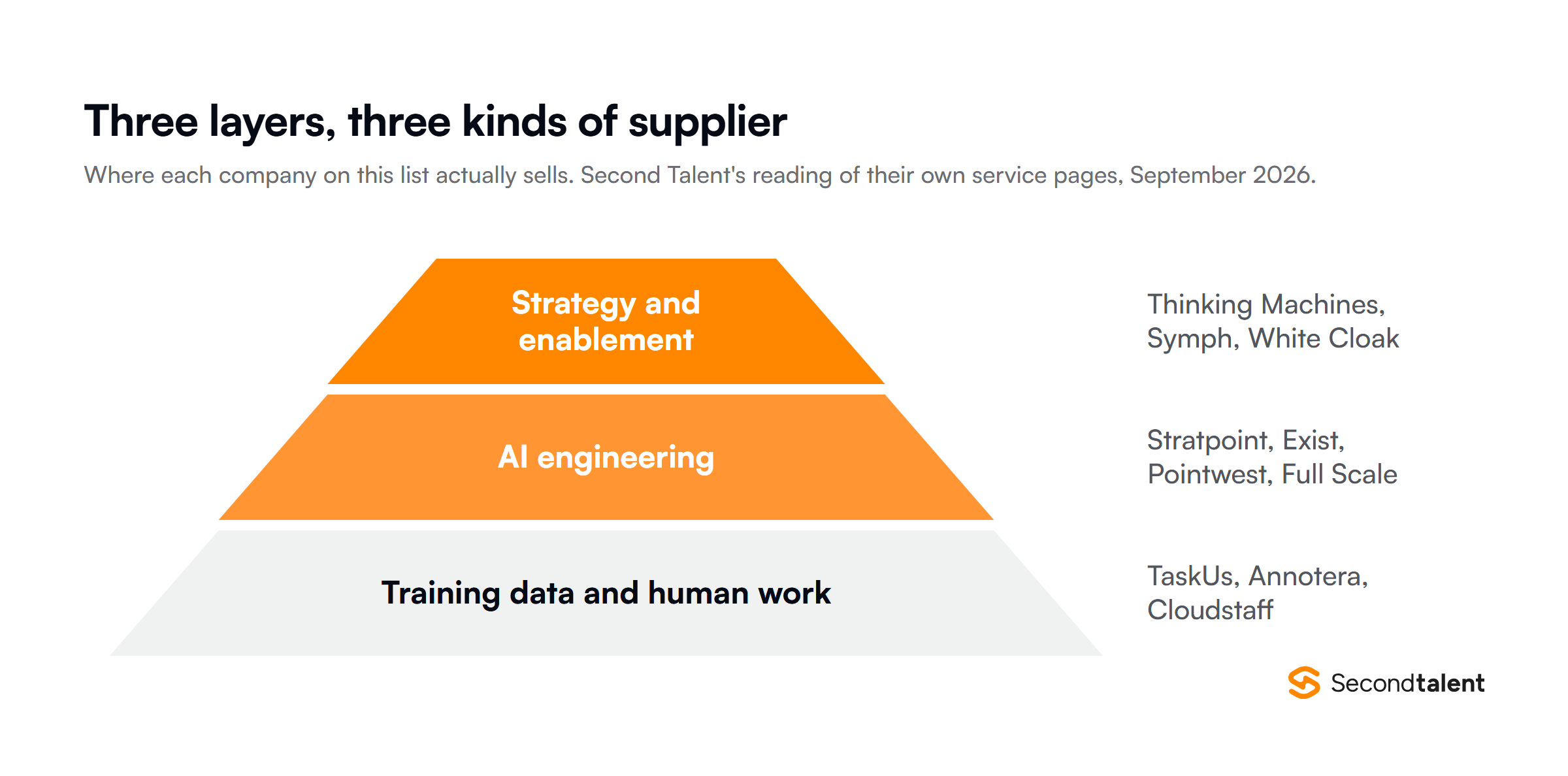
Those two entries already sit in different businesses, and the rest of the list splits the same way. Buying labelled data from a consultancy, or strategy from an annotation operation, is the most common way these engagements go wrong.
3. Cloudstaff: AI tooling wrapped around an offshore team
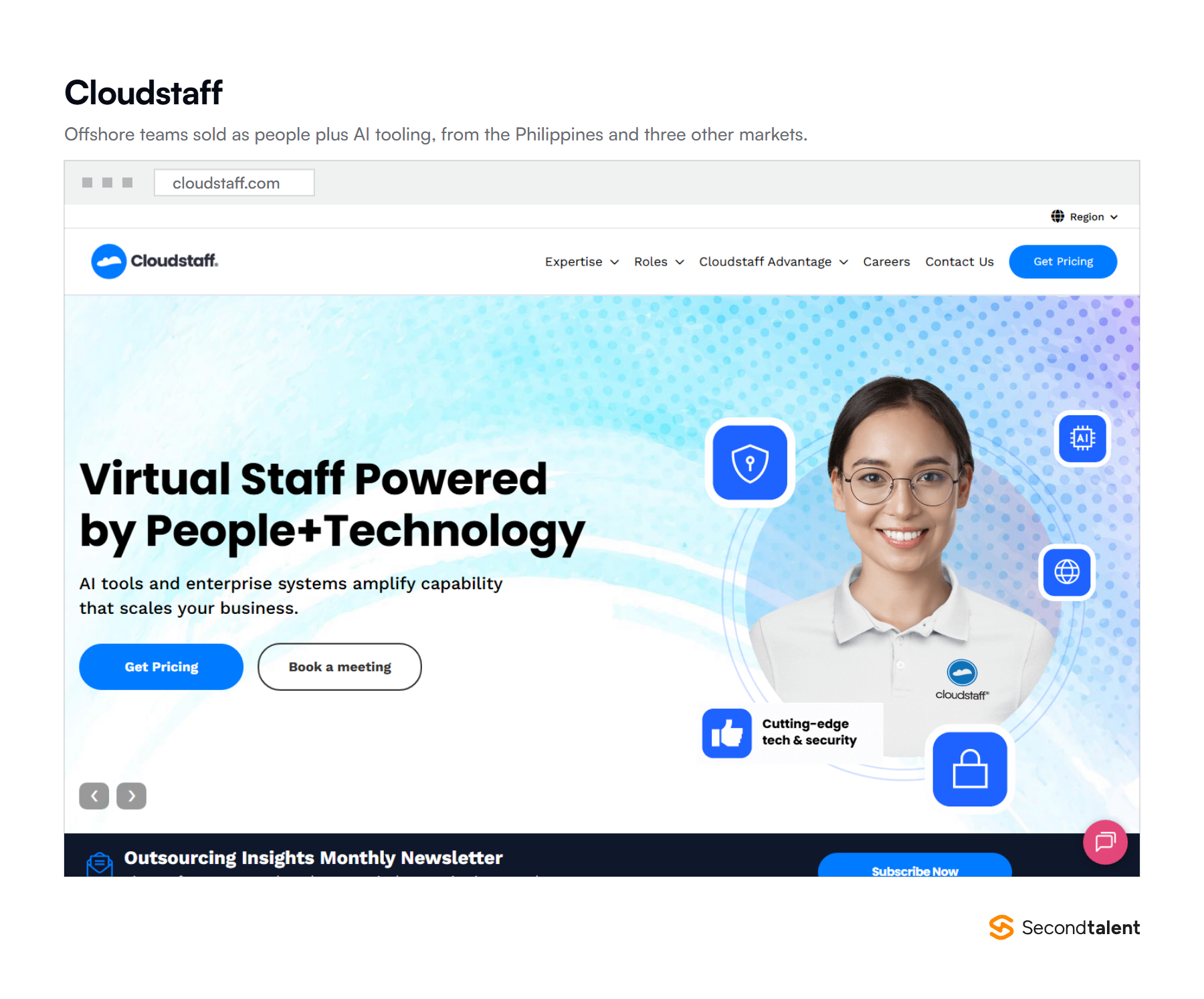
Cloudstaff suits the company whose AI work is continuous operations rather than a project: document processing, data preparation, review queues, support that a model answers first. It sells staff plus the tooling around them, and handles recruitment, employment, payroll and equipment.
Founded in 2005, it now serves more than 1,000 companies from the Philippines, Colombia, India and Kenya. It claims a 99% staff retention rate against a candidate network it puts above a million.
Most teams are running in 15 to 25 days, and the company holds ISO 27001 and ISO 9001. For AI work that means the security paperwork is already done before your data moves.
The pricing argument is the familiar one: about 70% of the fully loaded cost of the same role onshore. Cloudstaff turns that into $150,000 to $450,000 of yearly savings for a team of five to ten. Treat it as the vendor’s arithmetic, then run your own against our comparison of offshore staffing companies in the Philippines.
- Best for: ongoing AI-assisted operations where the team stays for years.
- Watch out: this is staffing, not engineering. The AI design has to come from you.
- Published scale: 1,000+ client companies, four delivery countries, ISO 27001 and 9001.
4. Pointwest: the largest Filipino-owned option
More than half of Pointwest’s clients have stayed with it for five years or more, which is the number to weigh when a supplier will be inside your systems for a decade. It describes itself as one of the world’s largest Filipino-owned IT and BPO service providers, and it has been running since 2003.
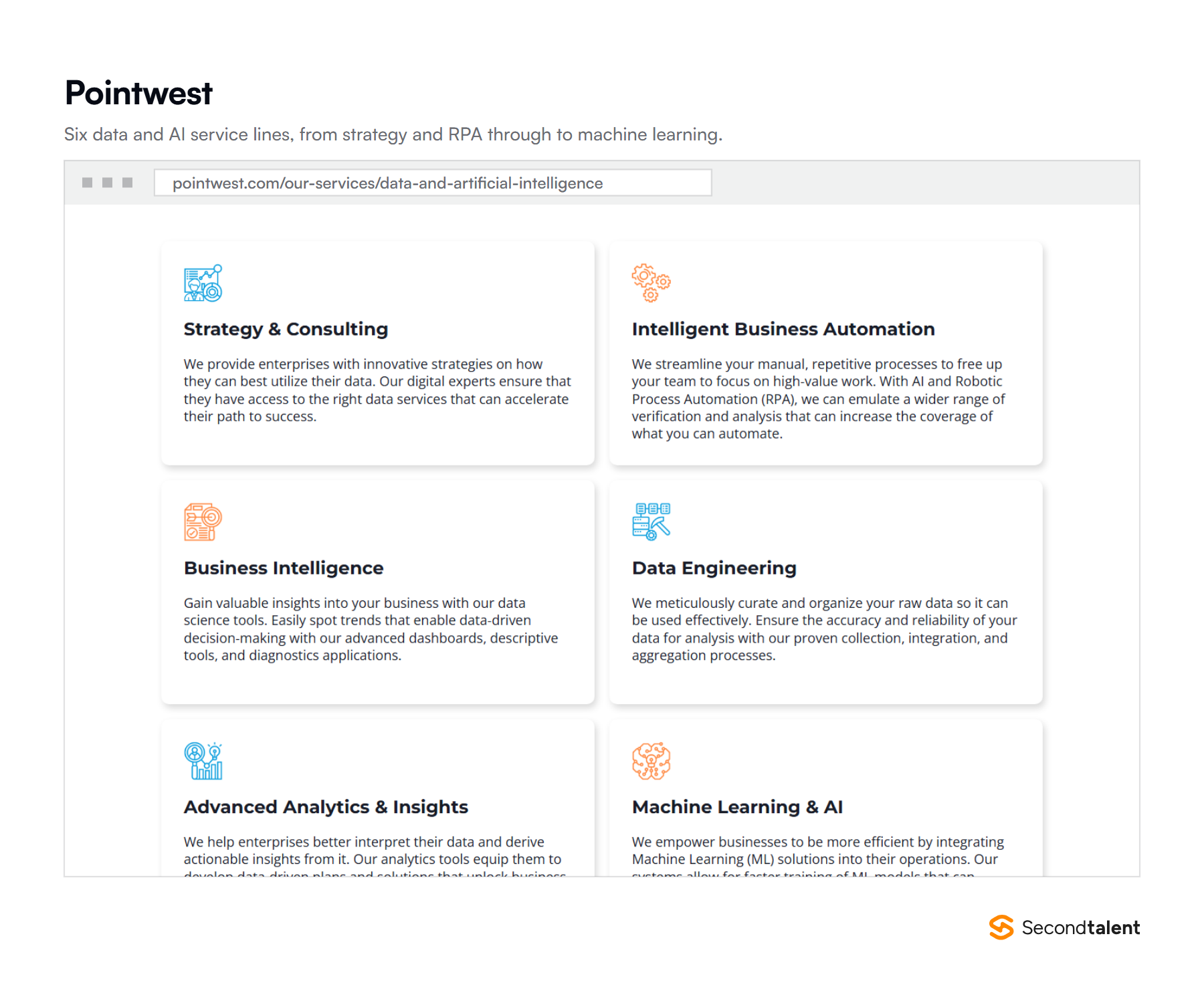
Its data and AI practice covers six lines: strategy and consulting, intelligent business automation with RPA, business intelligence, data engineering, advanced analytics, and machine learning. That ordering is honest about where the work starts, which is cleaning up the data rather than training anything.
Recognition comes from the local industry rather than the analyst houses. It holds an International ICT Awards Hall of Fame place for best Filipino-owned company, and took Tricentis Asia Partner of the Year in 2024.
Healthcare is a visible specialism, medical coding automation included. The firm still fronts Filipino engineering as its pitch, and fronted it again at a national industry expo this year.
- Best for: enterprises that want a Filipino-owned supplier with automation and data engineering depth.
- Watch out: no headcount published, and AI sits inside a broad services menu.
- Published scale: founded 2003, six data and AI service lines, majority of clients past five years.
5. Stratpoint Technologies: AI on top of the AWS practice
Stratpoint is the pick when the AI has to live inside regulated infrastructure that somebody has to keep running. It became the first homegrown AWS services provider in the Philippines in 2010. AWS MSP partner status followed in November 2025, then a regional AWS partner award in May 2026.
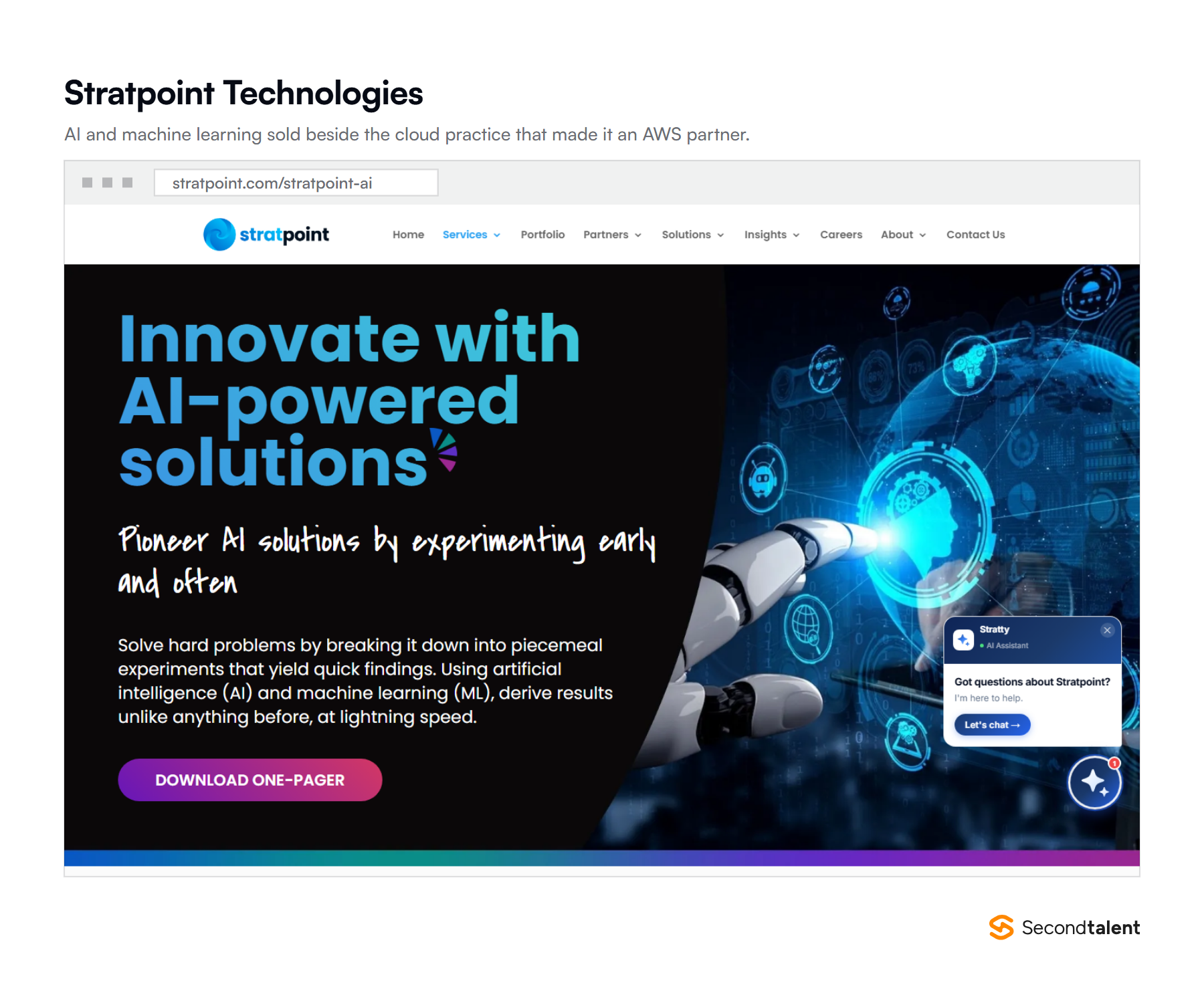
The AI practice sells experiments rather than transformation decks: break the problem into pieces, test, keep what works. That means machine learning, generative AI and the data engineering underneath, from the same team that runs the cloud platform.
The client list is the Philippine enterprise roll call: Globe, UnionBank, SM, Singlife and Robinsons. The company started in 2005 when its founder acquired and rebranded a software house called Sequel Solutions, and it added Katalon test automation partnership in late 2025.
- Best for: banks, telcos and retailers running AI on AWS with compliance obligations.
- Watch out: the cloud practice is the anchor, so ask how many engineers sit on AI work.
- Published scale: founded 2005, AWS Advanced and MSP partner, no headcount published.
6. Exist Software Labs: generative AI for enterprise systems
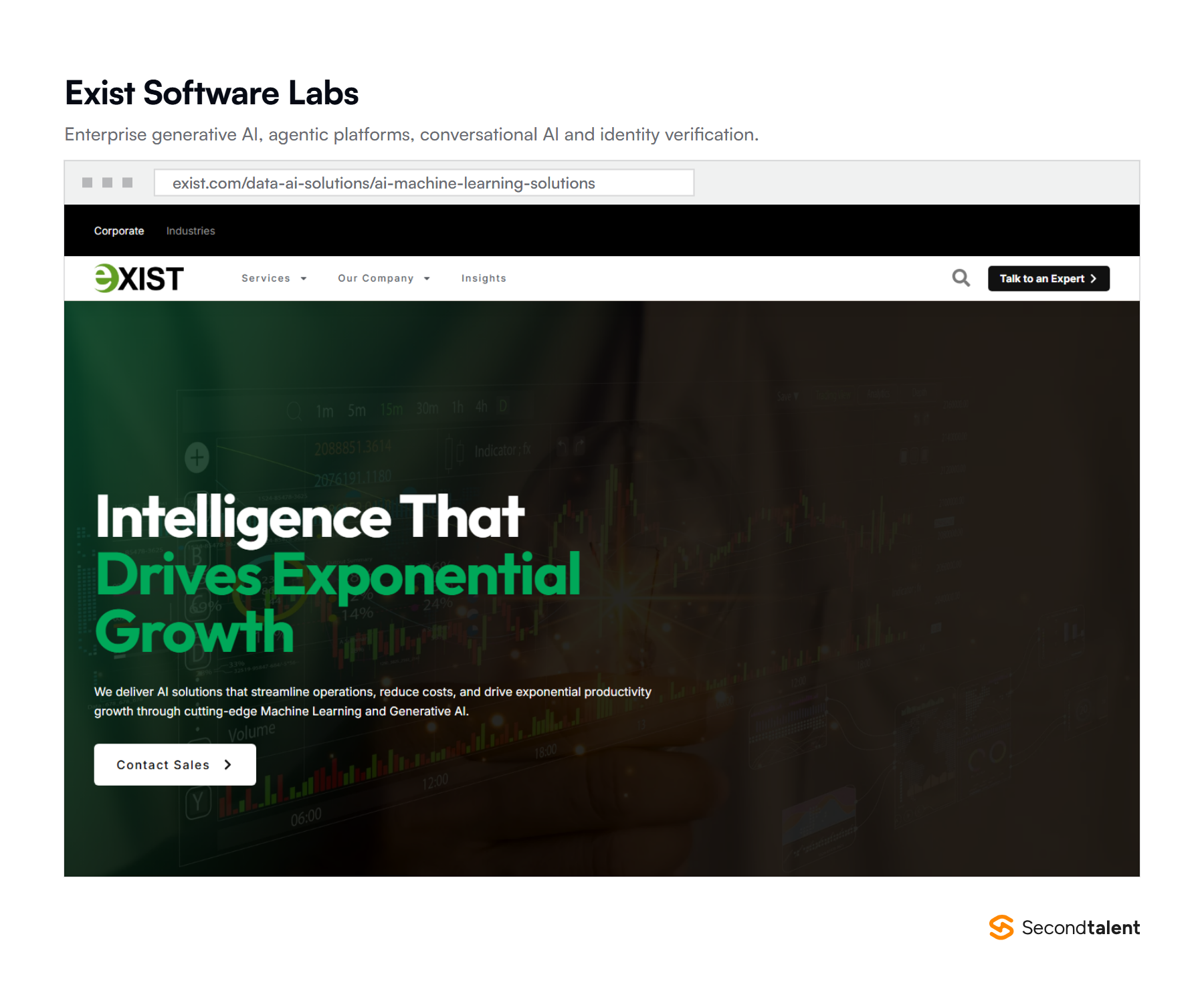
Exist sells AI that has to plug into systems a bank or insurer already runs. Its AI and machine learning page lists conversational AI, generative AI and agentic platforms, predictive analytics, and AI-based identity verification for customer onboarding.
The identity verification line is the tell. It is unglamorous, regulated work that few AI shops want. It also puts Exist in the same conversations as the core banking vendors, not the design studios.
Its published thinking leans to platform choices over model hype, with recent pieces on Microsoft Fabric as the data layer and on when to build rather than buy. That fits a supplier whose clients need one architecture to survive the next model release.
The menu around the AI work is the giveaway: predictive analytics, agentic automation and consulting sold together, aimed at companies that already run large systems and want fewer of them.
- Best for: enterprise integration work, onboarding automation and conversational AI inside existing systems.
- Watch out: no headcount, no client numbers and no pricing published anywhere on the site.
- Published scale: not disclosed.
7. White Cloak Technologies: AI in products that ship to customers
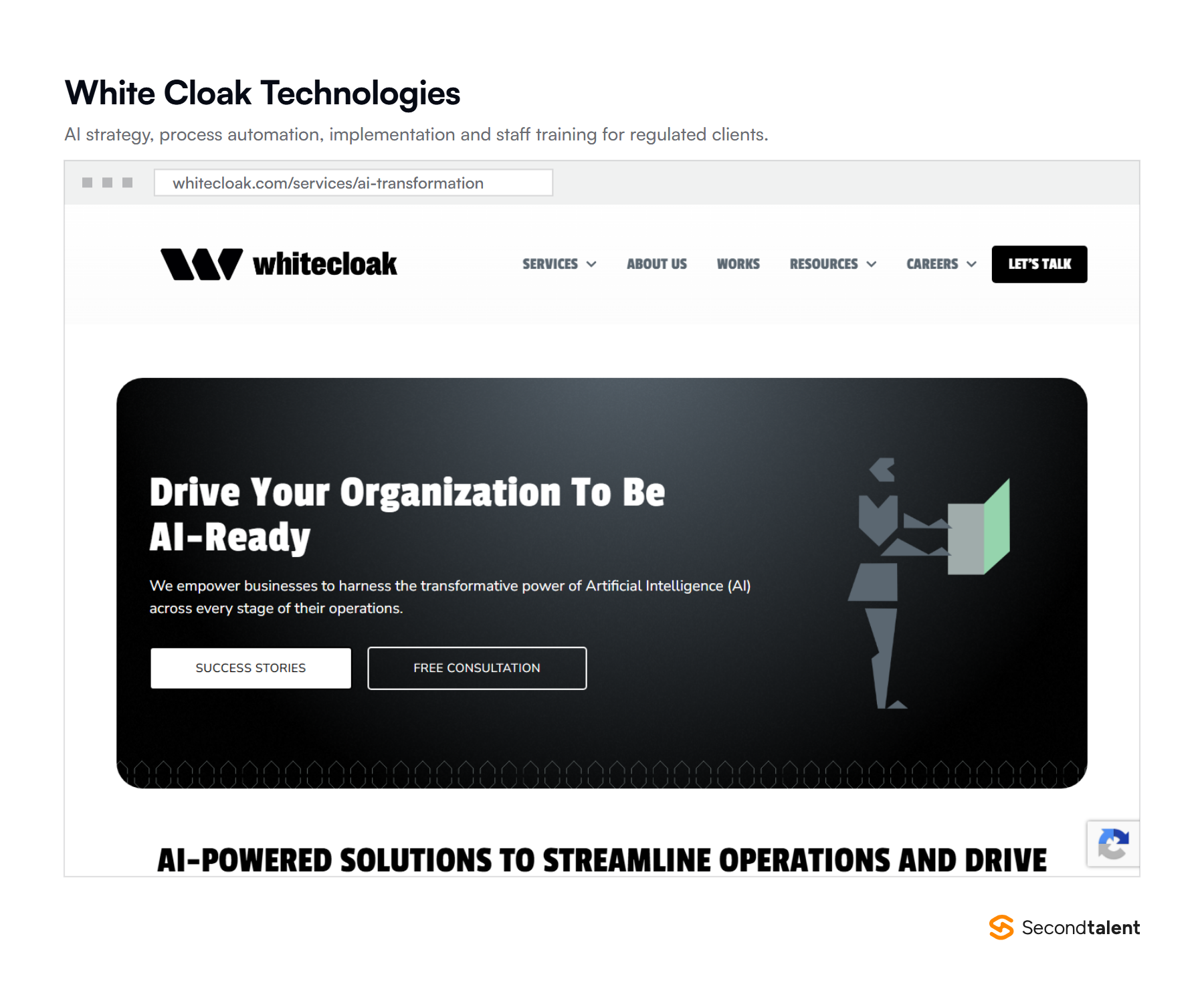
White Cloak came up building consumer-grade apps for large Philippine corporations, and its AI transformation practice follows the same shape: strategy and roadmap, process automation, analytics, implementation, integration, then training for the staff who inherit it.
Training is the part most suppliers skip. Naming it as a service line says something about who White Cloak sells to, which is organisations where adoption fails in the branch rather than in the model.
It also ships its own products, the Pixie AI chatbot among them. Local recognition has followed since 2020, including an Asia CEO Awards circle of excellence place and an Asia Pacific Enterprise Award.
White Cloak started in 2014 and works out of Ortigas Center in Pasig. Its portfolio skews to banking and insurance apps, which is the reason the AI work arrives with a compliance conversation attached.
- Best for: customer-facing AI features inside mobile and web products, plus the change management around them.
- Watch out: a product studio first, so model-heavy work may be subcontracted.
- Published scale: founded 2014, headcount not published.
8. Symph: 89 engineers and a Google partnership
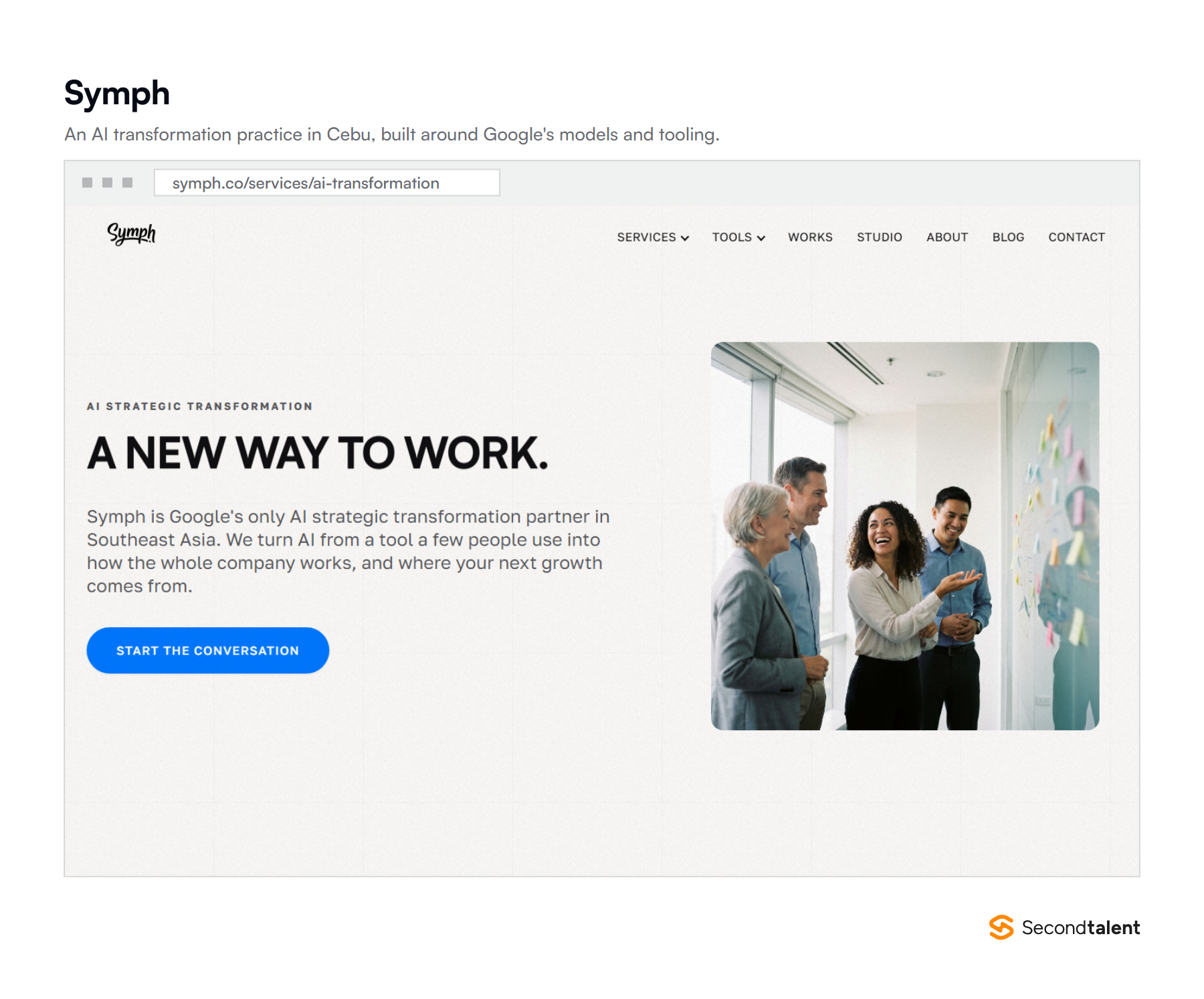
Symph publishes the number six others on this list withhold: 89 engineers, after 16 years. That is small enough to name each person on your project, and large enough to staff one. It is also the clearest picture available of a mid-sized Philippine AI partner.
It describes itself as Google’s only AI strategic transformation partner in Southeast Asia. Engagements open by mapping how teams work today and where AI fits. Its own framing: the boring 30% of the work moves to AI, and the team keeps the rest of the week.
Being in Cebu rather than Manila matters more than it sounds. Salaries and attrition both run lower outside the capital, and Cebu holds the second deepest engineering pool in the country. Full Scale and Arcanys deliver from the same city for the same reason.
- Best for: mid-sized companies embedding AI into existing workflows rather than building a platform.
- Watch out: at 89 engineers, a large programme will consume a real share of the firm.
- Published scale: 89 engineers, 16 years, one Google partnership.
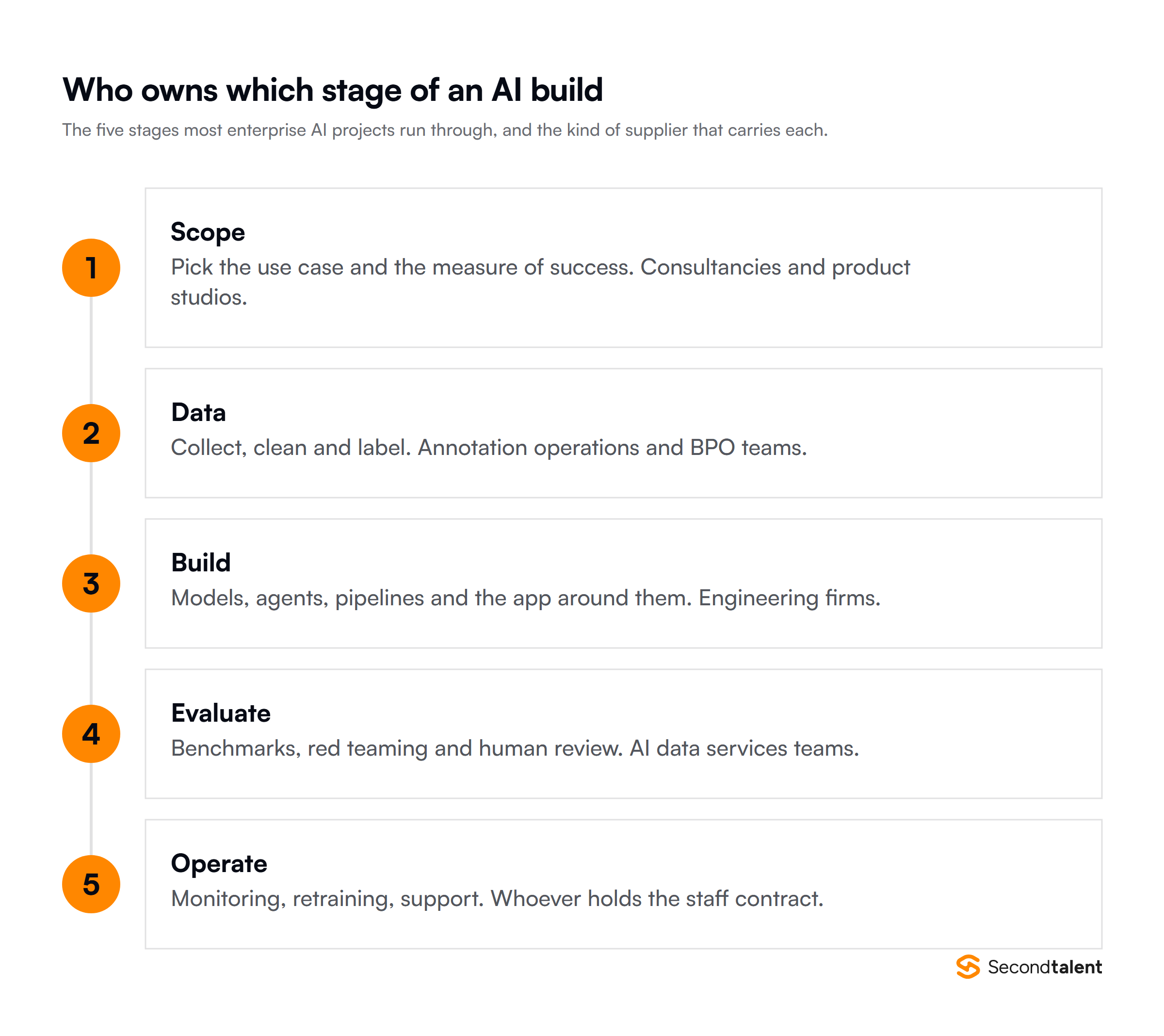
Most disappointing engagements come from buying one stage and assuming the supplier covers the next. A consultancy that scopes well seldom wants the labelling. An annotation operation will not evaluate the model it helped train.
9. Full Scale: the only published price on this list
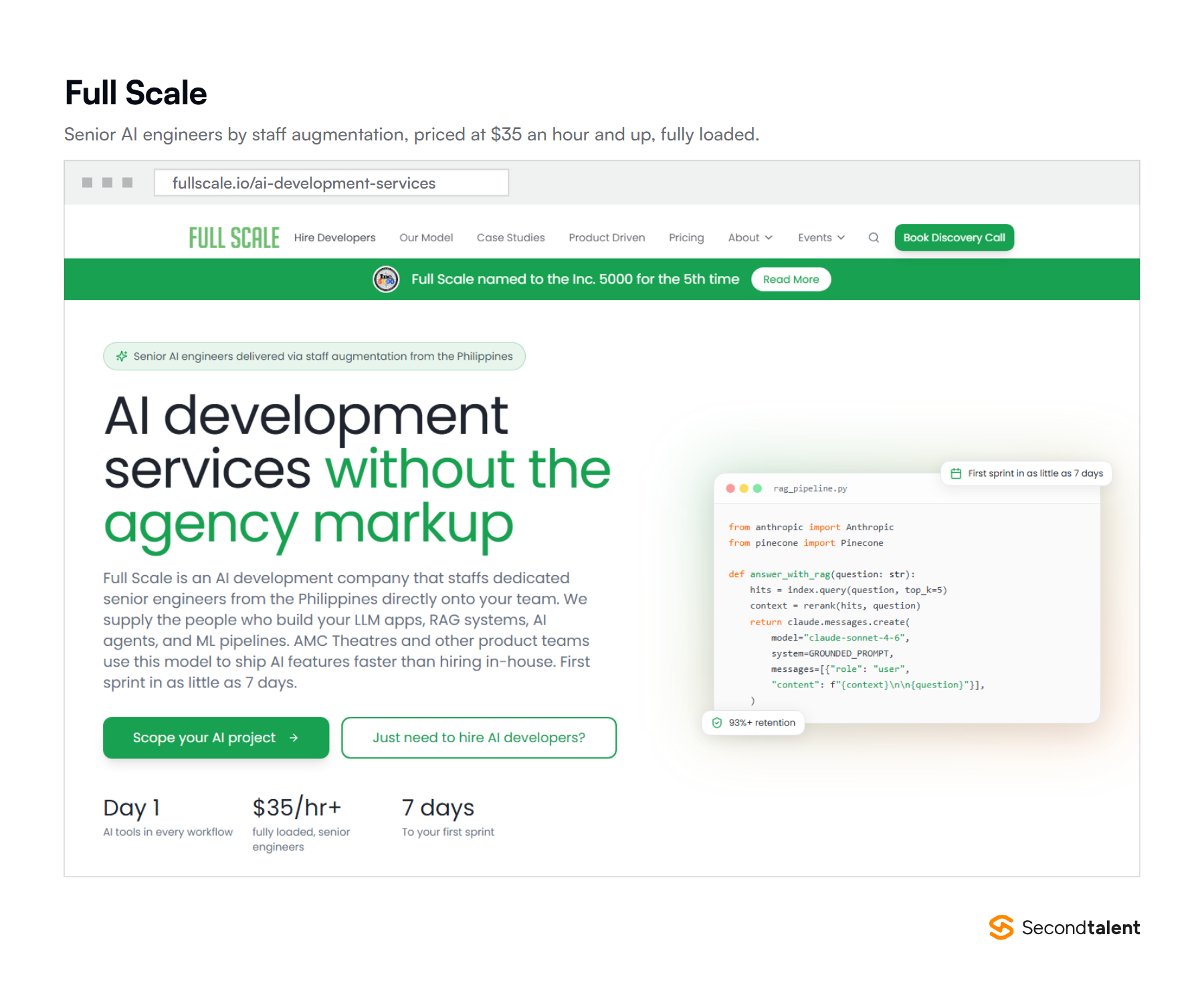
Full Scale puts $35 an hour and up, fully loaded, on the page, which makes it the only company here you can budget against before a sales call. Engineers work from the Philippines, join your team, and report to your technical lead.
The specialisms are current rather than generic: LLM applications, RAG systems, agent engineering with the OpenAI and Anthropic agent SDKs, LangGraph and CrewAI, plus machine learning and MLOps. Its engineers work in Claude, GitHub Copilot and Cursor daily. The company calls that a hiring filter, not a perk.
It claims a first sprint in as little as seven days, retention above 93%, and five Inc. 5000 listings. AMC Theatres, which runs more than 900 cinemas, is the named reference client.
Its founder also builds product startups inside the company. That is where the AI practice gets its own reps, rather than learning on a client’s budget.
- Best for: product teams that want senior AI engineers inside their own process, fast.
- Watch out: staff augmentation puts the architecture and the outcome on you.
- Published scale: $35 an hour and up, 93%+ retention, five Inc. 5000 listings.
10. Annotera: labelled data from four Philippine cities
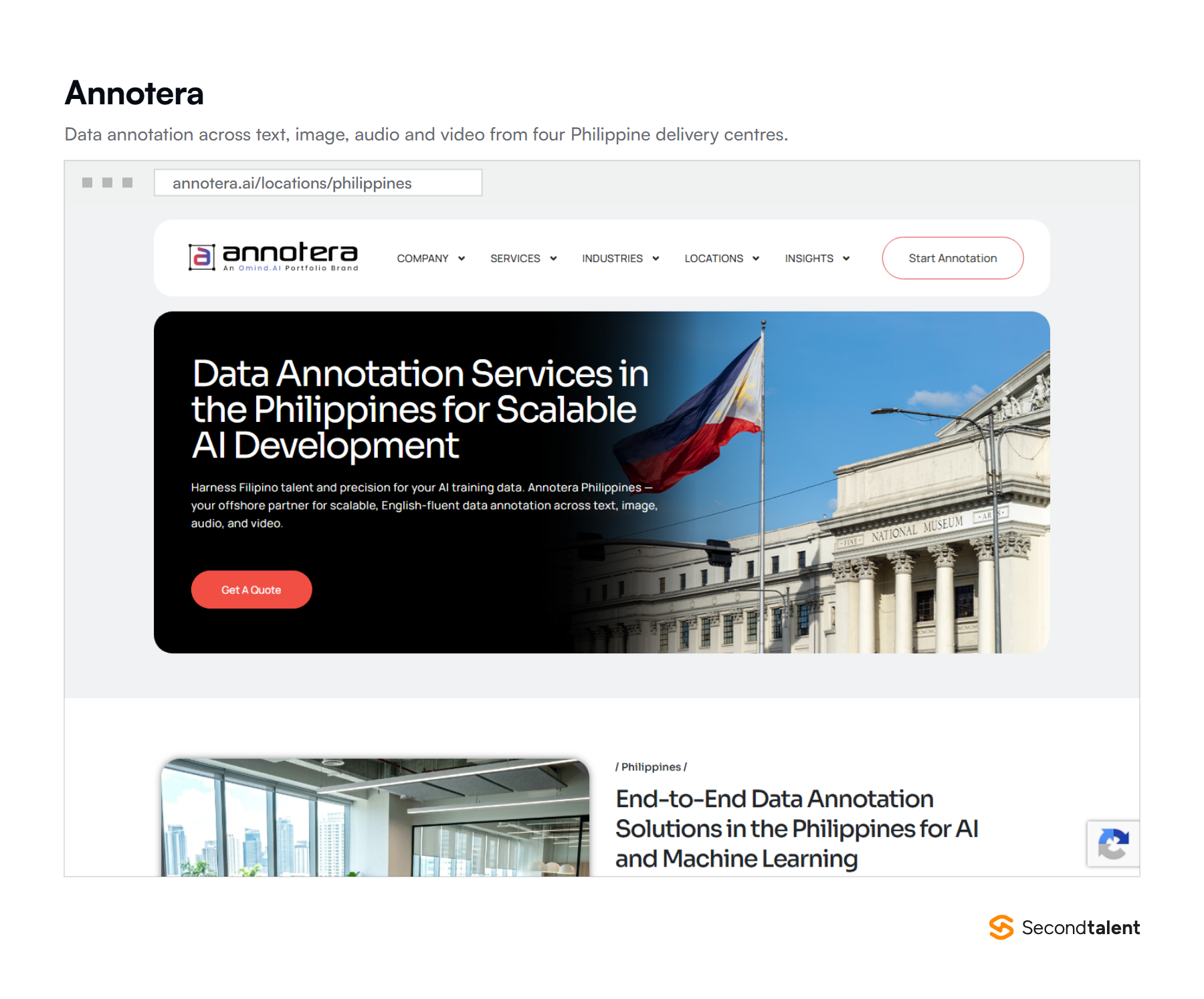
Annotera runs annotation teams in Manila, Cebu, Silang in Cavite, and Legazpi City, covering text, image, audio and video. Putting centres in Silang and Legazpi is the interesting decision, because it reaches labour pools that the Manila and Cebu operators have already bid up.
Quality control runs in three layers: annotator review, team lead spot checks, then independent QA, with a claimed 99% accuracy before delivery. Annotera assigns dedicated teams rather than crowd workers, so the people who learn your edge cases in week one are the same ones scaling in month three.
The security wording deserves attention. Annotera calls its practices ISO 27001-aligned rather than certified, alongside HIPAA-aware and GDPR-compliant workflows.
Ownership deserves a line. Annotera is the annotation brand of Omind AI and sits behind Fusion CX, a 20,000-employee group, with 12 delivery locations worldwide. You are buying Philippine delivery from a global operator, not a Philippine company, which matters for contracting and for where your data sits.
If labelled data is the whole job, compare it against building the function yourself. Our guides to hiring data annotators in the Philippines and the Philippine annotation market cover the salary and quality maths.
- Best for: multimodal labelling at volume with dedicated teams and English-language nuance.
- Watch out: security is described as aligned to ISO 27001, so ask for the certificate.
- Published scale: four Philippine centres, 12 locations worldwide, backed by a 20,000-employee group.
What the Work Costs, and Why the Industry Cut Its Own Target
The Philippine IT-BPM sector earned $40 billion in export revenue in 2025, with 1.9 million workers. In July 2026 its industry association cut the 2028 outlook to $50.5 billion and 2.14 million jobs in the best case. In 2022 it had projected $59 billion and 2.5 million.
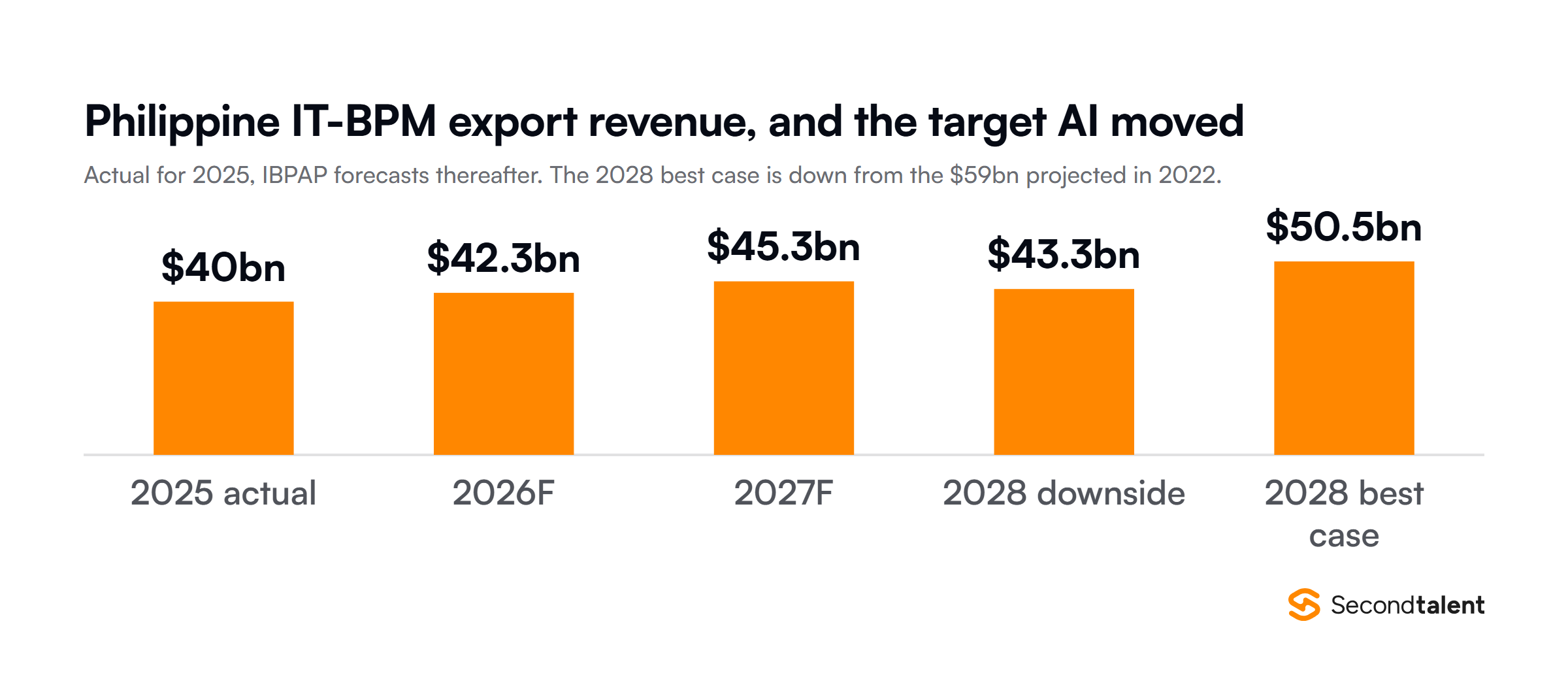
IBPAP president Jack Madrid named AI, buyer behaviour and global competition as the risks, and put the downside case at $43.3 billion with 1.85 million workers. His own framing was that the outlook is “ambitious, but achievable”, depending on how fast the country invests in talent.
That pressure reaches vendor pricing. Nine of the ten publish no rate at all, so the floor under any quote is what the engineers themselves cost.
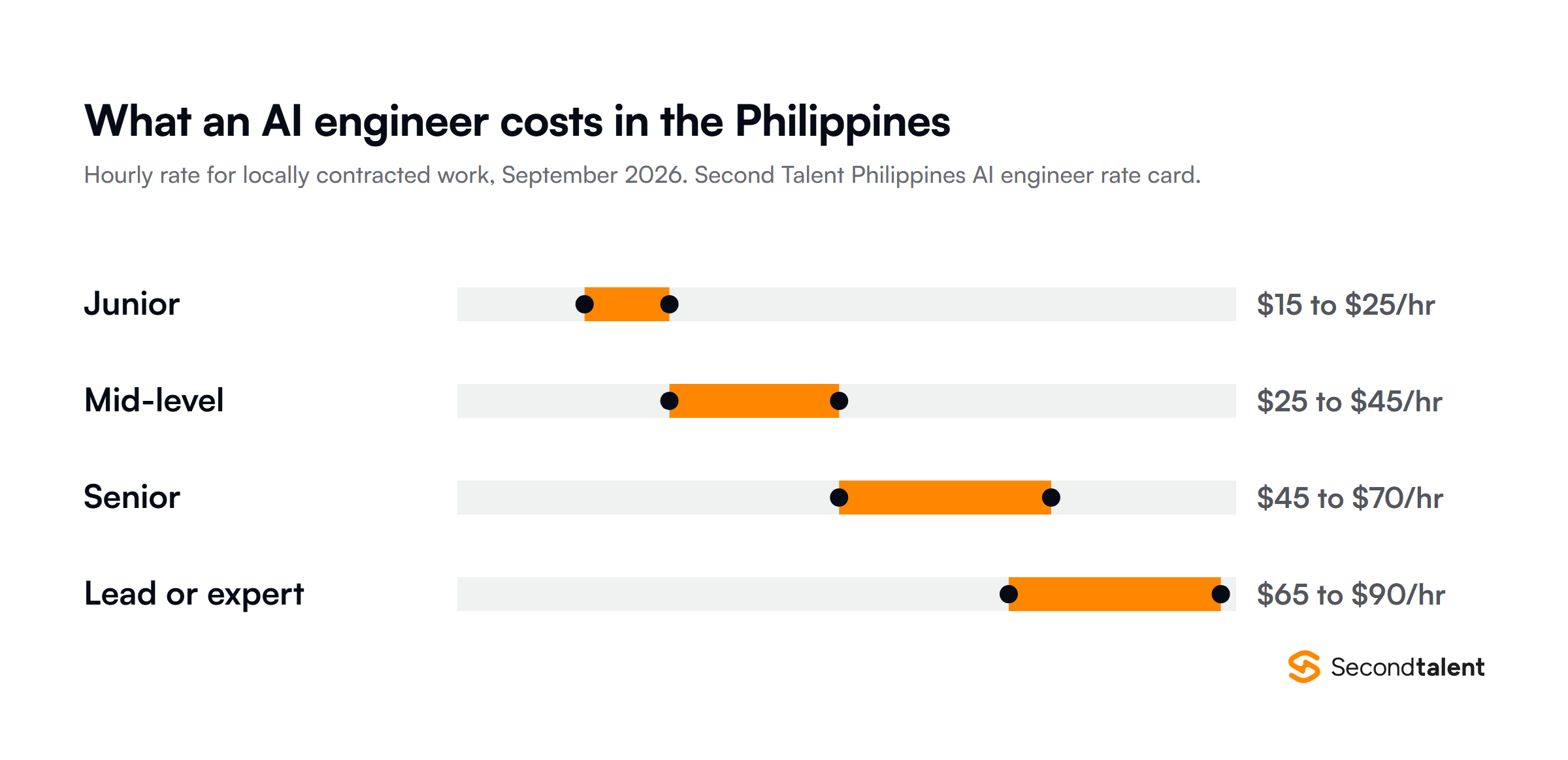
Our Philippines AI engineer rate card puts mid-level work at $25 to $45 an hour and senior work at $45 to $70 on local contracts. The same people charge $35 to $60 and $60 to $90 on international ones. A vendor quote sits above both bands, because it carries management, QA and the bench.
- Priced per unit, per seat or per hour of review
- Scales up and down within weeks
- Ask about QA layers, throughput and who owns the labels
- Priced per engineer per month, with a bench premium
- Takes weeks to staff and months to be productive
- Ask for named engineers and what happens when they leave
One more number belongs in the comparison. The country hosts about 200 global capability centres, adding about ten a year. The largest, JPMorgan Chase, employs an estimated 21,000 people. Those centres bid for the same engineers these vendors are quoting you.
When Hiring the Engineers Beats Hiring the Vendor
A vendor is the right answer for a project with an end date. Ongoing AI work often is not. The context that makes year two cheaper leaves with the delivery team. We built Second Talent for that case: AI engineers in the Philippines hired as your own staff, at a monthly cost you can set against the bands above.
Our Philippines employer of record carries the employment if you have no entity, and data annotation outsourcing runs the labelling side as a managed service. If you are still comparing countries, our Philippines, Vietnam and Indonesia comparison sets out the trade. Tell us what you are building and profiles follow within 24 hours.
Frequently Asked Questions
Which is the largest AI outsourcing company in the Philippines?
TaskUs, with more than 63,000 teammates worldwide and the Philippines as its largest delivery base. Its AI data services division covers annotation, RLHF, model testing and AI safety work.
How much does it cost to outsource AI development to the Philippines?
Expect a vendor rate above the local engineering rate, which runs $25 to $45 an hour for mid-level AI work and $45 to $70 for senior. Full Scale publishes $35 an hour and up for fully loaded senior engineers, which is a useful floor when comparing quotes.
Is the Philippines better for AI data work or AI engineering?
Data work, on current evidence. English fluency, an experienced BPO workforce and 1.9 million people already doing process work make labelling, moderation and evaluation the deepest capability. The engineering firms are strong but smaller, with Symph publishing 89 engineers and most others publishing nothing.
Will AI shrink the Philippine outsourcing industry?
The industry association now plans for both outcomes. Its 2028 best case is 2.14 million workers and its downside is 1.85 million, against 1.9 million in 2025. Revenue still grows in both scenarios, which points to higher-value work rather than fewer suppliers.
Do you need a Philippine entity to work with these companies?
No. All ten take contracts from foreign clients, and several sign outside the country: TaskUs from the United States, Full Scale from the United States, Annotera through its parent group. You need an entity or an employer of record only if you hire the engineers yourself.

![How to Hire Developers in Asia Remotely. How to Hire Developers in Asia Remotely from the USA [2026], by Second Talent.](https://www.secondtalent.com/wp-content/uploads/2026/09/hire-developers-in-asia-remotely-featured-v2-768x403.jpg)
![Workplace Diversity Statistics. Top 100+ Workplace Diversity Statistics [2026], by Second Talent.](https://www.secondtalent.com/wp-content/uploads/2026/09/workplace-diversity-statistics-featured-v2-768x403.jpg)