Five routes put engineers in Vietnam on your team: an employer of record, direct contractors, a dedicated team through a talent partner, an outsourcing vendor, or your own entity.
On 1 March 2026 Vietnam reversed the sequence foreign investors had followed for a decade. Under Law 143/2025/QH15 you can now register the company first and apply for the investment certificate within the next twelve months, instead of waiting on the certificate to exist at all. It is a real simplification, and most companies hiring five or ten engineers in Hanoi or Ho Chi Minh City still never need it. In the Vietnam hires we place, the deciding factor is almost never the monthly headline cost.
The five routes, side by side
| Route | Who employs the engineer | Working by | What you pay | Fits when |
|---|---|---|---|---|
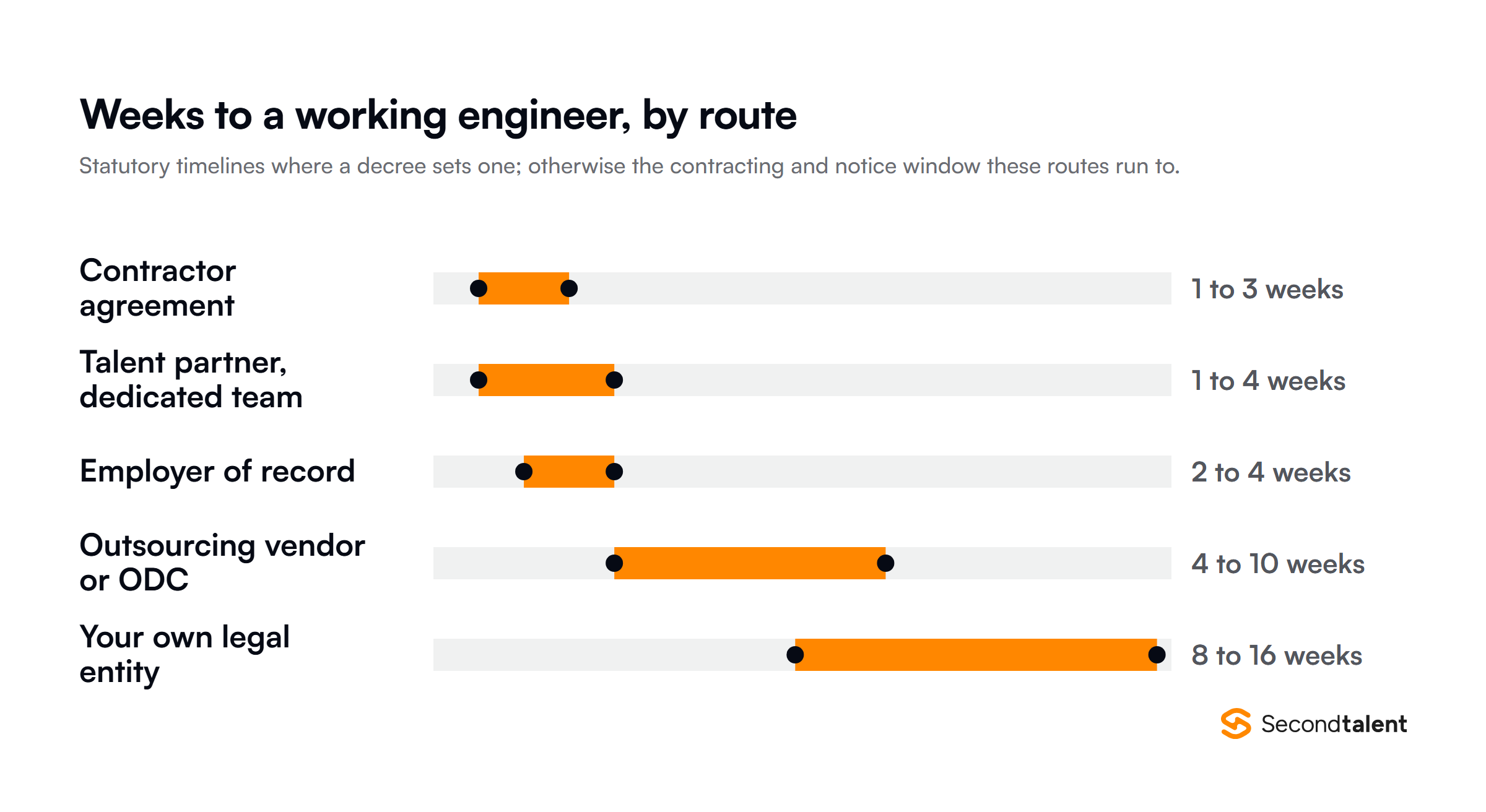
| Employer of record | The provider’s Vietnamese entity | 2 to 4 weeks | Salary, 23.5% employer contributions, $199 to $699 a month | You want employees rather than vendors, without a company of your own |
| Direct contractors | Nobody. They invoice you | 1 to 3 weeks | Their rate. They handle their own tax | Scoped, finite work with an independent specialist |
| Talent partner, dedicated team | The partner, on a Vietnamese contract | 1 to 4 weeks | One blended monthly rate per engineer | You want vetted engineers embedded in your team and managed by you |
| Outsourcing vendor or ODC | The vendor | 4 to 10 weeks | Fixed price, or a blended day rate per role | The scope is defined and you have no engineering managers to spare |
| Your own entity | You | 8 to 16 weeks | $3,500 to $21,000 to set up, then payroll and filings | Fifteen to twenty engineers, local revenue, a long horizon |
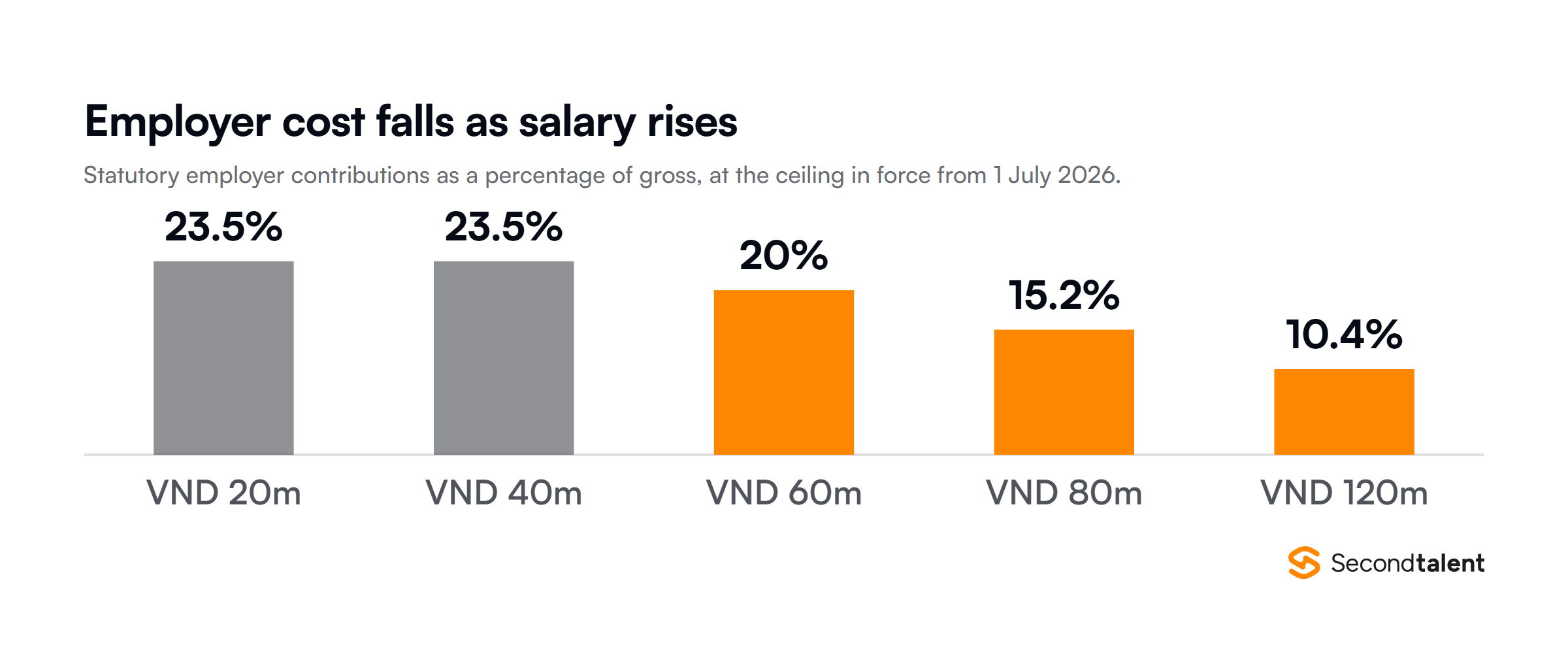
- 1Employer contributions run to 23.5% of gross pay, but the social and health base stopped rising at VND 50.6m a month on 1 July 2026, so a senior engineer costs a smaller share of pay to employ than a junior one.
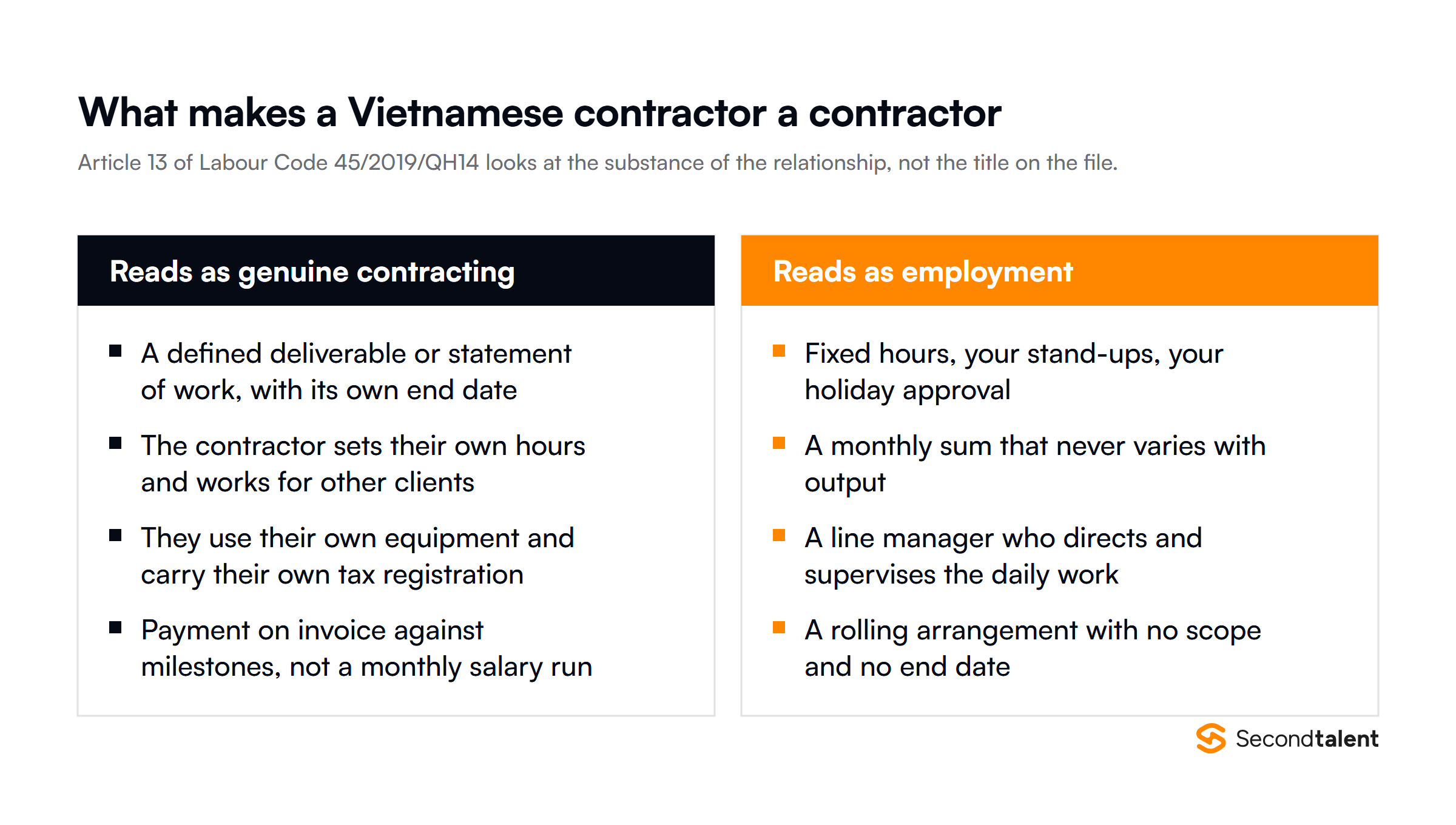
- 2Article 13 of the Labour Code reads a contract as employment when one side manages and supervises the work, whatever the document is called.
- 3Since 1 January 2026 a Vietnamese individual pays nothing on the first VND 500m of business revenue a year, five times the old threshold, which changes the arithmetic for freelancers.
- 4ITviec puts a senior back-end developer on VND 54.9m a month, around $2,100. That is the local employment market, not the international contract market, and the two carry different prices.
What’s your Vietnam hiring priority?
Select your situation below.
An employer of record signs the contract on an entity that already exists, so a Vietnamese hire starts in two to four weeks once you have chosen the person. A foreign hire needing a work permit takes five to eight weeks, helped by Decree 219/2025, which cut the statutory processing time to ten working days. Building your own company first puts three to six months in front of the same hire. See how EOR works in Vietnam
Our own rate data puts a mid-level full-stack developer in Vietnam at 0.44 times the equivalent United States rate, a saving of roughly 56%. Local employment salaries sit lower again: ITviec puts a mid-level back-end developer at VND 30m to 55m a month. You also avoid the setup cost of a Vietnamese company. Check Vietnam developer rates
Employers in Vietnam owe 23.5% on top of gross pay, and 2026 moved three of the numbers underneath that: a new minimum wage, a new contribution ceiling from 1 July, and a rewritten personal income tax law. An EOR carries the filings and the liability. Compare EOR options
Vietnam’s shortfall is concentrated in senior, AI and security roles rather than junior developers, so the search matters more than the market. We place pre-vetted engineers across the stack. Browse developer roles in Vietnam
1. Employer of record: a Vietnamese employee without a Vietnamese company
An employer of record is a company that already holds a Vietnamese entity and employs your hire on your behalf. The person signs a Vietnamese-law contract with the provider, appears on the provider’s payroll and social insurance filings, and works for you every day.
This is the route for a team that wants employees rather than suppliers: people who sit in your stand-ups, hold your repository access and stay for years, in a country where you have no legal presence and no plan to build one.
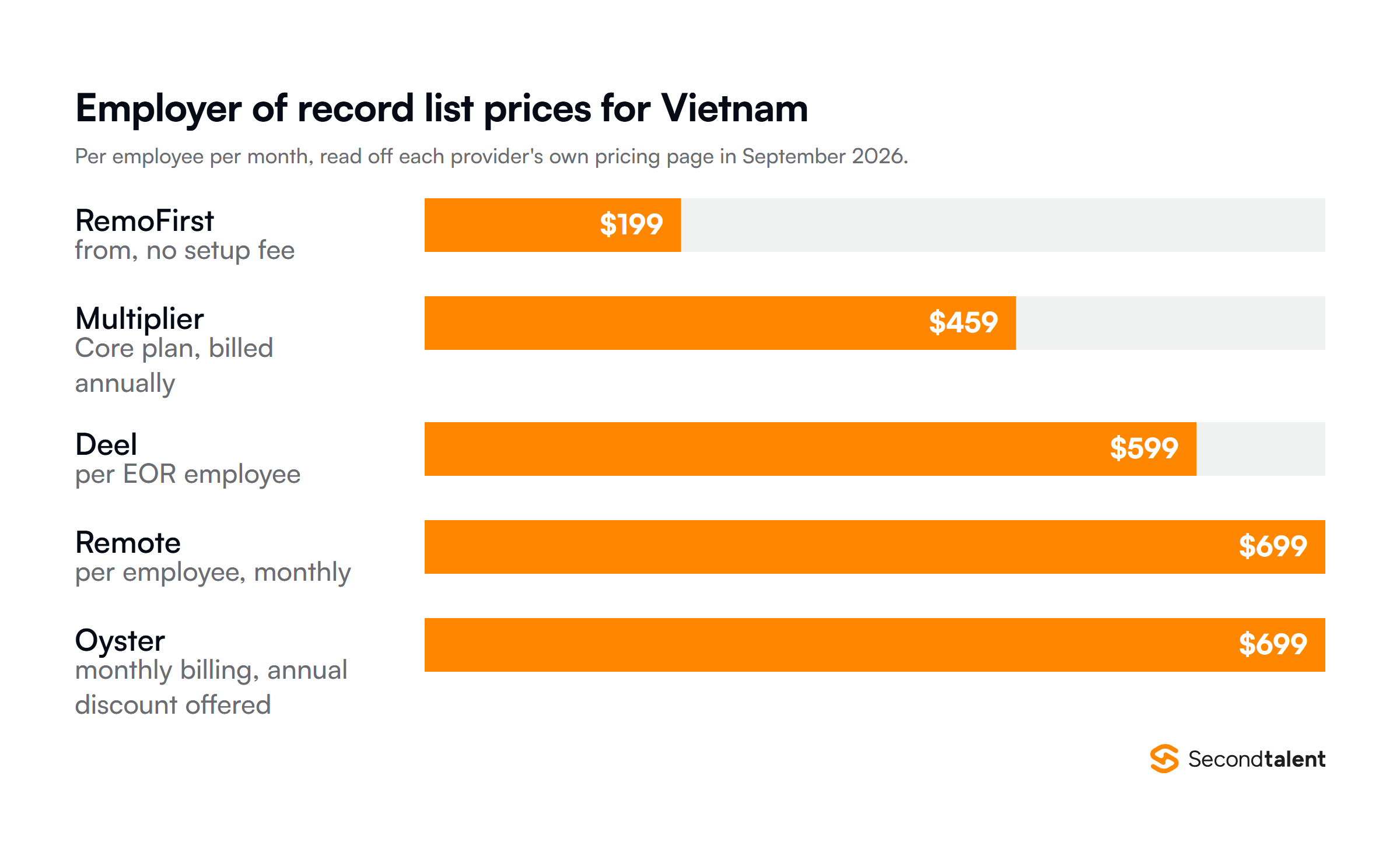
Providers publish their prices, and the spread is wide. Read off each provider’s own pricing page in September 2026, RemoFirst starts at $199 per person a month with no setup fee, Multiplier’s Core plan is $459 billed annually, Deel is $599, and Remote and Oyster both list $699.
The fee is the small number. On top of gross salary a Vietnamese employer owes 23.5%: social insurance 17.5%, health insurance 3%, the trade union fee 2% and unemployment insurance 1%. The employee pays a further 10.5% out of their own pay.
That percentage is not flat. The law caps the social and health base at twenty times the reference level, and Decree 161/2026 lifted that reference level to VND 2,530,000 on 1 July 2026, moving the cap from VND 46.8m to VND 50.6m a month.
Above the cap, contributions stop growing while salary keeps going. A VND 80m engineer costs 15.2% on top, not 23.5%.
A foreign national on a work permit sits outside unemployment insurance, so the employer side falls to 22.5%.
The permit itself got faster in 2026. Decree 219/2025 merged the old two-stage approval into one online dossier and cut the statutory timeline to ten working days. A foreign hire now lands at five to eight weeks rather than three months.
- Best for: one to fifteen permanent engineers, a first hire in the market, or a person you already found and need to employ next month.
- Where it struggles: the per-head fee does not fall with scale, so at fifteen to twenty engineers it starts to rival your own entity. Providers also differ on notice periods, equity handling and who signs the intellectual property assignment. That detail matters more than the monthly price.
- What it costs: salary, plus 23.5% employer contributions, plus $199 to $699 per employee per month. Our own Vietnam EOR service covers the filings, the contract and the statutory benefits.
2. Direct contractors: fastest to start, easiest to get wrong
A contractor agreement is the only route with no third party in it. You sign with the individual, they invoice you, and they register and declare their own Vietnamese tax. Nothing needs to exist before you start.
It suits finite, scoped work: a migration, a design system, a mobile build with an end date. It does not suit a permanent engineer you manage daily, and Vietnamese law is explicit about why.
“A document with a different name is also considered an employment contract if it contains the agreement on the paid job, salary, management and supervision of a party.”
Article 13, Labour Code 45/2019/QH14, English translation
Nothing in that test asks what the file is called. It asks whether one party directs the other’s work.
Fixed hours, a line manager, a flat monthly sum and no end date read as employment however you title the agreement. The exposure is back contributions and unpaid statutory benefits, not a fine you can budget for.
The tax side changed this year, in the contractor’s favour. Vietnam abolished the lump-sum method for business households and individuals on 1 January 2026 and moved everyone to declaration, and the tax-free revenue threshold went from VND 100m to VND 500m a year. Above that, an individual who can document costs pays 15% on profit up to VND 3bn of revenue.
As a foreign company with no Vietnamese entity you cannot withhold their personal income tax for them, so the filing sits with the contractor. Write the scope, the deliverables and the end date into the agreement, keep invoices against milestones, and re-read the arrangement every six months. The difference between a remote employee and a freelancer is worth being deliberate about before the relationship drifts.
- Best for: a specialist for a defined piece of work, a pilot before you commit to the market, or a genuine consultant with several clients.
- Where it struggles: permanent work. Six months of daily supervision converts the relationship in substance, and the risk lands on you, not on the contractor. Payment also gets awkward at scale, since each person invoices separately and none of them are on a payroll you can audit.
- What it costs: their rate and nothing else, which is why the route stays tempting well past the point where it works.
3. A dedicated team through a talent partner
This route sits between the employer of record and the outsourcing vendor. A talent partner sources and vets the engineers, employs or contracts them in Vietnam, and hands you people who work only for you. You set the roadmap, run the reviews and decide who gets promoted.
The difference from an EOR is the front half of the process. An EOR employs whoever you found. A talent partner finds them.
That half is the expensive one if you have no recruiter who can read a Vietnamese CV, no way to test an engineer’s English in a working session, and no feel for what a fair offer looks like in Ho Chi Minh City.
Pricing is a single blended rate rather than salary plus contributions plus a platform fee. Our own Vietnam rate data puts a mid-level full-stack developer at $28 to $68 an hour, which is $4,480 to $10,880 a month at 160 billable hours, with juniors from $18 and leads to $120.
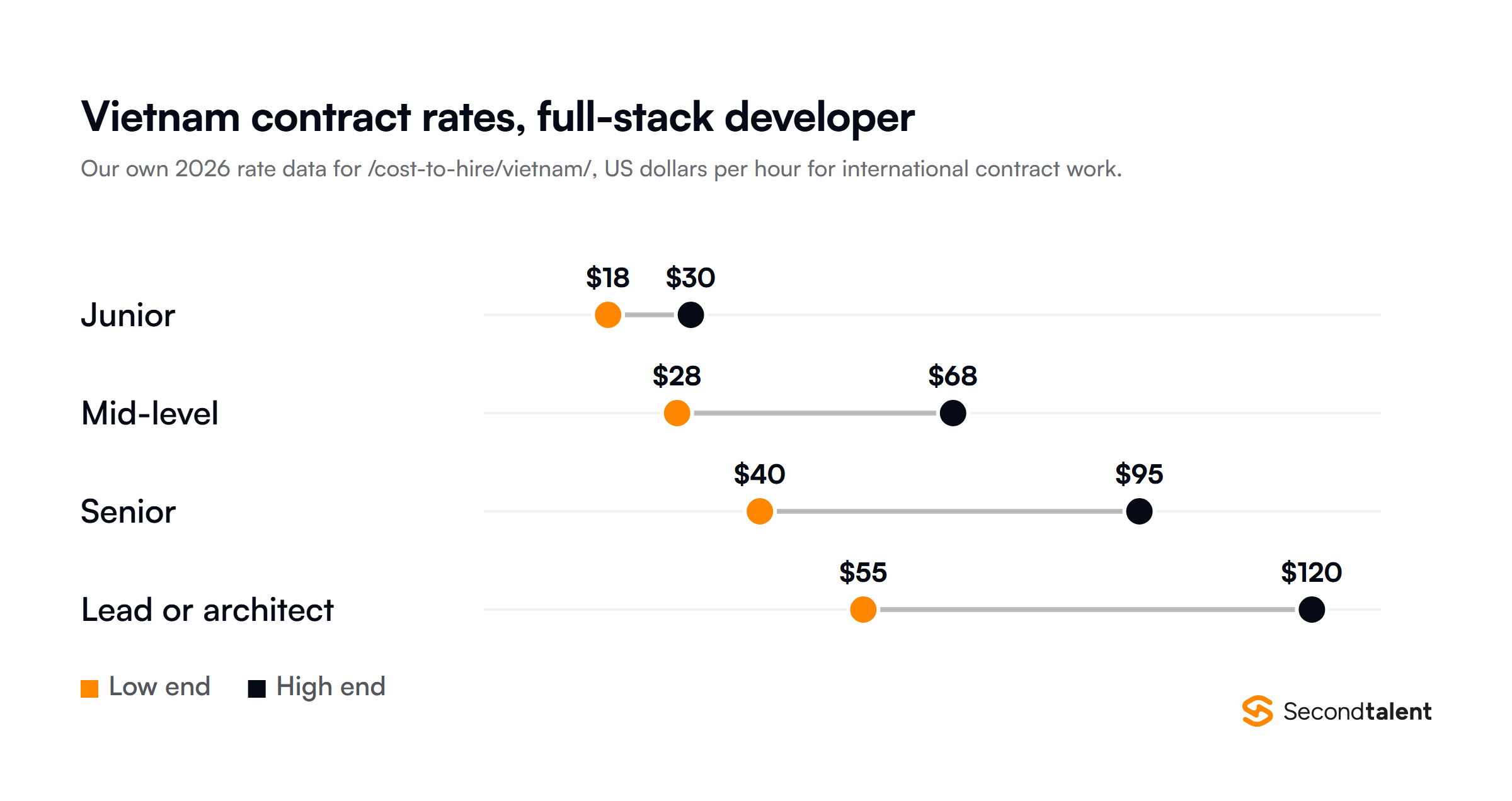
Those numbers are not the same species as a local salary, and mixing them is the most common budgeting error we see in this market. A contract rate covers a business, its margin, its bench and its guarantees. A salary covers one person’s pay.
- Back-end developer median VND 37.8m a month
- Data engineer VND 41.3m, tech lead VND 51.8m
- Entry level starts at VND 12.4m
- Mid-level full-stack $28 to $68 an hour
- Machine learning engineer $39 to $94
- Rate carries vetting, cover and margin
We run this model across nine Asian markets, and Vietnam is where the AI and data roles have moved fastest: AI engineers, data scientists and DevOps engineers now make up more of what clients ask us for than straight full-stack work. The developer rate card prices each of them.
- Best for: standing up three to fifteen engineers in a quarter when you have engineering management but no local recruiting reach.
- Where it struggles: partners differ in how much vetting sits behind the shortlist. Ask how many candidates they screened for the role in front of you, who wrote the technical assessment, and what happens in month two if it is not working.
- What it costs: one monthly rate per engineer, with the employment, payroll and statutory filings inside it. See the Vietnam talent pool for who is available now.
4. An outsourcing vendor or offshore development centre
Vietnam’s digital technology industry turned over $198 billion in 2025 across 80,052 active companies, and the services end of that is the oldest way foreign teams have used the country. You buy delivery, not headcount.
The vendors are not interchangeable, and scale is the first filter. FPT Software runs more than 30,000 people across 30 countries, and its parent group employed 88,553 people at the end of July 2026. Below it the market specialises: TMA Solutions in telecom and embedded work, CMC Global in cloud migration and the Japan corridor, NashTech as a UK-headquartered firm with Vietnamese delivery.
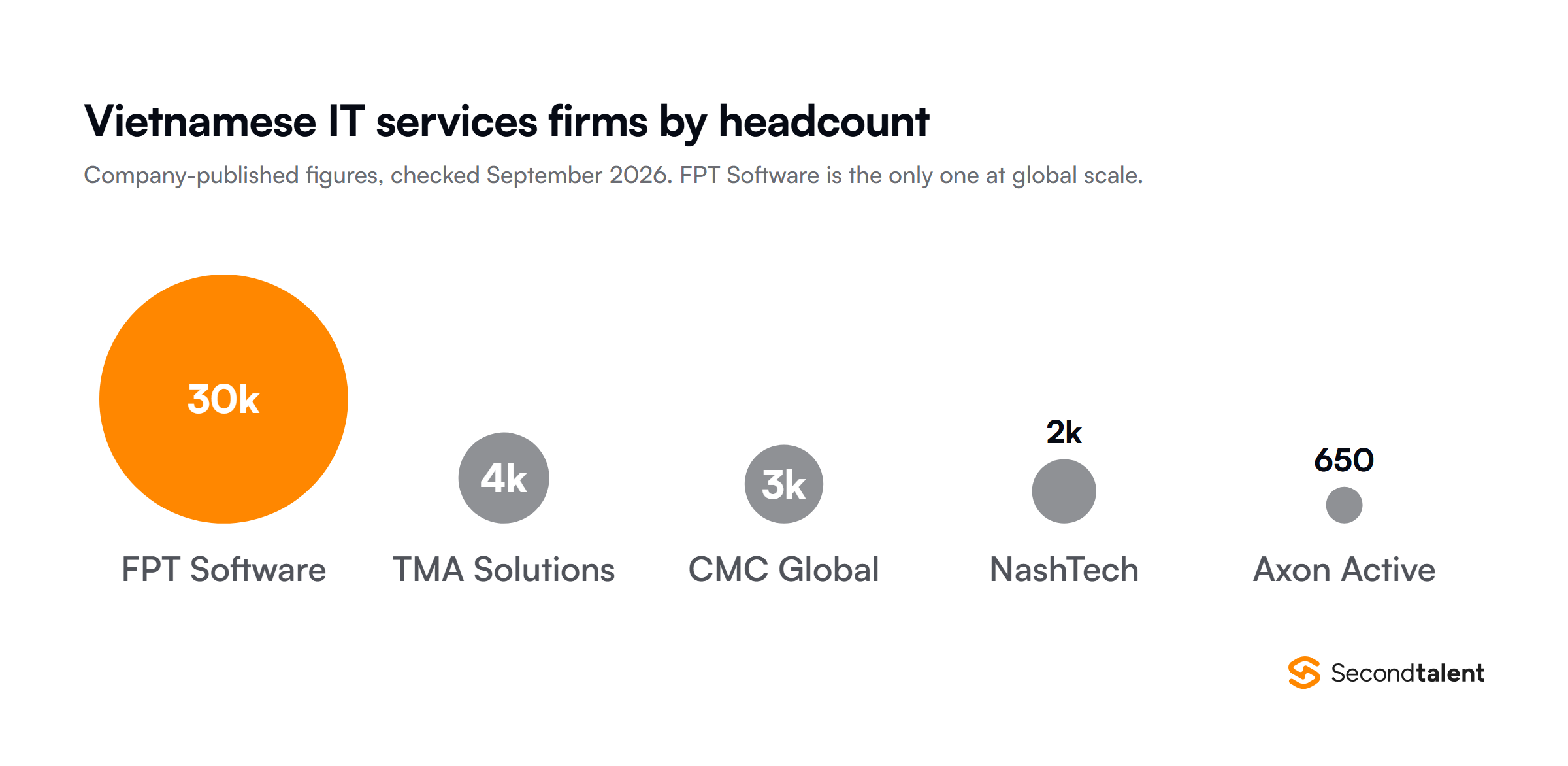
Certifications are the one signal worth checking before a first meeting. TMA Solutions holds CMMI Level 5 and TL 9000 for telecom work, NashTech was the first company in Vietnam appraised at CMMI Level 5 v2.0, and Axon Active is Swiss-owned and runs around 80 teams for 40 clients. None of that proves a vendor will suit you, but it tells you which ones have been audited by somebody other than their own sales team.
Test them on the work, not the deck. Ask for the CVs of the named engineers, run your own technical interview with each of them, and pay for a two-week paid trial on a real ticket before signing a twelve-month agreement.
The variant worth knowing is the offshore development centre. Instead of buying a project you buy a named team: the vendor recruits to your spec, hosts them in its office, and bills a monthly rate per seat.
A build-operate-transfer agreement goes one step further and moves that team into your own entity after an agreed period. Several of the firms in our review of Vietnamese outsourcing companies start their biggest accounts this way.
Two clauses decide whether this route ages well. The first is intellectual property: the assignment has to be explicit, in writing, and cover code from subcontractors. The second is continuity, because a vendor’s incentive is to rotate people between accounts. Name the individuals in the agreement, set a notice period for replacing any of them, and price the handover time.
- Best for: a defined scope, a fixed budget, or a technology you have no one in-house to supervise. Vietnam’s software delivery market is deepest in the enterprise and embedded work most vendors sell.
- Where it struggles: product work with a moving roadmap. Fixed-price contracts punish change, and time-and-materials contracts remove the discipline that made fixed price attractive. A vendor margin of 30% to 50% also sits on top of every hour.
- What it costs: a blended day rate per role, or a project price. Neither line is the engineer’s salary.
5. Your own Vietnamese entity
Owning the entity is the only route where the engineers are your employees, with no fee per head and no third party in the contract. It is also the only one you cannot unwind in a month.
The sequence changed this year. Until March a foreign investor needed an investment registration certificate before the company could exist at all.
Law 143/2025/QH15 lets an investor who meets market-access conditions take the enterprise registration certificate first, then file for the investment certificate within twelve months. The same law cut conditional business lines from 227 to 198 on 1 July 2026.
The licences are not the slow part. The investment certificate runs to fifteen business days and the enterprise certificate three to five.
The bank account, the capital transfer, the seal, the tax registration and the first filing take longer than all of it. Plan for two to four months from decision to a payroll that runs, if you have no local partner.
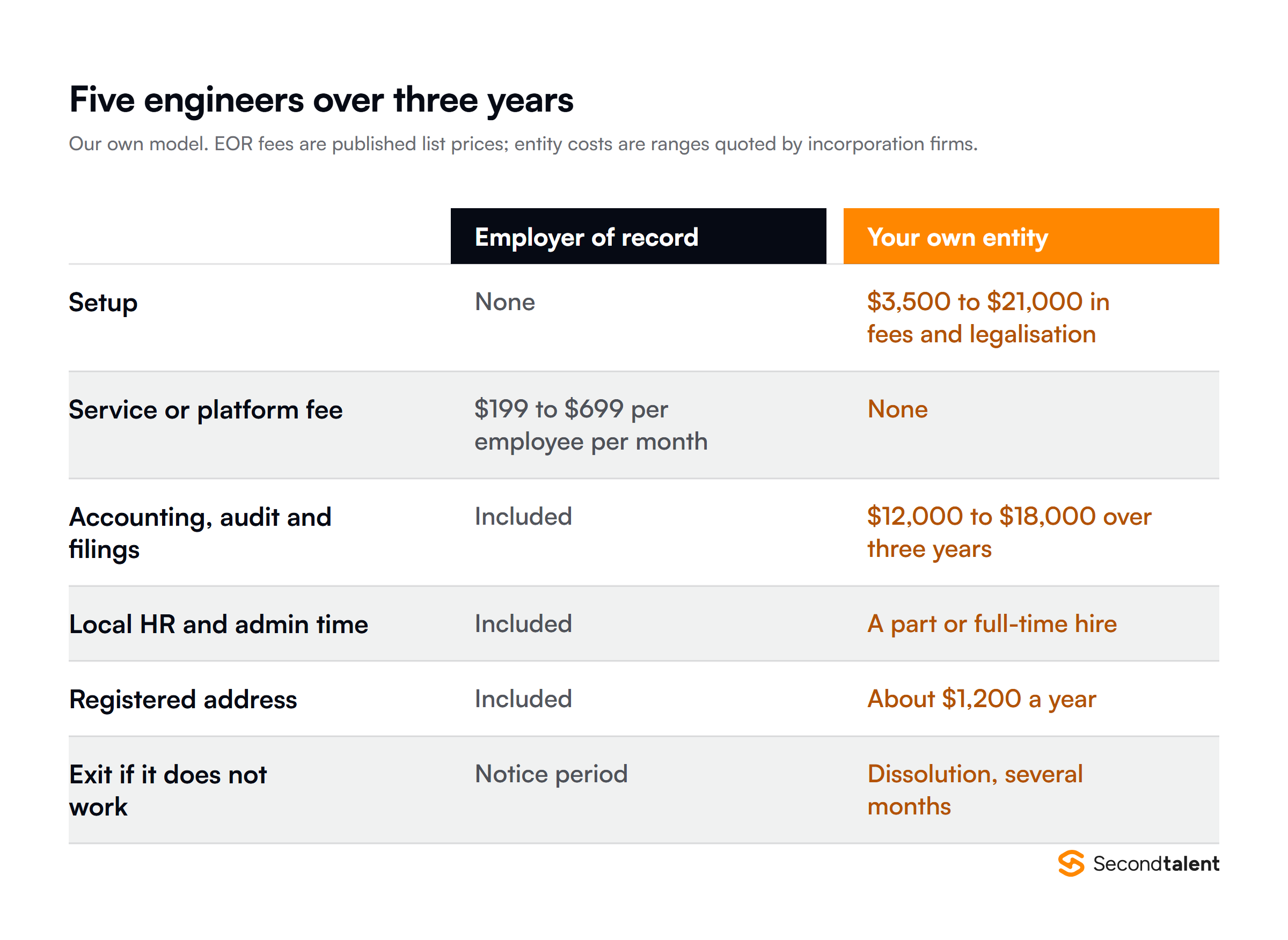
The running cost is where the comparison turns. An entity needs monthly accounting, an annual audit, a registered address and someone who owns payroll and social insurance filings in Vietnamese. The 23.5% employer stack is the same on both routes. The difference is who files it, and who answers for a late filing.
One incentive is worth checking before you write the entity off as a cost centre. The Law on Digital Technology Industry, in force since 1 January 2026, gives qualifying high-quality personnel on semiconductor, AI and training projects in designated zones a five-year personal income tax exemption. It is narrow and project-specific, so treat it as a possible bonus for a particular team, never as a general discount.
Four statutory changes landed in 2026, and each one moves a number that a 2025 hiring plan would have used.
- Best for: fifteen to twenty engineers and up, a plan measured in years, or revenue you need to invoice and collect inside Vietnam.
- Where it struggles: the first hire. Nobody starts work while the bank account is opening, and an exit means dissolution, which takes months and a final audit.
- What it costs: $3,500 to $21,000 to set up, then $12,000 to $18,000 of accounting and filings over three years, a registered address at around $1,200 a year, and the management time nobody budgets for.
Getting the first Vietnamese hire live
Most teams that come to us have already tried the cheapest version of this: one contractor, found through a friend of a friend, working full time on a rolling invoice. It works until the person matters, and then the arrangement is doing the opposite of what it was chosen for.
We place pre-vetted engineers across nine Asian markets. We either employ them ourselves or run them through our Vietnam employer of record, so the first hire can start in weeks without a company of your own. If you would rather source it yourself, we have covered the job boards that work in Vietnam, and the startups chasing the same engineers are worth knowing before you write an offer.
Tell us the role and we will come back with a shortlist within 24 hours, with the rate, the route and the contribution maths already worked out.
Frequently asked questions
Can I hire someone in Vietnam without a company there?
Yes. Four of the five routes need no Vietnamese entity of your own: an employer of record, a contractor agreement, a talent partner and an outsourcing vendor. Only the fifth requires you to incorporate.
When should we switch from an employer of record to our own entity?
Model it at fifteen engineers and decide at twenty. Below that, per-head fees stay smaller than the fixed cost of accounting, audit, a registered address and the local administrator you will end up hiring. Above it, the fees keep scaling and most of the entity’s costs do not.
Is it legal to pay a Vietnamese freelancer directly from abroad?
It is, as long as the relationship is independent in substance. The individual registers and declares their own tax, and since 1 January 2026 pays nothing on the first VND 500m of revenue a year.
A full-time, supervised role dressed as a contract is the unsafe version. Article 13 of the Labour Code reads that as employment whatever the title says.
Why hire in Vietnam rather than India or the Philippines?
Vietnam ranks 44th of 139 economies on the WIPO Global Innovation Index 2025, third in ASEAN, and it is deep in embedded and hardware-adjacent work because of who manufactures there. English is strong in the major hubs and thinner outside them, so test it in a working session.
Who pays the 23.5%?
The employer, on top of gross salary, whoever that employer is. Through an employer of record or a talent partner it arrives inside the invoice; with your own entity you file and pay it yourself. The employee loses a further 10.5% from their own pay.