
![Tech Startups in Vietnam to Watch. Top 20 Tech Startups in Vietnam to Watch [2026], by Second Talent.](https://www.secondtalent.com/wp-content/uploads/2026/09/tech-startups-in-vietnam-featured-v2.jpg)
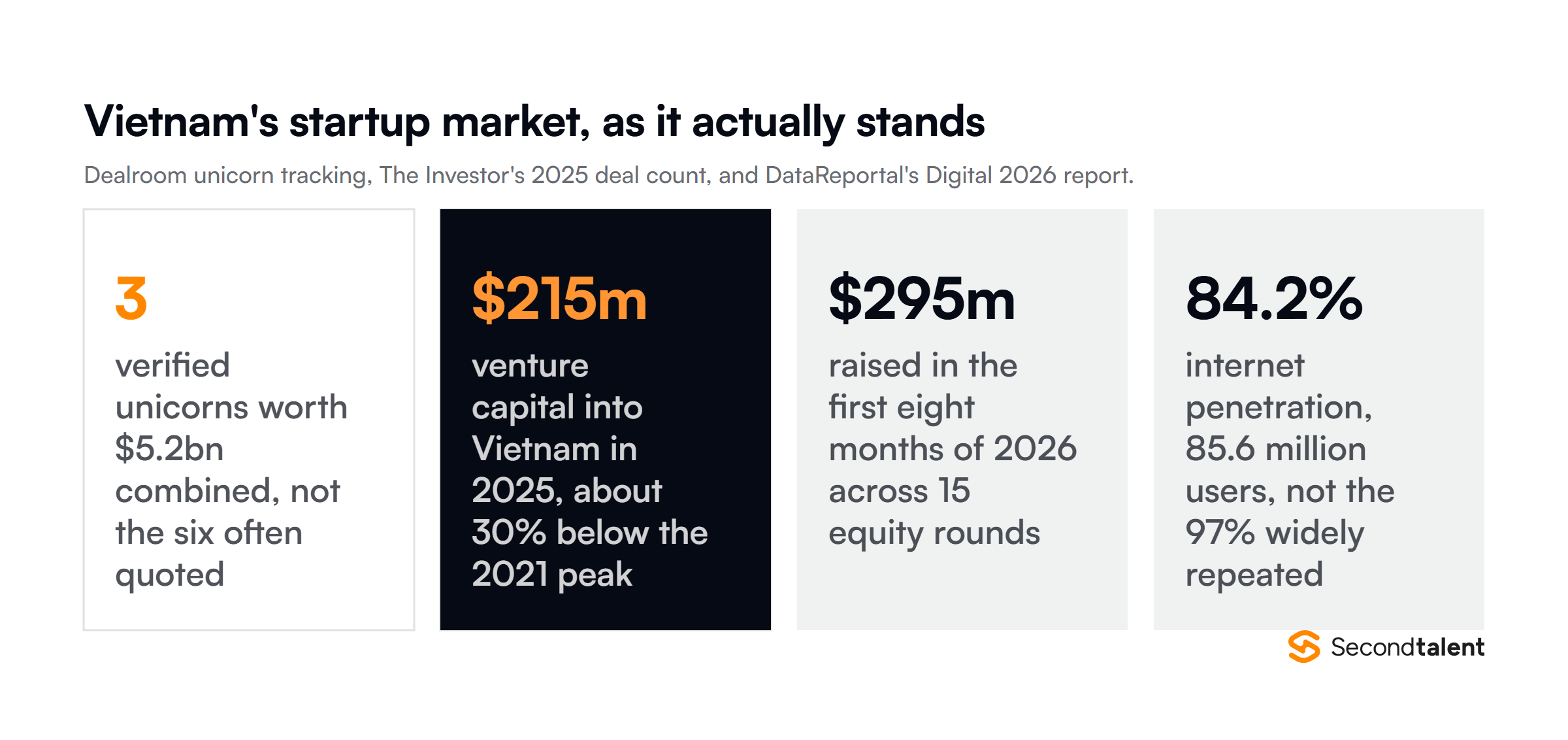
I checked every “top Vietnamese startups” list still ranking on Google, and most of them count six unicorns. Dealroom’s actual verified number is three, worth $5.2 billion between them.
The country’s venture market raised $215 million across 41 deals in 2025, about 30% below the 2021 peak, with the ten largest rounds taking 72% of it.
Most of those lists were written in 2021 and lightly refreshed since, so they still carry companies that have shut down, been absorbed, or left the market they were once famous for.
This guide profiles twenty companies still operating in September 2026, states plainly what happened to the ones that aren’t, and marks which figures are verified against which are self-reported.
The twenty companies below sit in three groups. The first three have verified billion-dollar valuations.
The next eleven are scaled operators, several of which state profitability, which in this market is a stronger signal than a valuation nobody has tested. The last six raised in 2025 or 2026 and are still unproven.
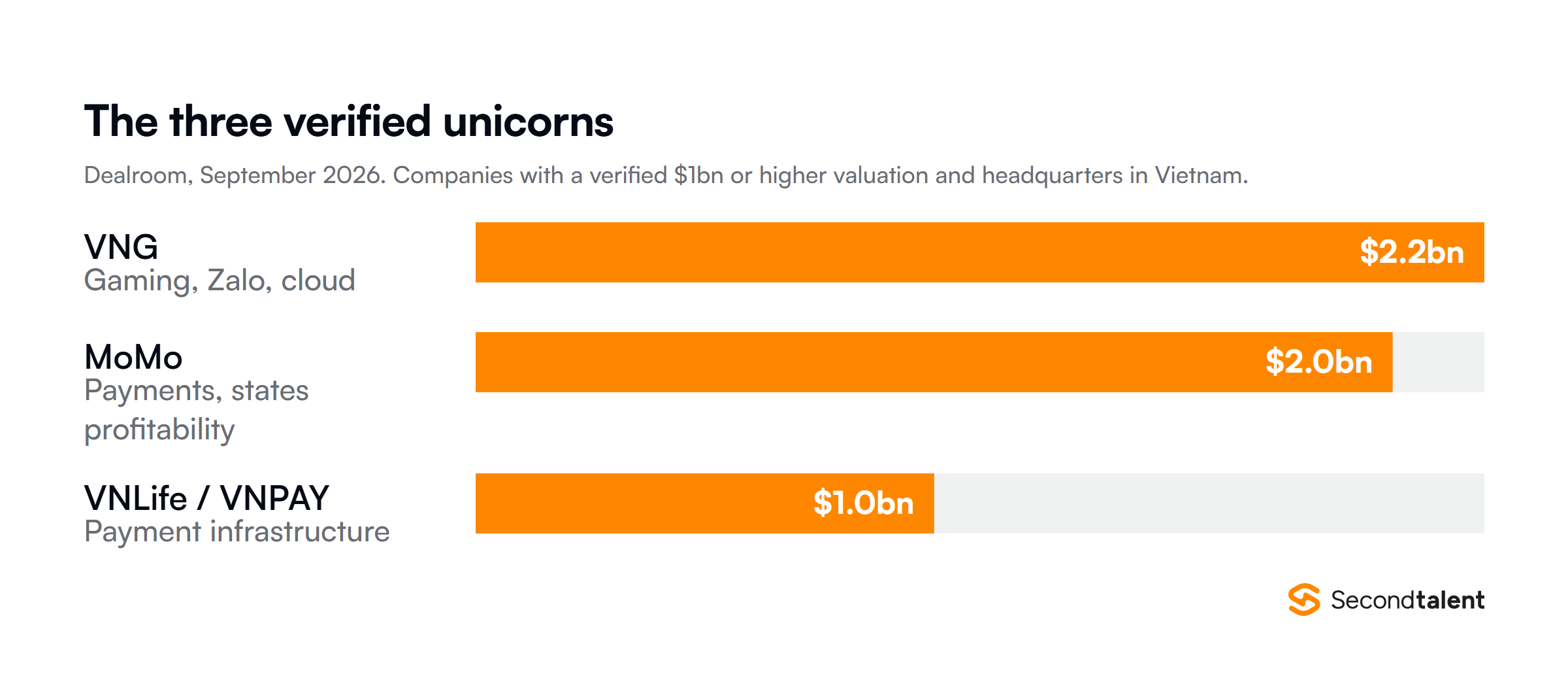
Which Are the Three Verified Unicorn Startups in Vietnam?
1. VNG Corporation
Gaming, messaging and cloud · $2.2bn (Dealroom) · founded 2004
Vietnam’s first unicorn and still its largest. VNG runs Zalo, the messaging app most of the country uses, alongside a games business, ZaloPay and a cloud division.
The company withdrew its United States IPO filing in January 2024 and has not listed since. That leaves VNG in the position much of this list shares: real scale, real revenue, no public market to price it.
2. MoMo
Payments and financial services · $2.0bn (Dealroom) · about $434m raised
MoMo is Vietnam’s largest digital wallet, reporting more than 40 million users, and states that it has reached profitability.
Its $200 million Series E, led by Mizuho Financial Group, valued it near $2 billion, and reporting put the figure at $2.3 billion in 2024.
In April 2026 the company hired Jefferies and Morgan Stanley to explore strategic options at a valuation above $2 billion, which is the closest thing Vietnam currently has to a large technology exit in progress.
3. VNLife and VNPAY
Payment infrastructure · $1.0bn (Dealroom) · $250m Series B
VNPAY built the QR payment rails that Vietnamese banking apps run on, connecting banks, merchants and government services. Parent company VNLife raised $250 million from General Atlantic and Dragoneer.
This is infrastructure rather than a consumer brand, which is why it is less visible than MoMo despite comparable importance to how Vietnam actually pays for things.
The Scaled Operators
4. Sky Mavis
Blockchain gaming · $1.95bn, revised down from $3bn · $311m raised
Sky Mavis built Axie Infinity and the Ronin chain, and briefly made Vietnam the center of play-to-earn gaming.
The scale of the retreat since is the point: its valuation was cut from $3 billion to $1.95 billion in a subsequent round, and daily players fell from a 2.7 million peak to a small fraction of that.
Ronin survived the $625 million bridge exploit of 2022 and continues to operate as gaming infrastructure. Treat any figure quoted from the 2021 peak with suspicion.
5. Cake by VPBank
Digital banking · more than 7 million customers · profitable
Cake is Vietnam’s first pure digital bank to report a profit, which it reached after about three and a half years. Euromoney named it Vietnam’s best digital bank in its 2026 awards.
It is a VPBank venture rather than an independent startup, and that is precisely why it worked: banking licenses in Vietnam are not something a startup obtains on its own.
6. ELSA Speak
AI language learning · more than 90 million downloads · $60m raised
Founded by Van Dinh Hong Vu, ELSA uses speech recognition trained on non-native speakers to coach English pronunciation.
It passed 90 million downloads by January 2026 and has raised $60 million across four rounds, most recently a $23 million Series C.
ELSA is headquartered in Silicon Valley with Vietnamese founders and a large Vietnamese team, which is a common shape for the country’s most internationally successful software companies.
7. Techcoop
Agritech supply chain · $70m Series A · profitable
Techcoop raised the largest Vietnamese round of the period in February 2025: $70 million, structured as $28 million of equity and $42 million of debt, co-led by Ascend Vietnam Ventures and TNB Aura.
Because most of it is debt, it does not appear in equity-only rankings.
The company finances and traces export agricultural supply chains, states profitability, and reported an annualised revenue run rate in the hundreds of millions of dollars.
Agriculture employs a large share of the Vietnamese workforce and has almost no software in it, which is the opportunity.
8. BuyMed (thuocsi.vn)
Pharmaceutical B2B marketplace · $63.5m raised
BuyMed connects pharmaceutical manufacturers and distributors with pharmacies and clinics through thuocsi.vn, adding warehousing, logistics and financing on top of the marketplace.
Counterfeit medicine and fragmented distribution are real problems in Vietnamese pharmacy, and BuyMed is attacking both with software rather than with a new retail brand.
9. ZaloPay
Digital payments · subsidiary of VNG
ZaloPay is the payment arm of VNG, distributed through Zalo’s user base. It has run at a loss for years while it buys share in a market where MoMo is dominant, and has pivoted toward lending and installment products to find margin.
Its strategic value is the Zalo integration rather than standalone economics.
10. Giao Hang Nhanh
Logistics · part of Scommerce
GHN operates one of Vietnam’s largest parcel networks and an API-first integration that e-commerce sellers build against directly. It acquired AhaMove, adding on-demand delivery.
Note that coverage claims phrased as “all 63 provinces” are now out of date in a literal sense: Vietnam consolidated to 34 provinces on 1 July 2025.
11. Timo
Digital banking · $20m from Square Peg
Timo was Vietnam’s first digital-only bank, operating in partnership with a licensed bank rather than holding its own license. It raised $20 million in a round led by Square Peg.
Its bilingual interface has made it a common choice for foreign professionals living in Vietnam, a small but defensible niche.
12. Finhay
Wealthtech · about $26m raised
Finhay lets Vietnamese savers invest from very small amounts, starting around VND 50,000, and has expanded into advisory products. It raised a $25 million Series B co-led by Openspace Ventures and Vietnam Investments Group.
The thesis is a young population with savings habits but almost no history of retail investing.
13. Fundiin
Buy now, pay later · about $30m raised
Fundiin offers installment payments at checkout for merchants across fashion, electronics and travel, underwriting customers who have no credit card.
Credit card penetration in Vietnam is low, which is the whole opportunity and also the whole risk.
Its own credit model, rather than merchant distribution, is what will decide whether the business works through a downturn.
14. Nhi Dong 315
Pediatric healthcare · clinic network
Nhi Dong 315 runs a private pediatric and maternity clinic network concentrated in Ho Chi Minh City, combining clinics, vaccination centers and pharmacies. GIC has invested.
It is a healthcare services roll-up with software attached rather than a technology company, and it is on this list because private healthcare capacity is one of the clearest consumer gaps in Vietnam.
The 2025 and 2026 Funded Cohort
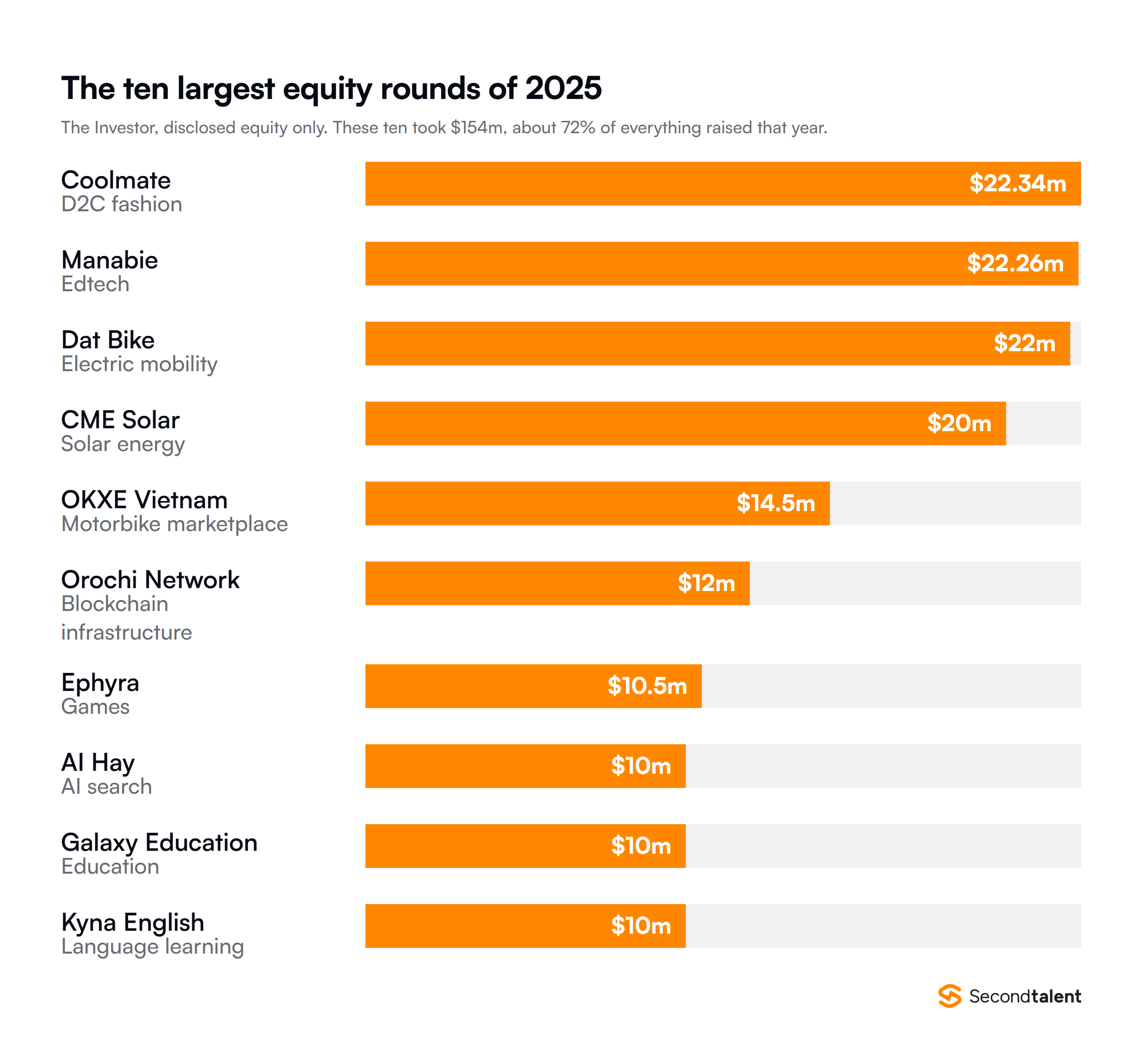
These six raised recently and have not yet proved the model. Their rounds are the largest disclosed equity raises of 2025, which tells you as much about the size of the market as about the companies.
15. Coolmate
Direct-to-consumer fashion · $22.34m Series B+ · largest equity round of 2025
Coolmate sells men’s basics directly, controlling its own supply chain and returns rather than selling through Shopee or TikTok Shop.
In a market where 97% of e-commerce GMV runs through two platforms, owning the customer relationship is the strategy.
It raised the largest disclosed equity round in Vietnam in 2025.
16. Manabie
Edtech · $22.26m Series A
Manabie sells a learning management system to schools rather than to students, which avoids the consumer acquisition costs that have hurt Vietnamese edtech.
17. Dat Bike
Electric mobility · $22m Series B+
Dat Bike designs and builds electric motorbikes in Vietnam for a market of tens of millions of petrol two-wheelers. It is competing against VinFast’s scale with a narrower, cheaper product.
18. CME Solar
Commercial solar · $20m pre-Series A
CME Solar installs rooftop solar for businesses under power purchase agreements, so the customer pays for electricity rather than for hardware. Vietnamese industrial power demand is growing faster than generation.
19. OKXE Vietnam
Used motorbike marketplace · $14.5m Series A · 8.2 million downloads
OKXE brings pricing transparency and financing to used motorbike sales, a large informal market. The financing layer, not the listings, is where the business is.
20. AI Hay
AI search · $10m Series A · more than 10 million downloads
AI Hay is a Vietnamese-language AI answer engine, built on the bet that a local product tuned to Vietnamese queries beats a translated global one. It is the clearest domestic AI consumer product to raise real money.
Where the Exits Are Coming From
With no technology IPO, Vietnamese outcomes are trade sales, and the two largest recent ones went to American semiconductor companies. Nvidia acquired VinBrain, Vingroup’s AI healthcare unit, in December 2024.
Qualcomm acquired the generative AI division of VinAI in April 2025.
Both targets came out of Vingroup rather than the venture-backed ecosystem, and both were bought for engineering teams and research as much as for products.
For anyone assessing Vietnam, that is the pattern worth noting: the assets foreign acquirers want are technical teams.
| What people say | What the evidence shows |
|---|---|
| Vietnam has six unicorns | Dealroom verifies three, worth $5.2bn combined |
| VNG listed on NASDAQ | It withdrew the filing in January 2024 and has not listed |
| 97% internet penetration | 84.2%, or 85.6 million users, per DataReportal Digital 2026 |
| Tiki is a top-three e-commerce unicorn | Below 1% market share, valued under $10m |
| Telio leads Vietnamese B2B commerce | Dissolved in December 2024 |
| The ecosystem is at escape velocity | 2025 funding was about 30% below the 2021 peak |
What to Watch Next
- Whether MoMo finds a buyer or a listing. A completed process above $2 billion would be Vietnam’s first genuine large technology exit and would reprice everything behind it.
- The Law on Digital Technology Industry. In force since 1 January 2026, it gives semiconductor and AI projects a legal framework and gives qualifying specialists a five-year income tax exemption in designated zones.
- Whether the 2026 funding recovery holds. Fewer, larger rounds is a healthier shape than 2021’s spray, but $295 million in eight months is still small for a country of 100 million.
- Agritech and industrial software. Techcoop and CME Solar are attacking sectors with real revenue and almost no software, which has worked better lately than consumer plays.
The Takeaway
Vietnam’s technology sector is genuinely large and genuinely productive, and its startup ecosystem is smaller and more fragile than the headline version. Both things are true, and the gap between them is where most published lists go wrong.
For most companies reading this, the opportunity in Vietnam is not investing in these twenty. It is hiring the engineers who built them.
Vietnam’s digital technology industry employs a deep pool of people who have shipped consumer products at national scale, and they cost roughly 56% less than the equivalent United States contract rate on our own numbers.
If hiring is what you came for, see what engineers actually cost in Vietnam, how to employ them without a Vietnamese entity, or the roles we place there.
If you would rather buy delivery than build a team, we also profile the software development outsourcing companies in Vietnam.