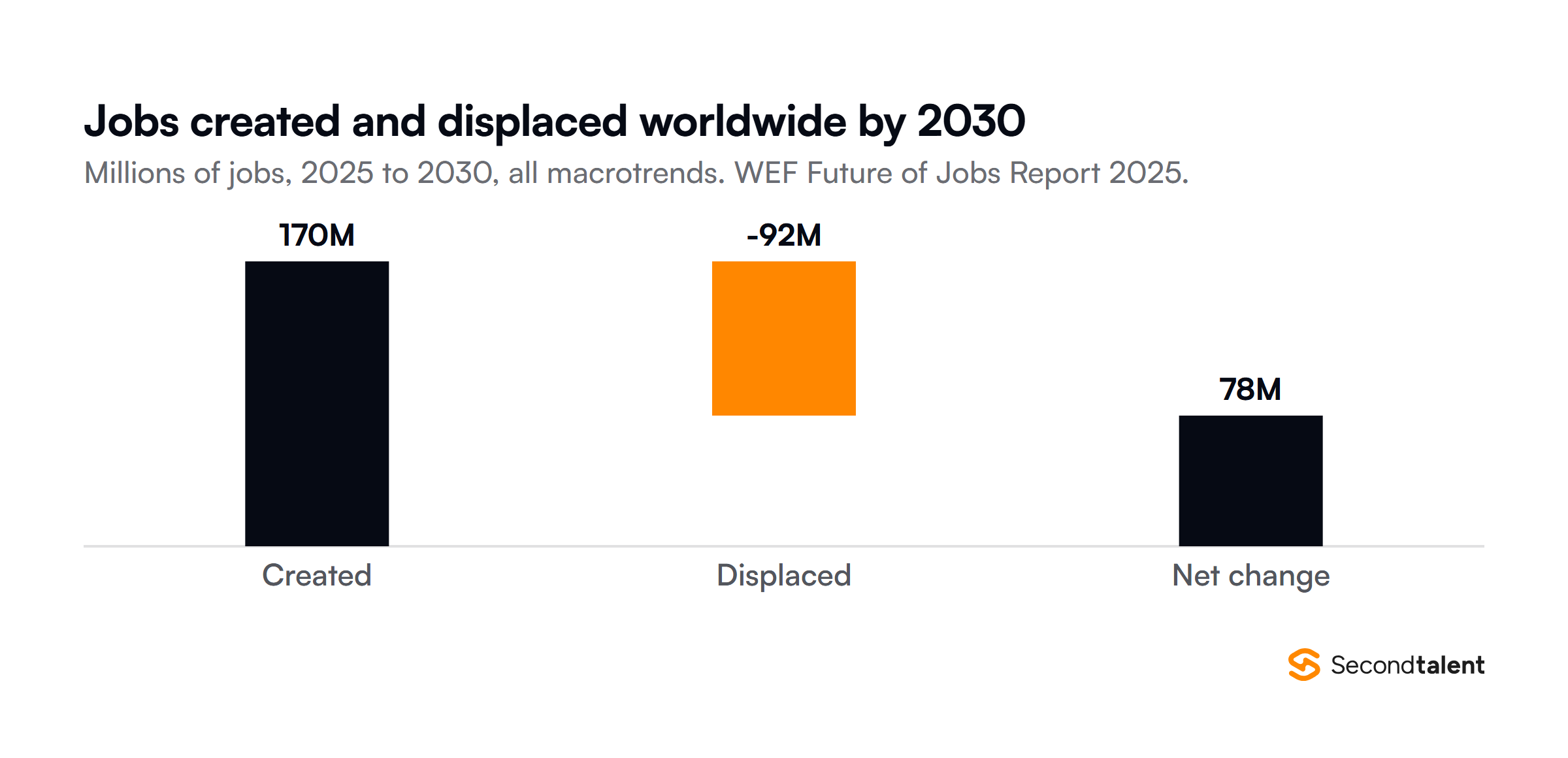
TL;DR: Employers surveyed by the World Economic Forum expect 170 million jobs to be created and 92 million displaced worldwide by 2030. In the US, the Bureau of Labor Statistics projects 3.5% job growth from 2025 to 2035, with office and administrative support work shrinking fastest.
Nurse practitioners top the US government’s list of fastest-growing jobs for the next decade, with growth of 41.0% by 2035. Data scientists come third, at 34.6%. The same BLS projections, published on August 27, 2026, name AI-powered automation tools as one reason office support work will lose 752,100 jobs.
- 1One in four workers worldwide holds a job with some exposure to generative AI, but only 3.3% are in the most exposed group, the ILO estimates.
- 2The claim that most 2030 jobs “haven’t been invented yet” traces to a 2017 workshop estimate for Dell, not to any dataset.
- 3About 60% of US work in 2018 was in job titles added since 1940, MIT economist David Autor and his co-authors found.
- 4AI engineer is the fastest-growing job on LinkedIn’s 2026 US list, and data annotator ranks fourth.
How Many Jobs Will Be Created and Lost by 2030?
Farmworkers, not software developers, top the list of jobs set to add the most roles by 2030: 35 million more, in the World Economic Forum’s Future of Jobs Report 2025. Delivery drivers come second and software developers third.
Across all jobs, the employers expect 170 million to be created and 92 million displaced, a net gain of 78 million. That churn equals 22% of the 1.2 billion formal jobs in the report’s dataset.
The fastest-growing and fastest-declining roles, in percentage terms, split almost cleanly between technology and clerical work:
- Postal service clerks
- Bank tellers
- Data entry clerks
- Cashiers and ticket clerks
- Administrative assistants and executive secretaries
- Big data specialists
- Fintech engineers
- AI and machine learning specialists
- Software and applications developers
- Security management specialists
Graphic designers sit 11th on the declining list. The report calls their appearance there, alongside legal secretaries, “a first-time prediction not seen in previous editions,” one that “may illustrate GenAI’s increasing capacity to perform knowledge work.”
Employers plan to answer with training more than cuts. 85% plan to prioritize upskilling, 70% expect to hire staff with new skills, 50% plan to move staff from declining to growing roles, and 40% plan to reduce staff whose skills lose relevance. Two thirds plan to hire people with specific AI skills.
Which US Jobs Will Grow Fastest Through 2035?
Healthcare will supply almost a third of all new US jobs over the next decade. The BLS expects total employment to rise from 170.3 million in 2025 to 176.2 million in 2035, a 5.9 million gain, after 10.9% growth in the decade before.
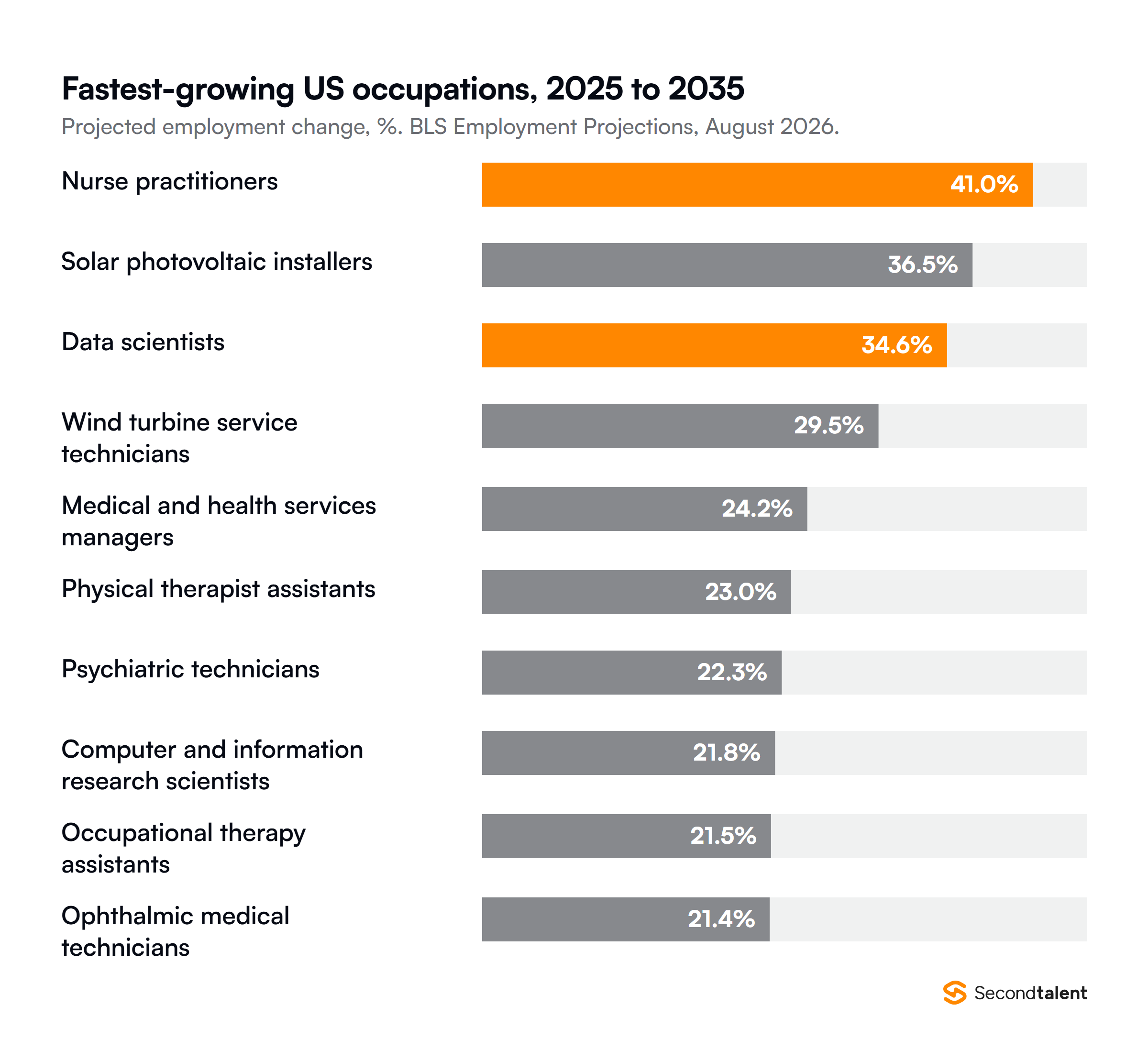
Fast growth from a small base adds few jobs. Solar installers and wind turbine technicians, second and fourth on the fastest-growing table, will add fewer than 15,000 jobs between them. Home health and personal care aides will add 847,300, the most of any occupation, and software developers 174,700.
AI shows up on the growth side too. The industry that covers computing infrastructure and data processing is projected to grow 25.1% and add 120,400 jobs. Utilities, at 9.8%, is the fastest-growing sector, a projection BLS ties in part to AI power demand. Our tech industry hiring statistics break down the tech occupations.
Where US jobs will shrink
“The continued integration of automation tools, including those powered by AI, into workflows is likely to reduce demand for several office and administrative support occupations.”
US Bureau of Labor Statistics, Employment Projections 2025 to 2035, August 27, 2026
Office and administrative support is the fastest-shrinking group, at minus 4.0%. Sales jobs are projected to fall 1.4% and production jobs 0.4%.
| Occupation | Jobs in 2025 | Jobs in 2035 | Change |
|---|---|---|---|
| Word processors and typists | 40,400 | 26,500 | -34.4% |
| Telephone operators | 3,500 | 2,500 | -27.6% |
| Switchboard operators | 35,400 | 26,200 | -26.0% |
| Data entry keyers | 131,800 | 98,200 | -25.5% |
| Telemarketers | 60,900 | 47,800 | -21.4% |
In raw numbers, cashiers lose the most jobs (200,600), followed by general office clerks (156,200) and customer service representatives (141,800). BLS also now publishes AI exposure categories for occupations, one input being Anthropic’s data on observed Claude use, and warns that “an exposure category is not a forecast of employment growth or decline.”
How Many Jobs Are Exposed to AI?
Almost 70% of UK employment is in occupations with high exposure to AI, against 60% in the US and 26% in India, an IMF staff discussion note estimated in January 2024. Worldwide, almost 40% of employment is exposed.
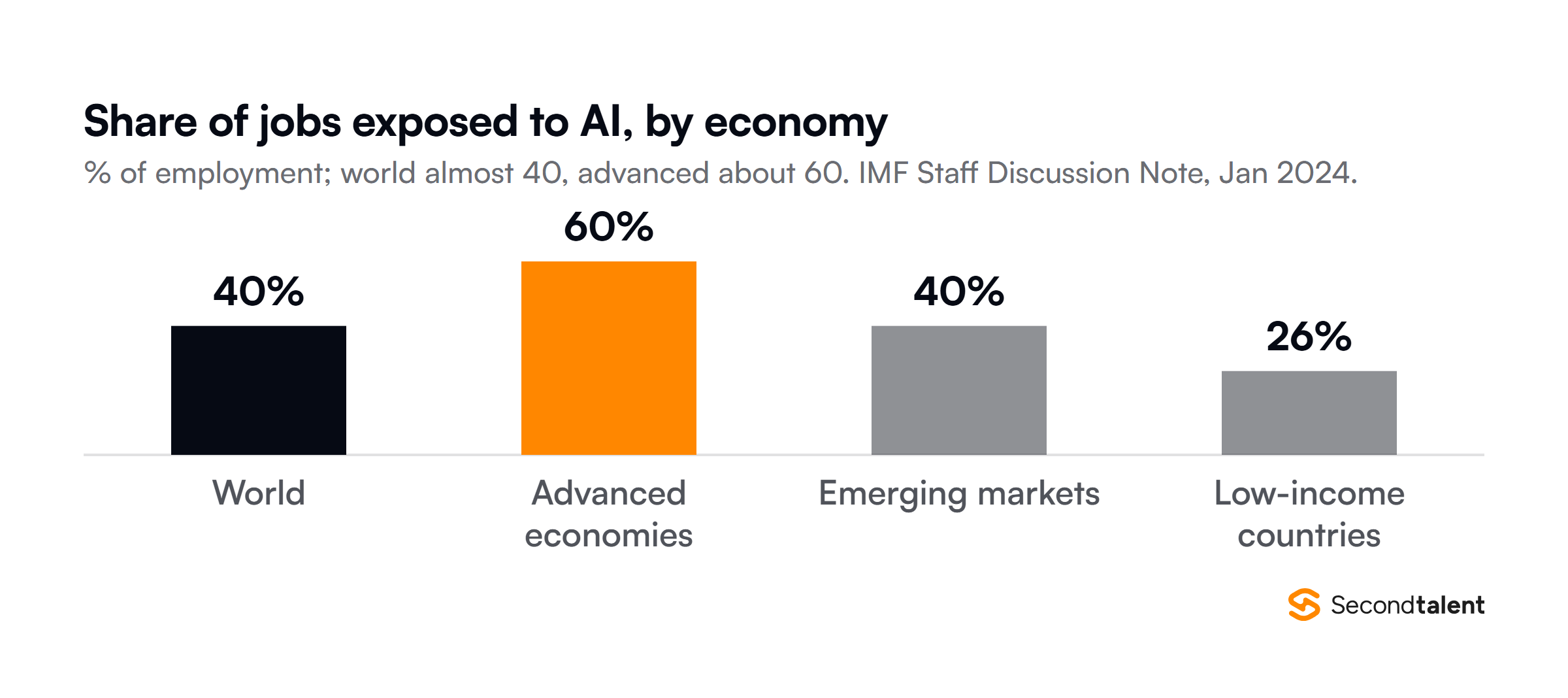
Exposure cuts both ways. In advanced economies, the IMF expects about half of exposed jobs may be hurt by AI, while the rest could gain from higher productivity.
The ILO’s narrower measure
The International Labour Organization’s May 2025 exposure index looks at generative AI only, task by task. Clerical occupations have the highest exposure.
Goldman Sachs has put a number on displacement. Its August 2025 estimate is that AI could displace 6% to 7% of the US workforce if widely adopted, within a range of 3% to 14% under other assumptions. It expects unemployment to rise by half a percentage point during the transition.
How Much Work Could Be Automated?
Technology that exists today could in theory automate activities that take up about 57% of US work hours, the McKinsey Global Institute estimated in “Agents, robots, and us” in November 2025. The report adds that this “reflects the technical potential for change in what people do, not a forecast of job losses.”
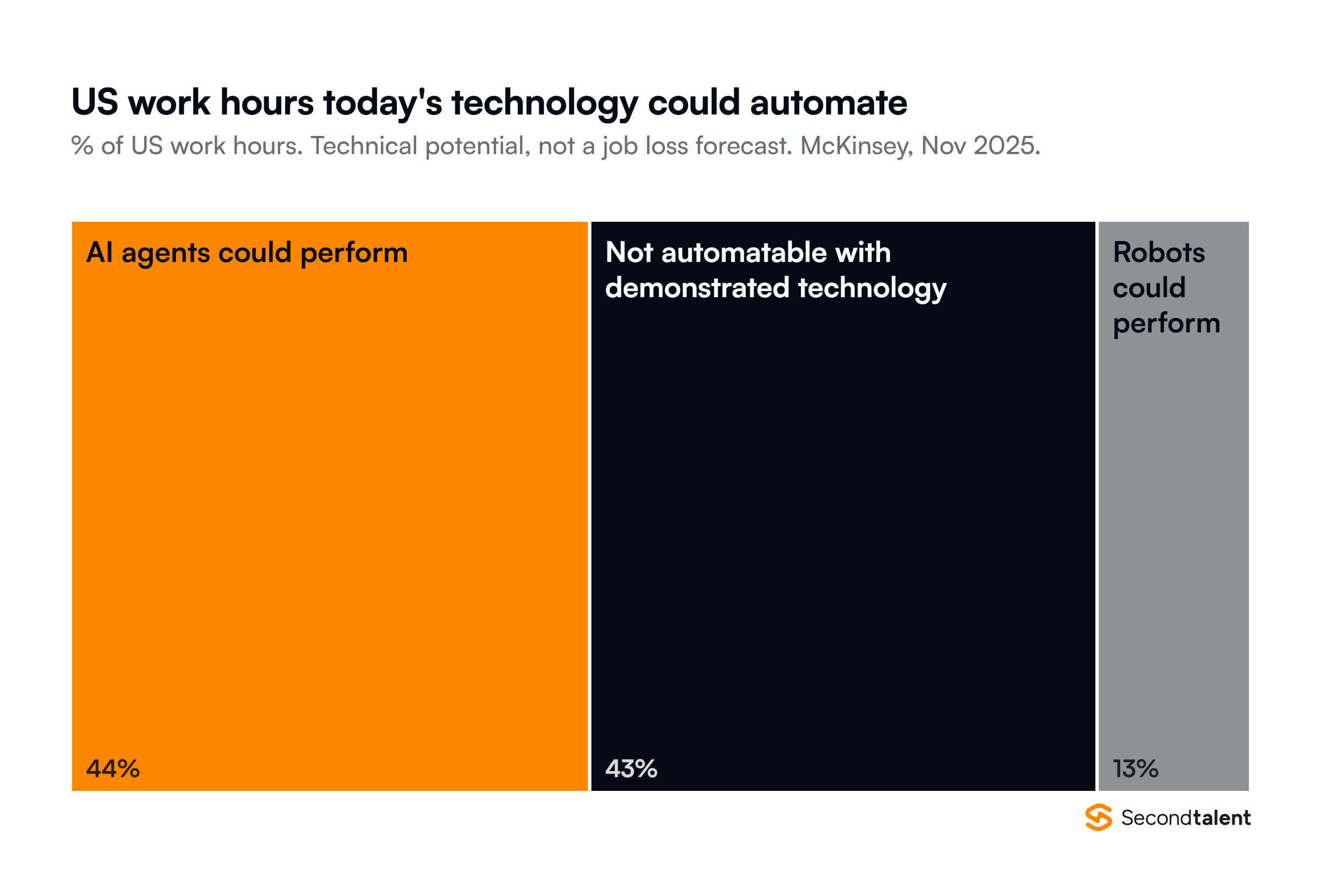
In McKinsey’s midpoint scenario, agents and robots could generate about $2.9 trillion a year in US economic value by 2030. Most skills carry across: about 72% are needed both for work AI could do and for work that must stay with people.
Demand for AI fluency grew nearly sevenfold in the two years to mid-2025, and it is now a job requirement in occupations employing about seven million workers. McKinsey’s 2023 US study estimated that 12 million more workers may need to change occupations by 2030, with lower-wage workers up to 14 times more likely to need one.
The OECD draws a wider circle. Counting all automation technologies, not only AI, its 2023 Employment Outlook found 27% of jobs in occupations at high risk of automation. Its July 2026 edition found the role of large language models in young people’s job-entry problems “appears to be limited” so far.
Where Do the Best-Known Future of Work Claims Come From?
Three of the most quoted numbers about jobs and automation say something narrower than the versions that circulate.
“85% of the jobs of 2030 haven’t been invented yet”
- A research finding that 85% of all jobs in 2030 do not exist yet
- Often credited to Dell as a new report
- Experts at a March 2017 workshop “estimated” the figure
- It covers jobs “today’s learners” will do, not all jobs
Dell’s July 2017 press release turned that into “an estimated 85 percent of jobs in 2030 haven’t been invented yet.” The report itself ties the number to workshop experts and does not show how they reached it.
Measured history gives a slower pace. Autor, Chin, Salomons and Seegmiller traced US job titles through census records: roughly 60% of 2018 employment was in titles added since 1940, and 74% among professionals. That took 78 years.
“Half of all work will be automated by 2060”
McKinsey’s 2017 study said half of work activities could be automated by 2055, “up to 20 years earlier or later.” It also found fewer than 5% of occupations could be fully automated. In June 2023 McKinsey moved its estimate to between 2030 and 2060, with a midpoint of 2045. 2060 is the outer edge of that range, not the forecast.
“AI will take 300 million jobs”
Goldman Sachs wrote in 2023 that generative AI could “expose the equivalent of 300 million full-time jobs to automation,” not that they would be lost. The same note said roughly two thirds of US occupations are exposed to some degree, with a quarter to half of their workload replaceable, and projected a 7% rise in global GDP.
What New Jobs Is AI Creating?
Four of the ten fastest-growing US jobs on LinkedIn’s Jobs on the Rise 2026 list are AI roles, and the top two are AI engineers and AI consultants.
The demand runs beyond tech titles. In the US, jobs requiring AI literacy grew 70% in a year, and companies with a head of AI position rose 28%, LinkedIn reported in January 2026. Indeed counted US postings that mention AI at 134% above their February 2020 level at the end of 2025.
For how these tools are used inside companies today, see our AI in the workplace statistics.
Creators, UGC and AI video
LinkedIn members adding “creator” to their profiles grew nearly 90% between 2021 and summer 2025. Goldman Sachs expects the creator economy to reach $480 billion by 2027, from $250 billion in 2023, though only about 4% of its 50 million creators earn over $100,000 a year.
Advertisers are shifting budget to them. The IAB projects creator ad spend at $37 billion in 2025, up 26%, and $44 billion in 2026. In 2023, Upwork found 14.7 million US freelancers creating influencer-style content.
Part of that work is user-generated content made to order. UGC creators are paid for clips that the brand then posts or runs as ads on its own channels. On Collabstr, one of several UGC platforms, UGC campaigns rose from 15% to 35% of all influencer campaigns in 2025, and nearly 80% of brand deals cost under $300.
Production work is where prices are falling. An AI video generator turns a prompt or an image into a draft clip. On Upwork, generative AI and creative production contract starts grew 90% year on year while earnings per contract fell 13%, its 2026 index found.
Sales roles and AI agents
Gartner predicts that by 2028 AI agents will outnumber sellers ten to one, yet fewer than 40% of sellers will say agents improved their productivity. Sales teams are already heavy users:
Salesforce’s sellers expect agents to cut prospect research time by 34% and email drafting by 36%. Those tasks are the core of the sales development representative (SDR) job, and software vendors now sell agents built for it, so buyers should know what an AI SDR is before comparing products.
Automated outreach still has to reach the inbox. Since February 2024, Google has required anyone sending more than 5,000 messages a day to Gmail to use SPF, DKIM and DMARC, offer one-click unsubscribe on marketing mail and keep spam rates under 0.10%, never reaching 0.30%.
Vendor-written reviews such as Warmy vs. Instantly.ai, published on Warmy’s own blog, compare email warm-up tools meant to protect sender reputation.
How Big Is the Freelance and Gig Workforce?
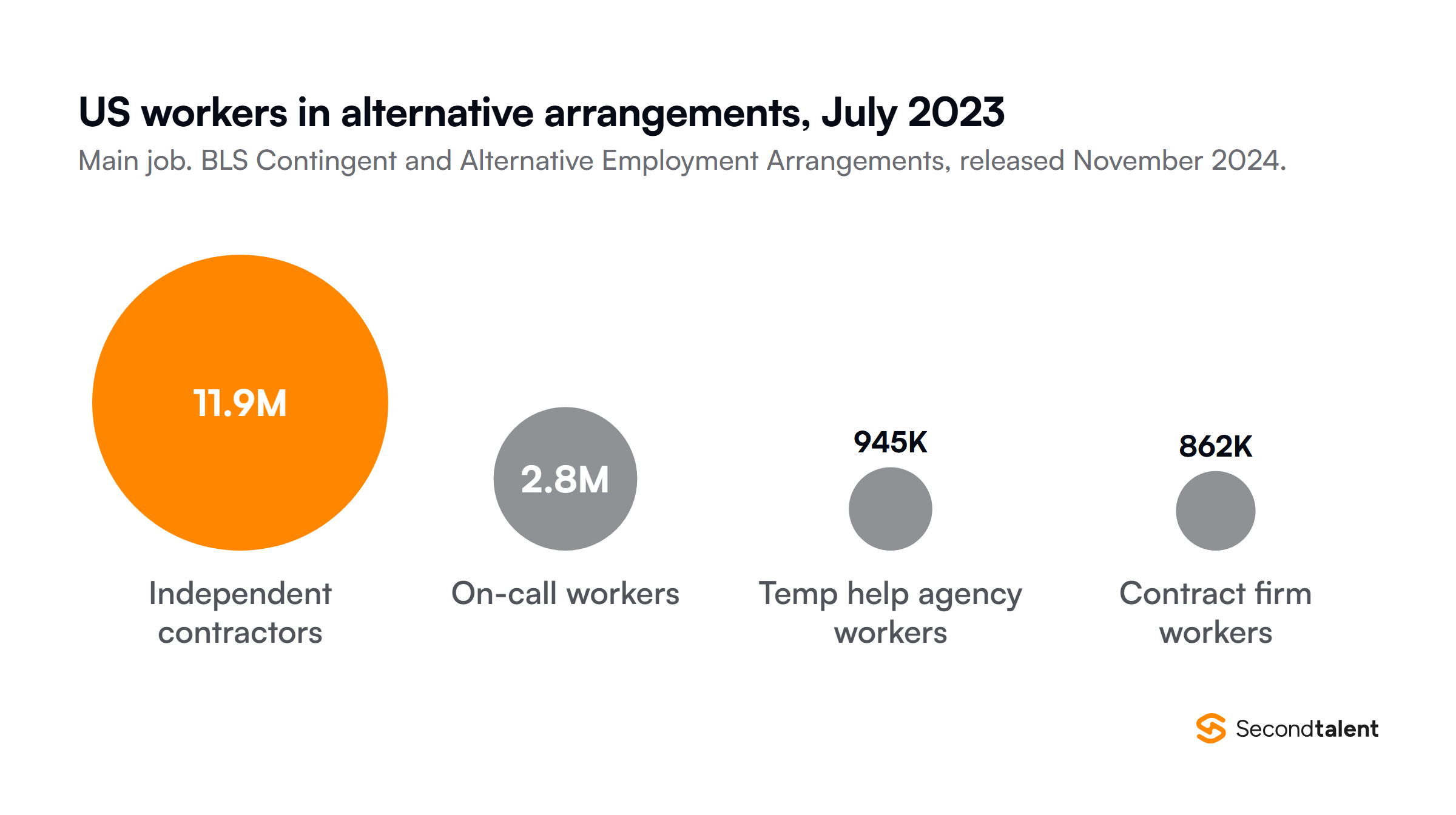
More than a third of US independent contractors are 55 or older, the latest BLS survey of alternative work shows. In July 2023 there were 11.9 million of them, 7.4% of total employment, far more than on-call, temp agency or contract firm workers combined.
Contingent workers, those who do not expect their jobs to last, made up 4.3% of workers in 2023, up from 3.8% in 2017. Their median weekly earnings were 74% of what non-contingent workers earned.
Freelancing estimates depend on who is counted. These four measure different groups:
The two Upwork 38% figures cover different populations and are not a trend. Its 2026 survey also found 58% of full-time employees considering freelancing, up from 36% a year before, and freelancers doing AI work on its marketplace earning 34% more per hour.
The World Bank’s study found women earning 68% of men’s wages on one major platform it reviewed. For how office, hybrid and remote work compare, see our workplace statistics and remote work statistics.
Which Skills Will Employers Need?
Seven in ten employers in the WEF survey call analytical thinking essential, making it the top core skill. AI and big data are the fastest-growing skills, followed by networks and cybersecurity, then technological literacy. The expected change is smaller than in earlier editions: 39% of core skills by 2030, down from 44% in 2023 and 57% in 2020.
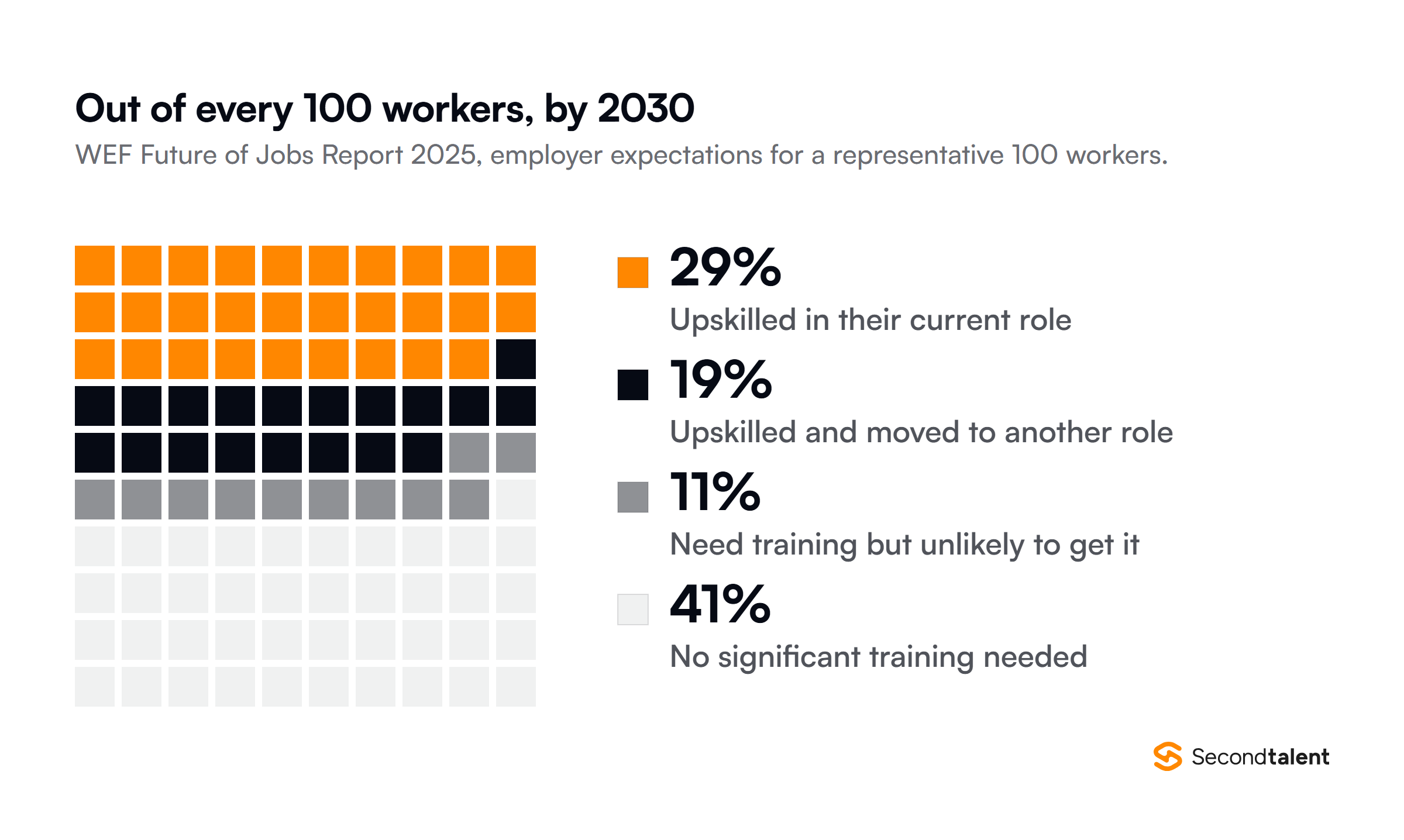
The report puts the training need in people. If the world’s workforce were 100 workers, 59 would need training by 2030, and employers expect 11 of those not to get it.
Employers call skill gaps the biggest barrier to changing their business, with 63% naming them. LinkedIn’s Work Change Report goes further than the WEF: it expects 70% of the skills used in most jobs to change by 2030. The rate at which members add new skills has risen 140% since 2022.
What AI skills pay, and how hard they are to find
- Wage premium: PwC’s 2026 AI Jobs Barometer puts the premium for AI skills at 62%, from 57% last year. The 2025 report itself printed 56%.
- Pace of change: skills required for the most AI-exposed jobs are changing twice as fast as in the least exposed, PwC found.
- Hiring difficulty: 72% of employers report trouble filling roles in 2026, down from 74%, and AI model and application development (20%) and AI literacy (19%) now top the hard-to-find list, ManpowerGroup says.
- Learning: Coursera logs 14 generative AI enrollments a minute, and enterprise learners’ GenAI enrollments rose 234% in a year.
LinkedIn’s fastest-growing skill group in the US for 2026 is AI engineering and implementation, which covers data annotation, fine-tuning, retrieval-augmented generation and vector databases. Our global AI talent shortage statistics and the list of engineering skills declining fastest due to AI cover the engineering side.
Hiring for the Skills in Short Supply
AI engineers top LinkedIn’s 2026 jobs list, and AI model and application development tops ManpowerGroup’s list of hard-to-find skills. Second Talent matches companies with pre-vetted machine learning engineers and AI agent developers in Asia.
Our remote work hiring statistics show how employers now hire across borders. Tell us the skills you need and we will send matching profiles.
Frequently Asked Questions
Will AI destroy more jobs than it creates?
None of the major forecasts here says so. The WEF’s employers expect a net gain by 2030 across all trends, and the BLS still projects US job growth to 2035. Estimates of AI-driven job losses, such as Goldman Sachs’ 6% to 7% of US workers, depend on how widely AI is adopted.
Which jobs are most at risk from AI?
Clerical and administrative work, on every source here. The ILO rates clerical occupations the most exposed to generative AI, the WEF lists data entry clerks and administrative assistants among the fastest-declining roles, and the BLS expects office support jobs to shrink fastest.
Is there a 2026 Future of Jobs Report?
No. The World Economic Forum’s latest edition is the Future of Jobs Report 2025, published in January 2025. The figures on 170 million jobs created and 39% of skills changing come from that edition.



![Engineering Productivity Metrics to Track. Top 10 Key Engineering Productivity Metrics to Track [2026], by Second Talent.](https://www.secondtalent.com/wp-content/uploads/2026/09/top-10-engineering-productivity-metrics-featured-v2-768x403.jpg)