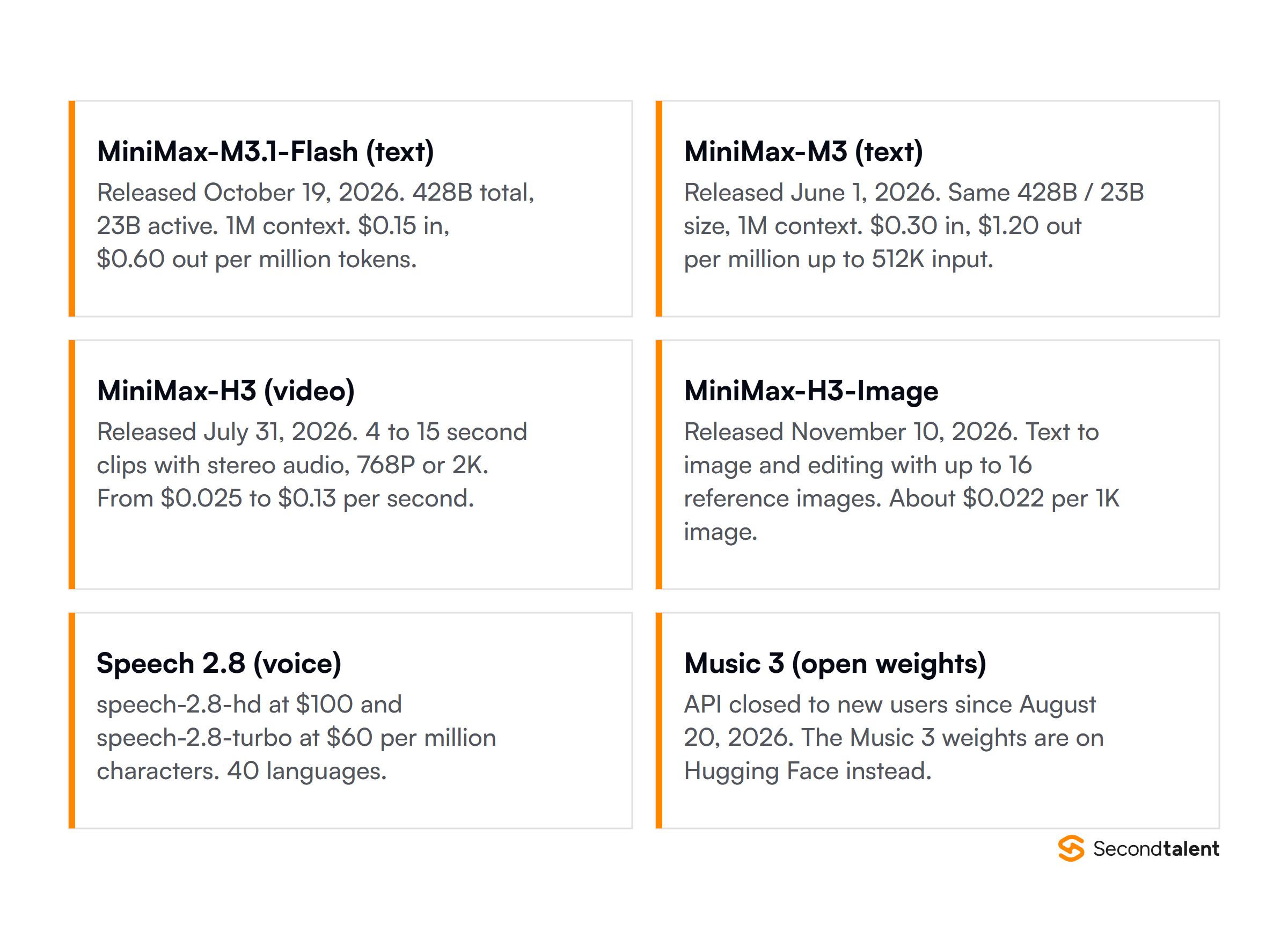
TL;DR: MiniMax's current text models are MiniMax-M3.1-Flash ($0.15 input, $0.60 output per million tokens) and MiniMax-M3 ($0.30 / $1.20), both with a 1M-token context and open weights. Around them sit the H3 video model (from $0.025 a second), H3-Image and the Speech 2.8 voices. The older M2.5 and M2.7 models stop working on the API on November 18, 2026.
Before MiniMax put its name on M3.1 Flash, an anonymous model called Space Bunny processed more than 200 trillion tokens while running anonymously. MiniMax revealed it as an early build on October 19, 2026, the day M3.1 Flash launched.
The Shanghai lab listed on the Hong Kong Stock Exchange on January 9, 2026, and it now sells text, video, image and voice models from one API.
Key takeaways
1M3 and M3.1-Flash are the same size: about 428B parameters, 23B active per token. Flash is the newer, faster, cheaper build.
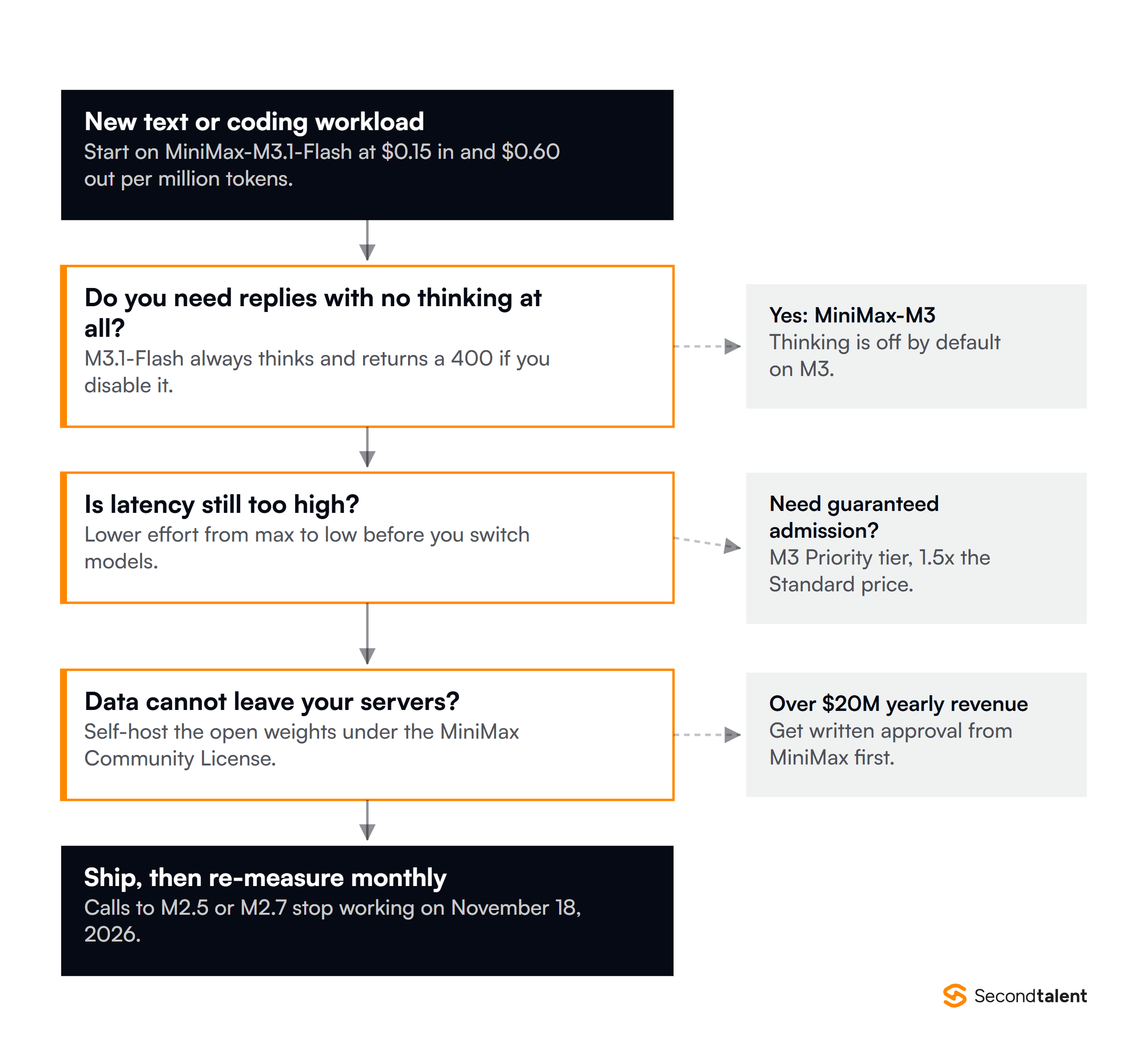
2M3.1-Flash cannot switch thinking off. M3 has thinking off by default. That one difference decides many routing choices.
3The open weights ship under a community license that needs a "Built with MiniMax" credit for commercial use, and written approval above $20M in yearly revenue.
4The music API closed to new users on August 20, 2026. Music 3 now ships as open weights on Hugging Face instead.
The MiniMax Models at a Glance
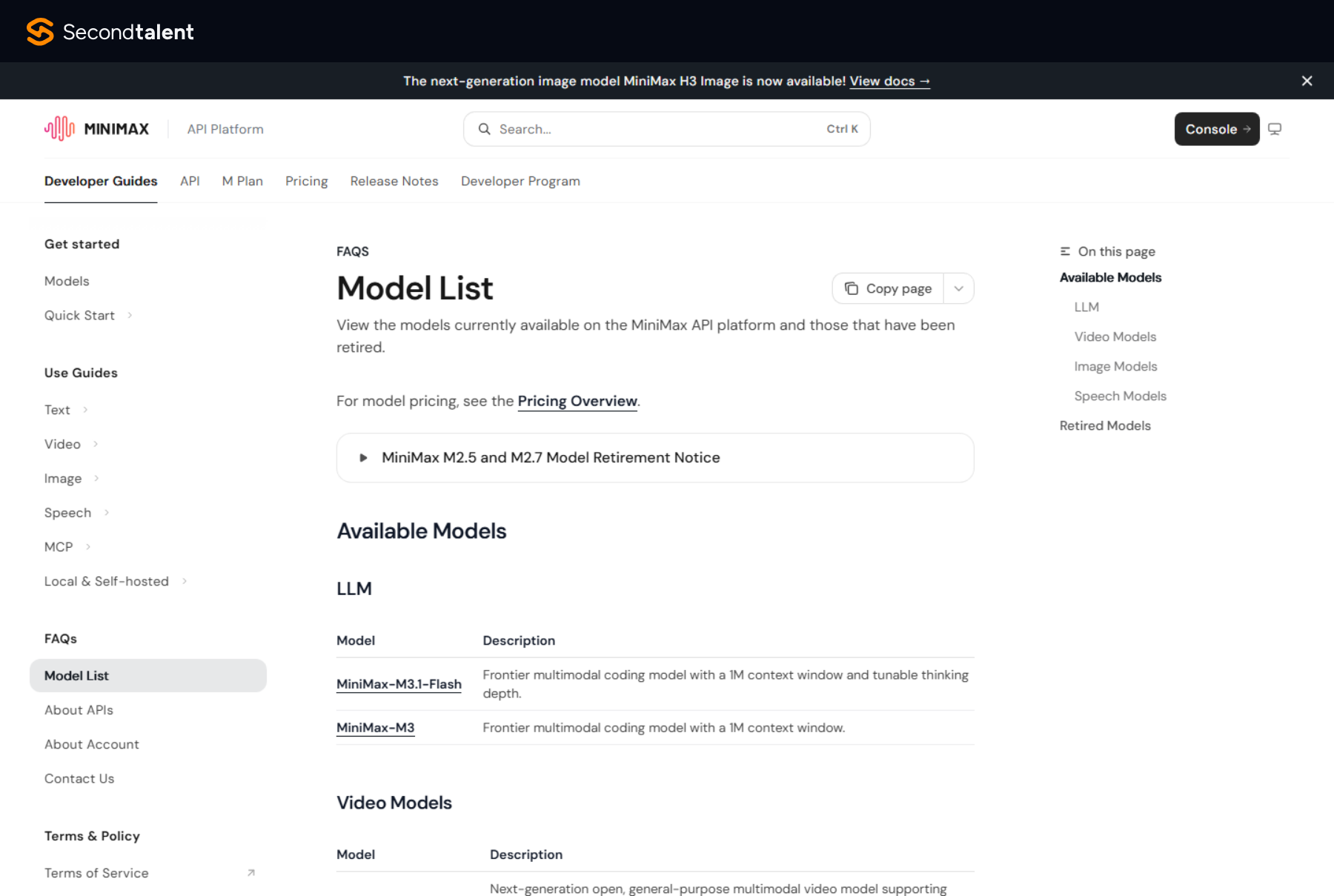
These are the models on the MiniMax API model list as of November 12, 2026, with the exact ID your engineers type. Prices are in US dollars.
Model
Model ID
Context
Max output
Price
Best for
M3.1 Flash
MiniMax-M3.1-Flash
1M
Not published
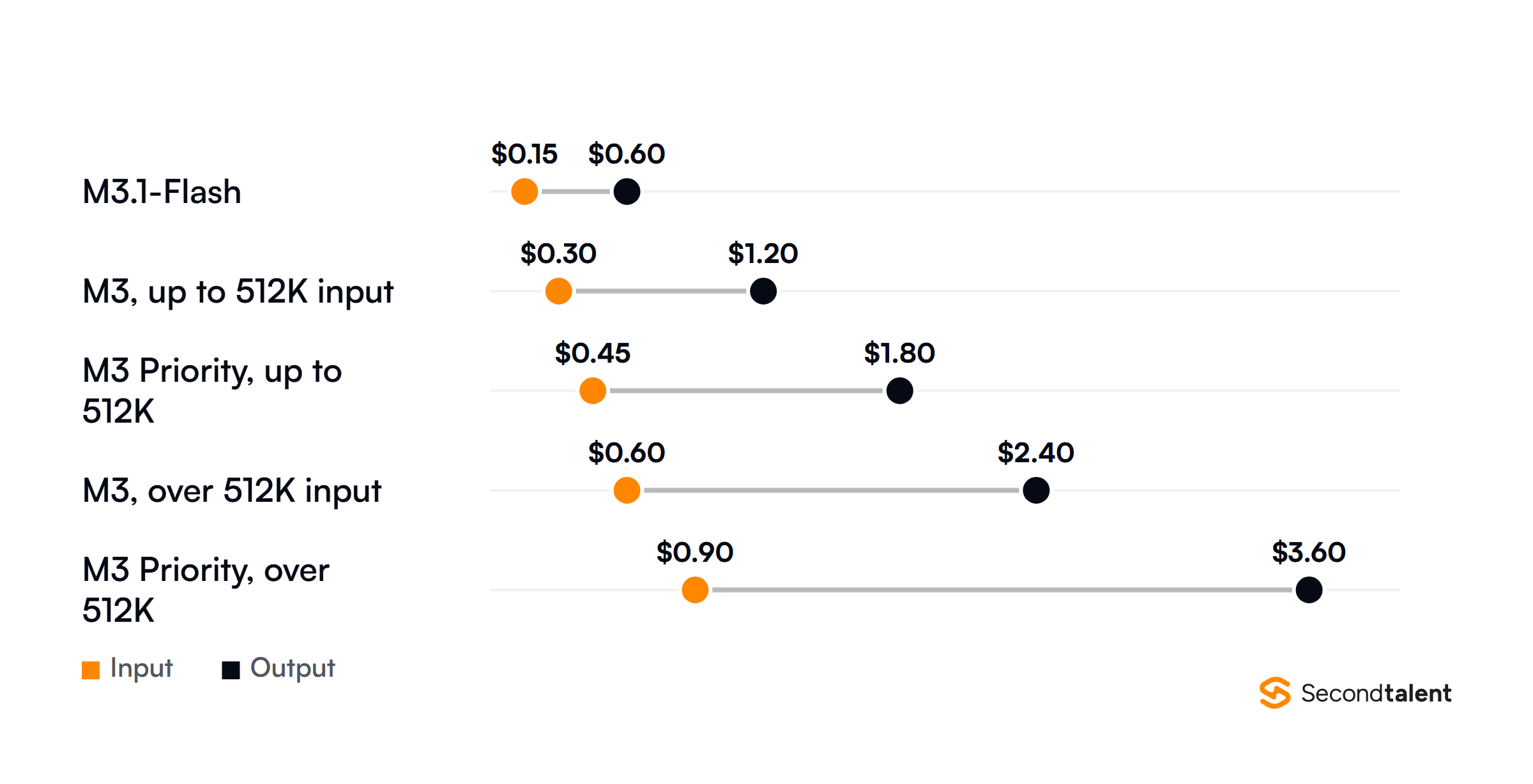
$0.15 / $0.60 per 1M tokens
Default for coding, agents and everyday text work
M3
MiniMax-M3
1M (512K guaranteed)
Not published
$0.30 / $1.20 per 1M tokens up to 512K input
Replies without thinking, Priority admission
H3
MiniMax-H3 (plus -Highspeed, -Lite, -Max)
4 to 15 s clips
768P or 2K
$0.025 to $0.13 per second of output
Video with native stereo audio
H3 Image
MiniMax-H3-Image, MiniMax-H3-Image-Highspeed
Up to 16 reference images
Up to 4K
$3.80 per 1M output image tokens (Standard)
Text to image and image editing
Speech 2.8
speech-2.8-hd, speech-2.8-turbo
40 languages
n/a
$100 / $60 per 1M characters
Voice-overs, agents that speak, cloned voices
Reading the prices. Text prices are input, then output, per million tokens on MiniMax's international pricing page. MiniMax does not publish a max output figure for either text model; the API caps a reply at whatever you set in max_tokens, and thinking tokens count toward it.
The MiniMax Lineup in Plain English
MiniMax names its families by letter. M is the language line, which reads text, images and video and writes text. H is the generation line: H3 makes video with sound, and H3 Image makes pictures. Speech and Music keep plain names.
The Hailuo brand, which MiniMax used for its video models through Hailuo 2.3, now sits in the legacy list, and H3 replaces it.
Most of the line is open weight. The MiniMaxAI organization on Hugging Face hosts M3, M3.1-Flash, H3, H3-Image and Music 3, next to older checkpoints back to MiniMax-Text-01 from January 2025.
The speech models and the hosted helpers, such as the prompt rewriter H3 leans on, stay API only.
Oct 27, 2025
MiniMax-M2: 230B total, 10B active, the start of the M2 line
$0.60 output per 1M tokens170+ tokens a second, median73.7% on DeepSWE v1.1
Flash in MiniMax's naming does not mean small. The M3.1-Flash model card lists about 428B total parameters with 23B active per token, the same size as M3.
The serving stack is the difference: sparse attention through the whole model, quantization-aware training and a speculative decoding head.
MiniMax says online inference runs nearly three times faster than its predecessor and agent tasks cost 70% less, with output peaking above 200 tokens a second.
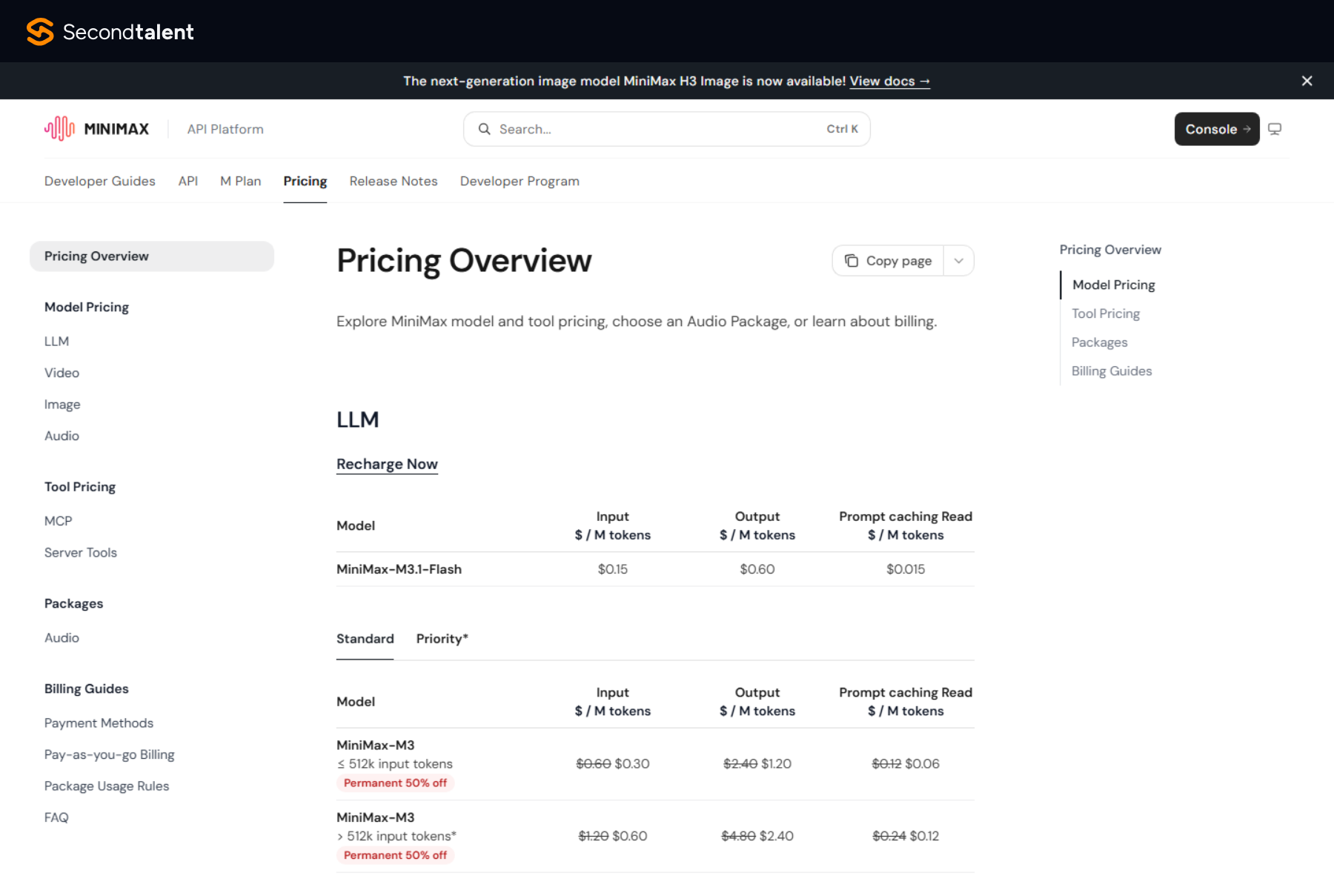
It costs $0.15 per million input tokens, $0.60 per million output tokens, and $0.015 for cached input, with one flat rate across the full 1M-token window.
MiniMax's own benchmark table puts it at 73.7% on DeepSWE v1.1 and 61.7 on OSWorld 2.0. The same table is candid about the gap: on Terminal Bench 4.0 it scores 38.1 against 51.8 for Claude Opus 5.
Those are vendor-run numbers, so test on your own tasks before you trust them.
MiniMax-M3
M3 arrived on June 1, 2026 and introduced MiniMax Sparse Attention, an operator built for million-token prompts.
According to the M3 model card, it runs 9 times faster at prefill and 15 times faster at decode than M2 at 1M context, cutting per-token compute to a twentieth.
MiniMax reports 80.5 on SWE-bench Verified and, on its M3 page, 83.5 on BrowseComp against 79.3 for Claude Opus 4.7.
M3 stays on the API for two reasons. It is the only current text model that can answer without thinking, and it is the only one with a Priority tier.
Its context promise is also hedged: the API supports up to 1M tokens with a guaranteed minimum of 512K, while MiniMax lists M3.1-Flash at a flat 1,000,000.
MiniMax-M3.1-Flash
Thinking always on, effort low to max (default max)
One flat price across 1M tokens
No Priority tier
MiniMax-M3
Thinking off by default, on with adaptive
Price doubles above 512K input tokens
Priority tier at 1.5x Standard
MiniMax-H3 video
H3 makes 4 to 15 second clips at 24 frames a second, with voice, sound effects and music generated in the same pass as the picture.
The H3 model card describes a 33B-parameter dense transformer that outputs 768P, plus a second pass that regenerates the clip at 2K. Not every part is open.
MiniMax keeps the prompt rewriter, H3-Context-IR, on its own servers, at $0.90 input and $3.60 output per million tokens, and has not released the 2K pass as weights.
Users in the US, EU, UK and South Korea fill in an application form before using the weights.
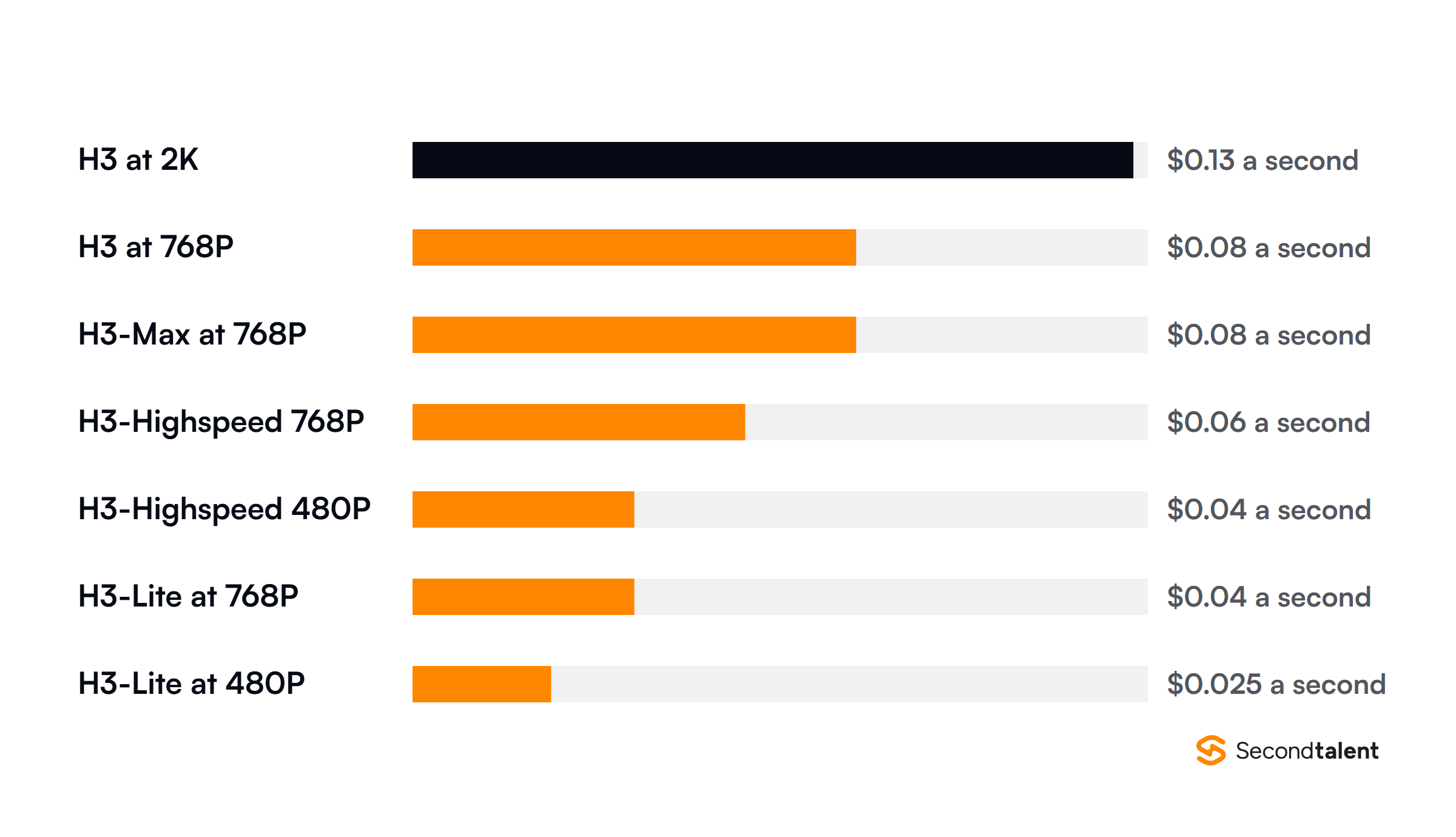
On the API, H3 bills by the second of video, not by the clip. Four variants trade quality for price, from H3 at 2K down to H3-Lite at 480P.
Per-second billing changes the math against the old Hailuo models, which are still on the API.
At $0.08 a second, a 10-second H3 clip at 768P comes to $0.80 of output, while the same pricing page lists a 10-second 768P Hailuo 2.3 clip at $0.56 flat. H3-Lite at 768P works out to $0.40 for those 10 seconds.
H3-Max costs the same $0.08 a second for output but bills reference video at $0.143 a second, and it is the variant that accepts image, video and audio references together.
MiniMax-H3-Image
H3-Image is the newest model in the family, released on November 10, 2026. It handles text to image and editing with 1 to 16 reference images, and the open checkpoint on Hugging Face is a 33.1B-parameter diffusion transformer.
On the API it bills by tokens. A 1K text-to-image render costs about $0.022 on Standard and $0.035 on Highspeed, by MiniMax's own worked examples. A 50% discount on 4K output runs until November 17, 2026.
The older image-01 still costs $0.0035 per image, which makes it the budget pick for thumbnails.
Speech 2.8 and the voice tools
Speech 2.8 launched on January 23, 2026 with sound tags that let a voice laugh, breathe or say "um" on cue, according to the Speech 2.8 announcement, which also says a 10-second sample is enough to clone a voice.
Both versions cover 40 languages. speech-2.8-hd costs $100 per million characters and speech-2.8-turbo costs $60. Cloning a voice is $1.50 per voice and designing one from a prompt is $3, each charged on first use.
Speech-to-text runs $0.38 per hour of audio.
Music 3
Music moved off the paid API in 2026. New users lost access to music and lyrics generation on August 20, 2026, and the model list now files every music model under retired, though existing paying customers can keep calling them.
The replacement is Music 3 as open weights: an 8B planning model built from Qwen3-8B, a 0.6B model for acoustic detail, and a synthesis stage that writes 32 kHz stereo WAV.
What the Current Text Models Can Do
Both M models read text, images and video in one request and write text. The API takes images up to 10 MB and videos up to 50 MB inline, and videos up to 512 MB through the Files API, per the Anthropic-compatible API reference.
Tool use, tool results and thinking blocks all pass through, so agents built for Claude's message format run with a changed base URL.
MiniMax recommends that Anthropic-compatible endpoint over its OpenAI-compatible one, and the docs show setup for Claude Code and Cursor. Two parameters break the usual habits.
The API ignores temperature and holds it at 1, and it holds top_p at 0.95, so prompt changes are the only way to tighten output.
MiniMax bills two server tools per call: web search and image understanding over MCP, at $0.01 a request each.
MiniMax Pricing Compared Across the Lineup
Output tokens drive a text bill, and M3.1-Flash charges half what M3 does for them: $0.60 against $1.20 per million. M3's listed rates are already half its original prices, under what MiniMax labels a permanent 50% discount.
Long prompts cost more on M3 only: past 512K input tokens, its rates double to $0.60 and $2.40. Priority adds 50% on top, and M3.1-Flash does not offer it.
Cached input is the other lever.
On M3.1-Flash a cache hit costs $0.015 per million tokens, a tenth of the input rate, and M3 charges $0.06 up to 512K. An agent that resends the same system prompt and file context on every turn pays mostly cache rates after the first call.
MiniMax does not list a separate cache write price.
Subscriptions sit beside pay-as-you-go. The Token Plan comes in Go, Explore and Build tiers with 1x, 3x and 7.5x the base quota. All three include M3.1 Flash, H3 Image and speech; only Explore and Build include H3 video.
Quotas reset on a 5-hour and a weekly window, and unused quota does not roll over. MiniMax does not print the tier prices in its docs, so check the console before you budget.
Context Windows and Output Limits
Both text models accept up to 1M tokens. MiniMax's pricing page puts 1,000 tokens at about 750 English words, so a full window holds roughly 750,000 words: a large codebase or several hundred pages of contracts.
The sparse attention design is what makes that size affordable to serve, and MiniMax's own reasoning for M3 is long agent runs, long coding sessions and long video understanding.
Max output is the number MiniMax leaves out. The text generation docs show max_tokens set to 4,096 in every example and give no ceiling.
Because thinking tokens count toward that limit, a low setting on M3.1-Flash at max effort can end with the reply cut off and no visible answer at all. Set a generous limit, stream long replies, and log the stop reason.
How Thinking and Effort Work
The two text models handle reasoning in opposite ways, per the text generation guide. M3.1-Flash always thinks.
You set depth with effort, at low, medium, high, xhigh or max, and leaving it out means max, the slowest and most token-hungry setting. Sending a disabled flag returns a 400 error.
On the Anthropic-style API the field is output_config.effort; on the OpenAI-style API it is reasoning_effort.
M3 starts with thinking off. Pass adaptive and the model decides when to reason; it has no effort dial. The practical rule: set effort on every M3.1-Flash call instead of trusting the default.
Start at medium for chat and extraction, and keep max for planning and hard code changes. If a route must answer with zero reasoning tokens, it belongs on M3.
Open Weights and the License
M3 and M3.1-Flash ship under the MiniMax Community License, and it is stricter than the modified MIT license that covered M2. The base grant is for non-commercial use.
Commercial use needs a visible "Built with MiniMax M3" credit and a one-time notice email; above $20 million in yearly revenue, you need written approval first. The license also bans military use.
I check that revenue line first in any Chinese model license, because it decides whether legal has to get involved before engineering starts.
Self-hosting a 428B model is a cluster job, not a laptop one. The M3 card lists recipes for SGLang, vLLM, Transformers, KTransformers, unsloth and AMD's ATOM, and MiniMax publishes an MXFP8 build to cut memory.
Read the license and the hardware bill together before you pick self-hosting over a $0.60 output rate.
Which MiniMax Model Should You Use?
If I were starting a new agent project this month, I would begin on M3.1-Flash with effort set explicitly, because it is the cheaper and newer of two models that share one parameter count. The table maps common jobs to a model.
Job
Model
Why
Coding agents, long refactors
M3.1-Flash at high or max effort
73.7% on DeepSWE v1.1, $0.60 output
Chat, tagging, extraction
M3.1-Flash at low effort
Fewer thinking tokens per answer
Replies with no reasoning
M3
Thinking off by default
Latency-critical traffic at peak
M3 Priority
Priority admission at 1.5x Standard
Social and ad video
H3-Highspeed or H3-Lite
$0.025 to $0.06 a second
Hero video at 2K
H3
$0.13 a second with stereo audio
Product images and edits
H3-Image
Up to 16 reference images
Voice agents and narration
speech-2.8-turbo
$60 per million characters
Measure before you switch models. Lowering effort on M3.1-Flash is cheaper than moving traffic to M3, and moving M3 traffic to Priority costs 50% more on every token.
The deadline to watch is November 18, 2026. MiniMax's retirement notice closed the M2.5 and M2.7 families to new users on October 19 and retires them on November 18, after which pay-as-you-go calls fail.
Subscription plans work another way: since October 19, requests to M2.5 and M2.7 under the M Plan and Token Plan route to M3.1 Flash, and the old model names keep working.
Older model
Status on the MiniMax API
Move to
MiniMax-M2.7, M2.7-highspeed
Closed to new users October 19, 2026; retires November 18, 2026
MiniMax-M3.1-Flash
MiniMax-M2.5, M2.5-highspeed
Closed to new users October 19, 2026; retires November 18, 2026
MiniMax-M3.1-Flash
MiniMax-M2.1, M2.1-highspeed, MiniMax-M2, M2-her
Retired
MiniMax-M3.1-Flash
MiniMax-Text-01, MiniMax-VL-01, MiniMax-M1
Not on the API model list; open weights remain on Hugging Face
MiniMax-M3 or M3.1-Flash
MiniMax-Hailuo-2.3, 2.3-Fast, Hailuo-02
Legacy, still available; from $0.10 per 512P 6-second clip
Closed to new users August 20, 2026; existing paying users only
MiniMax Music 3 open weights
Moving from M2.7 to M3.1-Flash is mostly a model ID change, but two things break.
Any code that turned thinking off now gets a 400 error, and the default effort of max can raise token use and latency on short tasks that M2.7 answered quickly.
Text-01 is still worth knowing for one number: 456B parameters with 45.9B active, and up to 4 million tokens of context at inference, which is still the longest window MiniMax has published.
MiniMax makes the model cheap; the engineering around it is where the cost sits. Routing between effort levels, migrating off M2.7 before the cutoff, and serving a 428B open model take engineers who have shipped LLM systems.
Our LLM developer cost guide puts a mid-level LLM developer at $119 to $185 an hour in the US, against $23 to $39 an hour for a vetted LLM developer from Asia. We send a shortlist within 24 hours.
Hailuo is the name MiniMax gave its earlier video models, up to Hailuo 2.3. MiniMax is the company. On the API, H3 is now the current video model and the Hailuo models sit in the legacy list.
Can I use the MiniMax API outside China?
Yes. The international platform at platform.minimax.io bills in US dollars, and every price in this guide comes from it. MiniMax runs a separate China platform with its own price list.
Does MiniMax work with Claude Code?
Yes. The Anthropic-compatible endpoint accepts Claude-format requests, and MiniMax's docs include setup guides for Claude Code and Cursor. Change the base URL, the API key and the model name.
Elton Chan is the Co-Founder of Second Talent, a solution that connects global tech leaders with top-tier tech talent across Asia. He specializes in talent solutions and has led Second Talent’s rapid growth since 2024, helping scale its network to over 100,000 pre-vetted developers and earning industry recognition as the #1 in the Global Hiring category on G2.
A long-time entrepreneur with deep roots in digital transformation, Elton previously co-founded Branch8, a Y Combinator–backed e-commerce technology firm, and served as the Founding Chairman of HKEBA, a leading Asia-focused business association driving innovation, digital education, and cross-border collaboration.
His work bridges technology, talent, and business strategy to shape how companies scale in an increasingly remote and digital world.