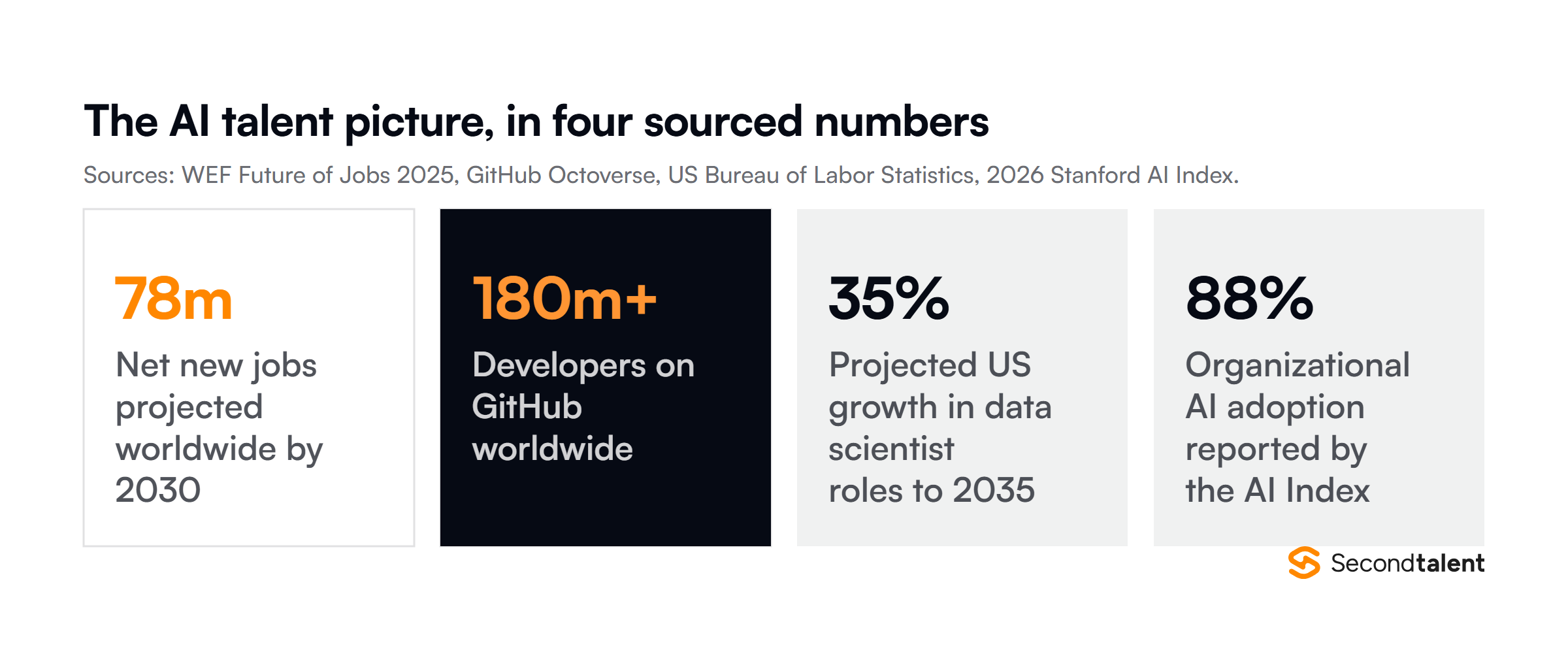
TL;DR: There is no single global AI talent shortage number, and anyone quoting one is guessing. What the public data does support: 170 million roles created and 92 million displaced worldwide by 2030, US data scientist employment growing 35% to 2035 against about 4% across all occupations, and a developer population growing fastest well outside the markets most companies recruit in. The scarcity is concentrated in specialisms, not spread across headcount.
Most articles on this topic open with a precise global figure for unfilled AI roles. No public dataset produces one. Job-opening counts by country, by AI specialism, with supply ratios attached, are not something anyone measures reliably.
What follows is what the evidence actually shows, from named sources you can open, and what it means if you are trying to hire.
Five things that decide AI hiring right now
- The shortage is real in data and security, not across engineering generally.
- Net job creation is positive at 78 million, but the created and displaced roles go to different people.
- Supply is growing fastest outside the markets most companies recruit in.
- Adoption is near universal at 88%. Financial impact is not, at 37%.
- AI fluency on a CV and AI fluency in practice are different things. Test for it.
What the job numbers actually say
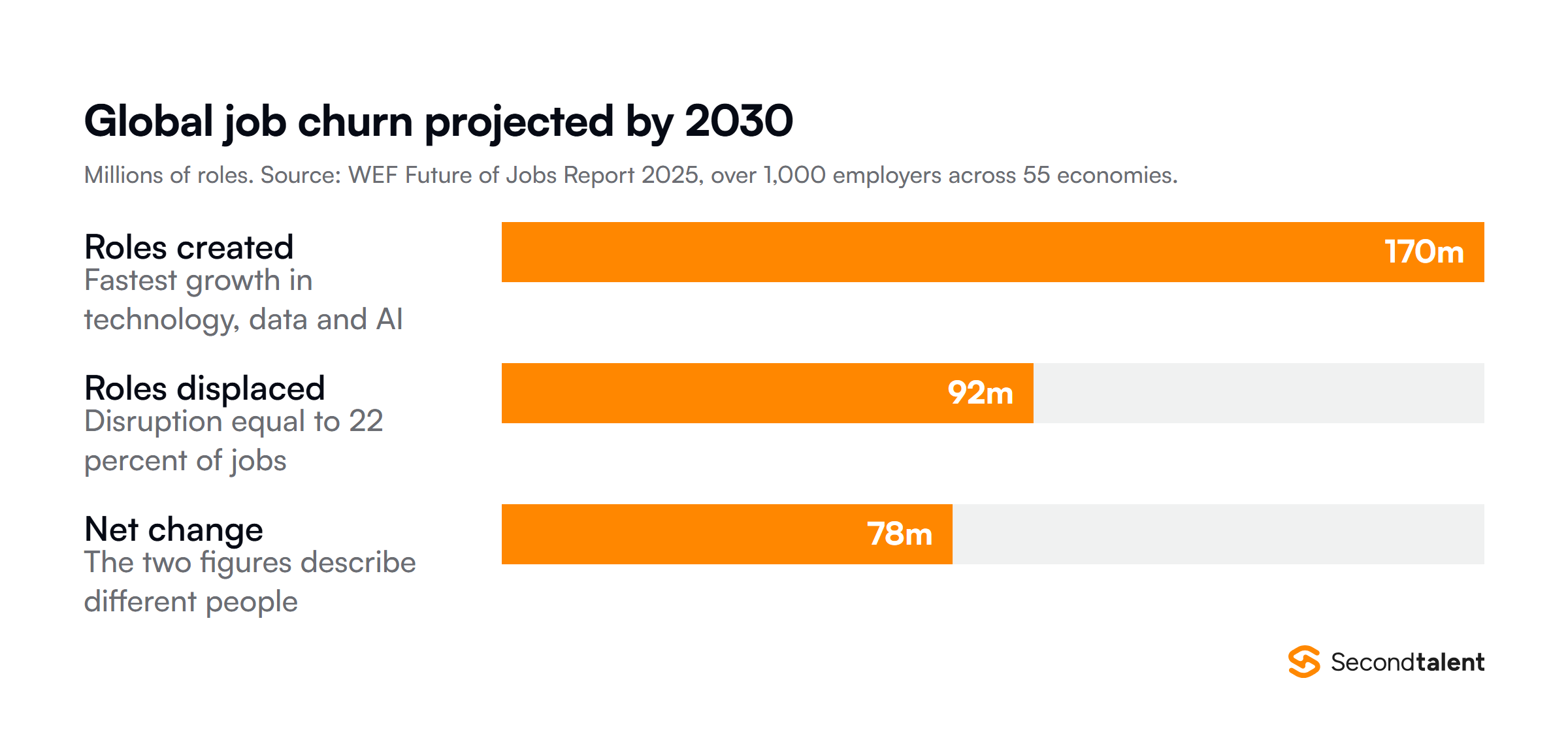
The World Economic Forum’s Future of Jobs Report 2025 projects 170 million new roles and 92 million displaced by 2030, a net gain of 78 million and churn equal to 22% of all jobs. It draws on more than 1,000 employers representing over 14 million workers across 55 economies.
The net figure is the one everyone quotes and the least useful of the three. A person displaced from one role is not automatically the person who fills a new one, and the fastest-growing group is technology, data and AI roles specifically.
That is the actual shape of the problem. Not too few workers, but a mismatch between the skills leaving and the skills arriving.
Where the shortage is real, and where it is not
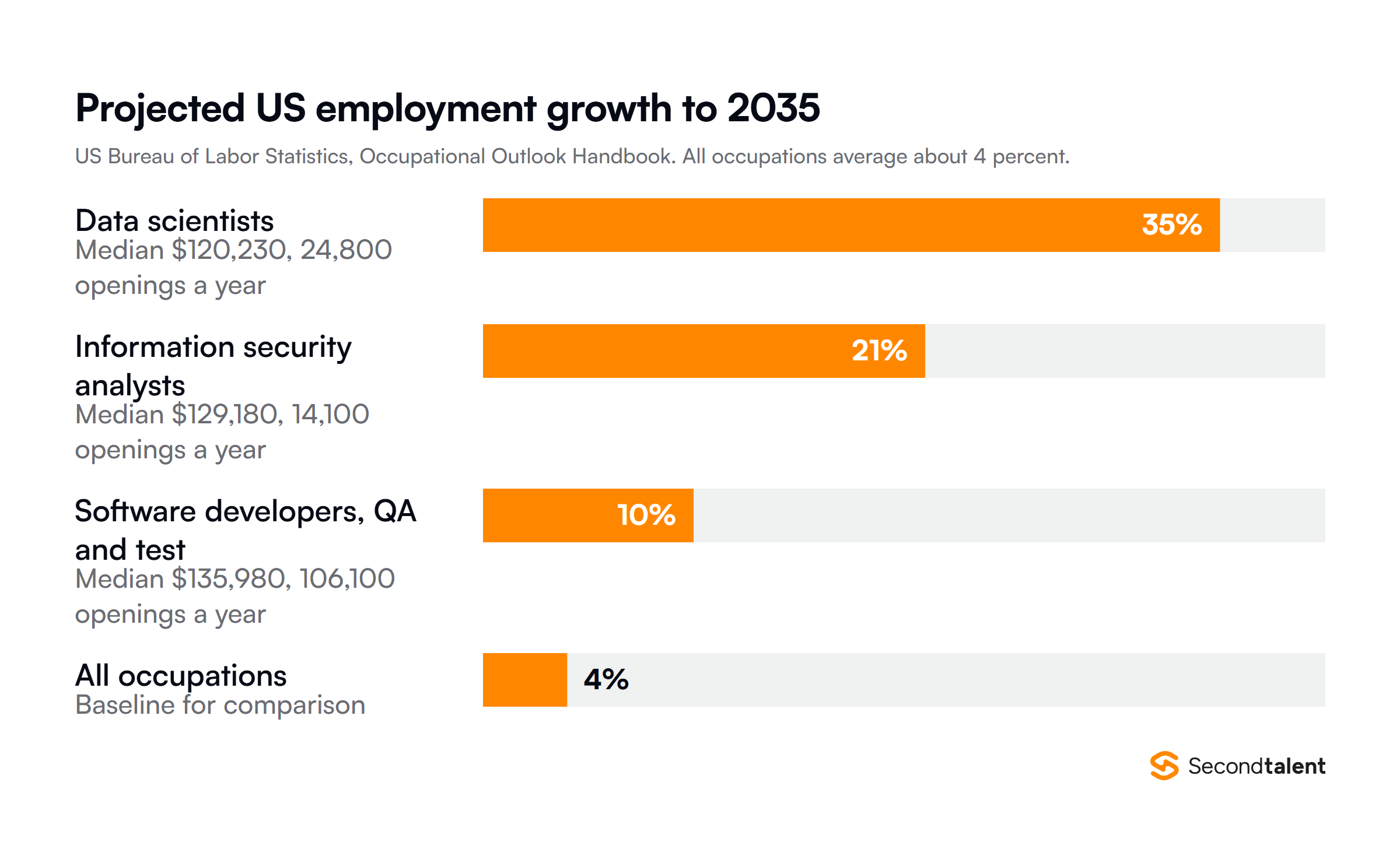
US Bureau of Labor Statistics projections to 2035 give the clearest published picture of which roles are genuinely hard to fill:
- Data scientists: 35% growth, median $120,230, about 24,800 openings a year.
- Information security analysts: 21% growth, median $129,180, about 14,100 openings a year.
- Software developers, QA and test: 10% growth, median $135,980, about 106,100 openings a year.
- All occupations: about 4%.
Read the two columns together. Software development has by far the most openings in absolute terms but grows closest to the economy-wide rate. Data science grows nearly nine times the average from a much smaller base.
So “we cannot find AI people” usually means one of two specific things: you need a data specialist, or you need a security specialist. Those are different hiring problems from needing another backend engineer, and they are the ones worth paying a premium for.
Supply is growing, just not where most companies look
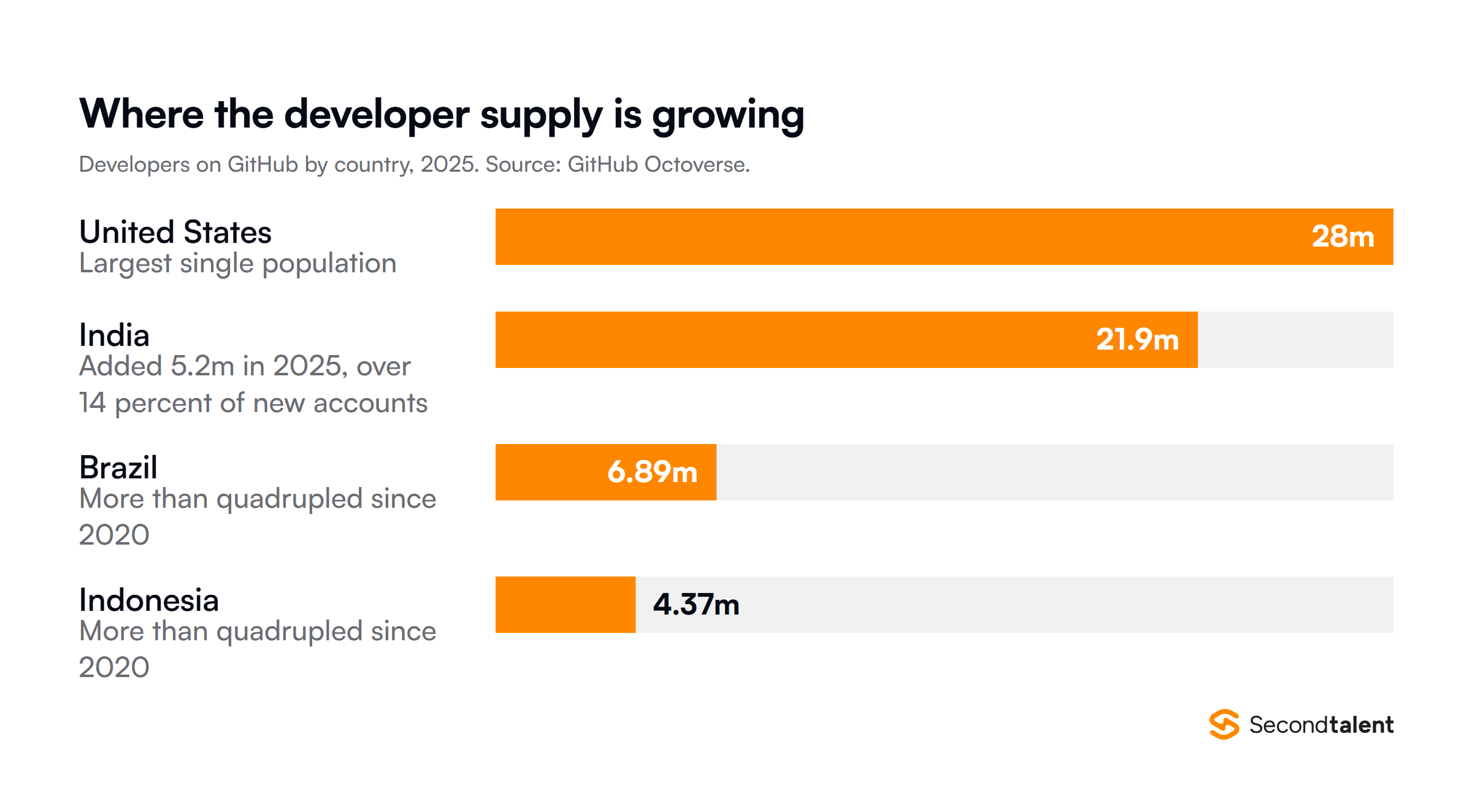
GitHub’s Octoverse report counts more than 180 million developers, up from 100 million in 2023. India sits at 21.9 million after adding 5.2 million in 2025 alone, which was over 14% of every new account worldwide. Brazil and Indonesia have both more than quadrupled since 2020.
The 2026 Stanford AI Index adds a detail that cuts against the usual framing: AI engineering skills are accelerating fastest in the United Arab Emirates, Chile and South Africa. None of those appear on a typical shortlist.
A shortage in your city is not a shortage in the world. Before raising an offer, it is worth checking whether the constraint is supply or search radius. Our guides on hiring engineers in Vietnam, the Philippines, India and Indonesia cover what each market is actually strong at.
“AI engineer” is at least four different jobs
A large part of the perceived shortage is a naming problem. Companies write one job title and then interview for four incompatible skill sets.
- Applied AI engineer. Builds product features on top of existing models. Needs strong software engineering and good judgement about model limits. The largest and most fillable group.
- Data scientist or ML engineer. Works on the data and the modelling itself. This is where BLS shows 35% growth, and where scarcity is genuine.
- AI platform or infrastructure engineer. Runs the serving, evaluation and cost side. Closer to a DevOps profile than a research one, and often the real bottleneck once something ships.
- Security specialist covering AI systems. The 21% growth band. Distinct enough that hiring a generalist rarely covers it.
Write the brief for one of those four and the market usually looks less empty than it did. Write it for all four at once and no candidate matches, which reads as a shortage but is a specification problem. If the work is mostly serving and reliability, DevOps engineers are often the better first hire.
The remote assumption worth checking
Widening the search usually means hiring remotely, and the data there runs against the common assumption.
In the 2025 Stack Overflow Developer Survey of 33,686 developers, 32.4% worked fully remote and 17.9% fully in person. The US led on remote at 45%. In India, in-person was the largest single arrangement at 30.5%, ahead of remote at 25.6%.
So the hiring company is often the more remote-native party, not the offshore team. Assuming the reverse is how distributed teams end up with a process nobody on one side has run before.
Adoption is near universal. Results are not.
The 2026 Stanford AI Index puts organizational AI adoption at 88%, and four in five university students now use generative AI.
McKinsey’s 2026 State of AI survey of 1,719 respondents across 97 nations shows what happens after adoption. Nearly nine in ten report regular AI use in at least one function, and 44% say AI is scaling across the enterprise, up from 38%. But only 37% attribute any EBIT impact to it, essentially unchanged year on year, and just 6% qualify as high performers.
The gap worth hiring against: 80% of individuals say AI improved their own productivity, while only 37% of organizations see it in the numbers. The scarce skill is not using AI tools. It is redesigning the work around them. McKinsey’s high performers are distinguished by fundamentally redesigning workflows rather than inserting AI into existing ones.
What the tools have and have not changed
Coding assistants are now the default. Gartner projects that 75% of enterprise software engineers will use AI code assistants by 2028, up from under 10% in early 2023.
The productivity claim behind that has a real study underneath it. GitHub’s controlled study of 95 developers found the Copilot group finished the task 55% faster, 1 hour 11 minutes against 2 hours 41 minutes.
What that does not do is remove the need for senior judgement. The AI Index describes a jagged frontier: a model can win a gold medal at the International Mathematical Olympiad and still read an analog clock correctly only 50.1% of the time. Agents improved from 12% to about 66% task success on real computer tasks, which still means failing roughly one attempt in three.
Faster juniors do not replace the person who knows which output to distrust.
The budget line people forget
Hiring is not the only cost that scales. McKinsey’s 2026 survey found about one in five organizations already limiting AI use because of operating costs, including token spend, and that constraint shows up fairly evenly across company sizes and industries.
At the same time 28% now spend more than 10% of their total IT budget on AI, and 60% expect to increase AI investment over the next year. Cost pressure and rising spend are happening together, which is what a technology looks like when it is moving from experiment to line item.
There is a hiring consequence. An engineer who can cut inference cost by restructuring how a feature calls a model is doing work that shows up directly in the budget. That skill sits closer to platform engineering than to modelling, and it is rarely what an “AI engineer” job ad asks for.
The demand side is real enough to justify the spend. The 2026 AI Index estimates the value of generative AI tools to US consumers at $172 billion annually by early 2026, with the median value per user tripling between 2025 and 2026.
What actually closes the gap
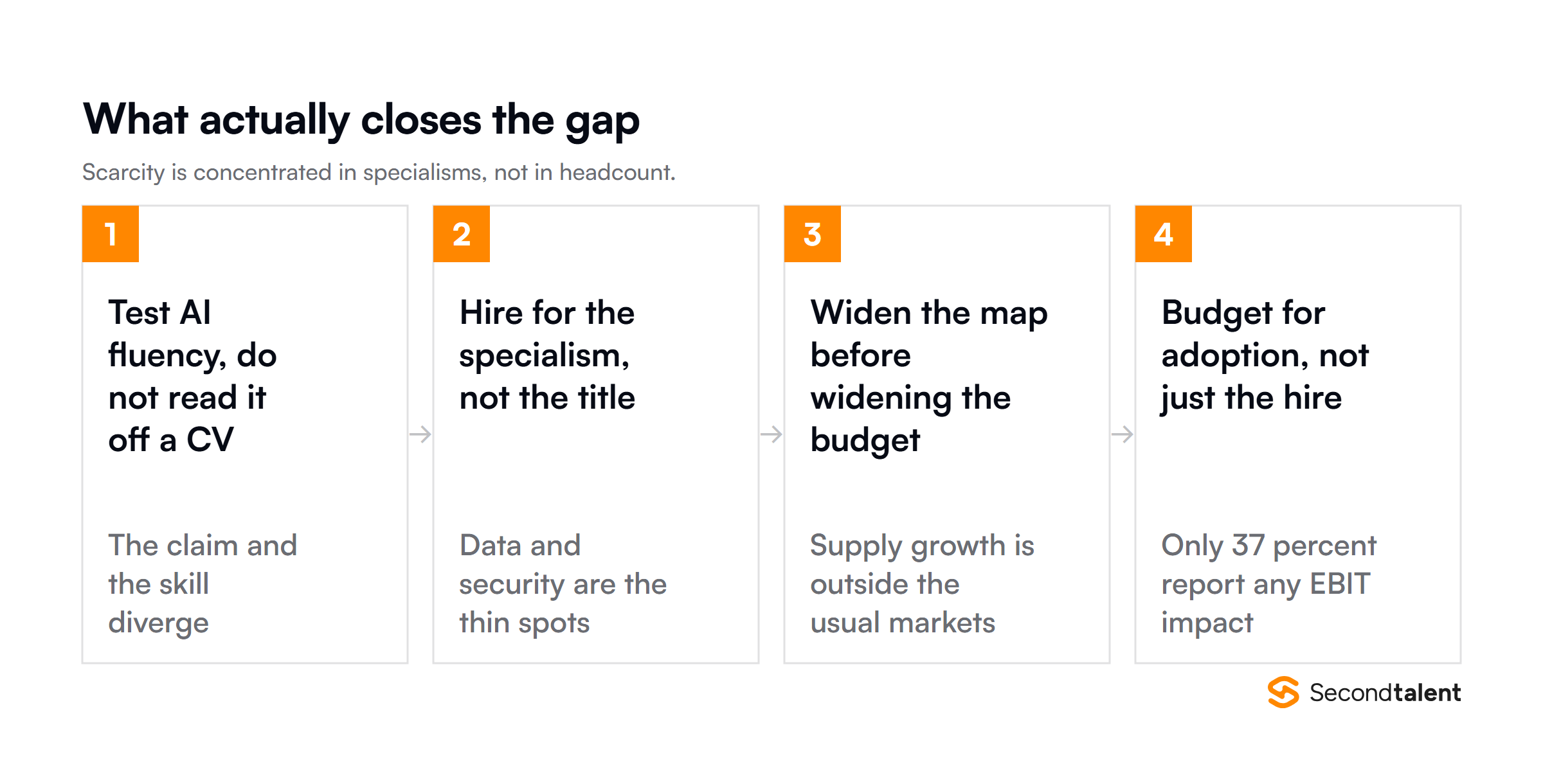
- Test the fluency. Everyone lists AI tools now. Give candidates a real task and watch how they use them, including when they decide not to.
- Name the specialism. “AI engineer” covers at least four different jobs. Data, security, platform and applied modelling have different markets and different scarcity.
- Widen the map before the budget. Supply is growing fastest outside the usual markets, and that is cheaper than an offer war at home.
- Budget for adoption. The hire is not the deliverable. Only 37% of organizations can point to financial impact, and the ones that can redesigned the workflow.
This is how we vet. AI tool fluency is assessed during the process rather than assumed from a CV, because the claim and the skill have come apart. Our AI and machine learning engineers and agentic AI specialists are the two profiles most requested for this work, and the developer rate card shows what they cost by market.
Hiring for AI work? Tell us what you are building and we will match you with vetted engineers in about 24 hours.
Frequently asked questions
How big is the global AI talent shortage?
No credible source publishes a single global figure, and numbers claiming otherwise are usually estimates repeated until they look official. What is measured: churn of 170 million roles created and 92 million displaced worldwide by 2030, and US growth rates well above average in data science and security.
Which AI roles are hardest to fill?
Data science and information security. BLS projects 35% and 21% US growth to 2035 against about 4% across all occupations. General software engineering has more openings in absolute terms but grows much closer to the average.
Is AI reducing the need for developers?
Not so far. In McKinsey’s 2026 survey 39% of respondents expect AI-related headcount declines in the coming year, but only 14% reported an actual decline over the past year, against 32% who had expected one. Expectations have consistently run ahead of what happened.
Do AI coding tools make engineers faster?
Measurably, on scoped tasks. GitHub’s study of 95 developers found a 55% speed gain on a defined task. That result does not extend to ambiguous work, architecture or judgement about when the tool is wrong.
Should we train existing staff or hire in?
Both, for different gaps. Tool fluency trains well and quickly. Deep specialisms such as security and applied modelling take years, which is where hiring or an external partner pays. The organizations seeing financial impact redesigned workflows rather than just adding tools.




![Singapore AI Companies Leading Southeast Asia. Top 10 Singapore AI Companies Leading Southeast Asia [2026], by Second Talent.](https://www.secondtalent.com/wp-content/uploads/2026/09/singapore-ai-companies-featured-v2-768x403.jpg)
![AI Recruiting Tools. Top 7 AI Recruiting Tools in 2026 [Tried & Tested], by Second Talent.](https://www.secondtalent.com/wp-content/uploads/2026/09/top-ai-recruiting-tools-featured-v2-768x403.jpg)