TL;DR: The HR workflows AI automates best in 2026 are high-volume and rule-based: resume screening, interview scheduling, onboarding handoffs, payroll checks and helpdesk questions. The best published results are vendor-reported: General Motors cut interview scheduling from 5 to 7 days to 29 minutes, and IBM's AskHR agent resolves 94% of common questions. Keep a human on every hiring decision, because New York City, Illinois and California already regulate automated hiring tools.
Checkers & Rally's, the US drive-through chain, says conversational AI from Paradox saved its hiring teams 35,000 hours and cut six days from its time to hire. Most HR automation in 2026 works the same way. A narrow, repetitive step comes off a recruiter's desk, and the judgment calls stay with a person.
- 1Gartner expects 50% of current HR tasks to be automated or handled by AI agents by 2030.
- 2Only 39% of HR professionals told SHRM that AI is adopted in their HR function, in a survey fielded in December 2025.
- 3California employers must keep automated-decision data for four years under rules in force since October 1, 2025.
- 4The EU has banned AI that infers employees' emotions at work since February 2, 2025, outside medical and safety uses.
1. Resume Screening and Candidate Matching
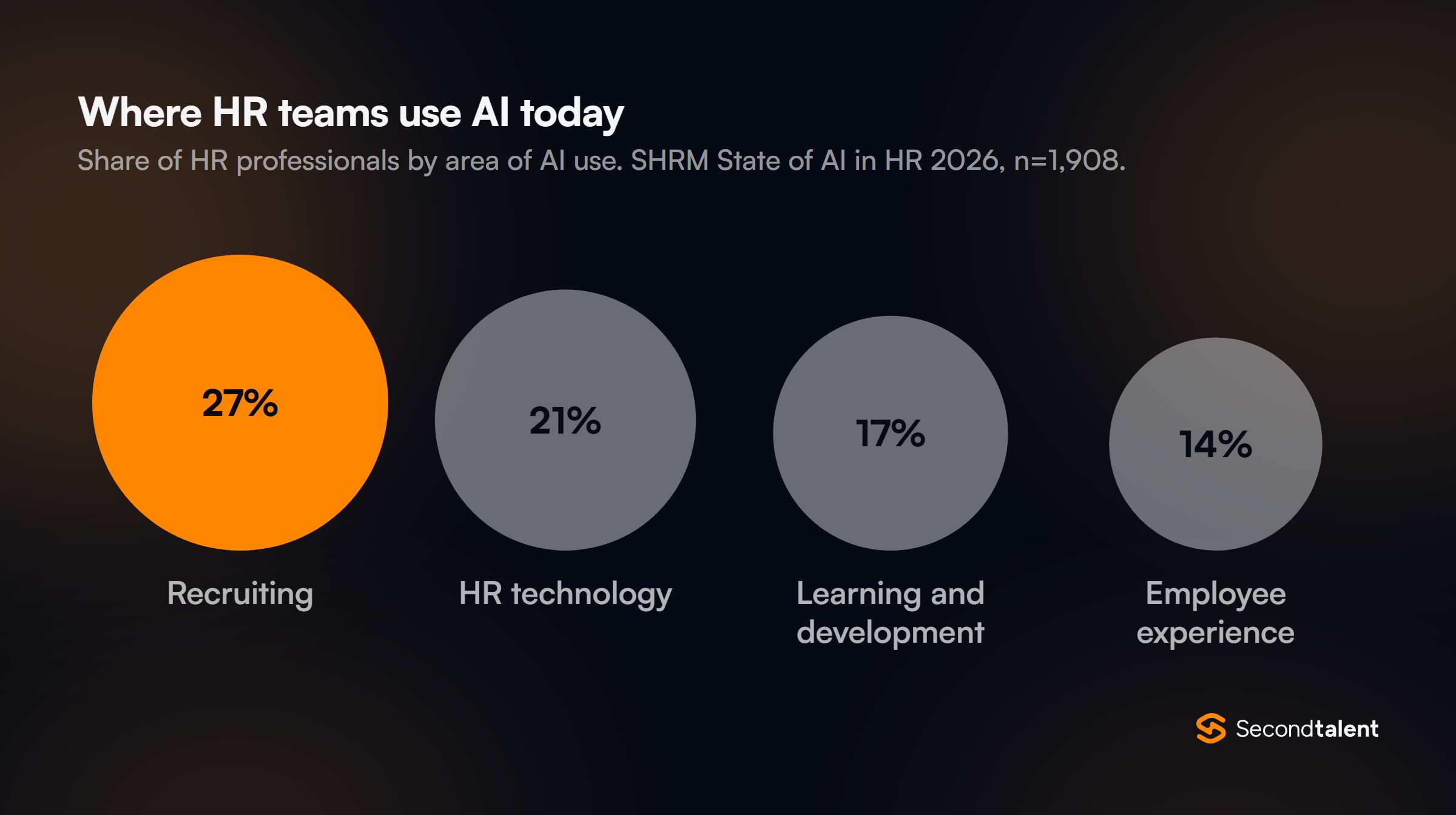
Screening is where most HR teams start. Recruiting is the most common area of AI use in HR. It was named by 27% of respondents in SHRM's State of AI in HR 2026.
The flow has three steps. Most errors start at parsing. A document parsing API turns PDF and Word resumes into structured fields. A bad parse means a candidate gets ranked on the wrong data. The tool then scores each applicant against criteria a recruiter wrote down. It also shows why each one ranked where it did ("matched on Python, AWS and five years of backend work").
The best-documented example is LinkedIn's Hiring Assistant, which reached all English-language recruiter customers in September 2025. LinkedIn reports that early users save more than four hours per role and review 62% fewer profiles, with a 69% improvement in InMail acceptance. Those are LinkedIn's own figures, not an independent test.
The human job here is the criteria and the decision. A recruiter decides who advances and who gets rejected. The ranking is advice. Our AI in recruitment statistics cover adoption in more depth, and the AI recruitment tools cost comparison prices the main products.
2. Interview Scheduling
Scheduling has the clearest before-and-after numbers of any HR workflow, because the old process was pure back-and-forth email. General Motors' results with Paradox's scheduling assistant, as Paradox reports them:
- 5 to 7 days to schedule an interview
- Every reschedule restarts the thread
- 29 minutes to schedule
- 74,000+ candidate interviews booked
- $2M saved a year
The assistant reads interviewer calendars, offers candidates open slots by text or chat, sends reminders and handles reschedules across time zones. Workday completed its acquisition of Paradox on October 1, 2025. Scheduling now ships inside one of the largest HR suites.
Two things stay human: who sits on the panel, and the scorecard each interviewer fills in. A faster calendar does nothing for a process where each interviewer asks different questions.
3. Onboarding
A new hire touches a dozen systems in the first week, and every one of them waits on someone to click something. AI workflow automation handles those handoffs. A signed offer in the ATS creates accounts in the HRIS, email, Slack and code repositories. The same trigger assigns a laptop, schedules first-week meetings and routes the I-9, W-4 and direct deposit forms.
ServiceNow publishes numbers from running this on its own workforce:
Automation gets the accounts and paperwork done before day one. It does not replace the manager's first-week plan or a named buddy, which decide whether the hire is productive by month three. For engineering hires, the first 90 days blueprint covers that half.
4. Payroll Checks
No large employer has published a named, audited result for AI in payroll yet. The case studies in circulation are anonymous ("a global tech firm"), and the vendor numbers are product claims. Workday says its Payroll Agent, available in 2026, enables compliance up to 4x faster.
The workflow itself is well understood. Time data, approved salary changes and benefit deductions flow into one pre-run check. The AI layer then flags anomalies before the run: a 30% raise for one employee, a duplicate bonus, a manager who approved their own hours. Using Payroll Automation Software makes it easier to detect errors early while ensuring payroll is processed accurately and on time.
Payroll for staff in other countries adds local tax, social contributions and filing calendars that change every year. An employer of record or a local provider runs that part, with the anomaly check on top.
5. Time, Attendance and Shift Scheduling
For hourly and frontline teams, the expensive part is not clocking in, it is covering a shift when someone calls in sick. Workday says its Frontline Agent cuts time spent managing staffing changes by up to 90%, a product claim rather than a customer result.
Some HR platforms go further by pairing software with purpose-built location hardware, clock machines, wearable badges, and environment sensors. This is especially valuable for deskless or field-based teams where mobile phones are impractical. Human resources software like SenseHR, for example, captures attendance automatically and feeds it straight into payroll without manual exports. Similarly, Keka HR streamlines workforce management by monitoring attendance, tracking leaves, and syncing the data with payroll, reducing administrative overhead for managers.
Managers then deal only with exceptions: missed punches, overtime about to trigger, a shift with no cover. Overtime and break rules differ by state and country, so the rules engine needs an owner in HR who updates it.
6. Performance Review Drafting
Performance tools now pull goals, project updates, peer feedback and one-on-one notes into a draft summary for the manager. Workday describes its Performance Agent as analyzing "performance data from various enterprise applications to streamline reviews and recommend actions". Lattice and 15Five offer AI drafting too. None of them has published a measured time saving.
This is also the workflow with the most legal weight after hiring. The EU AI Act lists AI used to evaluate performance or decide promotions and terminations as high-risk, with obligations from December 2, 2027. The safe pattern: AI assembles the evidence and a first draft, the manager writes the rating and owns every word sent to the employee.
7. HR Helpdesk and Employee Questions
"When is the next pay date?" and "What is the parental leave policy in Singapore?" have one right answer each. That is why HR helpdesks were among the first functions to get AI agents. IBM has run AskHR on its own workforce since 2016. In 2024 it handled more than 11.5 million employee interactions across 80 automated HR tasks.
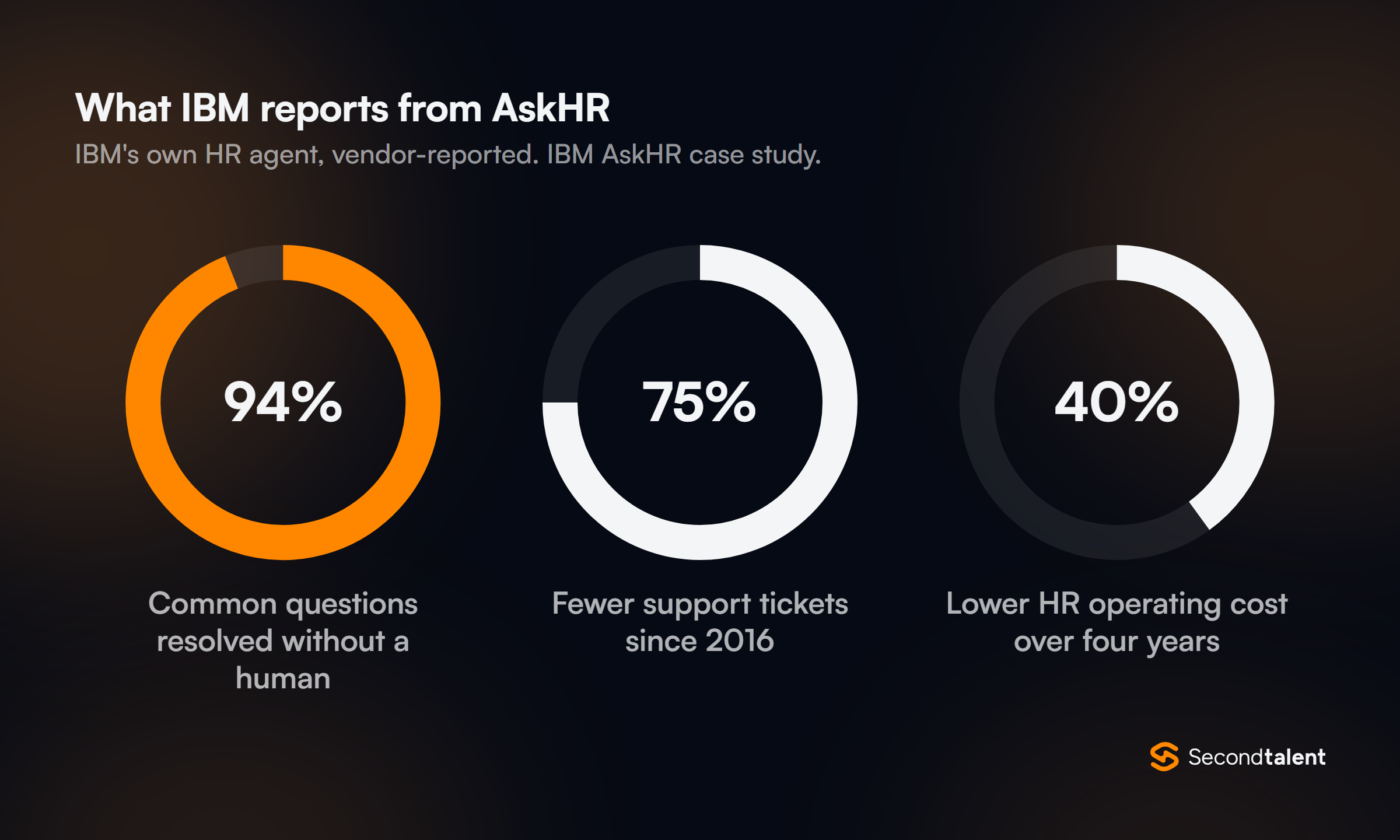
The IBM case study is vendor-reported, since IBM is its own customer. Microsoft has published targets rather than results for its Employee Self-Service Agent: a 44% cut in monthly HR tickets by mid-2026, according to Microsoft Inside Track.
A custom build is retrieval over your HR policy documents plus a chat interface in Slack or Teams, a common project for AI agent developers. Teams that don't want to build can buy it instead. HR help desk software now ships this AI layer built in. It answers routine policy and benefits questions from your own documents and routes the rest to the right person with full context.
8. Learning and Development
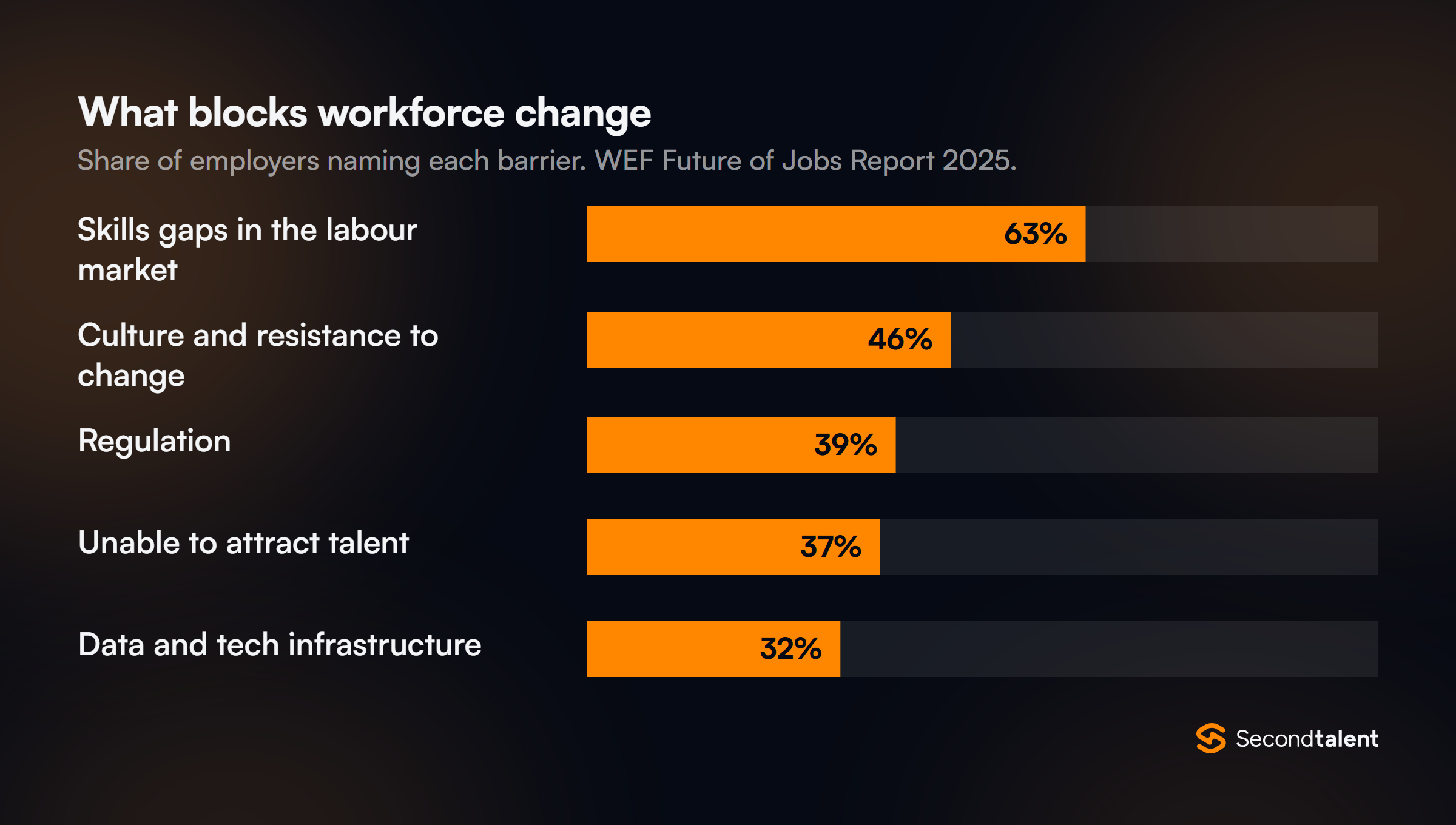
Skills gaps are the top barrier to business transformation for 63% of employers in the WEF Future of Jobs Report 2025. And 85% plan to prioritize upskilling. The WEF expects 39% of workers' core skills to change by 2030.
AI in L&D is mostly matching. It reads an employee's role, skills and goals, then recommends courses, projects or mentors. In LinkedIn's 2025 Workplace Learning Report, 71% of L&D professionals said they were exploring, experimenting with or integrating AI in their work.
AI skill is also becoming a hiring criterion in its own right. Gartner predicts that by 2027, 75% of hiring processes will include certifications and tests for workplace AI proficiency.
9. Offboarding and Access Removal
Offboarding is a security workflow before it is an HR one. A leaver who keeps access to a code repository for a week is an open door. Insider incidents are also expensive to contain:
The automated flow starts when HR records the termination date. At the end of the last day, the system revokes access across single sign-on, SaaS apps and repositories. It also books the device return, calculates final pay and benefits end dates, and sends the exit survey. AI tools need to be on that list: IBM found that 97% of organizations with an AI-related security incident lacked proper AI access controls.
The exit conversation and the knowledge handover stay with the manager.
10. Employee Sentiment and Engagement Analysis
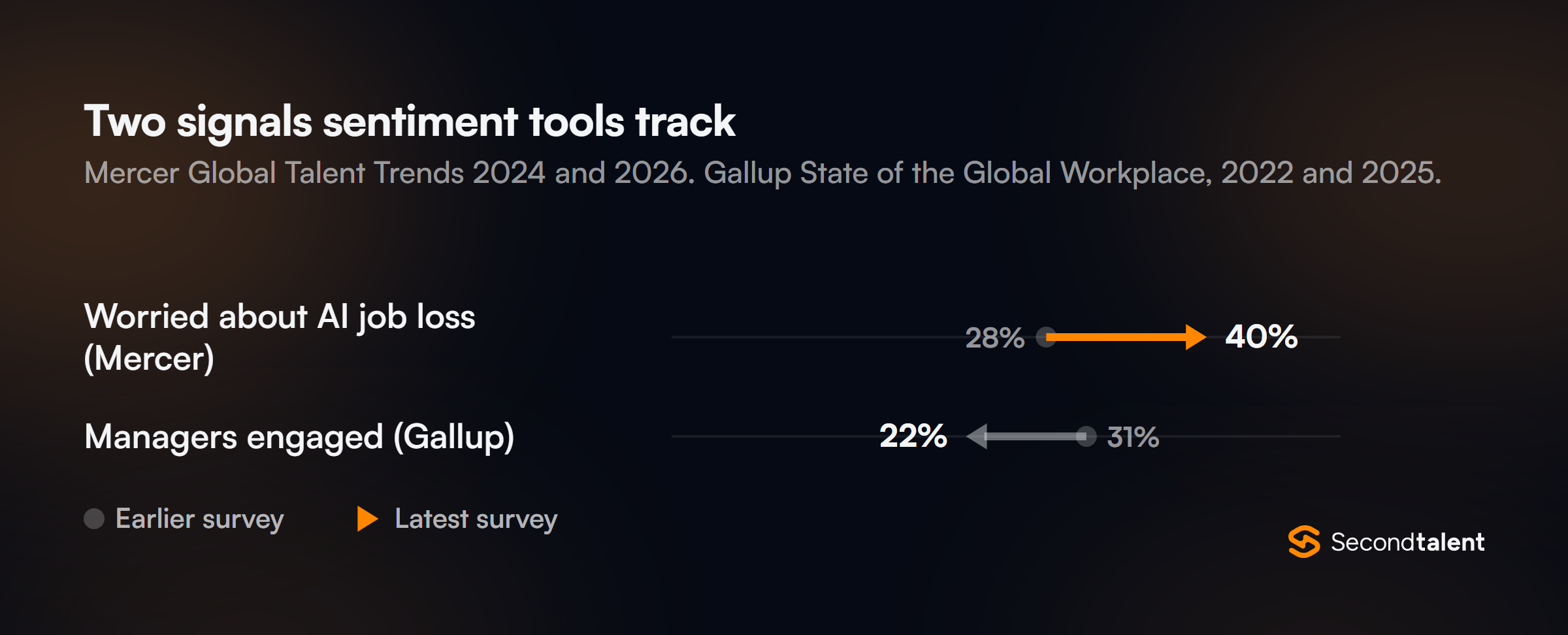
Global employee engagement fell to 20% in 2025, its lowest level since 2020, according to Gallup's State of the Global Workplace. Manager engagement fell from 31% to 22% over the same stretch from 2022. Worry about AI is part of the mood. Mercer's Global Talent Trends 2026 found concern about losing a job to AI rose from 28% of employees in 2024 to 40%.
Sentiment tools read open-text survey answers and pulse comments, group them by topic and track the trend by team. Mercer also found 62% of employees feel leaders underestimate AI's emotional impact. Only 19% of HR leaders consider it. That is the kind of gap these tools surface.
Which HR Tasks to Automate First
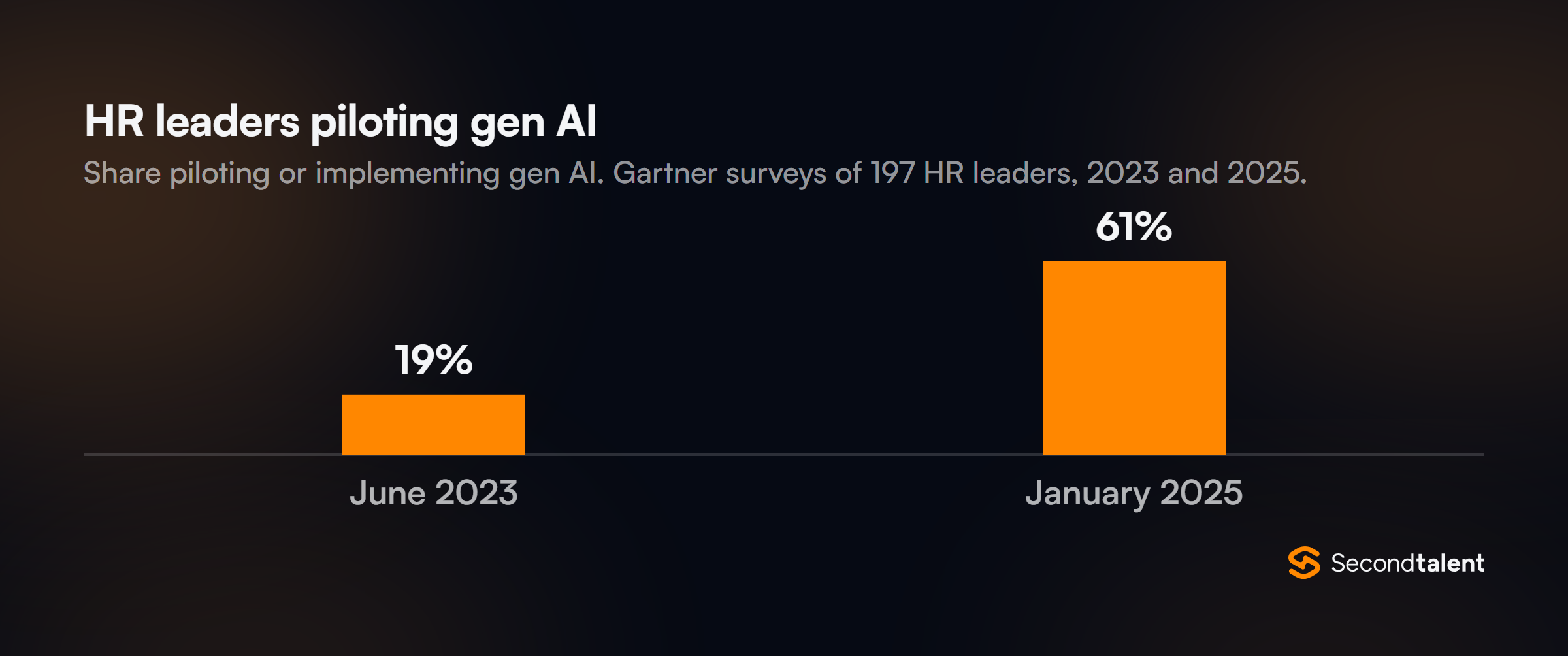
Adoption is moving faster than most HR teams' plans. In Gartner's surveys of HR leaders, the share piloting or implementing generative AI more than tripled between June 2023 and January 2025.
The workforce effects are still small. In a July 2025 Gartner survey, 27% of HR leaders had redefined job roles for AI. Another 24% had redeployed employees, and 10% had replaced some employees with AI or automation. Three tests pick the first workflows: high volume, a clear right answer, and low legal exposure if the tool gets it wrong.
| Workflow | Volume | Clear right answer | Legal exposure |
|---|---|---|---|
| HR helpdesk questions | High | Yes, from policy documents | Low |
| Interview scheduling | High | Yes | Low |
| Onboarding and offboarding handoffs | Every hire and leaver | Yes, a checklist | Low, and offboarding lowers security risk |
| Payroll anomaly checks | Every pay run | Mostly | Medium: a human approves the run |
| Resume screening | High | No, it is a judgment | High: regulated in NYC, Illinois, California |
| Performance reviews | Once or twice a year | No | High in the EU from December 2027 |
Screening scores well on volume, which is why it is the most common starting point, but it carries the most legal risk. Put it on the list with the human checkpoints below built in from the start. For the wider numbers on HR budgets and tooling, see the HR industry statistics and the HR technology stack statistics.
A Human + AI Workflow Template for Hiring
The regulations and standards on automated hiring agree on one design: the tool ranks and summarizes, a named person decides, and every step leaves a record. This six-step flow follows that design.
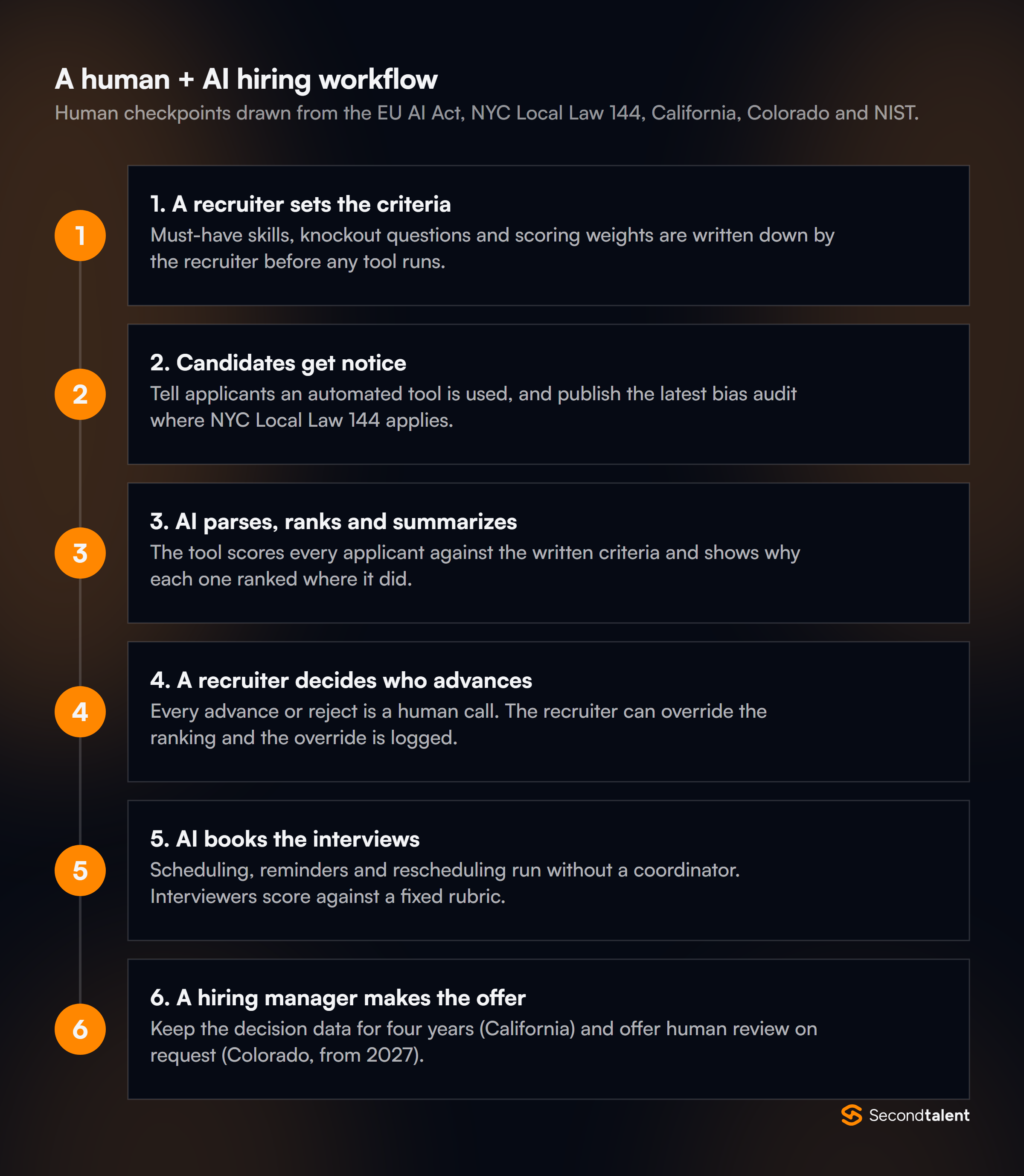
Step 4 is the one that matters most legally. Article 14 of the EU AI Act requires that the person overseeing a high-risk system can "disregard, override or reverse the output". Colorado's new law gives rejected applicants the right to ask for human review from 2027. The NIST AI Risk Management Framework asks for the same thing in management terms: written roles and responsibilities for human oversight of each AI system (GOVERN 3.2).
In practice, log each override with a reason. A recruiter who never disagrees with the ranking is not reviewing it, and an audit will ask for exactly that record.
The Rules on Automated Hiring Decisions in 2026
New York City’s Local Law 144 requires a bias audit in the year before an employer uses an automated hiring tool. The employer must post the results and notify candidates. Enforcement has been light. A December 2025 audit by the New York State Comptroller found the city had flagged one likely violation among 32 employers it reviewed. The auditors found 17.
Illinois' law has applied since January 1, 2026. The state proposed its notice rules in May 2026 and withdrew them in June, so there are no final rules yet. California's regulations make automated tools that harm applicants on protected characteristics unlawful and warn that assessments eliciting disability information may be an unlawful medical inquiry. Colorado repealed its 2024 AI Act and replaced it with SB 26-189. It requires notice at the point of interaction, and a plain-language explanation within 30 days of an adverse decision.
The EU AI Act covers hiring tools too, and the Digital Omnibus pushed its high-risk obligations back to December 2, 2027. The delay is now final. Regulation (EU) 2026/1744 appeared in the Official Journal on July 24, 2026. Employers using high-risk AI will also have to inform workers' representatives and affected workers before deployment.
Who Builds These Workflows
Most of these workflows are integration work: connecting an ATS, HRIS, payroll and identity system, then adding a model where a judgment call gets summarized. That is the job of AI automation engineers and workflow automation engineers. Second Talent matches US and global teams with pre-vetted engineers from Asia from $2,999 a month. The Asia Tech Salary Index shows what the roles pay by market. Tell us what you are building and we will send a shortlist within 24 hours.
Frequently Asked Questions
What are examples of automated HR workflows?
Common examples are resume screening, interview scheduling, onboarding account setup, payroll anomaly checks, shift scheduling, performance review drafts, HR helpdesk agents, learning recommendations, offboarding access removal and survey sentiment analysis.
Is AI resume screening legal in the US?
Yes, with conditions that depend on the location. New York City requires an annual bias audit and candidate notice. Illinois requires notice and bars discriminatory use. California holds employers liable for discriminatory automated decisions. Federal anti-discrimination law applies everywhere.
Can AI make hiring decisions on its own?
It should not. The EU AI Act and the NIST framework both expect a person who can override the tool. Colorado will give rejected applicants a right to human review from January 1, 2027.
Does the EU AI Act apply to HR software now?
Partly. The ban on inferring employees' emotions has applied since February 2, 2025. The high-risk rules for recruitment, promotion, termination and performance monitoring apply from December 2, 2027.

![Engineering Productivity Metrics to Track. Top 10 Key Engineering Productivity Metrics to Track [2026], by Second Talent.](https://www.secondtalent.com/wp-content/uploads/2026/09/top-10-engineering-productivity-metrics-featured-v2-768x403.jpg)