TL;DR: Java is used by 29.7% of professional developers in Stack Overflow's 2025 survey, down from 30.6% a year earlier. It ranks fourth on the TIOBE Index and second on the PYPL index in September 2026. Java 25, released in September 2025, is the current long-term support version.
Java’s rating on the TIOBE Index fell to 7.54% in September 2026, the lowest monthly figure in a series that starts in 2001, when Java stood at 26.49%. Banks have not moved as fast: 43.9% of professional developers in banking and finance used Java in 2025, our count from Stack Overflow survey data.
- 1Oracle’s Premier Support for Java 17 ends in September 2026, the same month free Oracle JDK 21 updates move to a licence that is free only for personal, development and similar non-commercial use.
- 2Java 8 is in regular use by 31% of Java developers in JetBrains’ 2025 survey, down from 83% in 2019.
- 3About 40 million Log4j downloads from Maven Central in 2025 still contained the Log4Shell flaw, Sonatype found.
- 481% of organizations in Azul’s 2026 survey have moved, are moving or plan to move some Oracle Java to other OpenJDK builds.
How Many Developers Use Java in 2026?
Java was the one language among the 15 most used in the Stack Overflow Developer Survey 2025 that lost professional users. The survey’s published results show 29.4% of all 31,771 respondents using it. Among professional developers, our calculation from the public response file gives 29.7%, down from 30.6% in 2024.
Its users are lukewarm about staying. Java’s admired score is 41.8%, meaning that share of current users want to keep working with it next year. Across all respondents, 15.8% said they want to work in Java over the coming year.
Few developers write only Java. Only 1.3% of professional Java users worked in no other language last year. Of the rest, 73.4% also used JavaScript, 68.9% SQL and 61.7% Python. Kotlin developers lean on it most: 68.1% of professional Kotlin users wrote Java as well.
Finance, insurance and government lead
Finance and the public sector lead. Insurance and government both sit above 34%, while software companies, the largest group in the survey, match the overall average. Manufacturing has the lowest share of the industries with enough respondents to count:
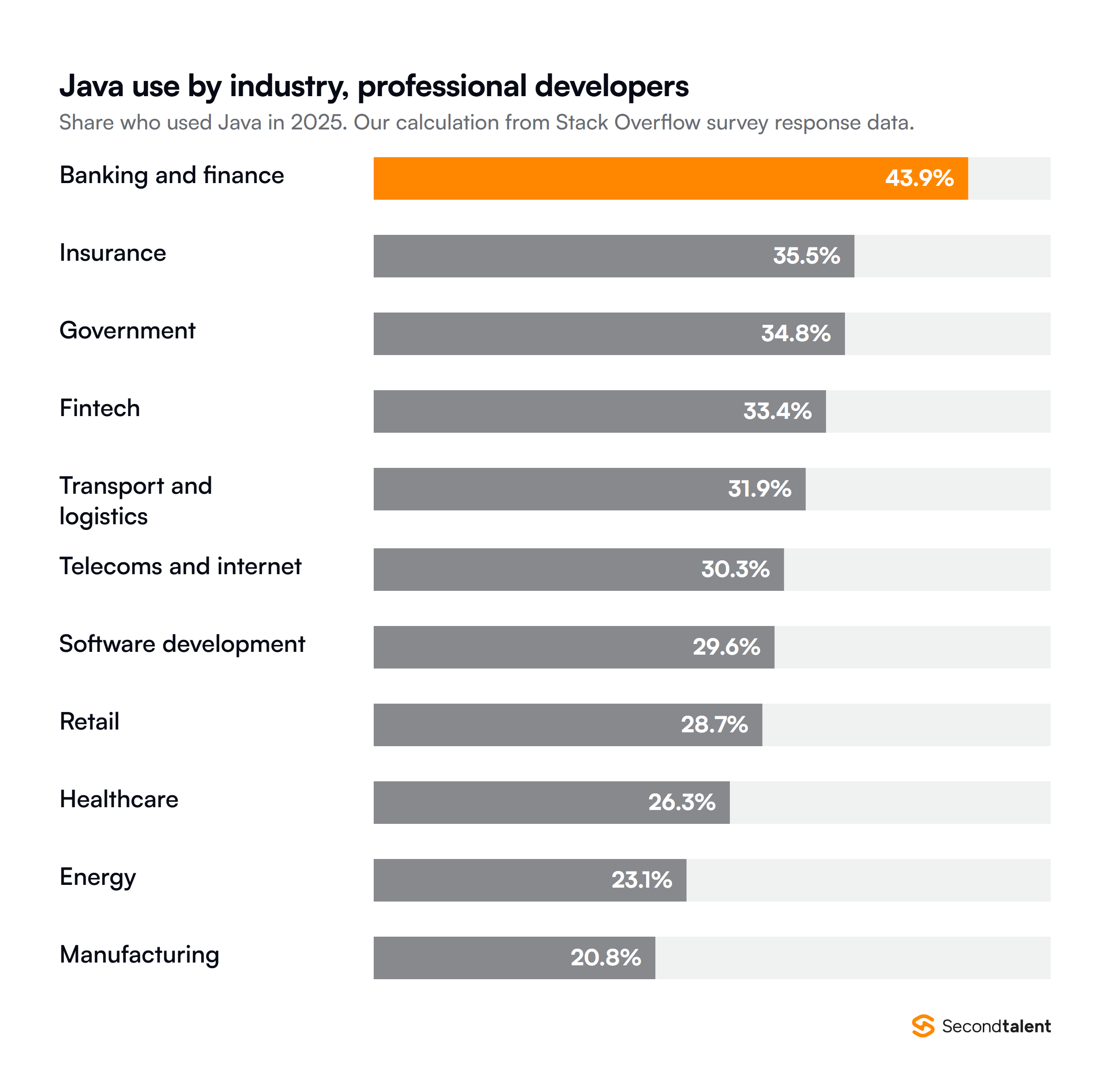
By job, mobile developers use Java most, at 40.9%, then back-end developers at 36.5% and software architects at 33.2%. Front-end developers are lowest, at 14.5%. Age matters too: 41.1% of professional developers aged 18 to 24 used Java, against 27.9% of those aged 35 to 44.
Country shares differ by more than ten points. Among countries with at least 400 professional respondents, India had the highest share at 38.0%, followed by Germany at 34.6% and Italy at 34.4%. The US figure was 28.2% and the UK’s 22.5%.
Where Does Java Rank on TIOBE, PYPL and GitHub?
Java now sits fourth on the TIOBE Index. TIOBE’s 12-month averages put it first in 2006, 2011 and 2016, second in 2021 and fourth in 2026. Each tracker counts something different, so the ranks below do not agree:
The TIOBE Index rates languages by search engine results. Java’s rating slipped from 8.35% in September 2025 to 7.54%, while C passed C++ for second place and Python lost 8.22 points but stayed first. TIOBE last named Java its language of the year in 2015.
PYPL measures Google searches for language tutorials. Java led it each September from 2004 to 2017 and reached 30.6% in September 2005. Python passed it in 2018, and Java’s share has kept shrinking since:
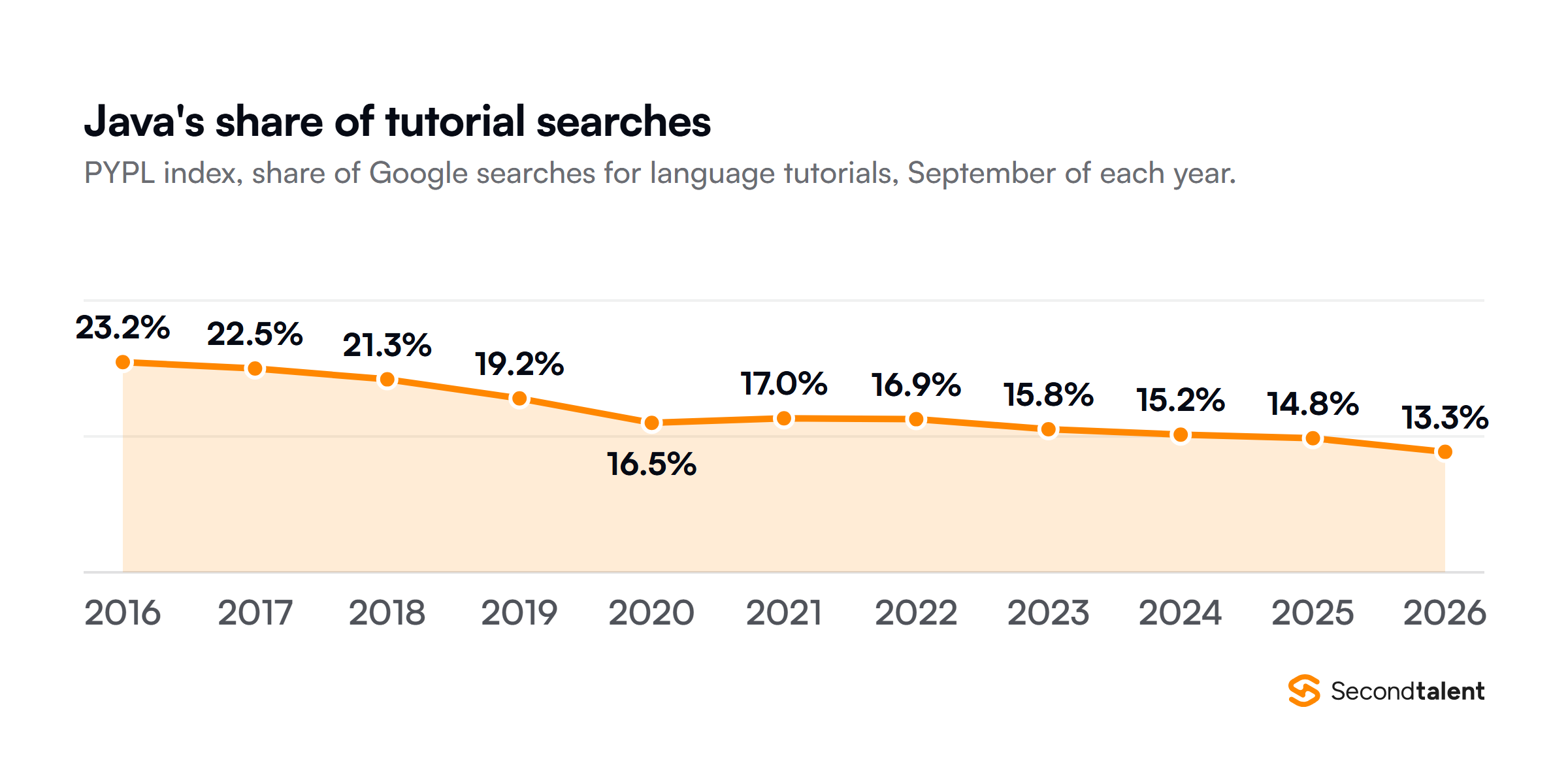
PYPL shares add up to 100%, so Python’s jump from 30.2% to 52.1% in a year left less room for everything else. Java dipped to 9.7% in May 2026, when C/C++ briefly held second place, then climbed back.
On GitHub, Java ranks fourth for contributor growth behind TypeScript, Python and JavaScript. Octoverse 2025 calls it “steady enterprise-driven growth” and lists Java among six languages used in nearly 80% of new repositories. Our most used programming languages ranking sets Java against the other 14.
Which Java Versions Do Developers Use?
Java 21 overtook Java 17 as the version most developers use regularly in JetBrains’ State of Java 2025, by 40% to 39%, after starting the year at 28%. Java 8, 11 and 17 all lost ground:
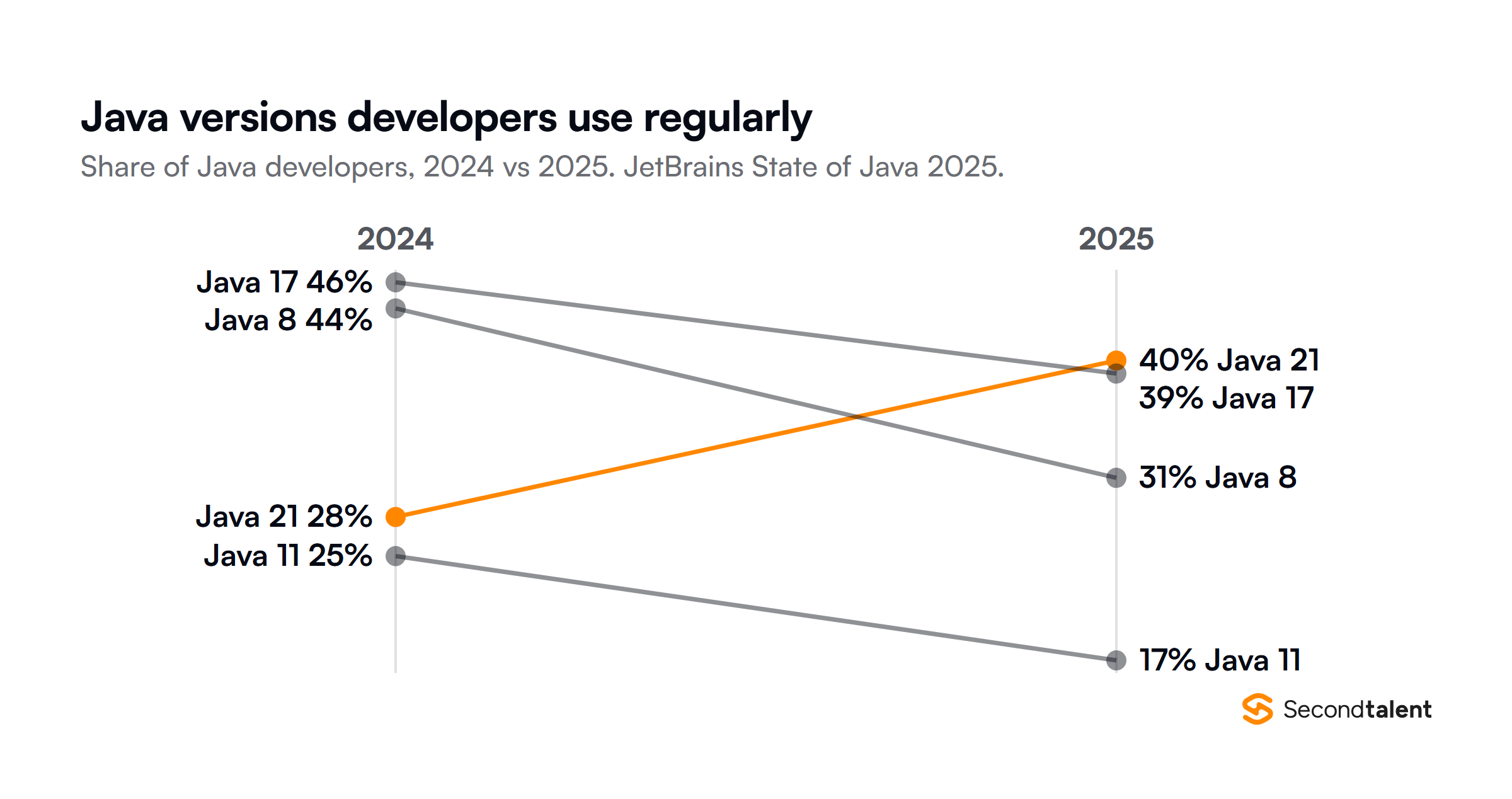
Java 8 dates from March 2014 and has fallen in each year of the JetBrains series. Newer releases beyond 21 are still small: 14% use Java 24, 9% Java 23 and 7% Java 22.
The Eclipse Foundation’s 2025 Jakarta EE Developer Survey, with more than 1,700 participants, saw the same move to Java 21. Its use jumped to 43% from 30% in 2024. The two surveys split on Java 11: the Eclipse survey found it rebounding to 37%, where JetBrains shows it falling to 17%.
Production systems move more slowly than surveys. The New Relic 2024 Java report, the latest edition, found 35% of monitored applications on Java 17. Six months after launch, Java 21 ran 1.4% of them. Fewer than 2% of applications used a non-LTS version.
When Do New Java Versions Come Out?
OpenJDK has set September 15, 2026 for JDK 27’s general availability, and the release makes G1 the default garbage collector in all environments. OpenJDK’s JDK 27 page lists nine features, including post-quantum hybrid key exchange for TLS 1.3 and compact object headers switched on by default.
A new feature release ships each March and September. Oracle picks the September release of odd years for long-term support (LTS), and each non-LTS release loses Premier Support when the next one ships.
Oracle’s commercial support runs far longer than the release cycle. These are the LTS dates on the Oracle Java SE Support Roadmap, where “or later” marks dates Oracle may extend:
| Version | Released | Premier Support until | Extended Support until |
|---|---|---|---|
| Java 8 | Mar 2014 | Mar 2022 | Dec 2030 |
| Java 11 | Sep 2018 | Sep 2023 | Jan 2032 |
| Java 17 | Sep 2021 | Sep 2026 or later | Sep 2029 or later |
| Java 21 | Sep 2023 | Sep 2028 or later | Sep 2031 or later |
| Java 25 | Sep 2025 | Sep 2030 or later | Sep 2033 or later |
| Java 29 (planned) | Sep 2027 | Sep 2032 or later | Sep 2035 or later |
Oracle is waiving the Extended Support fee for Java 17 from October 2026 to September 2029. Java 8 and 11 customers already get waived uplift fees until the end of their extended support. Other OpenJDK vendors publish their own support schedules.
How Much Does Oracle Java Cost?
Oracle charges for Java by a company’s total headcount, not by the number of developers or servers using it. The Java SE Universal Subscription price list, dated March 1, 2023, starts at $15 per employee per month and falls in steps as headcount grows:
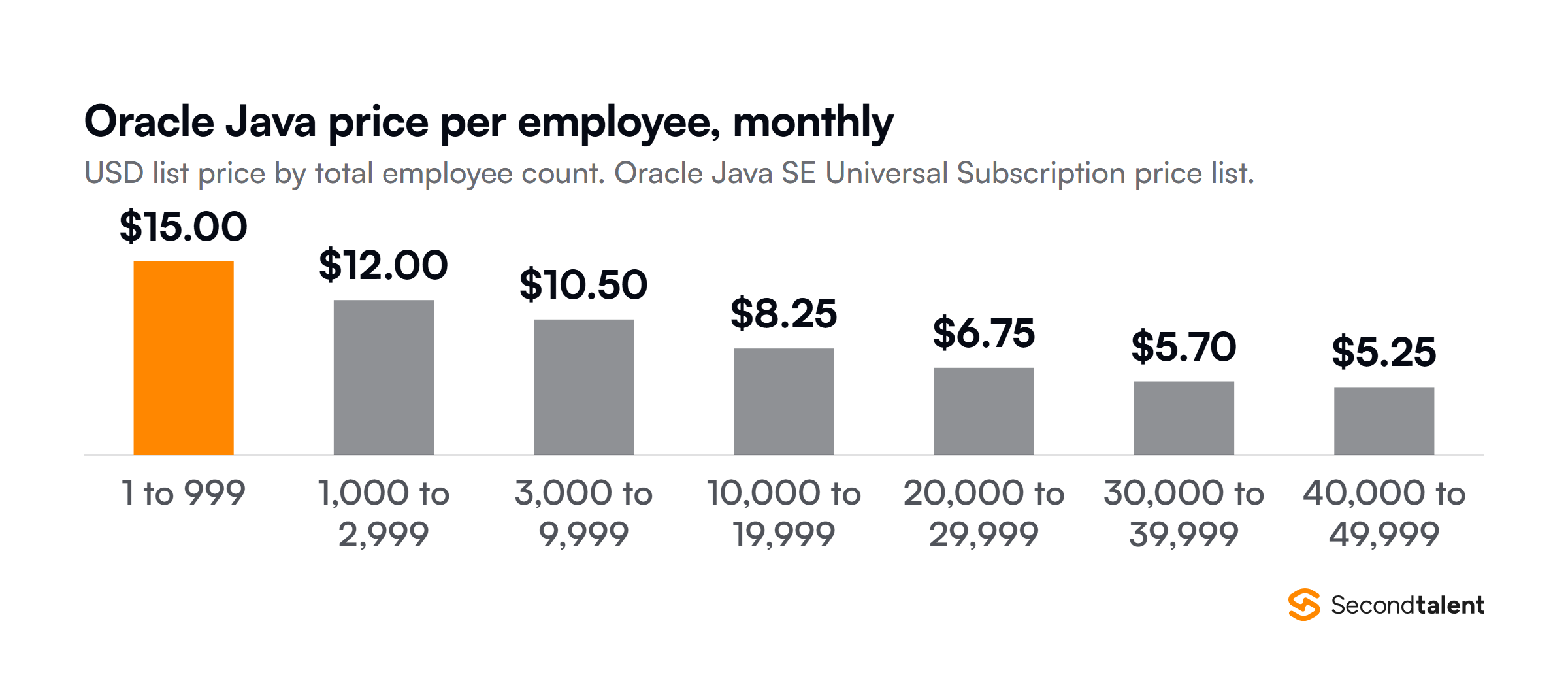
“Employees” includes the full-time, part-time and temporary staff of contractors, outsourcers and consultants who support the business. Oracle’s own example is a company with 23,000 staff and 5,000 contractors: 28,000 employees at $6.75 a month comes to $2,268,000 a year. Above 50,000 employees, pricing is by quote.
Some Oracle JDK releases cost nothing. JDK 25 is free for all users under Oracle’s no-fee terms. JDK 21 had the same terms, but its updates after September 2026 move to the OTN licence, which is free only for personal and development use, as JDK 17’s updates did in October 2024.
Companies are moving to other OpenJDK builds
More than 2,000 Java professionals answered Azul’s 2026 State of Java Survey, published in February 2026. Only 7% said they were “not at all concerned” about Oracle’s pricing, about half last year’s level.
After cost, respondents named a preference for open source (31%), uncertainty over Oracle’s changes (29%) and audit risk (26%).
New Relic’s application data showed the shift earlier. Oracle supplied about 75% of the JDKs its customers ran in 2020, then 34% in 2022, 29% in 2023 and 21% in 2024. Eclipse Adoptium rose from 12% to 18% in 2024, and Amazon’s share fell from 31% to 18%.
How Much Are Java Libraries Downloaded?
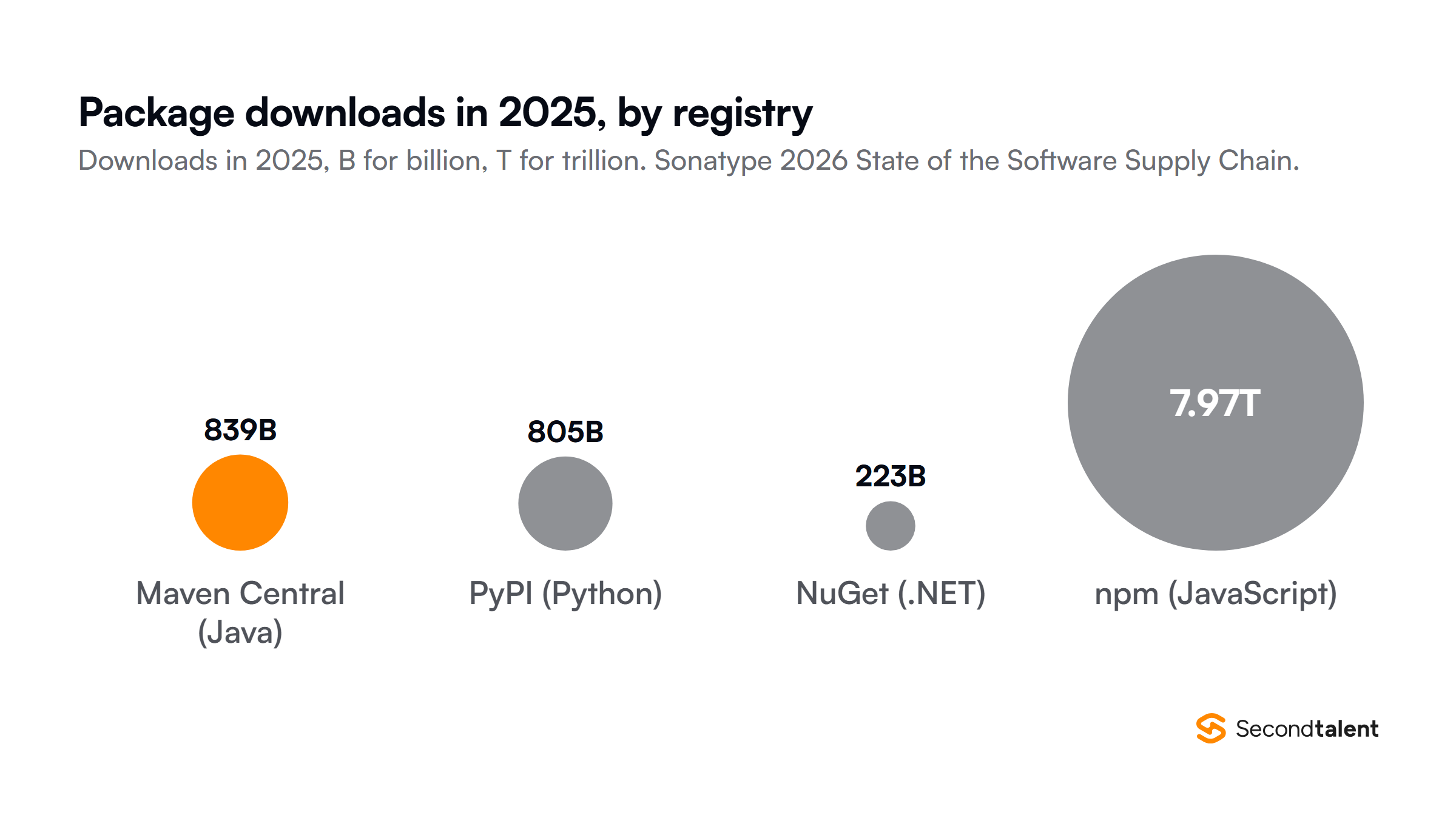
Maven Central, the main public registry for Java libraries, served 839.05 billion downloads in 2025, up 19.42%. That put it slightly ahead of Python’s PyPI, according to Sonatype’s 2026 State of the Software Supply Chain, though npm’s volume is nearly ten times larger:
Publishers added more than 3.3 million Maven Central releases in 2025. Sonatype also found that 40% of vulnerable Maven Central releases in 2025 carried a CVSS severity score of 9.0 or higher.
Old flaws keep getting downloaded
Developers pulled Log4j from Maven Central nearly 300 million times in 2025, and roughly 13% of those downloads still contained Log4Shell. Sonatype notes that fixed versions had been available for almost four years. In the ten countries with the most developers, the vulnerable share ran from 8% to 29%.
Security alerts are arriving more often. In Azul’s 2026 survey, 56% of organizations deal with Java-related CVEs daily or weekly, up from 41% in 2025. And 30% say their teams spend more than half their time chasing false positives.
Spring or Jakarta EE: the surveys disagree
Two 2025 surveys give different answers on the most used Java framework, and each publisher has a stake in its answer:
- 65% use Spring
- 67% build with Maven
- 72% use IntelliJ IDEA, which JetBrains makes
- 58% use Jakarta EE, which the foundation runs
- 56% use Spring
- 18% have already adopted Jakarta EE 11
The Eclipse survey reached enterprise Java users through the Jakarta EE community, while most of JetBrains’ respondents live in China and India. Spring Boot and Jakarta EE also overlap, since Spring builds on Jakarta EE specifications. Our Spring Boot interview guide covers the framework in more depth.
Is Java Used to Build AI Features?
Sixty-two percent of organizations in Azul’s 2026 survey use Java to code AI functionality, up from 50% a year earlier. Almost a third, 31%, say more than half of the Java applications they build now contain AI features.
ChatGPT is the AI tool Java developers use most for coding. In the JetBrains survey, 40% use ChatGPT for coding, 29% GitHub Copilot, 16% JetBrains AI Assistant and 14% Cursor. The Chinese tools DeepSeek (13%) and Tongyi Lingma (12%) follow, a sign of how many respondents are in China.
AI-written Java carries its own risks. GitHub’s Octoverse 2025 found Broken Access Control overtook Injection as the top CodeQL alert, and it now leads in Java, Python, Go and C++. GitHub points to AI-assisted coding that can scaffold endpoints without authorization checks.
Python gains more developers from Java than from any other language, a JetBrains analysis from August 2026 finds. Java developers who switch mostly move to Python and TypeScript, not Kotlin. Our list of AI programming languages by usage compares Java with Python and C++ for AI projects.
How Much Do Java Developers Earn?
Employed professional developers in the US who used Java reported a median of $160,000 in the 2025 Stack Overflow survey, by our calculation, up from $150,000 in 2024. The worldwide median was $78,112. Pay varies widely by country:
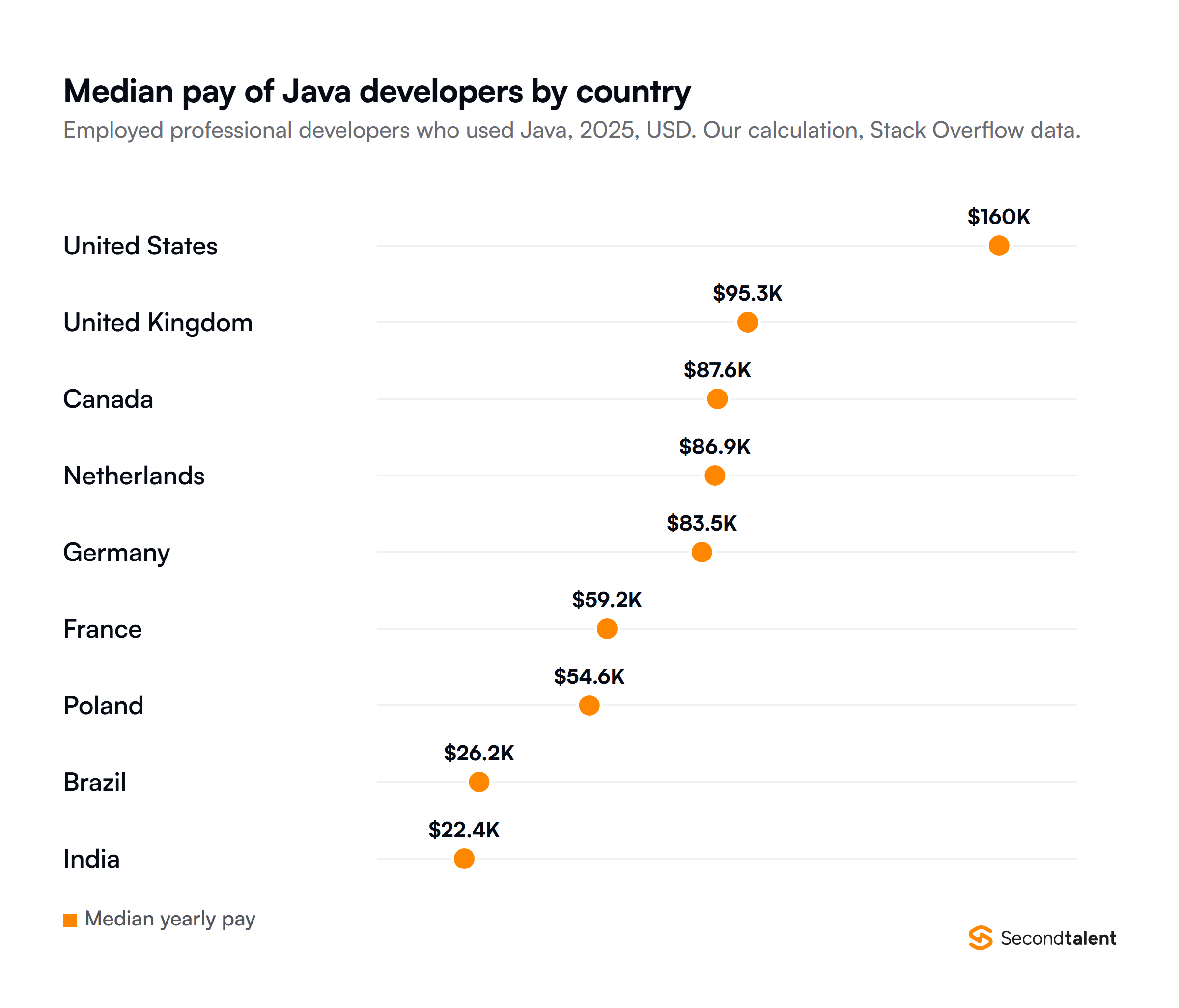
The UK median of $95,299 is more than four times India’s $22,377, our calculation from the same data. Germany, at $83,531, sits close to Canada and the Netherlands. Poland’s $54,580 is roughly double Brazil’s.
Salaries and contract rates are different measures. Our cost to hire a Java developer page compares freelance rates across markets.
Hire Java Developers in Asia
If you are upgrading off Java 8 or 17, or building new services on Java 25, Second Talent can help you staff it. We place pre-vetted Java developers from markets including India and Vietnam.
Our Java developer rate card for the Philippines shows local pay by seniority. Tell us the role you need and we will send matching profiles.
Frequently Asked Questions
Is Java still worth learning in 2026?
Yes, for back-end, Android and enterprise work. It is fourth on TIOBE and second on PYPL, and banks and insurers use it more than other industries in Stack Overflow’s data. Its share is falling, and most developers who leave it move to Python.
Is Java free to use?
OpenJDK builds are free, from Oracle and from other vendors such as Eclipse Adoptium and Amazon. Oracle JDK 25 is free under Oracle’s no-fee terms. Commercial use of Oracle JDK updates under the OTN licence, such as those for Java 17, needs a Java SE Universal Subscription, priced per employee.
What is the latest version of Java?
JDK 27, due on September 15, 2026, is the newest feature release. The newest long-term support version is Java 25. Most teams run production on an LTS version and skip the six-month releases in between.
Is Kotlin replacing Java?
Not on current numbers. Stack Overflow’s 2025 survey has 11.5% of professional developers using Kotlin, against 29.7% for Java, and most Kotlin users write Java too. JetBrains ranks Java to Kotlin only third among the most common language switches, behind Python to Java and Java to Python.



![Engineering Productivity Metrics to Track. Top 10 Key Engineering Productivity Metrics to Track [2026], by Second Talent.](https://www.secondtalent.com/wp-content/uploads/2026/09/top-10-engineering-productivity-metrics-featured-v2-768x403.jpg)