TL;DR: By default the contractor owns the code: US copyright vests in the person who writes it, and a contractor's software almost never qualifies as a "work made for hire." You get ownership only through a signed written assignment, worded "hereby assigns," that also meets the formalities of the contractor's country. Through an employer of record, the code reaches you only if the local employment contract and the EOR's terms both pass it on.
The Copyright Act lists nine kinds of commissioned work that a contract can label "made for hire," and a computer program is not one of them.
So the invoice you paid a developer in Manila or Krakow buys you the code's use, not its copyright. I would read the IP clause in an offshore contract before the hourly rate. A missing signature tends to surface in an investor's data room.
Key takeaways
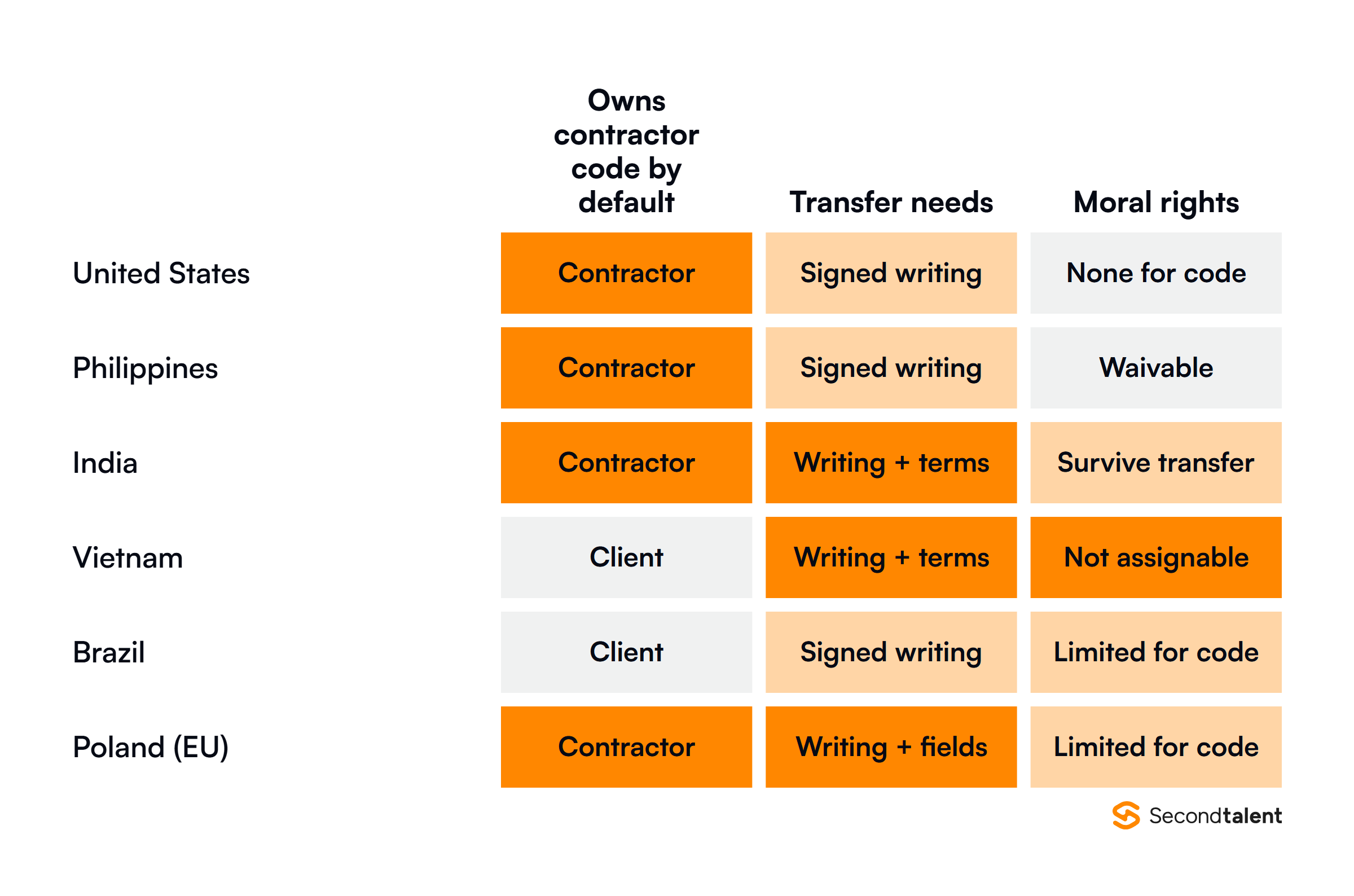
1In India, an assignment that does not state its term is deemed to last five years, and one that names no territory covers India only.
2Poland treats a contract with no express transfer clause as a license, and a transfer covers only the "fields of exploitation" it lists.
3Brazil and Vietnam run the other way: software made under a service contract belongs to the client by default, unless the contract says otherwise.
4The NVCA's Fall 2026 model stock purchase agreement asks a startup to state that every consultant who built material IP has assigned it.
Who owns code written by an offshore contractor by default?
The contractor does. Under 17 U.S.C. 201(a), copyright "vests initially in the author," and the author is the person who wrote the code.
The one exception is a work made for hire, where the hiring party counts as the author from the first line.
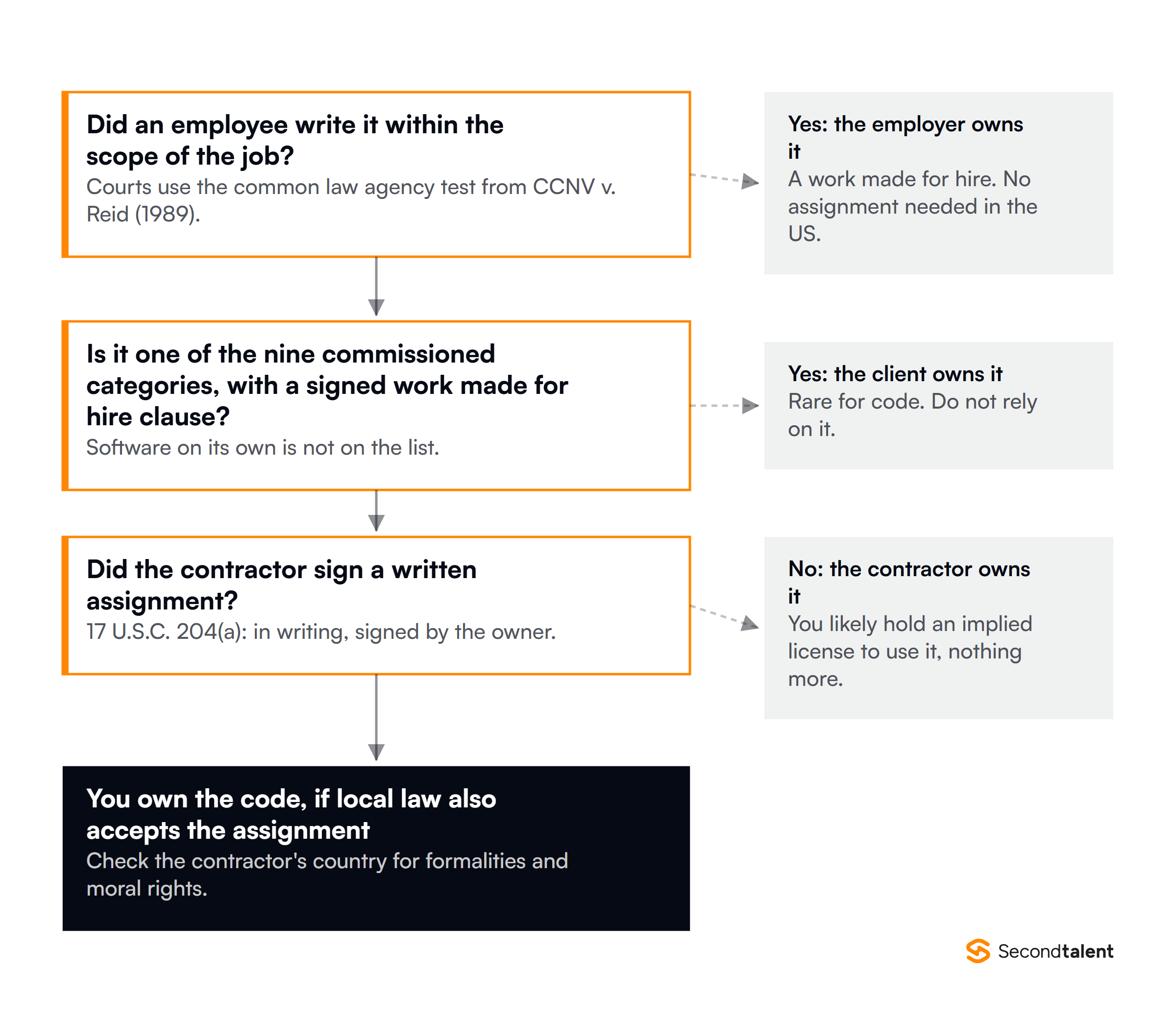
A work qualifies as made for hire in two cases only. In the first, an employee wrote it within the scope of the job.
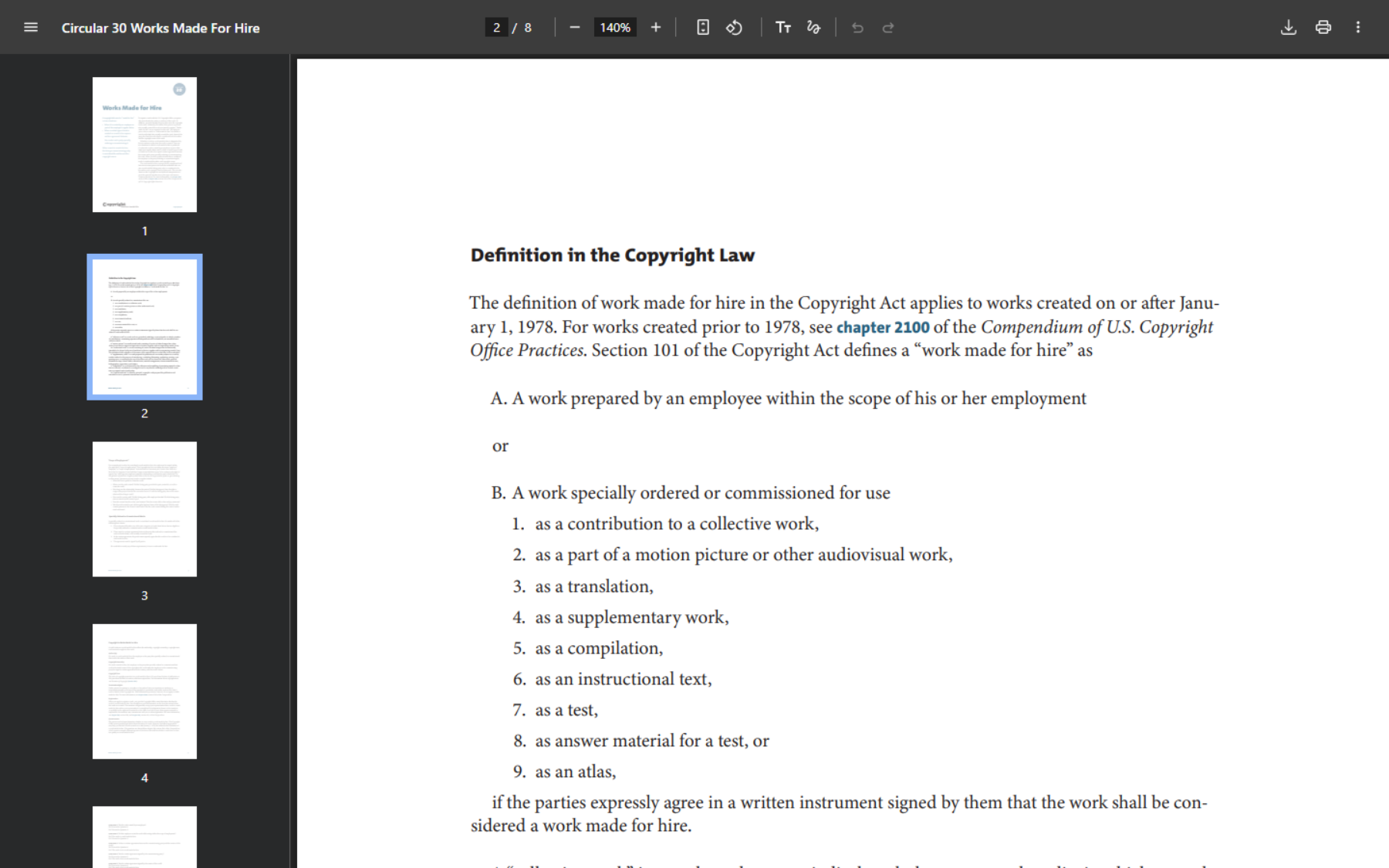
In the second, a client commissioned it in one of nine categories and both sides signed a writing calling it a work made for hire. The US Copyright Office sets out both in Circular 30, Works Made for Hire, revised in August 2024.
The nine are collective works, audiovisual works, translations, supplementary works, compilations, instructional texts, tests, test answers and atlases. A backend service or a mobile app fits none of them well.
The circular's own questionnaire ends in "not a work made for hire" for anything outside the list, even when both parties signed.
They include who supplies the tools, who sets the hours, how pay works, and whether the person gets benefits and tax withholding.
A freelancer abroad who invoices monthly, uses their own laptop and has other clients fails most of those tests.
Without an assignment, you still get something. In Effects Associates v. Cohen (9th Circuit, 1990), a producer paid for special effects footage but got no written transfer. The court gave him an implied, nonexclusive license to use it.
The effects studio kept the copyright and could license the footage to anyone else.
Swap footage for a codebase and you have the position of a startup whose first two engineers were unpapered freelancers.
Paying a contractor abroad does not change this analysis; the tax side of that relationship is covered in our guide to paying developers outside the US.
Why "hereby assigns" beats "agrees to assign"
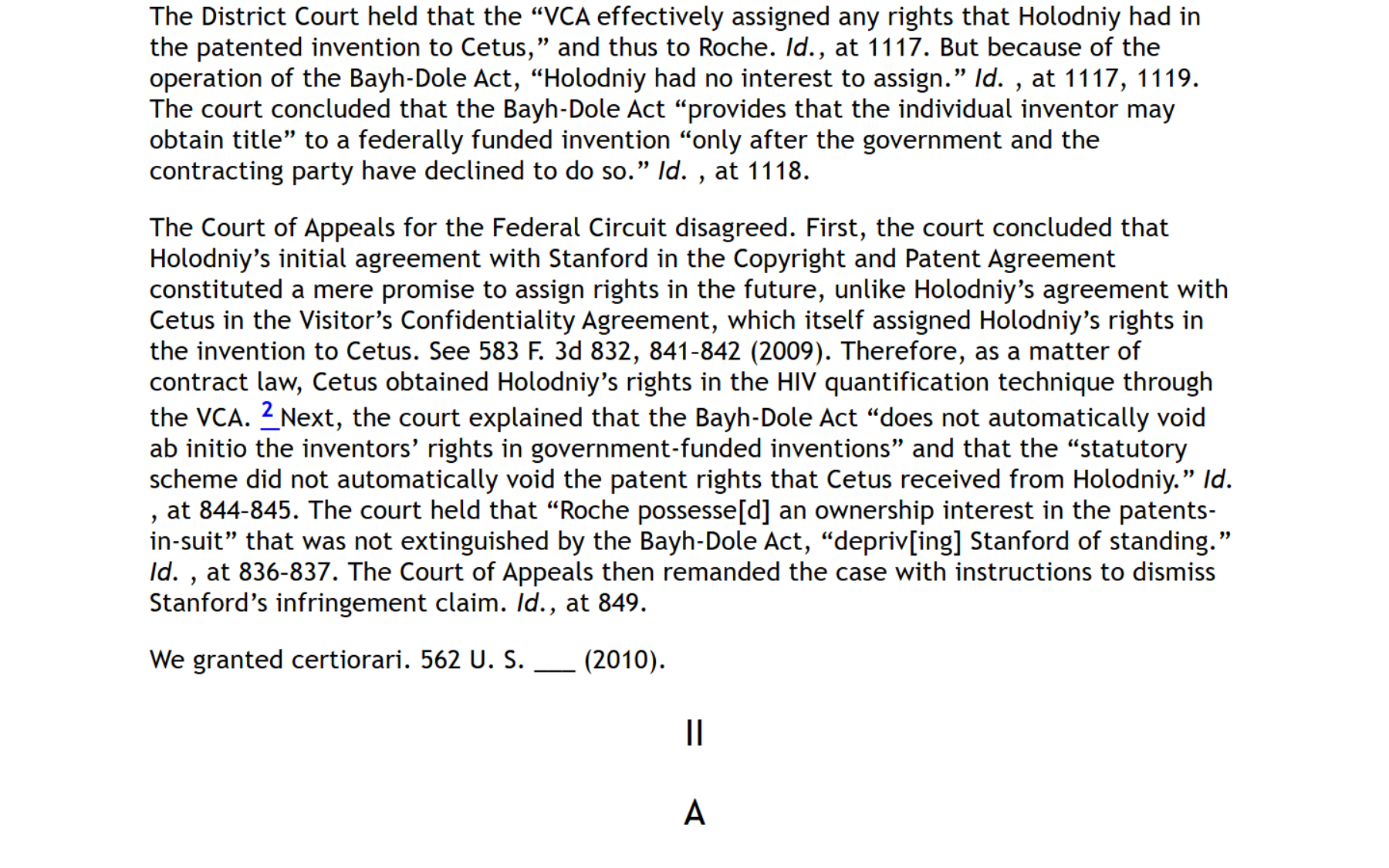
Stanford University lost its standing to sue Roche over an HIV test patent because of three words in a researcher's paperwork. Dr. Mark Holodniy had signed a Stanford form saying he "agree[d] to assign" his inventions.
He later signed a Cetus form saying he "will assign and do[es] hereby assign" them.
The Federal Circuit read the Stanford form as "a mere promise to assign rights in the future" and the Cetus form as an assignment that took effect on its own.
Cetus therefore held Holodniy's rights first, and Roche later bought Cetus's PCR assets. The Supreme Court affirmed in Stanford v. Roche, 563 U.S. 776 (2011).
It decided the case on the Bayh-Dole Act and noted in footnote 2 that it was not reviewing how the lower court read the two contracts.
"Agrees to assign"
A promise to transfer later
You may need a lawsuit to enforce it
Loses to anyone the contractor assigns to first
"Hereby assigns"
A present transfer of future work
Rights pass as each line of code is written
Add "agrees to assign" as a backstop, never instead
Two US formalities sit on top of the wording. A copyright transfer is invalid unless it is "in writing and signed by the owner of the rights conveyed," per 17 U.S.C. 204(a).
Patents follow the same rule: they are "assignable in law by an instrument in writing" under 35 U.S.C. 261. An e-signature works; a Slack "sure, it's yours" is risky evidence.
Should the contract also say "work made for hire"?
Many US templates do both. The work is "made for hire to the extent permitted by law," and anything that is not is "hereby assigned." For California companies, that first phrase has a cost.
Labor Code 3351.5(c) makes a person who signs a work made for hire agreement an employee for workers' compensation. Unemployment Insurance Code 686 does the same for unemployment and disability insurance, as Farella Braun + Martel explains.
The firm calls a plain assignment the employer's best option. Whether those statutes reach a contractor living abroad is a question for your counsel.
The trade-off is small. Under 17 U.S.C. 203, an individual author can end an assignment in a five-year window that opens 35 years after the grant. Circular 30 notes the right does not apply to works made for hire.
For most application code, 35 years is past its useful life.
How the contractor's own country's law changes the answer
A US-law assignment governed by Delaware law can still fail where the contractor lives, because local copyright law decides what an author may transfer and in what form.
US courts have not settled which country's law governs a cross-border assignment. In Creazioni Artistiche Musicali v. Carlin America (2018), the Second Circuit noted it had no choice-of-law rule yet for voluntary copyright assignments.
The safe drafting answer is a contract that works under both systems.
We read each statute below on 24 November 2026 on an official site or the WIPO Lex database. Moral rights, the second column of trouble, are an author's personal rights to be named and to object to distortion.
US law gives them only to works of visual art under 17 U.S.C. 106A, so US templates often forget them.
Philippines
The Intellectual Property Code (RA 8293) splits a commissioned work in two. Under Section 178.4, the client who paid "shall have ownership of the work."
But "the copyright thereto shall remain with the creator, unless there is a written stipulation to the contrary."
Section 180.2 adds that copyright is not assigned without "a written indication of such intention." Moral rights cannot be assigned, but Section 195 lets an author waive them "by a written instrument," so put the waiver in the contract.
India
India's Copyright Act, 1957 asks the most of the paperwork. Section 19 requires a signed writing that names the work, the rights, the duration, the territory and the royalty or other consideration.
Leave the term out and Section 19(5) deems it five years; leave the territory out and 19(6) presumes India only.
Under 19(4), rights the assignee does not exercise within one year lapse "unless otherwise specified in the assignment," so the contract should say so.
Section 17 makes the author the first owner, and the commissioning rule in 17(b) covers photographs, paintings, engravings and films, not software.
Moral rights under Section 57 survive assignment, and the Act neither allows nor forbids a waiver, so ask Indian counsel how to handle them.
Vietnam
The Law on Intellectual Property leans toward the client. Article 39(2) makes organizations and individuals "that have entered into contracts with authors for creation of works" the holders of the economic rights, unless agreed otherwise.
Article 46 requires transfer contracts in writing, with the price stated. Authors cannot transfer attribution and integrity rights at all.
The 2022 amendment says the author and owner of a program "agree in writing" on its repair and upgrade. A further amendment took effect on 1 April 2026, so ask local counsel for the consolidated text.
Brazil
Brazil has a software statute with a client-friendly default. Article 4 of Lei 9.609/1998 gives the rights in a program to the employer or the client of a service contract.
It applies when the program was the purpose of the contract or flows from it. Code the developer writes on their own time, without your resources, stays theirs.
Only two moral rights apply to software, paternity and objection to harmful changes, and under the general Copyright Law (Lei 9.610) moral rights cannot be waived.
Article 49 of that law limits an assignment to the country where it was signed unless the contract says otherwise, so state "worldwide."
Poland and the EU
Poland is strict on form. The Copyright Act of 1994 voids a transfer not made in writing (Article 53).
The transfer covers only the "fields of exploitation" it lists (Article 41(2)), and a contract without an express transfer clause is read as a license (Article 65).
A B2B contractor is not an employee, so the employee rule in Article 74(3) does not help.
For software, Article 77 leaves only the rights to authorship and to be named, and neither can be waived. Integrity and first-disclosure rights do not apply to programs.
EU law gives employers the economic rights in programs employees write "in the execution of [their] duties" under Article 2(3) of the Software Directive 2009/24/EC.
It has no rule for contractors, so national law decides, and Polish law leaves the copyright with the contractor until a written transfer.
Employee, contractor or EOR employee: who owns the work?
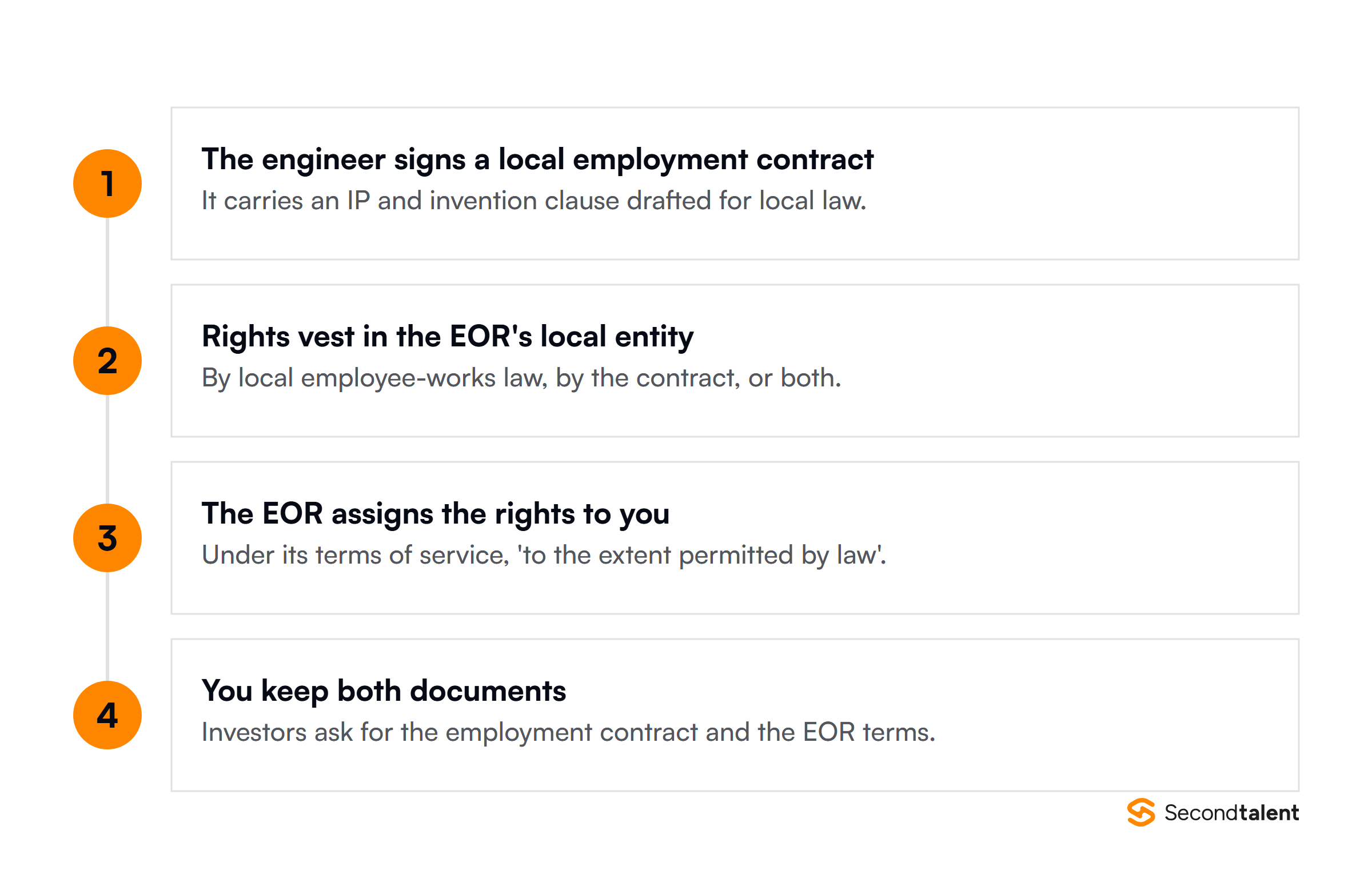
An engineer employed through an employer of record works for the EOR's local entity, not for you, so employee-works rules hand the code to the EOR first. You own it only once the EOR passes it on.
Work made for hire within the scope of the job. Still sign an invention assignment for patents.
Direct contractorAbroad
The contractor
Until a signed assignment that also meets local formalities.
EOR employeeAbroad
The EOR, then you
Two documents must line up: the local employment contract and the EOR terms.
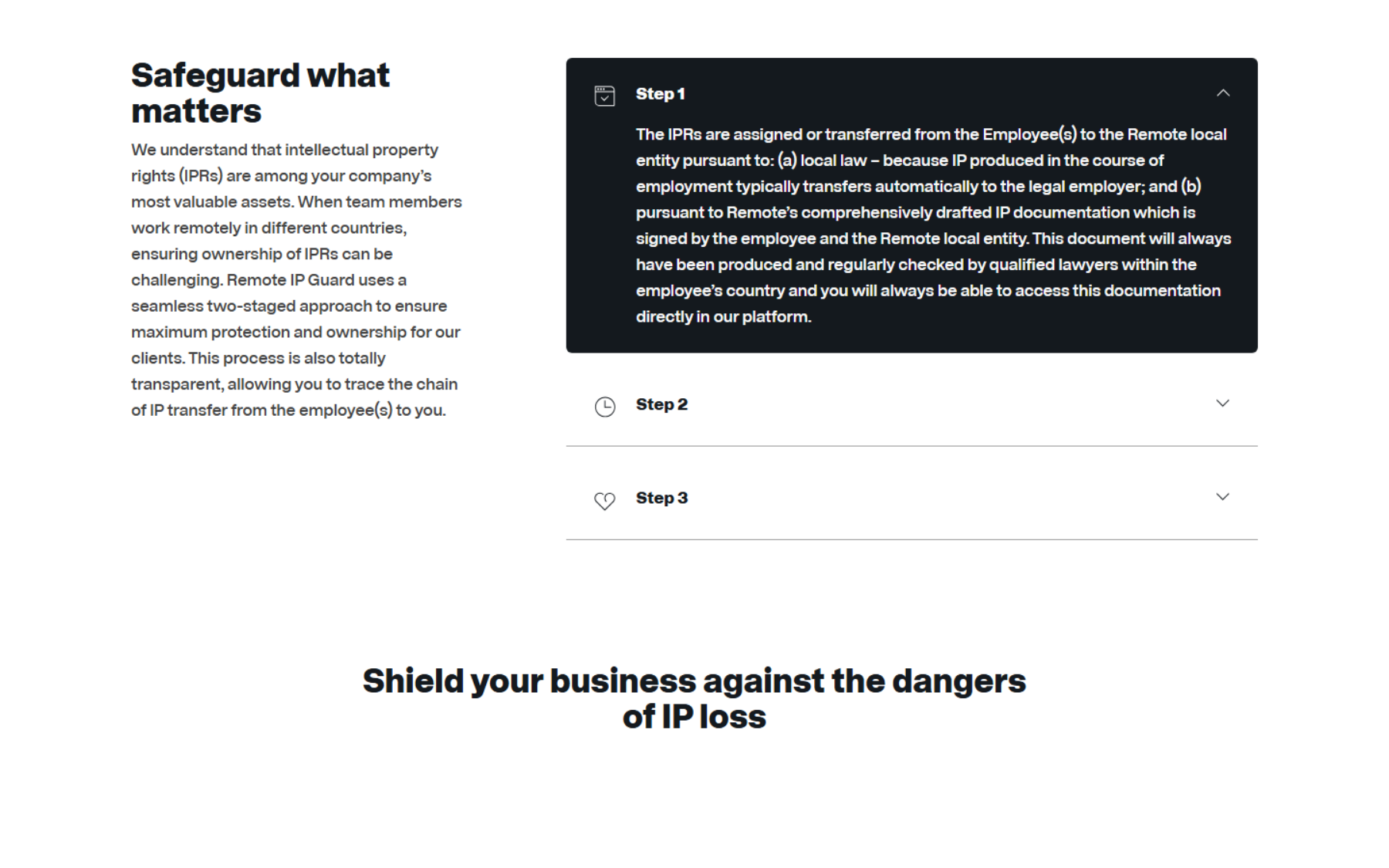
Remote spells the chain out on its IP Guard page. Rights move from the employee to the Remote local entity, under local law and Remote's IP documents. Then they pass "directly to you, the customer, under our Terms of Service."
Its terms (updated August 3, 2026) say each Remote affiliate "hereby immediately transfer[s] and assign[s]" the IP to you "to the extent permitted by law," with a moral rights waiver on the same terms.
We read what nine EOR, contractor and talent platforms publish about IP on 24 November 2026.
None charges a separate published price for IP protection; the cost sits inside the EOR fee, which our EOR cost guide and EOR cost calculator break down by country.
Pass-through: Toptal takes ownership, then provides it to you
Not published
Upwork (Optional Service Contract Terms)
Direct from freelancer to you, only on full payment; background technology excluded
Waived "under applicable law"
Papaya Global
Not published
Not published
Two lines in that table deserve a second look. Oyster's contractor terms say nothing in them transfers a contractor's IP on its own; your own contract does that work.
Upwork's default terms pass the work product only "upon Freelancer's receipt of full payment," so a disputed final invoice can leave code unassigned.
If I were choosing an EOR for an engineering hire, I would ask for the local employment contract template for that country before I signed, not after.
Open-source and third-party code the contractor brings in
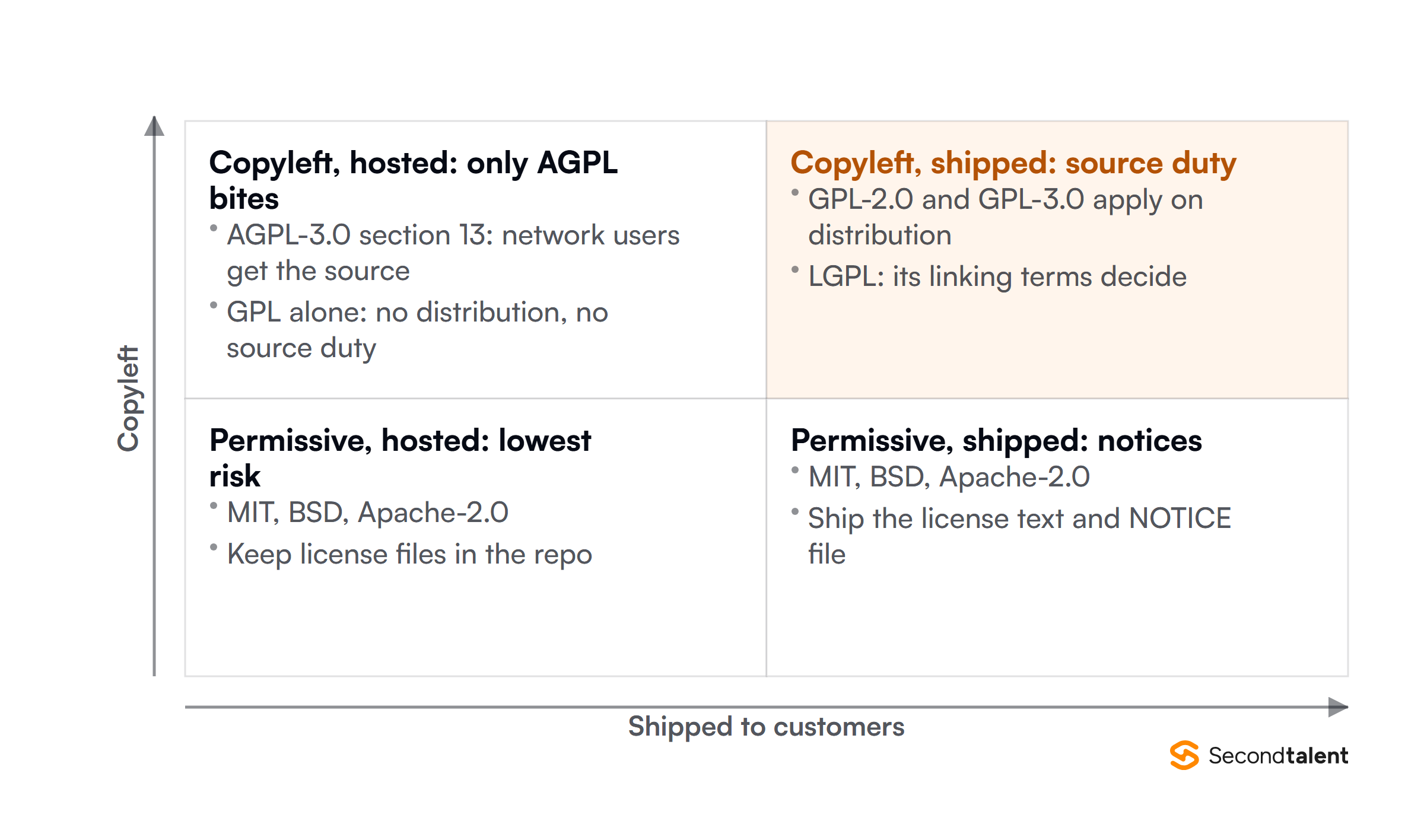
An assignment transfers only what the contractor owns. A GPL library pasted into your product stays under the GPL.
Section 5(c) of the GPL-3.0 requires you to license "the entire work, as a whole" under the GPL to anyone who receives a copy. The GPL FAQ confirms that internal use alone triggers no release.
A hosted SaaS product escapes the GPL's distribution trigger but not the AGPL-3.0. Its section 13 requires a modified version to offer "all users interacting with it remotely through a computer network" the source code.
Upwork's default contract terms show what a careful client asks for. Unless agreed, the freelancer may not deliver code that would force you to publish the source or give the work away.
AI coding assistants add a newer route for third-party code. GitHub lets users and organizations block Copilot suggestions that match public code. The check compares about 150 characters of code against public repositories.
Require contractors to use your managed accounts with that setting on, and run a license scanner in CI so a reviewer sees each new dependency's license.
Pre-existing IP and the license back
Senior contractors arrive with their own helpers, such as a deployment script or a component library they reuse across clients. A blanket assignment of "all work" can sweep those in, and contractors push back for good reason.
The workable pattern has three parts:
A schedule of prior inventions. The contractor lists what they own before day one; anything not listed is presumed to be new work.
A license for anything embedded. If prior code ends up in your product, you get a perpetual, irrevocable, worldwide, royalty-free license to use, modify and sublicense it.
Notice before use. The contractor tells you before adding their own or third-party code, so you can refuse it.
Upwork's default terms build this in: "Background Technology" is excluded from the assignment, must be disclosed in a bill of materials, and is licensed to the client instead.
The NVCA model agreement treats "backup licenses from employees and contractors" as standard, which tells you investors expect such licenses to exist.
Patents and the inventions assignment
Patent law has no work made for hire doctrine at all. In Stanford v. Roche, the Supreme Court restated "the basic principle of patent law that inventors own their inventions."
It also rejected "the idea that mere employment is sufficient to vest title" in the employer.
So even your US employees need a signed invention assignment. An offshore contractor's novel algorithm stays theirs without one.
A sound clause covers ideas, inventions and improvements as well as code. The contractor must disclose inventions and sign filing papers later. If you cannot reach them, a power of attorney lets you sign for them.
India adds a filing rule. Under Section 39 of the Patents Act, 1970, an Indian resident needs a written permit to apply for a patent abroad. The exception is an invention filed in India at least six weeks earlier.
Check with patent counsel before filing a US application that names an Indian-resident inventor.
Clause checklist for an offshore contractor agreement
Each line below answers one of the failures above. Have counsel in the contractor's country confirm the last four.
Present assignment: "hereby assigns" all rights in work product, inventions and documentation, now and as created, with "agrees to assign" only as a backstop.
Scope: source code, object code, designs, docs, data models, tests and every copy, in every medium "now known or later developed."
Prior inventions schedule and license back for anything embedded.
Open-source rule: no copyleft or AGPL code without written approval; list every third-party component.
Moral rights: a waiver where local law allows one (Philippines), and a promise not to assert them where a waiver is barred or unclear (India, Brazil, Poland).
Further assurances and power of attorney for patent and copyright filings.
Local formalities: term ("perpetual" or the full copyright term), territory ("worldwide"), stated consideration (India, Vietnam), and listed fields of exploitation (Poland).
Payment terms: the assignment should not wait on payment, or the contract needs a rule for disputed invoices.
Signatures from the individual developer, not only from their company, when an agency or one-person firm sits in between.
Not legal advice. This summarises statutes and published terms as read on 24 November 2026. Ask US counsel to draft the agreement and local counsel to confirm it works in the contractor's country before you rely on it.
What investors and acquirers check, and how to fix a gap
The NVCA model Stock Purchase Agreement (Fall 2026) is a common starting point for US venture rounds. It asks the company to state that "each current and former consultant" who worked on material IP has assigned it.
Each must also have signed a confidentiality and IP agreement in the form shown to investors.
A separate open-source representation covers any license that would force company code to be "disclosed or distributed in source code form."
Signed IP agreement for every contributorEOR terms plus local contractOpen-source inventoryPrior inventions exclusions
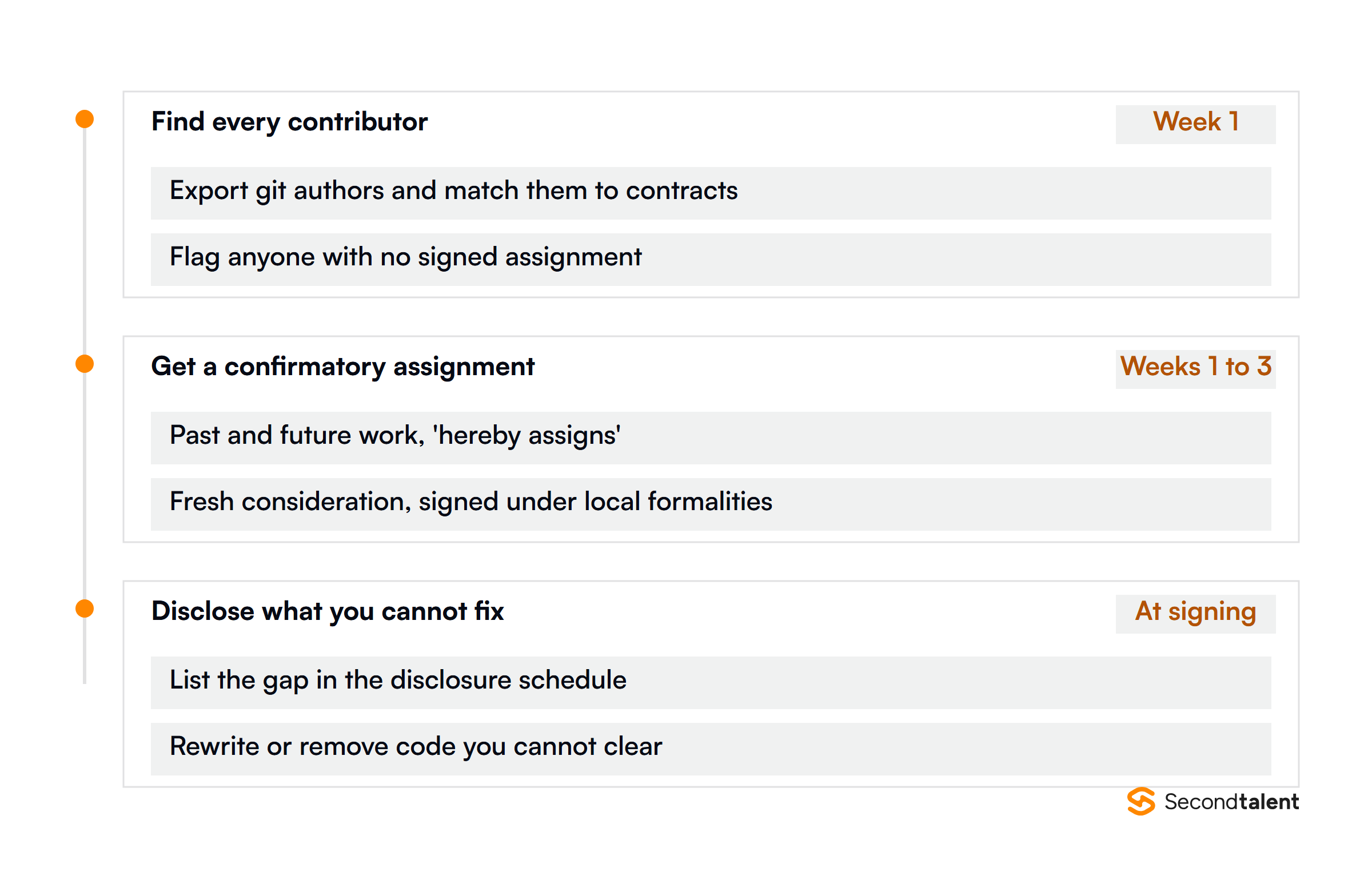
Counsel on the other side tests those statements against your git history. A commit author with no signed agreement becomes a question, and an exception goes on the disclosure schedule.
I have not found a published, sourced figure for what fixing a gap costs. The cost is legal time plus whatever the former contractor asks for signing.
The fix is a confirmatory assignment, sometimes called nunc pro tunc, in which the contractor assigns past work as of its creation.
It needs fresh consideration in many systems, a stated price in India and Vietnam, and the local form rules above.
A contractor who has moved on, or cannot be found, may refuse; then counsel will weigh relying on the implied license, rewriting the affected code, or disclosing the gap. All three cost more than a signature on day one.
Hiring offshore engineers with the IP paperwork in place
Second Talent, our own service, places pre-vetted engineers based in Asia with US companies as dedicated or staff augmentation hires.
You get a shortlist of 6 to 8 pre-vetted profiles within 24 hours and 4 to 6 hours of daily overlap with US business hours. Pricing is 160 hours for $3,999/mo, with no upfront fees.
Whichever provider you use, ask for the signed assignment chain for each engineer before their first commit, and that includes us.
FAQ
Does an NDA give me ownership of the code?
No. An NDA restricts disclosure. Ownership moves only through a signed assignment under 17 U.S.C. 204(a), plus whatever form the contractor's country requires.
Does paying the contractor in full transfer the copyright?
Not under US law. Payment can give you an implied license to use the code, as in Effects Associates v. Cohen. Brazil and Vietnam are exceptions where a service contract can vest the rights in the client by default.
Who owns code a contractor wrote with an AI assistant?
The human-written and human-arranged parts are protected and assignable as usual.
The Copyright Office's January 2025 report on copyrightability says copyright "does not extend to purely AI-generated material," so those parts carry no copyright to assign.
Which country's law should the contract choose?
Most US companies pick a US state for the contract, but the contractor's local copyright rules on form and moral rights can still apply. Draft to satisfy both.
Get developers who ship with AI agents. Starts at $25/Hour.
Elton Chan is the Co-Founder of Second Talent, a solution that connects global tech leaders with top-tier tech talent across Asia. He specializes in talent solutions and has led Second Talent’s rapid growth since 2024, helping scale its network to over 100,000 pre-vetted developers and earning industry recognition as the #1 in the Global Hiring category on G2.
A long-time entrepreneur with deep roots in digital transformation, Elton previously co-founded Branch8, a Y Combinator–backed e-commerce technology firm, and served as the Founding Chairman of HKEBA, a leading Asia-focused business association driving innovation, digital education, and cross-border collaboration.
His work bridges technology, talent, and business strategy to shape how companies scale in an increasingly remote and digital world.