











Skip to content

RSUs and Stock Options for Offshore Engineers (2026)

Anita Wong By Anita Wong, Chief People Officer 16 min read
RSUs and stock options for offshore engineers in 2026: a guide to equity for employees abroad, EOR hires and contractors, by Second Talent.
TL;DR: A US company can give engineers outside the US nonqualified stock options (NSOs), RSUs or cash-settled phantom awards, but not the ISO tax break, which needs employment by your own corporate group and only helps US taxpayers. Private startups tend to grant NSOs at the 409A price or double-trigger RSUs under Rule 701; public companies grant RSUs registered on Form S-8. The engineer's country decides the rest: in India, the Philippines, Singapore and China the tax lands at exercise or vest and the local employer, or the EOR, withholds it through payroll.

Rule 701 lets a private US company issue at least $1 million of stock a year to its people without registering it, and an engineer in Bengaluru counts toward that cap like one in Austin. The tax follows the engineer home.

I lead talent strategy at Second Talent after four years in global talent acquisition at Meta. To me, equity is a promise to the person who accepts it, so the offer has to work in their country before anyone signs.

Key takeaways
  1. 1Pulley, a cap table platform that bundled 409A valuations and Rule 701 tracking for $3,500 a year, stops operating on December 8, 2026.
  2. 2China's foreign exchange regulator registers equity plans of overseas-listed companies, which leaves a private startup's shares without a registration route.
  3. 3Since October 29, 2022, Philippine option gains are taxed as compensation at exercise for every rank, and the employer files a sworn statement within 30 days of the grant.
  4. 4A double-trigger RSU often expires seven years after grant, and an engineer whose company never exits keeps nothing.
Which equity instrument fits an engineer outside the US?

NSOs and RSUs fit most engineers abroad; phantom stock fits the countries where real shares get stuck. Before the how, the why: each instrument decides when the engineer owes tax, and whether they will have cash on that day.

Get that wrong and a reward becomes a bill.

InstrumentWhat the engineer getsOffshore fitWatch for
ISO (incentive stock option)Option with a US tax deferralNoEmployees of your corporation, parent or subsidiary only; the benefit is a US tax one
NSO (nonqualified option)Right to buy shares at a fixed priceYes, the default at private startupsExercise price at or above fair market value; local tax at exercise in most of our sample
RSU, single triggerShares delivered as they vestYes, at public companiesTax at vest with no shares to sell if you are private
RSU, double triggerShares once service and a liquidity event both happenYes, at late-stage private companiesExpires, often after 7 years, if no exit comes
RSA (restricted stock award)Shares issued up front, subject to vestingSeldomThe 83(b) election that makes RSAs work is a US election
SAR (stock appreciation right)The rise in share value, in cash or sharesYes, cash-settled where shares are blockedExercise price at or above fair market value under 409A
Phantom stockA cash bonus that tracks the share priceYes, where shares are blockedPaid through payroll, so it is salary for tax

Why ISOs drop out

Under 26 U.S.C. 422, an ISO goes to an individual "for any reason connected with his employment" by the granting corporation or its parent or subsidiary. The holder must stay an employee until three months before exercise.

The EOR, not you, employs an EOR worker, and the EOR is neither your parent nor your subsidiary. A contractor has no employer at all.

An engineer at your own foreign subsidiary can hold an ISO on paper, but the deferral helps only someone who files a US return.

Single and double trigger RSUs

A single-trigger RSU vests with time alone. At a public company that works, because the engineer can sell some of the shares on vest day to pay the tax. A private company has no market, so it adds a second trigger: an IPO or sale.

Goodwin describes these double-vest RSUs as taxable once both conditions are met, and notes "A five- or seven-year term/expiration date is common", because the deadline is what keeps the award at risk of forfeiture for tax purposes.

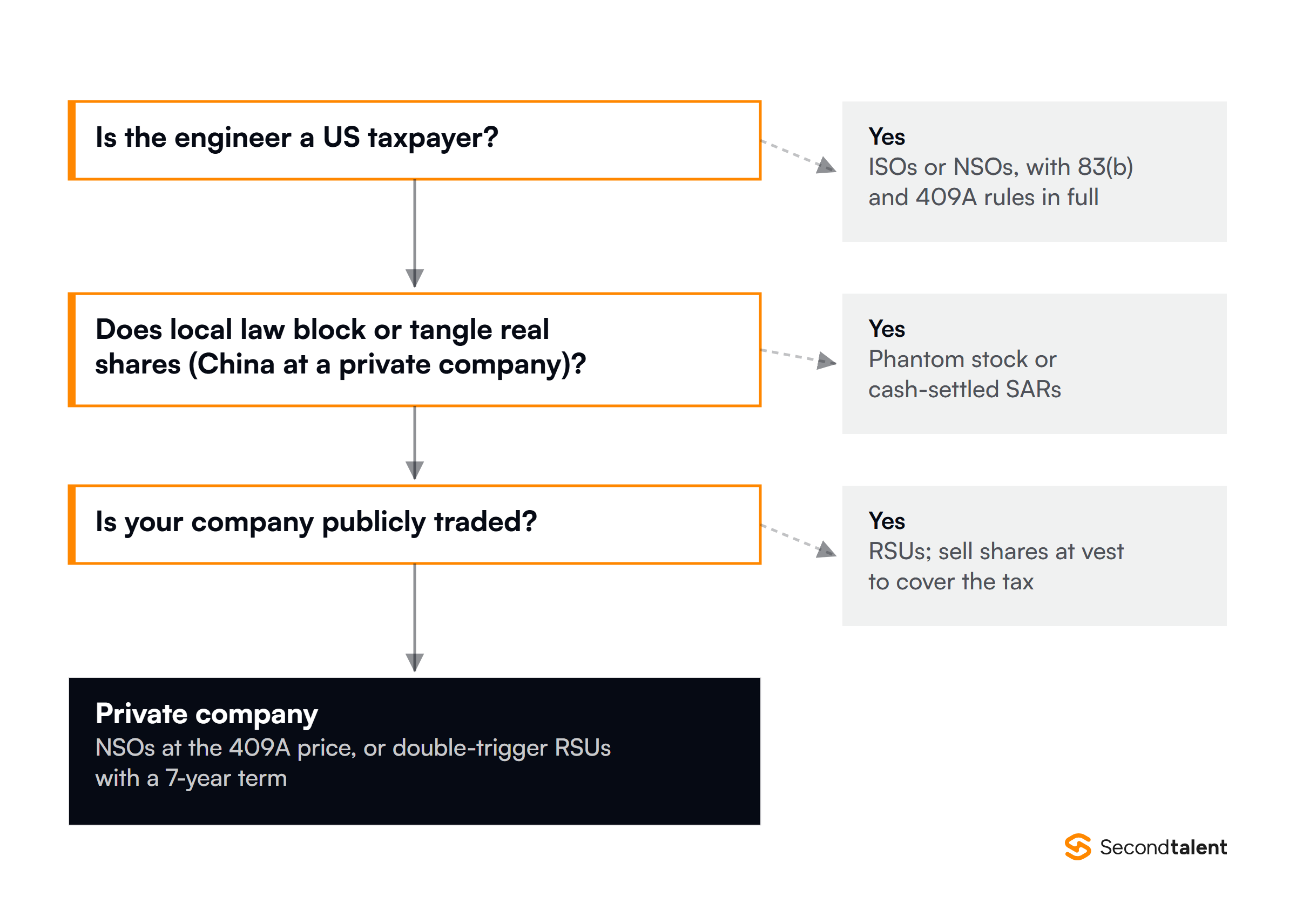
Flowchart for choosing an equity instrument for an engineer outside the US: a US taxpayer can get ISOs or NSOs with 83(b) and 409A rules in full; where local law blocks real shares, such as China at a private company, use phantom stock or cash-settled SARs; a public company grants RSUs and sells shares at vest to cover tax; a private company grants NSOs at the 409A price or double-trigger RSUs with a 7-year term. Based on 26 USC 422, Treas. Reg. 1.409A-1, Goodwin and SAFE's Circular 7 guide.

Private and public companies end up with different defaults for the same engineer:

Private startup
  • NSOs priced at a 409A valuation no older than 12 months
  • Or double-trigger RSUs with a fixed term
  • Exempt from registration under Rule 701, within its 12-month cap
Public company
  • RSUs that vest with time; shares sold at vest to cover tax
  • Plan shares registered on Form S-8
  • Market price replaces the 409A valuation
Sources: Treas. Reg. 1.409A-1; 17 CFR 230.701; 17 CFR 239.16b, read 24 November 2026.

The US rules: 409A, Rule 701, Form S-8 and 83(b)

The US side decides whether you may issue the shares at all and at what price. It does little to the engineer's tax bill abroad, which is the next section.

Section 409A: the exercise price and RSU timing

Under Treas. Reg. 1.409A-1, an option or SAR stays outside 409A only if its exercise price is at least the fair market value of the stock on the grant date.

For a private company, the IRS presumes an independent appraisal reasonable if it is no more than 12 months old at grant. That is why boards order a fresh 409A valuation each year.

RSUs lean on the short-term deferral rule in the same regulation. Settle the shares by the 15th day of the third month after the year they stop being forfeitable: March 15 for a calendar-year company and employee.

The regulation also carves out pay a nonresident alien would not include in US gross income. I would still price each grant at the 409A value, so the plan keeps working if an engineer later moves to the US.

Rule 701: who counts and how much you can grant

Rule 701 covers companies that do not file reports with the SEC. It exempts grants under a written compensatory plan to employees, directors and officers of the issuer and its majority-owned subsidiaries.

Consultants and advisors qualify if they pass three tests:

  • They are natural persons, not companies.
  • They provide bona fide services to you.
  • The services have nothing to do with raising capital or making a market in your stock.

The cap applies to what you sell in any 12 months:

$1M
Floor of the 12-month sales cap
15%
Of total assets, or of the class outstanding, if higher
$10M
Sales in 12 months that trigger extra disclosure
Grant date
When an option counts, at its exercise price
Source: 17 CFR 230.701(d) and (e), read 24 November 2026.

An EOR worker is not your employee, so they fit the consultant and advisor category: one person, real services, no fundraising. Ask securities counsel to confirm your plan's definitions reach them before the first grant.

Rule 701 treats the shares as restricted securities.

Form S-8 for public companies

Once you file reports with the SEC, Rule 701 stops applying and you register plan shares on Form S-8.

Under 17 CFR 239.16b the form covers employees of the registrant and its subsidiaries and parents, and the form's own instructions extend "employee" to consultants and advisors on the same three tests as Rule 701.

83(b): a US election with no effect abroad

An 83(b) election, filed within 30 days of receiving restricted shares, moves US tax to the grant date. For an engineer who owes no US tax on this pay, it changes nothing; their own country's law sets the tax point.

That is the main reason RSAs seldom suit offshore staff.

The engineer's country: tax, withholding and exchange controls

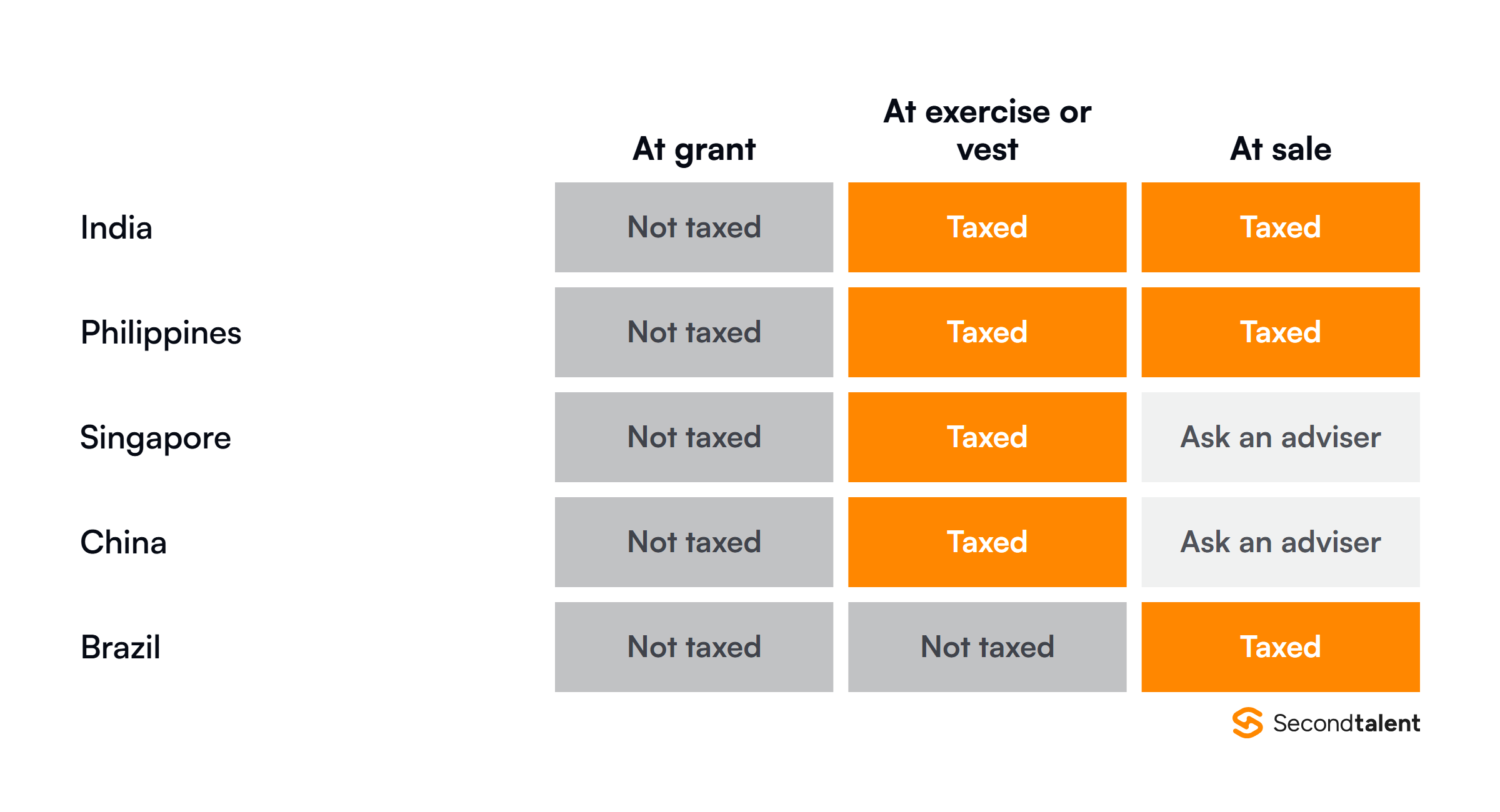
In four of the five markets we checked, the tax on an employee option falls at exercise or vest, when the engineer may hold shares but no cash. Brazil is the exception.

The table below reads PwC's Worldwide Tax Summaries for employees of a local employer, plus Grant Thornton's note on the Philippine rule.

Heatmap of when an employee stock option is taxed for an employee of a local employer: India not taxed at grant, taxed at exercise and at sale; Philippines not taxed at grant, taxed at exercise and at sale; Singapore taxed at exercise or vest, sale ask an adviser; China taxed at exercise or vest, sale ask an adviser; Brazil taxed only at sale. Source: PwC Worldwide Tax Summaries and Grant Thornton Philippines, read 24 November 2026.

India: perquisite tax at exercise, and an exchange-control gap for EOR staff

Shares allotted free or below value are a taxable perquisite, valued at fair market value on the exercise date less what the employee paid, per PwC's India summary (reviewed May 12, 2026).

Unlisted shares need a value from a Category I merchant banker dated no more than 180 days before exercise. The employer withholds the tax from salary, and a later sale brings capital gains.

The exchange-control side matters more for EOR hires.

AZB & Partners reads India's 2022 overseas investment rules as allowing grants to staff of the foreign company's Indian office, branch or subsidiary, or of an Indian entity it holds equity in.

The foreign company must offer the plan "on a uniform basis" worldwide.

The value counts toward the employee's $250,000 yearly remittance limit, and the Indian employer files Form OPI twice a year. An EOR's Indian entity is none of those, so ask Indian counsel first.

Philippines: compensation at exercise, two employer filings

Revenue Regulations 13-2022, in force from October 29, 2022, treat an option exercise by rank-and-file or managerial staff as compensation subject to withholding, according to Grant Thornton Philippines.

The taxable amount is the higher of book value or fair market value at exercise, less the grant price.

The employer files a sworn statement within 30 days of the grant and a report by the 10th of the month after each exercise. A later sale of unlisted shares carries 15% capital gains tax, per PwC's Philippines summary.

Singapore: taxed at vest, and a deemed exercise when people leave

Singapore taxes gains from options and awards granted during Singapore employment at exercise or vest, per PwC's Singapore summary.

A non-citizen who leaves the job, goes on an overseas posting or is away for more than three months pays tax on unvested and unexercised awards on a deemed basis, unless the tax authority approves a tracking option.

I flag this one early to managers, because it lands on the engineer at the exact moment they are leaving.

Brazil: tax at sale, with a recharge caveat

PwC's Brazil summary (reviewed September 23, 2026) says income tax on stock options is due from residents "upon the sale of the shares, where the sale results in a capital gain."

It adds that further implications arise when the costs are recharged to the Brazilian entity, so the corporate funding choice can change the employee's position.

China: the SAFE registration block

China taxes equity income at exercise or vest as employment income, per PwC's China summary. The harder problem is money moving.

SAFE's own service guide describes the registration as one for domestic individuals in equity incentive plans of overseas-listed companies, under Circular 7 of 2012.

Computershare adds that one domestic agent handles the filings and proceeds return through a dedicated foreign exchange account.

A private US startup has no listed shares to register. That is why phantom stock or cash-settled SARs, paid through local payroll, are the instruments to raise with PRC counsel for engineers in China.

Equity for EOR employees: who withholds when shares vest

The EOR runs the engineer's payroll, so the EOR withholds. You still issue the grant from your own plan and cap table; Oyster's equity page states that it does not create or issue grants.

The EOR's job is to turn your vest or exercise data into a correct payslip and filing.

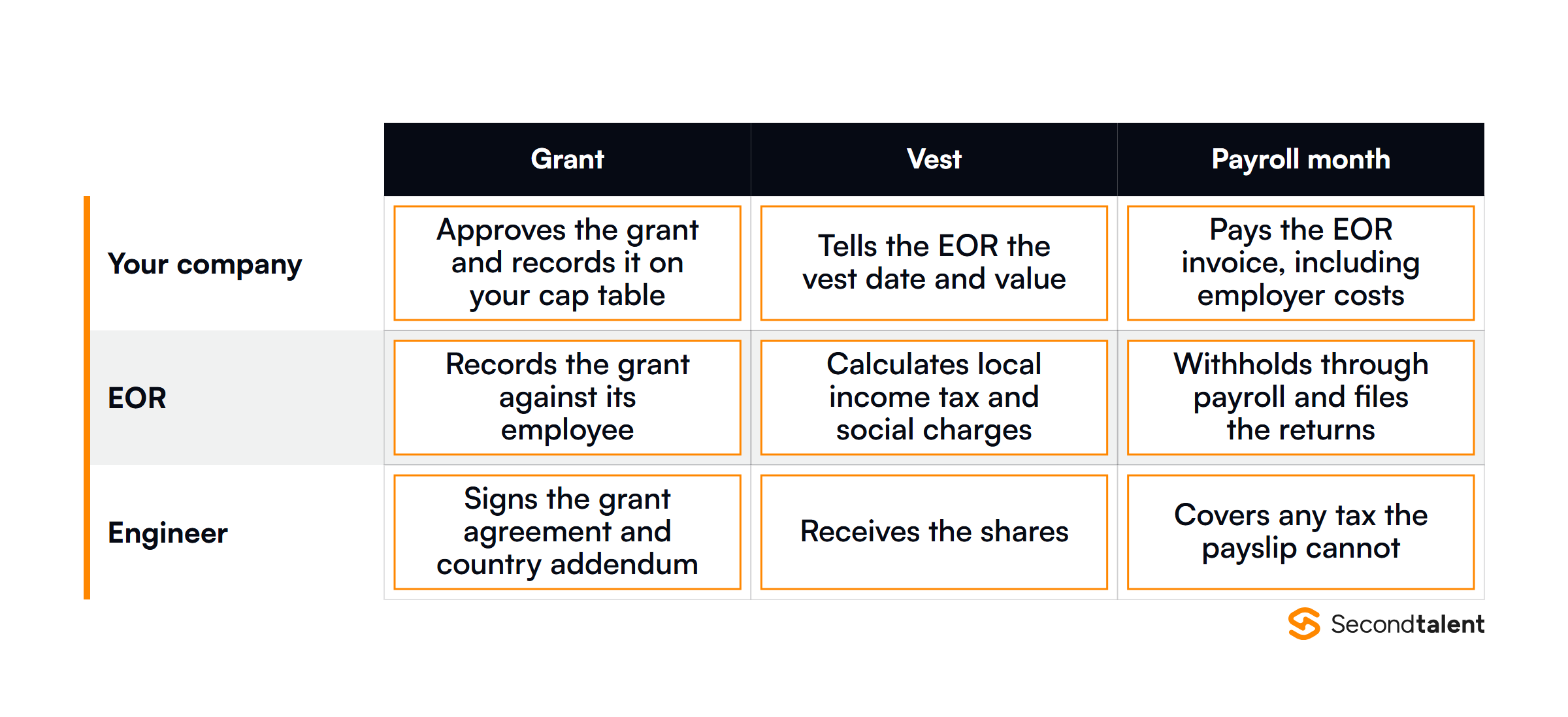
Swimlane of who does what when an EOR employee's RSUs vest: your company approves and records the grant, tells the EOR the vest date and value, then pays the EOR invoice including employer costs; the EOR records the grant, calculates local income tax and social charges, then withholds through payroll and files returns; the engineer signs the grant agreement and country addendum, receives the shares and covers any tax the payslip cannot. Based on the Oyster, Deel and Remote equity pages, 24 November 2026.

A company with its own subsidiary abroad can use a recharge agreement: the subsidiary pays the US parent for the cost of equity issued to its employees.

Equity Methods describes it as the way to capture a tax deduction most foreign subsidiaries otherwise lose.

Brazil shows the side effect: a recharge can change the employee's tax. With an EOR there is no subsidiary to recharge. The employer costs arrive on the EOR's invoice instead, and Deel's equity page says its invoices reflect equity events.

What each provider publishes about international equity

We read each provider's own equity and pricing pages on 24 November 2026. "Not published" means the page asks for a demo or quote.

ProviderAward types namedWithholding on equity eventsCountriesEquity price
DeelOptions, RSUs, tokensYes; events "processed with the right withholding"50+ for the paid managed service; 110+ in its FAQCore product free; managed service not published
RemoteStock options, RSUs, phantom sharesWorkflows for taxable events; withholding not spelled outNot publishedFrom $39 a month
OysterStock options, RSUs; cash and phantom as fallbackYes, "in supported countries"Guidance in 80+Not published
CartaOption exercises via the Deel integrationDeel-calculated withholding, paid in local currency12 listed, incl. India (Deel Global Payroll only) and SingaporeNot published
PulleyOptions, RSAs, SAFEsNot publishedNot published$1,200 or $3,500 a year; closing Dec 8, 2026
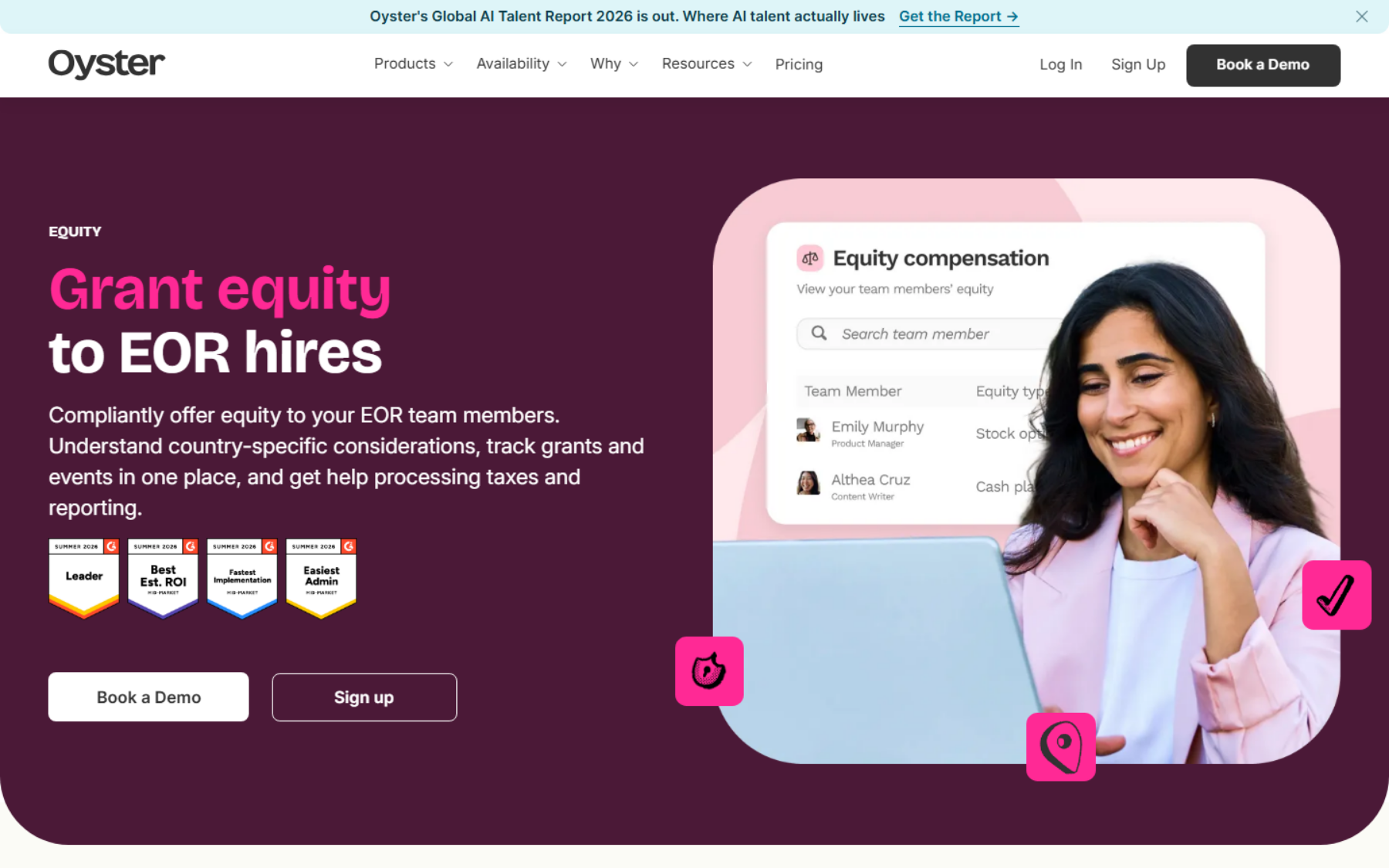
Screenshot of Oyster's equity product page, oysterhr.com, headed Grant equity to EOR hires, offering country-specific guidance, grant tracking and help processing taxes and reporting. Captured 24 November 2026.

Oyster is the most explicit about the fallback: "Cash and phantom plans may be alternatives where traditional equity support is unavailable."

Its EOR fee is $699 a month per employee, and Remote's is $599 on an annual contract; our employer of record cost guide compares the rest, and the EOR cost calculator adds country employer costs.

Equity for contractors: possible, with a classification cost

You can grant options or RSUs to a contractor: Rule 701 and Form S-8 both cover consultants who are natural persons providing bona fide services.

ISOs are out, and so is the payroll that would withhold tax, so the contractor handles their own filing unless local law puts a duty on the payer.

The risk sits in the engineer's country.

A full-time contractor with equity on the same vesting schedule as your staff looks more like an employee to a local labor authority, and I would treat the grant as one more fact for local counsel to weigh.

Our guide to paying developers outside the US covers the misclassification test, and who owns code written by offshore contractors covers the IP clause the grant agreement should not replace.

Worked example: a $40,000 RSU grant at a private startup and a public company

Same engineer, same grant, two different tax calendars.

Our estimate assumes a $40,000 RSU grant vesting 25% a year over four years, a flat share price, and an engineer in a country that taxes RSUs at vest or delivery, such as Singapore or India.

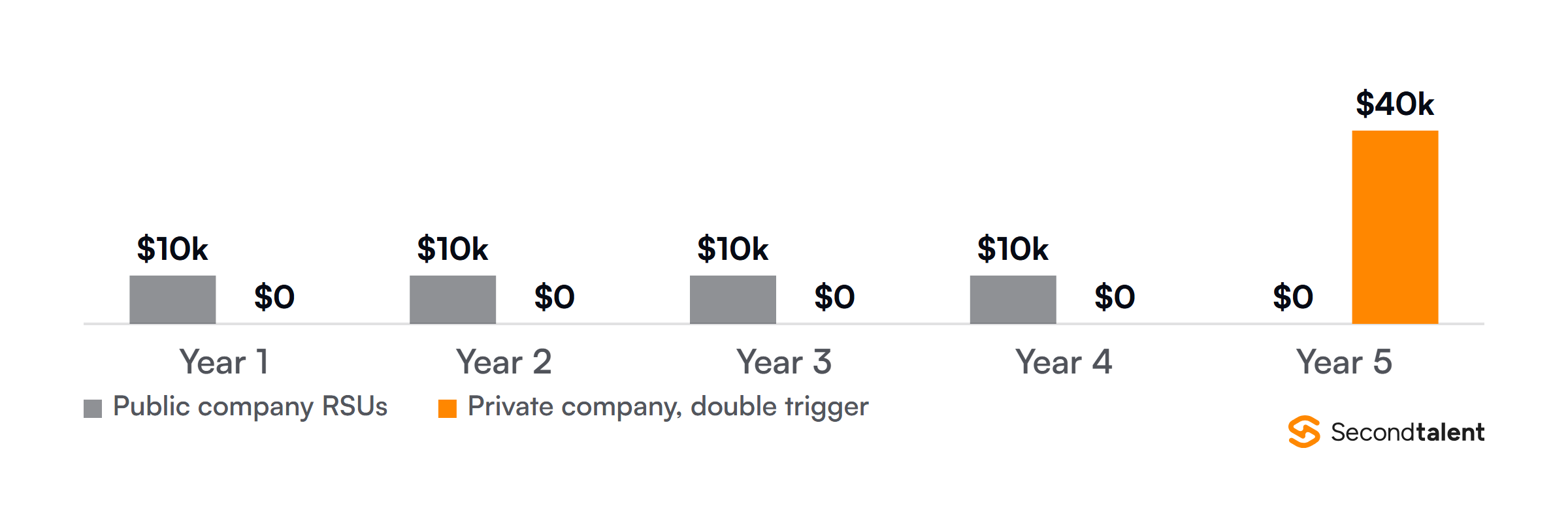
Grouped column chart of taxable income from a $40,000 RSU grant by year: a public company engineer has $10,000 taxable in each of years 1 to 4; a private company double-trigger engineer has $0 in years 1 to 4 and $40,000 in year 5 when the company exits. Our estimate with 25% vesting a year and a flat share price.
  • Public company: $10,000 of taxable income in each of years 1 to 4. The broker sells part of each vest so the employer or EOR can withhold.
  • Private company, double trigger: nothing is taxable while the shares vest by service. If the company is sold or lists in year 5, all $40,000 becomes taxable at once, and the shares must be delivered by March 15 of the following year to stay in the short-term deferral window.
  • Private company, no exit: if no liquidity event comes before the term ends, commonly seven years after grant, the RSUs expire and the engineer receives $0.
Year 0
Grant: $40,000 of double-trigger RSUs, recorded with the EOR or local employer
Years 1 to 4
Service vesting: 25% a year, no tax yet
Year 5
Liquidity event: all vested units taxable; payroll withholds
By March 15, year 6
Settlement: shares delivered inside the 409A short-term deferral window
Year 7
Expiry: unsettled RSUs lapse if no exit has happened
Our estimate. Rules from Treas. Reg. 1.409A-1(b)(4) and Goodwin on double-vest RSUs.

From the people side, the year-5 spike is the part I would explain in the offer conversation, not after the exit.

A $40,000 lump of income in one year can push the engineer into a higher bracket, and they need to know the employer withholds from the shares, not from their savings.

Setting it up: sub-plans, grant agreements and cost

Most companies keep one US plan and attach a country addendum, often called a sub-plan, for each market that needs different terms: a different tax point, a local filing, a cash-settlement clause for China.

The addendum is where the local rules in this guide become contract terms.

Grant agreement checklist

  • Who the holder is: employee of your subsidiary, EOR employee or consultant, matching the plan's Rule 701 or S-8 definitions.
  • Instrument and price: NSO exercise price at or above the latest 409A value, or the RSU trigger and term.
  • Vesting and leaving: cliff, schedule, what happens to unvested awards, and the post-termination exercise window.
  • Tax withholding clause: the holder authorizes sale of shares or payroll deduction to cover local tax, and the EOR is named where it withholds.
  • Country addendum: local tax point, filings (India Form OPI, the Philippine sworn statement), data consent and any cash-settlement fallback.
  • Currency and exchange control: how the exercise price is paid and how sale proceeds come home.
  • IP and confidentiality: kept in the employment or contractor agreement, not the grant.

What it costs

Few costs are public. Pulley's pricing page listed $1,200 a year for its Startup plan and $3,500 for Growth, which included 409A valuations, Rule 701 tracking and option exercises, under a banner announcing the shutdown.

Screenshot of Pulley's pricing page, pulley.com, with a banner reading Pulley is shutting down on 12/8/26 above plans at $1,200 a year for Startup, $3,500 a year for Growth and Contact Us for Enterprise. Captured 24 November 2026.

Pulley's shutdown FAQ, dated September 15, 2026, names Carta as its transition partner and keeps data readable until January 31, 2027. Remote prices its equity product from $39 a month, and Deel's core equity product is free.

None of the pages we read publish fees for local counsel or sub-plan drafting. If your equity data sits with a vendor, add it to the vendor review you already run, as in our guide to hiring offshore engineers under SOC 2 and HIPAA.

Decision table: country, worker type and instrument

This is how I would start the conversation with counsel for each market, using the sources above. It is a framework for the first meeting, not tax or legal advice.

CountryOwn subsidiary employeeEOR employeeContractor
IndiaNSOs or RSUs; perquisite at exercise, employer TDS, Form OPIAsk counsel first: the ESOP route names your own Indian entities; phantom as fallbackOptions possible under Rule 701; check classification
PhilippinesNSOs or RSUs; tax at exercise, sworn statement within 30 days of grantNSOs or RSUs; confirm the EOR files the grant and exercise reportsOptions possible; check classification
SingaporeNSOs or RSUs; tax at exercise or vest, deemed exercise on leavingNSOs or RSUs through EOR payrollOptions possible; check classification
BrazilOptions; tax at sale, decide recharge with an adviserOptions; confirm the EOR's reportingOptions possible; check classification
ChinaRSUs once listed (SAFE registration); phantom while privatePhantom stock or cash-settled SARsCash-based awards; ask PRC counsel

If you are still choosing between an EOR, a PEO and contractor management for these hires, our comparison of EOR vs PEO vs contractor management sets out the trade-offs.

Past a handful of EOR hires in one country, a subsidiary with a recharge agreement may suit equity better; see when to switch from an EOR to your own entity.

Hiring engineers abroad through Second Talent

Second Talent is our own service, so weigh this section with that in mind. We draw on 100,000+ pre-vetted developers and send a shortlist of 6 to 8 pre-vetted profiles within 24 hours.

Pricing runs from $25 USD/hr (billed monthly), or 160 hours for $3,999/mo, with no upfront fees and a replacement guarantee.

Our engineers live and work in Asia, with 4 to 6 hours of daily overlap with US business hours.

We hold the engineer's contract, as in staff augmentation, so plan any equity for them the way you would for an EOR employee: your plan and cap table, with us and your counsel agreeing who reports the income.

FAQ

Can a foreign engineer file an 83(b) election?

They can file one, but it only changes US tax. If the engineer owes no US tax on the shares, local law still sets the tax point.

Do I need a 409A valuation for grants to engineers abroad?

For options and SARs at a private company, yes in practice: one plan, one price at or above fair market value, and the grant stays compliant if the engineer ever becomes a US taxpayer.

When should I bring in a tax adviser or counsel?

Before the first grant in each new country, before granting to an EOR worker or contractor, and before any change to vesting, settlement or a recharge agreement.

Get developers who ship with AI agents. Starts at $25/Hour.

Start Hiring $0 cost until you hire
Anita Wong

Written by

Anita Wong is the Chief People Officer at Second Talent, where she has led talent strategy since 2024. She oversees recruiting, strategic workforce planning, and the people systems that help clients and the Second Talent team grow across Asia. Before joining Second Talent, Anita spent four years as a Global Talent Acquisition Manager at Meta, where she scaled recruitment processes and built programs for talent development. She studied at the University of California, Berkeley, and is based in Hong Kong.

More posts by Anita Wong →