












Skip to content

Paying Developers Outside the US: 1099, W-8BEN or EOR (2026)

Elton Chan By Elton Chan, Co-Founder 15 min read
Paying developers outside the US in 2026: W-8BEN, 1099-NEC and employer of record options, a guide by Second Talent.
TL;DR: For a developer who is not a US citizen or green-card holder and works wholly outside the US, you collect Form W-8BEN, keep it on file, withhold nothing and file no 1099-NEC or 1042-S. On a $5,000 monthly payment that route costs about $5,028 through Wise, against $5,325 through a contractor of record and about $6,113 through an employer of record in the Philippines, by our estimate. Pay through an EOR once you manage the developer like an employee, because the costly risks sit in the developer's own country, not with the IRS.

The IRS sources a contractor's pay by where the work happens, "regardless of where the contract was made, the place of payment, or the residence of the payer," in the words of Publication 515.

A developer in Manila writing code for your Austin startup earns foreign-source income, and the US return for it is blank.

I would not stop at the W-8BEN, though. The bills that hurt come from the developer's tax office, a missing IP clause or a bank's exchange rate.

Key takeaways
  1. 1One work trip to the US changes the paperwork: the days worked there are US-source income, subject to 30% withholding unless a treaty claim on Form 8233 applies.
  2. 2A US citizen coding from Lisbon still gets a Form W-9 and a 1099-NEC once you pay them $2,000 or more in 2026.
  3. 3A Wells Fargo transfer to India lost 3.14% to the exchange rate on quotes Wise collected in November 2026, with no fee shown.
  4. 4The Labor Department's November 19, 2026 contractor rule does not reach a developer whose workweeks are spent in a foreign country.
Paying a developer outside the US: the three routes compared

You can pay the developer yourself as a contractor, pay them through a platform that may also act as their contracting party, or have an employer of record (EOR) hire them in their own country.

The forms you collect and file depend on the route and on one fact about the person: whether they are a US person for tax purposes.

RouteWho the developer works forWhat you collectWhat you file with the IRSMonthly cost on $5,000 (our estimate)Who carries classification risk
Direct foreign contractorYour company, under a contractForm W-8BEN (W-8BEN-E for a company)Nothing, if all work is done abroad$5,028 to $5,157You
US citizen or green-card holder abroadYour company, under a contractForm W-9Form 1099-NEC at $2,000 or more a year$5,028 to $5,157You
Contractor platformYour company; the platform pays outThe same forms, through the platform's onboardingSame as direct$5,029 to $5,049, plus any FX spreadYou, unless you buy an indemnity tier
Contractor of recordThe provider, which bills youThe provider's invoiceNothing for a foreign developer$5,199 to $5,400The provider
Employer of recordThe provider, as a local employerThe provider's invoiceNothing; the provider runs local payrollAbout $6,113 in the PhilippinesThe provider, under local employment law

The cost column assumes a $5,000 payment or gross salary and uses list prices we read on 24 November 2026. The full arithmetic is in the cost section below.

For the broader model comparison, including PEOs, see our guide to EOR vs PEO vs contractor management.

Route 1: paying a foreign contractor directly with Form W-8BEN

Form W-8BEN is the certificate a nonresident individual gives a US payer to show they are a foreign person.

The IRS instructions tell the contractor not to send it to the IRS but to give it to the person requesting it, so it lives in your files.

What you collect and how long it lasts

  • Form W-8BEN from a developer who invoices as an individual. It stays valid through the last day of the third calendar year after signing, unless their circumstances change first.
  • Form W-8BEN-E from a developer who invoices through their own company.
  • A signed contractor agreement with scope, rate, payment terms and an IP assignment (see the IP section).
  • Invoices that state where the work was performed, which is the fact your tax position rests on.

Why there is no 1099-NEC and no withholding

Pay for services is US-source only for the part done in the United States. Work done wholly abroad is foreign-source, and US withholding under chapter 3 attaches to US-source income.

Publication 515 adds that foreign persons who give you a valid Form W-8 "are exempt from backup withholding and Form 1099 reporting."

Form 1042-S does not come into it either. The Form 1042-S instructions say foreign-source income "is generally not required to be reported" on that form.

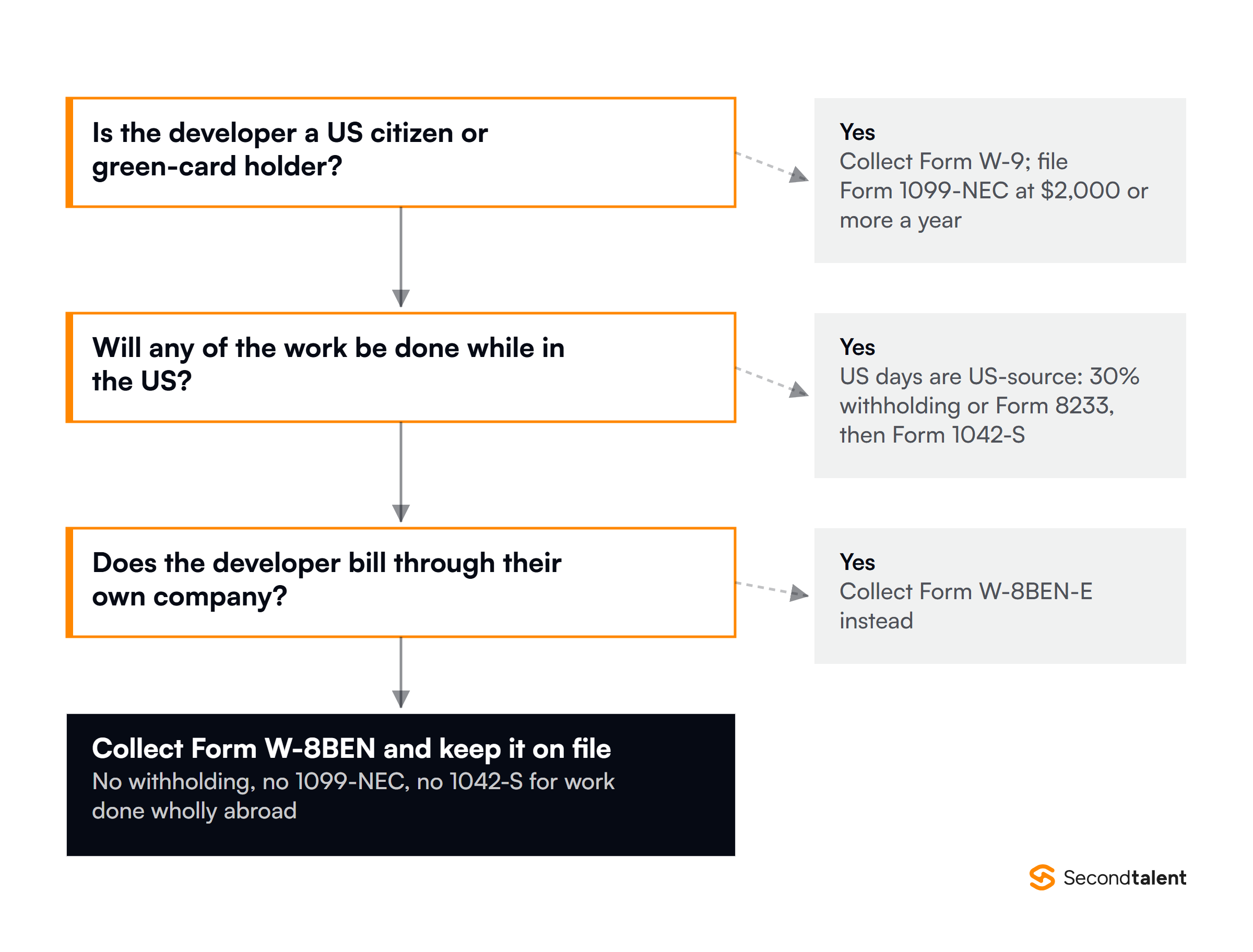
Flowchart of which IRS form a developer outside the US gets: a US citizen or green-card holder gives Form W-9 and gets a 1099-NEC at $2,000 or more a year; work done while in the US is US-source with 30% withholding or Form 8233, then Form 1042-S; a developer billing through a company gives Form W-8BEN-E; otherwise collect Form W-8BEN and keep it, with no withholding, 1099-NEC or 1042-S for work done wholly abroad. Based on IRS Publication 515 and form instructions.

When Form 1042-S does apply

Fly the developer to your office for a two-week sprint and those two weeks are US-source income. Publication 515 says you allocate pay that is partly US and partly foreign on a time basis, by the days worked in the US.

For an independent contractor, that US part carries 30% withholding unless the developer claims a treaty exemption on Form 8233. You review and sign the 8233 and forward it to the IRS within 5 days of accepting it.

You then report the payment on Form 1042-S and file Form 1042; the 2026 forms are due March 15, 2027.

Publication 515 has one more useful line for travel: travel and lodging you reimburse under an accountable plan is not reportable and not subject to chapter 3 withholding. The fee for the US days still is.

The US-person trap: citizens and green-card holders abroad

A US citizen living in Portugal is still a US person, and the W-8BEN instructions say US citizens, "including those living outside the United States," should not use the form.

You collect Form W-9 instead and treat them like any domestic contractor.

For tax years beginning after 2025, the 1099-NEC instructions raise the reporting threshold to $2,000. Form 1099-NEC is due to the IRS and the contractor by January 31.

If the contractor does not give you a taxpayer identification number, payments can fall under backup withholding at 24%.

Before the first payment
Collect the form: W-8BEN or W-8BEN-E from a foreign developer, W-9 from a US person
Within 5 days
Form 8233: forward an accepted treaty claim to the IRS, only if work is done in the US
Jan 31, 2027
Form 1099-NEC: for US persons paid $2,000 or more in 2026
Mar 15, 2027
Forms 1042-S and 1042: only for US-source pay to a foreign contractor in 2026
Dec 31, third year after signing
W-8BEN expires: ask for a new one before the next payment
Sources: IRS Publication 515; Instructions for Forms W-8BEN, 1042-S, 1099-MISC and 1099-NEC, read 24 November 2026.

Route 2: contractor platforms and contractor of record

A contractor platform does the paperwork of Route 1 for a monthly fee; a contractor of record (COR) goes further and becomes the developer's contracting party.

Remote's help center lists the forms its onboarding asks for: W-9 for US persons at home or abroad, W-8BEN for individuals outside the US, and W-8BEN-E for those contracting through an entity.

Contractor management
  • You sign the contract; the platform collects forms, invoices and pays
  • $5 to $49 a month per contractor on the pages we read
  • Classification risk stays with you; Remote's $99 Plus tier adds up to $100,000 of indemnity per contractor, capped at $1M per company
Contractor of record
  • The provider contracts the developer and bills you for the work
  • $199 to $400 a month per contractor on the pages we read
  • Remote lists its COR protection as uncapped
Source: Deel, Remote, Multiplier and Papaya Global pricing pages, read 24 November 2026.

We read the public pricing pages of six providers on 24 November 2026. All prices are "starting at" list prices in USD per worker per month; "not published" means the page asks for a quote.

ProviderContractor managementContractor of recordEmployer of recordNote on the page
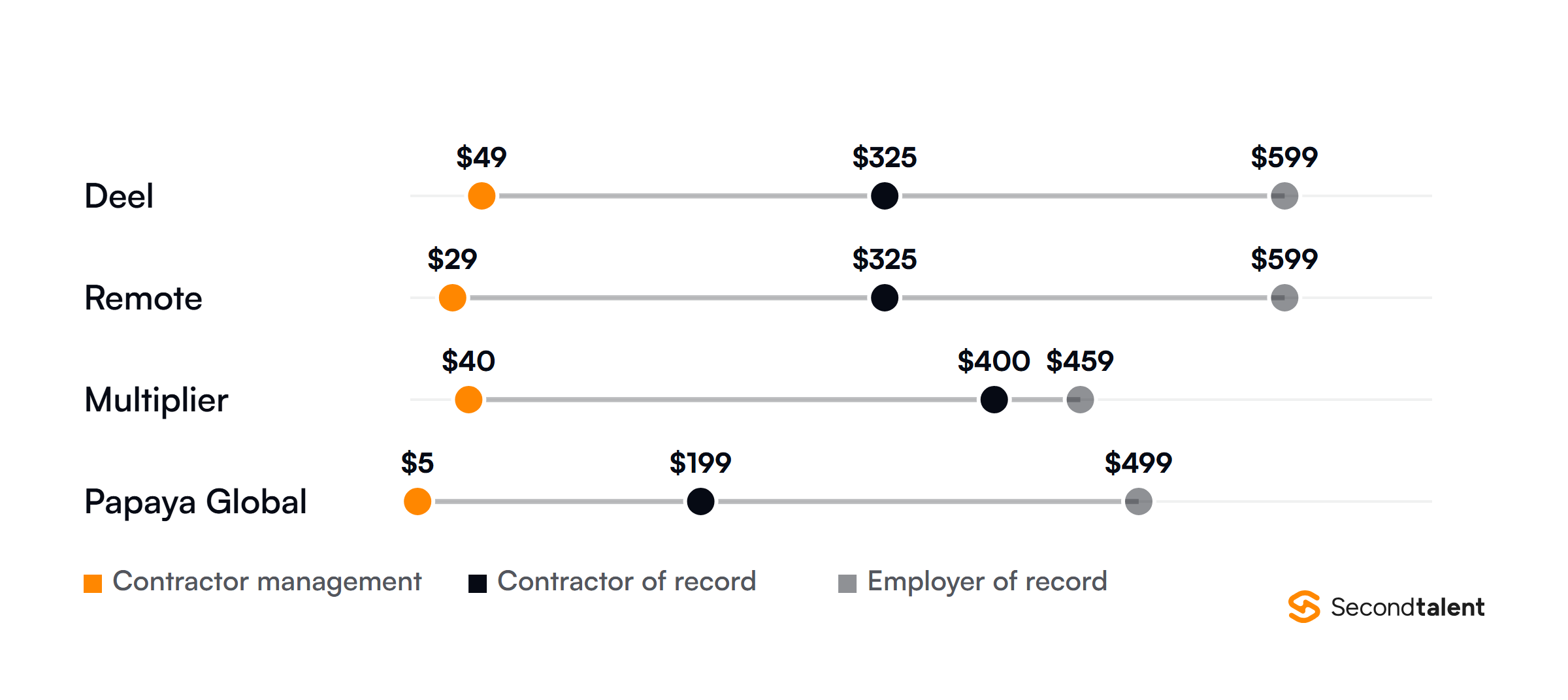
Deel$49$325$599FX described as "competitive", no rate published
Remote$29 ($99 Plus)$325$599 (annual contract)One FX rate per monthly billing cycle, shown on the invoice
Oyster$29 after 30 days freeNot published$699Refundable EOR deposit, amount not published
Multiplier$40$400$459 Core, $519 GrowthBilled annually; $6 background check per worker
Papaya Global$5$199$499Quote required for each product
RipplingNot publishedNot publishedNot publishedPlans "start at $8 per employee per month" overall
Dot plot of published monthly prices per worker on 24 November 2026: Deel $49 contractor management, $325 contractor of record, $599 EOR; Remote $29, $325, $599; Multiplier $40, $400, $459 billed annually; Papaya Global $5, $199, $499. Source: each vendor's pricing page.

The gap between contractor management and COR is the price of moving classification risk off your books: $276 a month at Deel and $296 at Remote.

If you run security reviews on these vendors too, our guide to hiring offshore engineers under SOC 2 and HIPAA covers what to ask for.

Route 3: employing the developer through an employer of record

Under an EOR the developer becomes a salaried employee of the provider's local entity, with a local employment contract, payroll tax, social insurance and statutory benefits. You direct the work and pay one invoice.

Published EOR prices on our list run from $459 at Multiplier to $699 at Oyster, and our employer of record cost guide covers 15 providers.

The fee is the smaller part of the extra cost. A Philippine employer owes social insurance and a 13th-month payment on top of salary, so a $5,000 gross salary (PHP 318,860 at the 24 November mid-market rate) carries these employer costs:

$416.67
13th-month pay, one twelfth of salary
$54.88
SSS, 10% of the PHP 35,000 salary credit cap
$39.20
PhilHealth, employer half of 5% on PHP 100,000
$3.14
Pag-IBIG, 2% of the PHP 10,000 fund salary cap
Our estimate at PHP 63.772 per USD. Sources: Presidential Decree 851; Grant Thornton Philippines on SSS and Pag-IBIG; Philstar on PhilHealth's 2025 premium.

That is $513.89 a month before the EOR fee.

The 13th-month rule comes from Presidential Decree 851; the SSS rate of 10% on a maximum salary credit of PHP 35,000 is from Grant Thornton Philippines, and Philstar reported the 5% PhilHealth premium capped at PHP 100,000 of income.

Employer costs differ by country, and Oyster asks for a refundable deposit before an EOR hire starts. Run your own country and salary through the EOR cost calculator before you compare quotes.

What a $5,000-a-month developer costs under each route

Pay the developer yourself and the only cost above $5,000 is moving the money. Each step up the ladder adds a fee that buys you something: paperwork handled, classification risk carried, or a full employment relationship.

RouteAdded each monthMonthly total12 months
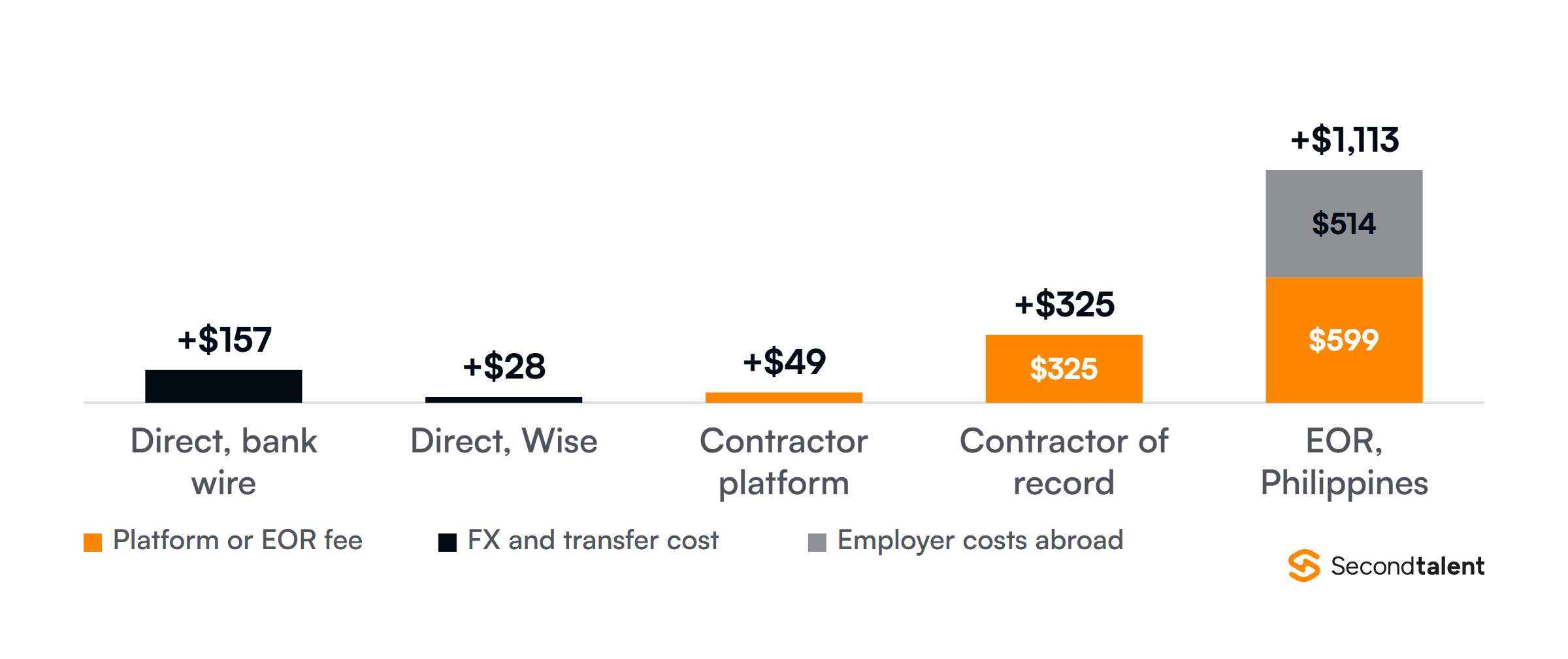
Direct, Wise transfer to India$28 transfer fee$5,028$60,336
Direct, Wells Fargo transfer to India$157 in exchange-rate markup$5,157$61,884
Contractor platform (Deel)$49 fee, FX not published$5,049$60,588
Contractor of record (Deel or Remote)$325 fee$5,325$63,900
EOR in the Philippines ($599 fee)$599 fee plus $513.89 employer costs$6,113$73,355
Stacked column chart of what each route adds to a $5,000 monthly payment: direct bank wire $157 in FX cost, direct via Wise $28, contractor platform $49 fee, contractor of record $325 fee, EOR in the Philippines $599 fee plus $514 employer costs, $1,113 in total. Our estimate from vendor list prices and Wise quotes, 24 November 2026.
How we built it. The contractor routes treat $5,000 as the invoice; the EOR route treats it as gross salary, so the developer's take-home differs between routes. Platform fees are list prices, not negotiated ones, and the Wise and bank figures are single quotes for the India corridor.

Over a year, the EOR route costs about $13,000 more than paying the same developer yourself through Wise. Weigh that against what a misclassification claim or a lost IP dispute would cost in the developer's country.

For the US-side version of the same comparison, see contract vs direct hire.

Payment rails and FX: where the money leaks

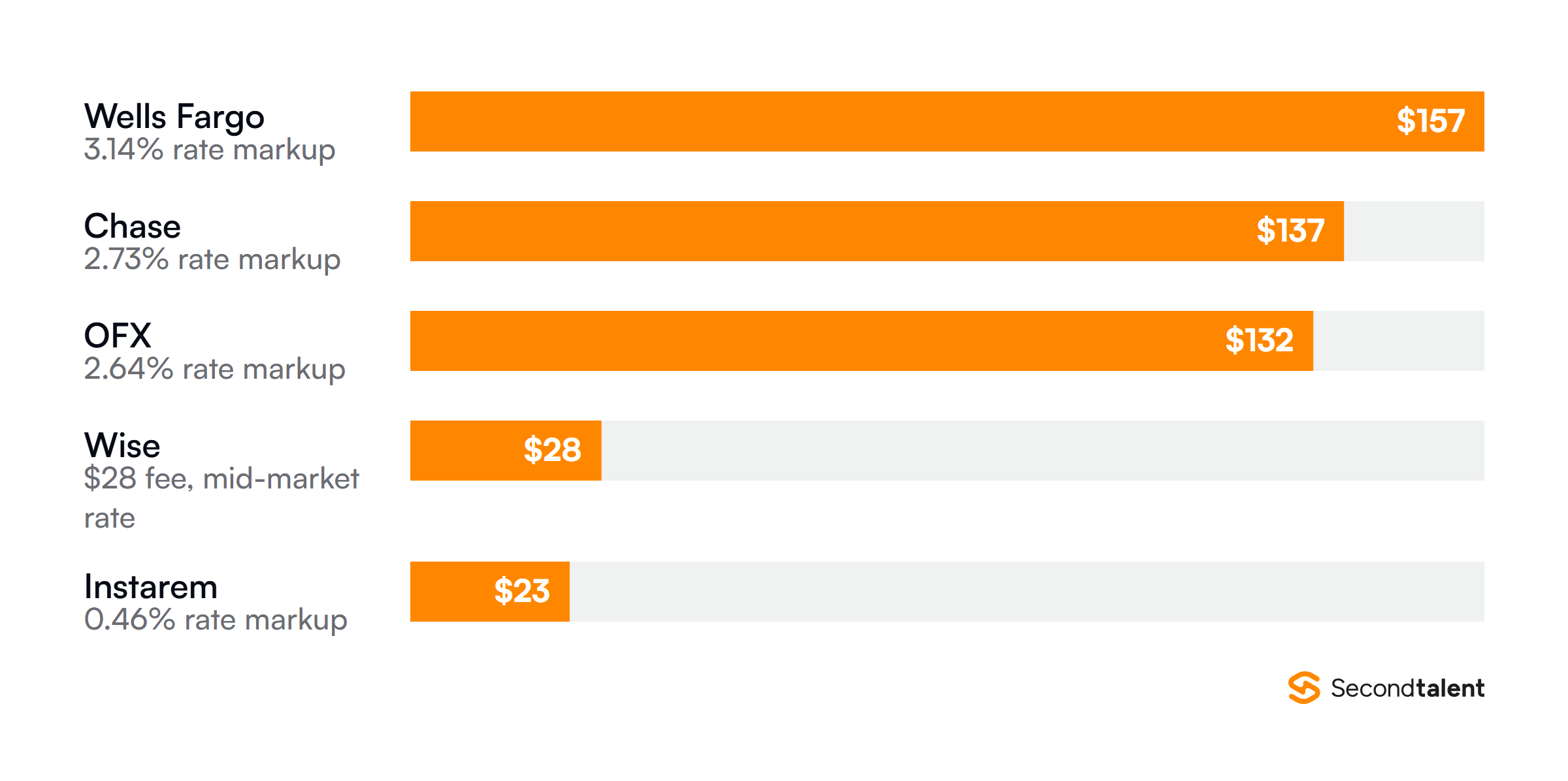
On a $5,000 transfer to India, the big US banks quoted no fee and still cost the most.

We pulled the Wise comparison data for a $5,000 send from the US on 24 November 2026 and measured each quote against the mid-market rate of 92.886 rupees per dollar.

Bar chart of the cost of sending $5,000 from the US to India: Wells Fargo $157 with a 3.14% rate markup, Chase $137 at 2.73%, OFX $132 at 2.64%, Wise $28 fee at the mid-market rate, Instarem $23 at 0.46%. Source: Wise comparison API, pulled 24 November 2026.

Wells Fargo's rate sat 3.14% below mid-market and Chase's 2.73% below, on quotes dated 20 November. Wise charged a $28 fee at the mid-market rate.

The pattern held in the other corridors we pulled: Wells Fargo cost $160 on $5,000 to the Philippines and $158 to Mexico, against $31 and $32 through Wise.

  • Check who sets the rate. Wise runs this comparison and lists itself, so treat it as a vendor's data set; the bank quotes come from Wise's own collection.
  • Consumer apps quote lower. Remitly and Xoom quoted close to zero cost for India on the same day, but they are built for personal remittances, not business invoices.
  • Platforms bundle the rate. Remote sets one FX rate per billing cycle and shows it on the invoice; Deel publishes no rate. Ask for the spread in writing.

Does the DOL's November 2026 contractor rule apply?

Not to a developer who works abroad full time.

Section 13(f) of the Fair Labor Standards Act switches off its minimum wage, overtime and related sections for any employee whose workweek is spent "in a workplace within a foreign country," per 29 U.S.C. 213(f).

The final rule announced on November 19, 2026 names two core factors: control over the work and the worker's chance of profit or loss from initiative or investment.

The DOL page says it covers the FLSA, FMLA and MSPA, does not change classification under the Internal Revenue Code, and does not preempt state law. It gives no effective date.

It matters for the US-person contractor who comes home and keeps working from Denver, or for weeks your foreign developer spends at your US office. For tax, the IRS common-law test still decides.

Misclassification risk in the developer's own country

The country where the developer lives applies its own employee test, and a full-time contractor who works only for you, on your hours, under your manager, is the profile that fails those tests.

The usual cost is back payroll tax, social contributions and employee benefits, owed by the party the local authority treats as employer.

The UK shows how much the details vary.

Its off-payroll (IR35) rules put the status decision on the client, but HMRC's guidance says the rules do not apply to an organization based wholly overseas with no UK connection; the worker's intermediary decides instead.

A US company with no UK presence shifts that call to the contractor, but the employment-law question remains.

If you want the developer full time for more than a year, I would ask local counsel or move them to a COR or EOR before the first anniversary.

A short memo from counsel in the developer's country costs less than one year of back contributions.

Permanent establishment risk

A developer writing code at home seldom creates a taxable presence for your company abroad; a salesperson signing deals can.

The Tax Adviser, the AICPA's journal, lists the dependent agent "who habitually exercises authority to conclude contracts on behalf of the company" as one way a permanent establishment arises, and warns the risk rises in EOR arrangements when the employee concludes contracts without oversight.

For home offices, the OECD's 2025 update to the Article 5 commentary says a home used for less than 50% of working time over 12 months is generally not a place of business, and that a commercial reason must exist for the location, according to EY.

Employee convenience and lower office costs do not count.

Two caveats from the same sources: the US generally reserves the right to apply the pre-2017 version of Article 5, and India, Israel, Nigeria and Malaysia have entered reservations or their own readings of the guidance.

Keep contract-signing authority with US staff and ask a tax adviser before a remote hire takes a client-facing role.

IP assignment: who owns the code

Under US copyright law, code from an independent contractor belongs to the contractor unless a signed agreement transfers it.

Copyright Office Circular 30 limits "work made for hire" by non-employees to nine commissioned categories, and a standalone program is not one of them. A transfer of copyright must be in writing and signed, per 17 U.S.C. 204.

  • Direct contractor: put a present-tense assignment ("hereby assigns") of all code, docs and inventions in the contract, plus a waiver of moral rights where local law allows one.
  • Platform or COR: read the template; check that rights flow from the developer to the provider and on to you.
  • EOR: the local employment contract needs the assignment clause too, because local law decides what an employer owns.

Which route should you pick?

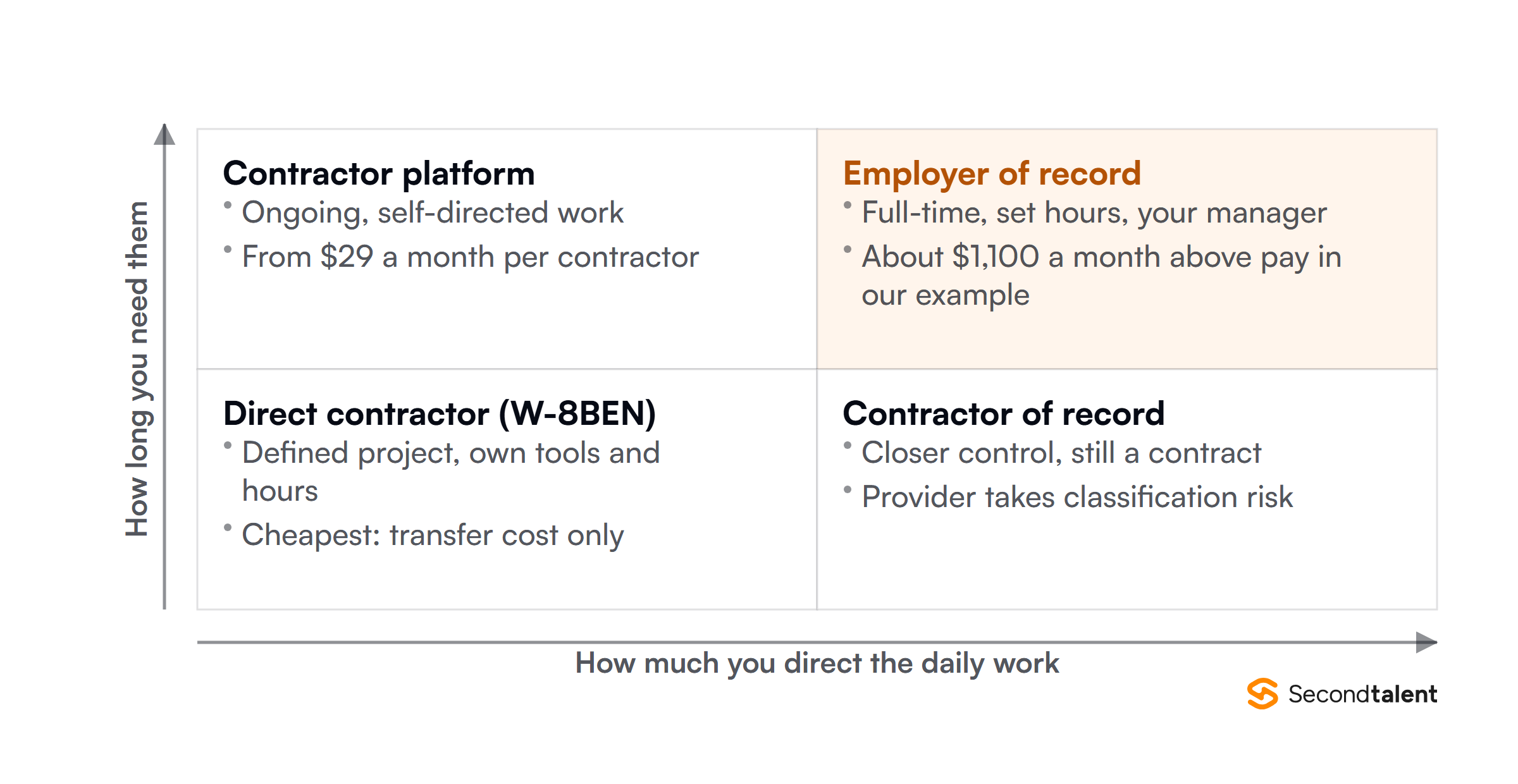
Pick by how much you direct the work and how long you need the person. A three-month build by a developer who sets their own hours fits a direct contract with a W-8BEN.

A developer on your sprint calendar, in your standups, for two years, fits an EOR.

Two by two matrix of payment routes by how much you direct the daily work and how long you need the developer: contractor platform for long, self-directed work from $29 a month; employer of record for long work under your manager, about $1,100 a month above pay in our example; direct contractor with W-8BEN for short, self-directed projects; contractor of record for short work under closer control, with the provider taking classification risk.

If I were paying a first engineer abroad for a US startup, I would start with a contractor platform at $29 to $49 a month, then move to an EOR once the role looks permanent.

Past a handful of EOR hires in one country, compare the fees with opening your own entity; our guide on when to switch from an EOR to an entity runs that math.

Hiring developers abroad through Second Talent

Second Talent is our own service, so weigh this section with that in mind.

We draw on 100,000+ pre-vetted developers and send a shortlist of 6 to 8 pre-vetted profiles within 24 hours, priced from $25 USD/hr (billed monthly), or 160 hours for $3,999/mo, with no upfront fees and a replacement guarantee.

Our engineers are based in Asia, with 4 to 6 hours of daily overlap with US business hours, and we handle their contracts and pay, much like staff augmentation.

FAQ

Do I send Form W-8BEN to the IRS?

No. You keep it in your own records as the payer, as the form instructions say. Ask for a new one when it expires or when the developer's details change.

Can an EOR employee still create a permanent establishment?

Yes. The EOR is the legal employer, but if the employee concludes contracts for your company without much oversight, The Tax Adviser notes the PE risk rises. Keep developers out of contract signing.

Can I move a contractor to an EOR later?

Yes. The EOR hires the developer on a local employment contract, which replaces your contractor agreement, and the EOR fee replaces the platform fee.

Agree the start date so the contractor's final invoice and the first payroll do not overlap.

Get developers who ship with AI agents. Starts at $25/Hour.

Start Hiring $0 cost until you hire
Elton Chan

Written by

Elton Chan is the Co-Founder of Second Talent, a solution that connects global tech leaders with top-tier tech talent across Asia. He specializes in talent solutions and has led Second Talent’s rapid growth since 2024, helping scale its network to over 100,000 pre-vetted developers and earning industry recognition as the #1 in the Global Hiring category on G2. A long-time entrepreneur with deep roots in digital transformation, Elton previously co-founded Branch8, a Y Combinator–backed e-commerce technology firm, and served as the Founding Chairman of HKEBA, a leading Asia-focused business association driving innovation, digital education, and cross-border collaboration. His work bridges technology, talent, and business strategy to shape how companies scale in an increasingly remote and digital world.

More posts by Elton Chan →