






Skip to content

Hiring Offshore Engineers Under SOC 2 and HIPAA (2026)

Elton Chan By Elton Chan, Co-Founder 14 min read
Hiring offshore engineers under SOC 2 and HIPAA in 2026, a guide by Second Talent.
TL;DR: Neither SOC 2 nor HIPAA bans offshore engineers; you need a BAA only when a vendor firm, not your own workforce, handles PHI. The hard limit is a DOJ rule on staff in China, Russia and four other countries who can reach health or financial data on over 10,000 Americans. Of 15 hiring platforms we checked on 24 November 2026, 8 state a SOC 2 Type II report and none offers a BAA.

Remote, a large employer of record (EOR) provider, says in its help center that it will not sign HIPAA business associate agreements for the engineers it employs for you. It treats them as your own personnel.

That position decides who carries the HIPAA work when a US healthtech company hires an engineer in Manila or Krakow through an EOR: you do. I would read each vendor's version of that page before I looked at its SOC 2 badge.

Key takeaways
  1. 1HHS says the HIPAA Rules have no requirements specific to ePHI held outside the US; the overseas risk goes into your Security Rule risk analysis.
  2. 2The AICPA has proposed new SOC 2 criteria, open for comment until January 15, 2027; the 2017 criteria still govern audits until they take effect.
  3. 3The HIPAA Security Rule update that would make MFA and encryption mandatory was still a proposal on 24 November 2026.
  4. 4A cloud desktop, device management and SSO with MFA cost about $84 a month per engineer at list prices (our estimate).
Do SOC 2 and HIPAA allow offshore engineers?

Yes. Neither framework names a country. SOC 2 is a report a CPA firm writes against the AICPA's Trust Services Criteria. The criteria ask whether your controls work for each person who touches the system, wherever they sit.

HIPAA regulates what happens to protected health information (PHI), not the passport of the person who reads it.

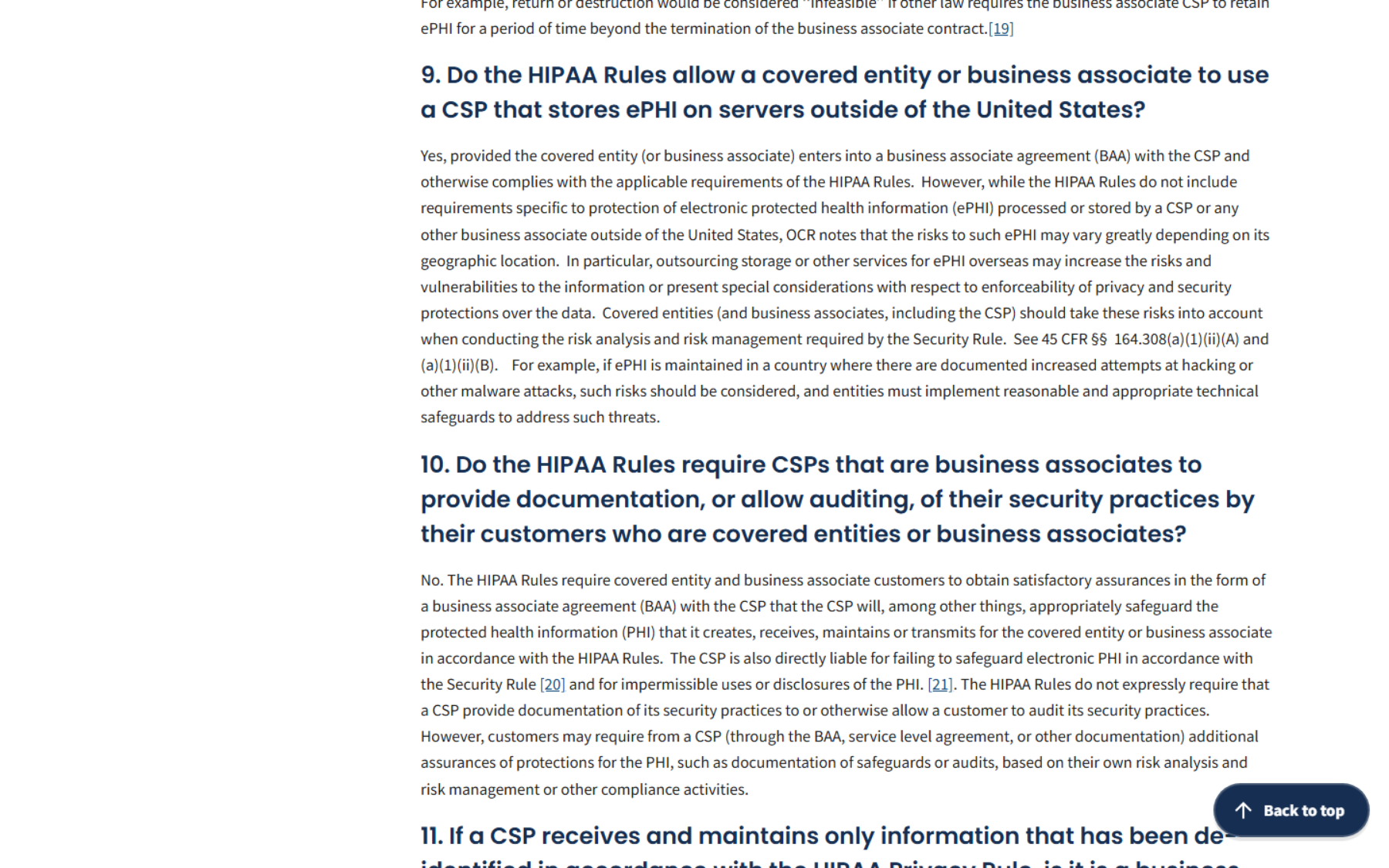
The clearest official line is in the HHS guidance on cloud computing. Can a covered entity use a provider that stores ePHI on servers outside the United States? HHS answers yes, if there is a BAA and the rest of the HIPAA Rules are met.

HHS guidance on HIPAA and cloud computing, question 9: yes, a covered entity may use a cloud provider that stores ePHI on servers outside the United States if it signs a business associate agreement, though overseas storage may increase risk and belongs in the risk analysis.

The same answer warns that overseas storage "may increase the risks and vulnerabilities to the information." Covered entities should weigh that in the risk analysis the Security Rule requires (HHS guidance on HIPAA and cloud computing).

Read that as the rule for people too: you may give offshore staff access, and you write down why the risk is acceptable.

SOC 2
  • Voluntary report, usually demanded by your customers' security reviews
  • Asks whether your controls cover every user, contractors and vendor staff included
  • Offshore staff show up as test samples: their onboarding, access and offboarding records
HIPAA
  • Federal law for covered entities and their business associates
  • Needs a BAA with any vendor that handles PHI for you
  • Offshore access is a risk analysis item, not a ban

What SOC 2 auditors test when engineers work outside the US

An auditor picks a sample of people who joined, changed roles or left during the audit period and asks for the evidence trail on each. An offshore contractor lands in that sample like any employee.

A missing background check, or a login left active two weeks after the last day, becomes an exception in your report.

The criteria behind those tests sit in the AICPA's 2017 Trust Services Criteria (with 2022 points of focus). The full text needs a free AICPA account, so the summaries below are ours.

CriterionWhat it coversWhat the auditor asks for on an offshore engineer
CC1.4Hiring and keeping competent peopleBackground check (or the vendor's attestation of one), signed policies, security training date
CC6.1Logical access securitySSO and MFA on every system with customer data
CC6.2Registering and authorizing users before accessAn approved access request dated before the first login
CC6.3Role-based access, least privilege, removalRole mapping, quarterly access review, removal at exit
CC6.7Moving and removing dataControls that keep customer data off personal devices, USB and email
CC6.8Malicious softwareEndpoint protection on the device or the cloud desktop
CC7.2Monitoring for anomaliesLogs showing who accessed production and when
CC8.1Change managementPull requests reviewed and approved by someone other than the author
CC9.2Vendor and business partner riskYour review of the staffing vendor: its SOC 2 report, contract terms, risk rating

Subservice organizations and complementary user entity controls

If a staffing firm or EOR supplies the engineer, it may be a subservice organization in your SOC 2 report.

Most reports use the carve-out method, which leaves the vendor's controls out of your auditor's testing, as CPA firm Schellman explains in its carve-out vs inclusive guide.

The inclusive method pulls them in and tests them, which few vendors agree to.

Carve-out does not remove your duty to watch the vendor. CPA firm Linford & Co. describes the review you owe. Read the vendor's SOC report.

Check that its complementary user entity controls (CUECs, the controls it expects you to run) exist on your side. Then document the mapping.

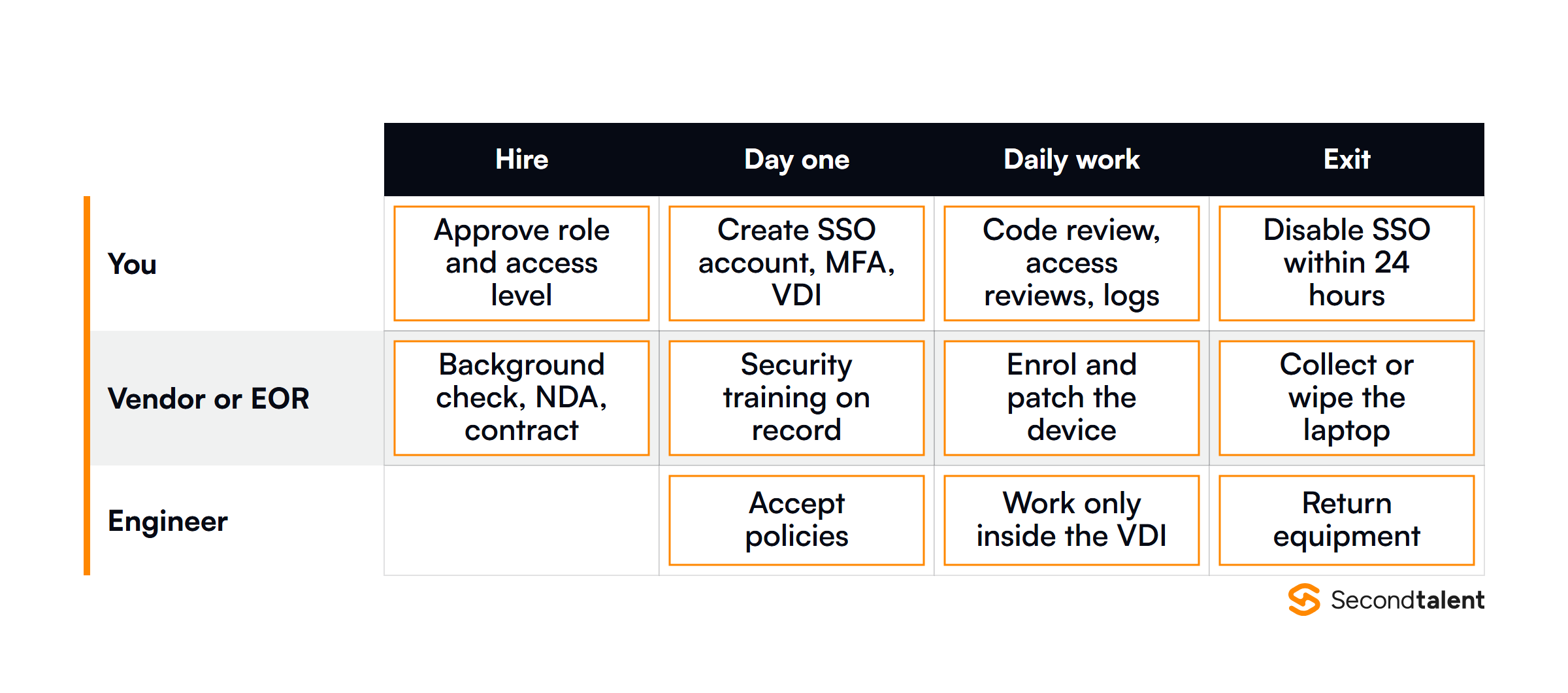
Swimlane of who runs each control when a vendor supplies an offshore engineer. You: approve role and access, create SSO, MFA and VDI, run code review and access reviews, disable SSO within 24 hours. Vendor or EOR: background check and contract, security training, device enrolment and patching, collect or wipe the laptop. Engineer: accept policies, work inside the VDI, return equipment.

A vendor with no SOC 2 report leaves a gap you fill yourself. Use a security questionnaire, contract clauses on background checks and devices, and your own evidence for each row in the chart.

Two notices matter for 2027 audits. The AICPA has released draft SOC 2 criteria, with comments due January 15, 2027. They would apply to engagements beginning on or after December 31, 2027, reports CPA Practice Advisor.

The AICPA's SOC 2 page also says it is looking into allegations about a compliance vendor that offers SOC services. Check that your vendor's auditor is a licensed CPA firm.

When an offshore engineer or vendor needs a BAA

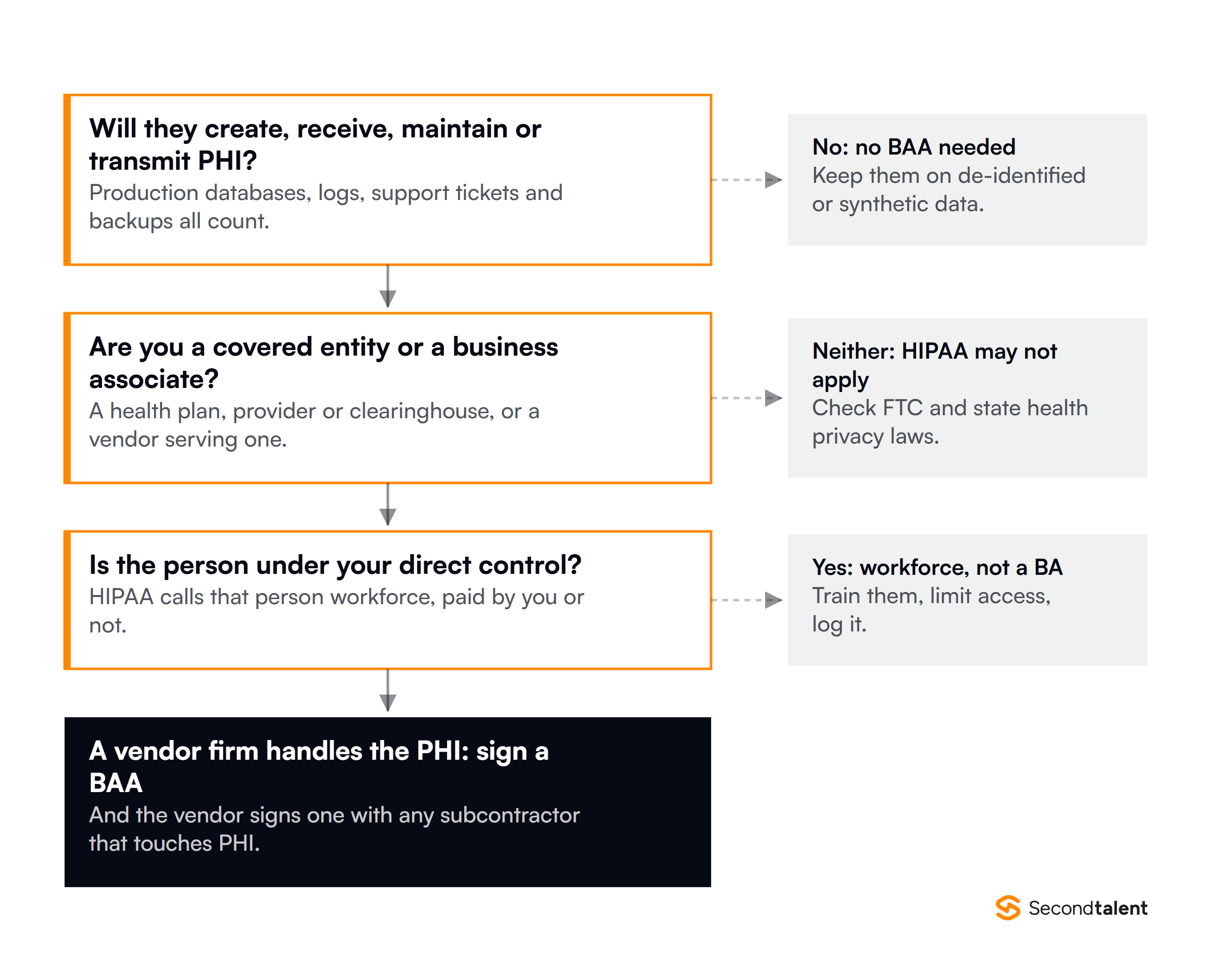
You need a BAA when a person or firm outside your workforce creates, receives, maintains or transmits PHI for you. An engineer under your direct control counts as workforce instead.

HIPAA's definition in 45 CFR 160.103 covers employees, volunteers, trainees and other persons under "the direct control" of the entity. It applies "whether or not they are paid" by that entity.

Flowchart of whether an offshore engineer or vendor needs a HIPAA business associate agreement: no BAA if they never touch PHI or if you are not a covered entity or business associate; a person under your direct control is workforce, not a business associate; a vendor firm that handles PHI signs a BAA, and so does its subcontractor.

The chain matters once a firm sits in the middle.

HHS's business associate guidance says a business associate "must establish a BAA with its subcontractor before disclosing PHI," and every downstream subcontractor is a business associate too.

So if you are a SaaS vendor to hospitals and an agency's engineer works on your PHI, the agency signs a BAA with you, not with the hospital.

Why most EORs will not sign one

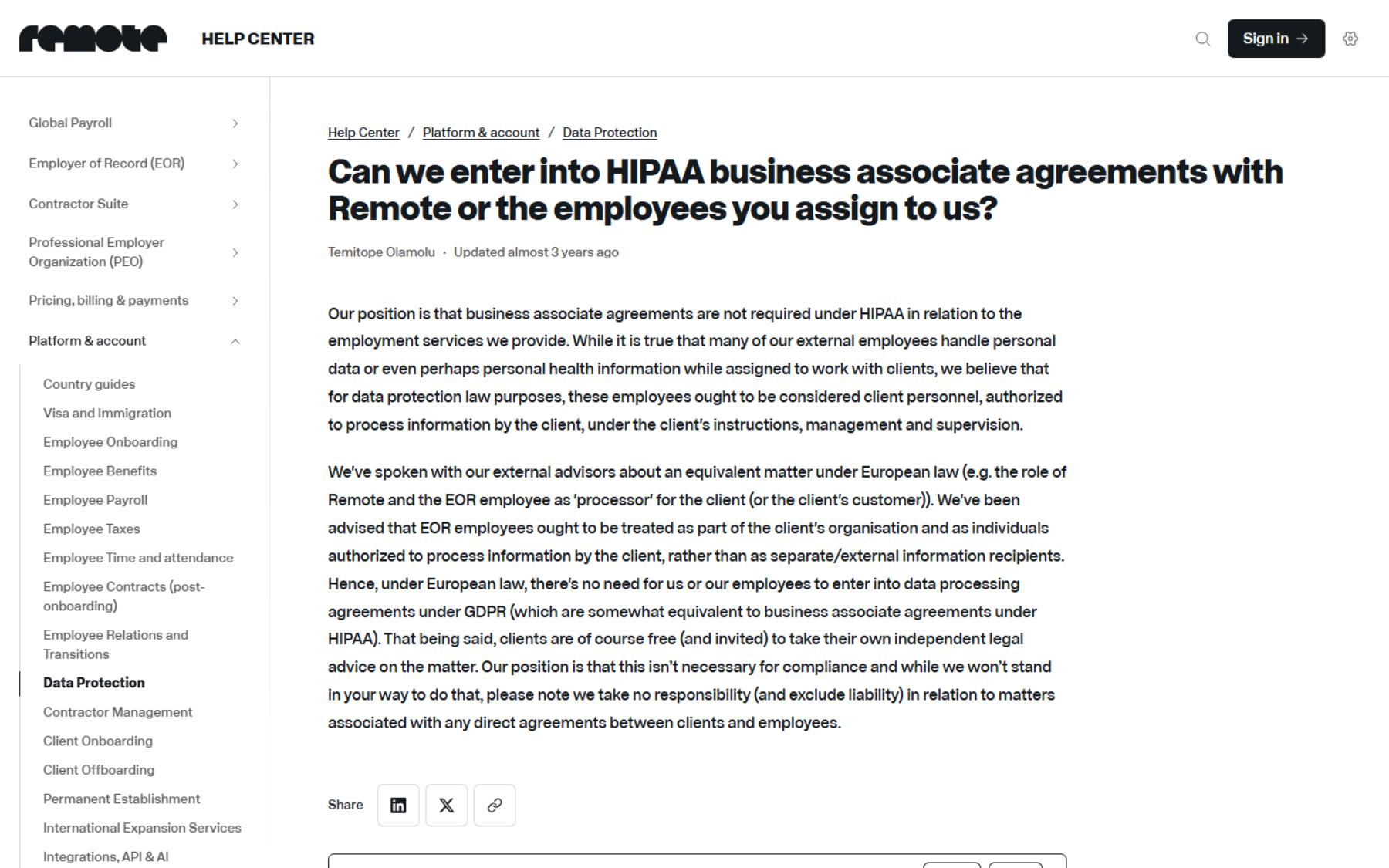
An EOR employs the engineer on paper, while you direct the daily work. Remote's help center turns that into a policy, shown below: the engineers it assigns are "client personnel," so it holds that a BAA is not required.

Remote help center article stating its position that HIPAA business associate agreements are not required for the employment services it provides, because assigned employees are treated as client personnel.

That reading fits the workforce definition, but it moves every safeguard onto you: training, access limits, sanctions and the device. Remote's article also invites clients to take their own legal advice.

A staffing agency or outsourcing firm that manages the engineers and their laptops looks more like a business associate. Put that case in front of counsel before PHI moves.

The EOR, contractor and staffing models differ on more than HIPAA. Our comparison of EOR, PEO and contractor management covers who employs whom. Contract vs direct hire covers the US side of the same choice.

Minimum necessary and test data: keep PHI away from most offshore roles

Most engineering work does not need real patient data, and HIPAA's minimum necessary standard turns that into a rule. HHS's minimum necessary guidance says your policies must name "the persons or classes of persons" who need access.

They must also name the types of PHI needed and the "conditions appropriate to such access."

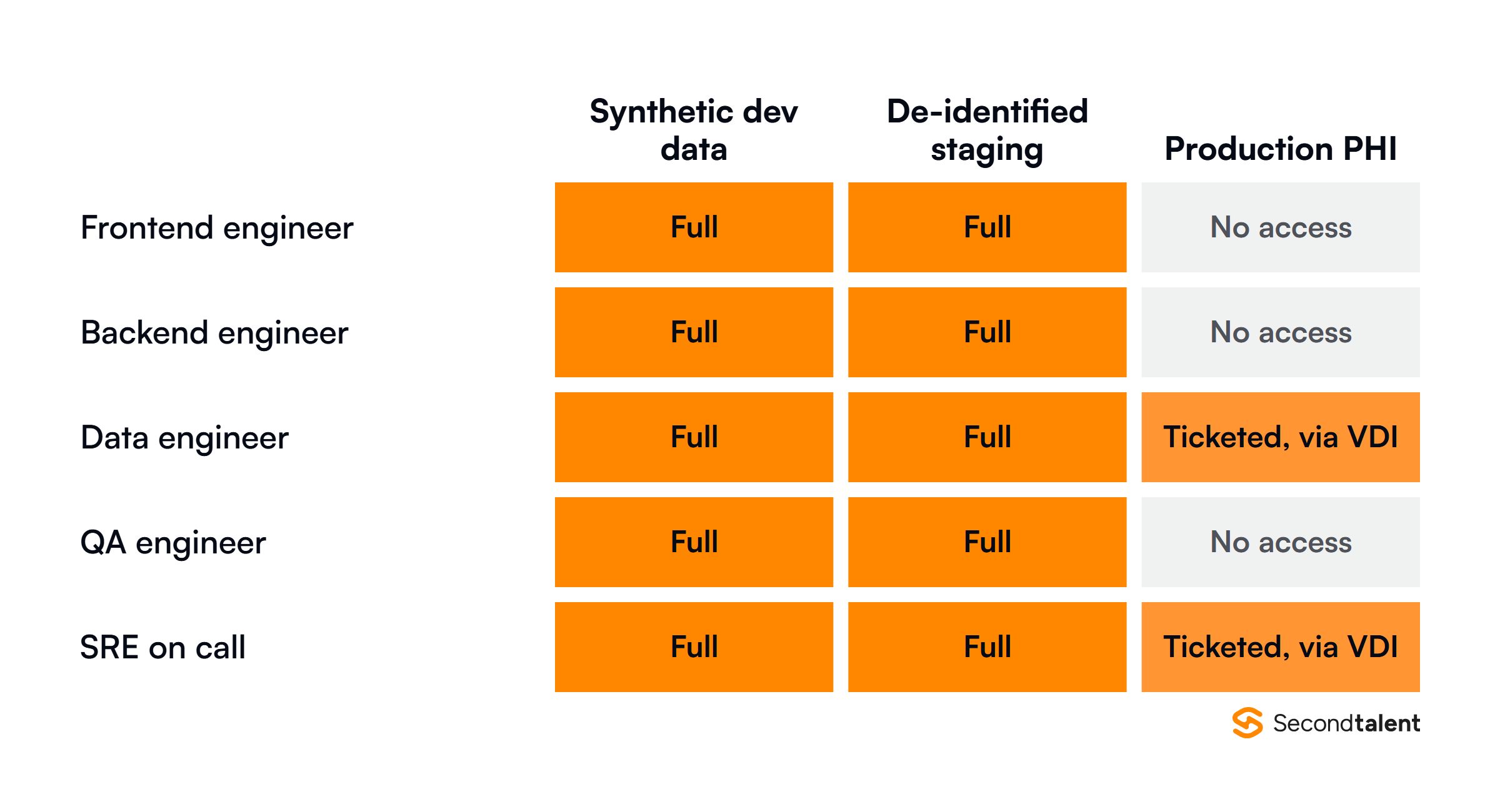
For an engineering team that means role-based access written down per role. A frontend engineer building a scheduling screen works on synthetic data.

A data engineer fixing a pipeline may need production access, through a ticket, inside a monitored session.

Heatmap of an example access model for an offshore team: frontend, backend, data, QA and SRE engineers all have full access to synthetic dev data and de-identified staging; only the data engineer and the SRE on call get ticketed production PHI access through the VDI, and the rest have none.

Staging data leaves HIPAA's scope only after de-identification. HHS's de-identification guidance allows two methods. Safe Harbor strips 18 listed identifiers, such as names, record numbers and dates more specific than the year.

Expert Determination relies on a qualified statistician. A production copy with fake names but real dates of service still holds PHI.

De-identified is not out of scope everywhere. The Justice Department rule below counts health data "regardless of whether the data is anonymized, pseudonymized, de-identified, or encrypted," so a HIPAA-clean staging set can still fall under it.

The rules that do restrict offshore access

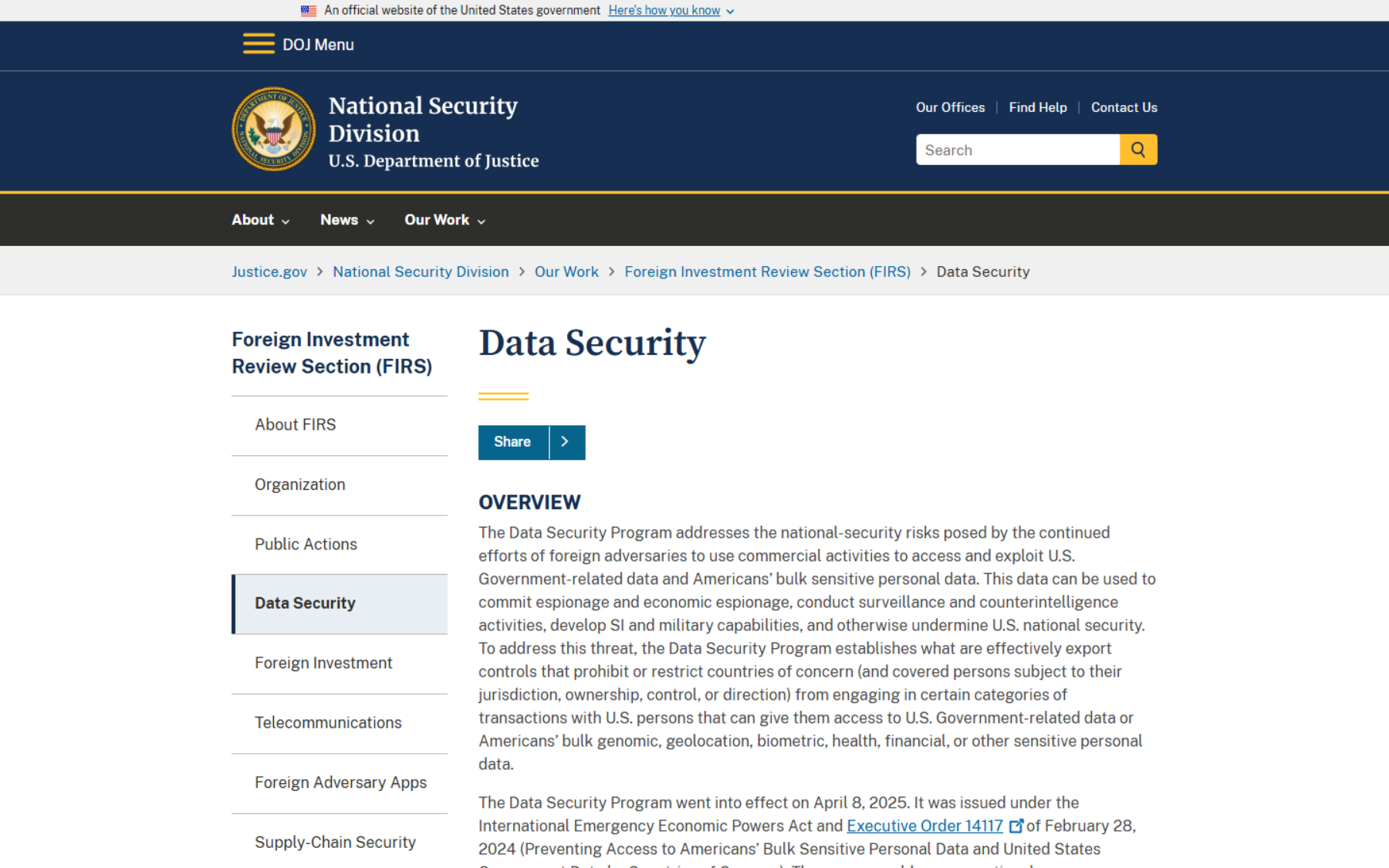
The Justice Department's Data Security Program covers staff who live in China (including Hong Kong and Macau), Cuba, Iran, North Korea, Russia or Venezuela.

Employing such a person in a job with access to bulk sensitive data is a restricted transaction. The rule took effect on April 8, 2025.

US Department of Justice National Security Division Data Security page, stating the Data Security Program restricts countries of concern from accessing Americans' bulk health, financial and other sensitive personal data and went into effect on April 8, 2025.

The thresholds are low for a healthtech or fintech product. Under 28 CFR part 202, health or financial data on more than 10,000 US persons counts as bulk.

You may go ahead only if you meet the CISA security requirements and the rule's due diligence and audit duties. Residence decides it, not citizenship.

A Russian citizen living in Poland is not a covered person, and the rule counts a Chinese citizen working in the US as a US person. The DOJ's program page lists the compliance guide and FAQs.

Apr 8, 2025
DOJ Data Security Program takes effect, covering employment and vendor agreements with covered persons
Oct 5, 2025
Due diligence, audit and reporting duties for restricted transactions apply
Jan 1, 2026
Texas SB 1188: electronic health records must be physically kept in the US
Oct 2026
AICPA exposure draft of the 2027 SOC 2 criteria; comments close Jan 15, 2027
Nov 24, 2026
HIPAA Security Rule update (MFA, encryption, 24-hour access-change notices) still a proposal; no final rule in the Federal Register

State law and your customers' contracts

Texas went further than HIPAA. Since January 1, 2026, its SB 1188 has required covered entities to keep electronic health records inside the United States.

Civil penalties run from $5,000 to $250,000 per violation, as law firm Goodwin summarizes. Goodwin notes the statute is unclear on offshore read-only access.

A product with Texas patients should ask counsel before an offshore engineer gets even a view into production.

Contracts are the other limit, and often the tighter one. Hospital systems, health plans and banks write "US-only access" or "no offshore PHI" clauses into their BAAs and master agreements. Those clauses bind you whatever the statute says.

Fintechs covered by the FTC's Safeguards Rule must also oversee service providers by contract and use MFA for anyone accessing customer information, per the FTC's Safeguards Rule guide.

The practical setup: VDI, SSO, MFA, device management and logs

The setup that clears both SOC 2 and HIPAA reviews keeps customer data on infrastructure you control and gives the offshore engineer a window into it.

A cloud desktop (VDI) holds the code and any data, the laptop only displays it, and SSO with MFA decides who opens the window.

ControlWhat to set upEvidence to keepFramework link
Background checkCheck through the vendor or a local provider, within local lawDated vendor attestation per personSOC 2 CC1.4
Contract and NDAConfidentiality, IP assignment, device and data clauses; BAA where a firm handles PHISigned copies before day oneSOC 2 CC9.2, HIPAA 164.504(e)
Security trainingTraining at onboarding and yearly, including HIPAA for PHI rolesCompletion recordsSOC 2 CC2.2, HIPAA 164.308(a)(5)
SSO and MFAOne identity provider; MFA on every appIdentity provider user list and policy exportSOC 2 CC6.1, FTC Safeguards Rule
Least privilegeRole-based groups; production by ticket onlyQuarterly access review sign-offSOC 2 CC6.3, HIPAA minimum necessary
Cloud desktop (VDI)Code and data stay in the VDI; clipboard, download and USB blockedVDI policy screenshotsSOC 2 CC6.7
Device management (MDM)Enrolled laptop: disk encryption, screen lock, OS patches, endpoint protectionMDM compliance reportSOC 2 CC6.8
Audit logsLogs for production, VDI sessions and repository access, kept per your retention policyLog samples and review ticketsSOC 2 CC7.2, HIPAA 164.312(b)
Change managementBranch protection; a second reviewer on every mergePull request historySOC 2 CC8.1
OffboardingDisable SSO on the last day; recover or wipe the deviceTicket with timestampsSOC 2 CC6.2, CC6.3

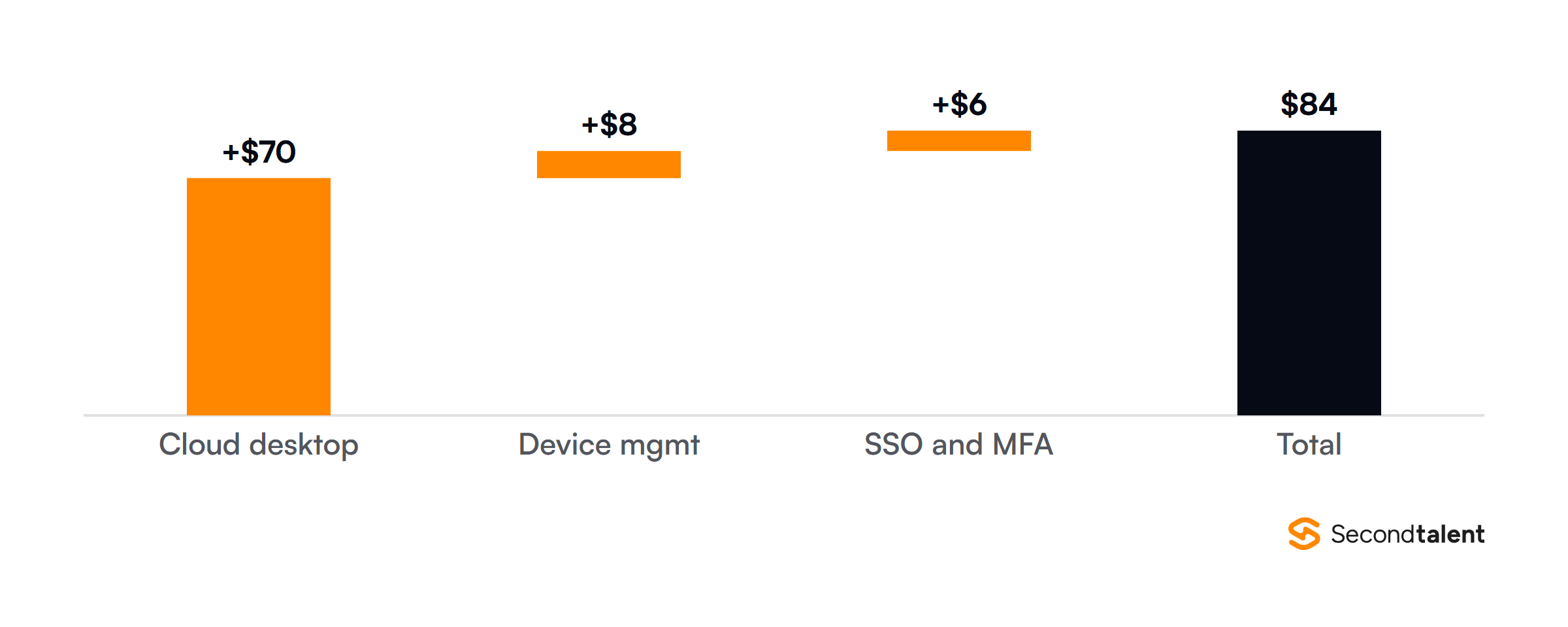
The tooling is cheap next to the salary. We checked list prices on 24 November 2026. An AWS WorkSpaces Power desktop (4 vCPU, 16 GB, Ubuntu, US East) costs $70 a month.

Microsoft Intune Plan 1 costs $8 per user, and Okta's Starter suite with SSO and MFA $6 per user, billed yearly.

Waterfall chart of monthly security tooling per offshore engineer at list prices on 24 November 2026: cloud desktop $70 (AWS WorkSpaces), device management $8 (Microsoft Intune Plan 1), SSO and MFA $6 (Okta Starter), total $84. Our estimate.
$515
A month for a five-engineer team, after Okta's $1,500 yearly minimum
2.1%
$84 against a $3,999 monthly engineer rate
$11,332
Monthly wage of a median US software developer, before benefits
Our estimate from list prices on the AWS, Microsoft and Okta pricing pages (24 Nov 2026) and the BLS median of $135,980 a year (May 2025).

The five-engineer figure is five desktops ($350), five Intune seats ($40) and $125 a month for Okta. Five Okta seats come to $360 a year, under the $1,500 annual contract minimum.

Prices come from the AWS WorkSpaces pricing list and Microsoft Intune pricing; the US wage is the BLS median for software developers.

Most US companies already pay for an identity provider, which makes the real add-on closer to the desktop and the device seat.

The engineer's pay is the bigger line. Our guide to paying developers outside the US covers contractor payments, W-8BEN forms and EOR payroll. The employer of record cost guide and EOR cost calculator price the EOR route.

What staffing, EOR and talent platforms publish about SOC 2, ISO 27001 and BAAs

The EOR providers publish the most: all seven we checked state a SOC 2 Type II report. Among developer marketplaces and staffing firms, only Upwork states one, and no platform on the list publishes a standard offer to sign a HIPAA BAA.

8 of 15 state a SOC 2 Type II report8 of 15 state ISO 270010 of 15 publish a BAA offer
PlatformTypeSOC 2ISO 27001HIPAA BAA
DeelEORType IIYes, plus ISO 27701Not published; says it has a HIPAA compliance approach
RemoteEORType IIYesDeclines: says BAAs are not required
OysterEORType II (security, availability, confidentiality)Not publishedNot published
RipplingEOR and global payrollType 2 (security, confidentiality, availability)YesNot published; links a HIPAA fact sheet
MultiplierEORType 2Yes (27001:2022)Not published
Pebl (formerly Velocity Global)EORType 2 (2026 report)Yes (27001:2022)Not published
G-PEORType II (2026 report)YesNot published
UpworkFreelance marketplaceType 2*Yes*Not published
BairesDevOutsourcingSays "SOC 2 certified," no type stated*Yes (27001:2022)*Not published
TuringStaffingNot publishedNot publishedNo offer page; privacy policy says it can act as a "business associate" under a written agreement
ToptalTalent networkNot published for the developer networkNot publishedNot published
AndelaTalent marketplaceNot publishedNot publishedNot published
ArcDeveloper marketplaceNot publishedNot publishedNot published
Lemon.ioDeveloper marketplaceNot publishedNot publishedNot published; NDAs only
Second Talent (our own service)StaffingNot published; offers SOC 2-aligned workflows on requestNot publishedNot published
How we checked (24 November 2026). We read each platform's own security page, trust center, help center and legal pages, and counted only what the vendor states about itself. *Upwork and BairesDev block automated readers, so their claims come from search-indexed copies of their own pages. Toptal's security pages now show Pebl, its former HireGlobal EOR unit, so Pebl's reports are not counted for Toptal.

EOR reports cover the EOR's own platform and payroll systems, which is what a CC9.2 vendor review needs. They say nothing about the engineer's laptop or your production access, because those sit with you.

Of the eight marketplaces and staffing firms, six publish no SOC 2 report, so the evidence comes from your contract and your own controls.

If I were buying for a healthtech company, I would put two questions to each vendor in writing before price. Will you share your SOC 2 report under NDA? Will you sign our BAA, or tell us in writing why not?

For a wider list of providers by country and model, see our ranking of companies to hire offshore developers.

Hiring offshore engineers for a regulated product

Second Talent, our own service, places engineers based in Asia with US companies as dedicated or staff augmentation hires.

You get a shortlist of 6 to 8 pre-vetted profiles within 24 hours and 4 to 6 hours of daily overlap with US business hours. Pricing is 160 hours for $3,999/mo, with no upfront fees.

As the table shows, we do not publish a SOC 2 report or a BAA offer. For a PHI role, plan the VDI, SSO and access setup above on your side, and agree the contract terms with us before the first login.

FAQ

Is SOC 2 required by law?

No. SOC 2 is a voluntary report by a licensed CPA firm. Customers ask for it in security reviews, and once you hold one, your offshore engineers are inside its scope.

Does a vendor's SOC 2 report cover the engineers it places with me?

Only for the controls the vendor runs, such as background checks or payroll systems, and only if those are in the report's scope. Access to your systems is your control and appears in your own report.

Do offshore engineers need HIPAA training?

If they are part of your workforce and can reach ePHI, yes. The Security Rule requires a security awareness and training program for all workforce members at 45 CFR 164.308(a)(5).

Is ISO 27001 a substitute for SOC 2?

For many European buyers it is; most US security questionnaires still ask for SOC 2. ISO 27001 certifies a management system, while a SOC 2 Type II report describes how specific controls performed over a period.

Get developers who ship with AI agents. Starts at $25/Hour.

Start Hiring $0 cost until you hire
Elton Chan

Written by

Elton Chan is the Co-Founder of Second Talent, a solution that connects global tech leaders with top-tier tech talent across Asia. He specializes in talent solutions and has led Second Talent’s rapid growth since 2024, helping scale its network to over 100,000 pre-vetted developers and earning industry recognition as the #1 in the Global Hiring category on G2. A long-time entrepreneur with deep roots in digital transformation, Elton previously co-founded Branch8, a Y Combinator–backed e-commerce technology firm, and served as the Founding Chairman of HKEBA, a leading Asia-focused business association driving innovation, digital education, and cross-border collaboration. His work bridges technology, talent, and business strategy to shape how companies scale in an increasingly remote and digital world.

More posts by Elton Chan →