TL;DR: Choose contract developers for short-term projects, specialized skills, or uncertain timelines. Choose direct hires for long-term roles, core product work, and team culture building.
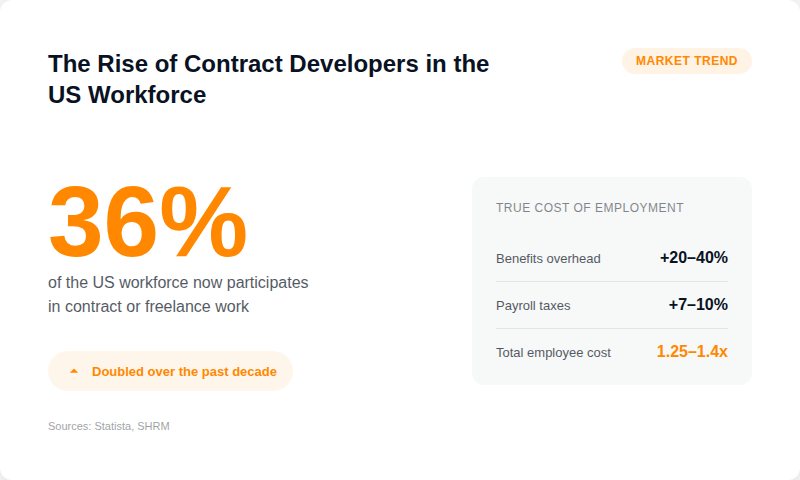
A large and growing share of the US workforce now takes contract or freelance work a figure that has doubled over the past decade. For software development specifically, this shift is even more pronounced.
CTOs and engineering leaders increasingly face a strategic choice: should they hire developers as contractors or bring them on as direct employees?
The answer isn’t one-size-fits-all. Each model offers distinct advantages depending on your company stage, project requirements, and long-term goals.
Making the wrong choice can result in wasted budget, delayed projects, or a fragmented engineering culture.
This guide breaks down contract vs. direct hire for developers, covering costs, legal considerations, team dynamics, and decision frameworks.
By the end, you’ll know which model fits your specific situation and how to execute either approach effectively.
What’s your hiring situation right now?
Select your situation below.
You’re launching a 3-6 month project and need specific expertise without long-term commitment. Contract developers in Vietnam cost 50-70% less than US rates while delivering the same quality. You avoid benefits overhead and can scale quickly. Compare Vietnam contract rates →
You’re scaling your product team and need developers who’ll own your codebase long-term. Direct hires in Southeast Asia offer 50-70% cost savings versus Western markets, with full cultural alignment and dedication to your mission. Hire full-stack developers →
You want contractors but need to stay compliant with local labor laws across multiple countries. An EOR handles payroll, taxes, and employment contracts in 150+ countries, eliminating your misclassification risk entirely. Get EOR pricing →
You need core employees for product work plus contractors for peak periods. Our talent sourcing finds you both direct hires and vetted contractors across Asia, giving you the 36% workforce flexibility Statista reports without the hiring headaches. Explore talent sourcing →
Understanding the Two Models
Before comparing, let’s define exactly what each hiring model entails and how they differ structurally.
What Is Contract Hiring?
Contract developers work for your company on a temporary basis, typically through a defined agreement specifying duration, deliverables, or hourly/daily rates.
They may work through a staffing agency, as independent contractors, or via platforms that handle compliance.
Contract arrangements come in several forms:
- Fixed-term contracts: Set duration (3 months, 6 months, 1 year) with defined end date
- Project-based contracts: Engagement tied to specific deliverables rather than time
- Hourly/retainer contracts: Ongoing work billed by time, often with flexible scope
- Contract-to-hire: Trial period as contractor with option to convert to full-time
What Is Direct Hire?
Direct hire (also called permanent hire or full-time employment) means the developer becomes an employee of your company. You handle payroll, benefits, taxes, and all employer obligations. The relationship has no predetermined end date.
For international hiring, direct employment often requires either establishing a legal entity in the developer’s country or using an Employer of Record (EOR) service to handle compliance on your behalf.
Cost Comparison: Contract vs. Direct Hire
Cost is often the first consideration, but the comparison isn’t as straightforward as hourly rates suggest. You need to account for total cost of engagement.
Contract Developer Costs
Contract developers typically charge higher hourly or daily rates than equivalent salaried employees. However, you avoid many hidden costs of employment.
- Rate premium: 20-50% higher than equivalent salary when converted to hourly
- No benefits costs: You don’t pay health insurance, retirement contributions, or PTO
- No payroll taxes: Contractors handle their own tax obligations
- Flexibility savings: Pay only for hours worked; scale up or down quickly
- Potential agency fees: Staffing agencies typically charge 25-75% markup on rates
Direct Hire Costs
Direct hires have lower base rates but significant additional costs that aren’t immediately visible in salary figures.
- Base salary: Typically lower than contractor equivalent rates
- Benefits: Add 20-40% to base salary (health, dental, vision, retirement)
- Payroll taxes: Employer portion adds 7-10% depending on jurisdiction
- Equipment and software: One-time and ongoing costs for tools
- Recruiting costs: Agency fees (15-25% of salary) or internal recruiting time
- Onboarding investment: Training time before full productivity
Research from SHRM indicates the true cost of an employee is typically 1.25-1.4x their base salary when all factors are included.
Total Cost Comparison Table
This table illustrates how costs compare for a senior developer role over different time periods:
| Cost Factor | Contract (6 months) | Direct Hire (6 months) | Direct Hire (2 years) |
|---|---|---|---|
| Base compensation | $90,000 | $75,000 | $300,000 |
| Benefits (30%) | $0 | $22,500 | $90,000 |
| Payroll taxes (8%) | $0 | $6,000 | $24,000 |
| Recruiting costs | $2,000 | $18,750 | $18,750 |
| Onboarding time value | $5,000 | $15,000 | $15,000 |
| Total Cost | $97,000 | $137,250 | $447,750 |
| Monthly Cost | $16,167 | $22,875 | $18,656 |
As the table shows, contractors are often more cost-effective for short engagements, while direct hires become more economical over longer periods as recruiting and onboarding costs amortize.
Use the Recruitment Cost Calculator to model costs for your specific situation.
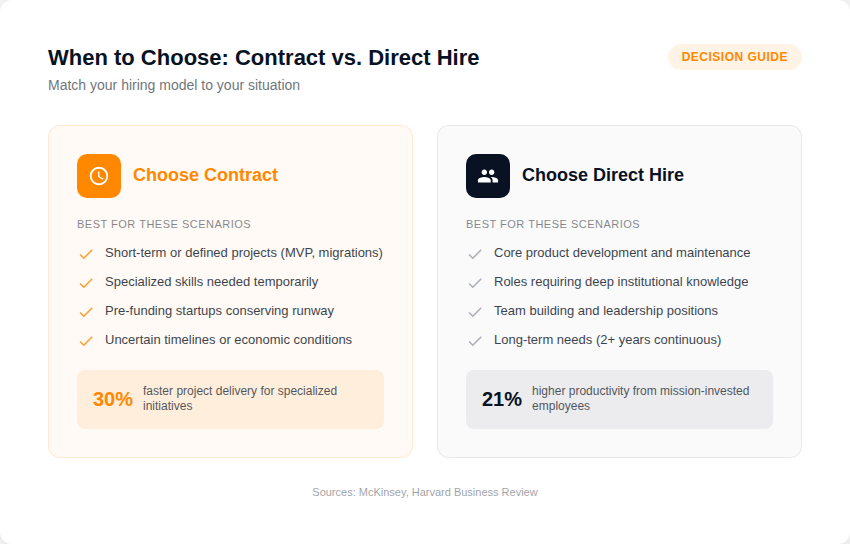
When to Choose Contract Developers
Contract hiring makes strategic sense in several common scenarios. Recognizing these situations helps you deploy contractors effectively.
Short-term or defined projects:
- Building an MVP with uncertain product-market fit
- One-time migrations, integrations, or infrastructure upgrades
- Seasonal demand spikes requiring temporary capacity
- Proof-of-concept work before committing to larger investment
Specialized skills needed temporarily:
- Niche technologies your team doesn’t have (blockchain, ML, specific frameworks)
- Security audits or penetration testing
- Performance optimization requiring deep expertise
- Legacy system work that won’t be ongoing
Business uncertainty:
- Pre-funding startups conserving runway
- Companies in transition (M&A, pivots, restructuring)
- Testing new product lines before building permanent teams
- Uncertain economic conditions requiring workforce flexibility
When to Choose Direct Hire
Direct hiring is the better choice when you’re building for the long term and need developers deeply invested in your company’s success.
Core product development:
- Building and maintaining your primary product or platform
- Work requiring deep domain knowledge that accumulates over time
- Systems where institutional knowledge is critical
- Customer-facing features requiring ongoing iteration
Team and culture building:
- Leadership and mentorship roles
- Positions requiring cross-functional collaboration
- Roles where cultural alignment directly impacts work quality
- Building institutional knowledge and documentation
Strategic long-term needs:
- Roles you’ll need continuously for 2+ years
- Positions involving sensitive data or IP requiring higher trust
- Work requiring security clearances or compliance certifications
- Technical leadership positions shaping architecture decisions
Pros and Cons Comparison
This side-by-side comparison summarizes the key trade-offs:
| Factor | Contract Developers | Direct Hire Developers |
|---|---|---|
| Flexibility | High – scale up/down quickly | Low – hiring and termination take time |
| Cost (short-term) | Often lower total cost | Higher due to recruiting/onboarding |
| Cost (long-term) | Higher due to rate premiums | Lower per month over time |
| Commitment | Project-focused | Company-focused |
| Knowledge retention | Risk of loss when contract ends | Builds institutional knowledge |
| Management overhead | Less HR burden | Full employment responsibilities |
| Cultural integration | Limited | Full team member |
| Legal complexity | Misclassification risk | Standard employment law |
| Availability | Faster to engage | Longer recruiting timeline |
| IP protection | Requires careful contracts | Clearer ownership by default |
Legal and Compliance Considerations
Both hiring models carry legal obligations, but the risks differ significantly. Understanding these helps you avoid costly mistakes.
Contract Hiring Risks
The biggest legal risk with contractors is worker misclassification. If authorities determine your “contractor” is actually an employee, you face back taxes, penalties, and potential lawsuits.
- Control test: Do you control how, when, and where the work is done?
- Integration test: Is the worker integral to your business operations?
- Economic dependence: Does the worker depend primarily on your company for income?
- Equipment provision: Do you provide tools, software, and workspace?
Misclassification exposes you to back taxes, unpaid benefits and penalties. The IRS common-law test is what decides whether someone is a contractor or an employee. Some states impose additional penalties.
Direct Hire Compliance
Direct employment has clearer legal frameworks but requires ongoing compliance:
- Employment law: Wage and hour rules, anti-discrimination, leave requirements
- Benefits administration: Healthcare, retirement plans, required disclosures
- Termination procedures: Notice requirements, severance, final pay timing
- International complexity: Each country has different employment laws
For international direct hires, using an EOR service handles compliance in the employee’s country. Review the EOR Cost Calculator to understand the investment required.
The Hybrid Approach: Best of Both Worlds
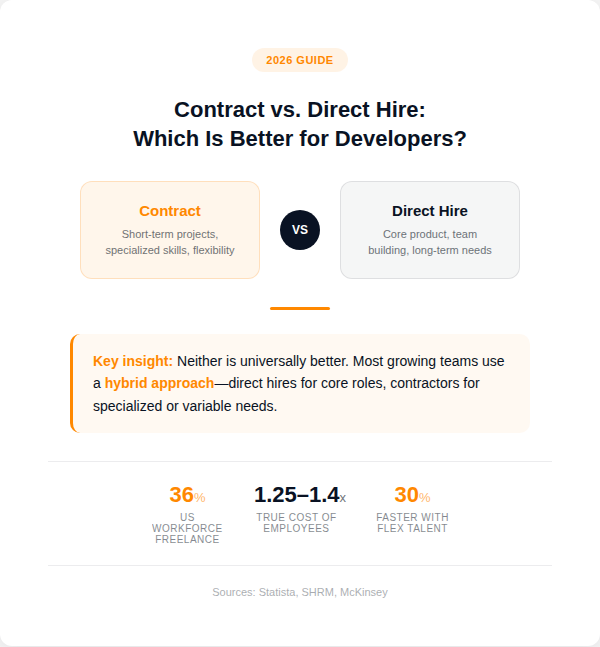
Many successful engineering teams use a hybrid model, combining direct hires for core roles with contractors for specialized or variable needs.

Typical hybrid structure:
- Direct hires: Engineering leadership, core product developers, platform engineers
- Contractors: Specialized expertise (DevOps, security, ML), overflow capacity, specific projects
This approach gives you stability for critical functions while maintaining flexibility for variable workloads. The key is clear boundaries—contractors should work on defined projects rather than becoming de facto employees.
Contract-to-hire arrangements offer another hybrid option. You engage someone as a contractor initially, then convert to full-time employment after a trial period. This reduces hiring risk while allowing both parties to evaluate fit.
Impact on Team Dynamics and Culture
Your hiring model affects not just the individual role but your entire team dynamic. Consider these cultural implications:
Contractors and team integration:
- May feel (or be treated as) outsiders, reducing collaboration
- Less incentive to mentor junior team members or improve processes
- Knowledge transfer becomes critical before contract ends
- Can bring fresh perspectives and outside best practices
Direct hires and team building:
- Invest in team relationships and company success
- More likely to participate in code reviews, documentation, mentoring
- Career growth opportunities increase engagement and retention
- Shared context accumulates over time, improving efficiency
For insights on evaluating candidates for team fit, explore the Interview Guides available for various developer roles
Where to Find Contract and Direct Hire Developers
Different channels work better for different hiring models:
For contractors:
- Freelance platforms (Upwork, Toptal, specialized developer networks)
- Staffing agencies specializing in tech
- Professional networks and referrals
- Contract-focused talent platforms
For direct hires:
- Traditional recruiting (job boards, LinkedIn, internal recruiting)
- Recruitment agencies with permanent placement focus
- Employee referral programs
- Talent platforms like Second Talent that specialize in vetted permanent placements
When hiring internationally, consider both the talent pool and the legal infrastructure. Some regions have stronger contractor cultures (US, EU), while others favor employment relationships.
The talent vetting process should evaluate candidates appropriately for your chosen engagement model.
Managing Contractors vs. Employees Effectively
Success with either model requires appropriate management approaches:
Managing contractors effectively:
- Define clear deliverables, timelines, and acceptance criteria upfront
- Establish communication cadences without micromanaging
- Document everything—contractors leave, and knowledge shouldn’t leave with them
- Treat them professionally but maintain appropriate boundaries
Managing direct hires effectively:
- Invest in onboarding and career development
- Create clear growth paths and regular feedback cycles
- Build team cohesion through shared goals and collaboration
- Balance autonomy with alignment on company objectives
Data from Gallup shows that employees with regular feedback conversations are 3.6x more likely to be engaged. Contractors benefit from clear expectations more than ongoing feedback.
Conclusion:
Neither contract nor direct hire is universally better, each serves different needs. The right choice depends on your timeline, budget, the nature of the work, and how the role fits into your larger team strategy.
For most growing startups, a hybrid approach works best. Build your core team with direct hires who are invested in the company’s long-term success.
Supplement with contractors for specialized skills, defined projects, and capacity flexibility.
Whatever model you choose, clarity is essential. Define the engagement type upfront, set appropriate expectations, and structure the relationship for success.
The goal isn’t just filling a role, it’s building the engineering capability your company needs to grow.
Start building your team with Second Talent today and get matched with qualified developers within days.
Hiring contractors rather than employees changes the arithmetic. The freelance developer rate index prices 14 roles across nine regions, benchmarked against North America and sourced from published wage data.