
TL;DR: Nearshore buys you working hours in common. Offshore buys you a bigger talent pool and a lower rate. Pick on whichever of those your project cannot do without, because the cost gap between the two narrows once you count management time, and the time zone gap never does.
I’ve read a lot of nearshore versus offshore comparisons, and most of them answer the wrong question. They rank regions by hourly rate, when the number that actually decides the outcome is how many hours a day your two teams are awake at the same time.
In this guide I break down what each model actually costs, where the developers are, and how much daily overlap you get from each region. Every figure is attributed to a named source you can open yourself.
Nearshore vs Offshore
| Factor | Nearshore | Offshore |
|---|---|---|
| Daily time zone overlap | 4 to 8 hours | 0 to 3 hours |
| Rate vs a US hire | Lower, but the smaller gap | Lower, and the bigger gap |
| Talent pool size | Moderate | Very large |
| Management overhead | Lower | Higher, and it is a real cost |
| Best for | Work where requirements move weekly | Work you can specify up front |
| Travel | Short flights, same day | Long haul |
| Weak point | Depth in scarce specialisms | Anything needing a same day answer |
What decides this, in five lines
- Overlap is the variable you cannot buy back later. Rates you can renegotiate.
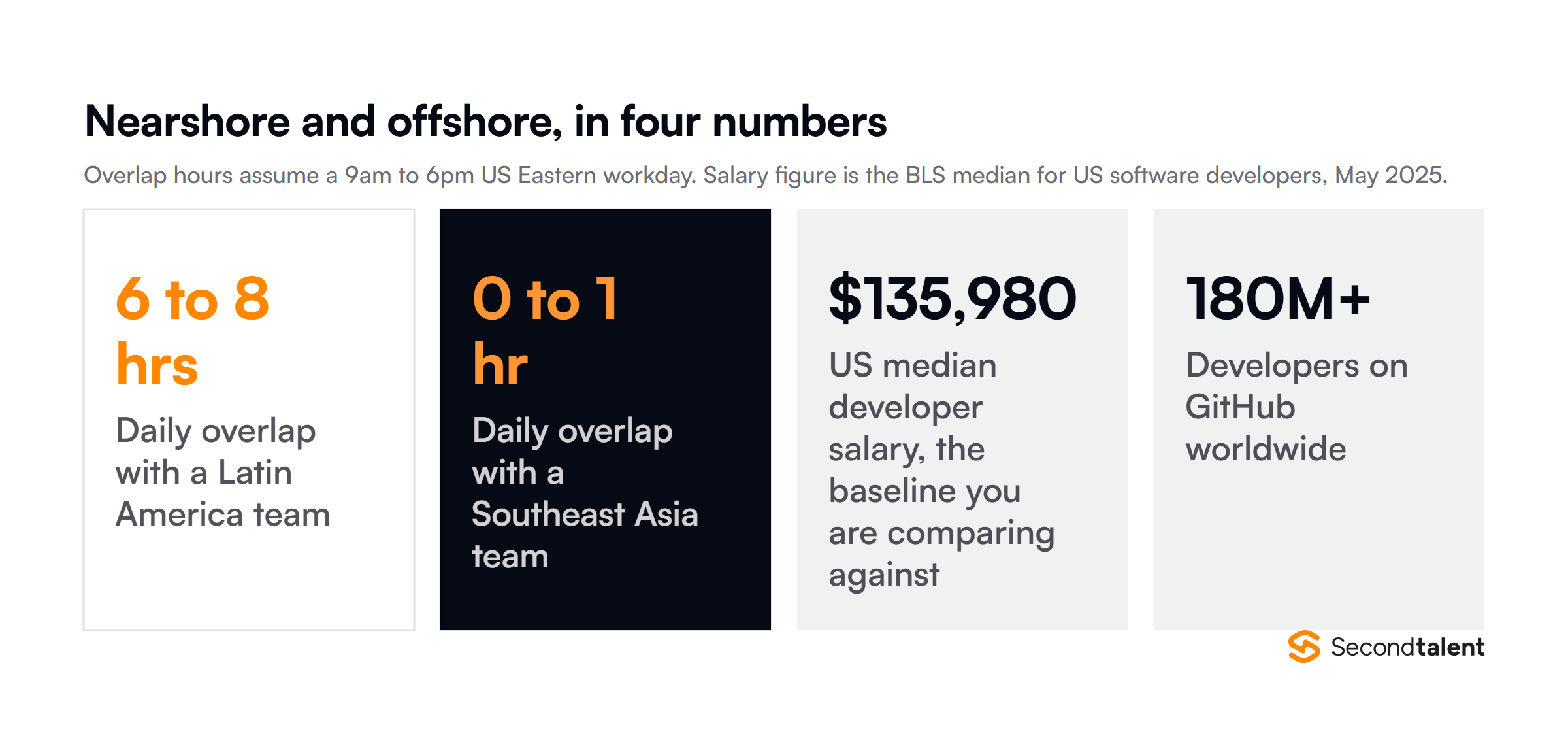
- The US median developer salary is $135,980, which is the number every other region is discounted against.
- Talent depth does not follow the nearshore and offshore split. India alone added 5.2 million developers on GitHub in 2025.
- Offshore costs more to manage than the rate card implies. Budget the coordination, do not discover it.
- Most teams end up hybrid, and that is usually the right answer rather than a compromise.
What’s your biggest priority right now?
Select your situation below.
You need to stretch your budget as far as possible. Vietnam and Philippines developers cost 40-60% less than nearshore options while delivering enterprise-grade quality. Your $10k/month budget can hire 2-3 senior developers instead of one. Compare Vietnam rates →
You need daily standups and instant feedback loops. Singapore developers share a working day with teams across Asia and Australia and still reach European mornings, so feedback closes the same day instead of overnight. Perfect for Agile teams requiring continuous communication and quick iteration cycles. Hire Singapore developers →
You want global talent without legal headaches. Our Employer of Record handles contracts, payroll, and compliance in nine Asian markets. You focus on building product while we manage the administrative complexity and local labor laws. Get EOR pricing →
You need hard-to-find skills like AI/ML or cloud architecture. Asia’s tech hubs have deep talent pools in specialized domains at 50% lower costs than Western markets. Get senior expertise without the Silicon Valley price tag. Find AI developers →
What Do Nearshore and Offshore Mean?
Nearshore development means hiring in a country close to your own, usually within about three time zones. For a US company that is Latin America. For a Western European company it is Central and Eastern Europe.
Offshore development is hiring far enough away that your working days barely touch. For US and European companies that usually means South Asia or Southeast Asia.
The labels are relative to where you sit, which is why a single global ranking of “best offshore country” is close to meaningless. Eastern Europe is nearshore from Berlin and offshore from San Francisco.
Nearshore vs Offshore Hiring Cost
The US Bureau of Labor Statistics puts the median annual wage for software developers at $135,980 as of May 2025, with the top 10 percent above $214,670. That median is the number every offshore and nearshore quote is implicitly discounted against.
Both models save money against it. The honest framing is that nearshore saves less and costs less to run, while offshore saves more and costs more to run. Anyone quoting you a single savings percentage is quoting a salary difference, not a cost difference.
The costs that do not appear on a rate card
- Management time. Someone senior spends part of their week bridging the gap. On an offshore team that is a real line item, and it is usually the engineering manager you least want spending time on scheduling.
- Slower first iterations. A question that takes ten minutes to resolve in shared hours can take a full day across a twelve hour gap. Early in a project, when questions are frequent, that compounds.
- Travel. Nearshore visits are short flights. Offshore visits are trips.
- Employment and partner fees. Whether you use an employer of record or a staffing partner, that fee sits on top of salary and varies by market.
Model it rather than estimating it. Our developer cost calculator and offshore hiring cost calculator both work in total cost of employment rather than headline salary, which is the comparison that matters.
Talent Depth: Follow the Developers, Not the Map
The assumption that offshore means cheaper and weaker has not matched the data for years. The clearest public measure of where developers actually are is GitHub’s own Octoverse report, which counts more than 180 million developers on the platform.
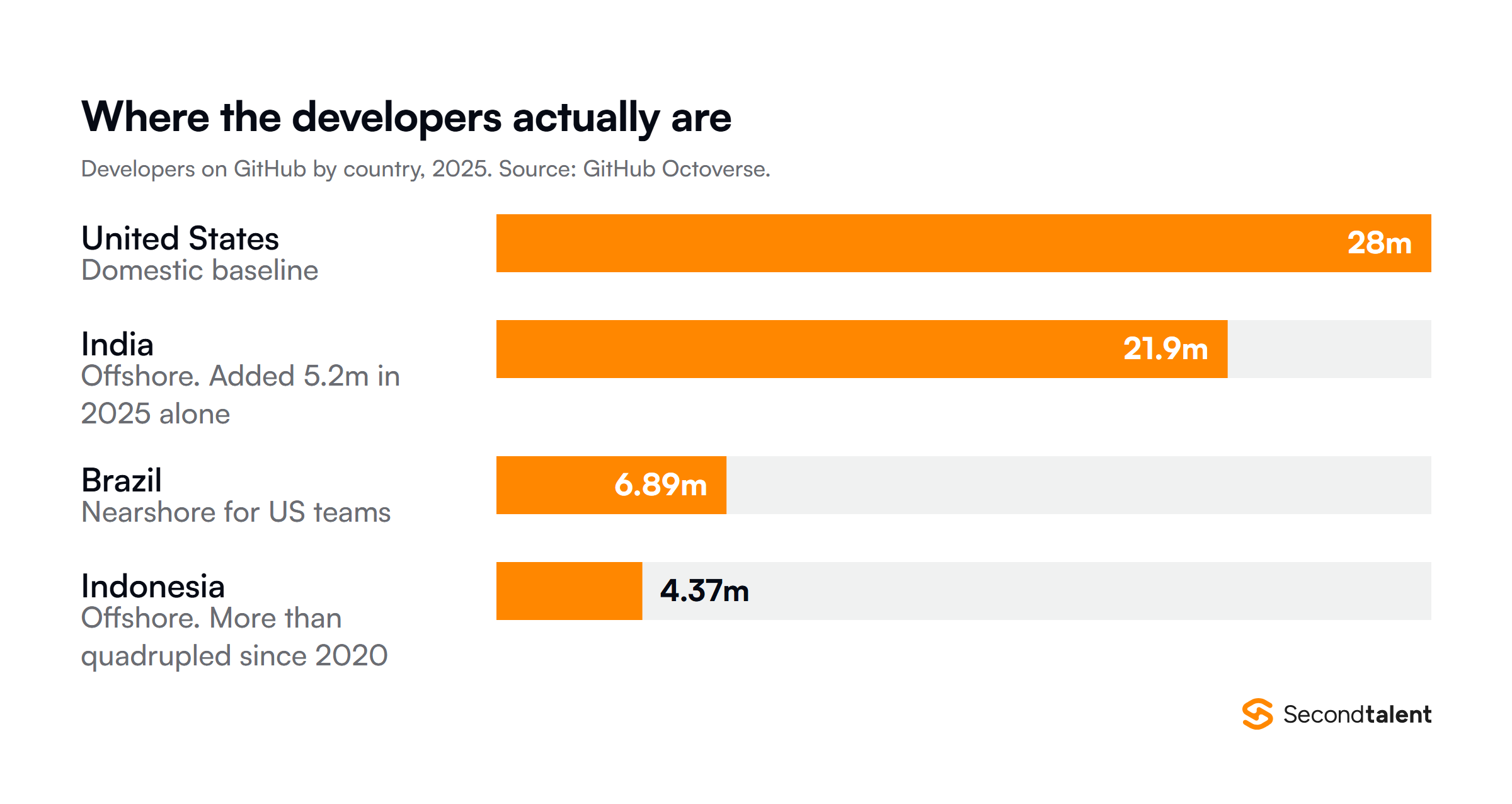
Two things in that chart matter for this decision. India, at 21.9 million developers, added 5.2 million in 2025 alone, which was over 14 percent of every new GitHub account worldwide. And Brazil, the classic nearshore market for US teams, sits at 6.89 million, having more than quadrupled since 2020.
Both models now have real depth. The question is no longer whether the talent exists, it is whether you can reach the specific person you need. That varies far more by specialism than by region, which is why our guide on scaling a team without adding headcount starts from the skill rather than the map.
Southeast Asia is worth calling out separately. The Philippine IT and business process sector alone closed 2025 with roughly 1.9 million workers and about $40 billion in export revenues, according to IBPAP, as reported by the Philippine Daily Inquirer and SunStar. That is an industry, not a labour arbitrage opportunity.
Vetting Matters More Than Geography
Developer quality varies more within a country than between countries. That makes your screening process, not your map, the thing that determines quality.
- Test real problems from your own codebase, not algorithm puzzles.
- Verify claimed experience against references and shipped work.
- Use a paid trial task before a long commitment.
- Keep reviewing code quality after the hire, not just during it.
Our interview guides cover how to structure technical evaluations that hold up across regions.
Time Zones: The Part That Decides the Most
This is the factor people underweight when comparing quotes and then feel every day afterwards.
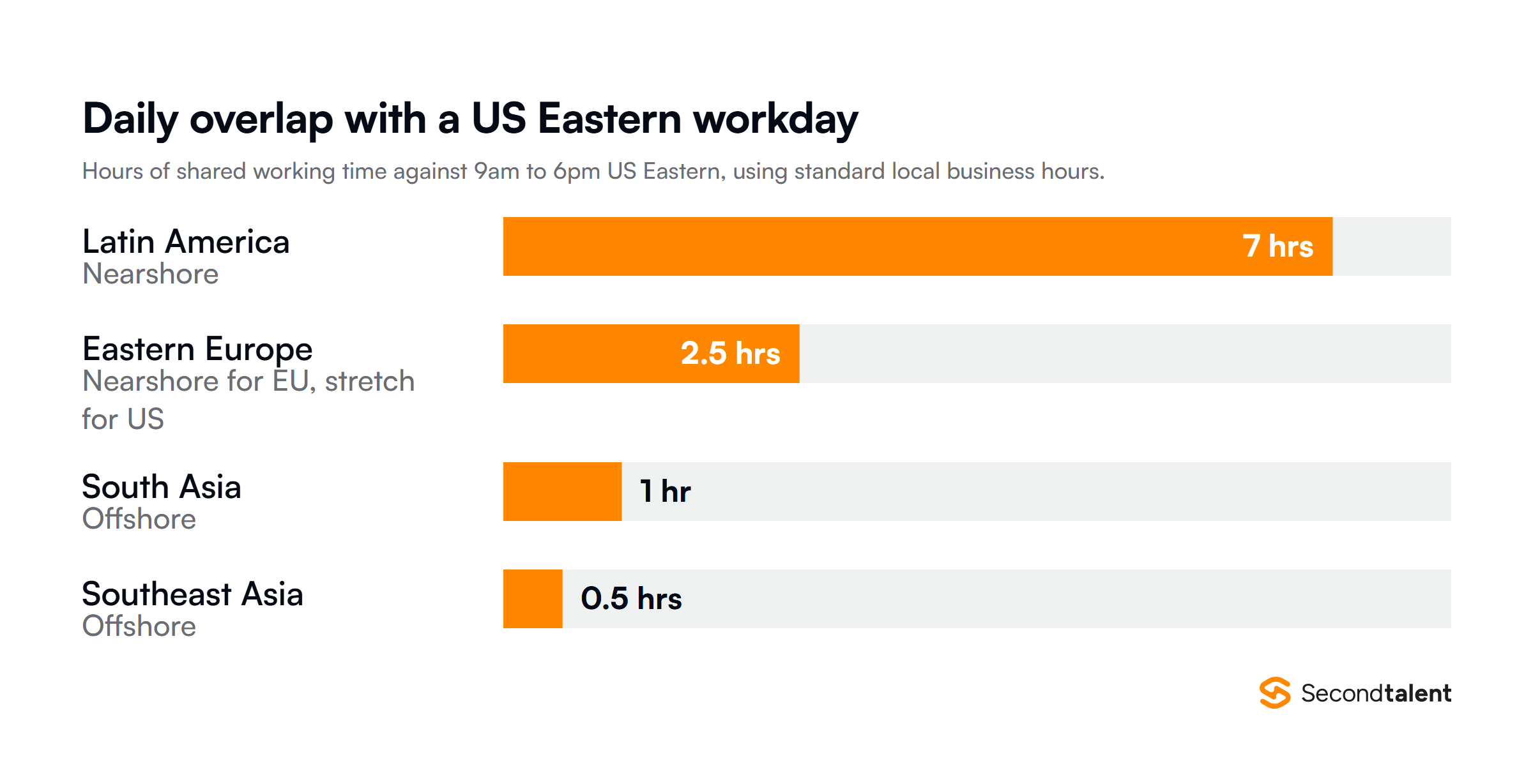
Those figures assume standard local business hours against a 9am to 6pm US Eastern day. They change if either side shifts its hours, and plenty of offshore teams do exactly that. It is worth knowing that you are asking for it, and worth paying for it.
When Overlap Earns Its Premium
Overlap pays for itself when requirements are still moving. Daily standups, pair programming and same day answers all need shared hours. On an early stage product where the spec changes weekly, a nearshore team will usually out-deliver a cheaper offshore one.
Making Offshore Work Anyway
Offshore works when you treat asynchronous communication as the default rather than a failure state. Teams that get good at it usually end up with better documentation than their co-located peers, because they had no choice.
- Write a real handoff at the end of each team’s day, not a status line.
- Record short video updates where written notes would lose the context.
- Agree fixed office hours when each side is reachable for anything urgent.
- Write decisions down with the reasoning attached, so nobody waits twelve hours to ask why.
Our time zone coordinator finds the overlap windows worth defending, and the guides on building remote teams in the Philippines and Malaysia go into the operating detail.
Culture, and One Assumption You Should Drop
Cultural fit is usually discussed as a nearshore advantage, and there is something to it. Latin American developers working with US companies often share expectations about directness, pushing back on unrealistic deadlines and meeting etiquette.
The assumption worth dropping is that offshore automatically means a remote-first culture. In the 2025 Stack Overflow Developer Survey, 32.4 percent of developers worldwide reported working fully remote against 17.9 percent fully in person. In India, in-person was the single largest arrangement at 30.5 percent, ahead of remote at 25.6 percent. In the US, remote led at 45 percent.
So the US company is often the more remote-native party in the relationship. Do not assume your offshore team already runs the way you do.
Which Model Fits Your Work
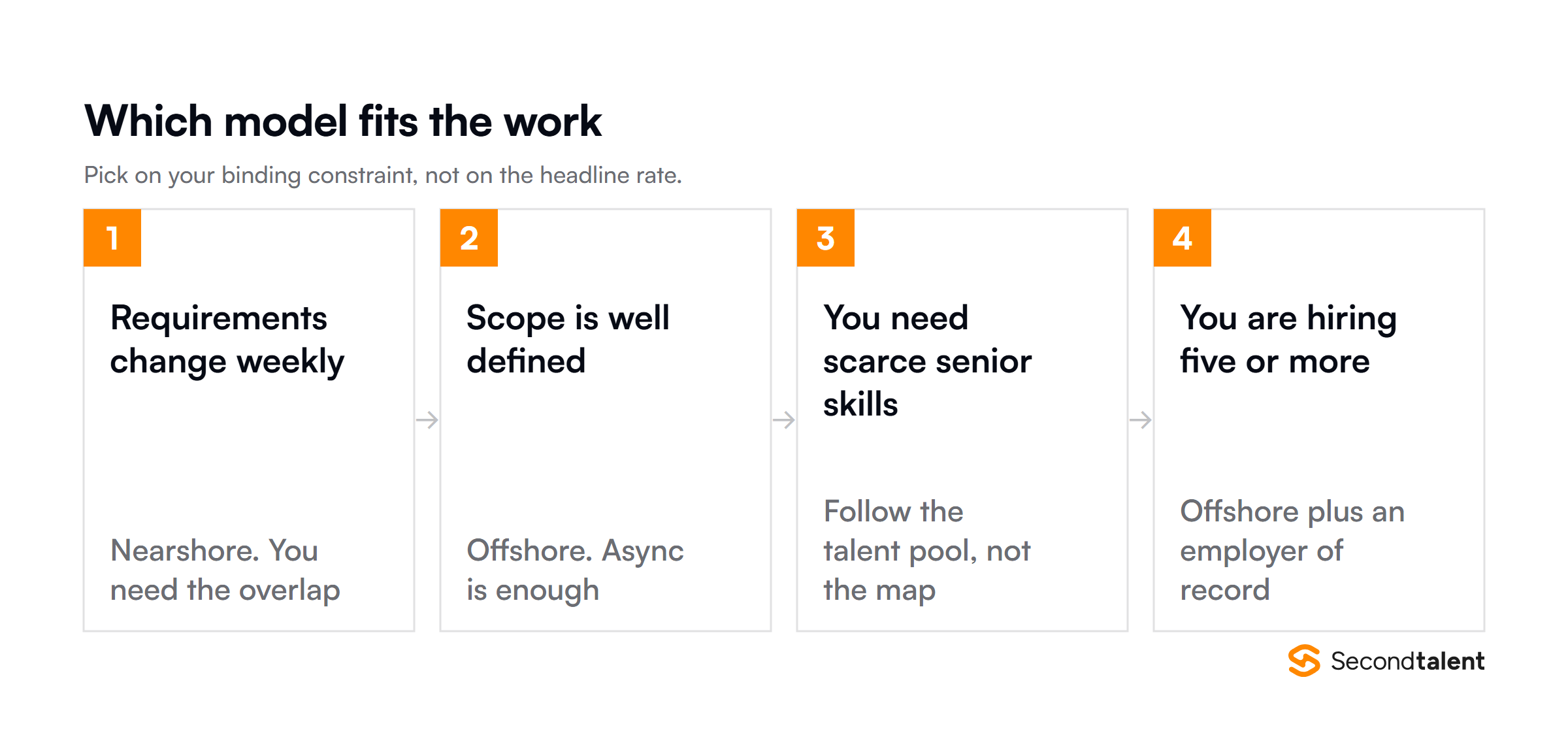
When to Choose Nearshore:
- Requirements are still changing and the spec is written in conversation.
- Your team is small enough that one blocked question stops the sprint.
- The work needs frequent contact with customers or stakeholders in your hours.
When to Choose Offshore:
- Scope can be specified up front and handed over cleanly.
- You are hiring several people and the rate difference compounds.
- The skills you need are concentrated in India, Vietnam, the Philippines, Indonesia or China.
- You already run written-first, or are willing to learn.
The Hybrid Answer Most Teams Land On
Framing this as a binary is the most common mistake. Most teams that get it right run both, and split by the kind of work rather than by headcount.
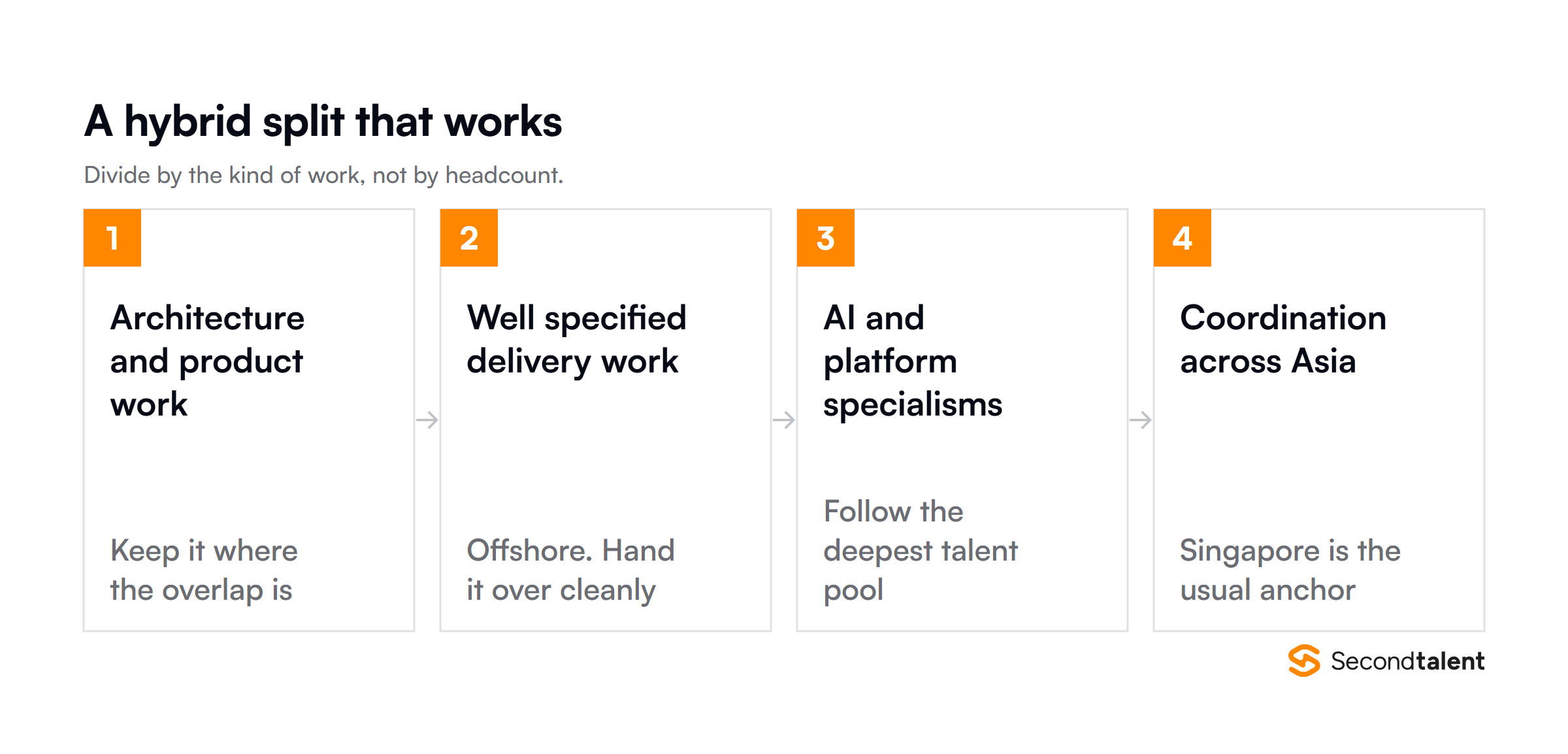
A workable structure: keep architecture, product-facing work and anything customer-visible in a nearshore or in-house core, and put well-specified delivery work, platform engineering and AI and machine learning specialisms offshore where the pool is deepest. Singapore is often the coordination point for teams doing this across Asia.
Risks, and How to Cover Them
| Risk | How to cover it |
|---|---|
| Misclassifying a contractor who is functionally an employee | Use an employer of record in the market, not a contractor agreement |
| Key person leaves and takes the context | Written decisions, paired ownership, no single point of knowledge |
| Quality drifts after onboarding | Code review metrics and a real probation checkpoint |
| Overlap erodes as people shift hours | Put the overlap window in the contract, not the kickoff deck |
| IP and data handling across borders | Local counsel on the contract, and access controls that match the risk |
The compliance ones are the easiest to underrate and the most expensive to fix later. Our employer of record service covers contracts, payroll and local labour law in nine Asian markets, including the Philippines, Vietnam and Singapore.
Getting Started
Work in this order. Decide whether your binding constraint is overlap or budget. Model the total cost of employment rather than the rate. Pick two markets, not five. Run one hire through your full vetting process before committing to a team.
If you want the shortlist rather than the search, see how we work or browse developers by skill and market. Tell us what you are building and we will come back with vetted candidates in about 24 hours.
Frequently Asked Questions
What is the difference between nearshore and offshore development?
Nearshore means hiring in a nearby country within roughly three time zones, so your working days overlap. Offshore means hiring far enough away that they barely do. Both terms are relative to where your company sits.
Is offshore development cheaper than nearshore?
On salary, yes. On total cost, the gap is smaller than it looks, because offshore teams need more management time, longer onboarding and more deliberate process. Compare total cost of employment, not rates.
How many hours of overlap do you actually need?
Two to three hours is enough for a team working from a settled spec. Work where requirements change weekly needs four or more, which in practice means nearshore or an offshore team shifting its hours.
Is offshore talent lower quality?
No. Quality varies more within a country than between countries. India has 21.9 million developers on GitHub and added 5.2 million in 2025, so the depth is there. Your vetting process decides what you get, not the country.
Do I need a local entity to hire offshore?
Not if you use an employer of record, which already holds the entity and takes on the employment. The alternative is engaging people as contractors, which carries misclassification risk in most markets.
Can I use nearshore and offshore together?
Yes, and most teams eventually do. Keep product-facing and architectural work where the overlap is, and put well-specified delivery work where the talent pool is deepest.






![Countries With the Highest Software Engineer Salaries. Top 10 Countries With the Highest Software Engineer Salaries [2026], by Second Talent.](https://www.secondtalent.com/wp-content/uploads/2026/09/countries-with-highest-software-engineer-salaries-featured-v2-768x403.jpg)