TL;DR: Remote developers cost 50-70% less than local hires in 2026. But the real gap is loaded cost: office space, benefits, and payroll taxes add 45-55% on top of US salaries versus 15-20% overseas.
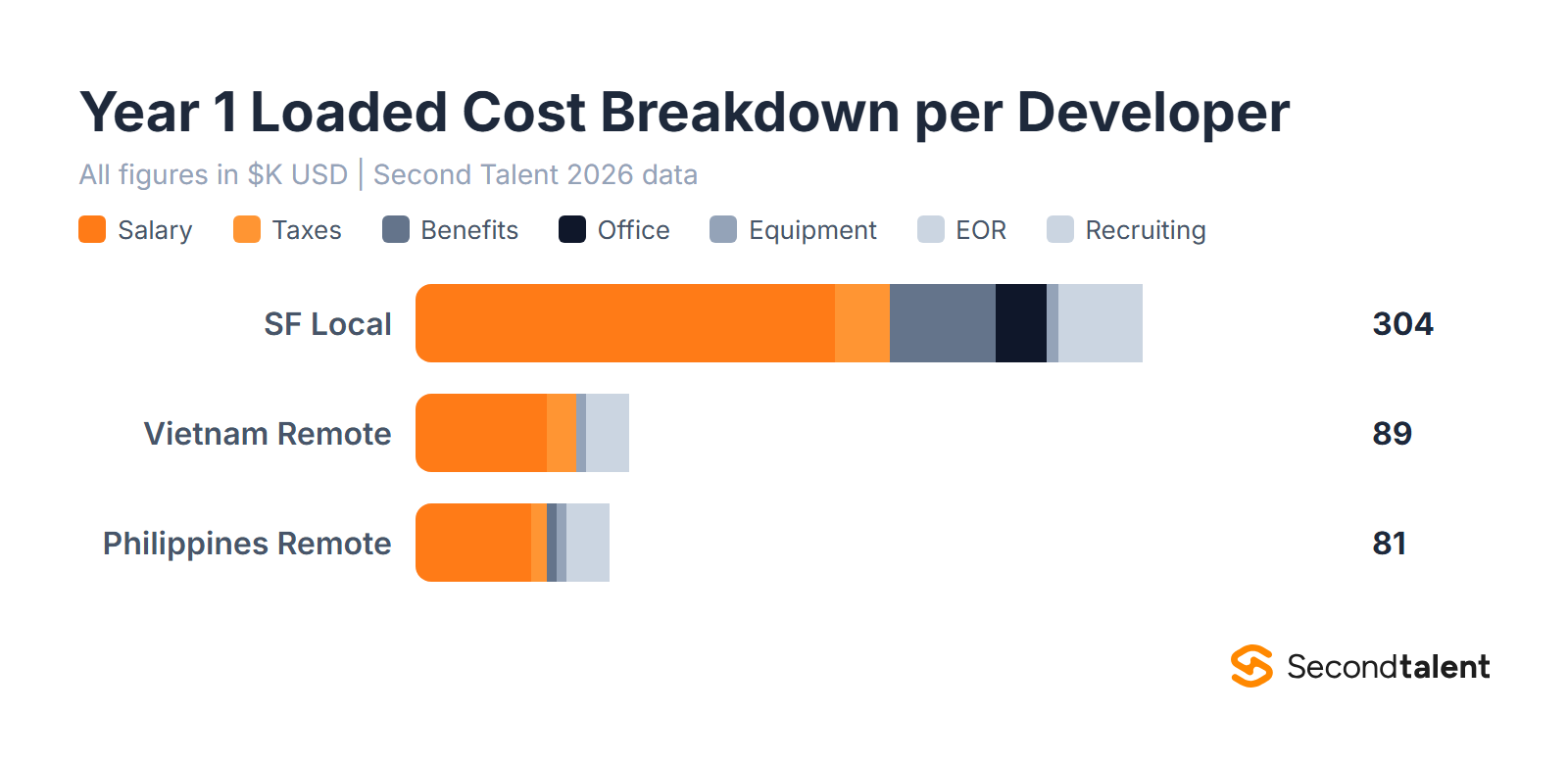
A senior full-stack developer in San Francisco costs $227,500 per year when you add benefits, taxes, and office space to a $175,000 base salary. The same experience level in Vietnam costs $63,250 fully loaded. That is a $164,250 difference per developer per year.
These numbers come from 500+ placements we made in 2025 and Q1 2026, cross-referenced with Levels.fyi 2026 compensation data and our Asia Tech Salary Index. The gap is not theoretical. We track actual offer letters, not posted ranges.
The cost difference stayed wide even as remote became standard. US tech salaries went flat in 2025. Southeast Asian developer salaries rose 8-10%. But the absolute dollar gap barely moved because the percentage increase applies to a much smaller base.
Here is what drives the gap:
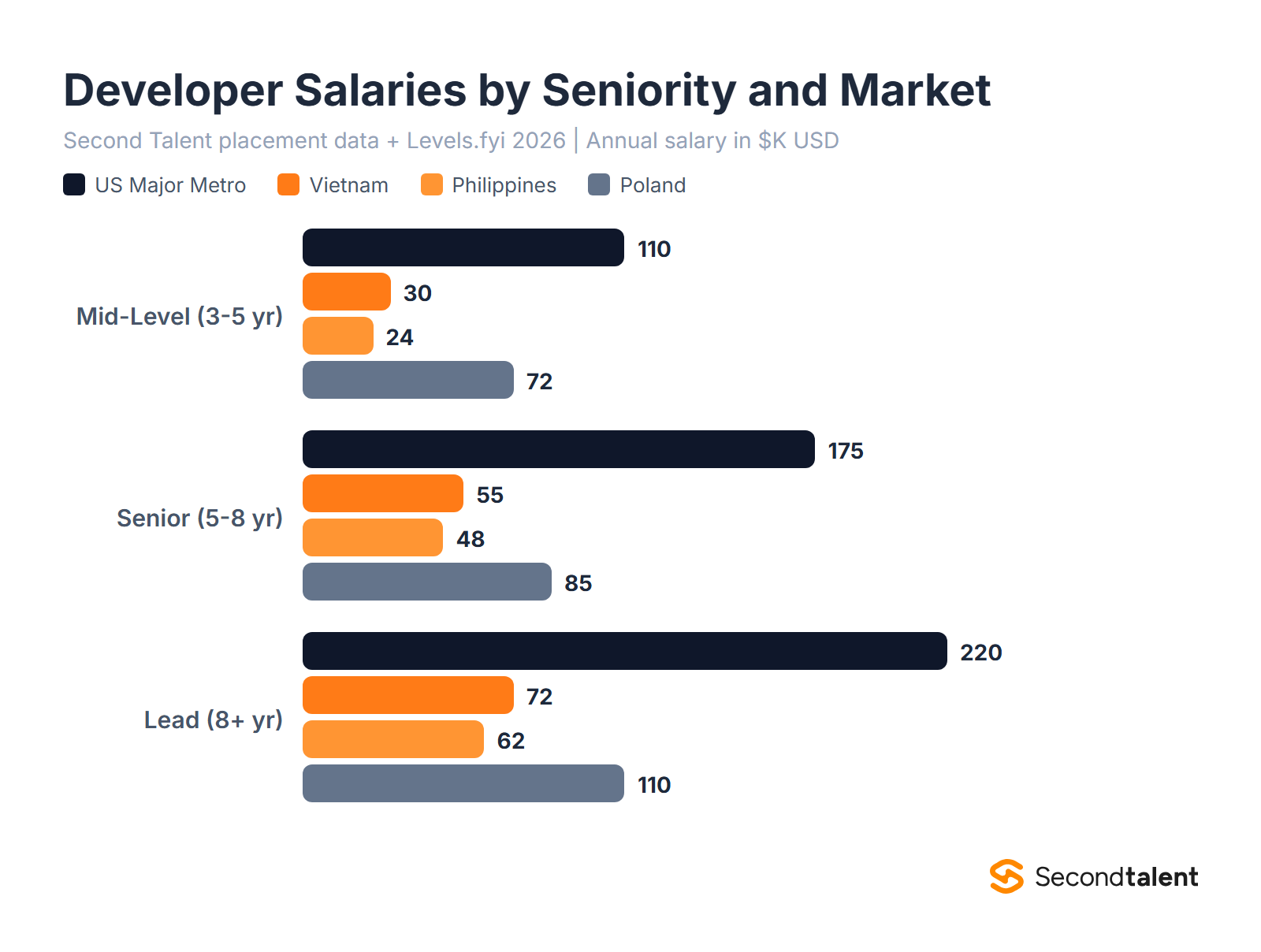
- Base salary: US senior developers earn $145,000-$200,000. Vietnam and Philippines seniors earn $45,000-$65,000 for equivalent skills.
- Employer tax burden: US employers pay 12-15% in payroll taxes (FICA + state). Vietnam employer contributions are 21.5%. Philippines total is about 14%. But 21.5% of $55,000 is still far less than 12% of $175,000.
- Office overhead: $15,000-$22,000 per person per year in major US cities. Zero for remote.
- Benefits gap: US health insurance alone costs $8,000-$12,000 per employee. In Vietnam, employer health insurance contribution is built into the 21.5% social insurance rate.
- Recruiting fees: US recruiters charge 20-25% of first-year salary ($35,000-$43,750). Remote sourcing through a platform runs $8,000-$15,000.
Full breakdown below.
| Location | Annual Salary | Employer Taxes | Benefits | Office + Equipment | Total Loaded Cost |
|---|---|---|---|---|---|
| San Francisco | $175,000 | $22,750 (13%) | $43,750 (25%) | $27,000 | $268,500 |
| New York | $165,000 | $21,450 (13%) | $41,250 (25%) | $25,000 | $252,700 |
| Austin | $145,000 | $17,400 (12%) | $36,250 (25%) | $18,000 | $216,650 |
| Vietnam (Remote) | $55,000 | $11,825 (21.5%) | Included in SI | $4,000 | $70,825 |
| Philippines (Remote) | $48,000 | $6,720 (14%) | $4,000 (13th mo) | $3,500 | $62,220 |
| Poland (Remote) | $72,000 | $14,400 (20%) | $7,200 | $4,000 | $97,600 |
What’s your hiring priority right now?
Select your situation below.
You’re watching your burn rate. Remote developers in Southeast Asia cost $60k-90k for senior talent that would be $180k locally. Our clients save an average of $330k per year on a 3-person team. That’s runway you can’t ignore. See Vietnam developer rates →
You need to ship features before your next funding round. Local hiring takes 3-4 months. Our talent sourcing gets you vetted senior engineers in 14 days. You skip the 40+ interviews and focus on building. Get talent sourcing help →
You don’t want to set up entities in 3 countries just to hire developers. EOR handles payroll, taxes, and compliance for $199/month per person. Your remote team is fully legal without the paperwork nightmare. Get EOR pricing →
You’re deciding between Vietnam, Philippines, and Indonesia. Vietnam offers the lowest rates ($50k-80k). Philippines has the best English fluency. Our salary index shows exactly what you’ll pay in each market for your tech stack. Check Asia salary benchmarks →
The True Loaded Cost of a US Developer
Base salary is only 65-70% of what a US developer actually costs you. The rest comes from four categories that most founders underestimate in their hiring budget.
Office Space and Equipment
San Francisco office space costs $85 per square foot per year according to CBRE’s Q4 2025 report. Each developer needs 150-200 square feet including desk, meeting room allocation, and common areas. That is $12,750 to $17,000 per person per year for space alone.
New York runs $75 per square foot. Austin is $42. Even in a cheaper market, you still pay $6,300-$8,400 per developer just for rent. Then add utilities, internet, cleaning, and kitchen supplies. One San Jose client calculated $22,000 per developer per year for total office costs.
Equipment adds $3,000-$5,000 upfront per developer. MacBook Pro ($2,500-$3,500), external monitor ($500-$800), standing desk ($400-$700), peripherals ($200-$400). Refresh cycle is every three years for laptops, five years for desks.
Benefits and Insurance
US employer-sponsored health insurance costs $8,435 per employee per year for individual coverage and $16,357 for family coverage. These are 2025 medians from KFF’s Employer Health Benefits Survey. Premiums rose 6% year over year. Tech companies typically cover 80-90% of individual premiums and 60-75% of family premiums.
401(k) matching at 4-6% of salary adds $7,000-$10,500 for a $175,000 developer. Most tech companies also offer dental ($600-$1,200/year), vision ($200-$400/year), life insurance ($300-$600/year), and disability insurance ($400-$800/year). Some add commuter benefits, wellness stipends, and professional development budgets.
Total benefits cost runs 25-30% of base salary. For a $175,000 developer, that is $43,750 to $52,500 on top of what they see in their paycheck.
Payroll Taxes and Compliance
Federal FICA taxes cost employers 7.65% of salary (6.2% Social Security up to $168,600 cap, 1.45% Medicare with no cap). California adds 3.4% for state unemployment insurance (SUI) on the first $7,000. Workers’ compensation insurance runs 0.5-1.5% depending on classification. New York SUI is higher at 4.1% on the first $12,500.
Then there is the compliance overhead. Payroll processing through Gusto, Rippling, or ADP costs $40-$80 per employee per month. HR compliance software adds $10-$20 per employee per month. Annual compliance audits, W-2 filing, and state tax registrations cost $500-$1,500 per employee per year.
Multi-state employment complicates things further. If your developer lives in a different state than your HQ, you need to register as an employer in that state. Each new state registration costs $500-$2,000 in legal fees plus ongoing filing obligations.
Recruiting Costs and Time to Fill
External recruiters charge 20-25% of first-year salary. For a $175,000 developer, that is $35,000 to $43,750 per successful placement. Retained search firms charge 30-33% for VP-level or specialized roles.
Internal recruiting avoids the placement fee but still costs money. Your engineering team spends 40-60 hours per hire on resume screening, phone screens, technical assessments, and onsite interviews. At $150 per hour for senior engineer time, that is $6,000-$9,000 in opportunity cost per hire.
Average time to fill a senior engineering role in the US is 52 days according to LinkedIn’s 2025 talent data. During that period, your existing team absorbs the extra workload. Factor in the productivity cost of onboarding (2-3 months at 50-70% output), and a single hire can take five months from job posting to full contribution.
What Remote Developers Actually Cost, Country by Country
Remote hiring removes office costs entirely and reduces employer tax burdens. But each country has its own cost structure. Here is what you actually pay.
Vietnam
Vietnam has 500,000+ software engineers according to Statista’s 2025 data. The talent pool grew 15% per year for the last five years. Ho Chi Minh City and Hanoi are the two main tech hubs.
Salary ranges by seniority: mid-level developers (3-5 years) earn $24,000-$36,000. Senior developers (5-8 years) earn $36,000-$60,000. Lead/architect roles (8+ years) earn $60,000-$84,000. These are gross annual figures in USD.
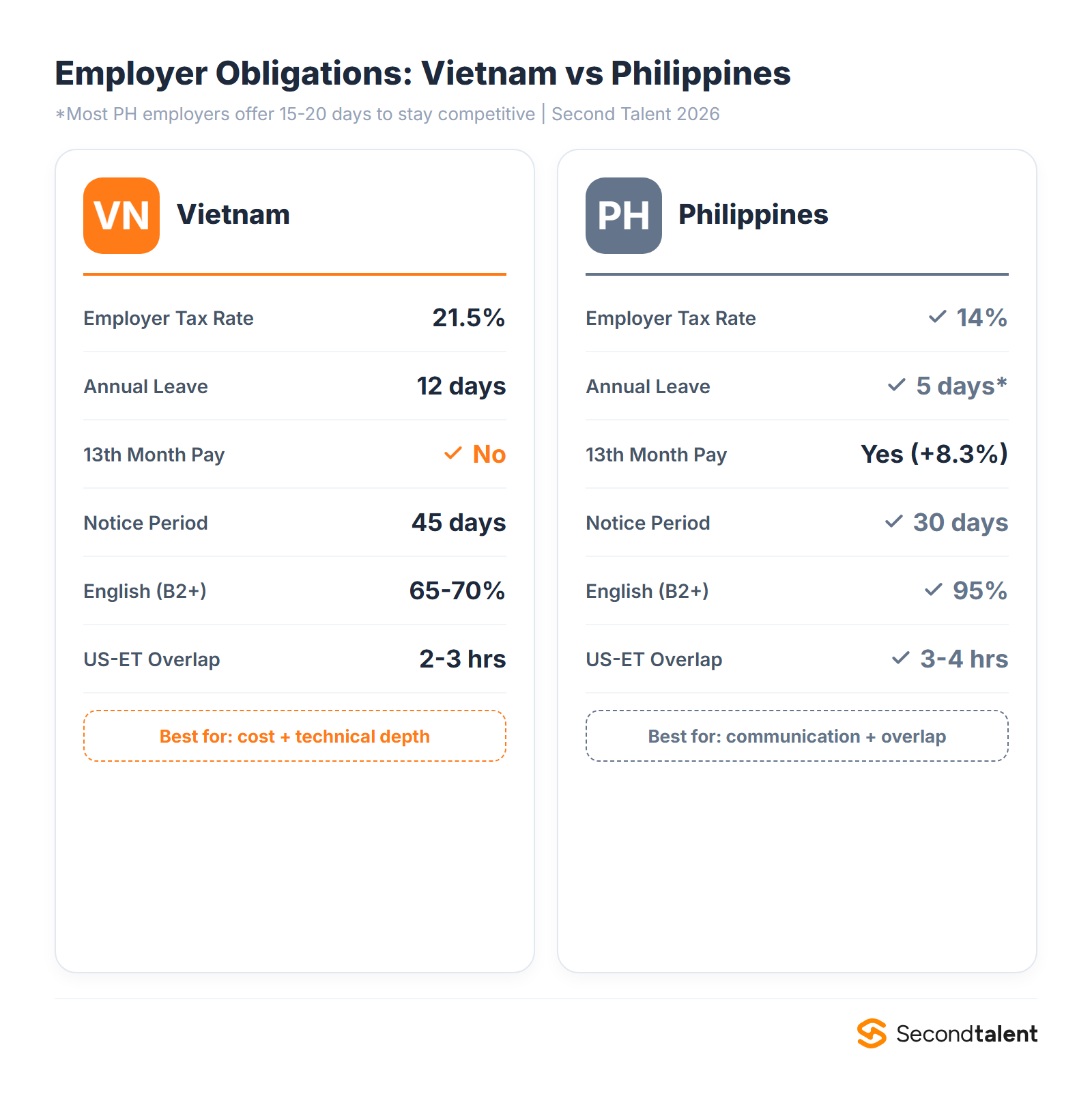
Employer contributions in Vietnam total 21.5% of gross salary. That breaks down to 17.5% for social insurance (retirement, sickness, maternity, occupational injury, unemployment) and 4% for health and union fees. The social insurance contribution is capped at 20 times the minimum wage (about $360/month base in 2026), which caps employer SI costs at roughly $7,560/year for higher earners.
Vietnamese labor law requires a minimum 12 days annual leave plus 10 public holidays. Severance pay is mandated at 0.5 months salary per year of service. IP assignment is straightforward under Vietnamese law but requires a written employment contract to transfer copyright from employee to employer. Without that clause, the developer owns the IP by default.
Philippines
The Philippines has the strongest English proficiency in Asia. Over 90% of developers we screen score CEFR B2 or higher. The BPO industry trained an entire generation in US business communication.
Salary ranges: mid-level developers earn $18,000-$30,000. Senior developers earn $30,000-$55,000. Lead roles earn $50,000-$72,000. The Philippines market is 10-15% cheaper than Vietnam for equivalent seniority.
Employer contributions total about 14% of gross salary. SSS (Social Security System) is 9.5%, PhilHealth (national health) is 2.25%, and Pag-IBIG (housing fund) is 2%. These contributions are capped at specific salary ceilings that are well below senior developer salaries, so the effective percentage decreases as salary rises.
The 13th-month pay is mandatory. Every employee gets one extra month of salary paid in December. Budget this as an 8.3% addition to annual cost. Philippines labor law also requires 5 days of service incentive leave and separation pay for termination without just cause. Time zone is GMT+8, which gives 3-4 hours of overlap with US East Coast morning hours.
Eastern Europe
Poland and Romania are the main markets. Senior developers earn $70,000-$95,000. Employer contributions are high: Poland charges 19.48% for social security, 2.45% for labor fund, and 0.1% for employee guaranteed benefits fund. Total employer burden is about 22%.
The advantage is time zone proximity to the US East Coast (6 hours difference) and EU data residency for companies that need it. The disadvantage is cost. A senior Polish developer at $85,000 plus 22% employer contributions costs $103,700. That is 50% more than the same role in Vietnam.
Equipment and Home Office
Most remote developers already have a home office. You provide a laptop ($1,500-$2,500 in Southeast Asia where Apple products cost less after tax adjustments) and an external monitor ($300-$500). Total first-year equipment cost: $2,500-$3,500.
Internet in Ho Chi Minh City averages 100 Mbps fiber for about $15/month. Manila fiber runs 50-100 Mbps for $25-$40/month. Both are reliable enough for daily video calls. Some companies give a $50-$100/month internet stipend.
Coworking spaces are available if developers want them. A hot desk in a HCMC coworking space costs $80-$120/month. Manila runs $100-$150/month. Dedicated desks cost 50% more. This is optional. Only about 20% of our placed developers use coworking.
EOR vs. Entity Setup
An Employer of Record (EOR) handles payroll, tax filing, and legal compliance in the developer’s country. Typical cost is $400-$600 per employee per month, or roughly 8-12% of a $60,000 salary.
Setting up your own legal entity costs $15,000-$30,000 in incorporation, legal, and accounting fees. Monthly maintenance runs $2,000-$5,000 for accounting, compliance, and registered agent services. The breakeven point is around 10-15 employees in a single country. Below that, EOR is cheaper. Above that, a local entity saves money.
One important difference: with an EOR, the developer is legally employed by the EOR, not your company. This can affect IP ownership. Make sure your EOR contract includes an IP assignment clause that transfers all work product to your company. Most reputable EOR providers include this by default, but verify it.
Five-Year Total Cost Comparison
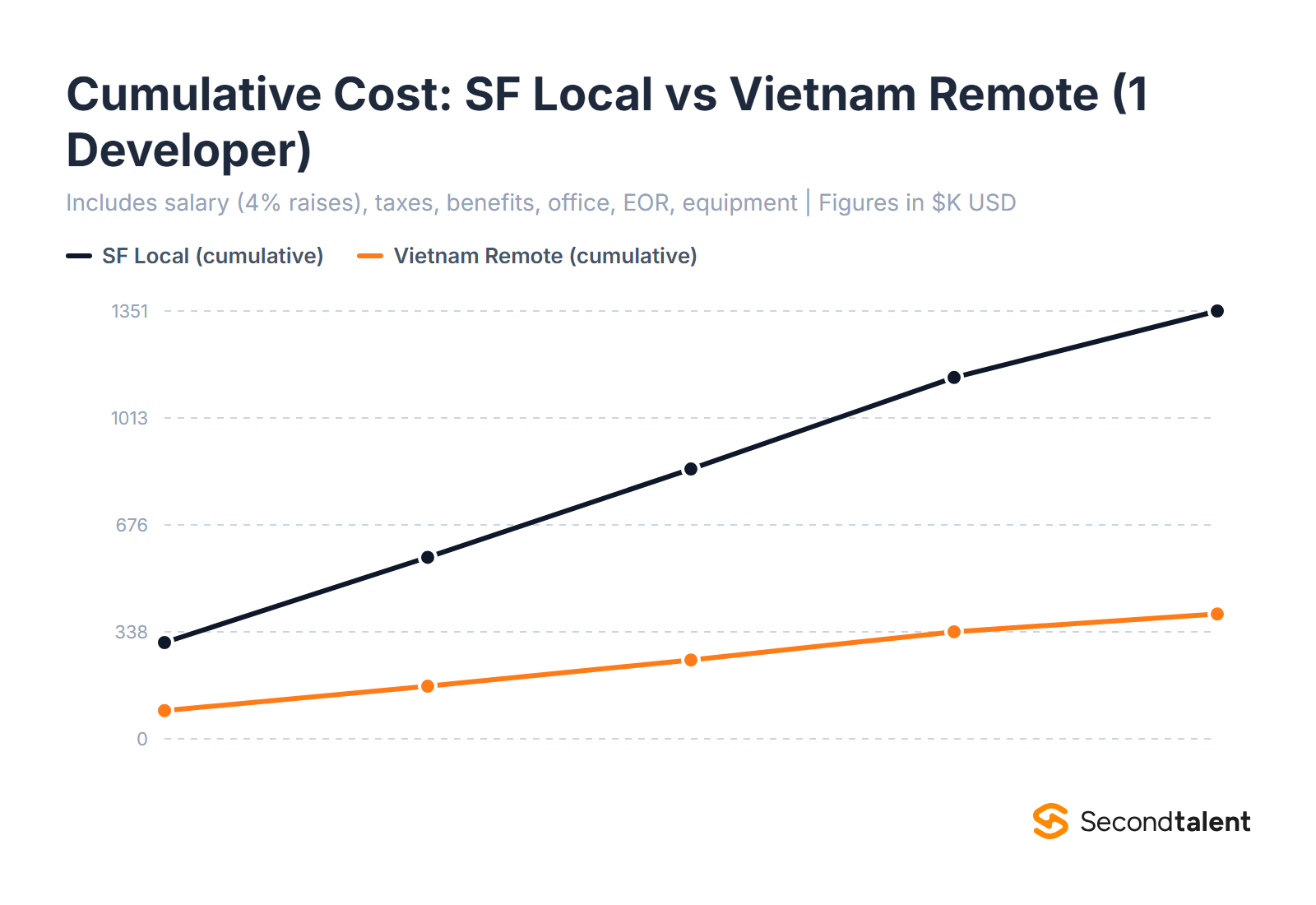
One-year comparisons understate the savings because they include one-time recruiting costs. Here is the five-year view for one senior full-stack developer.
| Cost Category | San Francisco Local | Vietnam Remote | Savings |
|---|---|---|---|
| Year 1 Salary | $175,000 | $55,000 | $120,000 |
| Benefits + Taxes (Year 1) | $52,500 | $11,825 | $40,675 |
| Office Space (Year 1) | $22,000 | $0 | $22,000 |
| Equipment (Year 1) | $5,000 | $3,500 | $1,500 |
| EOR Fee (Year 1) | N/A | $6,000 | -$6,000 |
| Recruiting (one-time) | $35,000 | $12,000 | $23,000 |
| Years 2-5 Salary (4% annual raises) | $745,336 | $234,536 | $510,800 |
| Years 2-5 Benefits + Taxes + Office | $316,768 | $71,384 | $245,384 |
| 5-Year Total | $1,350,604 | $394,245 | $956,359 |
You save $956,000 per developer over five years. For a team of five, that is $4.78 million. This calculation assumes 4% annual raises in both markets, stable office costs, and equipment refresh in year three.
McKinsey’s research on remote work economics found companies save 25-35% on real estate and 15-20% on overall compensation when they shift to distributed teams. Our data shows even higher savings because we compare US metros to Southeast Asian markets specifically, not just US remote versus US office.
Hidden Costs Most Analyses Miss
The salary and tax numbers are easy to calculate. The costs below are harder to quantify but still affect your total spend.
Management Overhead
Remote teams require more structured communication. Managers spend 10-15% more time on documentation, async updates, and one-on-ones with distributed team members.
A CTO we work with measured 3 extra hours per week on team coordination after switching to remote. That is 156 hours per year. At $200/hour loaded cost, that is $31,200 in management time.
But the same CTO reported a 40% drop in meetings because the team shifted to async communication. The net effect was positive: engineers spent more time coding and less time in status update meetings. His team’s deploy frequency increased from 2.1 to 3.4 per week per developer after the transition.
Team Cohesion and Offsites
Remote teams need intentional investment in relationship building. Budget $5,000-$10,000 per year per team for virtual events, care packages, and team subscriptions.
In-person offsites make a measurable difference in retention. One client flies their 8-person remote team to Manila twice per year. Each trip costs $25,000 total (flights, hotels, activities, meeting space). They report 3.2 years average retention versus 1.8 years for the local hires they had before. The $50,000 annual offsite cost pays for itself by avoiding even one turnover cycle.
Visa logistics for offsites are simple. US passport holders get visa-free entry to the Philippines (30 days) and Vietnam (45 days as of 2023). Southeast Asian developers visiting the US need B1/B2 visas, which take 2-4 months to process. Plan offsites in the developers’ countries instead.
Legal and Compliance by Country
Each country has specific labor law requirements that affect your cost structure:
Vietnam: 12 days annual leave (increases with tenure), 10 public holidays, mandatory social insurance enrollment within 30 days of hire, 45-day notice period for termination. Probation period is up to 60 days for professional roles. Severance is 0.5 months per year of service.
Philippines: 5 days service incentive leave (many companies offer 15-20 to stay competitive), 13th-month pay mandatory by December 24, separation pay of 0.5-1 month per year depending on cause. Night differential (10% premium for work between 10pm-6am) applies if your overlap hours fall in that range.
Poland: 20-26 days annual leave depending on tenure, 13 public holidays, 3-month notice period for employees with 3+ years. EU GDPR compliance required. Employee protections are significantly stronger than US at-will employment.
Currency and Payment Risk
Most remote developers prefer USD payment because it protects them from local currency depreciation. This shifts the exchange rate risk to you, but in practice USD-denominated salaries are stable.
If you pay in local currency, movements can work in your favor or against you. The Philippine peso depreciated 8% against USD in 2025, which would have reduced your costs in dollar terms. The Vietnamese dong was more stable, moving only 2-3%. The Polish zloty strengthened 5% against USD, which would have increased your costs.
Our recommendation: pay in USD. It simplifies accounting, makes your offer more attractive, and removes the need to hedge currency risk. The slight premium you pay (developers price in a currency stability benefit) is worth the administrative simplicity.
Quality at Lower Cost: What the Data Shows
Lower cost does not mean lower quality. The data from our placements and from independent assessments shows that skill levels are comparable when you hire at the right seniority.
Technical Assessment Scores
HackerRank’s 2025 Developer Skills Report ranks Vietnam 23rd globally for developer skills. That is ahead of Spain, Italy, and Israel. Vietnam scores especially well in algorithms, data structures, and mathematics.
We run our own technical assessments on every developer. The average score across all candidates is 78/100, which matches the US average on the same test suite. But our placed developers (who pass our screening) average 88/100 because we reject about 85% of applicants.
Vietnam produces 5,000 CS graduates per year from top universities like HCMC University of Technology and Hanoi University of Science and Technology. Many senior developers also worked at Samsung, LG, FPT, or Grab before going to smaller companies or freelancing.
English and Communication
We require CEFR B2 or higher English for every placement. B2 means the developer can discuss technical architecture, write clear pull request descriptions, participate in video meetings, and write documentation without translation help.
Philippines developers score highest in English across Asia. Over 95% of developers we screen meet the B2 threshold. English is an official language there and the medium of instruction in universities. Vietnam is catching up fast. About 65-70% of developers under 35 score B2 or higher. The gap is closing because Vietnamese tech companies increasingly use English as their working language.
One client told us their Vietnam backend developer writes better pull request descriptions than two of their local engineers. Communication quality is a skill you can test for during hiring. It does not correlate perfectly with geography.
Productivity After Onboarding
We track productivity metrics for developers we place. After the first 30 days of onboarding, remote developers match local developer output on three measures: pull requests merged per week, code review turnaround time, and bug escape rate.
One client measured story points per sprint. Their remote team averaged 42 points versus 45 for their local team in the first quarter. By the second quarter, the remote team averaged 46 points. The ramp-up period is real but short.
Another client tracks deployment frequency. Remote developers deploy 3.2 times per week versus 3.5 for local developers. The 8% gap comes entirely from time zone handoff delays on urgent hotfixes. For planned releases, the rates are identical.
When Local Hiring Wins
Remote saves money in most scenarios. But there are specific situations where local talent is the better investment.
Pre-Product-Market Fit
If you are iterating on product direction multiple times per week and pivoting based on daily user feedback, co-located teams move faster. The overhead of async communication compounds when the roadmap changes every few days.
That said, many successful companies launched with fully remote teams. GitHub, Zapier, and GitLab were remote from day one. The key factor is your team’s communication discipline, not location.
Regulated Industries with Data Residency
Healthcare (HIPAA), finance (SOC 2 with geographic controls), and defense (ITAR/EAR) may restrict where developers can access production data. Some compliance frameworks require developers to be in specific countries or hold security clearances.
Check your compliance requirements before hiring internationally. Most SaaS companies have no geographic restrictions on developer access. If you do have restrictions, they often apply only to production environments, not development or staging. Remote developers can still work on feature branches without touching regulated data.
Customer-Facing Technical Roles
Sales engineers and solutions architects often need to visit customer sites, attend conferences, or run workshops in person. These roles benefit from being local. Implementing sales engineer automation can reduce the travel burden, but the face-to-face component remains important for enterprise deals.
But backend developers, DevOps engineers, data engineers, and infrastructure roles almost never meet customers. These roles translate directly to remote without any loss of effectiveness.
Deep Niche Specializations
Rust systems programming, quantum computing, and specialized hardware/firmware engineering have smaller talent pools globally. US tech hubs concentrate these skills because the companies building with them (Google, Meta, hardware startups) are based there.
But mainstream stacks like React, Node.js, Python, Go, Java, and AWS/GCP are well represented everywhere. These cover 90%+ of startup engineering needs. If your stack is mainstream, the remote talent pool is large enough.
ROI Framework for Your Specific Scenario
Here is a formula to calculate your savings. Take your current (or planned) local developer salary and apply these multipliers.
| Cost Component | Local (% of salary) | Vietnam Remote (% of salary) | Philippines Remote (% of salary) |
|---|---|---|---|
| Base Salary | 100% | 31% ($55K / $175K) | 27% ($48K / $175K) |
| Employer Taxes | 13% | 6.8% (21.5% of 31%) | 3.8% (14% of 27%) |
| Benefits | 25% | Included in taxes | 2.3% (13th mo) |
| Office Space | 12% | 0% | 0% |
| Equipment | 3% | 2% | 2% |
| EOR Fee | 0% | 3.4% | 3.4% |
| Management Overhead | 5% | 8% | 7% |
| Recruiting (one-time) | 20% | 7% | 7% |
| Total Year 1 | 178% | 58% | 52% |
| Total Year 2+ | 158% | 51% | 46% |
For a $150,000 local developer, total year one cost is $267,000. A Vietnam remote developer with similar skills costs $87,000. A Philippines remote developer costs $78,000. You save $180,000-$189,000 per developer in year one.
Multiply by team size. A team of 8 developers saves $1.44-$1.51 million in year one alone. That money goes into product development, marketing, or runway extension. For a Series A startup burning $200K/month, that is 7-8 extra months of runway.
How to Execute Remote Hiring Well
Cost savings only materialize if you hire the right people and set them up to succeed. Here is what works based on 500+ placements.
Write Precise Job Requirements
Vague job posts attract hundreds of unqualified applicants. Be specific about years of experience per technology, scale of systems worked on, and domain knowledge.
Weak: “Looking for a full-stack developer with React experience.” Strong: “Need 5+ years React with TypeScript, 3+ years Node.js, experience with PostgreSQL and Redis, and at least one system serving 1M+ daily active users.”
The more specific your requirements, the fewer candidates you screen and the faster you hire. Our average time to present qualified candidates is 5 business days when the job spec is detailed.
Test Technical Skills with Paid Assessments
Use take-home projects that mirror your actual codebase. Give candidates 3-4 hours and pay $100-$200 for their time. Paying for the assessment signals respect and attracts better candidates.
We use a three-stage process: coding test (2 hours), system design interview (1 hour), and behavioral/communication interview (45 minutes). This filters out 85% of candidates. The 15% who pass have a 95% success rate after 90 days with our clients.
Review submitted code with your senior engineers. Look for clean architecture, meaningful variable names, test coverage, and error handling. The best signal is whether a developer writes code that other people can maintain.
Invest in Structured Onboarding
Create a 30-60-90 day plan with specific deliverables for each phase. Week one should focus on development environment setup, codebase orientation, and a small starter ticket. Month one should include a meaningful feature shipped. Month three should have the developer operating independently.
Assign a buddy from your existing team. The buddy answers daily questions, reviews initial PRs with extra care, and provides cultural context. This reduces ramp-up time by 30-40% compared to unstructured onboarding.
Record video walkthroughs of your architecture, deployment process, and development workflow. New developers can watch asynchronously and revisit sections they need. This investment pays off with every subsequent hire.
Build the Right Tool Stack
Remote teams need tools optimized for async collaboration. Here is what works and what it costs per developer per month in 2026:
- Slack Pro: $8.75/month. Daily communication and quick questions.
- GitHub Team or GitLab Premium: $4-$19/month. Code hosting, review, and CI/CD.
- Linear or Jira: $8-$10/month. Sprint planning and issue tracking.
- Notion or Confluence: $8-$10/month. Documentation and knowledge base.
- Loom Business: $12.50/month. Async video updates and code walkthroughs.
- Tuple or VS Code Live Share: $0-$39/month. Pair programming sessions.
Total: $50-$100 per developer per month. That is $600-$1,200 per year. Compare that to $15,000-$22,000 per year for office space. The tools cost 5% of what the office did.
Structure Sync Time Around Overlap Hours
Identify 2-3 hours of daily overlap between your local team and remote developers. For US East Coast and Philippines (GMT+8), that window is typically 8-11am ET / 8-11pm Manila. For Vietnam (GMT+7), it is 8-10am ET / 7-9pm Hanoi.
Use overlap hours for synchronous work: sprint planning, architecture discussions, pair programming on complex problems, and one-on-ones. Everything else should be async. Post daily standups in Slack at each person’s local 9am. Use Loom recordings for demos instead of live meetings.
Budget $3,000-$5,000 per person for quarterly offsites. Meeting in person once or twice a year builds the trust that makes async work smoother the other 50 weeks.
Common Mistakes That Erase Savings
These errors turn cost savings into hidden costs. We see them in about 30% of companies that try remote hiring without guidance.
Hiring Junior to Maximize Savings
The temptation is clear: a junior developer in Vietnam costs $18,000-$24,000 versus $55,000 for a senior. But juniors need 2-3x more code review time, produce 40-50% fewer story points, and introduce more bugs that seniors spend time fixing.
Hire senior developers remotely. They work independently, make architectural decisions without hand-holding, and ship production-quality code from week two. The cost is still 60% less than a US senior developer.
Skipping the Trial Period
Start every engagement with a 1-3 month paid trial. This protects both sides. You evaluate work quality, communication, and cultural fit in a real project context. The developer evaluates whether your team and codebase are what they expected.
We include a 90-day guarantee on all placements. If a developer is not the right fit, we find a replacement at no extra cost. About 5% of placements use this guarantee. The success rate is high because of the screening process, but the safety net matters.
Ignoring Time Zone Overlap
Less than 2 hours of daily overlap creates friction. India (GMT+5:30) gives US East Coast teams only 1-2 hours of overlap during normal business hours. That is not enough for ad-hoc discussions or urgent bug fixes.
Philippines (GMT+8) gives 3-4 hours with East Coast. Vietnam (GMT+7) gives 2-3 hours. Both work well because developers in these countries often adjust their schedule by 1-2 hours to increase overlap. Eastern Europe gives 5-6 hours with East Coast but costs significantly more.
Neglecting Retention
Losing a developer 6 months after hiring wastes the recruiting fee, onboarding investment, and 3 months of ramp-up productivity. Total loss: $15,000-$25,000 plus the opportunity cost of the open position.
We track retention across all placements. Companies that give 8-10% annual raises retain developers for 3+ years on average. Companies that give 3-4% raises lose people after 14-18 months. The incremental cost of a generous raise ($3,000-$5,000 per year) is a fraction of the replacement cost.
Other retention factors: meaningful work (developers leave when bored), career growth opportunities (title progression, tech lead paths), and team culture (regular check-ins, recognition, inclusion in company events). Money matters, but it is not the only factor.
What Changes in 2026-2027
Four trends are reshaping the cost equation for remote hiring.
AI Coding Tools Amplify Individual Output
GitHub’s research shows developers using Copilot complete tasks 55% faster. Claude Code, Cursor, and similar tools are pushing this further. A good developer with AI tooling now produces what took two developers in 2023.
This benefits remote hiring because it makes individual skill and work discipline more important than team proximity. A senior developer in Vietnam using Copilot and Claude outproduces a mid-level US developer without AI tools. The productivity multiplier favors skill over location.
Salary Compression is Slow
US senior developer salaries dropped 3% in 2025 according to Levels.fyi data. Southeast Asian developer salaries rose 8-10%. At this rate, the gap narrows about $5,000-$8,000 per year. Full equalization would take 15-20 years.
The compression is real but gradual. Companies that hire remote now lock in the current cost advantage. Salaries in Vietnam and Philippines will keep rising, but from a base that is 60-70% lower than the US. The absolute savings remain large for the foreseeable future.
New Markets Emerging
Indonesia and Thailand are growing as tech talent sources. Indonesia has the fourth largest population globally and produces 50,000+ CS graduates per year. Thailand has government-backed digital economy initiatives driving tech education.
Salaries in these markets are 10-15% lower than Vietnam and Philippines. The talent pools are less mature but improving rapidly. We started placing developers from Indonesia in 2025 and the quality has been strong for mid-level roles. Senior talent is still harder to find there compared to Vietnam.
Infrastructure Keeps Improving
Internet speeds in Southeast Asia improved 40% in the last two years. Ho Chi Minh City now has widespread fiber at 100-200 Mbps. Manila averages 50-100 Mbps on fiber plans. Power reliability in major cities is comparable to US metros.
Coworking spaces expanded across the region. WeWork, JustCo, and local operators offer professional offices with backup power, fast internet, and meeting rooms. Developers who prefer an office environment have good options without you paying for dedicated space.
The Bottom Line
Remote developers cost 50-70% less than local hires when you compare fully loaded costs. The quality is equivalent at the senior level if you screen properly. The savings compound over time because you avoid office leases, reduce benefits overhead, and pay lower employer taxes.
Local hiring makes sense for pre-PMF product work, regulated industries with data residency rules, and customer-facing technical roles. For everything else, a hybrid model works: local leadership, remote engineering.
The companies winning in 2026 are the ones that built distributed teams early. They have better unit economics, longer runways, and access to a global talent pool. Start with one or two remote developers. Test the process. Measure the results. Then scale.
Hire vetted remote software engineers with Second Talent. Our developers in Vietnam, Philippines, and across Southeast Asia are pre-screened, English-fluent, and ready to start in 2-3 weeks. Cut costs by 50-70% while keeping quality high.
Hiring contractors rather than employees changes the arithmetic. The freelance developer rate index prices 14 roles across nine regions, benchmarked against North America and sourced from published wage data.