TL;DR: Finding an offshore employee is cheap: Naukri job posts start at ₹2,500 in India and OnlineJobs.ph costs $69 a month in the Philippines, against a US median cost-per-hire of $1,200. Employing that person is where the money goes, with employer of record platforms listing $459 to $699 a month per employee and all-in Philippine staffing seats starting around $1,800 to $2,000. Our worked example of a Philippine customer service hire through an EOR comes to about $12,600 in the first year, more than half of it platform fees.
A Philippine recruitment agency cannot charge the worker a single peso. DOLE Department Order 141-14 bans fees on applicants, and if a new hire quits or abandons the job within three months, the agency owes the employer a free replacement or a 75% refund. The order sets no cap on what the agency charges the employer.
- 1TaskUs, which employs most of its staff in the Philippines, reported 26.6% voluntary attrition after 180 days of service in 2025.
- 2An NBI clearance, the standard Philippine background check, costs PHP 160 including the e-payment fee.
- 3Indian employers who retrench a worker pay severance plus 15 days’ wages into a Worker Re-skilling Fund.
- 4The widely quoted “US Department of Labor” bad-hire figure of 30% of first-year earnings cannot be traced to any Department of Labor publication.
What Offshore Recruitment Costs, Step by Step
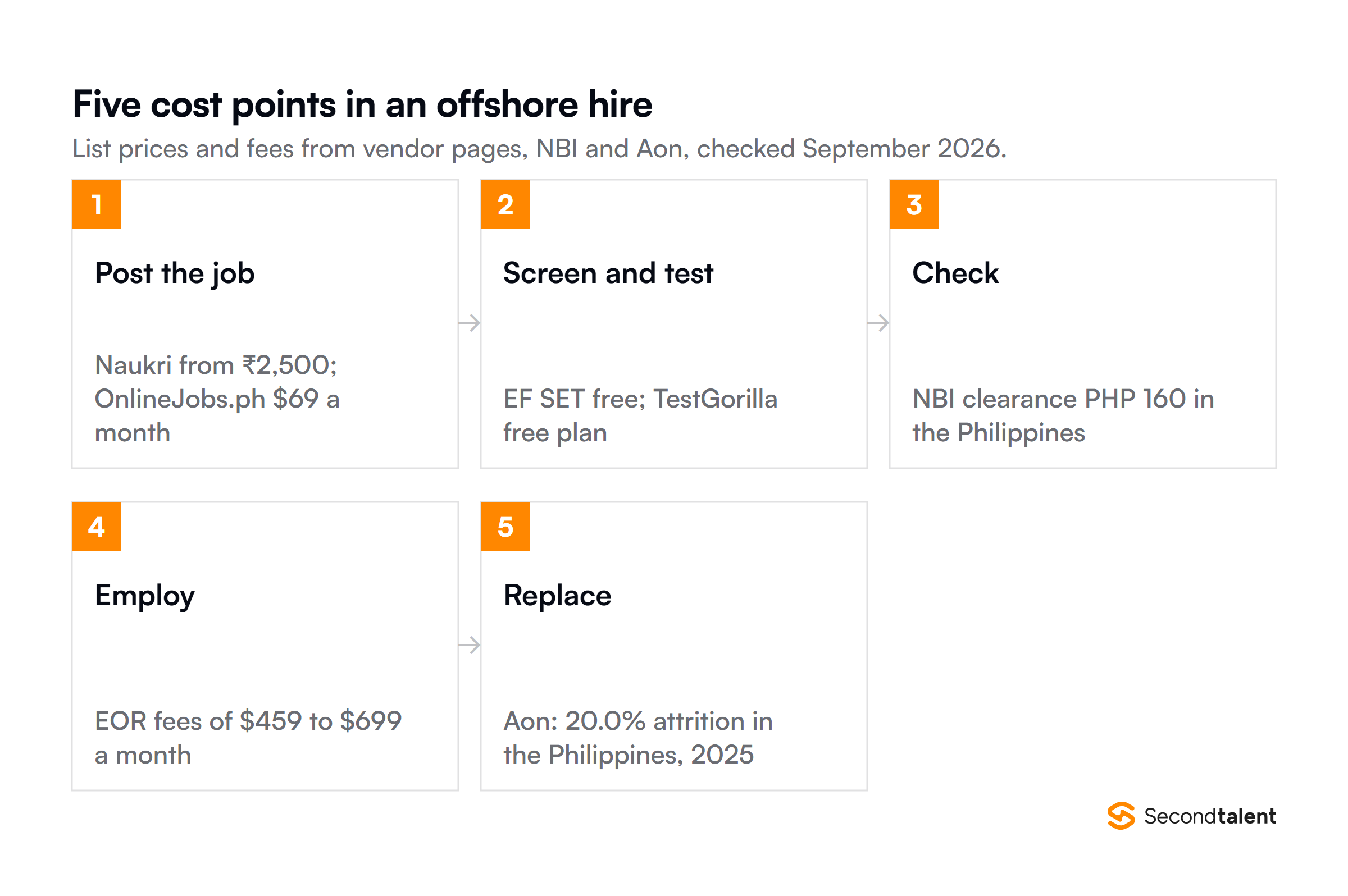
Offshore recruitment has five cost points, and they grow as the hire gets closer. Posting a job and testing candidates costs tens of dollars a month. Employing someone legally costs hundreds a month for as long as they stay, and each departure starts the cycle again.
The usual domestic benchmark comes from SHRM, whose 2025 Recruiting Benchmarking Report surveyed 2,371 US organisations.
SHRM’s 2026 summary says non-executive time-to-fill fell to a median of 39 days and cost-per-hire “remained relatively stable”. Neither benchmark includes salary, contributions or employment fees, which is where most offshore costs sit.
Job Boards and Sourcing Tools
In India, Naukri publishes its small-business prices. It charges ₹2,500 for a 30-day plan with two job posts and 60 CV views, ₹4,950 for 60 days and five posts, and ₹1,650 for a single “hot vacancy”, all before GST.
Naukri’s CV database, Resdex, is priced on request.
The Philippines’ two biggest general boards do not publish prices. JobStreet by SEEK shows its rates only after an employer logs in, and LinkedIn says job post pricing varies “depending on your hiring needs”. Indeed lets Philippine employers post free and sponsor posts on a budget they set. English screening can cost nothing, since EF SET’s test and certificate are free.
Our guides to job boards in the Philippines and job boards in India compare the main sites in each market.
Recruitment Agency Fees and the Rules Behind Them
In the Philippines, the employer pays the whole agency fee by law. Section 35 of the Department of Labor and Employment’s rules for private recruitment agencies is direct about it:
“No fees whatsoever shall be collected neither deducted from the salaries or wages of the workers.”
DOLE Department Order 141-14, Section 35
The same order lets agencies charge employers a service fee “as may be agreed upon”, with no ceiling, and makes the employer cover the worker’s transport.
Sections 37 and 38 give the employer a free replacement or a 75% refund if the hire is certified ill within a month, or quits, abandons the job or commits theft within three months. The older 1997 rules that capped agency fees no longer apply.
Agencies in both countries rarely publish their percentage, so the fee is set in negotiation. Some staffing firms fold recruiting into a monthly rate instead: Lioncrest, a Philippine firm, advertises “no recruitment fee” and a 120-day replacement guarantee on its pricing page. Our list of recruitment agencies in the Philippines covers the larger firms.
Background Checks and Pre-Employment Tests
The standard Philippine check is cheap and paid per applicant. The National Bureau of Investigation’s 2025 Citizen’s Charter lists a PHP 130 application fee plus a PHP 30 e-payment charge for a clearance, and first-time job seekers get theirs free. Older guides quoting PHP 25 are out of date.
Drug testing is the other Philippine line item. Under Section 36(d) of Republic Act 9165, private employees face random testing under company rules, at the employer’s cost and only at DOH-accredited laboratories. In India, the main background verification firms, including AuthBridge, IDfy and OnGrid, do not publish per-check prices.
Employing the Hire: EOR Fees, Staffing Seats and Statutory Costs
A company without a local entity pays one of two monthly prices. An employer of record becomes the legal employer and bills a fee on top of salary. A staffing firm bills one all-in rate that covers salary, contributions, equipment and management.
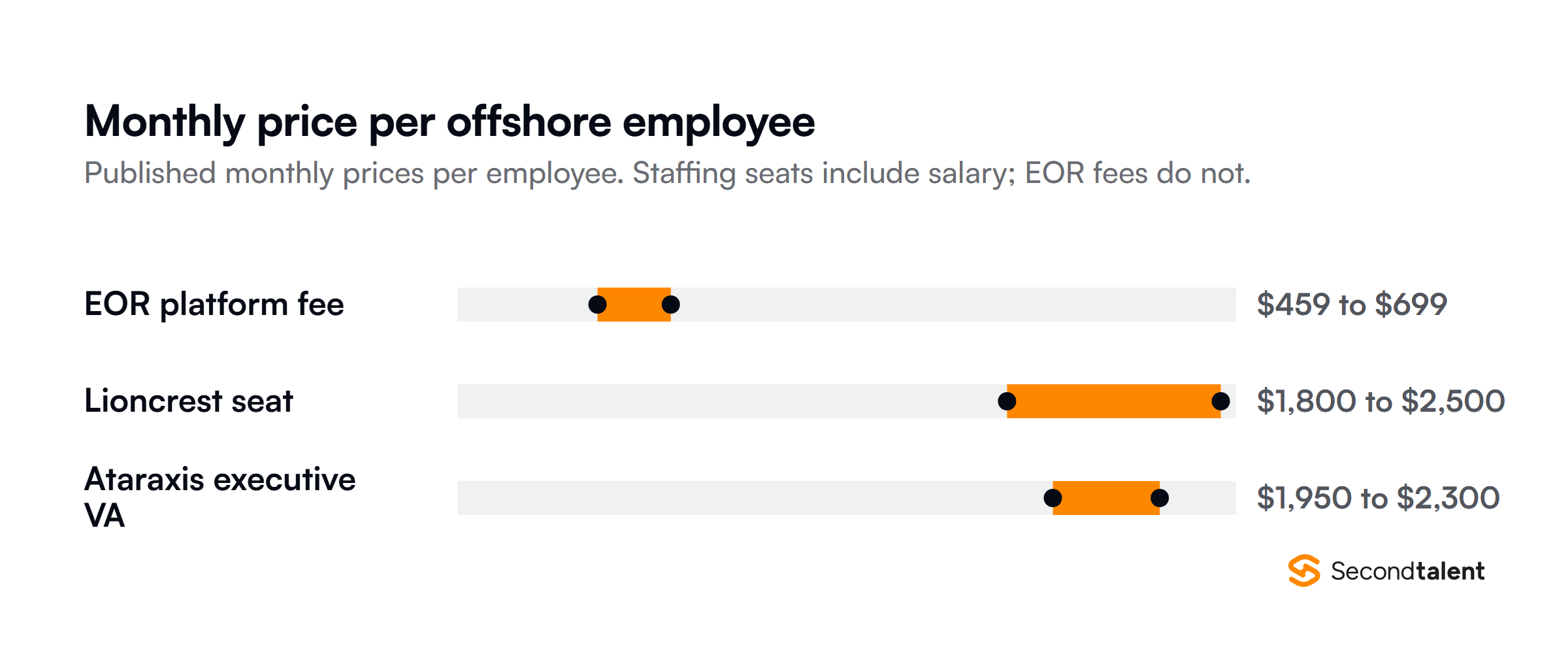
EOR list prices sit in a narrow band. Multiplier charges $459 a month on annual contracts and $499 monthly, Papaya Global starts at $499, Deel at $599, and Remote and Oyster list $699. Oyster requires a refundable deposit; Remote asks for reserve payments only “in rare, high risk circumstances”. None publishes a surcharge for the Philippines or India.
Staffing seats cost more because the salary is inside the price. Lioncrest lists executive assistants from $1,800 a month and customer support from $2,000. Ataraxis bills a full-time virtual assistant at $1,950 a month, and an executive assistant at $1,950 to $2,300. India’s Virtual Employee bills monthly in advance, gives US$1,995 a month as an example for a lawyer, and charges 15 days’ notice on the first invoice.
Under an EOR, statutory contributions are billed on top. In the Philippines that means SSS, PhilHealth, Pag-IBIG and a mandatory 13th month salary; in India, provident fund, ESI below ₹21,000 of monthly wages, and gratuity. Our Philippines payroll guide lists the rates, and our breakdown of what an EOR really costs covers the fees beyond the list price.
Night shifts and holidays
Philippine support staff covering US or European hours earn a premium. The Labor Code adds a night shift differential of at least 10% for work between 10pm and 6am, pays 200% for work on a regular holiday and 130% on a special non-working day.
The Philippines has 12 regular holidays and 8 special non-working days in 2026, so a team that follows a US calendar pays holiday rates on days its client treats as ordinary.
Tax risk without an entity
Hiring directly without an entity can create a taxable presence. India’s Supreme Court held in July 2025, in Hyatt International Southwest Asia v ADIT, that a foreign company had a permanent establishment through operational control alone.
The OECD’s 2025 update treats home working under 50% of time over 12 months as generally not a place of business, EY summarised, but India has reserved its position on that guidance.
A First-Year Cost Example
Take a customer service associate in the Philippines, hired through OnlineJobs.ph and employed through Deel. JobStreet puts typical pay for the role at PHP 20,000 to PHP 26,000 a month, so the example uses the midpoint, PHP 23,000.
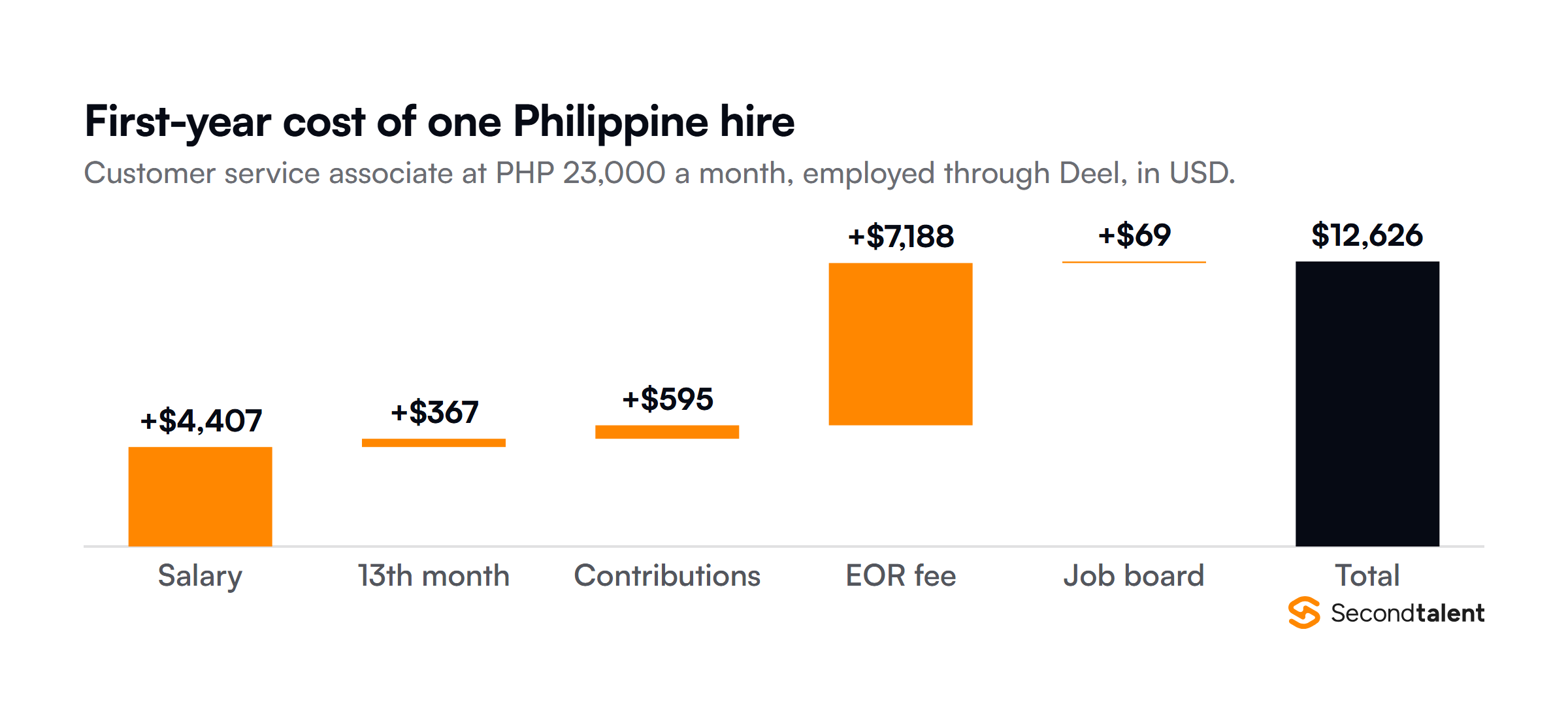
Twelve months of salary come to about $4,407. The 13th month adds $367, and employer SSS, PhilHealth and Pag-IBIG add about $595. Deel’s fee is $7,188 for the year, and a month of OnlineJobs.ph Pro is $69, for a total of about $12,626. Exchange rates are ECB reference rates from 11 September 2026.
The platform fee is the largest line, at 57% of the total. The same hire at Lioncrest’s customer support rate would start at $24,000 a year, with recruiting, equipment and a replacement guarantee included. Neither figure includes the manager’s time.
Attrition: Paying to Recruit Twice
Each departure repeats the cost of finding and checking a replacement. Aon put Philippine attrition at 20.0% in 2025, with the highest projected turnover of the six Southeast Asian markets it surveys.
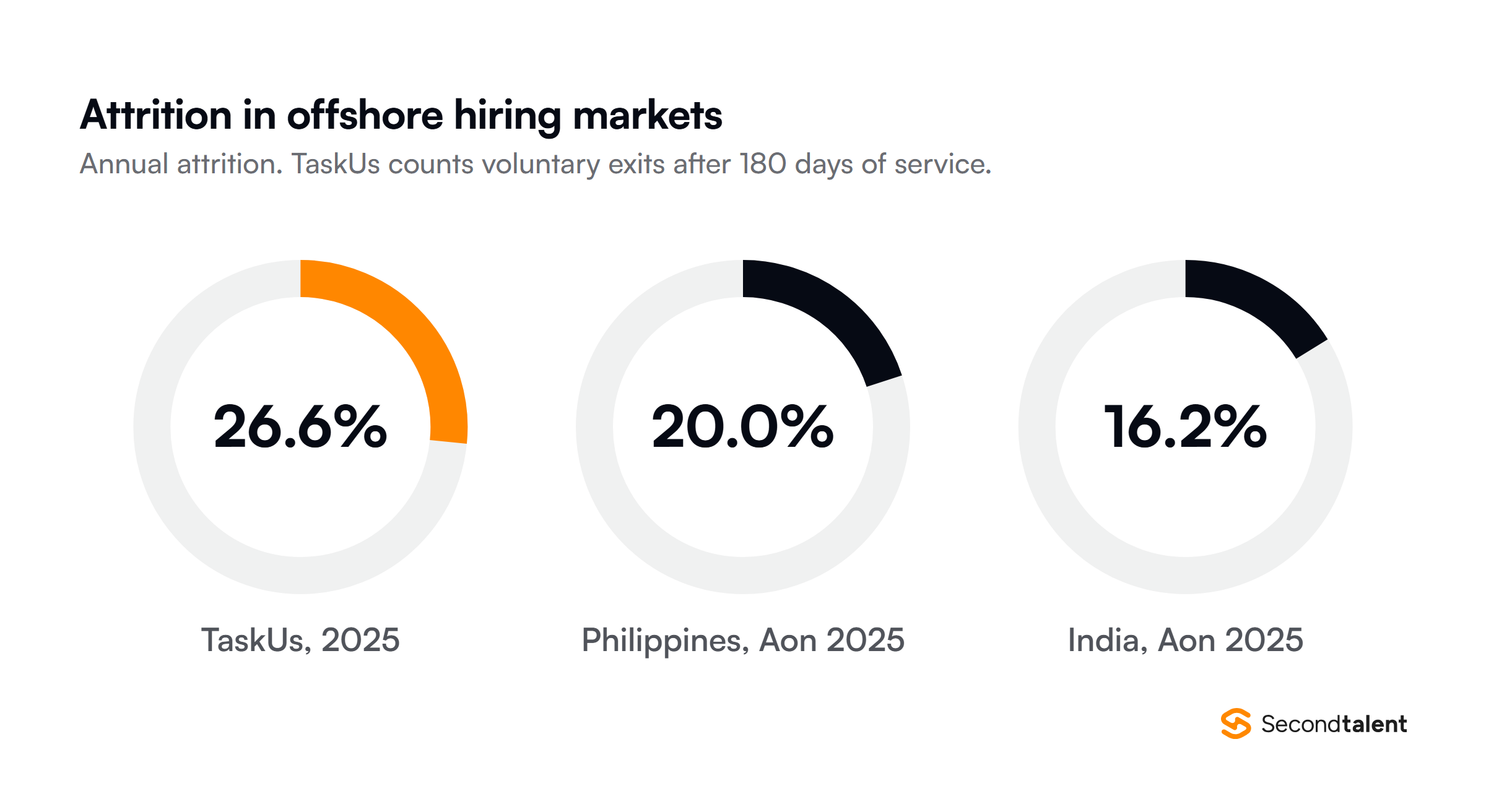
TaskUs, which has 58% of its employees in the Philippines, reported voluntary attrition of 26.6% among employees with more than 180 days of service in its 2025 annual report. India’s rate is lower: Aon put it at 16.2% in 2025, down from 17.7%.
Replacement guarantees only cover the start. DOLE’s rule protects the employer for three months and Lioncrest’s for 120 days, while the TaskUs figure counts employees who leave after six months. Our comparison of offshore staffing companies in the Philippines notes which firms offer longer cover.
What a Bad Hire Costs, and Which Figures Hold Up
Most bad-hire statistics in circulation are misattributed. The most repeated, “30% of first-year earnings” credited to the US Department of Labor, cannot be traced to any Department of Labor publication. SHRM’s “50% to 200% of salary” comes from a 2008 SHRM Foundation guide about turnover in general, not bad hires.
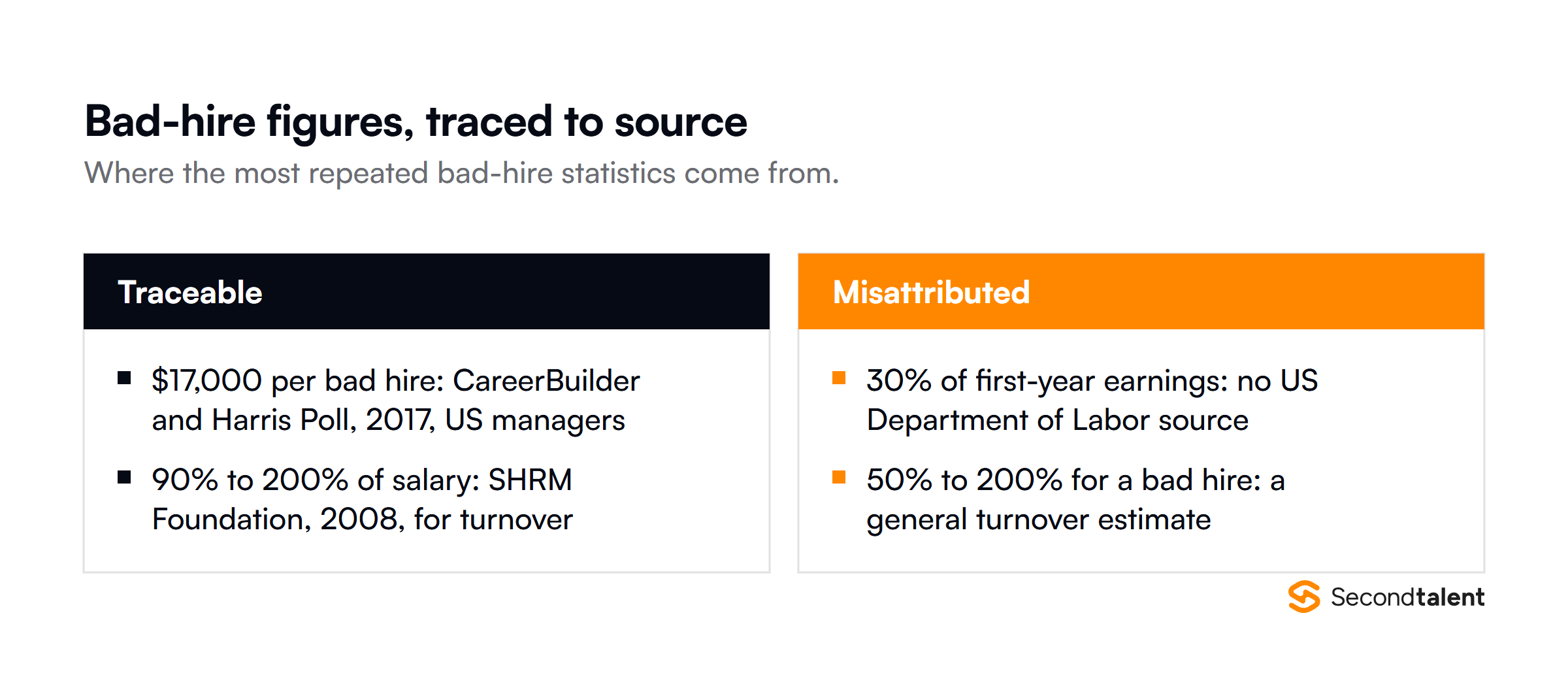
The CareerBuilder figure of $17,000 is real, from a 2017 Harris Poll of 2,391 US hiring and HR managers. It describes US salaries and US employers, so it overstates the cost of a mis-hire on a $400-a-month offshore salary. Separation pay is the offshore cost that is written into law.
- Redundancy: one month of pay per year of service
- Retrenchment or closure: half a month per year
- One month’s written notice; a client is jointly liable for a contractor’s unpaid wages
- Retrenchment: 15 days’ pay per year of service
- Plus 15 days’ wages to the Worker Re-skilling Fund within 45 days
- Unused leave encashed on exit
Recruiting Offshore With Second Talent
Second Talent recruits and employs staff in the Philippines and eight other Asian markets under employer of record, matches pre-vetted candidates within 24 hours, and 92% of the talent we place stays. Run your own numbers with our recruitment cost calculator or offshore hiring cost calculator.
See how our Philippines EOR works, or tell us the role you need to fill.
FAQs
How much notice does a new hire in India have to give their current employer?
The Industrial Relations Code requires one month’s notice for workers with at least a year of service. That notice period is part of your time-to-hire, so an employed candidate in India can take a month or more to join.
Can I hire offshore staff as contractors instead?
Only where the worker is independent in fact. In the Philippines, a client is jointly liable for a contractor’s unpaid wages under Article 106 of the Labor Code, and a labour-only arrangement makes the client the direct employer. Our guide to EOR vs PEO vs contractor management explains the tests.
Does remote work in the Philippines require an equipment allowance?
No. The Telecommuting Act, Republic Act 11165, makes telecommuting voluntary and requires equal pay, including overtime and night shift differential, but sets no internet or equipment allowance. Staffing firms such as Lioncrest include equipment in their monthly rate.




![Workplace Diversity Statistics. Top 100+ Workplace Diversity Statistics [2026], by Second Talent.](https://www.secondtalent.com/wp-content/uploads/2026/09/workplace-diversity-statistics-featured-v2-768x403.jpg)