TL;DR: Reported data annotation pay runs from $2 an hour or less for bulk labeling in Kenya to $150 an hour or more for software engineers on US AI training platforms. TIME found Kenyan labelers on an OpenAI project taking home $1.32 to $2 an hour. DataAnnotation's September 2026 job board lists $25 to $50 an hour for generalists.
Amazon will shut Mechanical Turk on September 30, 2026, yet its SageMaker Ground Truth price list still suggests paying MTurk workers $0.012 each to classify an image.
At the other end of the market, OpenAI’s contract paid Sama $12.50 an hour for Kenyan labelers in 2021 and 2022, six to nine times what those workers kept.
- 1Metro Manila’s daily minimum wage rises to PHP 755 on September 26, 2026, from PHP 695.
- 2Mercor shows an average contracted rate of $112 an hour for the experts on its platform.
- 3Remotasks cut off every worker in Kenya, Nigeria and Pakistan in March 2024.
- 4Prolific lists a pay-as-you-go fee of 42.8% for most corporate customers, on top of the pay they set.
What Do AI Training Platforms Pay per Hour?
DataAnnotation shows an hourly band for each role on its job board. In September 2026 it lists $25 to $40 for Japanese, Chinese, Thai, Vietnamese, Korean and Spanish specialists.
Physicians get $60 to $125 or more, and software engineers and data scientists $75 to $150 or more.
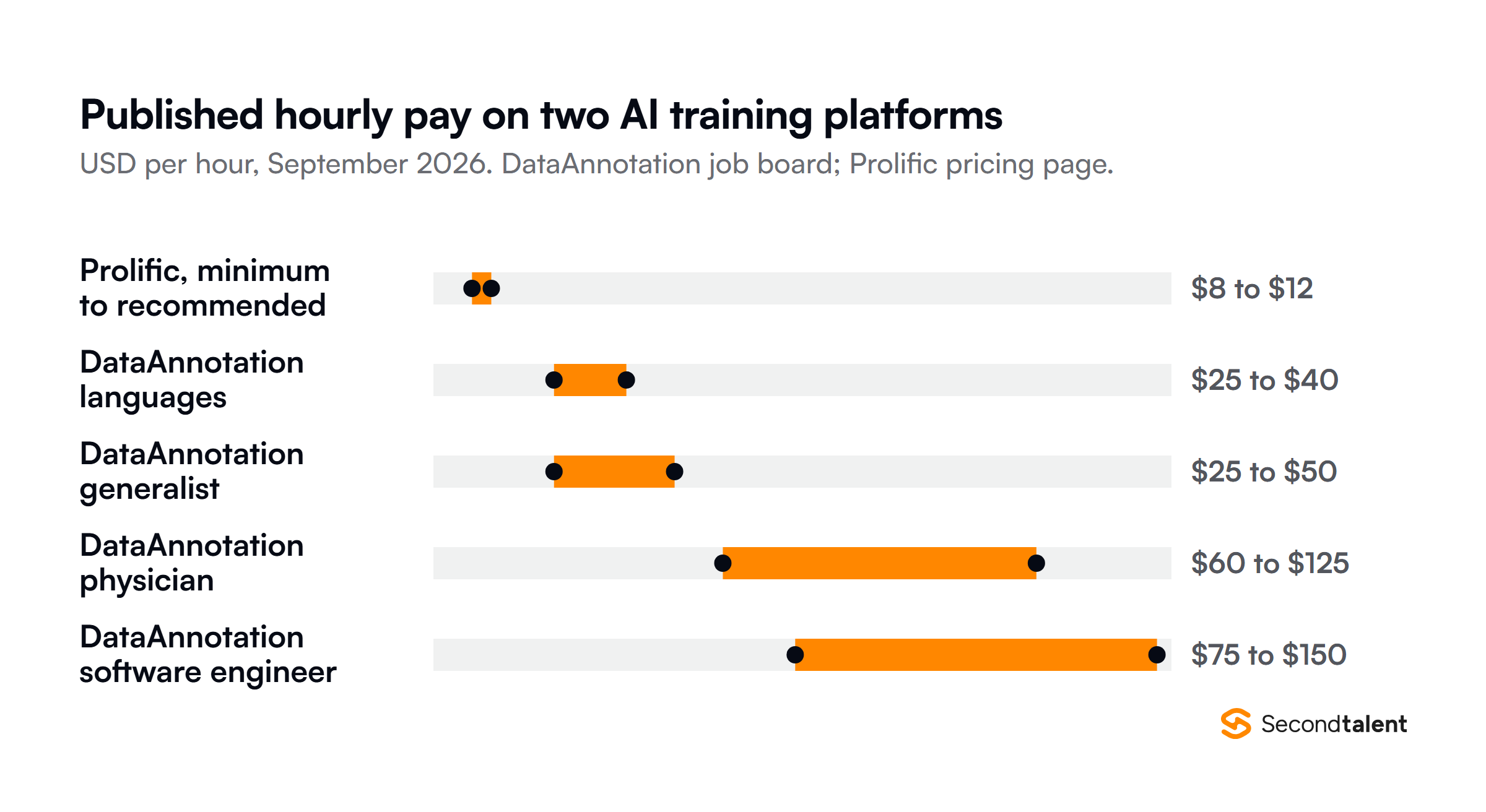
The DataAnnotation FAQ gives lower starting points by track: $20 or more for multilingual projects, $25 to $30 for general work, and $50 to $100 for coding, STEM and professional projects that need a degree or a license.
It describes the job as a flexible, task-based contractor role paid through PayPal.
Outlier, which Scale AI operates, asks for a valid ID and a mobile phone from your country of residence but does not post rates. Mercor posts roles by the hour instead, such as $75 to $100 for a financial crime and KYC analyst.
Prolific, a survey and AI data platform, sets a floor rather than a band. The Prolific pricing page puts minimum pay at £6 or $8 an hour and recommends at least £9 or $12, with more for AI annotation, coding or STEM tasks.
Our review of whether DataAnnotation is legit covers its assessments and payments, and our list of platforms to hire data annotation experts compares the marketplaces from the buyer’s side.
How Much Do Data Labelers Earn in Kenya?
The Kenyan figures with the most evidence behind them come from payslips. TIME reviewed internal Sama documents for an OpenAI project that labeled toxic text.
Junior agents earned a base salary of 21,000 shillings ($170) a month, plus a bonus of about $70 a month for the explicit content.
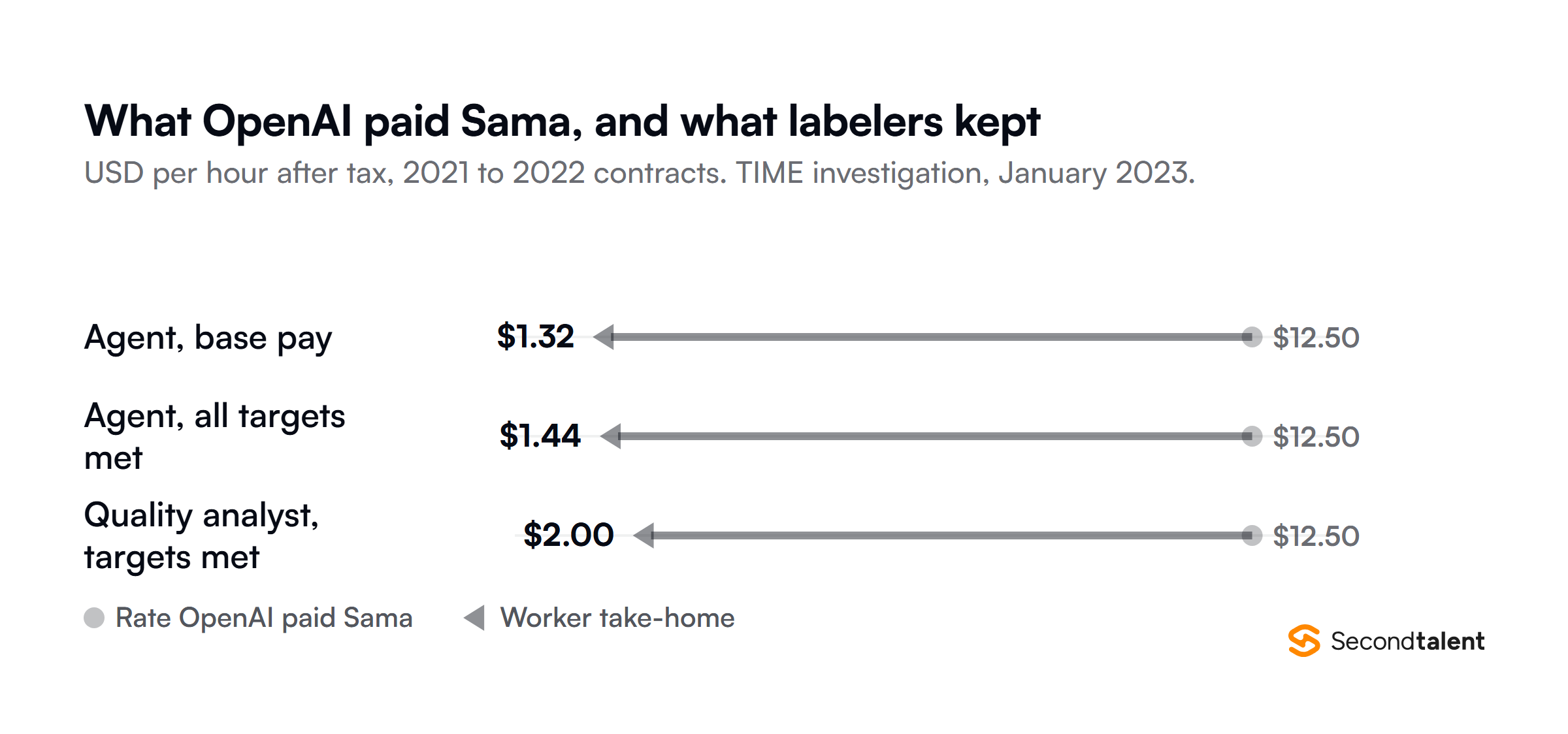
After tax, an agent on nine-hour shifts took home $1.32 an hour, or $1.44 with all targets met. Quality analysts, who checked the agents’ work, could reach $2.
Kenya has no universal minimum wage, but the floor for a Nairobi receptionist at the time was $1.52 an hour.
Sama disputed parts of this. It told TIME its workers could earn $1.46 to $3.74 an hour after tax, and that the $12.50 rate also paid for infrastructure, benefits, quality analysts and team leaders.
Sama ended all its OpenAI work in February 2022, eight months early.
Chinese buyers arrived with no contracts
In December 2025, Rest of World found students and graduates in Nairobi labeling short videos for China-based companies for as little as 700 shillings ($5.42), on days of around 12 hours.
None of the 10 annotators it spoke to knew which company the data was for.
- Three contracts worth about $200,000
- About three dozen salaried workers in three teams
- 150 to 250 text passages per shift, workers said; Sama said 70
- No contract; paid through M-Pesa
- Up to 26,000 video clips per person a day
- At least 85% accuracy to get paid
Workers joined through a Google Form and took instructions in WhatsApp groups of up to 30 people, on projects of about two weeks with no days off.
“The bigger the project, the more people we hire and the lower the rates,” a Kenyan supervisor of 30 said.
Joan Kinyua, a former Sama annotator, now leads the Data Labelers Association, a Nairobi union.
A member of Kenya’s National Innovation Technical Committee told the outlet that the government is drafting rules on which company counts as these workers’ employer.
What Is the Pay Floor in the Philippines and Vietnam?
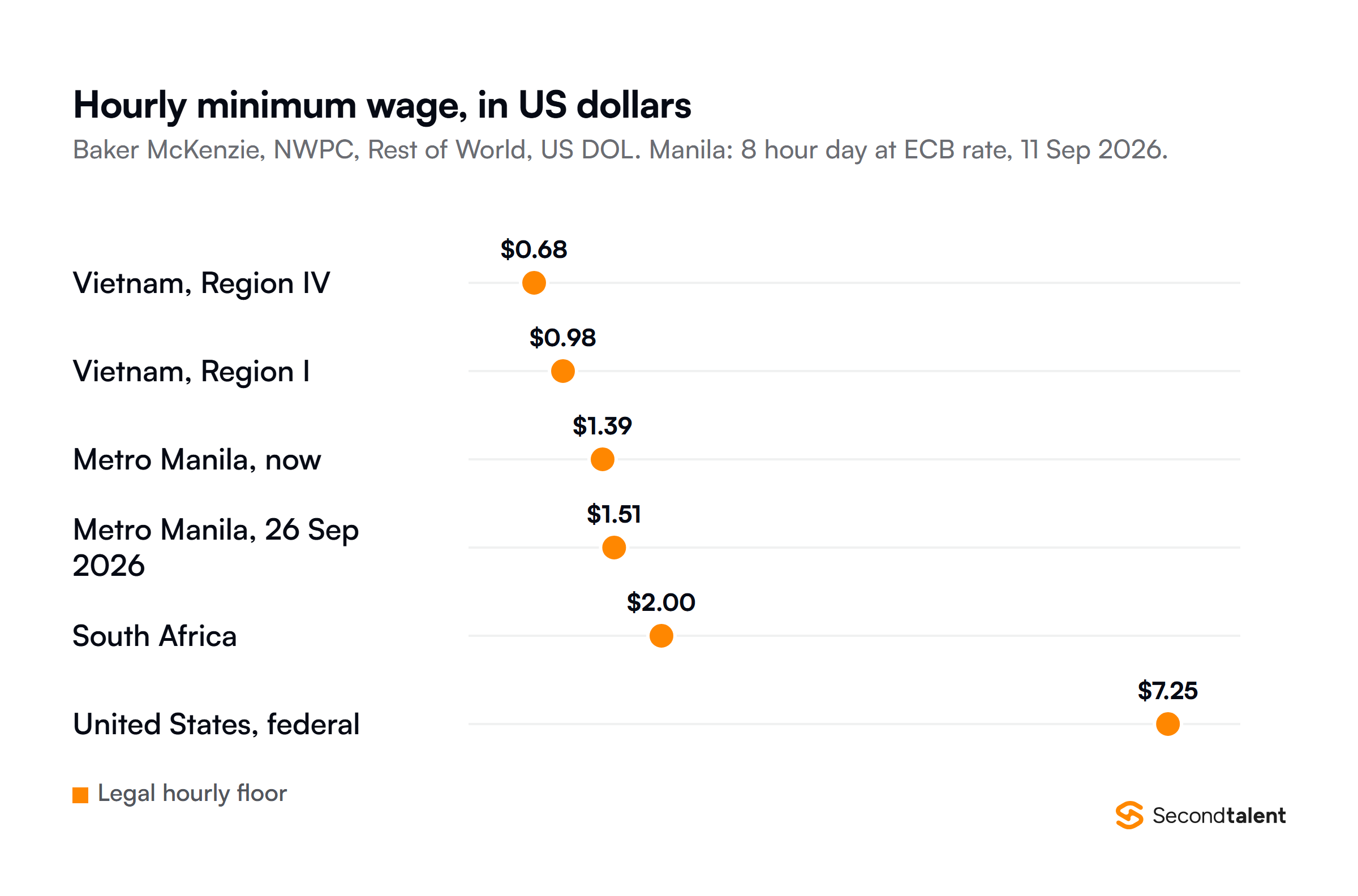
Metro Manila’s minimum wage goes up on September 26, 2026. According to the National Wages and Productivity Commission, Wage Order NCR-28 adds PHP 60 a day and takes non-farm workers from PHP 695 to PHP 755.
An earlier order, NCR-27, has a second PHP 25 step set for January 2027 but is still in court.
Over an eight-hour day, PHP 755 comes to about $1.51 an hour at the European Central Bank reference rate for September 11, 2026. That is our conversion, not an official figure.
An organizer with Code AI, a BPO workers’ coalition, told Rest of World that many laid-off call center employees now work as freelance data annotators. Our guide to hiring data annotators in the Philippines covers skills and hiring routes.
Vietnam
Vietnam sets four regional floors, and Decree 293/2025 raised all of them on January 1, 2026. The top rate is VND 5.31 million a month, about $204, according to Baker McKenzie’s note on the decree.
Access to crowd platforms has moved too. In March 2024 Remotasks told Rest of World it was still open to existing contractors in Vietnam, India, Thailand and Poland, but it had stopped new sign-ups in Vietnam, Thailand and Poland.
Our look at the data annotation market in Vietnam covers the local vendors.
India, South Africa and the US
A September 2026 Rest of World essay says waste sorters and welders in India earn 250 rupees ($2.60) an hour to film their work with cameras on their heads, for data that trains humanoid robots.
The same piece puts South Africa’s national minimum wage at 30.23 rand ($2) an hour.
For comparison, the US federal minimum wage has been $7.25 an hour since July 24, 2009. That is below the $8 an hour minimum Prolific allows on its platform.
Which Countries Are Gaining or Losing Annotation Work?
Venezuelans once made up as much as 75% of the workforce at Mighty AI and Scale AI, in 2018. Rest of World reported in April 2025 that this work has since become scarce and low-paid, as generative AI takes over the simpler tasks.
One Venezuelan in Colombia has tagged data on Appen for a decade, competing for tasks worth 5 to 25 cents each. She made around $500 a month before 2022.
She now makes 1,410,000 Colombian pesos ($320), close to the minimum wage, and tasks can stop coming for weeks.
“Clients now require more complex and diverse data sets, as well as comprehensive model evaluations.”
Si Chen, vice president of strategy at Appen, to Rest of World, April 2025
Scale AI announced Meta’s investment on June 12, 2025, with founder Alexandr Wang moving to Meta. Meta took a minority stake.
Expert work pays more, often by the task
A South African with a new PhD wrote in the Rest of World essay that a recruiter offered him 600 rand ($37) an hour to train an AI system to design tests and mark essays.
An AI interviewed him for 45 minutes, and he then stopped pursuing the job.
In China, lawyers, architects and engineers training AI told Rest of World in September 2026 that a task takes a few hours and pays 100 to 500 yuan ($15 to $74). ByteDance’s Xpert platform says it has signed up more than 50,000 experts.
Rejected work is a cost the rates leave out. Platforms including Xpert state in their user terms that trainers are not paid when a submission fails review, so hours of work can earn nothing.
What Do Buyers Pay per Label?
AWS posts its per-label prices in full. The SageMaker AI pricing page charges $0.08 per reviewed object when you review fewer than 50,000 a month, $0.04 between 50,000 and 1 million, and $0.02 above 1 million.
An object can be an image, a video frame, a text document or an audio file.
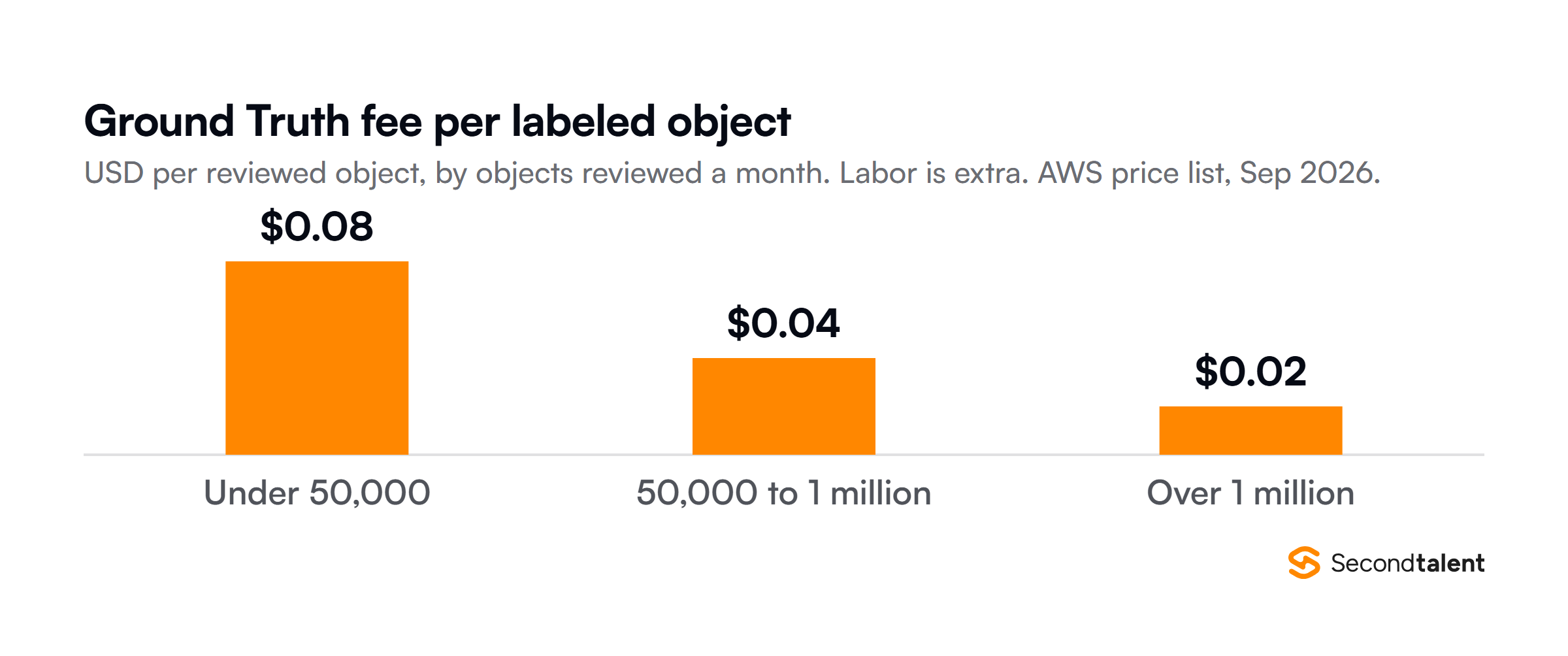
That fee pays for the tool, not the people. 3D point clouds cost $3 per frame, or $1.50 for each frame after the first in a sequence.
Labor comes on top: a vendor sets its own price in AWS Marketplace, while the Mechanical Turk route carries a suggested price per labeler for each object.
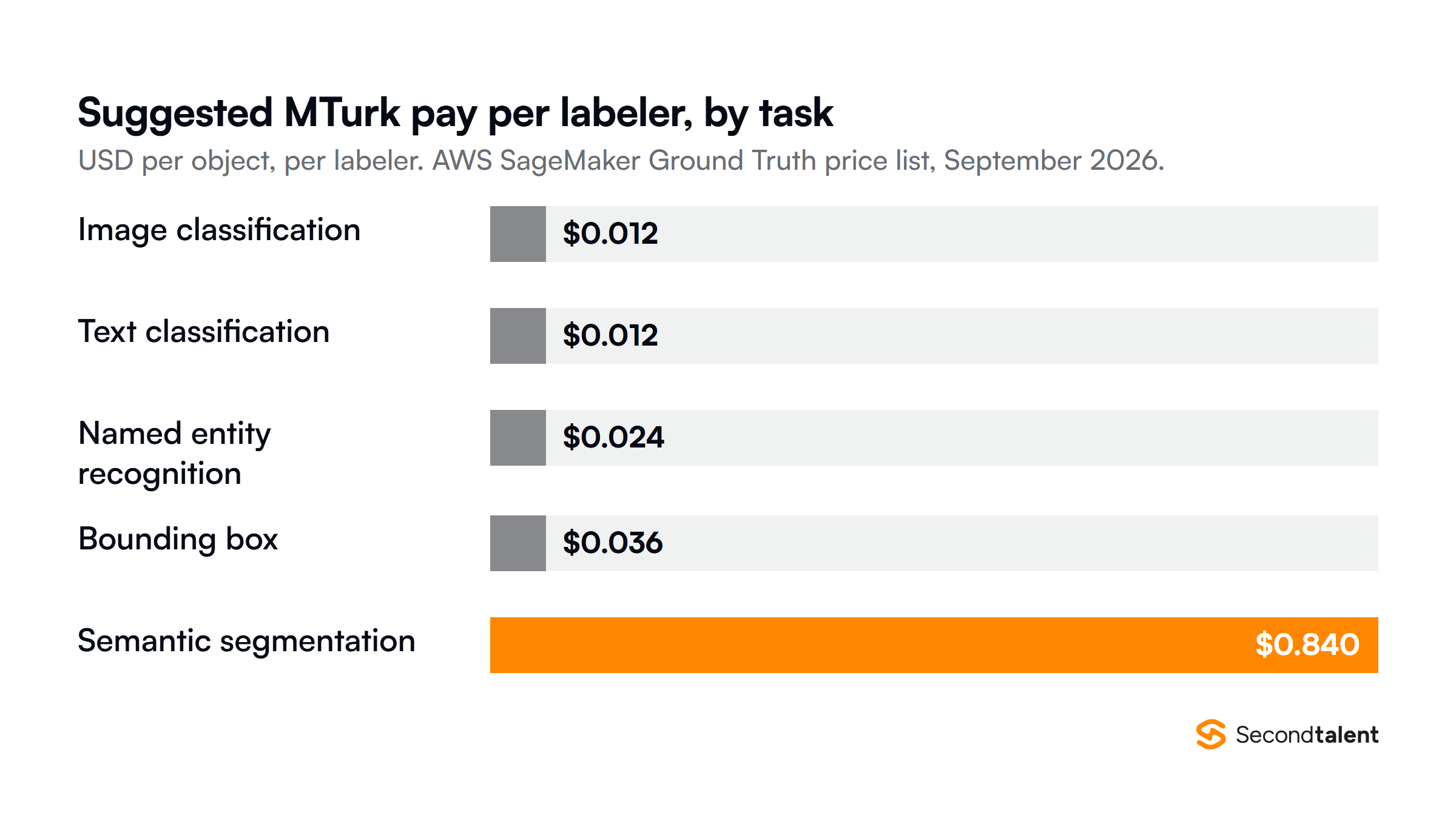
AWS recommends several labelers per object to improve accuracy, and you pay per object per review. Semantic segmentation, where labelers mark each pixel, carries a suggested $0.84, 70 times the price of classifying an image.
That multiple is our calculation from the AWS list.
The MTurk option has an end date. Amazon Mechanical Turk says it will close for good on September 30, 2026.
Until then it adds a 20% fee on worker pay and bonuses, another 20% on tasks with 10 or more assignments, and 5% for Masters workers.
Tools and managed vendors
Prolific charges on the same model as MTurk: you set the reward, then pay a pay-as-you-go platform fee, listed at 42.8% for most companies and 33.3% for academic or non-profit customers. Annotation software charges per seat instead.
CloudFactory, a managed vendor, posts no price. It labels a small sample at no cost, then quotes a piece rate or a consumption rate.
BasicAI’s industry analysis of service pricing lists the factors that move such a quote, including data type, industry expertise, volume and turnaround time.
Our comparison of data annotation tools for enterprise AI projects covers the software side, and our breakdown of outsourcing versus in-house annotation teams covers who does the labeling.
Hiring Data Annotators and AI Trainers
Second Talent builds salaried annotation teams across nine Asian markets, so you pay a monthly salary instead of a per-item price.
Our data annotation outsourcing service lists trained annotators from $1,100 a month and runs a free pilot batch first. For RLHF and evaluation work, you can also hire AI model training specialists.
Tell us what you need labeled and we will send matching profiles.
Frequently Asked Questions
Which country has the cheapest data annotation?
Of the legal floors above, Vietnam’s Region IV rate is the lowest. A floor does not set what a labeler earns on a task platform, though, because those platforms pay per task or per hour worked, and work can dry up for weeks.
Do AI training platforms pay less in poorer countries?
DataAnnotation, Mercor, Outlier and Prolific do not publish rates by country. Access is what changes: Remotasks closed whole countries in 2024, and some platforms ask for ID from your country of residence before you can work.
Are data annotators employees or contractors?
Both arrangements show up in the reporting. The Sama workers in TIME’s report drew a monthly salary with bonuses.
DataAnnotation calls its work a contractor role, and the Kenyan video labelers Rest of World interviewed had no contract at all.
Why do annotation price lists look so different?
They price different things. AWS charges per object for its tool, MTurk and Prolific add a percentage to the pay you choose, and managed vendors quote a project after a trial batch.