
TL;DR: A five-person development team employed in the US costs about $74,000 a month at median pay, on our calculation from Bureau of Labor Statistics data. The same five seats through a managed provider in Asia run about $15,000 to $30,000 a month at Second Talent's published rate of $3,000 to $6,000 per engineer. Outsourcing vendors' hourly rates split along the same regional lines.
US private employers spent $78.88 an hour per professional or management employee in June 2026, $24.82 of it on benefits. A dedicated team contract folds the whole bill, plus recruiting and payroll, into one monthly fee per engineer. Second Talent sets that fee for engineers in nine Asian markets, works with 200+ companies and keeps a 92% talent retention rate.
- 1A US software developer at the 90th percentile earns $214,670, 2.6 times one at the 10th percentile.
- 2Polish employers add 19.21% to 22.41% in social contributions on top of a developer’s gross salary.
- 3Remote and Oyster both list their employer of record service at $699 per employee a month. Rippling publishes no price at all.
- 4One in five employees in the Philippines left their employer in 2025, the highest attrition of six Southeast Asian markets in Aon’s survey.
How Much Does a Dedicated Development Team Cost per Month?
Benefits cost a US team more than two extra developers’ salaries. Take a common five-seat team: three software developers, one QA analyst and one systems administrator doing the DevOps work. At May 2025 median wages from the Bureau of Labor Statistics, their salaries come to $50,948 a month. Benefits take the total to about $74,300.
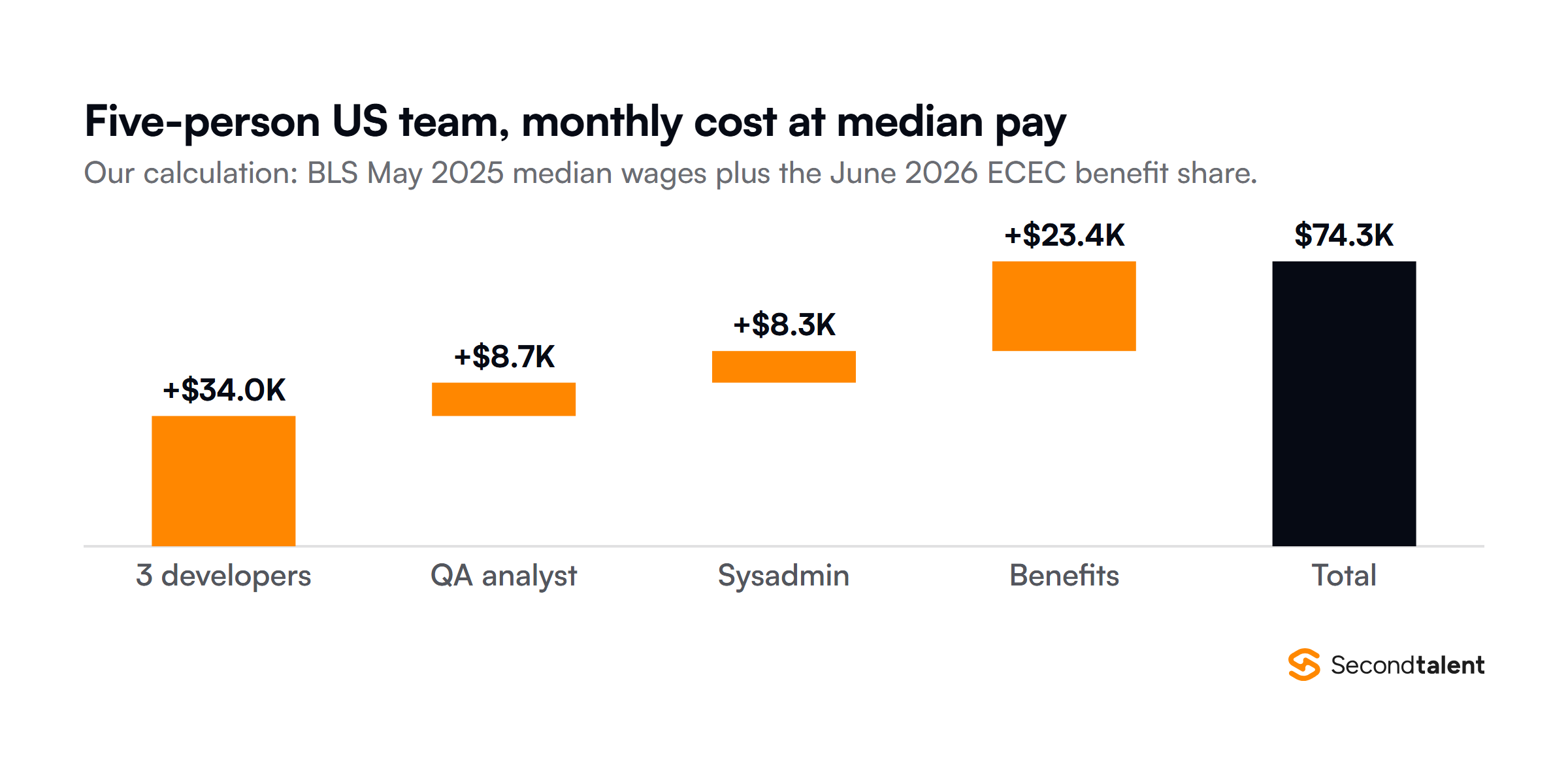
Pay the same five people at the 10th percentile and the team costs about $45,200 a month. At the 90th percentile it costs about $117,500.
Moving the seats offshore changes the inputs more than the arithmetic. These are the per-engineer monthly prices behind the four common routes, each from its own named source.
| Route | Per engineer, per month | Five-person team | Basis |
|---|---|---|---|
| US employee, median pay | About $14,900 average | About $74,300 | BLS wages and benefit share, our calculation |
| Polish developer via an EOR | About $5,590 to $5,830 | About $28,000 to $29,100 | Statistics Poland average pay, PwC contribution rates, Deel and Remote fees, our calculation |
| Managed engineer in Asia | $3,000 to $6,000 | $15,000 to $30,000 | Second Talent pricing page, fully loaded |
| Outsourcing vendor, hourly | $4,960 to $6,560 | $24,800 to $32,800 | Accelerance 2026 senior rates in Asia at 160 hours, our calculation |
The Polish row uses October 2024 wages converted at the European Central Bank’s September 11, 2026 rate, so treat it as an order of magnitude. Our offshore hiring cost calculator reruns the sum for other countries and headcounts.
What Do US Developers, QA and Data Roles Earn?
Data scientists earn less than software developers at the median, $120,230 against $135,980, yet BLS expects their jobs to grow 35% between 2025 and 2035, against 10% for developers, QA analysts and testers. QA analysts and testers earn a median $104,300, and project management specialists $102,320.
The medians hide a wide spread. The chart shows each role from the 10th to the 90th percentile, the pay band that covers four in five workers in the job.
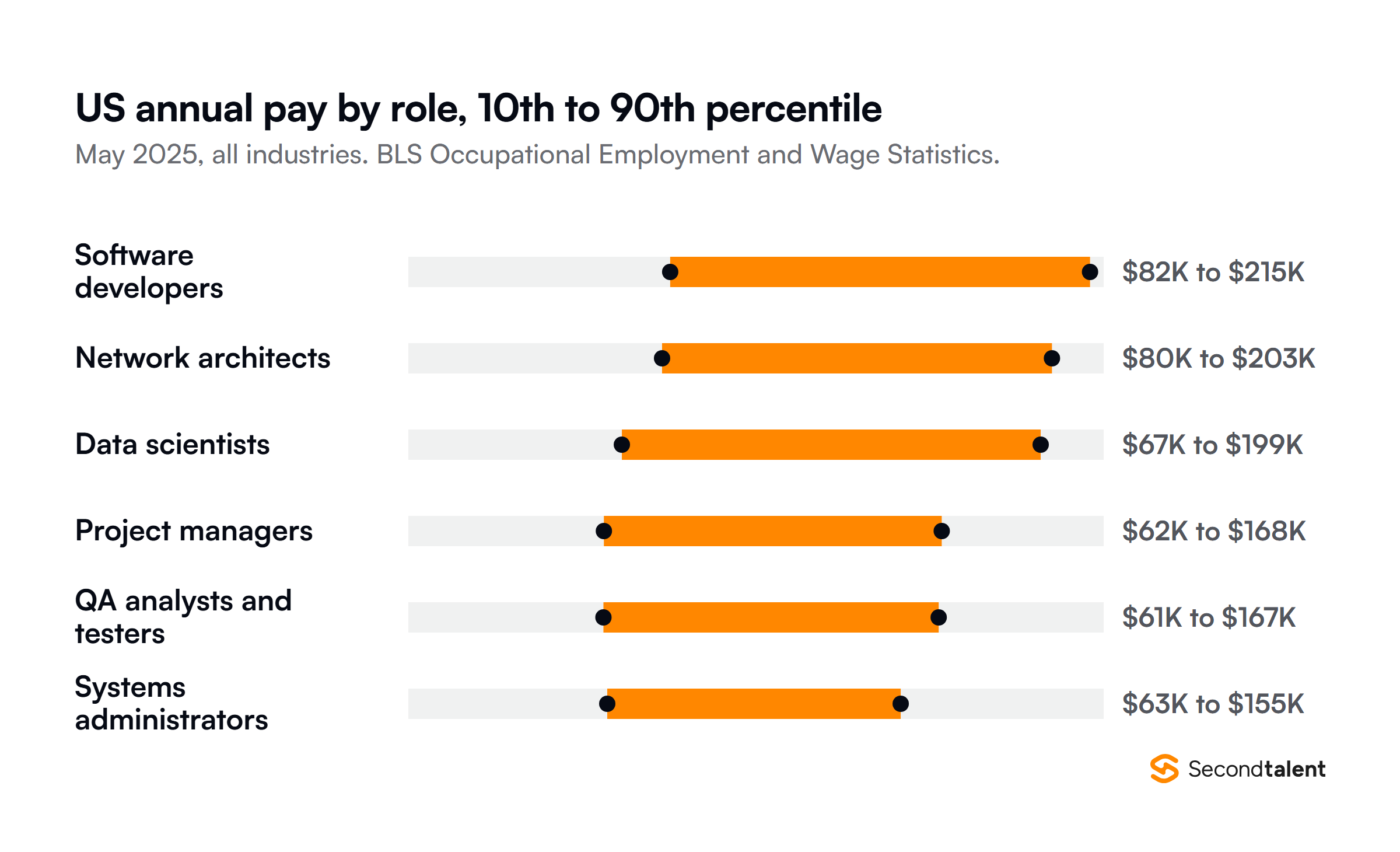
BLS has no occupation code for DevOps or cloud engineers. The closest are network and computer systems administrators, at a median $99,130, and computer network architects, at $134,050.
These are wages only, from the May 2025 survey of employers, with no benefits added. Our US cost to hire guide covers freelance rates for the same roles, and the tech industry hiring statistics track demand for them this year.
What Does a US Hire Cost on Top of Salary?
Paid leave costs a US employer more than any other benefit. In the Employer Costs for Employee Compensation release of September 9, 2026, paid leave cost $7.37 an hour for management, professional and related employees in private industry. All insurance benefits together cost $5.87.
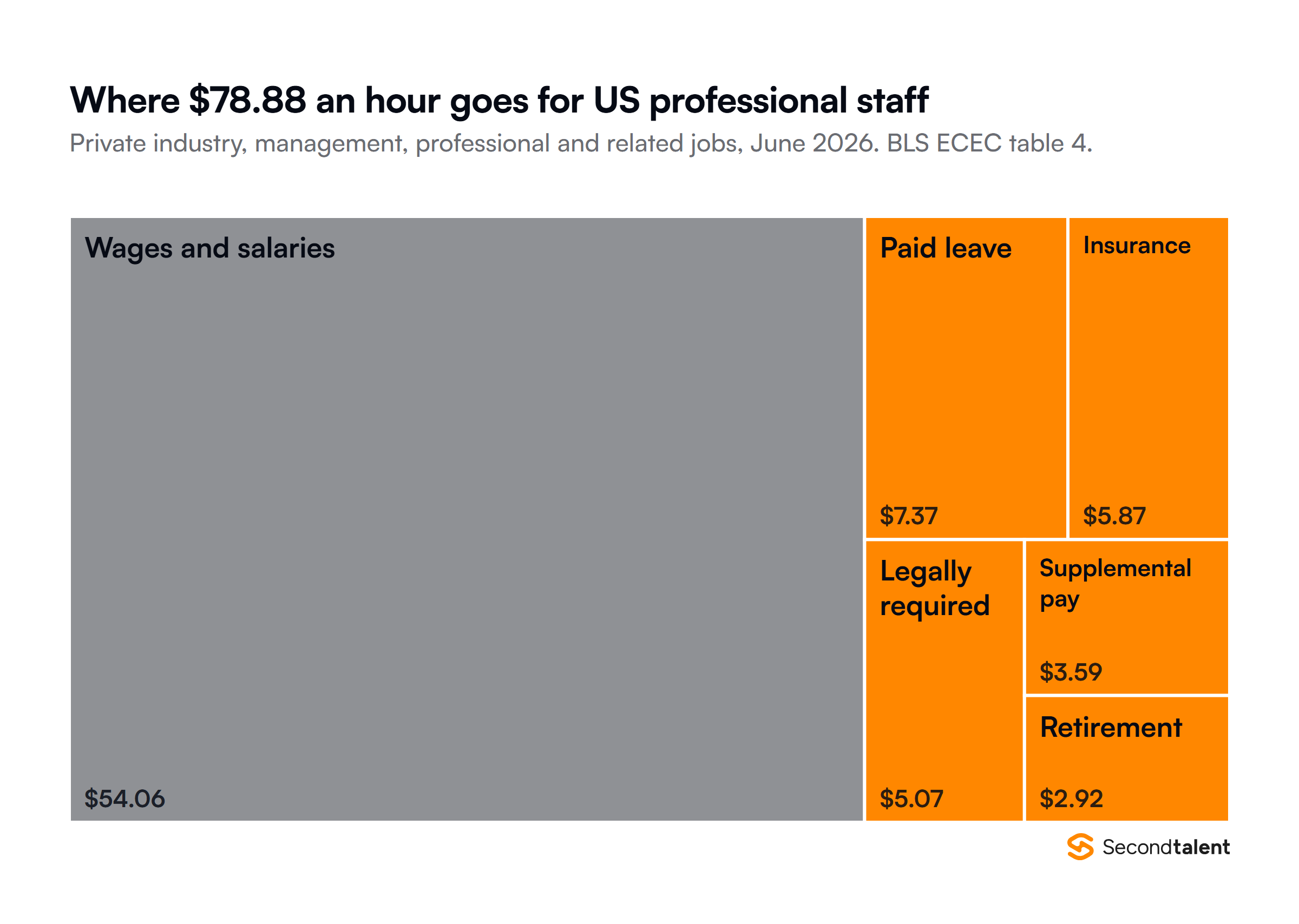
Benefits make up 31.5% of total compensation for this group, above the 30.0% average across all private industry workers. Dividing one figure by the other, a dollar of salary costs about $1.46 with benefits. Social Security, Medicare, unemployment insurance and the other benefits the law requires add $5.07 an hour.
The recruiting bill is small next to that. SHRM’s 2025 Recruiting Benchmarking Report puts the median cost per hire at $1,200 for non-executive roles, from 2,371 US organisations. The larger cost is time: a median of 44 days to fill the role, counted from the opened requisition to an accepted offer.
The benchmark covers recruiting spend, not the salary or benefits that follow. Our cost of offshore recruitment breakdown compares the same line items for hires in the Philippines and India.
How Much Do Developers Earn in Eastern Europe, Latin America and Asia?
A professional developer in Poland earns about the same as one in Romania, and both earn close to twice what a developer in Brazil does. Those are medians we calculated from the public response data of the 2025 Stack Overflow Developer Survey, which puts one pay question to developers in all countries.
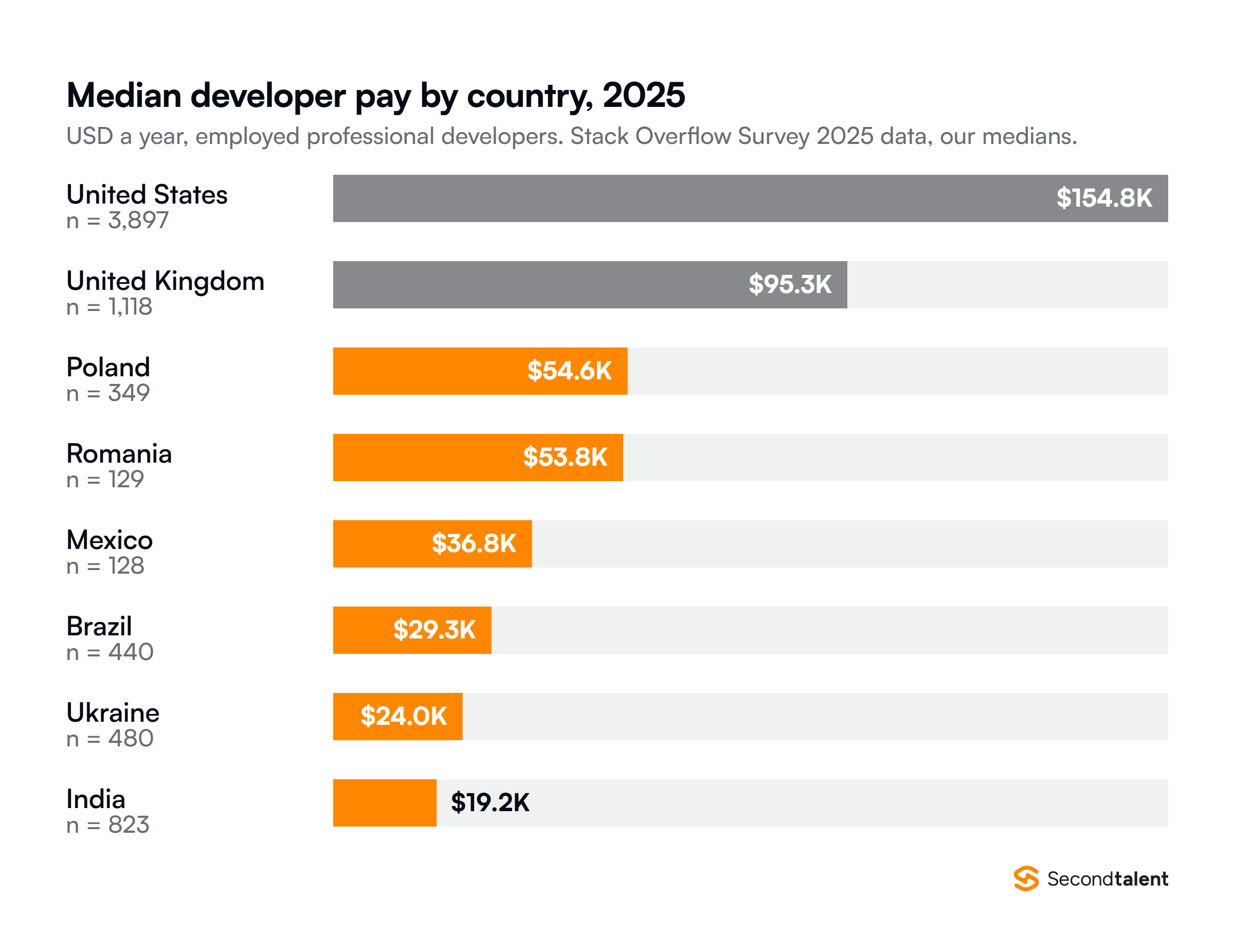
Inside each country, experience moves pay a long way. In the same data, Indian developers with ten or more years of work experience report a median of $45,915, almost five times the $9,299 of those with under five years. In Poland the jump happens earlier: $31,520 under five years, $64,131 at five to nine.
Eastern Europe in official statistics
Statistics Poland’s pay-by-occupation survey for October 2024 puts the average gross monthly salary of software and applications developers and analysts at PLN 15,630, and the median at PLN 13,900. The top tenth earned more than PLN 26,000. The survey covers employees, so developers who invoice as contractors are not in it.
An employer then adds social contributions of 19.21% to 22.41% of gross pay, PwC’s tax summary says. Our comparison of hiring costs in India, Eastern Europe and the Philippines sets those rates beside Romania’s and Ukraine’s.
Southeast Asia on our rate cards
Too few developers in Vietnam, the Philippines, Indonesia or Malaysia answered Stack Overflow’s survey for a reliable median, under 60 in each. For those markets we publish our own salary bands, updated in August and September 2026.
Salary is only part of the loaded cost in these markets too. The Vietnam full-stack rate card and the Philippines full-stack rate card list hourly rates by seniority next to the monthly bands.
Dedicated Team, Time and Materials or Fixed Price?
ScienceSoft bills more than 90% of its development projects on time and materials, the software house says on its pricing models page. It keeps fixed prices for projects with a scope agreed up front. The three models put the risk of a changing scope on different sides of the contract.
ScienceSoft’s dedicated teams page describes the model as a “higher initial cost but can be more cost-effective in the long run”, because the same engineers stay on the project. The vendor hires, pays and replaces them. Our comparison of staff augmentation models sets out where one added engineer beats a whole team.
Published hourly rates by region
Outsourcing rates fell in 2025. The Accelerance 2026 rates guide, drawn from a survey of 60 software development partners, found rates down almost 8% in Asia, 7.1% in Latin America and 4.4% in Europe year on year.
| Region | Junior developer, per hour | Senior developer, per hour | Senior, 160 hours a month (our calculation) |
|---|---|---|---|
| Asia | $24 to $31 | $31 to $41 | $4,960 to $6,560 |
| Europe | $31 to $39 | $64 to $76 | $10,240 to $12,160 |
| Latin America | $33 to $45 | $60 to $75 | $9,600 to $12,000 |
Clutch’s pricing guide reads rates off verified client reviews and groups countries into wider bands. Its typical band is $50 to $99 an hour for US and Polish firms, and $25 to $49 for firms in India, the Philippines, Ukraine and Mexico.
“Rates are stable. Talent and delivery excellence amplified by AI are the new price multipliers.”
Andy Hilliard, Accelerance CEO, 2026 rates guide summary, November 24, 2025
What Do Employer of Record Providers Charge?
An employer of record fee is flat, so it weighs heaviest on the cheapest hires. Remote charges $699 a month per employee whether that employee earns $2,000 or $12,000. On a Philippine senior developer at the top of our band, the fee adds almost a third to salary.
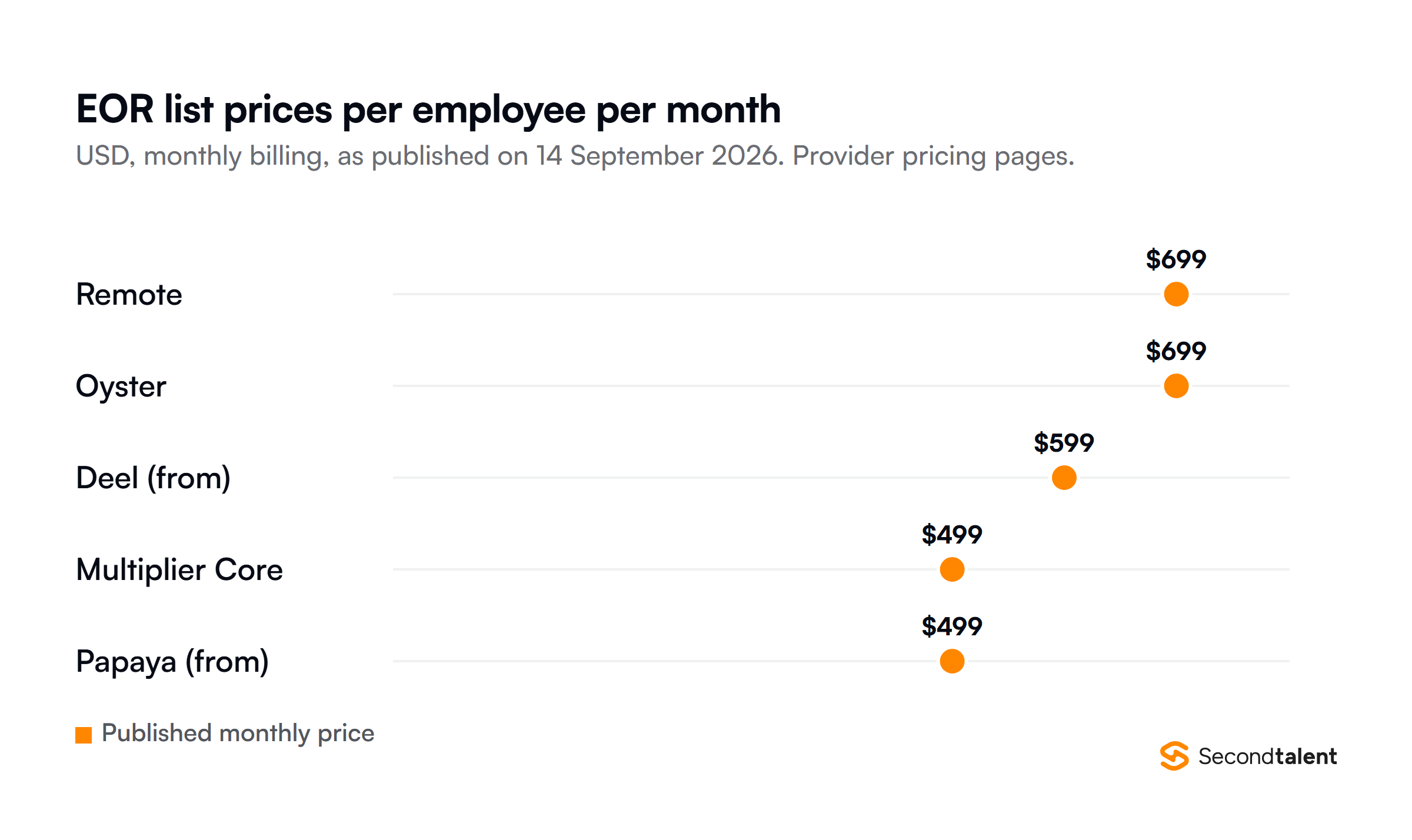
Deel starts at $599 and Oyster lists $699 with annual discounts it does not publish. Multiplier is the only one of the five to print both billing terms: $499 a month on monthly billing, $459 on an annual contract. Papaya Global prices its EOR plan from $499.
- No platform, onboarding or setup fee at Remote
- No setup or onboarding charge at Oyster
- Month-to-month terms at Deel
- The salary and employer contributions themselves
- A refundable deposit at Oyster
- Implementation fees where applicable and a one-off $6 background check at Multiplier
Rippling offers an employer of record service but sends a custom quote instead of publishing a price. An EOR employs engineers you have already found. Our guide to how EOR pricing works has more on what the fees include.
Put a Polish developer at Statistics Poland’s average pay through Deel or Remote and the monthly cost comes to about $5,590 to $5,830, on our calculation. Gross pay plus contributions is PLN 18,630 to 19,130, or $4,990 to $5,130 at September’s exchange rate, before the fee.
Which Costs Do Dedicated Team Quotes Leave Out?
Pay rises arrive each year whether or not the contract mentions them. Aon’s July to September 2025 survey of more than 700 Southeast Asian businesses budgets 2026 salary increases of 7.1% in Vietnam and 5.2% in the Philippines. Expect the vendor to reprice a retainer at renewal.
Attrition is the other recurring cost. Each departure repeats the search, the ramp-up and the handover, and a replacement guarantee covers only a fixed window after the start date. Aon’s figures count all employees across industries, so an engineering team’s own turnover can differ.
Managing a vendor takes client time that no quote shows. Deloitte’s 2024 Global Outsourcing Survey of more than 500 business and technology leaders found the most common problems on the buyer’s side of the contract. Lack of tracking for the benefits an outsourcing deal was meant to deliver led the list, at 55%.
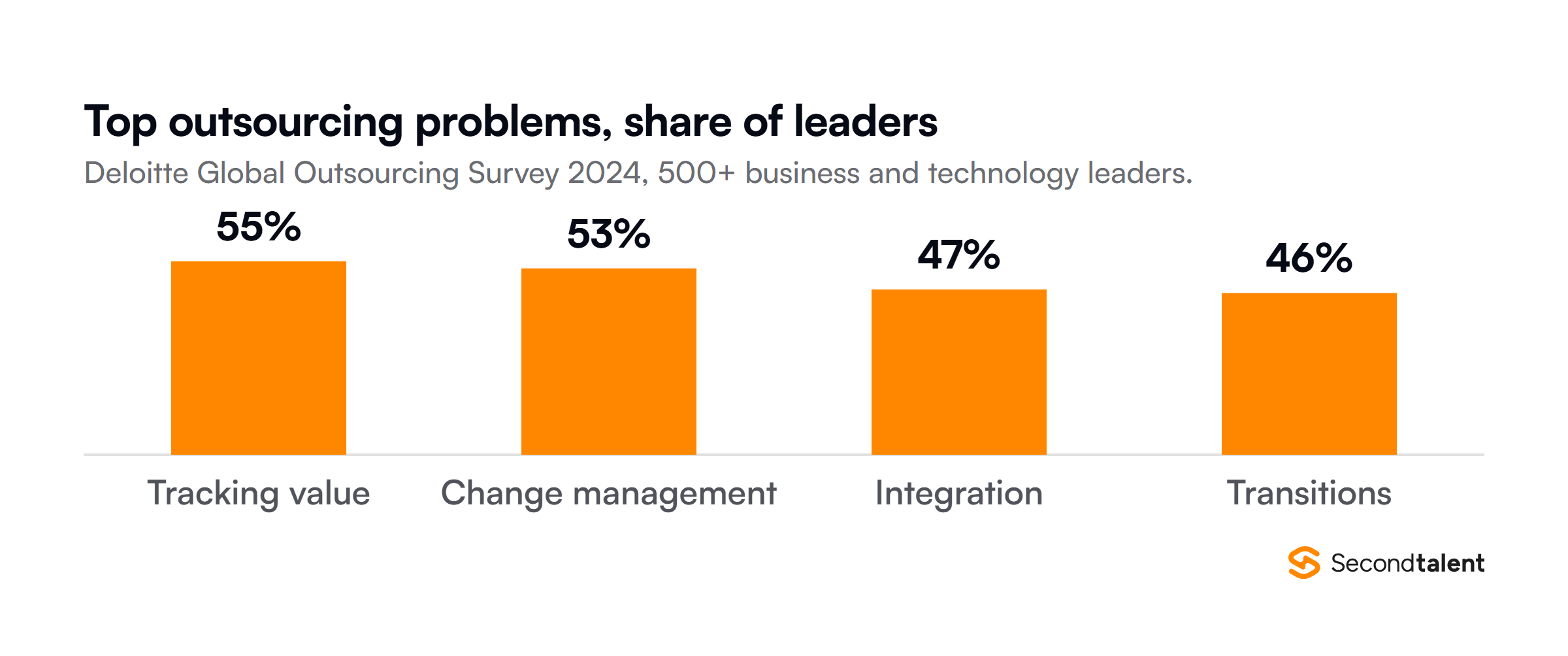
The same survey found 70% of organisations had brought some outsourced work back in-house over five years, and eliminating vendor markups was one of the main reasons given. Only 34% now name cost savings as the main reason to outsource, down from 70% four years before.
Ramp-up is the last line. Accelerance, which matches companies with outsourcing partners, wrote in a 2023 post that “no outsourced team works at 100 percent productivity immediately”. It gives 75 to 100 percent of an internal team’s productivity as the ballpark to aim for.
Pricing a Dedicated Team With Second Talent
Our Developer on Monthly subscription is $2,999 for a new client’s first month, then $4,999, with salary, payroll, taxes, employment through our EOR and equipment inside that one figure. Rates vary by stack and seniority, and our pricing page puts most clients’ savings at 50% to 70% against equivalent US salaries.
Contracts roll monthly with a 90-day replacement guarantee. Our engineers pass a four-stage vetting process that includes a test of how they work with AI coding tools. Browse the developer rate cards for your stack, then tell us the team you want to build and we will send a shortlist within 24 hours.
Frequently Asked Questions
Is a dedicated team cheaper than hiring freelancers?
Per hour, often not: a senior freelancer in Vietnam bills $55 to $80 an hour on our rate card. Across a full-time month of 160 hours that is $8,800 to $12,800, above the $3,000 to $6,000 a month our pricing page lists for a fully loaded engineer.
How many people does a dedicated team need?
No published standard exists. The five-seat example above, three developers with QA and operations support, is one workable shape, and a team can start smaller. Our comparison of dedicated and augmented teams covers when a single added engineer is the better buy.
Do dedicated team prices include taxes and benefits?
A managed subscription can include them, as ours does, so check the contract. Employer of record fees exclude the salary and employer contributions, which the provider bills on top. Fixed-price project quotes include the vendor’s own staff costs but not your internal product time.




![Countries With the Highest Software Engineer Salaries. Top 10 Countries With the Highest Software Engineer Salaries [2026], by Second Talent.](https://www.secondtalent.com/wp-content/uploads/2026/09/countries-with-highest-software-engineer-salaries-featured-v2-768x403.jpg)