
TL;DR: A dedicated 5-person remote engineering team costs $18,000-$29,000/month in Southeast Asia vs. $66,000-$84,000/month in the US. Total savings: 50-70%.
Running a US-based engineering team of five costs $700,000-$8,00,000 per year. Salaries alone account for $570,000-$670,000. Benefits, taxes, tools, and office space push the total higher every quarter.
That number forces hard trade-offs for startups. You hire three engineers instead of five. You skip QA. You delay features. Or you look outside the US for talent.
We have helped startups build dedicated remote engineering teams across Southeast Asia since 2020. The cost difference is not a rounding error.
A five-person team in Vietnam or the Philippines costs 50-70% less than the same team in San Francisco. Same skills. Same output. Different price tag.
This guide breaks down every cost involved in running a dedicated remote engineering team in 2026. By region. By role. By line item. No hidden surprises.
Quick guide: What’s your team budget range?
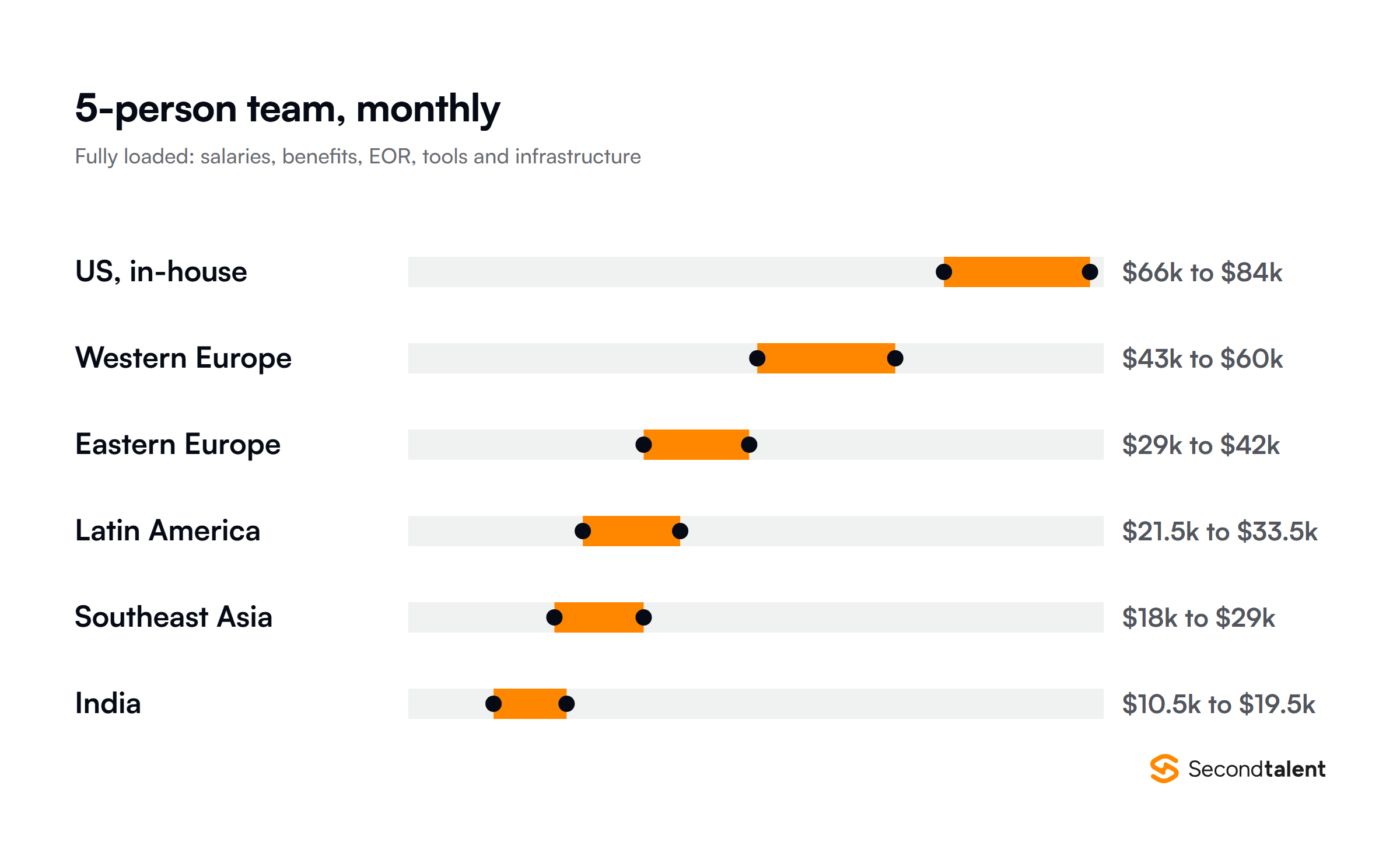
Monthly Cost Overview: 5-Person Remote Engineering Team by Region
This table shows the all-in monthly cost for a typical startup engineering team: 1 Tech Lead, 2 Mid-Level Engineers, 1 Junior Engineer, and 1 QA Engineer. All figures include base salary, benefits, EOR fees, and tools.
| Region | Monthly Base Salary | Benefits + EOR | Tools + Infra | Total Monthly Cost | vs. US In-House |
|---|---|---|---|---|---|
| United States (in-house) | $47,400-$57,000 | $13,200-$16,800 | $550 | $66,000-$84,000 | Baseline |
| Western Europe | $31,200-$44,400 | $9,400-$13,300 | $550 | $43,000-$60,000 | -29% to -35% |
| Eastern Europe | $19,600-$28,000 | $6,900-$10,500 | $550 | $29,000-$42,000 | -50% to -56% |
| Latin America | $14,000-$22,400 | $4,900-$7,800 | $550 | $21,500-$33,500 | -60% to -67% |
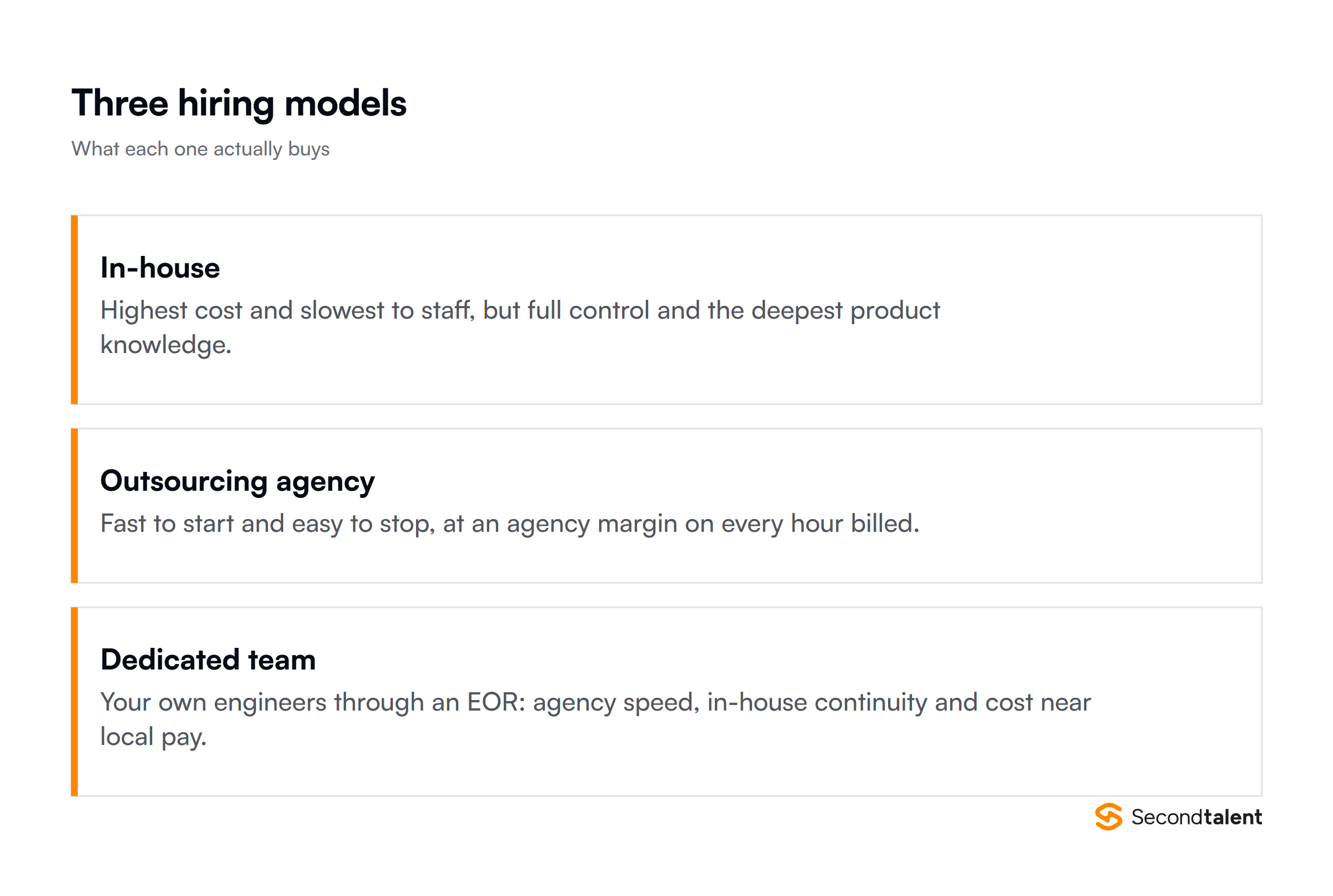
| Southeast Asia | $11,500-$18,200 | $4,500-$7,700 | $550 | $18,000-$29,000 | -65% to -73% |
| India | $5,700-$11,900 | $2,200-$4,800 | $550 | $10,500-$19,500 | -77% to -84% |
Sources: Motion Recruitment 2026 Salary Guide, Index.dev Eastern Europe Developer Salaries, VietnamDevs 2026 Salary Guide, and Second Talent placement data.
The gap is clear. A startup spending $66,000/month on a US team can build the same team in Southeast Asia for $18,000-$29,000. That frees up $37,000-$48,000 per month for product development, marketing, or runway extension.
Team Composition: What Each Role Costs by Region
Not every engineer costs the same. A Tech Lead in Vietnam earns more than a Junior Engineer in Poland. Here is a role-by-role breakdown for remote hires.
Tech Lead / Senior Engineer (5-8+ years)
| Region | Monthly Salary (Remote) | Annual Cost |
|---|---|---|
| United States | $13,000-$22,000 | $156,000-$264,000 |
| Western Europe | $9,000-$14,400 | $108,000-$173,000 |
| Poland | $7,700-$11,200 | $92,400-$134,400 |
| Ukraine | $4,600-$5,900 | $55,200-$70,800 |
| Brazil | $4,200-$7,000 | $50,400-$84,000 |
| Mexico | $4,900-$7,700 | $58,800-$92,400 |
| Vietnam | $3,500-$6,300 | $42,000-$75,600 |
| Philippines | $3,500-$5,900 | $42,000-$70,800 |
| India | $2,100-$4,200 | $25,200-$50,400 |
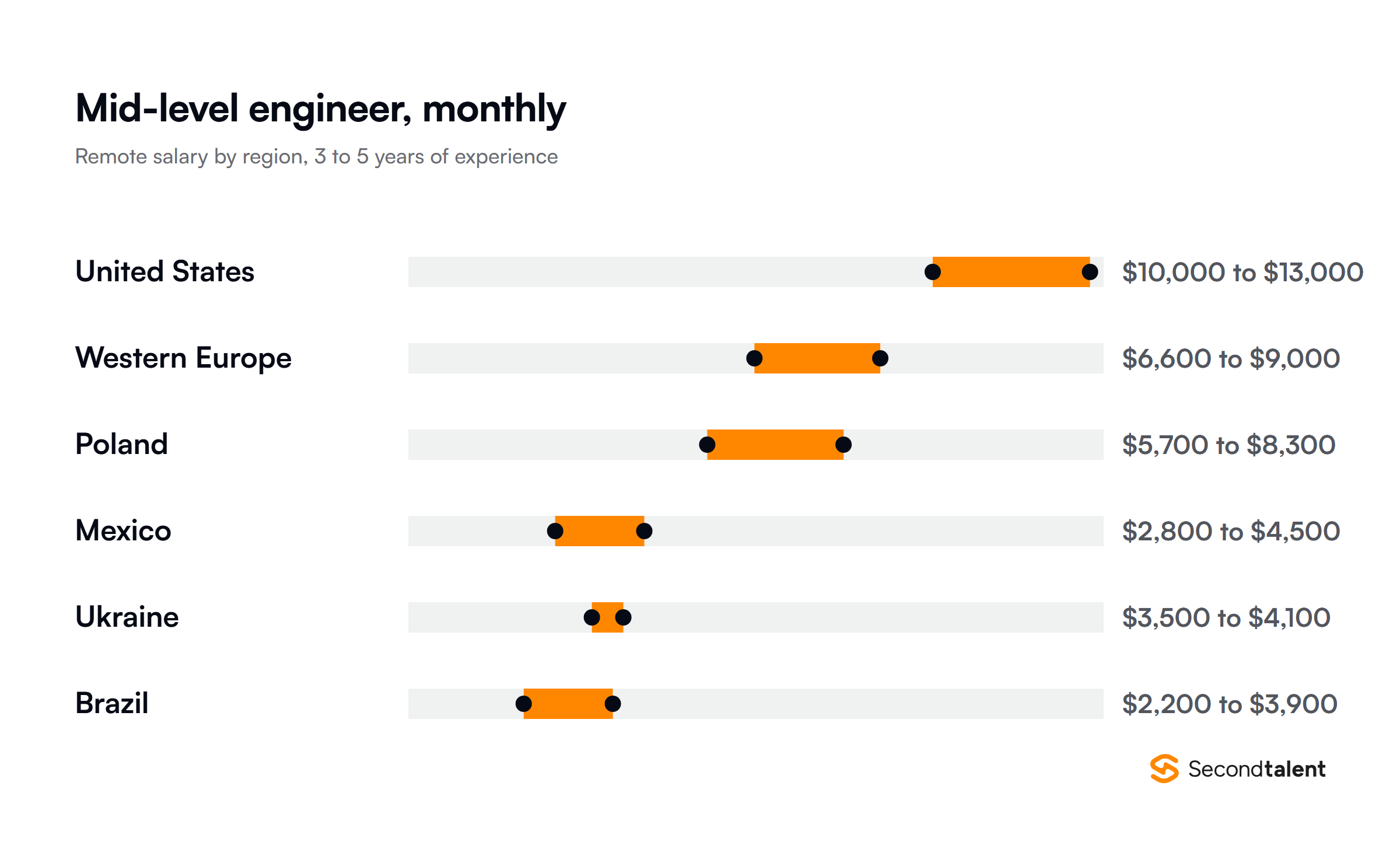
Mid-Level Engineer (3-5 years)
| Region | Monthly Salary (Remote) | Annual Cost |
|---|---|---|
| United States | $10,000-$13,000 | $120,000-$156,000 |
| Western Europe | $6,600-$9,000 | $79,200-$108,000 |
| Poland | $5,700-$8,300 | $68,400-$99,600 |
| Ukraine | $3,500-$4,100 | $42,000-$49,200 |
| Brazil | $2,200-$3,900 | $26,400-$46,800 |
| Mexico | $2,800-$4,500 | $33,600-$54,000 |
| Vietnam | $2,100-$3,500 | $25,200-$42,000 |
| Philippines | $2,100-$3,900 | $25,200-$46,800 |
| India | $1,000-$2,500 | $12,000-$30,000 |
Junior Engineer (1-3 years)
| Region | Monthly Salary (Remote) | Annual Cost |
|---|---|---|
| United States | $7,000-$9,000 | $84,000-$108,000 |
| Western Europe | $4,200-$6,000 | $50,400-$72,000 |
| Poland | $3,000-$4,500 | $36,000-$54,000 |
| Ukraine | $2,100-$2,400 | $25,200-$28,800 |
| Brazil | $1,100-$2,000 | $13,200-$24,000 |
| Vietnam | $1,100-$1,700 | $13,200-$20,400 |
| Philippines | $1,100-$2,000 | $13,200-$24,000 |
| India | $600-$1,000 | $7,200-$12,000 |
QA Engineer (2-5 years)
| Region | Monthly Salary (Remote) | Annual Cost |
|---|---|---|
| United States | $7,000-$10,000 | $84,000-$120,000 |
| Western Europe | $4,800-$7,200 | $57,600-$86,400 |
| Poland | $2,800-$4,500 | $33,600-$54,000 |
| Ukraine | $2,100-$3,500 | $25,200-$42,000 |
| Brazil | $1,700-$3,100 | $20,400-$37,200 |
| Vietnam | $900-$2,400 | $10,800-$28,800 |
| Philippines | $1,200-$2,500 | $14,400-$30,000 |
| India | $700-$1,700 | $8,400-$20,400 |
We worked with a Series A SaaS startup that needed a full backend team. They budgeted $250,000 per year. In the US, that covers one senior engineer.
We built them a 5-person team in Vietnam: a Tech Lead, two mid-level engineers, a junior engineer, and a QA engineer. They shipped their v2 product in four months.
Hidden Costs: What You Pay Beyond Salaries
Salaries are 60-70% of the total cost. The rest comes from tools, compliance, management, and onboarding. Startups that ignore these costs end up 20-30% over budget.
Development Tools and Infrastructure
| Tool | Cost Per Developer/Month | 5-Person Team/Month |
|---|---|---|
| GitHub Team | $4 | $20 |
| Jira Standard | $8 | $40 |
| Slack Pro | $7 | $35 |
| AWS (dev environment) | $30-$50 | $150-$250 |
| CI/CD (GitHub Actions) | $10-$20 | $50-$100 |
| Monitoring (Sentry/Datadog) | $15-$30 | $75-$150 |
| IDE Licenses | $10-$25 | $50-$125 |
| Total | $84-$164 | $420-$720 |
Tools cost the same whether your team is in San Francisco or Ho Chi Minh City. Budget $500-$700 per month for a 5-person team. This is a fixed cost that does not scale with location.
Employer of Record (EOR) Fees
You cannot hire a full-time employee in Vietnam or Poland without a legal entity there. An Employer of Record (EOR) solves this. The EOR becomes the legal employer. You manage the work.
EOR fees in 2026 range from $300-$700 per employee per month. According to Gloroots’ 2026 EOR pricing guide, the industry average is $400-$600 per employee. Some providers charge a percentage of salary instead.
That model costs 10-25% of gross pay.
For a 5-person team, budget $1,500-$3,500 per month in EOR fees. That adds $18,000-$42,000 per year. It sounds like a lot.
But it replaces the cost of setting up a foreign subsidiary, which runs $20,000-$50,000 upfront plus $10,000-$20,000 per year in maintenance.
Benefits and Statutory Costs
Every country has mandatory benefits. Social insurance. Health coverage. Pension contributions. Holiday pay. These vary by location.
- United States: Add 25-35% on top of salary for benefits, payroll taxes, and insurance.
- Southeast Asia: Add 15-25% for statutory benefits. Vietnam requires social insurance contributions of roughly 21% from the employer.
- Eastern Europe: Add 20-30%. Poland has employer social contributions around 20%.
- Latin America: Add 25-40%. Brazil has some of the highest employer-side costs in the world at 30-40%.
- India: Add 15-20% for Provident Fund, gratuity, and insurance.
Most EOR providers handle these payments. The costs are included in their fee structure or added as a line item. Always ask for a full cost breakdown before signing.
Management Overhead
Remote teams need management. Someone has to run standups, review code, unblock developers, and align priorities. For a 5-person team, you have two options.
Option 1: Your existing CTO or engineering manager leads the team. This costs nothing extra in salary. But it takes 5-10 hours per week of their time. That is time not spent on architecture, strategy, or hiring.
Option 2: Hire a dedicated project coordinator or engineering manager. A remote engineering manager in Southeast Asia costs $2,800-$5,600 per month. In Eastern Europe, $4,900-$8,400. In the US, $14,400-$21,600.
We recommend Option 1 for teams under 8 engineers. The Tech Lead on the remote team handles day-to-day coordination. Your CTO sets direction in a weekly sync.
One startup we placed a team for ran this model for 18 months before hiring a dedicated EM.
Onboarding Costs (One-Time)
New engineers take time to become productive. According to Whatfix’s 2026 onboarding study, the average US onboarding cost per software engineer is $19,000-$30,000. Remote teams cost less to onboard. No relocation. No office setup.
But ramp-up time is similar.
Budget 4-8 weeks for a new remote engineer to reach full productivity. During weeks 1-2, expect 25% output. By week 4, most engineers hit 60-75%. Full productivity comes at 6-8 weeks for well-documented codebases.
Hardware costs $500-$1,500 per remote engineer. Most remote developers have their own setup. Some companies provide a laptop stipend. A MacBook Air shipped to Vietnam costs less than outfitting a desk in a US office.
Southeast Asia: The Best Value for Dedicated Teams
Southeast Asia offers the strongest combination of cost, talent quality, and timezone overlap for companies in the US, Europe, and Australia. Here is how the four main markets compare.
| Factor | Vietnam | Philippines | Indonesia | Malaysia |
|---|---|---|---|---|
| 5-Person Team Monthly Cost | $18,200-$25,200 | $17,500-$24,500 | $14,700-$21,000 | $19,600-$26,600 |
| English Proficiency | Good (improving fast) | Excellent (native-level) | Moderate | Very Good |
| Developer Talent Pool | Large (growing 15% YoY) | Very Large | Large | Medium-Large |
| Top Frameworks | React, Node.js, Laravel, Python | React, Laravel, Node.js, .NET | Java, Laravel, React, Go | Java, React, Laravel, Spring |
| Timezone (GMT) | +7 | +8 | +7 | +8 |
| Salary Growth (Annual) | 8-12% | 6-10% | 7-10% | 5-8% |
| Turnover Risk | Low-Medium | Medium | Low-Medium | Low |
Vietnam is our strongest market for engineering teams. Ho Chi Minh City and Hanoi have deep pools of React, Node.js, and Python developers. Vietnamese engineers are known for strong technical skills and low turnover.
Salaries are rising 8-12% per year. But they started low enough that Vietnam remains cost-competitive for several more years. We have placed over 100 developers from Vietnam. See our Vietnam hiring page for details.
Philippines has the best English proficiency in the region. Communication is smooth from day one. The talent pool is massive. Turnover is slightly higher than Vietnam because of competition from BPO companies and other remote employers.
Rates are similar to Vietnam. See our Philippines hiring page.
Indonesia offers the lowest rates. Jakarta has a growing tech ecosystem. The trade-off is English proficiency. Plan for a bilingual team lead if your team runs standups in English.
Indonesian developers excel in Java, Go, and mobile development.
Malaysia has the most mature tech market in the region. Kuala Lumpur developers have enterprise experience. English is strong. Rates are 10-15% higher than Vietnam.
Best for teams that need Java, Spring, or enterprise integration experience.
Three Hiring Models Compared: In-House vs. Outsource Agency vs. Dedicated Remote Team
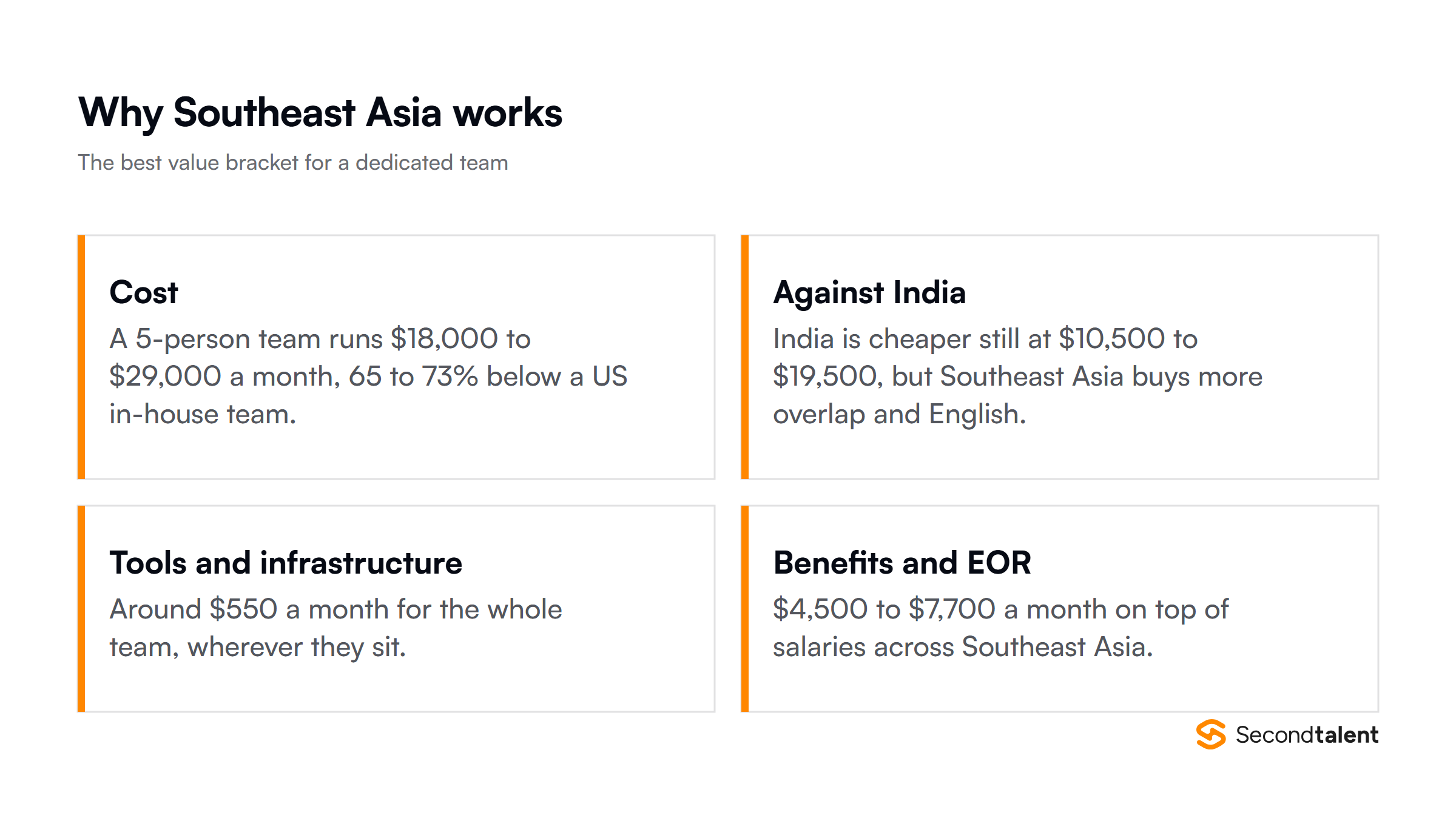
Not all remote hiring is the same. The model you choose affects cost, control, and quality. Here is a side-by-side comparison for a 5-person team.
| Factor | US In-House | Outsource Agency | Dedicated Remote Team |
|---|---|---|---|
| Monthly Cost | $66,000-$84,000 | $48,000-$90,000 | $18,000-$29,000 |
| Annual Cost | $792,000-$1,008,000 | $576,000-$1,080,000 | $216,000-$348,000 |
| You Pick the Engineers | Yes | No (agency assigns) | Yes |
| Engineers Work Only for You | Yes | No (shared resources) | Yes |
| IP Ownership | Full | Contract-dependent | Full |
| Direct Communication | Yes | Through PM layer | Yes |
| Scalability | Slow (3-6 month hiring) | Fast (1-2 weeks) | Medium (2-4 weeks) |
| Turnover Risk | Medium | High (agency rotates) | Low |
| Management Overhead | Low | Medium | Medium |
Agency outsourcing looks cheap on paper. But agencies mark up developer rates by 40-100%. A developer earning $2,800/month in Vietnam gets billed to you at $5,600-$8,400. The agency also rotates developers between projects.
Your “dedicated” team might work on three other clients’ code the same week.
A dedicated remote team is different. You interview and select each engineer. They work full-time on your product. They join your Slack, attend your standups, and push to your repos. The only difference from an in-house team is location.
According to DemandSage’s 2026 outsourcing report, 77% of businesses now outsource at least one IT function. The global IT outsourcing market is projected to reach $812 billion by 2029.
But the trend is shifting from agency outsourcing toward dedicated remote teams. Companies want control over their engineers without paying US salaries.
Real Cost Scenario: Building a 5-Person Team in Vietnam
Here is a real example from a client we worked with in 2025. A Series A startup building a B2B SaaS platform. They needed to scale from 2 engineers to 7 without burning through their $4M raise.
Monthly Cost Breakdown
| Line Item | Monthly Cost |
|---|---|
| Tech Lead (6 years exp, React + Node.js) | $5,300 |
| Mid-Level Engineer #1 (4 years, Python + Django) | $3,100 |
| Mid-Level Engineer #2 (3 years, React + TypeScript) | $2,800 |
| Junior Engineer (1.5 years, Full-stack) | $1,400 |
| QA Engineer (3 years, Manual + Automation) | $2,000 |
| Subtotal: Salaries | $14,600 |
| EOR Fees (5 x $450) | $2,250 |
| Statutory Benefits (20% avg) | $2,920 |
| Tools (GitHub, Jira, Slack, AWS dev) | $550 |
| Hardware Stipend (amortized) | $250 |
| Total Monthly Cost | $20,570 |
| Total Annual Cost | $246,840 |
The same team in the US would cost $792,000-$900,000 per year. This startup saved roughly $650,000 in year one. They used part of that to hire a US-based product manager and invest in better CI/CD infrastructure.
What Drives the Cost Difference
Three factors explain why remote engineering teams in Asia cost 50-70% less.
1. Cost of living. A mid-level engineer in Ho Chi Minh City earning $3,100/month has strong purchasing power. That salary is 3-4x the local median. The same engineer in San Francisco earning $12,000/month is below the city median.
You are not underpaying Asian engineers. You are paying competitive local rates in markets with lower living costs.
2. No US benefits burden. US employers pay 25-35% on top of salary for health insurance, 401(k) matching, payroll taxes, and PTO. In Vietnam, statutory benefits add 15-25%.
Health insurance costs $50-$150/month per person vs. $500-$1,500 in the US.
3. No office overhead. Remote teams eliminate office leases. A desk in a San Francisco co-working space costs $600-$1,000/month. Multiply that by five. A remote team needs $0 in office costs.
Some companies provide a $50-$100/month co-working stipend. That is optional.
Risks and How to Manage Them
Remote teams are not free of challenges. Here are the real risks and how to handle them.
Timezone gaps. Southeast Asia is 11-15 hours ahead of US West Coast. That limits real-time overlap to 2-4 hours. We recommend scheduling overlap from 8-10 AM Vietnam time (5-7 PM US Pacific). Async communication handles the rest.
Use Loom for walkthroughs. Use Linear or Jira for task tracking. One client told us they actually ship faster because engineers work while the US team sleeps.
Communication quality. English proficiency varies. Philippines and Malaysia have strong English. Vietnam is improving fast but some engineers need support. Always run a 30-minute English interview before hiring.
Test written communication too. Most remote work happens in writing.
Retention. The remote talent market in Southeast Asia is competitive. Developers with good English and modern skills get offers regularly. Pay at or above remote-market rates.
Underpaying by $200-$300/month to save costs leads to turnover that costs $15,000-$25,000 to replace.
IP protection. Use proper employment contracts through your EOR. Include IP assignment clauses, NDAs, and non-compete agreements. Most Southeast Asian countries have enforceable IP protection laws. Your EOR handles local compliance.
How AI Is Changing Remote Team Economics
AI coding tools are reshaping the cost equation. Gartner predicts AI-native platforms will reduce engineering team sizes by up to 80% by 2030. That prediction is aggressive. But the direction is clear.
Developers using GitHub Copilot, Cursor, and Claude Code report 25-50% productivity gains on routine tasks. One developer we placed said his code review time dropped by half after using Copilot.
Another said she writes boilerplate 3x faster.
This means a 5-person remote team with AI tools can deliver what a 7-8 person team delivered two years ago. The cost savings compound. You pay less per engineer AND each engineer produces more.
According to Deloitte’s 2024 Global Outsourcing Survey, 87% of HR leaders plan to adopt AI as part of outsourced services. The smart play is combining remote talent with AI tools. That is where the real leverage is.
How to Get Started
Define Your Team Structure First
Decide how many engineers you need and at what level. A common mistake is hiring five mid-level engineers. Better to hire one strong Tech Lead and build around them. The Tech Lead sets code standards, reviews PRs, and mentors juniors.
That structure scales.
Choose Your Region Based on Priorities
If cost is the top priority: Vietnam or Philippines. If timezone overlap with the US matters most: Latin America. If you need enterprise Java or .NET experience: Eastern Europe.
If English proficiency is non-negotiable: Philippines or Malaysia.
Start With 2-3 Engineers, Then Scale
Do not hire a full team on day one. Start with a Tech Lead and one mid-level engineer. Validate the workflow for 4-6 weeks. Then add the rest. This reduces risk and lets you refine your remote management process.
Use an EOR or Talent Partner
Setting up a foreign subsidiary takes months and costs $20,000-$50,000. An EOR lets you hire in days. A talent sourcing partner finds and vets candidates so you do not spend weeks screening.
Check the Asia Tech Salary Index for current benchmarks across the region.
The Bottom Line
A dedicated remote engineering team of five costs $18,000-$29,000 per month in Southeast Asia. The same team in the US costs $66,000-$84,000. That is a 50-70% savings with no loss in output quality.
The hidden costs are real but manageable. EOR fees, tools, benefits, and onboarding add 30-40% on top of base salaries. Even fully loaded, a Southeast Asian team costs less than two US engineers.
The companies getting the most value are not just cutting costs. They are reinvesting the savings into product, go-to-market, and better tooling. A $600,000 annual saving buys a lot of runway.
Remote engineering teams are not a temporary trend. According to Statista, the global IT outsourcing market grows 8% annually. The shift from agency outsourcing to dedicated remote teams is accelerating.
Startups that build this muscle early have a structural cost advantage.
Hire vetted remote engineers with Second Talent to build your dedicated engineering team at 50-70% lower cost than US hires.