
TL;DR: Hong Kong has the lightest statutory employer burden in the region. The Mandatory Provident Fund is the whole of it: 5% from each side, capped at HK$1,500 a month per party. Because that cap is an absolute figure rather than a percentage, employer cost stops growing above a HK$30,000 salary, so a senior hire carries under 2%. Three things changed for 2026: the 418 rule became the 468 rule on 18 January, the minimum wage rose to HK$43.1 on 1 May, and MPF offsetting against severance ended in May 2025.
We employ staff in Hong Kong through our own entity, so these are the numbers we run every month. This guide covers what you owe, what your employee takes home, and the three rule changes that landed while most cost models were not looking.
Download the full guide as a PDF at the end, or read on.
What employing someone in Hong Kong costs
Add 5% of salary, and stop at HK$1,500 a month. That is the employer MPF contribution, and it is the entire statutory employer cost. There is no social security tax, no unemployment insurance and no training levy.
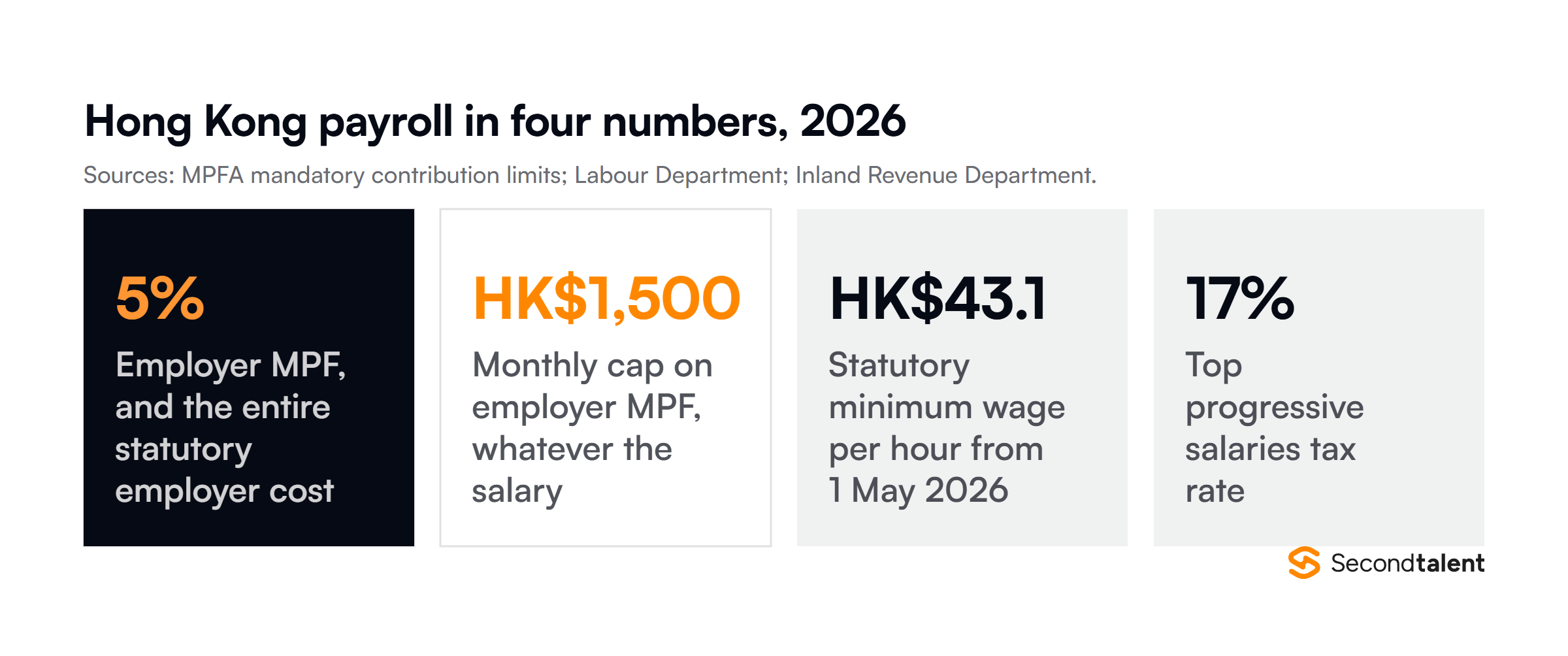
The cap is what makes Hong Kong different. MPF applies to monthly relevant income between HK$7,100 and HK$30,000, so contributions stop rising once salary passes HK$30,000.
Below HK$7,100 a month the employee is exempt from their own contribution, but the employer still pays 5%. Above HK$30,000 both sides sit at HK$1,500 and stay there, whatever the salary.
What a hire actually costs
Two worked examples, both for a tax resident with the basic allowance and no other reliefs, using 2026 MPF limits and the current salaries tax schedule.
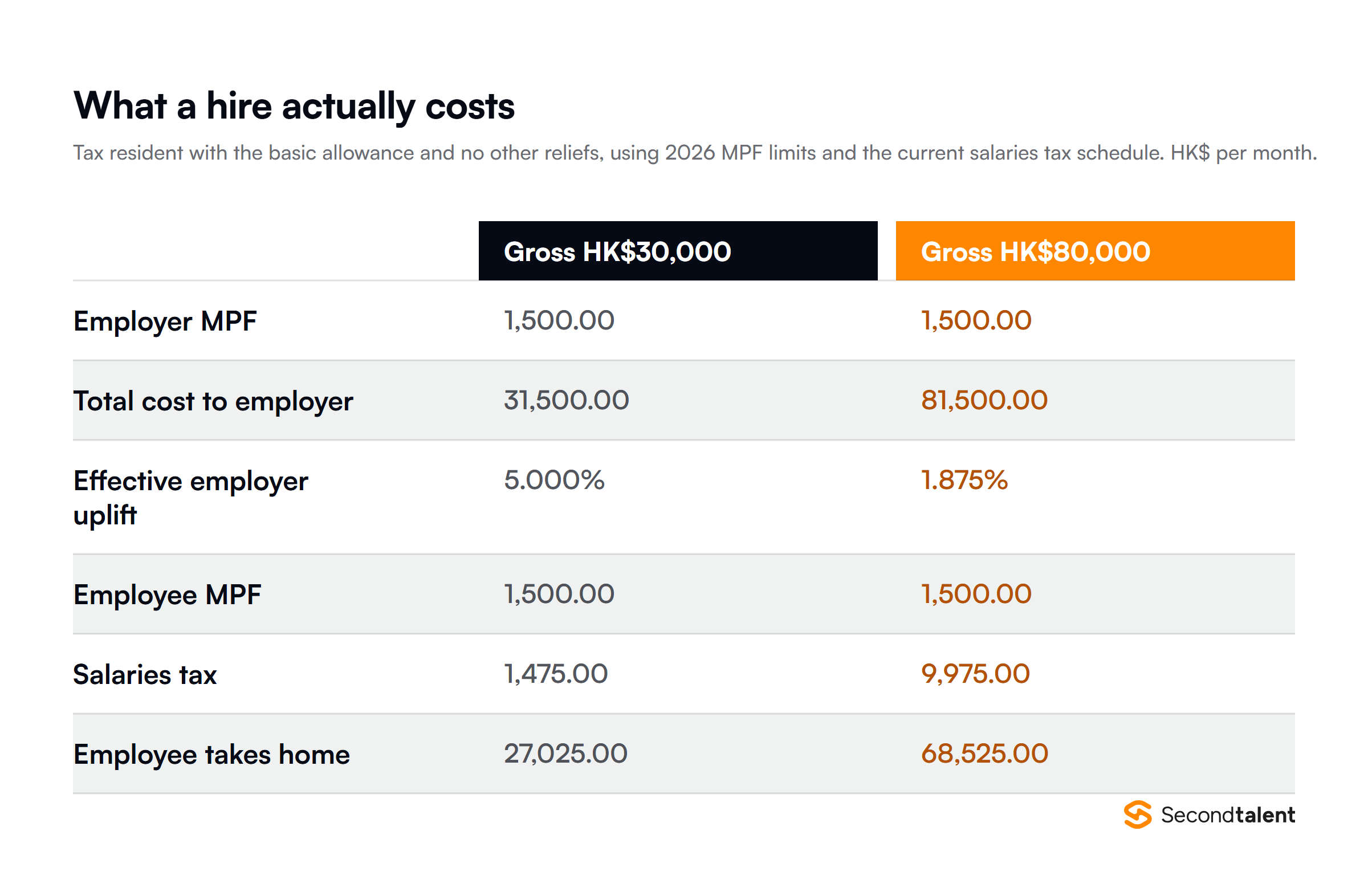
The effective employer uplift falls from 5% to under 2% as salary rises. In cash terms the employer pays exactly the same HK$1,500 for a HK$30,000 hire and a HK$300,000 one.
That makes Hong Kong the cheapest market in the region to employ senior staff on a statutory basis. It also means your budget model should treat employer contributions as a flat line, not a percentage.
Our EOR cost calculator models the full stack, and the Hong Kong EOR page covers what we handle on your behalf.
Salaries tax: you pay the lower of two calculations
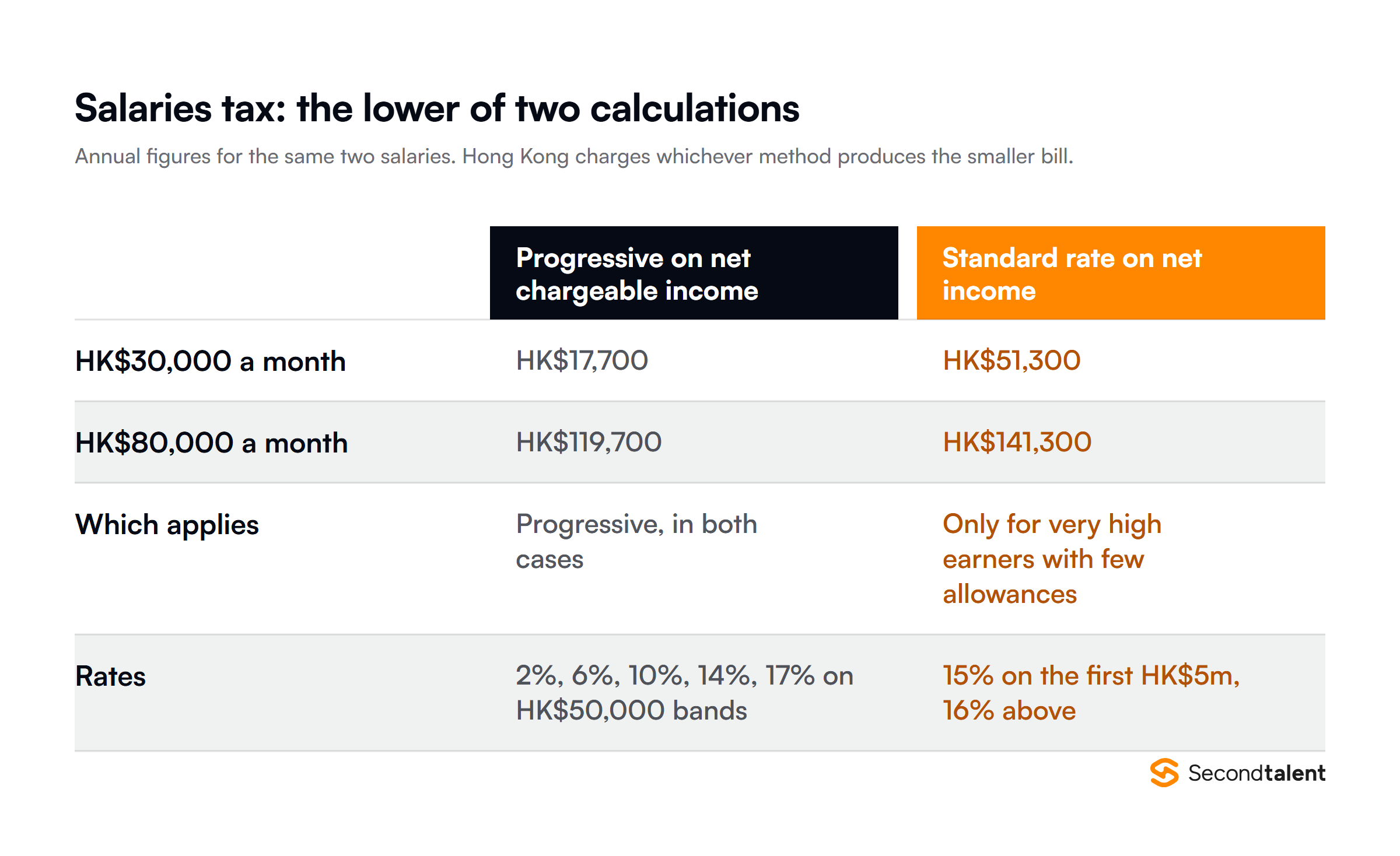
Hong Kong charges the lower of two figures, which is unusual and works in the taxpayer’s favour. One is progressive rates on income after allowances. The other is a standard rate on income before allowances.
| Net chargeable income (HK$) | Progressive rate |
|---|---|
| First 50,000 | 2% |
| Next 50,000 | 6% |
| Next 50,000 | 10% |
| Next 50,000 | 14% |
| Remainder | 17% |
The basic personal allowance is HK$132,000, and employee MPF contributions are deductible up to HK$18,000 a year. Only very high earners with few allowances land on the standard rate.
There is no monthly withholding
Employers do not deduct salaries tax from payroll. Employees file and pay their own tax directly. Your obligation is reporting: file the Employer’s Return each April, and file Form IR56G and withhold payments for one month before a departing employee leaves Hong Kong.
What changed in 2025 and 2026
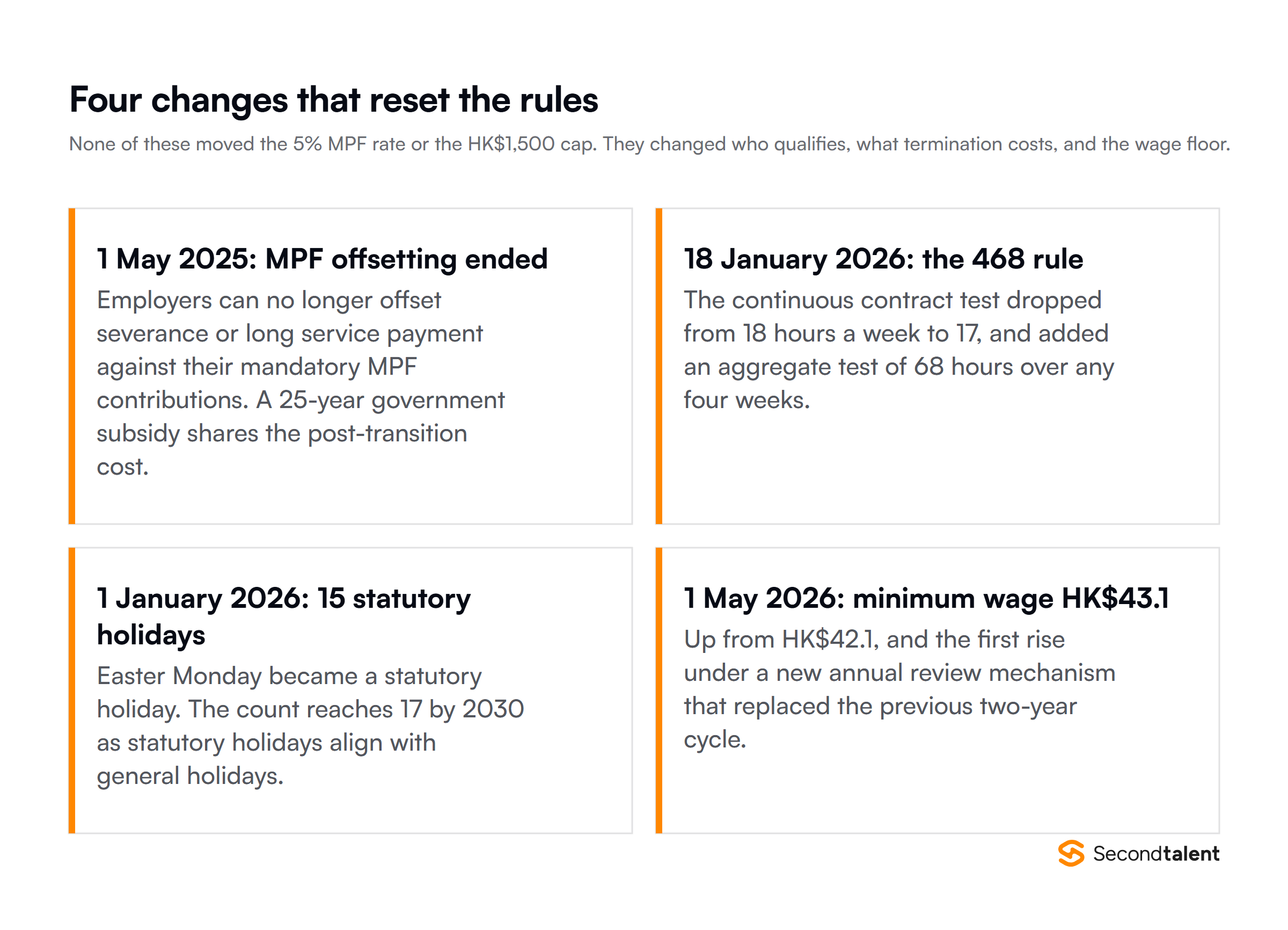
None of these moved the 5% MPF rate or the HK$1,500 cap. They changed who qualifies for statutory benefits, what termination costs, and the wage floor.
The 468 rule replaced the 418 rule
From 18 January 2026, more employees qualify as being on a continuous contract, which is the gateway to most statutory entitlements including paid annual leave, sickness allowance, severance and long service payment.
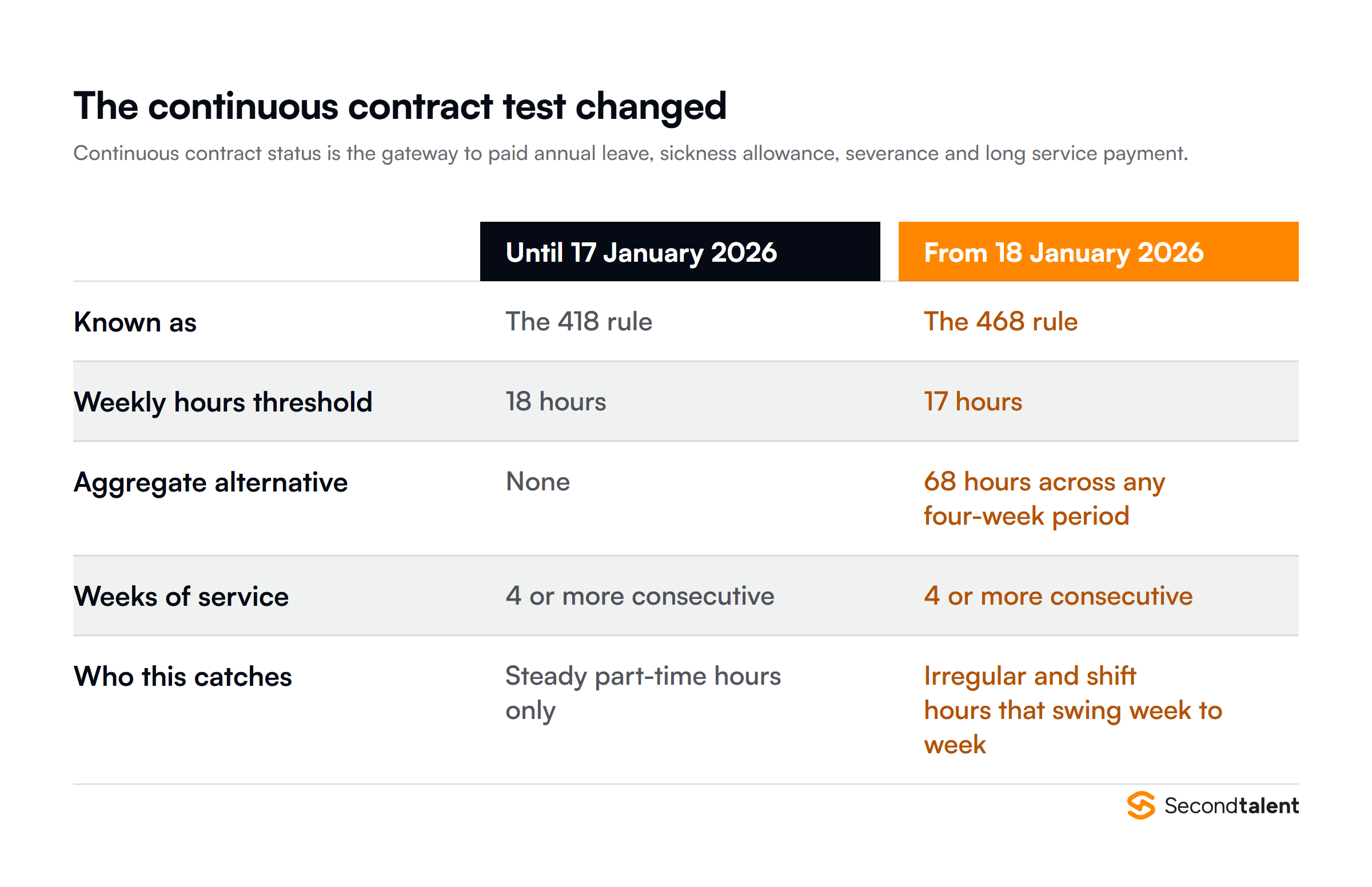
The aggregate test is the substantive change. An employee whose hours swing week to week can now qualify on a four-week total even if no single week reaches the threshold, which the old rule never captured.
Audit part-time, shift and irregular-hours staff against the new test rather than assuming last year’s classification holds. ONC’s note on the amendment sets out the detail.
Severance, long service payment and the end of MPF offsetting
This is the change with the biggest cost consequence. Since 1 May 2025, employers can no longer use accrued benefits from their mandatory MPF contributions to offset severance payment or long service payment.
Before that date the offset made termination cheap for many employers, because the MPF pot absorbed most of the liability. Now the post-transition portion is a real cash cost.
- Severance payment: for employees with 24 months or more of continuous service who are made redundant or laid off.
- Long service payment: for employees with 5 years or more of continuous service, on other qualifying terminations.
- Formula: two-thirds of a month’s wages per year of service, with the monthly wage figure capped at HK$22,500, and a total cap of HK$390,000.
- Still available to offset: accrued benefits from employers’ voluntary MPF contributions and contractual gratuities based on years of service.
The government runs a 25-year subsidy scheme that shares the post-transition cost, with a capped employer contribution in the early years. Model termination cost with the subsidy, not without it, or you will over-provision.
Notice and termination
Notice follows the contract, subject to a statutory floor. For an employee on a continuous contract the minimum is 7 days, and where the contract is silent the default is one month. Either side may pay wages in lieu.
Probation runs on its own rules. During the first month of probation neither side needs to give notice at all. After that first month, 7 days applies unless the contract sets a longer period.
Hong Kong is more employer-friendly on termination than Malaysia or Vietnam, with no requirement to establish a statutory ground. Specific protections still bite: you cannot dismiss an employee because of pregnancy, paid sick leave, a work injury claim, jury service or trade union membership.
Minimum wage and working hours
The statutory minimum wage rose to HK$43.1 an hour on 1 May 2026, up from HK$42.1. It is the first rise under a new annual review mechanism that replaced the previous two-year cycle.
Expect a review every year now rather than every other year, which makes the minimum wage a recurring budget line rather than an occasional one. There is no statutory cap on working hours and no statutory overtime premium.
Overtime pay is a matter of contract. Rest days are not: an employee on a continuous contract is entitled to at least one rest day in every period of seven days.
Leave entitlements
- Annual leave: 7 days after 12 months of service, rising by one day per year to a maximum of 14 days at nine years.
- Statutory holidays: 15 days in 2026, with Easter Monday added from 1 January. The count reaches 17 by 2030 as it aligns with general holidays.
- Sickness allowance: four-fifths of average daily wages, payable from accumulated paid sickness days for absences of four consecutive days or more.
- Maternity leave: 14 weeks. Weeks 11 to 14 are capped at HK$80,000 in total, and the employer can reclaim that portion from the government.
- Paternity leave: 5 days for employees with at least 40 weeks of continuous service.
Statutory annual leave is thin against market practice. Most professional employers in Hong Kong offer 15 to 20 days from day one, so treat the statutory floor as a legal minimum rather than a benchmark.
Benefits beyond the statutory minimum
Hong Kong’s public hospital system is heavily subsidised, and there is no statutory requirement to provide medical insurance. Private cover is nonetheless close to universal for professional roles, because waiting times drive candidates to expect it.
- Medical and dental insurance: expected at professional and technical levels, often extended to dependants at senior grades.
- Voluntary MPF contributions: a common top-up above the HK$1,500 cap, and one of the few employer benefits that can still offset severance liability.
- Annual bonus: not statutory in general, though an end-of-year payment becomes contractual once the practice is established. Check what your contracts actually promise.
- Housing and education allowances: common for relocated senior hires, and worth structuring carefully because housing benefits are taxed on a favourable basis.
Employing foreign nationals
Hong Kong runs no quota on skilled employment visas and sets no fixed minimum salary, which makes it more open than Singapore or Malaysia. The test is whether pay is broadly in line with the local market for the role.
- General Employment Policy: the standard employer-sponsored route. Needs a confirmed offer from a Hong Kong registered employer, a degree or strong technical credentials, market-rate pay, and skills not readily available locally.
- Top Talent Pass Scheme: a 24-month visa with no job offer required, for people who earned HK$2.5 million or more in the preceding year, or who graduated from a listed university. The eligible institution list grew to 200 from 1 January 2026.
- Extensions: from 1 March 2026, holders can apply up to three months before expiry rather than four weeks, which removes a common scramble.
The Top Talent route matters for hiring plans because the candidate arrives already permitted to work. You are recruiting from a pool that does not need you to sponsor anything, which shortens time to start considerably.
Registering and running payroll
- Enrol every eligible employee in an MPF scheme within 60 days of the start date, and make the first contribution accordingly.
- Pay wages within 7 days of the end of the wage period.
- Remit MPF contributions by the 10th day of the following month.
- File the Employer’s Return, forms BIR56A and IR56B, within one month of issue each April.
- File Form IR56G one month before a foreign employee leaves Hong Kong, and withhold payments until the Inland Revenue Department issues clearance.
Check which platform your MPF scheme sits on before setting up submissions. Schemes are migrating in stages to the centralised eMPF Platform, and the submission route differs depending on whether yours has moved across yet.
Keep an eye on one live proposal. The MPF authority consulted in March 2026 on raising the contribution income limits to a HK$10,500 minimum and a HK$40,000 maximum, which would lift the monthly cap from HK$1,500 to HK$2,000. It is not law yet, and it is the single change most likely to move your Hong Kong cost model.
Frequently asked questions
What is the total employer cost of hiring in Hong Kong?
Gross salary plus 5% employer MPF, capped at HK$1,500 a month. There is no other statutory employer contribution, which makes Hong Kong the lightest statutory burden in the region, especially for senior salaries.
Do foreign employees pay MPF in Hong Kong?
Usually yes. MPF applies regardless of nationality, unlike Singapore’s CPF. The main exemptions are employees entering Hong Kong to work for 13 months or less, and those already covered by an overseas retirement scheme.
What is the 468 rule?
The test for whether an employee is on a continuous contract, in force from 18 January 2026. An employee qualifies after four weeks with the same employer if they work 17 hours in a week, or 68 hours aggregated across any four-week period.
It replaced the 418 rule, which required 18 hours in each of four consecutive weeks. The change brings many part-time and irregular-hours employees into statutory entitlements for the first time.
Can employers still offset severance against MPF?
Not against mandatory contributions, since 1 May 2025. Accrued benefits from employers’ voluntary MPF contributions and service-based gratuities can still offset severance and long service payment, and a government subsidy scheme shares the post-transition cost.
Can I pay a Hong Kong employee without a local entity?
Not directly. MPF enrolment and the Employer’s Return both require a registered local employer. An employer of record in Hong Kong holds the contract on its own entity and handles the filings.
Our EOR versus entity calculator models the crossover, and the Hong Kong EOR provider comparison covers the local market. If you are assessing the wider market first, our roundup of tech startups in Hong Kong is a useful read.
Key takeaways
- Employer MPF at 5%, capped at HK$1,500 a month, is the entire statutory employer cost.
- Because the cap is absolute, employer uplift falls from 5% at HK$30,000 to under 2% at HK$80,000.
- MPF offsetting against severance ended on 1 May 2025. Termination now costs real cash, partly subsidised.
- The 468 rule from 18 January 2026 brings more part-time staff into statutory entitlements. Re-audit them.
- Watch the MPF threshold proposal: a HK$40,000 ceiling would lift the monthly cap to HK$2,000.
Download this guide as a PDF
The full 2026 Hong Kong payroll, benefits and tax guide, including MPF limits, the two salaries tax calculations, the 468 rule, severance after the offset abolition and both worked examples, formatted for sharing with your finance team.
Hiring in Hong Kong?
Second Talent employs staff in Hong Kong on our own entity and handles contracts, MPF enrolment, payroll and the Employer’s Return, so the rules above become our problem rather than yours. We also source the candidates. Tell us the role and we will come back with candidates and a full employment cost.
This guide is general information, current as at the date of publication, and is not tax or legal advice. The MPF contribution thresholds are under active review and the minimum wage now moves annually. Confirm your position with a qualified adviser before acting.

![How to Hire Developers in Asia Remotely. How to Hire Developers in Asia Remotely from the USA [2026], by Second Talent.](https://www.secondtalent.com/wp-content/uploads/2026/09/hire-developers-in-asia-remotely-featured-v2-768x403.jpg)
![AI Outsourcing in Singapore. Top 10 AI Outsourcing Companies in Singapore [2026], by Second Talent.](https://www.secondtalent.com/wp-content/uploads/2026/09/ai-outsourcing-companies-singapore-featured-v2-768x403.jpg)
![AI Outsourcing in India. Top 10 AI Outsourcing Companies in India [2026], by Second Talent.](https://www.secondtalent.com/wp-content/uploads/2026/09/ai-outsourcing-companies-india-featured-v2-768x403.jpg)
![AI Outsourcing in the Philippines. Top 10 AI Outsourcing Companies in the Philippines [2026], by Second Talent.](https://www.secondtalent.com/wp-content/uploads/2026/09/ai-outsourcing-companies-philippines-featured-v2-768x403.jpg)

![Software Development Outsourcing in Vietnam. Top 10 Software Development Outsourcing Companies in Vietnam [2026], by Second Talent.](https://www.secondtalent.com/wp-content/uploads/2026/09/software-development-outsourcing-companies-vietnam-featured-v2-768x403.jpg)