TL;DR: Ten vendors worth a shortlist for an education build in 2026, from AnyforSoft’s Drupal and Python education practice to Geeks Ltd in London. Match the vendor to the load, then compare quotes.
I once sat through an EdTech vendor pitch that spent twenty minutes on their AI tutoring roadmap and never once mentioned FERPA. That’s the gap this list is built around.
Below are ten vendors that have actually shipped under institutional or corporate load, concurrent traffic in the tens of thousands, student data that has to survive an audit. For each one you get its technical scope, its published delivery numbers, and the use case it fits, so you can shortlist by what your build needs.
Quick Comparison
| Company | Based | What it is | Strongest for |
|---|---|---|---|
| 1. AnyforSoft | Sarasota, FL | Drupal and Python education practice | FERPA-aware LMS builds wired into an existing HR or CRM system |
| 2. Redwerk | Kyiv, Ukraine | Product engineering shop, e-learning since 2010 | Public-sector and library-scale platforms under heavy concurrent traffic |
| 3. Vrinsoft Technology | Ahmedabad, India | Mobile-first app studio with AR, VR and IoT on the bench | Startups wanting immersive modules alongside a standard LMS |
| 4. LeewayHertz | San Francisco, CA | Gen AI consultancy, now a Hackett Group company | AI layered onto admissions, financial aid and compliance workflows |
| 5. Brainhub | Gliwice, Poland | JavaScript and .NET teams, part of STX Next | EdTech products scaling past an MVP with a JS-heavy stack |
| 6. Ditstek Innovations | Mohali, India | Consulting-led offshore team | LMS, SIS and AI assessment at a lower price point |
| 7. Halo Lab | Odesa, Ukraine | Design-led product studio | Founders who want design and engineering from one team |
| 8. Appinventiv | Noida, India | Enterprise app delivery at 1,700+ people | K-12 and corporate training apps that need scale and AI depth |
| 9. The NineHertz | Jaipur, India | Offshore engineering, positioned around AI-native builds | Budget-conscious teams standing up a dedicated offshore unit |
| 10. Geeks Ltd | London, UK | UK custom software house, public-sector heavy | Universities and government bodies needing UK-based delivery |
Five things that decide an EdTech build
- Load beats logo. A pilot for a ten-person cohort and a platform onboarding fifty thousand students in one week need different teams.
- Compliance narrows the field fast. FERPA, accessibility and data residency point you at vendors with institutional clients already on record.
- Geography sets the floor on price. A mid-level developer runs $15 to $38 an hour in India and $120 to $205 through a US agency.
- Agency, staff augmentation and employed team are three products. Decide which one you are buying before the first call.
- If the platform outlives the project, an employed team usually beats a rolling series of statements of work.
What Is an EdTech Software Development Company?
An EdTech software development company builds and maintains the software that education runs on: learning management systems, student information systems, assessment and proctoring platforms, and the integrations that connect them to HR, CRM and finance systems.
The difference from a general software vendor is the constraint set. Student records fall under privacy law, the traffic arrives in spikes tied to the academic calendar, and public-sector buyers hold you to accessibility standards that a consumer app never meets.
In the United States that starts with FERPA, the federal law governing the privacy of student education records, which the Department of Education enforces against institutions receiving its funding. A vendor who has never handled records under it will learn on your build.
The Market These Vendors Are Selling Into
EdTech money is tighter than it was, and it changes who you should hire.
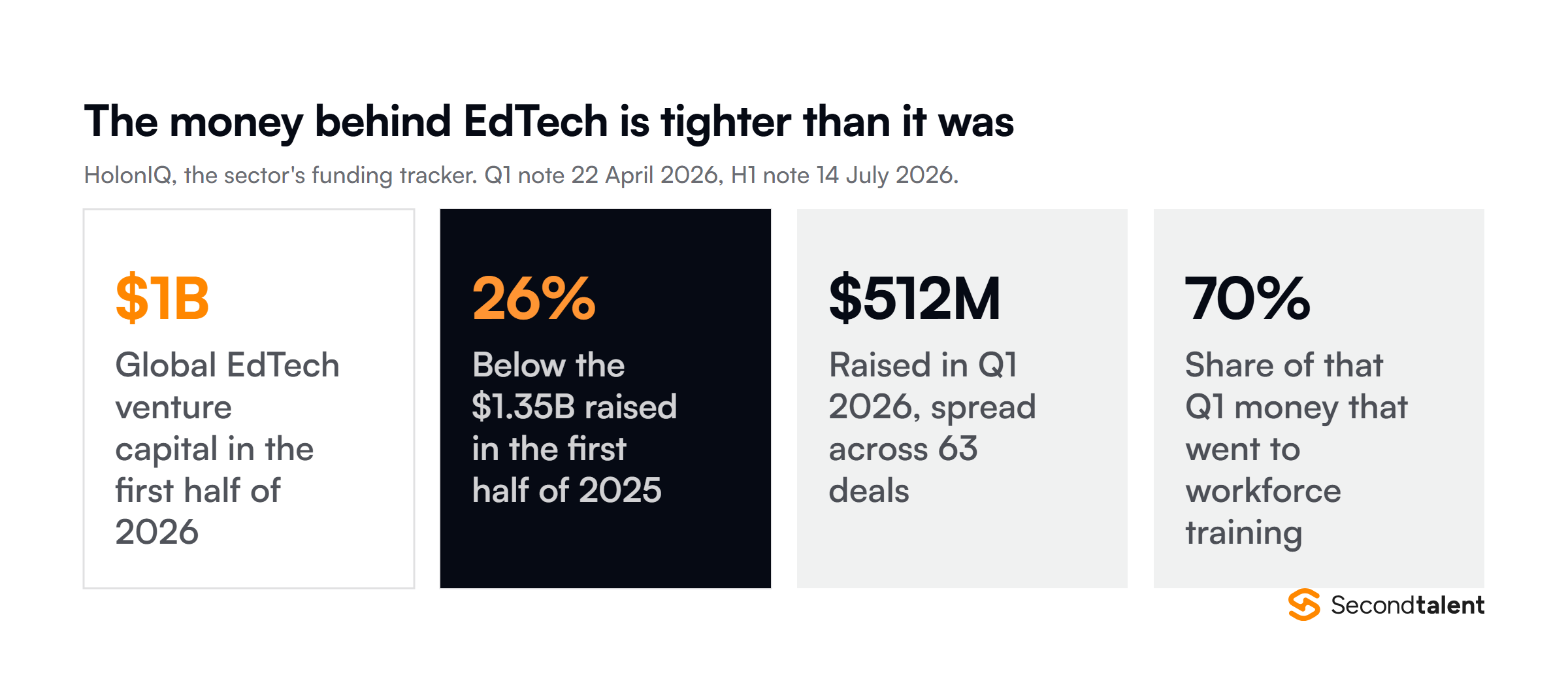
Global EdTech venture funding reached $1 billion in the first half of 2026, down 26% on the $1.35 billion raised over the same months of 2025, according to HolonIQ. Deal volume held steady, so the money is arriving in smaller cheques rather than drying up.
The quarter before set the tone. HolonIQ counted $512 million across 63 deals in Q1 2026, with 70% of it going to workforce training rather than classroom products.
Two consequences for a buyer. Budgets are smaller, so a fixed-scope agency project carries more risk than it did in 2021. And the AI features every vendor below now advertises are the features investors are funding, which means the claims need checking rather than assuming.
The Three Products These Vendors Sell
Before the list, the thing that saves the most time on a shortlist call.
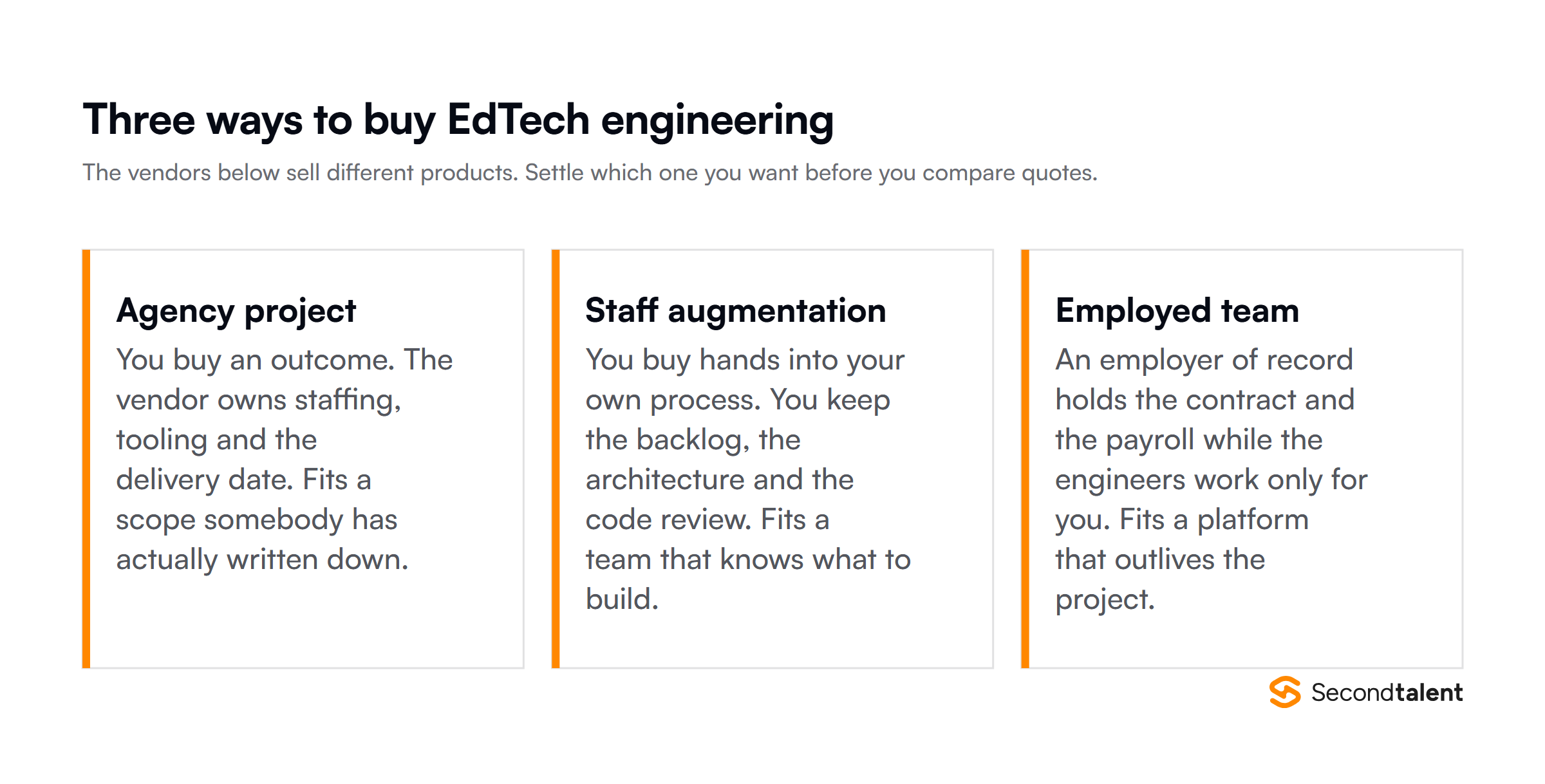
Most of the companies below sell all three under one brand, and the quotes are not comparable. An agency day rate covers project management, QA and the vendor’s own risk. A staff augmentation rate covers one person and leaves the management with you.
Ask which one a quote represents before you compare two of them.
The 10 Best EdTech Software Development Companies
1. AnyforSoft
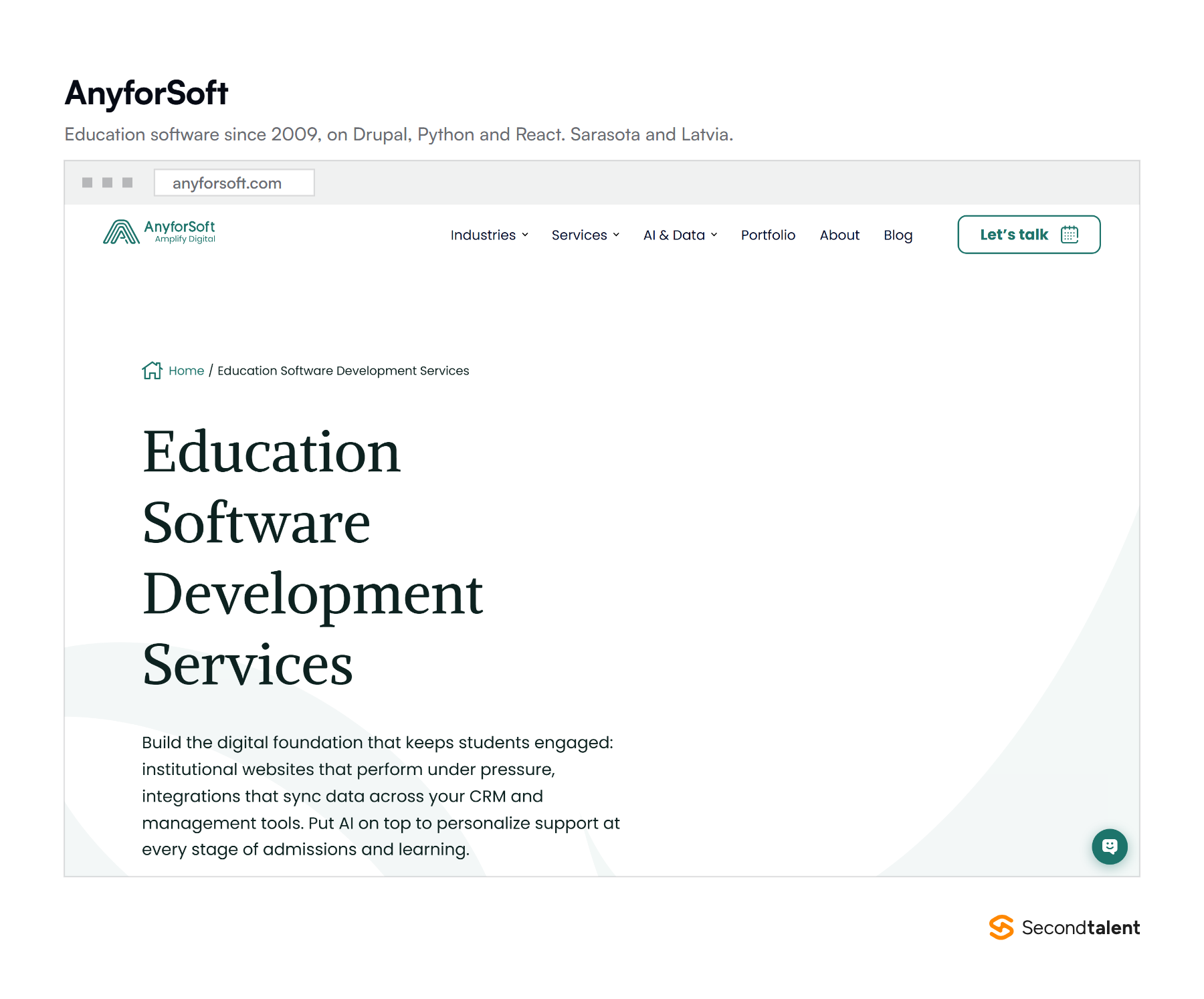
Location: Sarasota, FL, USA
AnyforSoft has built education software since 2009 and now runs the practice from Sarasota and Latvia. Custom LMS work and AI-driven learning tools make up the core scope, alongside education portal development for universities and corporate L&D teams.
Wittenborg University of Applied Sciences, Delaware County Community College, Imperial College Business School and High Pass Education anchor the client roster. The stack runs on Drupal and Python with React on the front end, and the company publishes a 4.9 Clutch rating and 150+ delivered projects.
Its education services include:
- Custom LMS development with HR and CRM system integration
- Headless education portals with React or Vue front ends
- Drupal 10 and 11 migration with FERPA-aligned data handling
- Automated reporting dashboards where compliance tracking matters
Best for: universities and corporate L&D teams that need a FERPA-aware LMS wired into HR systems they already run.
Watch for: the practice is Drupal and Python first. If your platform is already committed to a different stack, ask how much of the team’s education experience transfers.
2. Redwerk
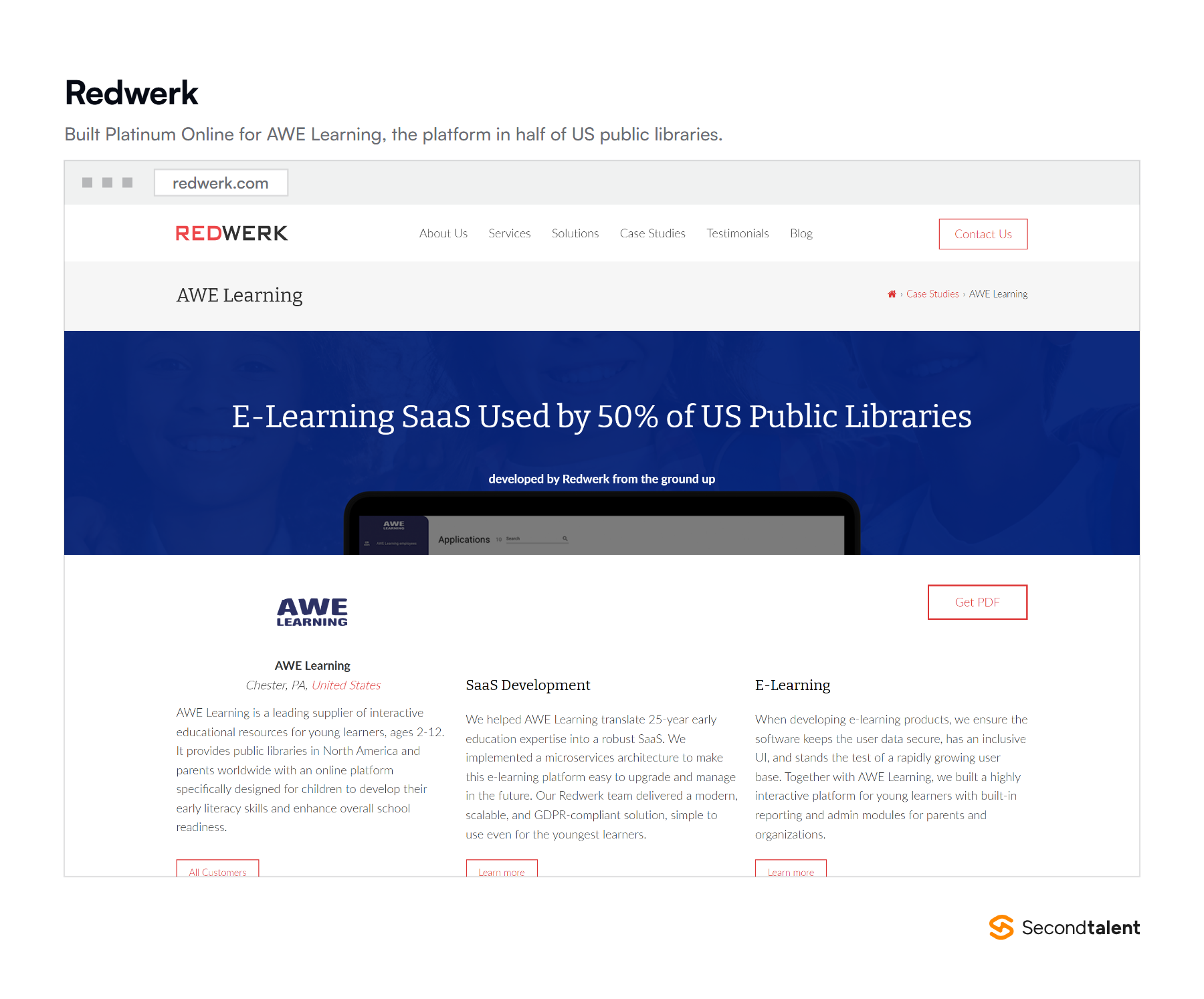
Location: Kyiv, Ukraine
Redwerk turns paper curricula into interactive learning tools, and has run e-learning and LMS projects since 2010 inside a software practice founded in 2005. Public libraries are the unusual niche: the Platinum Online platform it built for AWE Learning now runs in half of US public libraries, and won a Modern Library Award in 2021.
Universal Music and J.B. Hunt sit alongside the education clients. The company counts 90+ tenured engineers across offices in Kyiv and Tallinn, and 250+ projects delivered across 22 countries.
Its EdTech services include:
- LMS and e-learning platform builds for schools and training centres
- Converting paper curricula into video and interactive formats
- Round-the-clock support for corporate and institutional learners
- Platforms sized for library-scale traffic, which the team has already solved once
Best for: public-sector and library-scale platforms that have to hold up under heavy concurrent traffic.
Watch for: a 90-person shop cannot staff four parallel workstreams. Redwerk fits one serious build at a time.
3. Vrinsoft Technology
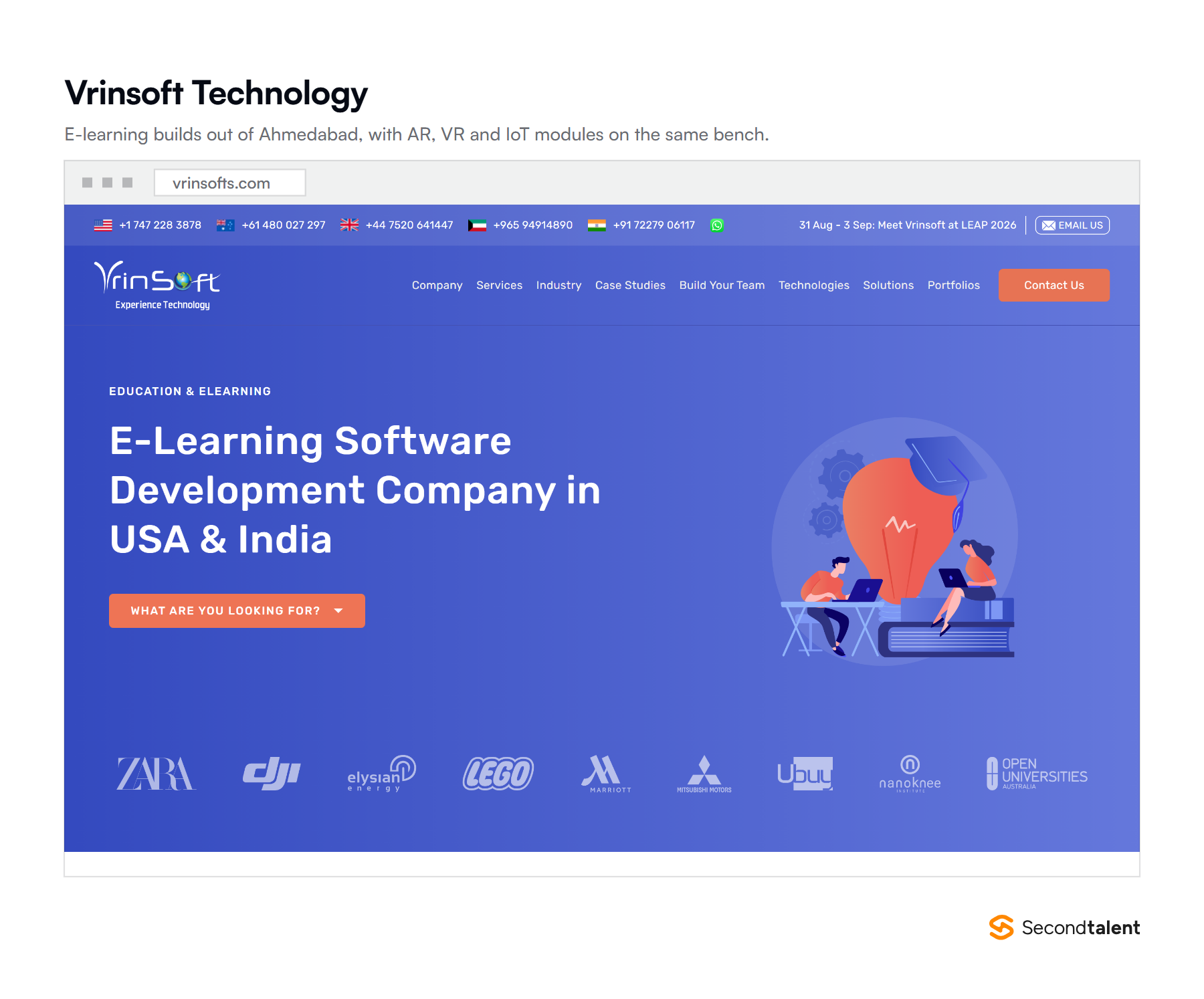
Location: Ahmedabad, Gujarat, India
Vrinsoft folds AR, VR, IoT and AI into standard tooling for education apps, and has built LMS platforms and cloud-based education software since 2009. Universities and EdTech startups make up most of the client base, alongside corporate training programmes and Open Universities Australia.
More than 200 people work across offices in the US, UK, Australia and the Gulf. The company holds ISO 9001:2015 certification and publishes a 4.8 Clutch rating. Immersive modules rarely ship as standard elsewhere at this price point.
Its education services include:
- E-learning app development with gamification and progress tracking
- AR and VR modules for immersive classroom simulations
- IoT classroom hardware integration for connected campuses
- Native iOS and Android builds where mobile comes first
Best for: EdTech startups that want AR, VR or IoT features alongside a standard LMS build.
Watch for: the portfolio spans retail, logistics and healthcare as much as education. Ask which named engineers have shipped a learning platform, not how many the company has.
4. LeewayHertz
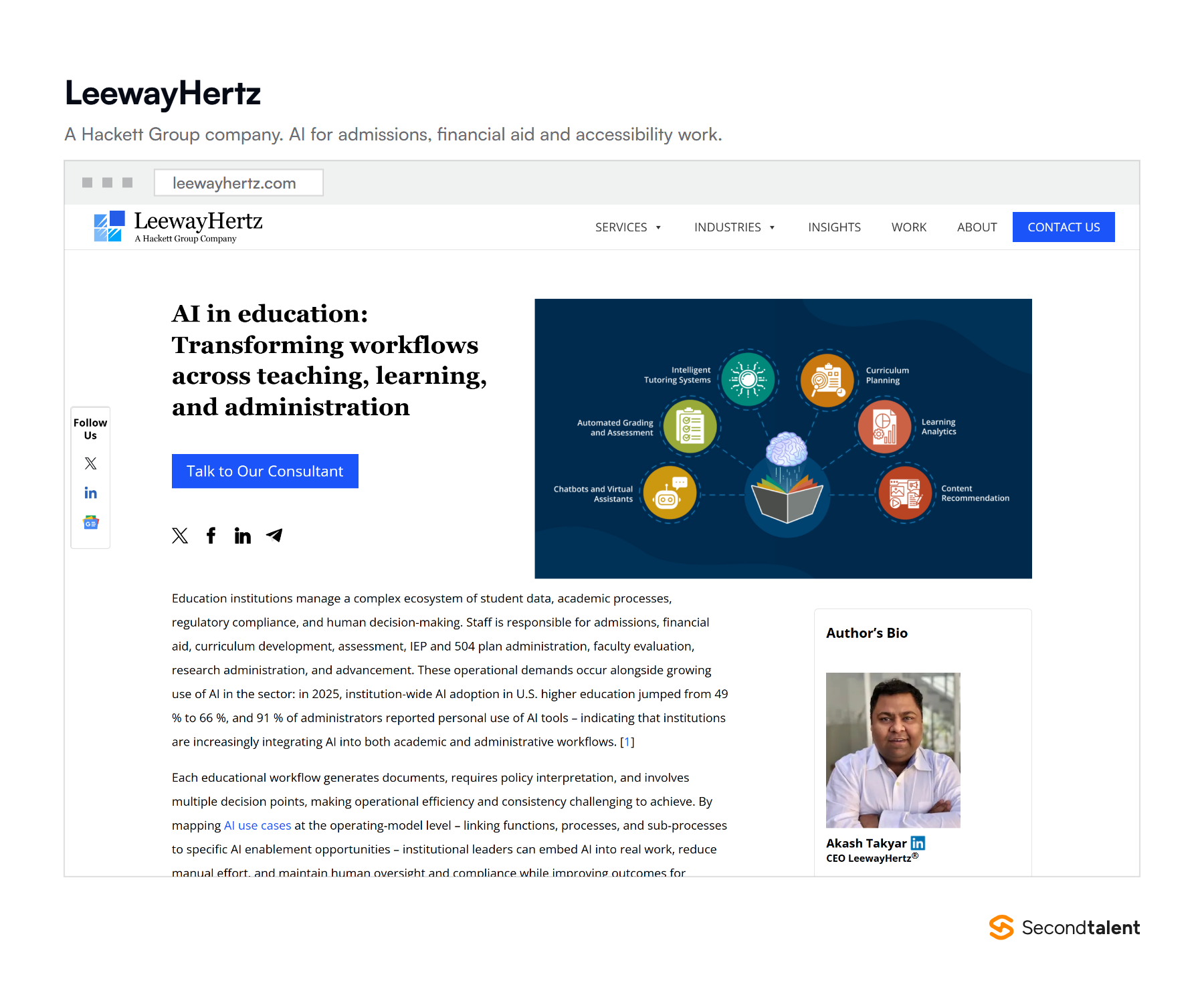
Location: San Francisco, CA, USA
LeewayHertz built its education practice around AI rather than around learning platforms. The Hackett Group acquired the firm in 2024 and now brands it as a Hackett Group company, folding it into a larger Gen AI consultancy. Gartner named it a representative vendor in its 2024 Hype Cycle report for generative AI.
ZBrain, the firm’s own orchestration platform, powers most of its education deployments and connects model output to institutional data with human review points in between.
Its education-relevant AI services include:
- Custom AI models for admissions and assessment workflows
- FAFSA verification and transcript evaluation, drafted and flagged for review
- IEP and 504 plan drafting with staff keeping the final decision
- Accessibility remediation for course content at scale
Best for: institutions that want AI layered onto admissions and compliance workflows they already run.
Watch for: this is a consultancy inside a NASDAQ-listed group, and the rate card says so. It is the wrong call if what you need is a front-end team.
5. Brainhub
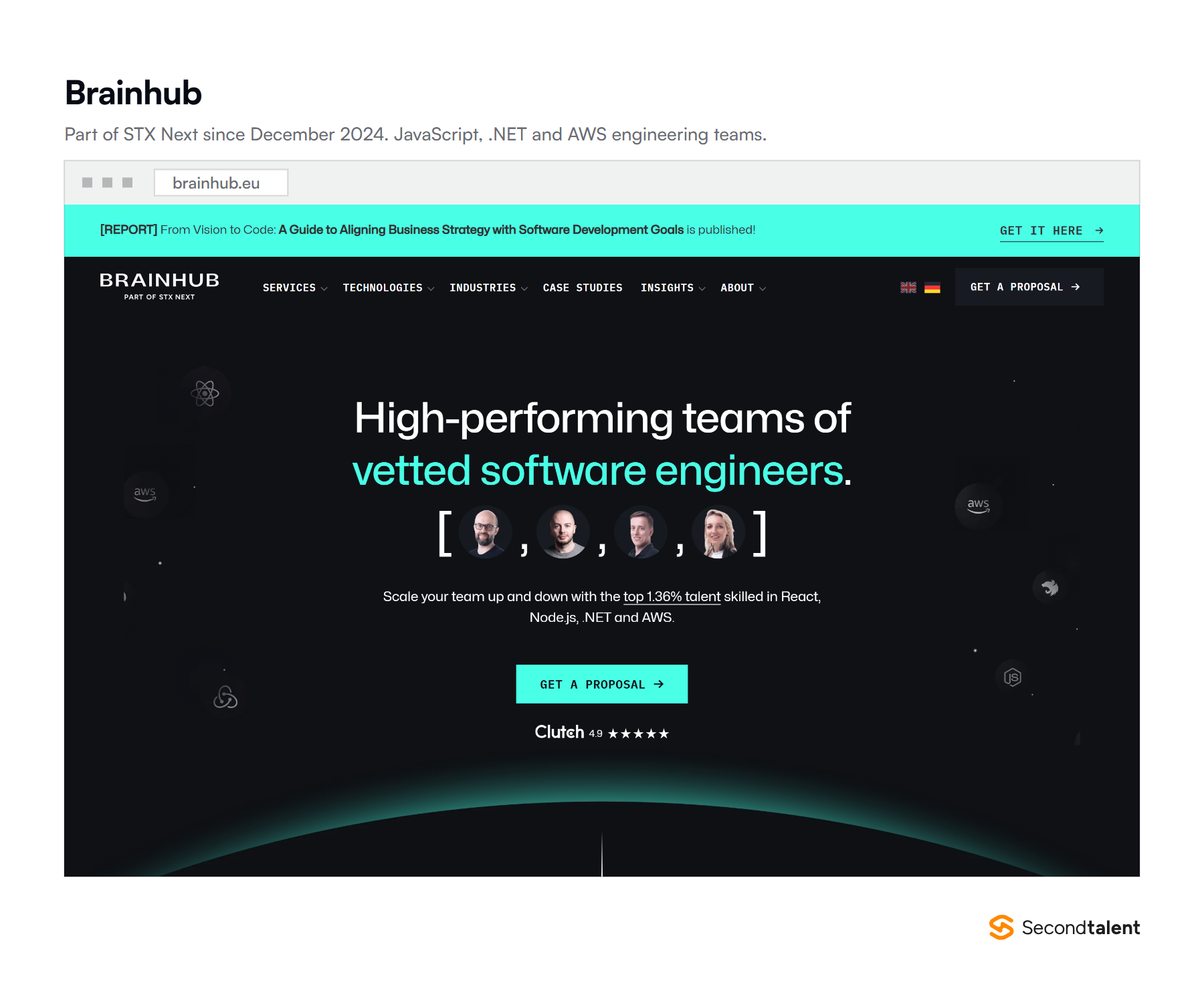
Location: Gliwice, Poland
Brainhub is a JavaScript and .NET engineering shop that joined STX Next in December 2024. The deal added Python and machine learning depth from the STX Next side, and the combined group now employs more than 600 people.
The company has delivered 80+ projects since 2015 across gaming, fintech, EdTech and healthcare, with National Geographic and Paradox Interactive among the names on record, and publishes a 4.9 Clutch rating from 42 reviews.
Its services relevant to EdTech include:
- Dedicated JavaScript and .NET teams for web and mobile builds
- Python and machine learning capacity through the STX Next merger
- Staff augmentation for EdTech teams scaling past an MVP
- Architecture documentation the team enforces rather than promises
Best for: EdTech products that need a JavaScript-heavy team with Python and ML sitting behind it.
Watch for: education is one vertical among several here, and no named education client appears on the site. Ask for the EdTech references directly.
6. Ditstek Innovations
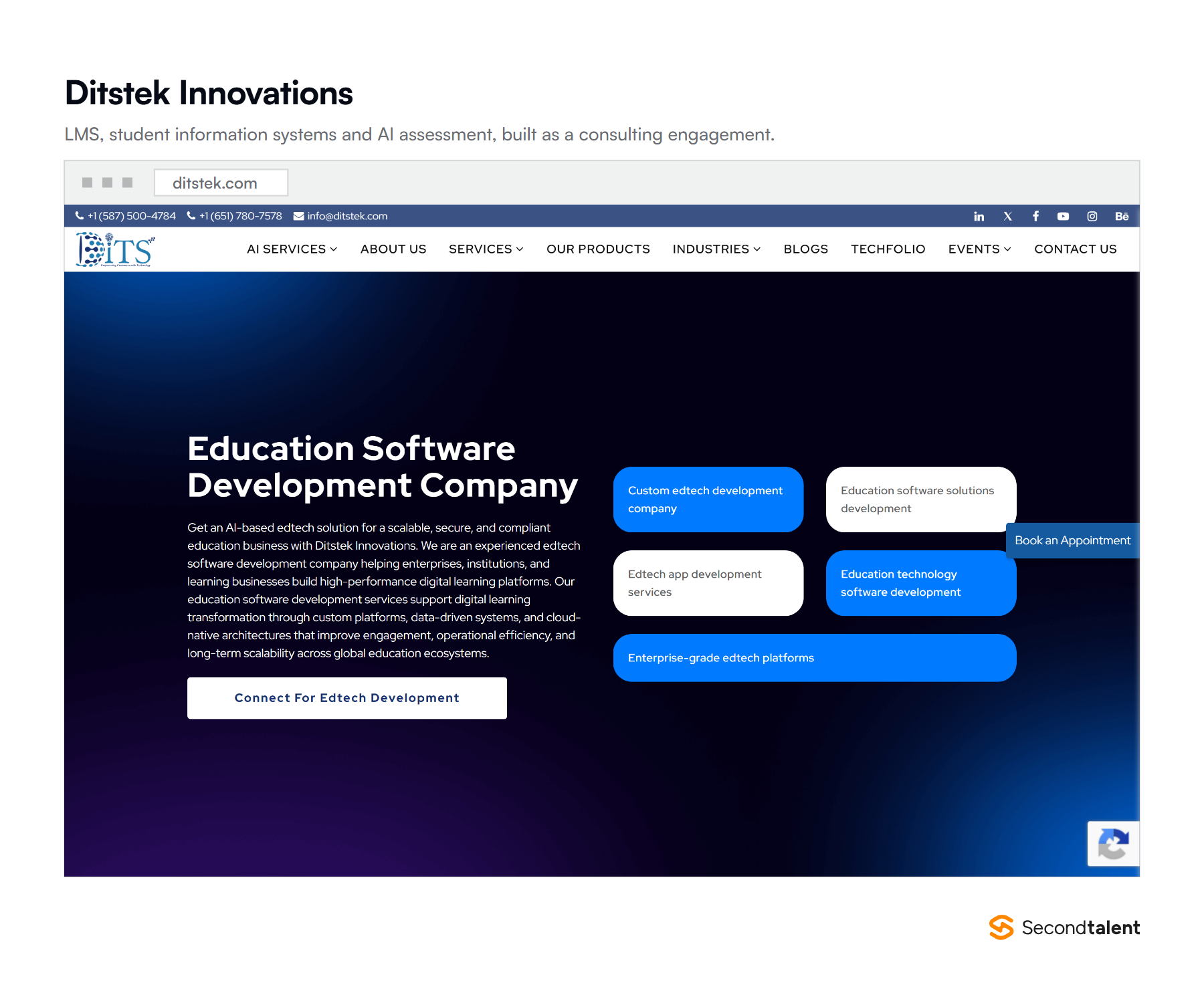
Location: Mohali, India
Ditstek runs a 100-plus-person consulting bench out of Mohali, in the Chandigarh region, serving clients across the USA, UK, Canada, Germany, Japan, Australia and the UAE. LMS platforms, attendance systems, AI-based student evaluation and SIS builds make up the education portfolio.
Its education page publishes 108+ delivered projects and 150+ dedicated developers, and the firm frames every engagement as consulting first, from strategy through implementation. Strategy-led delivery is rare at this size and this price point.
Its education software services include:
- LMS and student information system builds for schools and universities
- Attendance tracking, timetabling and AI-based assessment
- Legacy education platform modernisation
- Remote proctoring and examination platforms
Best for: startups and mid-market institutions that want a consulting-led offshore team at a lower price point.
Watch for: the published project count is the smallest on this list. That is fine for a first LMS and thin for a multi-campus rollout.
7. Halo Lab
Location: Odesa, Ukraine
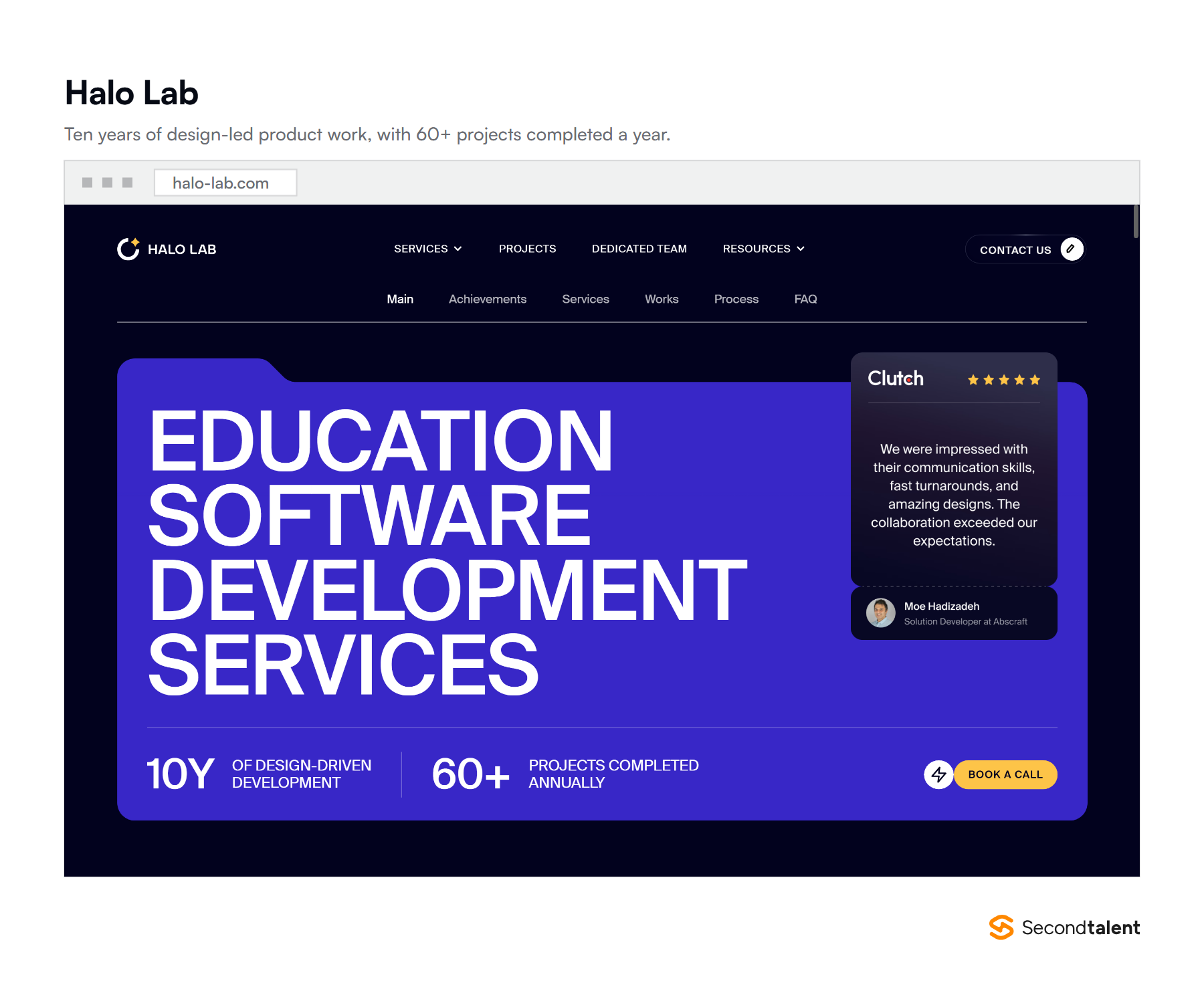
Halo Lab sells design and engineering as one engagement, which is why founders keep landing there. Its education page states ten years of design-driven development and 60+ projects completed a year, and the studio counts 120+ experts working across 30-plus industries.
Lingoro, an education dashboard, sits in the portfolio alongside a learning-management mobile app, and the team carries 80+ Clutch reviews.
Its education services include:
- UI and UX design for LMS dashboards and student-facing apps
- Education portal design paired with custom administrative systems
- School management software covering attendance and grading
- Branding work alongside the platform where a product needs both
Best for: founders who want design and engineering from the same team rather than a handoff halfway through.
Watch for: design leads every engagement here, which is the selling point and the constraint. A pure back-end rebuild is not what this studio is set up for.
8. Appinventiv
Location: Noida, India
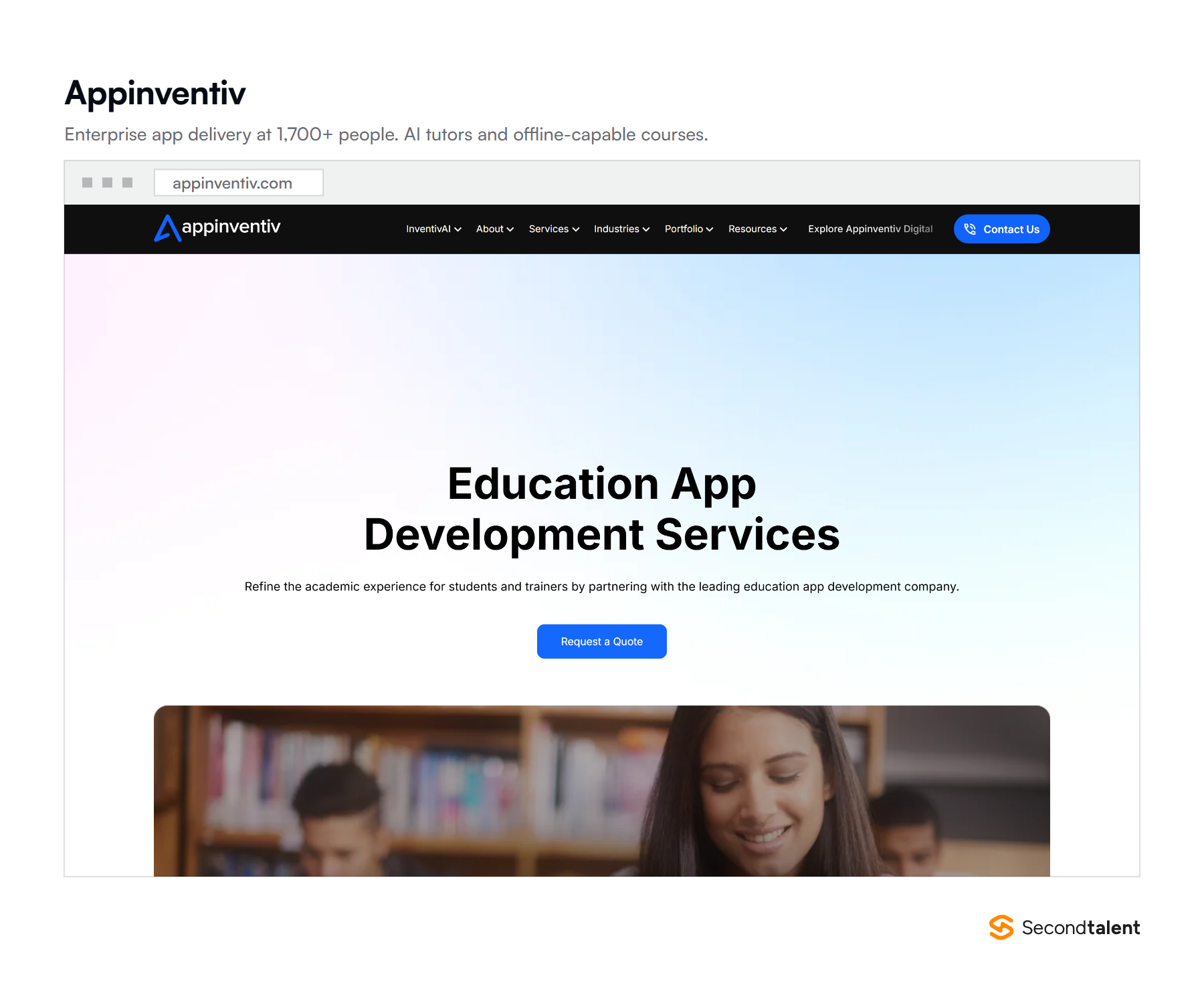
KFC, Adidas, IKEA and American Express sit among Appinventiv’s enterprise clients, and the company runs a delivery team of more than 1,700 people. AWS Advanced Tier Partner status backs the cloud side.
On the education side, its own case study for Edfundo, a financial-literacy app for children, states the product went on to raise $3.5 million in seed funding. Treat that as the vendor’s claim rather than an audited figure.
Its education app services include:
- Native iOS and Android builds for K-12 and corporate training
- AI tutors with personalised learning-path logic
- Offline-capable course delivery for low-connectivity regions
- Induction and engagement apps for onboarding cohorts
Best for: organisations that need enterprise-scale delivery capacity with AI or AR depth behind it.
Watch for: at 1,700 people you are buying an account team, not the founders. Pin down who sits on your squad before you sign.
9. The NineHertz
Location: Jaipur, India
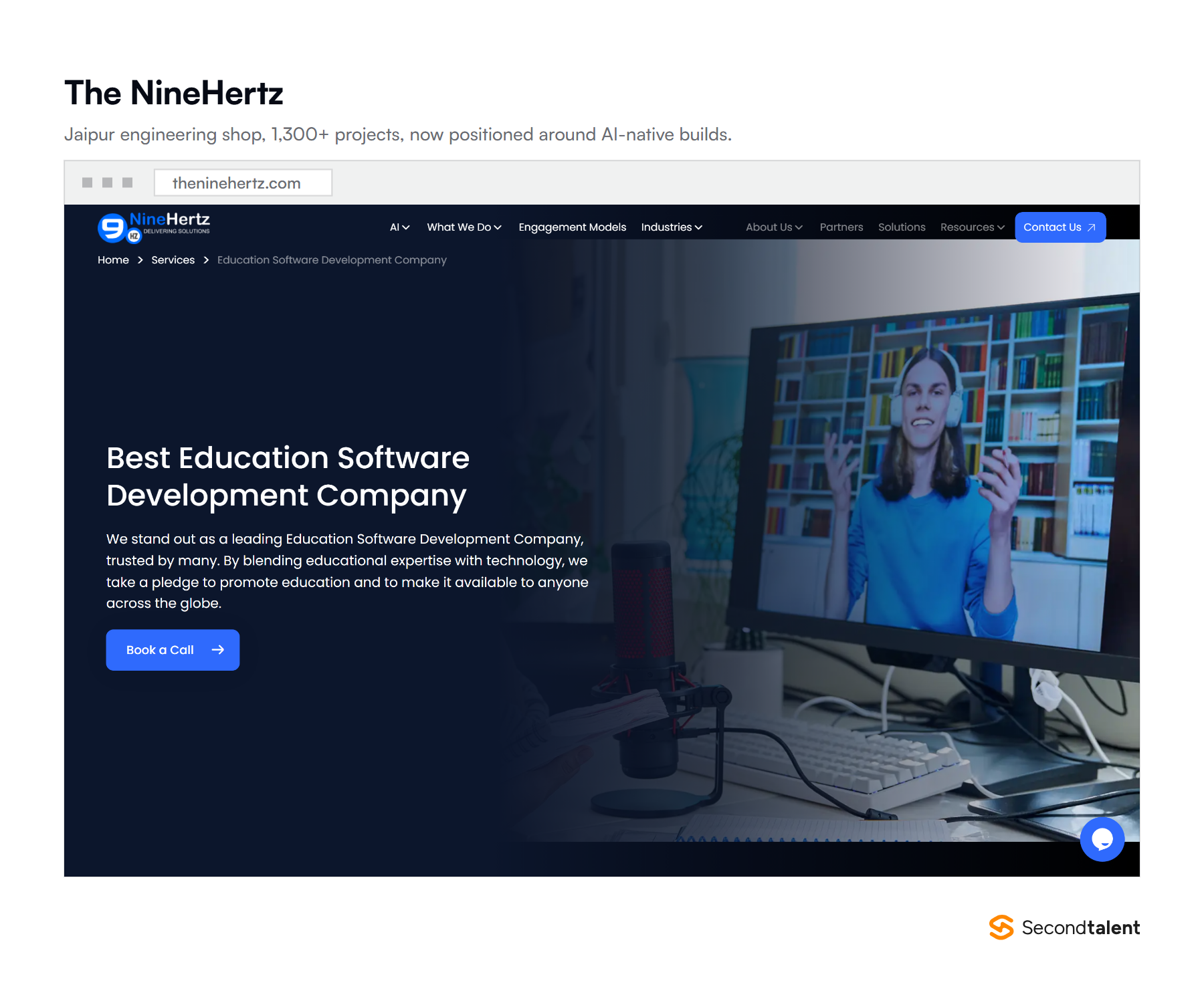
The NineHertz started in Jaipur in 2013 with six engineers and now works across ten countries with offices in Cincinnati and Stone Mountain, Georgia. More than 1,300 projects have shipped since, and the company positions itself as an AI-native engineering partner across build, run and evolve phases.
It publishes a 4.8 Clutch rating from 123 reviews, and has built remote-learning collaboration software for educational institutes.
Its education software services include:
- Purpose-built LMS and school collaboration platforms
- AI tutoring features added to existing education apps
- Offshore development centre setup for education companies scaling teams
- A dedicated offshore unit for budget-constrained roadmaps
Best for: education companies that want a large, budget-conscious offshore team with AI features built in.
Watch for: the offshore development centre model is a staffing product wearing an agency’s clothes. Price it against employing the same people directly.
10. Geeks Ltd
Location: London, UK
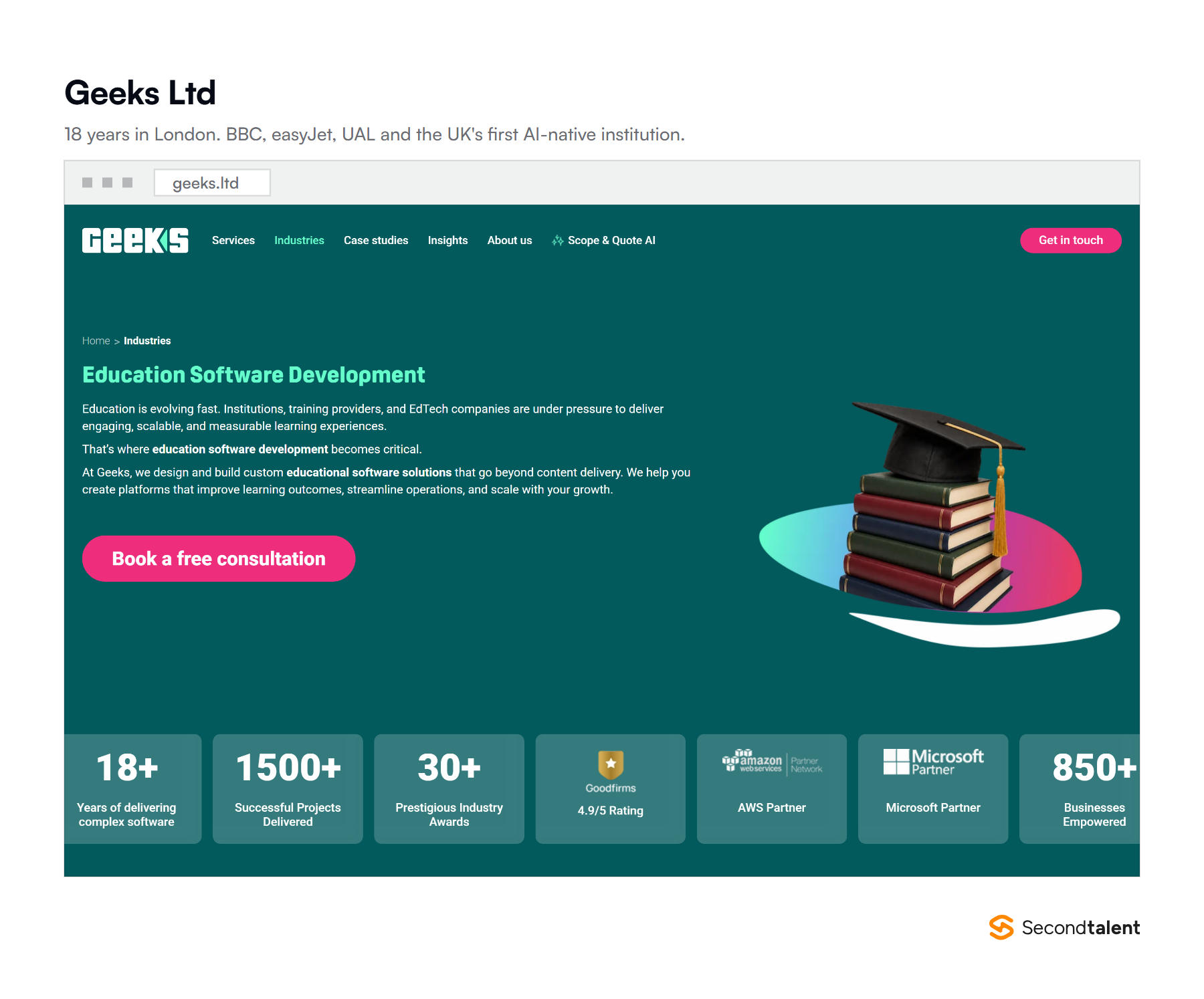
Geeks Ltd has run a custom software practice in London for 18 years and states 1,500+ projects delivered for 850+ businesses, including the BBC, easyJet, University of the Arts London and the Houses of Parliament. A Houston office supports US clients.
The education proof point is the London School of Innovation, which the firm’s education page describes as the UK’s first AI-native higher education institution. AWS Partner and Microsoft Partner status back the delivery side, alongside a 4.9 GoodFirms rating.
Its education-relevant services include:
- Ground-up higher-education platform design and build
- AI-powered learning tools for institutional clients
- Discovery workshops that define platform requirements before the build
- Phased migration that keeps operations running while legacy systems retire
Best for: universities and public-sector bodies that want a UK-based team with AI and procurement experience.
Watch for: UK delivery carries UK prices. If your build has no procurement or data-residency reason to sit in Britain, you are paying a premium for one.
What These Teams Cost
Sticker price tracks geography more closely than it tracks quality, and the spread is wide enough to change which vendor you can afford.
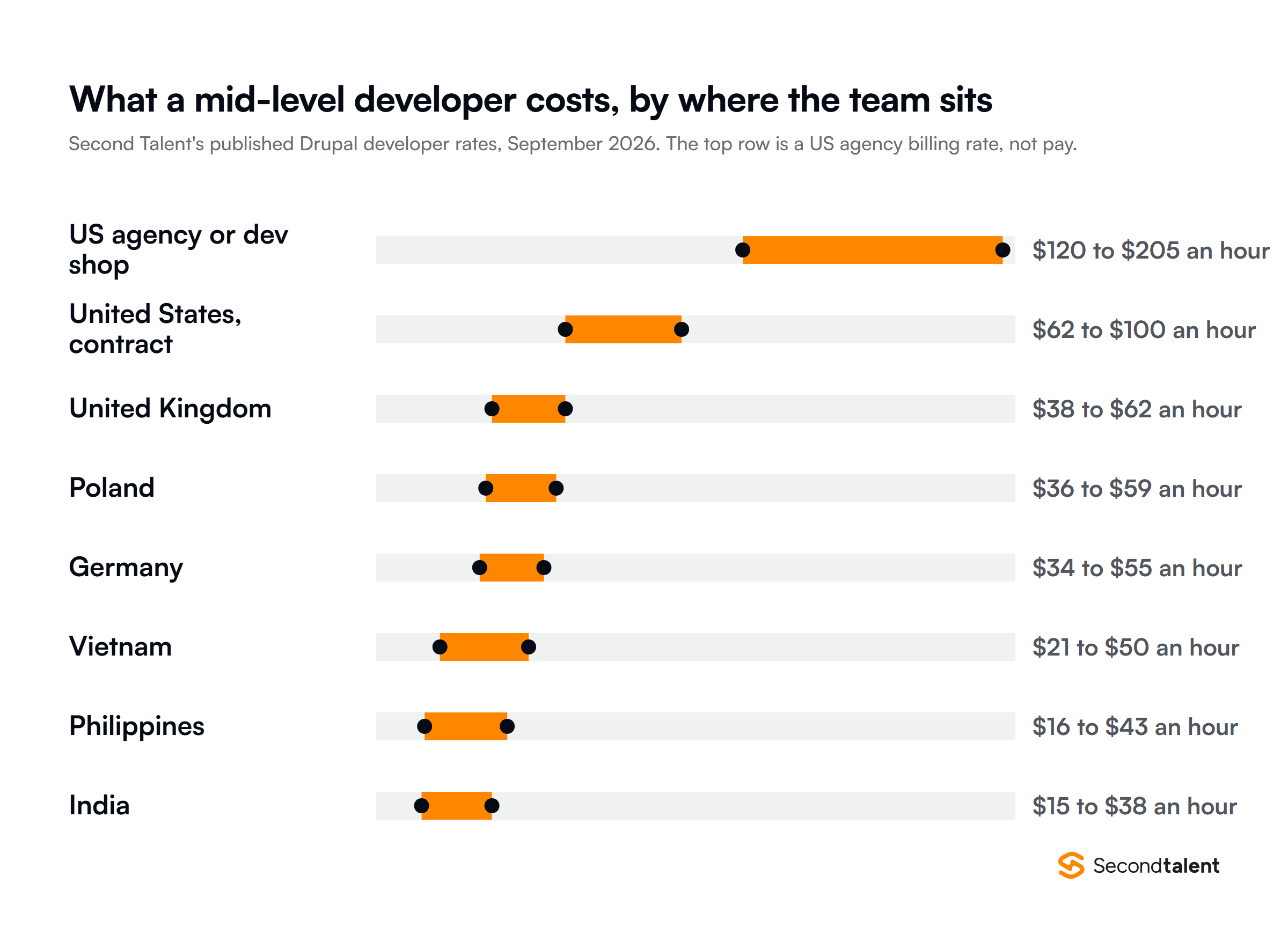
Those bands come from our own Drupal developer cost data for September 2026, for a mid-level developer with three to six years of experience. Drupal is a fair proxy here because it underpins so much institutional web and LMS work.
Read the top row against the rest. A US agency bills $120 to $205 an hour for the same seniority that costs $15 to $38 in India and $36 to $59 in Poland, which is most of why seven of the ten companies above run their delivery from India or Eastern Europe.
The agency band is not markup for its own sake. It carries project management, QA, warranty and the vendor’s risk on a fixed scope. It stops being worth it once your scope changes every sprint, because you are then paying that overhead to absorb changes you are generating.
If mobile is the bulk of your build, our React Native rate card covers the same markets, and the country guide to outsourcing in Asia covers where the engineering supply sits.
Choosing an EdTech Software Development company for Your Project
Start with scale, because it eliminates the most candidates fastest. A pilot LMS for a ten-person cohort needs less than a platform meant to onboard fifty thousand students in one semester, and team size plus delivery history should match that gap before anything else does.
Compliance weight comes next. FERPA, accessibility standards and data-residency rules point you toward vendors with institutional or government clients already on record, which in this list means AnyforSoft, Redwerk, LeewayHertz and Geeks Ltd.
Budget shapes what is left. Offshore teams in India or Ukraine run at a fraction of comparable US or UK rates, and the difference funds either a longer runway or a bigger team.
Technical depth is the last filter, and it separates general software vendors from teams that treat AI, LMS architecture, compliance and student-data security as core specialties rather than as line items on a capabilities deck.
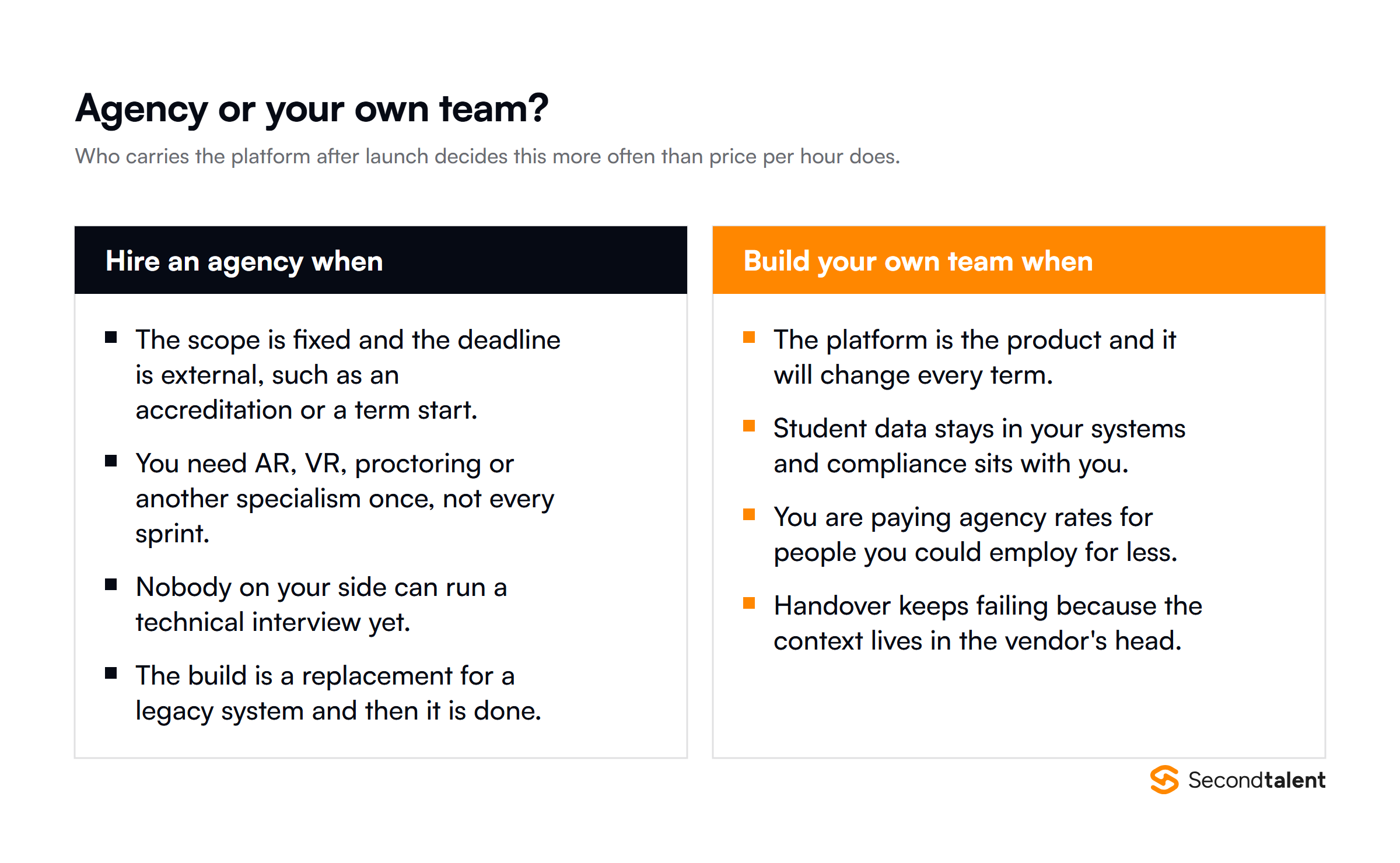
One more question worth asking before you sign any of them: does this build end?
An agency prices for work that finishes. A learning platform rarely does, because the academic calendar keeps generating requirements and the AI features you shipped this year need retraining next year.
When to Build the Team Instead
The pattern we see most often at Second Talent is a client on their third statement of work with the same agency, paying agency rates for what has quietly become a permanent team.
At that point the cheaper structure is to employ the engineers. We place vetted engineers across nine APAC markets at a flat $3,000 to $6,000 a month each, all in, with the employment, payroll and statutory contributions held through our own entities so you do not incorporate anywhere.
AI tool fluency gets tested during our vetting rather than assumed from a CV, which matters for an education product where AI features are now the roadmap. You can brief us and get a shortlist inside 24 hours.
Tell us what you are building and we will send engineers who have shipped it before. If you would rather compare markets first, our guides to software development in Vietnam and nearshore versus offshore delivery cover the trade-offs.
Frequently Asked Questions
How much does it cost to build an LMS?
It depends on where the team sits far more than on what you are building. A mid-level developer costs $15 to $38 an hour in India, $36 to $59 in Poland and $120 to $205 through a US agency, so the same six-month scope can differ by a factor of five before a line of code is written.
What does FERPA compliance require from a software vendor?
FERPA binds the institution, not the vendor, which is the part buyers miss. Your contract has to push those obligations down: access controls on education records, a defined school-official exception for the vendor’s staff, no secondary use of student data, and deletion terms at the end of the engagement.
Should I hire an EdTech agency or build my own team?
Hire an agency for a fixed scope with an external deadline, or for a specialism you need once. Build your own team when the platform is the product, when student data stays in your systems, or when you are on your third statement of work with the same vendor.
How long does an LMS build take?
Plan around the academic calendar rather than the vendor’s estimate. Most institutional platforms have one safe go-live window a year, and a build that misses it waits twelve months, so the real deadline is usually six to eight weeks earlier than the one in the statement of work.
Do offshore EdTech teams handle student data legally?
They can, and the constraint is data residency rather than distance. Check where the data physically sits, who holds the access credentials, and whether your own regulator or funding body restricts processing outside your jurisdiction before you shortlist on price.
What should I ask an EdTech vendor on the first call?
Ask which named engineers shipped their last education platform, what its peak concurrent load was, and who owns the code and the documentation when the engagement ends. Companies that answer those three quickly are the ones that have done it before.



![Workplace Diversity Statistics. Top 100+ Workplace Diversity Statistics [2026], by Second Talent.](https://www.secondtalent.com/wp-content/uploads/2026/09/workplace-diversity-statistics-featured-v2-768x403.jpg)

![Tech Industry Hiring Statistics. Top 50+ Tech Industry Hiring Statistics: Salaries, Skills Demand [2026], by Second Talent.](https://www.secondtalent.com/wp-content/uploads/2026/09/tech-industry-hiring-statistics-featured-v2-768x403.jpg)