
TL;DR: ChatGPT reached 1 billion weekly users in August 2026, OpenAI says. In the US, 49% of adults use AI chatbots, according to a Pew survey from February 2026. Businesses are further behind: 23.2% of US firms used AI in the Census Bureau's latest two-week reading.
Only 4.2% of consumer ChatGPT messages are about computer programming, OpenAI’s own study of a million sampled conversations found. On OpenRouter, where developers call hundreds of models through one API, programming grew from about 11% of tokens in early 2025 to over half by year end. OpenAI’s researchers suggest coding moved to APIs and agents such as Codex.
- 1Messages unrelated to work grew from 53% to 73% of consumer ChatGPT traffic between June 2024 and June 2025.
- 2ChatGPT’s share of visits to the seven largest chatbot websites fell from 73.3% to 55.5% in a year, on Similarweb’s count, while Gemini’s doubled.
- 3Google processed more than 3.2 quadrillion tokens a month by May 2026, up from 9.7 trillion two years earlier.
- 4Anthropic earned an estimated 40% of enterprise LLM spend in 2025, against 27% for OpenAI, Menlo Ventures found.
How Many People Use Generative AI in 2026?
OpenAI opened its August 6, 2026 model update with the headline number: “Every week, 1 billion people turn to ChatGPT.” A month later the company said its products reach more than one billion weekly users and 2.5 million businesses. Google announced a billion monthly Gemini app users five days after OpenAI’s post.
Growth came in steps of about 100 million. TechCrunch reported the 900 million mark in February 2026, alongside OpenAI’s funding announcement, and noted the 800 million OpenAI had given in October 2025. Our ChatGPT statistics cover its revenue and funding.
Half of US adults, and a quarter every day
Pew Research Center surveyed 5,119 US adults from February 17 to 23, 2026. About a quarter use AI chatbots daily, including 12% who use them several times a day and 4% who say “almost constantly.” In 2024, when Pew asked a narrower question, a third had used a chatbot.
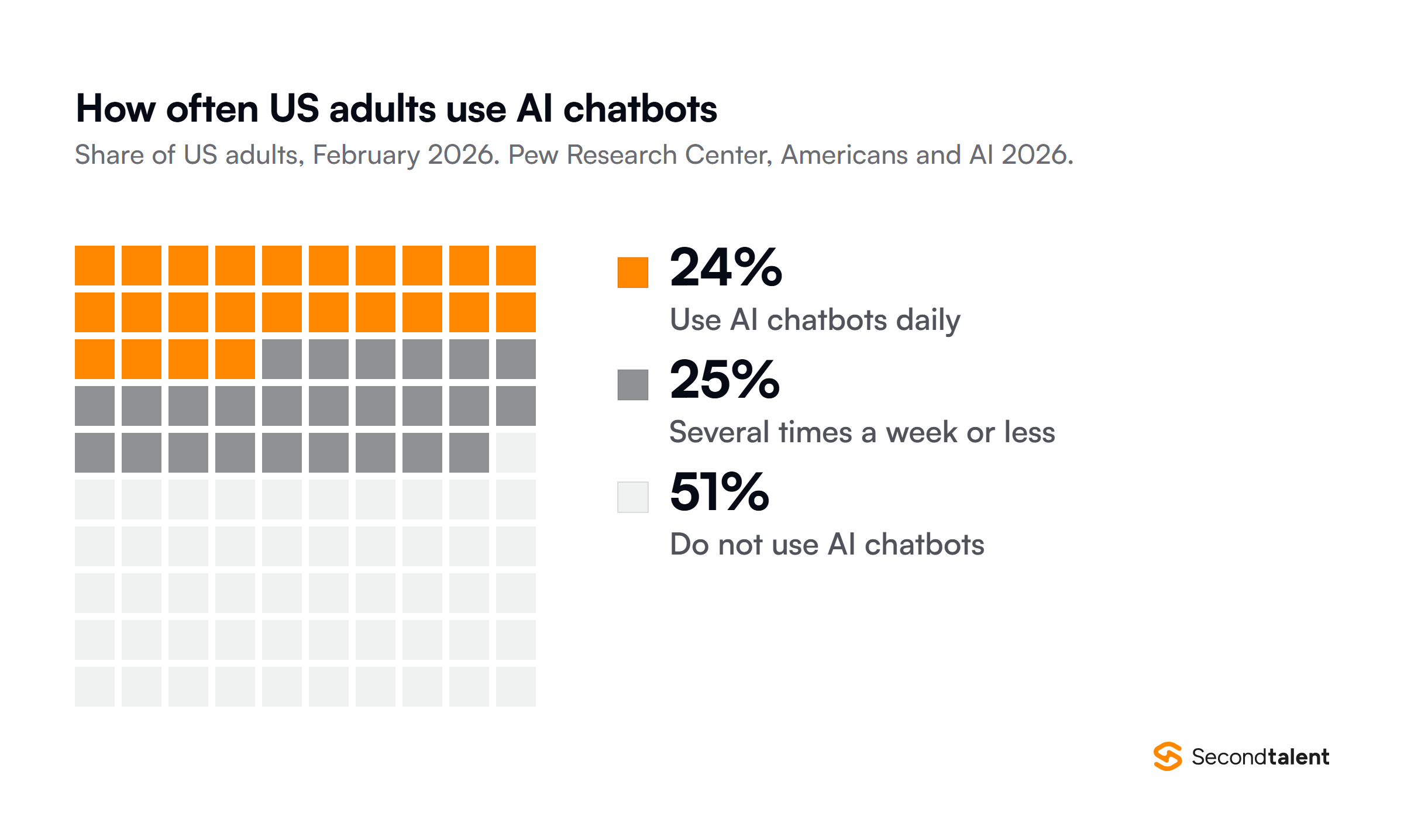
ChatGPT alone reaches 44% of US adults, up from 34% in 2025 and 18% in 2023, although the 2026 question also named other chatbots. Age splits it: 57% of adults under 50 use ChatGPT, against 28% of those 50 and older.
Working-age Americans use generative AI more than the adult average. The St. Louis Fed’s Real-Time Population Survey, run by economists Alexander Bick, Adam Blandin and David Deming, found 62% of adults aged 18 to 64 used it by May 2026, up from 45% in August 2024.
Which AI Chatbots Do People Use Most?
Gemini doubled its share of chatbot web traffic in a year. In Similarweb’s August 2026 update, which tracks visits to seven chatbot websites, Gemini rose from 12.9% to 25.6% and Claude from 1.9% to 9.3%. DeepSeek, Grok, Copilot and Perplexity all lost share.
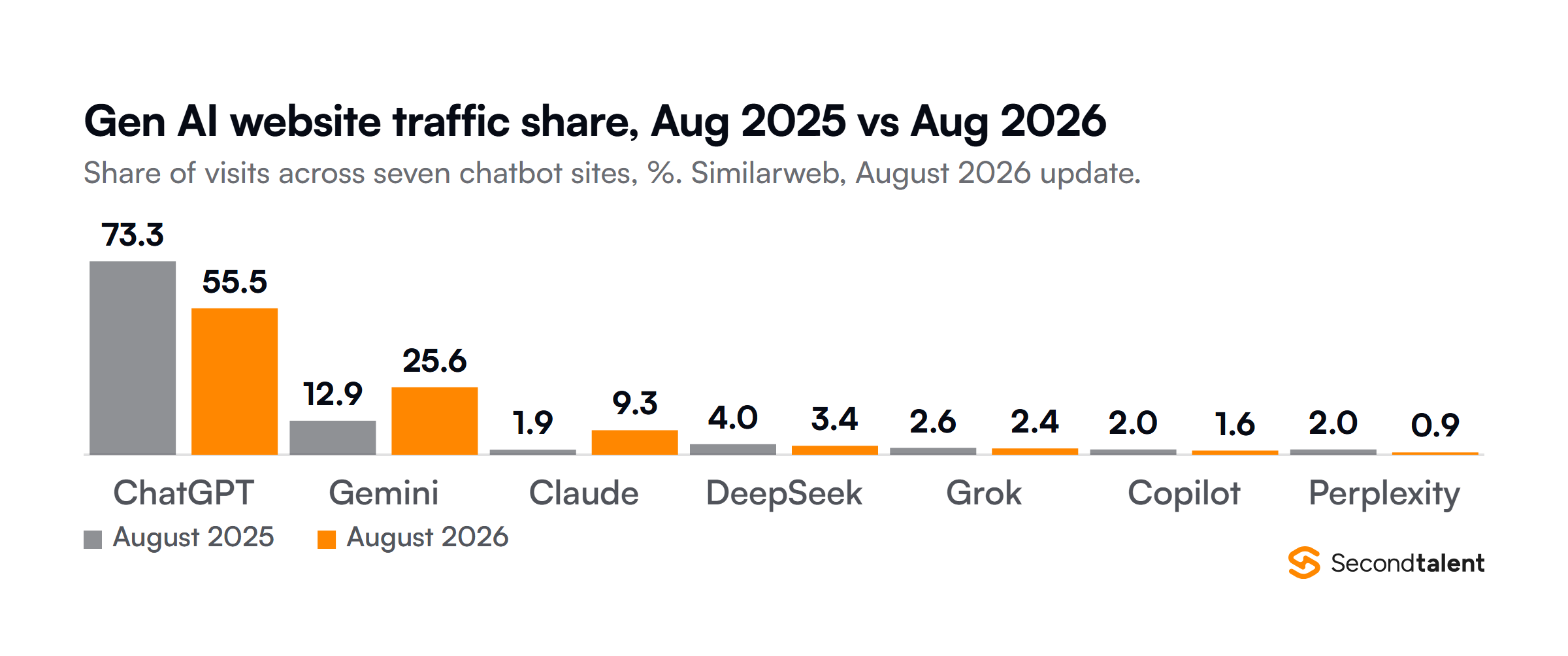
Similarweb counts visits to the chatbot websites, so use inside mobile apps, Android, Google Search or Microsoft 365 does not show up in these shares.
Pew’s US survey also puts ChatGPT first and Gemini second, but Copilot and Meta AI come next:
Claude shows the widest gap between the two measures: 6% of US adults in Pew’s survey, but third place in global web traffic. Our Claude statistics cover its business customers and revenue.
Google published a few usage details with its billion-user announcement. 63% of Gemini users talk to it by voice, 38% of school requests include an attachment, and the app generates more than 150 million images a day. It has more than 100 million active users on iOS. More in our Google Gemini statistics.
What Do People Use ChatGPT For?
Most of it has nothing to do with work. How People Use ChatGPT, a September 2025 paper by OpenAI researchers and Harvard economist David Deming, classified a sample of consumer messages. Daily messages grew from 451 million in June 2024 to 2.6 billion in June 2025, and work-related messages fell from 47% to 27% of them.
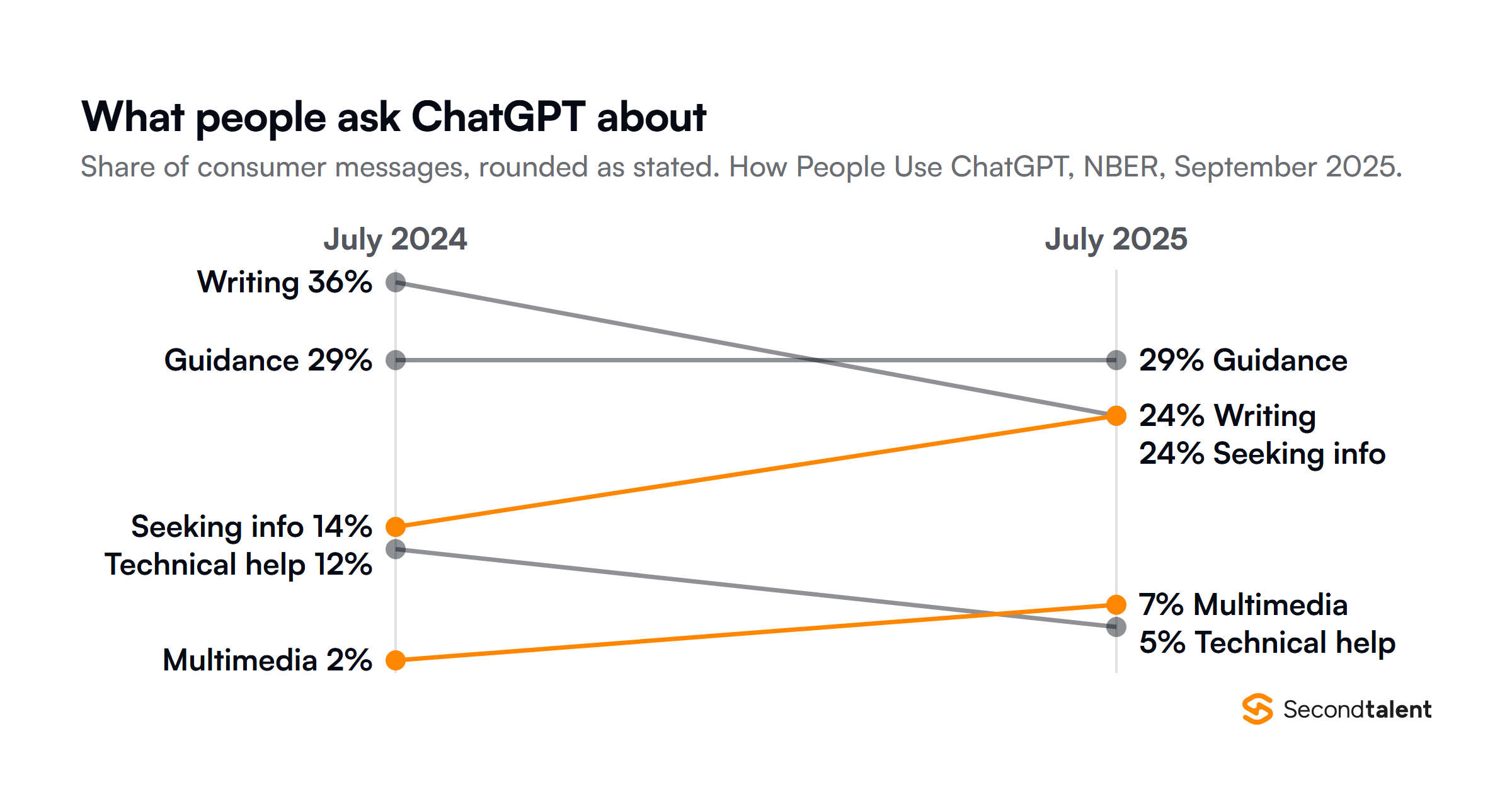
Three topics, Practical Guidance, Seeking Information and Writing, cover about 77% of conversations. Seeking Information gained the most ground, and the authors call it “a very close substitute for web search.” Tutoring and teaching requests alone make up 10.2% of all messages.
Writing dominates at work, at 40% of work-related messages in July 2025. About two thirds of writing requests ask ChatGPT to edit, critique, summarize or translate text the user supplied, rather than write something new. Companionship is rare: 1.9% of messages concern relationships and personal reflection, and 0.4% are games and role play.
Asking, doing and expressing
The paper also sorts messages by what the user wants back. 49% are Asking (information or advice for a decision), 40% are Doing (a finished output such as an email) and 11% are Expressing views or feelings. At work the mix flips, with 56% of work messages classed as Doing.
The user base changed too. In ChatGPT’s first months, about 80% of active users with a gendered first name had a typically masculine one. By June 2025 that share was 48%. Users aged 18 to 25 sent about 46% of messages from people who gave their age.
Pew’s survey asked Americans the same question from the other side, covering all chatbots:
How Do Claude and Copilot Users Differ?
Claude is a coding tool first. Tasks tied to computer and mathematical jobs made up 35% of Claude.ai conversations in February 2026, according to Anthropic’s March 2026 Economic Index report. Personal use still rose from 35% to 42% of conversations after November 2025, while coursework fell from 19% to 12%.
- 4.2% of messages about computer programming
- 73% of messages not related to work
- 35% of conversations on computer and math tasks
- 42% of conversations for personal use
Anthropic’s June 2026 report, sampled daily from April 10 to June 10, shows use following the calendar. Personal conversations rise from around 35% on weekdays to almost 50% at weekends.
On April 14, the day before the US tax deadline, tax conversations were eight times as common as on an average day in May. Recipe requests run 2.3 times above their average at 6 p.m.
The same report found 93% of conversations produce something the user takes away. Explanations lead at 17%, then documents and reports at 15% and guidance at 11%. Claude Code sessions ran on Opus, Anthropic’s most capable model class, 54% of the time, against 10% of chat conversations.
Microsoft’s workplace assistant shows a third pattern. An analysis of more than 100,000 Microsoft 365 Copilot chats in the 2026 Work Trend Index found 49% supported analysis, problem solving and evaluation. Working with people took 19%, producing work 17% and finding information 15%.
How Many Workers Use Generative AI on the Job?
45% of US workers used generative AI for their jobs by May 2026, up from 33% in August 2024, the St. Louis Fed survey found. On a stricter test, use for work in the past week, its tracker on FRED rose from 28.2% in the third quarter of 2024 to 39.2% in the second quarter of 2026.
The time involved is still small. AI assisted 6.3% of all work hours in the second quarter of 2026, up from 4.1%, and workers reported saving 2.2% of their hours, up from 1.6%.
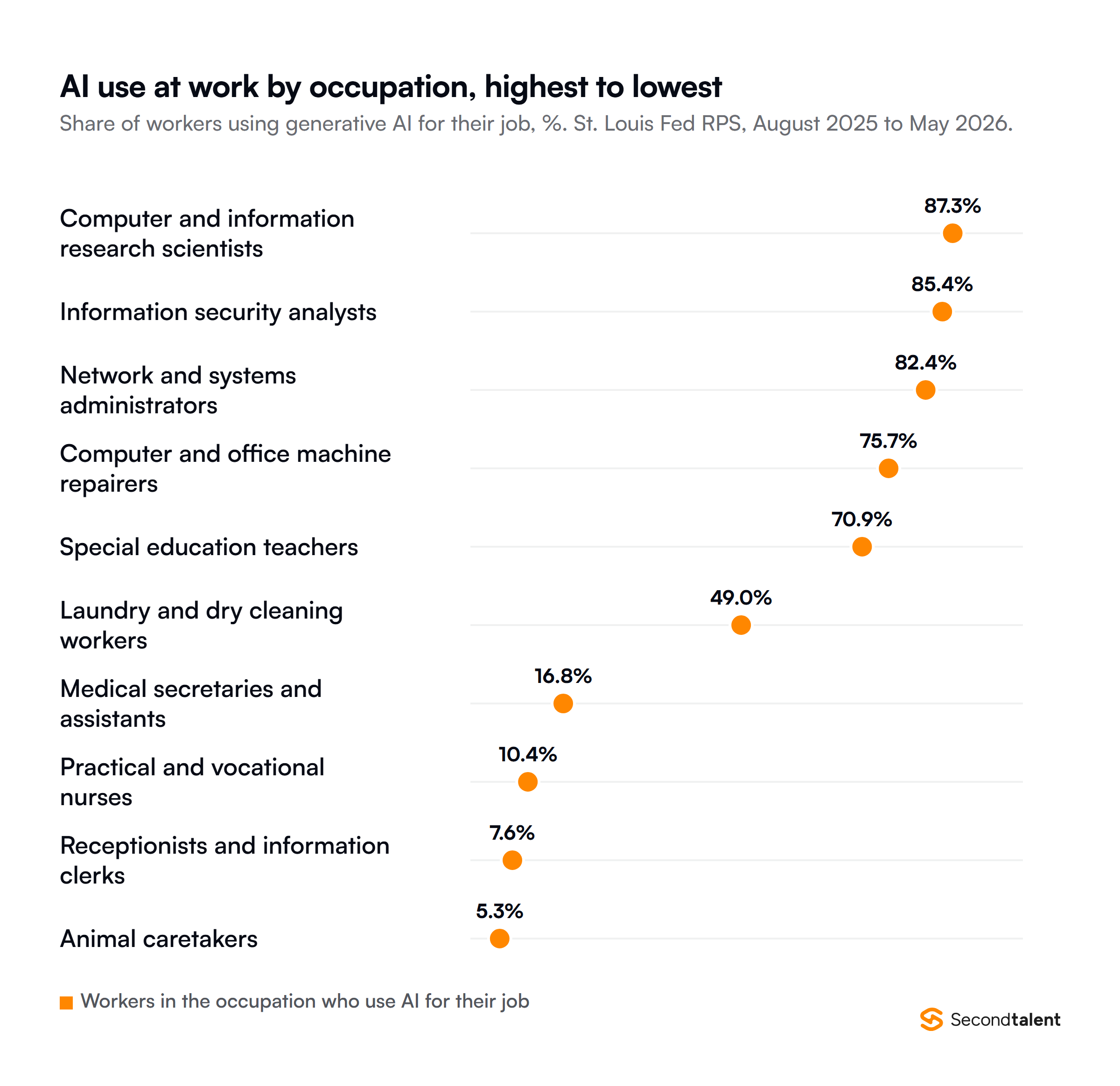
Adoption is wide but shallow. In more than 80% of occupations at least one worker in five uses AI, but only 40% of occupations pass 50% and fewer than 3% of individual tasks do. The most assisted tasks are reading documents for technical information (61.3%) and preparing research reports (60.7%).
Jobs built around sensitive records use far less than exposure models predict. Medical secretaries use AI at 16.8%, against a predicted 61%. Special education teachers, at 70.9%, and laundry workers, at 49.0%, use it at about double the predicted rate. Gallup’s employee survey, covered in our AI in the workplace statistics, measures how often.
Experience predicts use better than job title
The St. Louis Fed researchers found workers who have used generative AI for six months or more apply it to more of their tasks. Anthropic found the same with Claude: users who signed up at least six months earlier had a higher success rate on comparable tasks, and used it more for work.
Microsoft’s survey of 20,000 AI users in 10 countries, fielded from February to April 2026, puts only 19% in its “Frontier” group, where both the worker and the employer are ready. Among all respondents, 66% say AI gives them more time for high-value work and 58% produce work they could not a year ago.
That puts a premium on practice, whether it comes from daily use at work or from structured generative ai courses. Microsoft also reports that the number of active agents inside Microsoft 365 grew 15 times in a year, and 18 times in large enterprises.
How Many Businesses Use AI?
Fewer than one US business in four. The Census Bureau’s Business Trends and Outlook Survey asks firms every two weeks whether they used AI in any business function. The reading published September 10, 2026, covering August 10 to 23, was 23.2%, up from 17.3% in the first reading after the Census Bureau reworded the question in November 2025.
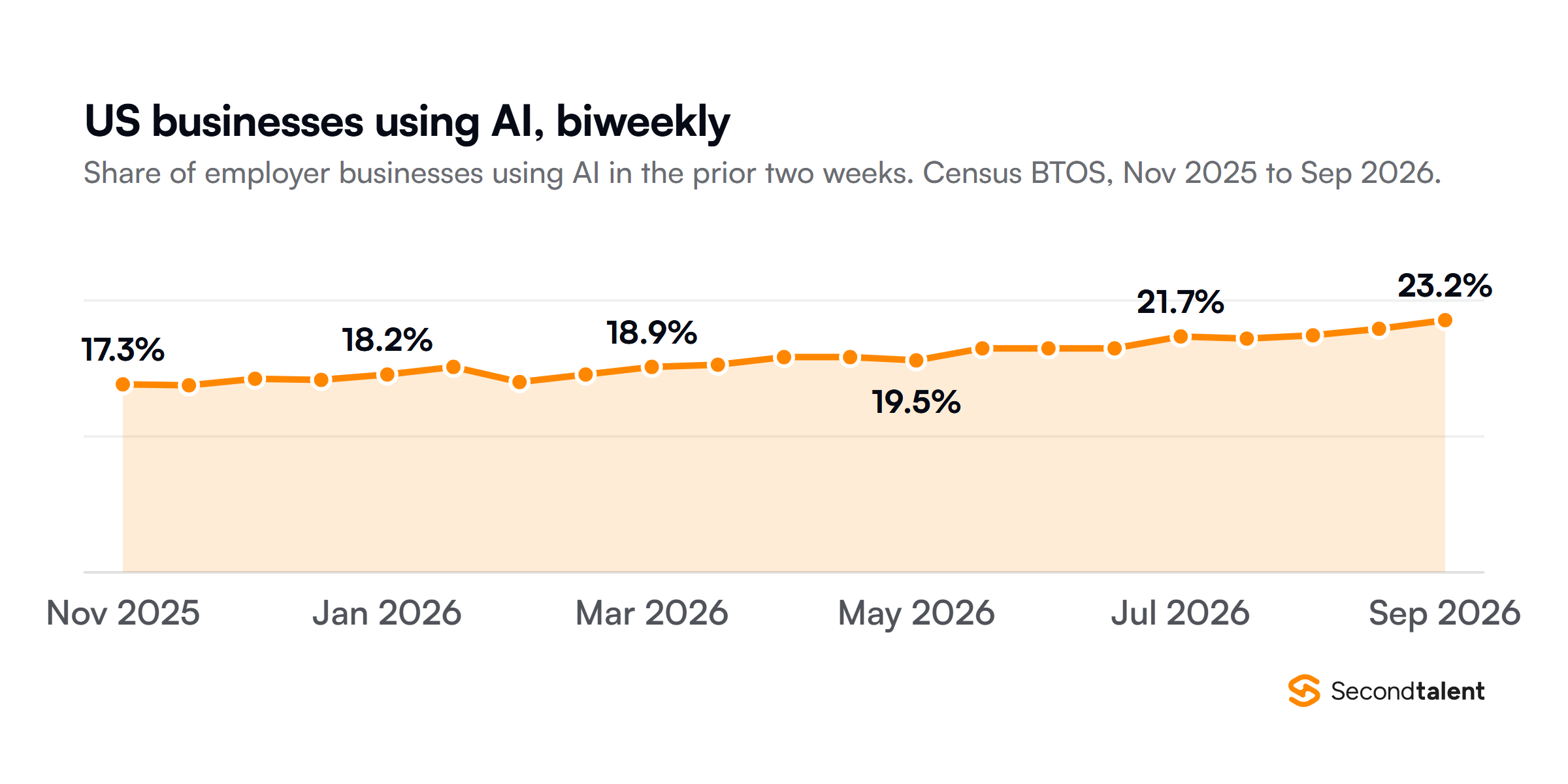
27.3% of businesses expect to use AI in the next six months. Before November 2025 the survey asked only about AI used to produce goods or services, so earlier readings are not comparable. Our enterprise AI adoption statistics break the Census rate down by firm size and sector.
Card spending tells a different story about depth. In the August 2026 Ramp AI Index, built from more than 70,000 firms on Ramp’s platform, the median firm spent $11.95 per employee on AI in July. The top 10% spent $650, and the top 1% spent $7,400.
By Ramp’s count, 43.5% of those businesses paid Anthropic in July 2026, 39.7% paid OpenAI and 4% paid xAI. Fable 5, Anthropic’s most expensive model, made up only 6% of the tokens businesses bought from Anthropic in its first month. Ramp’s customers are not a random sample, so its rates run far above the Census figure.
How Much Do Enterprises Spend on LLMs?
$37 billion on generative AI in 2025, up from $11.5 billion in 2024, Menlo Ventures estimates. Applications took $19 billion. Of the $18 billion that went to infrastructure, $12.5 billion paid for foundation model APIs, and Anthropic took the largest share of that.
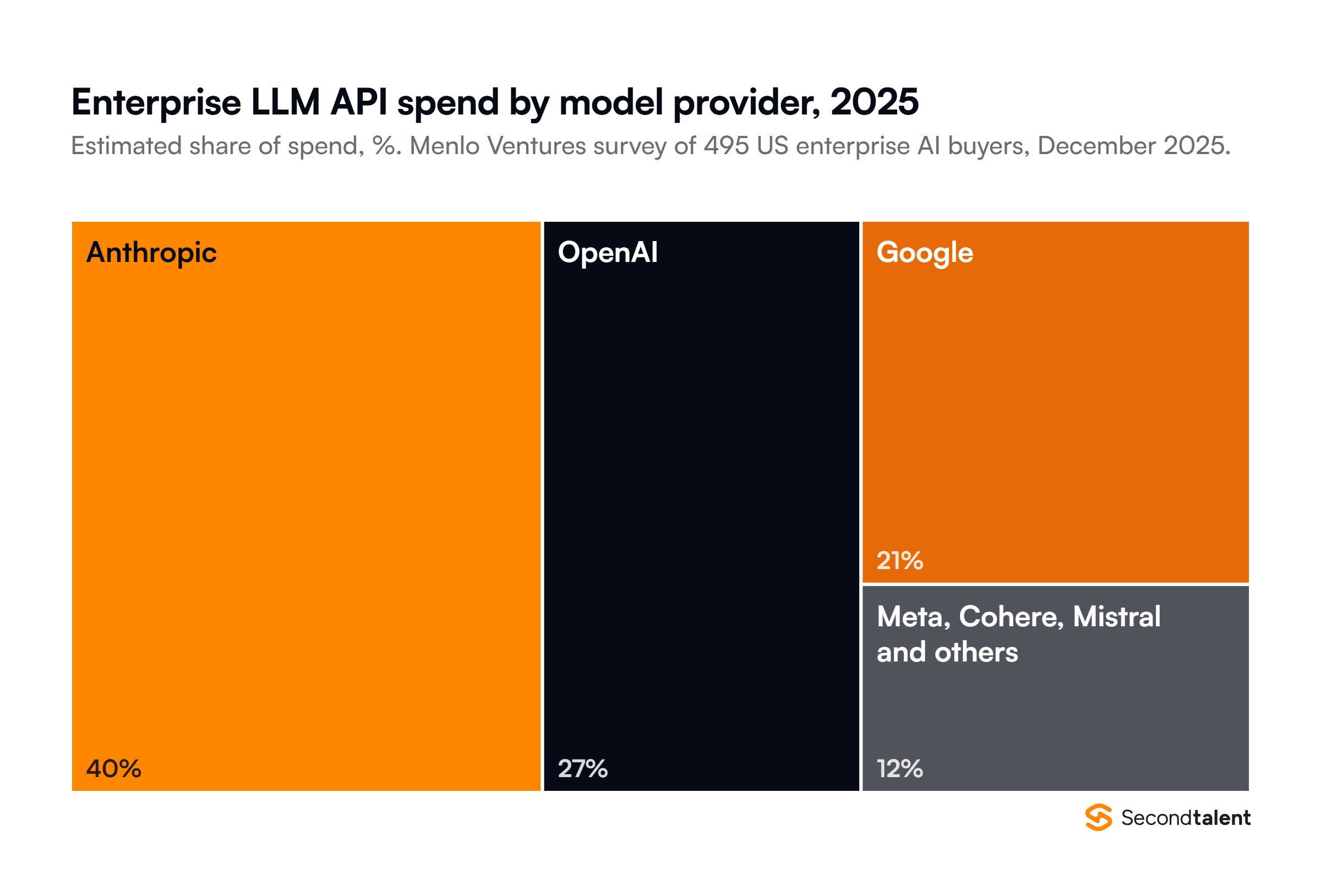
The order reversed in two years. Anthropic went from 12% of enterprise LLM spend in 2023 to 24% in 2024 and 40% in 2025. OpenAI fell from 50% to 27%, and Google rose from 7% to 21%. The three together hold 88%.
Coding explains most of it. Enterprise spend on AI coding tools reached $4.0 billion in 2025, up from $550 million, and Menlo puts Anthropic’s share of coding at 54% against 21% for OpenAI. Open-weight models held 11% of enterprise usage, down from 19%, and Chinese open models about 1% of all LLM API usage.
Most companies buy rather than build: enterprises bought 76% of their AI use cases in 2025 from vendors. Few run true agents that plan, act and adjust on their own, only 16% of enterprise deployments and 27% of startup ones.
How Many Tokens Do LLMs Process?
Google is processing more than 3.2 quadrillion tokens a month across its products. Sundar Pichai gave the figure in his I/O 2026 keynote on May 19, against about 480 trillion a year earlier.
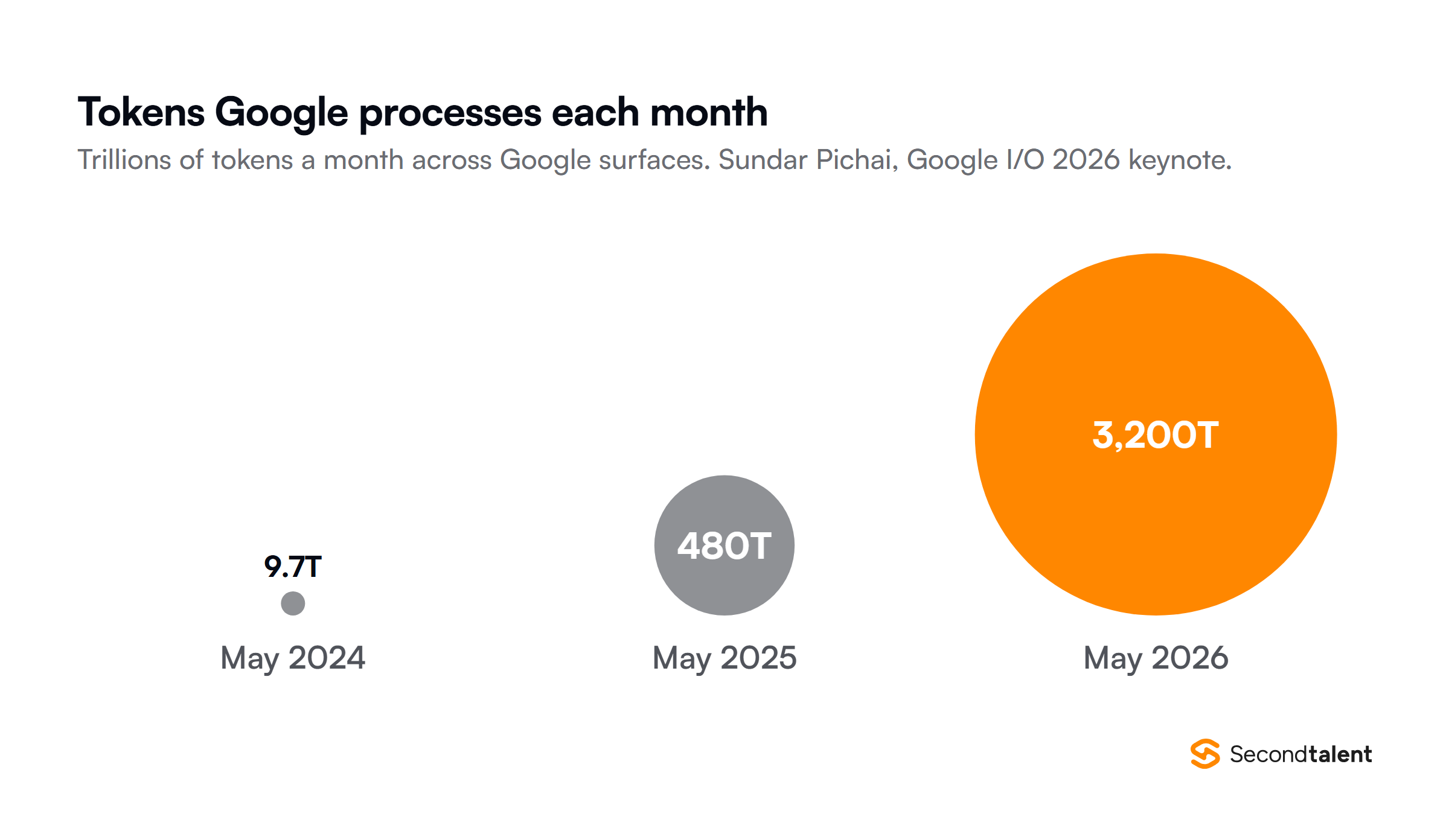
Developer demand is climbing as fast. On Alphabet’s July 22, 2026 earnings call, Pichai said Google’s model APIs process about 22 billion tokens per minute, up from 16 billion a quarter earlier. Nearly 500 Google Cloud customers each processed more than 1 trillion tokens over the previous 12 months.
OpenRouter, which routes developer requests to more than 400 models, gives a view across vendors. Its May 2026 funding announcement put weekly volume at 25 trillion tokens:
Requests are getting longer. In OpenRouter’s 100 trillion token study with a16z, average completions nearly tripled, from about 150 to 400 tokens. More than half of open-weight model tokens went to creative role play, the use OpenAI’s paper found almost absent from ChatGPT.
Claude use leans toward a few countries. The top 20 countries account for 48% of Claude usage adjusted for population, up from 45%, Anthropic reports. Our ranking of the countries with the highest AI adoption rates compares national measures.
Hiring Engineers Who Build With LLMs
The API tokens counted above pass through software that engineering teams build and keep running. Second Talent matches companies with vetted AI developers and machine learning engineers, and our developer rate cards show what those roles cost by country.
Tell us what you are building and we will send matching profiles.
Frequently Asked Questions
Is ChatGPT bigger than Gemini?
On web traffic and US survey use, yes. On headline users, the companies report different things: OpenAI gives weekly users and Google gives monthly users, so their billion-user milestones measure different things.
How much LLM use is coding?
It depends on the product. Coding is a small share of consumer ChatGPT messages, about a third of Claude.ai conversations, and more than half of developer tokens on OpenRouter. It is also the largest category of enterprise AI application spend in Menlo’s data.
Why do generative AI adoption rates vary so much?
They measure different populations and time windows. Pew asks all US adults whether they ever use chatbots, the St. Louis Fed asks adults aged 18 to 64, and the Census Bureau asks businesses about the previous two weeks. Ramp only sees firms that pay through its platform.





![Singapore AI Companies Leading Southeast Asia. Top 10 Singapore AI Companies Leading Southeast Asia [2026], by Second Talent.](https://www.secondtalent.com/wp-content/uploads/2026/09/singapore-ai-companies-featured-v2-768x403.jpg)