
TL;DR: The United Arab Emirates has the highest AI adoption rate in 2026: 73.3% of people aged 15 to 64 used a generative AI tool in the second quarter, on Microsoft's count. Singapore is second at 64.3%, ahead of Ireland, France and Norway at 49.4% to 49.9%. The United States leads the world in building AI but ranks 21st for using it, at 33.0%.
South Korea added almost 15 points of AI users in a year, from 25.9% of working-age people in the first half of 2025 to 40.6% in June 2026, faster than any other top-20 country. Worldwide the figure is 18.8%, and the gap between richer and poorer economies has widened in each of Microsoft's three releases since mid-2025.
- 1Singapore ranks first on OpenAI's per-person ChatGPT ranking for April to June 2026, and second on Anthropic's Claude usage index.
- 2Among businesses, Denmark leads Europe at 42.0% of firms with 10 or more staff using AI, twice the EU average.
- 3US private AI investment reached $285.9 billion in 2025, 23 times China's, per the Stanford AI Index.
- 4In India, 92% of online adults told KPMG they use AI, while Microsoft's usage data puts India at 18.5%.
The 10 Countries with the Highest AI Adoption Rates in 2026
The ten countries with the highest AI adoption rates in 2026 are the UAE, Singapore, Ireland, France, Norway, Spain, New Zealand, the United Kingdom, the Netherlands and Qatar. The ranking comes from the Microsoft AI Economy Institute's Global AI Diffusion report for Q2 2026, published on 21 September, which covers 147 economies.
| Country | AI users | Claude index | ChatGPT rank |
|---|---|---|---|
| 1. UAE | 73.3% | 2.84 | 6 |
| 2. Singapore | 64.3% | 5.81 | 1 |
| 3. Ireland | 49.9% | 3.23 | 28 |
| 4. France | 49.6% | 3.97 | 21 |
| 5. Norway | 49.4% | 4.04 | 13 |
| 6. Spain | 45.1% | 2.69 | 26 |
| 7. New Zealand | 44.1% | 4.84 | 40 |
| 8. UK | 43.7% | 3.35 | 41 |
| 9. Netherlands | 43.5% | 3.90 | 3 |
| 10. Qatar | 43.5% | 1.66 | 34 |
1. United Arab Emirates: 73.3%
The UAE appointed a Minister of State for Artificial Intelligence, Omar Sultan Al Olama, in October 2017. Nine years later it has the widest AI use of any country Microsoft measures, and the lead is growing. The UAE gained 9.3 points between the second half of 2025 and June 2026, more than any top-10 country.
The next phase is compute. G42 announced Stargate UAE in May 2025 with OpenAI, Oracle, NVIDIA, Cisco and SoftBank: a 1 GW cluster inside a planned 5 GW UAE-US AI campus. G42 said in October 2025 that the first 200 MW is due for delivery in 2026.
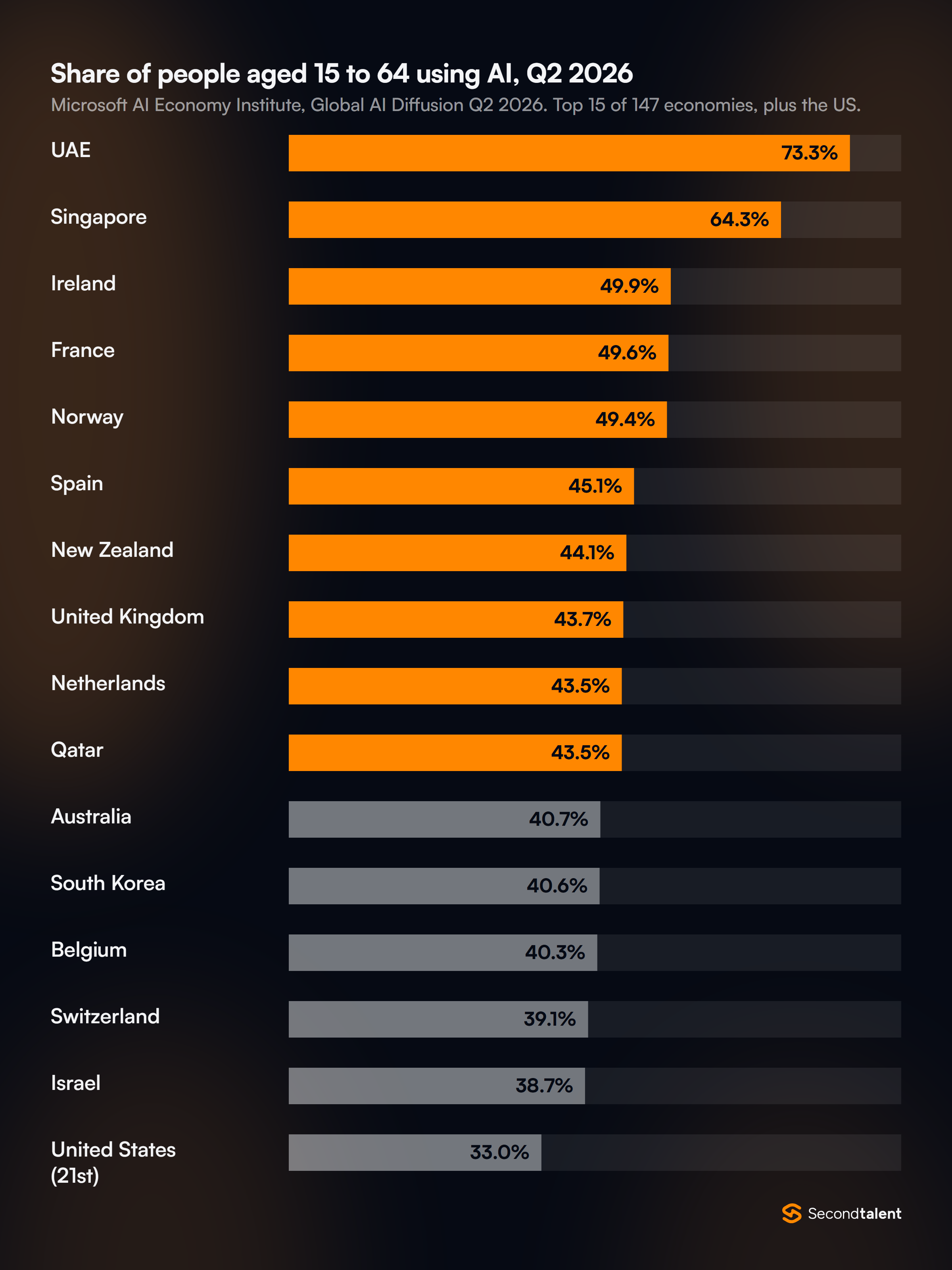
Claude usage is the exception. The UAE scores 2.84 on Anthropic's index, 23rd in the world, well behind Singapore and Australia. A country can top one tool's ranking and sit mid-table on another's.
2. Singapore: 64.3%
Singapore is the only country near the top of all three usage trackers. It ranks first on OpenAI's list, second on Anthropic's and second on Microsoft's. Of the advanced economies in the KPMG and University of Melbourne survey, it also reported the highest regular use, at 73%.
Firm-level data shows smaller companies catching up within a year. The IMDA Singapore Digital Economy Report 2025 puts AI adoption among SMEs at 14.5% in 2024, up from 4.2% a year earlier. Among larger firms it went from 44.0% to 62.5%. IMDA credits the SME jump to micro and small firms taking up off-the-shelf generative AI.
The government has put money behind it: more than S$1 billion over five years for AI compute, talent and industry, announced in Budget 2024. Our look at AI trends in Singapore follows where that money went.
3. Ireland: 49.9%
Ireland took third place from Norway this quarter, though third to fifth place sit within half a point of each other. Its people have adopted AI faster than its businesses.
Eurostat counts 19.6% of Irish firms with 10 or more staff using AI in 2025, a little under the EU average of 20.0%. That is despite Dublin hosting the European headquarters of Google, Meta and Microsoft.
4. France: 49.6%
France has the widest gap in Europe between people and companies. Half of working-age adults use AI, but only 18.2% of French firms with 10 or more employees did in 2025, according to Eurostat's enterprise survey. Denmark shows the opposite pattern: fewer individual users, and the highest business adoption in the EU.
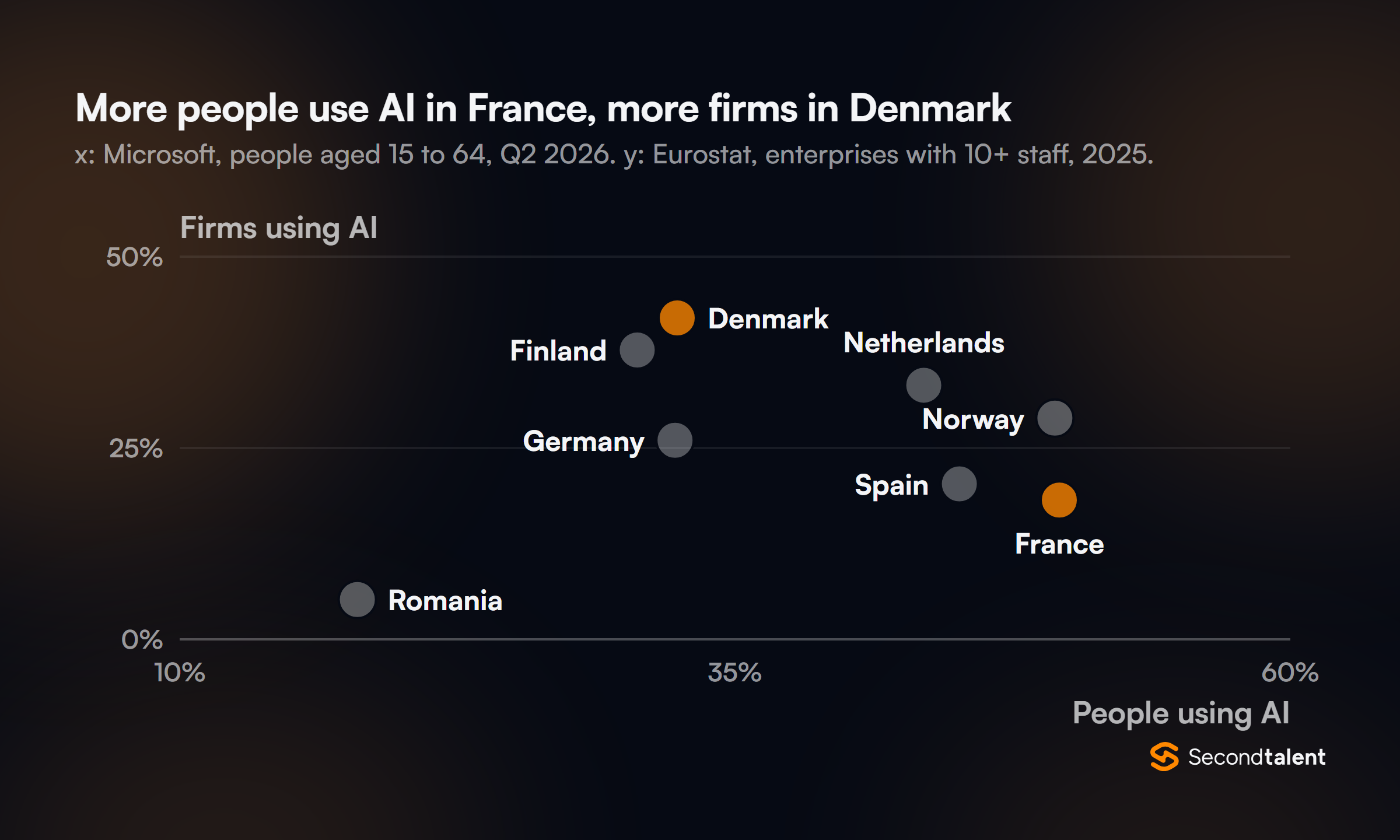
The state is well prepared. The Oxford Insights Government AI Readiness Index 2025 ranks France second of 195 governments, behind only the US. France also gained 5.6 points of AI users in a year, the third-largest rise in the top 20.
5. Norway: 49.4%
Norway was third in both Microsoft releases before this one and slipped to fifth. It grew 0.8 points in the quarter while Ireland and France each added more.
Norway is still the most balanced country in the top five: 28.9% of its firms used AI in 2025, well above the EU average, and 71% of Norwegians told KPMG they use AI at least once every few months.
6. Spain: 45.1%
Spanish businesses almost doubled their AI use in one year, from 11.3% of firms in 2024 to 20.3% in 2025. That took Spain from well below the EU average to above it, at 20.3% against 20.0%. Stanford's Global AI Vibrancy Tool ranks Spain seventh of 36 countries, ahead of the UAE, Japan and Canada.
7. New Zealand: 44.1%
New Zealanders use Claude at almost five times the rate their population share would predict, fifth in the world. Australia, 11th on Microsoft's list at 40.7%, leads Anthropic's index outright at 6.40.
Both countries sit near the bottom of the KPMG survey, where 50% of adults in each said they use AI at least every few months. Measured use runs well ahead of what people report.
8. United Kingdom: 43.7%
The UK ranks higher for building AI than any other country in this top 10. It had 172 newly funded AI companies in 2025, second only to the US, and $5.9 billion of private AI investment, third in the world.
British businesses are catching up with consumers. The Office for National Statistics found 29% of UK firms used at least one AI technology in June 2026, up 8 points in a year. Among firms with 250 or more staff the figure was 49%.
9. Netherlands: 43.5%
The Dutch said they use AI less than anyone else in the KPMG and University of Melbourne survey of 47 countries, at 43%. Yet OpenAI ranks the Netherlands third in the world for ChatGPT messages per person, and a third of Dutch firms (33.2%) used AI in 2025.
10. Qatar: 43.5%
Qatar ties the Netherlands at 43.5%, and Microsoft lists it tenth. It is the second Gulf state in the top 10, and Saudi Arabia is rising behind it: up from 30th to 25th in a single quarter at 31.4%, the biggest rank jump in the Q2 2026 report.
Where the US, China and the Other AI Leaders Rank
The US leads the world in AI, but not in AI use. It ranks first on all three capacity indexes below and 21st on adoption. The countries that build the most AI are not the countries where the most people use it. Our ranking of the countries at the forefront of AI development covers the capacity side in full.
United States: 33.0%, 21st
American labs released 59 notable AI models in 2025, according to the Stanford AI Index 2026. China released 35 and no other country more than eight. US private AI investment was $285.9 billion, and 1,953 new AI companies raised money, against 172 in the UK. Most of the leading AI companies are American, and our count of which countries build the most AI models shows how wide that lead is.
Use is lower: one American in three aged 15 to 64 used generative AI in the quarter, up from 28.3% in late 2025, which moved the US from 24th to 21st. The Census Bureau's Business Trends and Outlook Survey found 23.2% of US employer firms used AI in any business function in August 2026, up from 17.3% when the Census Bureau widened the question in November 2025.
China: 17.5%, 67th, with a caveat
Microsoft places China 67th, but its Q2 report says popular Chinese domestic AI tools are not yet counted and that the next edition should raise China's figure more than any other. The China Internet Network Information Center (CNNIC) counted 602 million generative AI users at the end of 2025, 42.8% of the population.
Beijing wants far more. The State Council's "AI+" plan of August 2025 targets over 70% use of intelligent terminals and agents by 2027 and over 90% by 2030. Our comparison of US and Chinese AI models on cost and performance covers the models behind that push.
Germany: 32.3%, 23rd
Germany ranks sixth on government AI readiness and ninth on the Observer's capacity index, yet 23rd on use. Its businesses do better than its public: 26.0% of German firms used AI in 2025, six points above the EU average.
Companies building AI teams in Germany without a local entity can start with RemoFirst’s guide to Employer of Record in Germany, which walks through provider options and compliance requirements.
Japan: 24.7%, 45th
Japan's own survey tells a faster story. The Ministry of Internal Affairs and Communications White Paper 2026 found 58.8% of Japanese people had used generative AI in fiscal 2025. Among adults aged 20 and over, the group surveyed a year earlier, use rose from 26.7% to 52.2%. Japan still trails the US and Germany, both at 75.6%, and China at 93.6%.
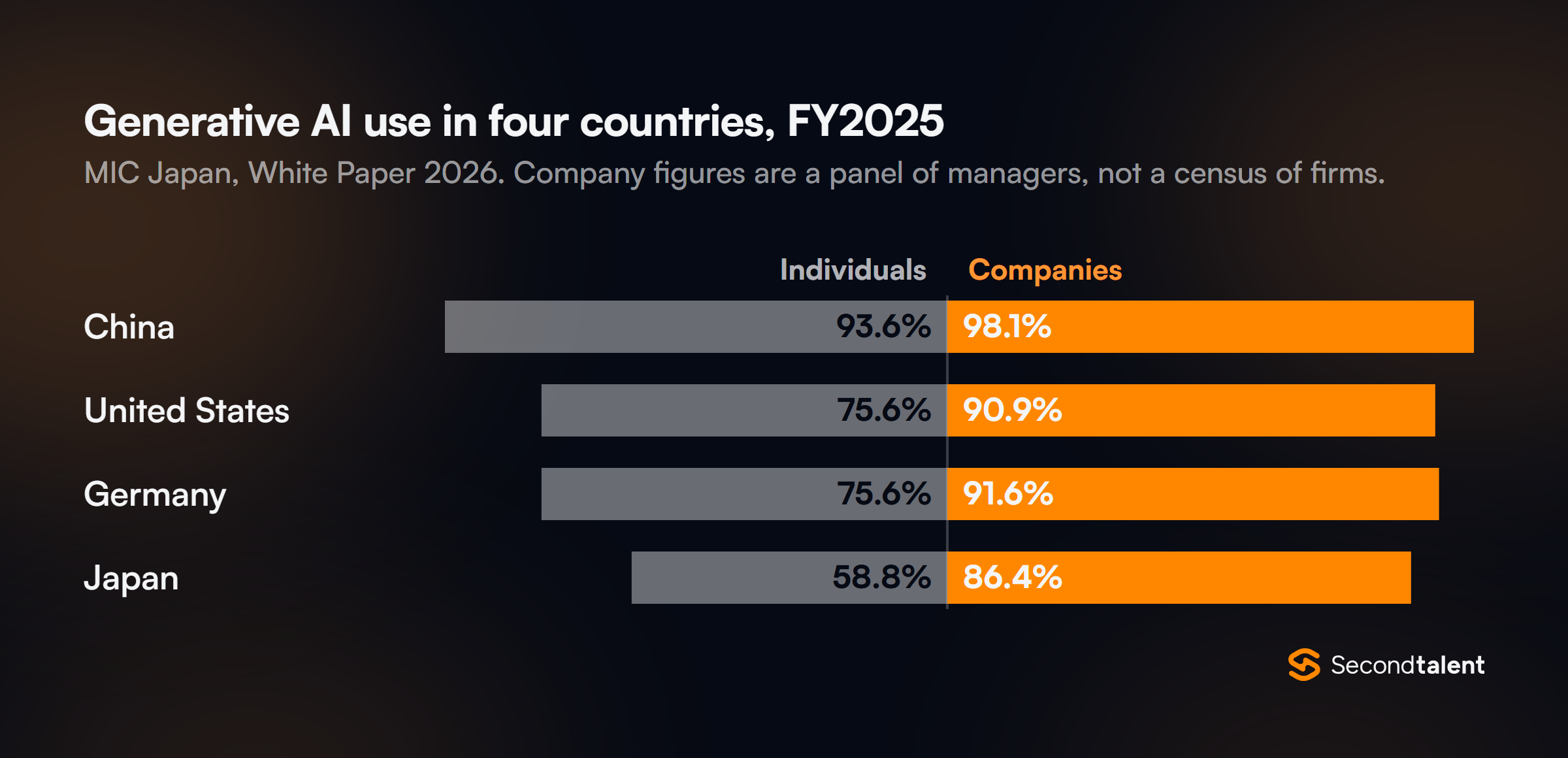
The company gap is smaller: 86.4% of Japanese firms in the ministry's panel used generative AI for some work, up from 55.2%. Japan's AI Promotion Act came fully into force on 1 September 2025, with the stated aim of making Japan "the friendliest country to develop and utilize AI."
Which Countries Are Adopting AI the Fastest
South Korea is adopting AI faster than any other country in the top 20. It rose from 30.7% in the second half of 2025 to 40.6% in June 2026, and from 16th to 12th in one quarter. Microsoft calls it the largest absolute gain in the report.
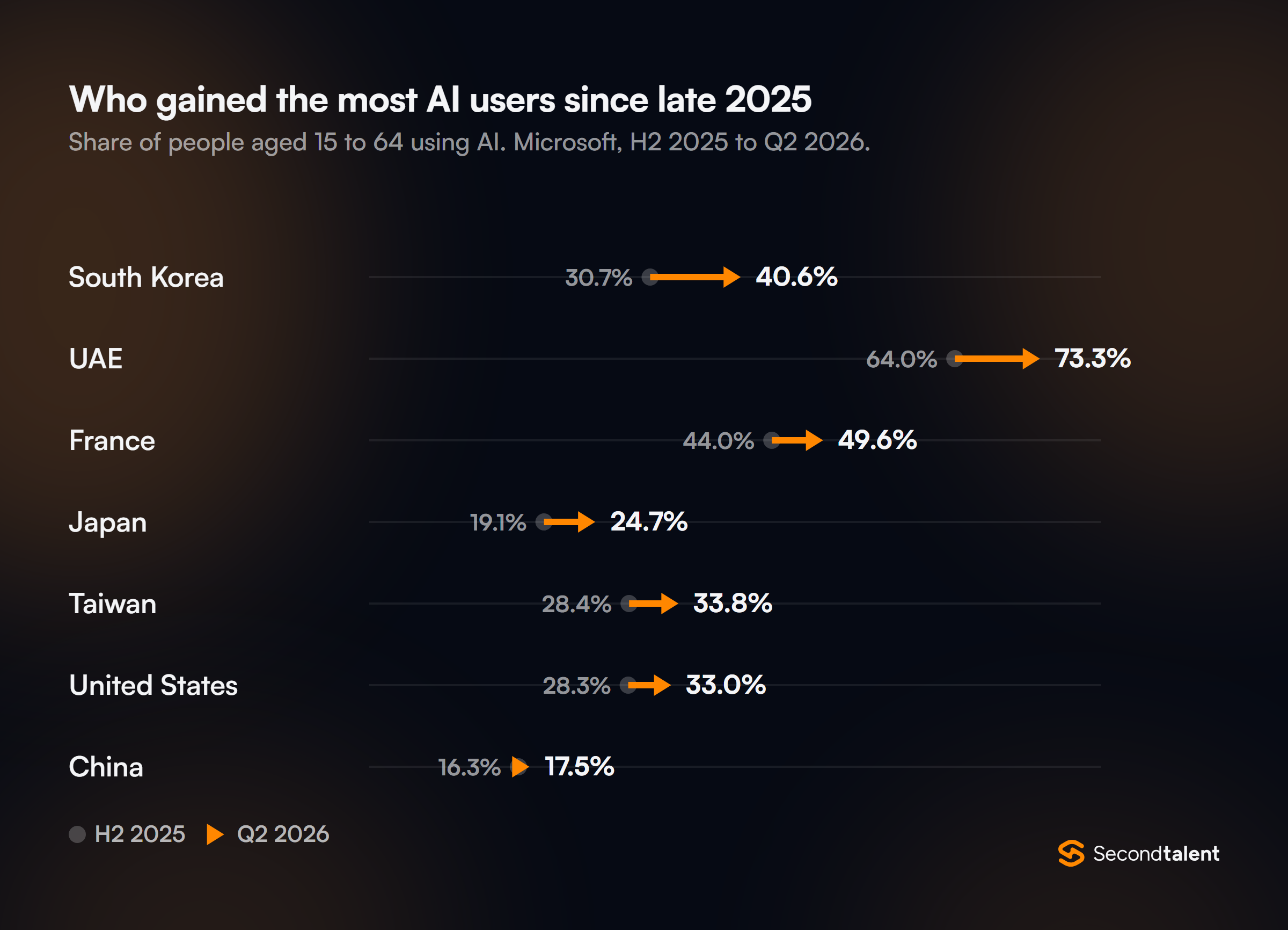
Korea's AI Basic Act took effect on 22 January 2026, with fines deferred for at least a year. Korean users are also heavy Claude users, at 3.78 on Anthropic's index, and account for 3.24% of all Claude traffic worldwide.
Asia dominates growth further down the table. In Microsoft's Q1 2026 report, 12 of the 15 fastest-growing economies since mid-2025 were in Asia, led by South Korea, Thailand and Japan. Japan added 5.6 points since late 2025, as much as France, from a much lower base.
AI Adoption in Southeast Asia and India
After Singapore, Vietnam has the highest AI adoption in Southeast Asia, at 27.9% of working-age people, 33rd in the world. Malaysia follows at 22.6%, then the Philippines at 20.7%, Indonesia at 14.8% and Thailand at 13.4%. India is at 18.5%, 64th.
| Country | AI users | Rank | ChatGPT rank | AI a net benefit |
|---|---|---|---|---|
| Singapore | 64.3% | 2 | 1 | 73% |
| Vietnam | 27.9% | 33 | 88 | n/a |
| Malaysia | 22.6% | 51 | 59 | 70% |
| Philippines | 20.7% | 56 | 92 | n/a |
| India | 18.5% | 64 | 109 | 67% |
| Indonesia | 14.8% | 76 | 101 | 85% |
| Thailand | 13.4% | 83 | 96 | 78% |
In the Ipsos AI Monitor 2025, the 30-country average for the last column was 56%. Southeast Asians are among the most positive about AI in the world, with Indonesia at 85% against 42% in the US. Thailand grew fastest in the region: its AI user share rose 36.4% from June 2025 to March 2026, second only to South Korea.
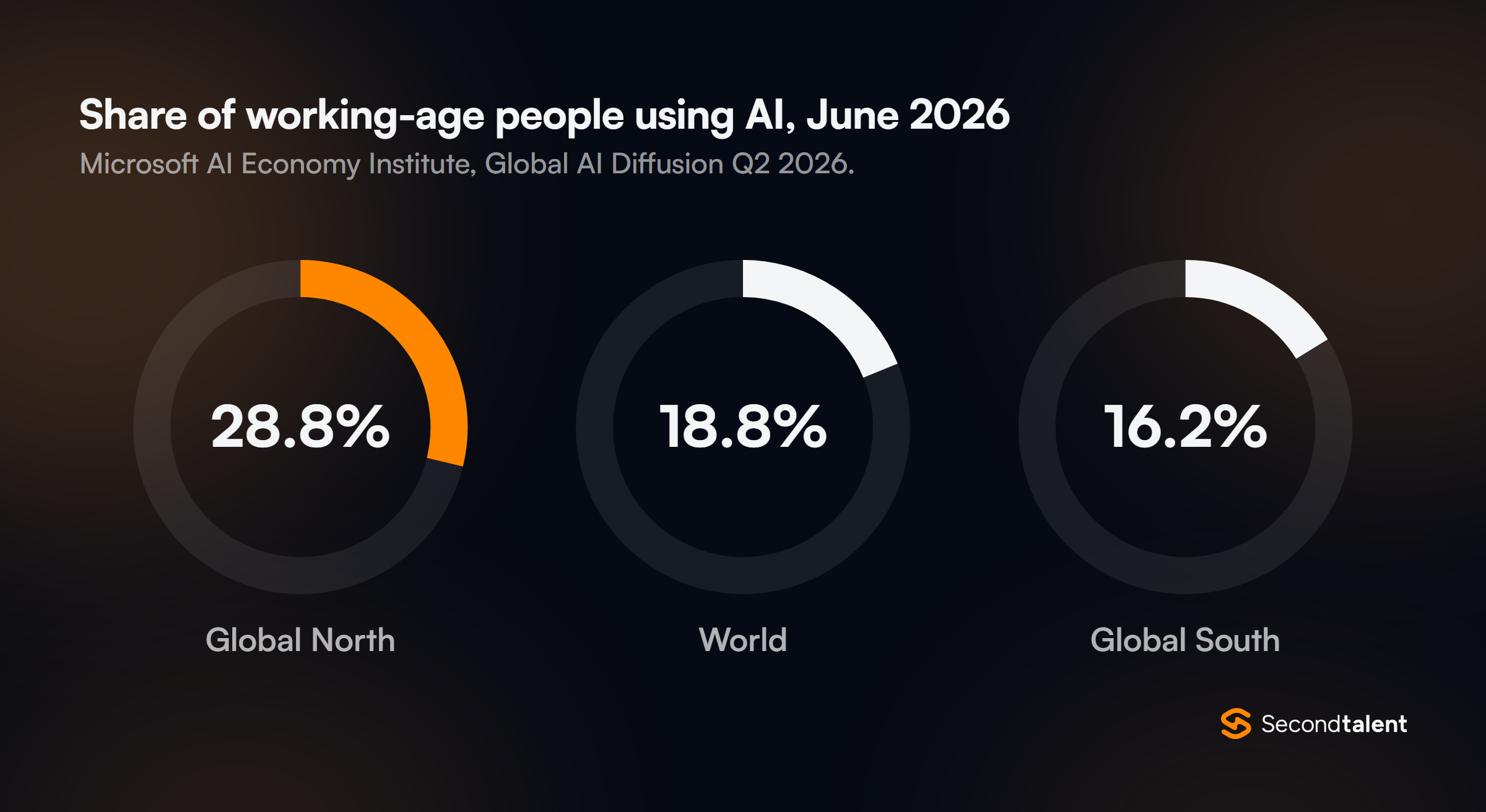
Most of the region sits near the Global South average. The gap between the two groups grew from 10.6 points in late 2025 to 12.6 points in June 2026. For the Vietnam-specific picture, see our list of AI companies in Vietnam.
- 18.5% of working-age people (Microsoft, Q2 2026)
- 109th of 147 on ChatGPT messages per person
- 0.30 on Anthropic's per-person index
- 92% of online adults say they use AI (KPMG, 2025)
- 7.12% of all Claude usage, 2nd after the US
- 38,000+ GPUs onboarded by the IndiaAI Mission
India shows how much the answer depends on the measure. Its 1.4 billion people make it the second-largest Claude market by volume, but per person it ranks 104th. The KPMG figure comes from an online panel, which leaves out the Indians who are not online. The IndiaAI Mission had onboarded more than 38,000 GPUs by March 2026.
Enterprise AI Adoption by Country
Denmark has the highest enterprise AI adoption rate in Europe: 42.0% of Danish firms with 10 or more employees used at least one AI technology in 2025, according to Eurostat. Finland, Sweden, Belgium and Luxembourg follow. Romania is last at 5.2%, and Greece was the only EU country where the share fell.
The European ranking
| Country | 2025 | 2024 |
|---|---|---|
| 1. Denmark | 42.0% | 27.6% |
| 2. Finland | 37.8% | 24.4% |
| 3. Sweden | 35.0% | 25.1% |
| 4. Belgium | 34.5% | 24.7% |
| 5. Luxembourg | 33.6% | 23.7% |
| 6. Netherlands | 33.2% | 23.1% |
| 7. Austria | 30.0% | 20.3% |
| 8. Norway | 28.9% | 20.8% |
| 9. Germany | 26.0% | 19.8% |
| 10. Estonia | 23.4% | 13.9% |
| EU average | 20.0% | 13.5% |
Eurostat asks the same question in every EU country, plus Norway and the candidate countries, which makes it the only like-for-like country ranking for businesses. The EU average rose from 8.1% in 2023 to 20.0% in 2025. Lithuania gained the most after Denmark and Finland, from 8.8% to 21.3%.
Large companies lead on AI adoption
Across the EU, 55.0% of enterprises with 250 or more staff used AI in 2025, against 30.4% of medium firms and 17.0% of small ones. The same gap appears in the UK, where 49% of firms with 250 or more staff used AI in June 2026, and in the US, Australia and Singapore.
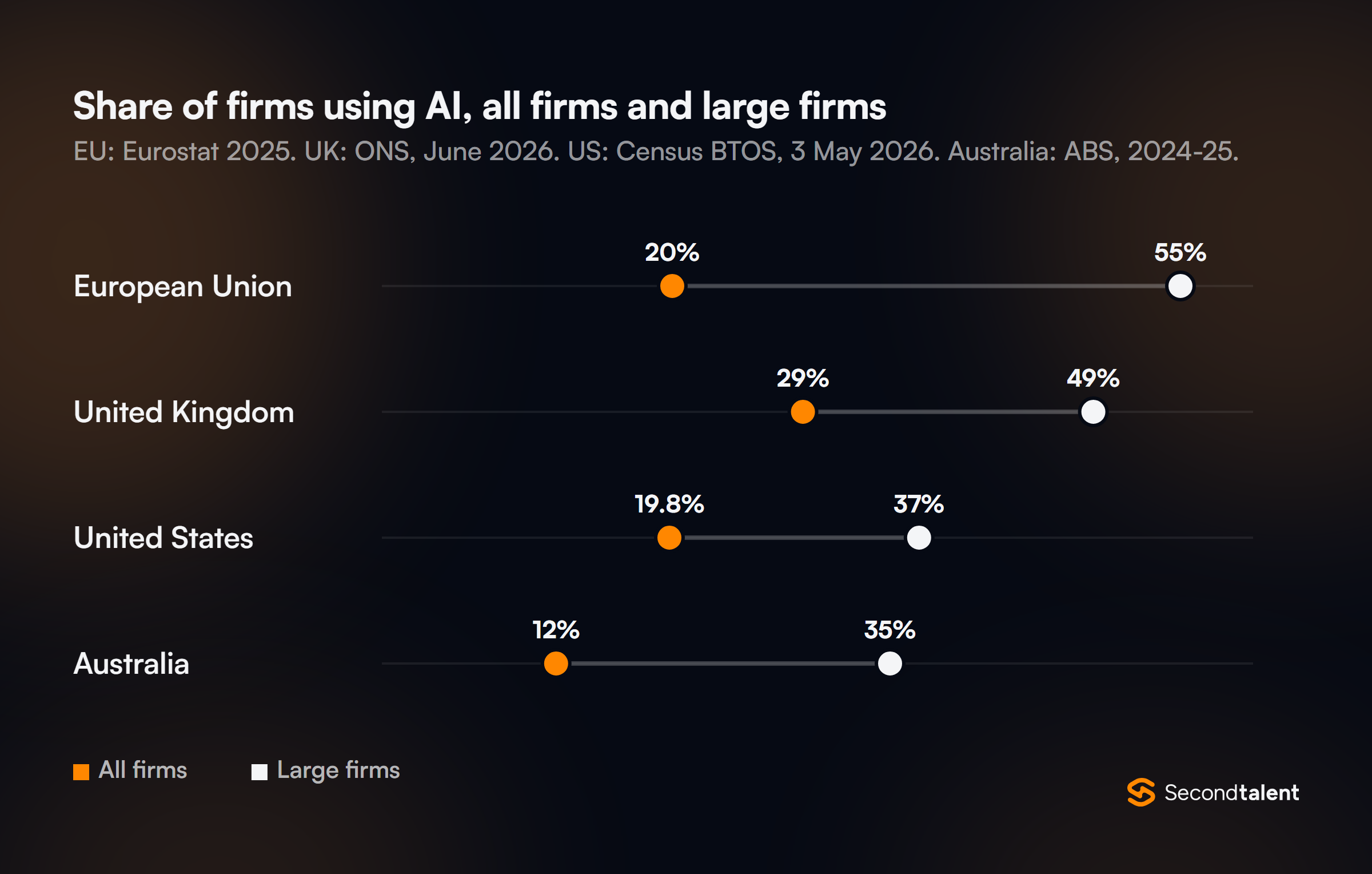
In the US, 37% of firms with 250 or more employees used AI in early May 2026, and 32% of those with 100 to 249, per the Census Bureau. Use rose among firms with 20 or more staff but did not change among smaller ones. In Australia, the ABS puts large businesses at around 35%, up from 9% in 2021-22. Singapore shows the widest split: 62.5% of larger firms against 14.5% of SMEs.
National statistics outside Europe
Each statistics office below asks a different question, over a different period, so read the figures side by side rather than as a ranking.
Canada's figure has tripled in two years, from 6.1% in the second quarter of 2024 to 19.2%, per Statistics Canada. Information and cultural industries (42.3%) and finance and insurance (40.4%) lead.
Surveys of large companies
Private surveys of big companies report far higher rates, because they only sample large companies. SAS and Coleman Parkes asked 1,600 decision makers at organisations with 500 or more staff in early 2024. 83% in China said they used generative AI, against 70% in the UK, 65% in the US and 63% in Australia.
IBM's last Global AI Adoption Index, fielded in late 2023 among firms with 1,000 or more employees, put India first at 59%, then the UAE (58%), Singapore (53%) and China (50%). IBM has not published a newer edition. Japan's ministry panel, shown in the Japan section above, found 86.4% of the Japanese companies it surveyed using generative AI.
Our roundup of enterprise AI adoption statistics covers what companies use AI for and how much they spend, and a second post ranks the industries adopting AI fastest.
Hiring AI Talent from High-Adoption Markets
Singapore sits second on AI use, and Vietnam leads the rest of Southeast Asia. Second Talent places vetted AI engineers from across Asia, including Vietnam, the Philippines and India, at 50-70% of the cost of a US hire.
Tell us the role you need to fill and we will send a shortlist.
Frequently Asked Questions
Which country uses AI the most?
The United Arab Emirates uses AI the most. 73.3% of its people aged 15 to 64 used a generative AI tool in the second quarter of 2026, according to Microsoft. Singapore is second at 64.3% and leads OpenAI's ranking of ChatGPT use per person.
Which country is leading in AI?
The United States leads in AI development. It produced 59 of the notable AI models of 2025 and $285.9 billion of private AI investment, and it tops the Observer, Stanford and Oxford Insights indexes. China is second on the Observer and Stanford indexes, and eighth on government readiness.
Why do AI adoption rankings disagree?
They measure different things. Microsoft estimates the share of people using AI from device telemetry. KPMG asks online survey respondents, which lifts countries such as India and China. Eurostat and national statistics offices count firms, not people. Rankings built from one tool, such as ChatGPT or Claude, reflect that tool's market share as well.
What is the global AI adoption rate in 2026?
18.8% of the world's working-age population used generative AI in June 2026, up from 15.1% in the first half of 2025. The rate is 28.8% in the Global North and 16.2% in the Global South. See our ChatGPT statistics for usage of the largest single tool.






![Singapore AI Companies Leading Southeast Asia. Top 10 Singapore AI Companies Leading Southeast Asia [2026], by Second Talent.](https://www.secondtalent.com/wp-content/uploads/2026/09/singapore-ai-companies-featured-v2-768x403.jpg)