
TL;DR: China carries the heaviest statutory employer burden in the region, commonly 30% to 35% of salary once the housing fund is counted, and the exact figure is set by your city rather than nationally. Contributions run on a base that stops at 300% of the local average wage, so the effective uplift falls on senior salaries.
We employ staff in China through our own entity, so these are the numbers we run every month. This guide covers what you owe, what your employee takes home, and the judicial interpretation that made a common cost-saving arrangement unenforceable.
Key takeaways
- Budget 30% to 35% on top of salary in a tier-one city, and confirm the rate for your specific city.
- The contribution base runs from 60% to 300% of the local average wage and resets every July.
- Social insurance waiver agreements have been void since 1 September 2025. Audit any gross-up arrangement now.
- A written contract is due within one month. Missing it costs double wages for up to eleven months.
- Expatriate fringe benefit tax treatment runs to 31 December 2027, and it is an either/or with special additional deductions.
What employing someone in China costs
Budget 30% to 35% on top of gross salary in a tier-one city. That covers five social insurances plus the housing provident fund, and the employee gives up a further 15% to 18% from their own pay.
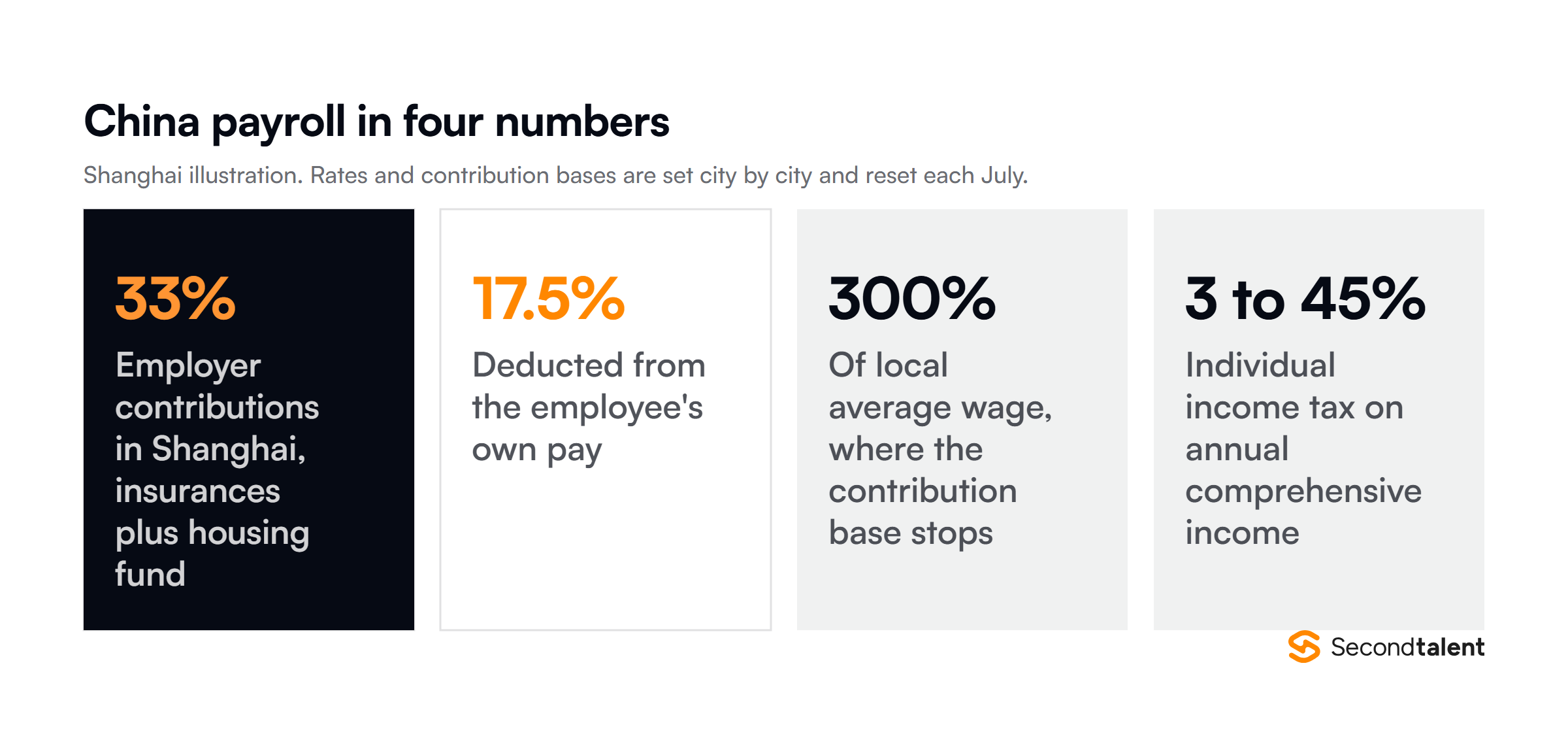
Two features make China different from the rest of the region. Rates are set locally rather than nationally, and the contribution base is banded, running from 60% to 300% of the previous year’s local average wage.
Salary below the floor is contributed on the floor. Salary above the ceiling is contributed on the ceiling. That caps employer cost in absolute terms, so a senior hire carries a lower percentage than a mid-level one.
City choice is therefore a real cost lever, not just a talent one. A lower-tier city carries a lower average wage, which pulls down both the contribution floor and the ceiling, and several set the housing fund nearer 5% than 12%.
Five insurances plus the housing fund
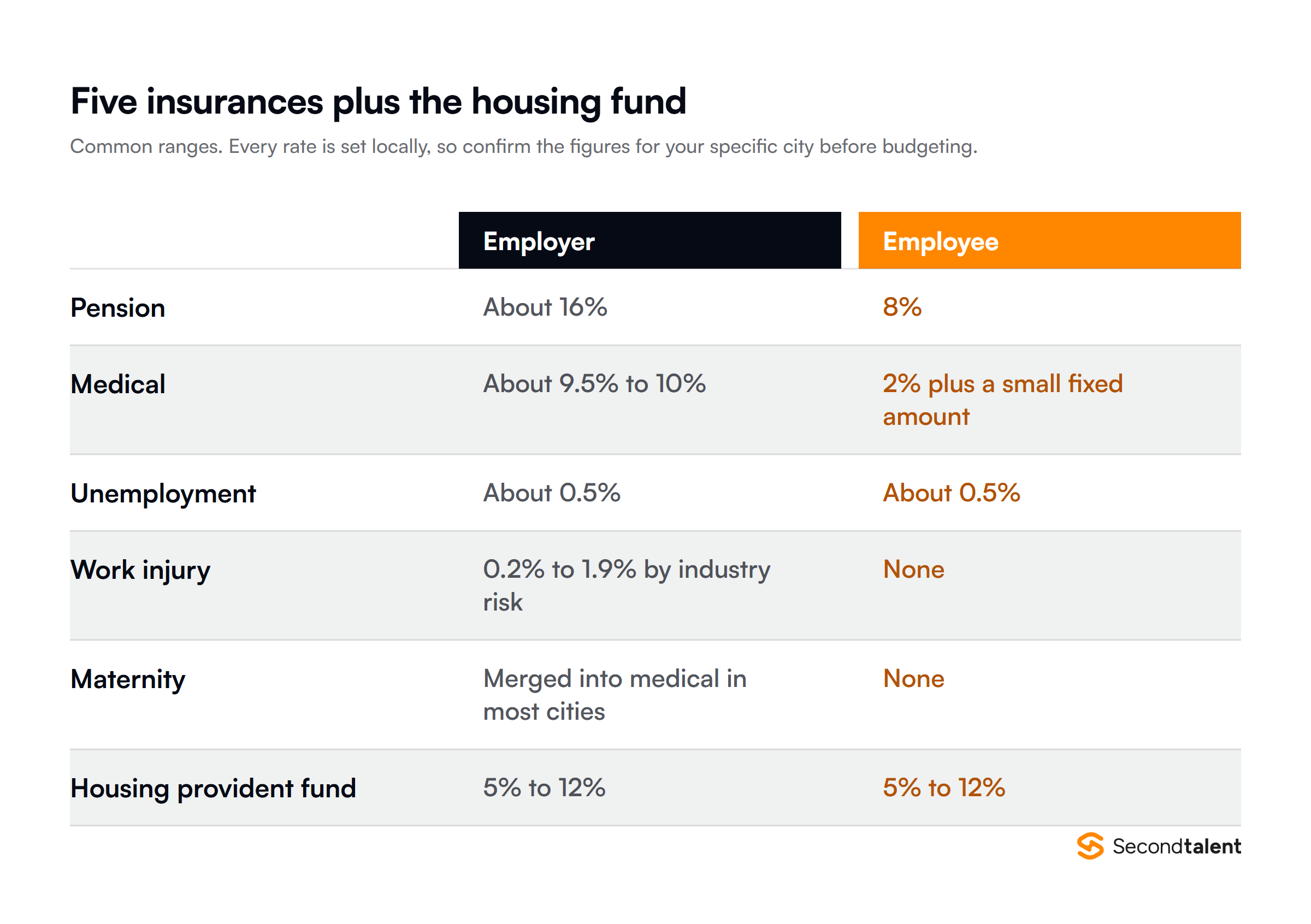
The housing provident fund is the swing factor. Cities set it anywhere between 5% and 12% from each side, and an employer choosing 12% over 5% adds seven points of payroll cost for every employee.
Work injury insurance is employer-only and priced by industry risk, from roughly 0.2% for office work to 1.9% for heavy industry. Maternity insurance has been folded into medical insurance in most cities.
There is no single national rate
Every figure in this guide is a common range or a Shanghai illustration. Shanghai, Beijing, Shenzhen and Chengdu all differ, and each city resets its contribution base every July from the previous year’s local average wage. Confirm the current numbers for your specific city before you budget.
What a hire actually costs
Two worked examples on illustrative Shanghai rates, using the contribution base window that ran from July 2025 to June 2026, with a floor near CNY 7,310 and a ceiling near CNY 36,549 a month.
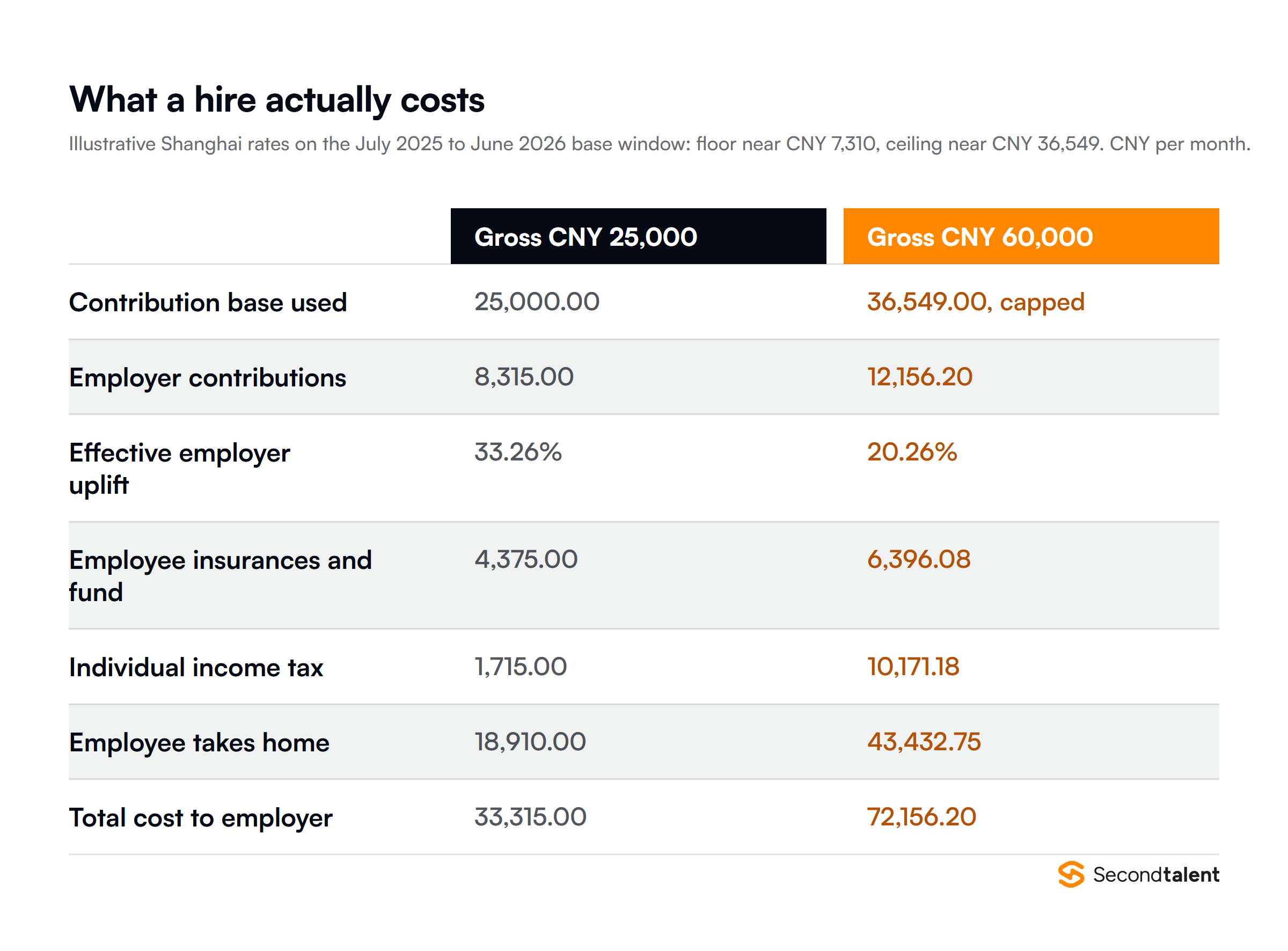
The ceiling is doing real work. At CNY 25,000 the employer pays the full 33.26%. At CNY 60,000 the same rates apply to a capped base, so the effective uplift drops to 20.26%.
Our EOR cost calculator models the full stack, and the China EOR page covers what we handle on your behalf.
The rule that voided social insurance opt-outs
This is the most consequential change for foreign employers in years. On 1 September 2025 the Supreme People’s Court’s Interpretation II on labour disputes took effect.
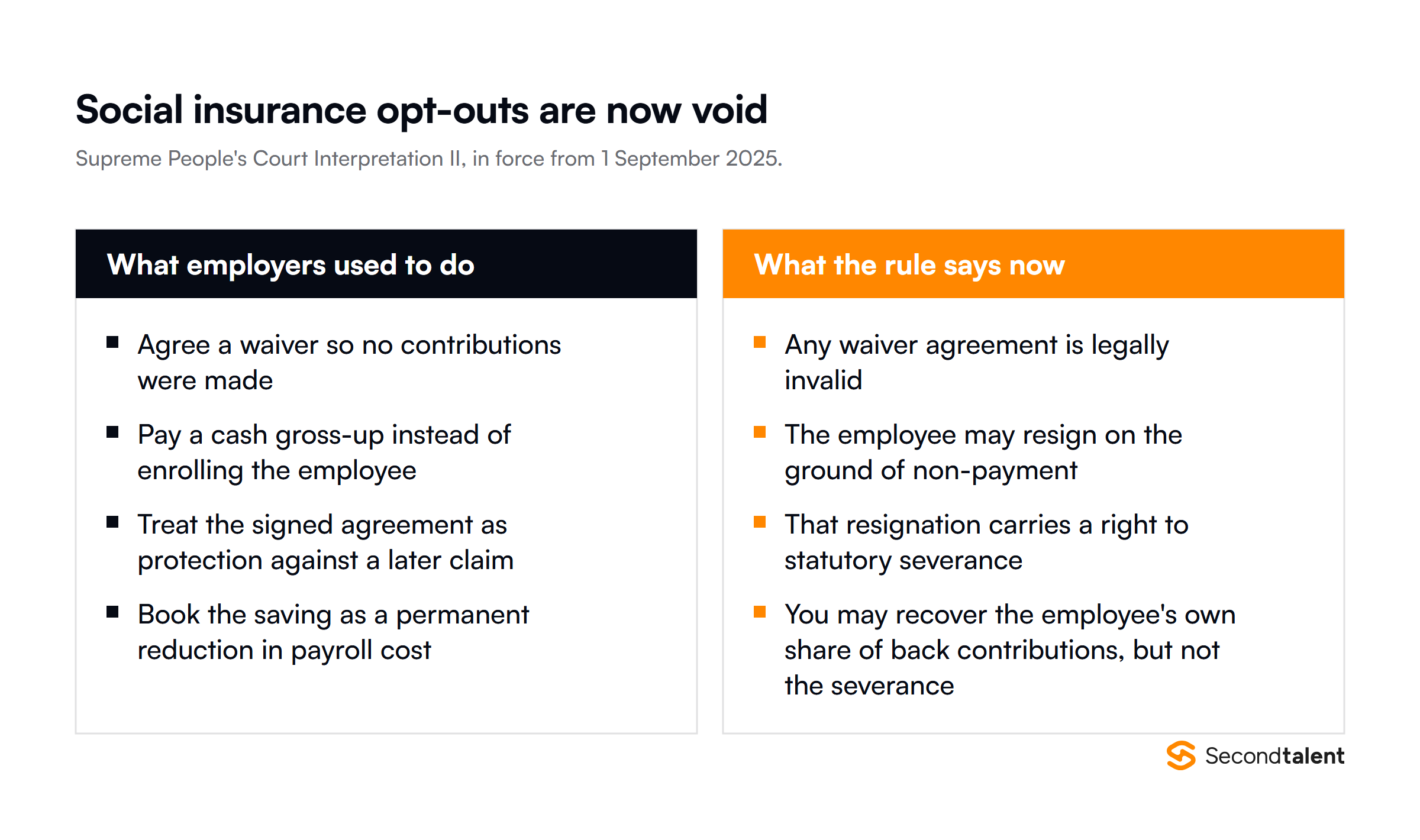
The practice it targets was widespread. Employees preferred cash, employers preferred lower cost, and both signed a waiver saying contributions would not be made. Those agreements now have no legal effect.
The exposure runs in one direction. An employee who signed a waiver can still resign on the ground that you failed to contribute, and claim statutory severance on the way out. You can pursue them for their own share of the back contributions, but not for the severance.
Audit any arrangement where an employee is paid a gross-up instead of being enrolled. If one exists, the liability is already accruing.
Individual income tax
Residents pay progressive rates from 3% to 45% on annual comprehensive income, withheld monthly on a cumulative basis so the effective rate rises through the year.
| Annual taxable income (CNY) | Rate |
|---|---|
| Up to 36,000 | 3% |
| 36,001 to 144,000 | 10% |
| 144,001 to 300,000 | 20% |
| 300,001 to 420,000 | 25% |
| 420,001 to 660,000 | 30% |
| 660,001 to 960,000 | 35% |
| Over 960,000 | 45% |
Special additional deductions cover children’s education, continuing education, housing loan interest or rent, elderly care and major medical expenses. They are claimed by the employee and reduce the withholding you calculate.
Foreign nationals keep a choice worth money. The preferential treatment of expatriate fringe benefits such as housing, children’s education and language training has been extended to 31 December 2027, and an expatriate elects either those exemptions or the standard special additional deductions, not both.
What changed recently
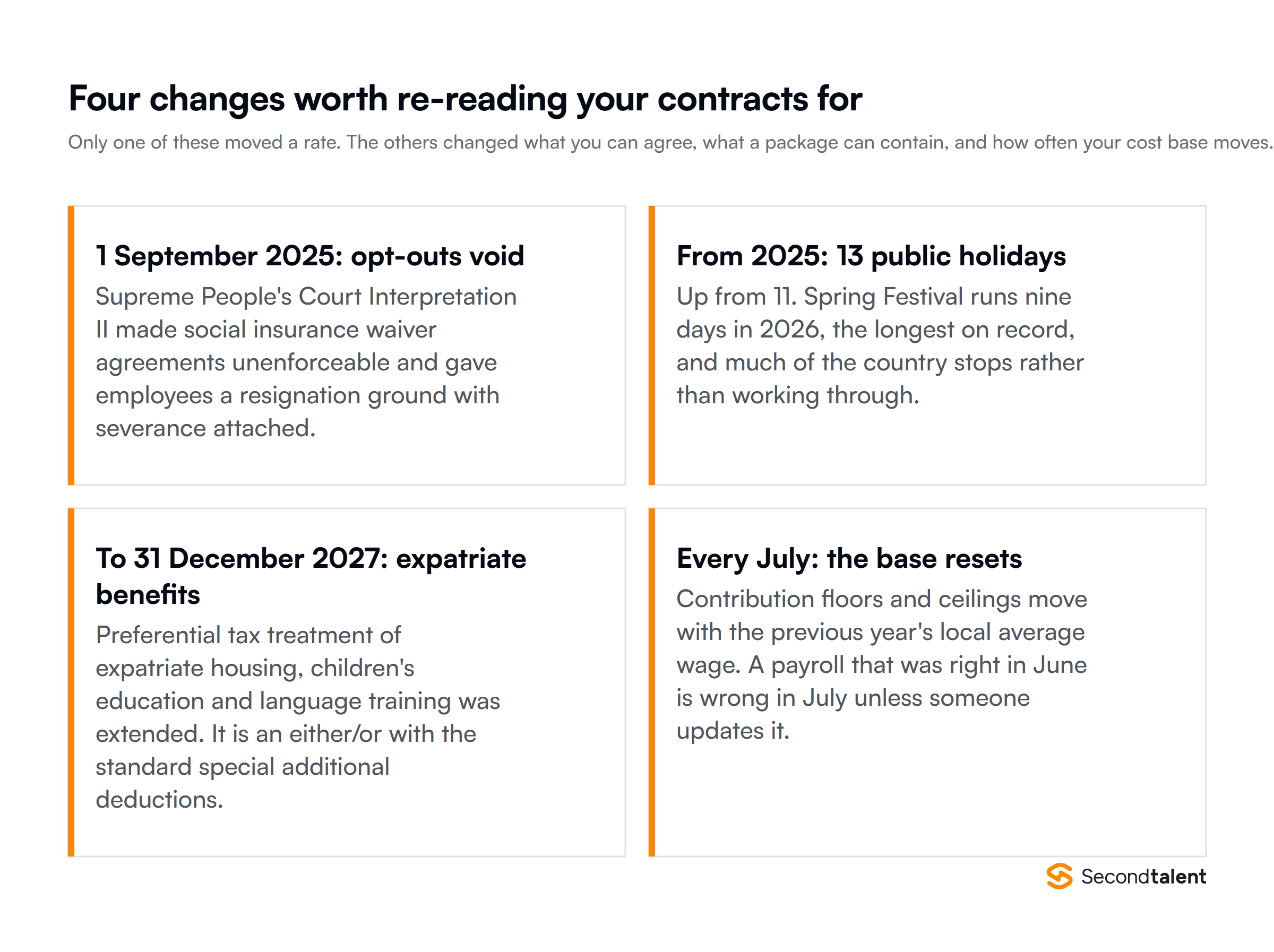
Only one of these changed a rate. The others changed what you can agree with an employee, what an expatriate package can contain, and how often your cost base moves.
Employing foreign nationals
Foreign employees have been inside the mandatory social insurance system since 2011. In practice enforcement varies by city, and the September 2025 interpretation makes any local informality riskier than it was.
Bilateral totalisation agreements are the genuine exemption route. China has them with a number of countries, and a national of a covered country can be exempted from specified contribution types on production of a certificate of coverage from their home scheme.
A foreign national also needs a work permit and a residence permit before starting. Both are employer-sponsored and tied to the role, so a change of employer means a new application rather than a transfer.
Contracts, probation and termination
A written employment contract is mandatory within one month of the start date. Miss it and the penalty is severe: double wages for every month worked without one, up to eleven months.
- Probation caps scale with contract length: up to 1 month for a contract under a year, up to 2 months for one to three years, and up to 6 months for three years or more or an open-ended contract.
- Probation pay: at least 80% of the contractual wage, and never below the local minimum wage.
- Severance: one month’s salary per year of service, half a month for service under six months, capped at 12 years and at three times the local average wage.
- No at-will termination. Dismissal must fit a statutory ground, and unlawful dismissal exposes you to double severance or reinstatement.
An open-ended contract becomes mandatory after two consecutive fixed terms, or after ten years of continuous service. Plan the second renewal deliberately, because it is the decision point that removes your ability to let a contract lapse.
Leave and public holidays
- Annual leave: 5 days for 1 to 10 years of total working life, 10 days for 10 to 20 years, and 15 days beyond 20. The count follows the employee’s whole career, not their service with you.
- Public holidays: 13 statutory days, up from 11 since 2025. Spring Festival and National Day are extended with adjacent working-day swaps.
- Maternity leave: 98 days nationally, extended substantially by most provinces, with the extension funded through maternity insurance.
- Paternity leave: set provincially, commonly 7 to 30 days.
- Sick leave: a medical treatment period scaled by age and service, paid at a local percentage of wages.
The Spring Festival shutdown is the operational fact that matters. In 2026 it runs nine days, the longest on record, and much of the country stops rather than working through.
Benefits beyond the statutory minimum
Statutory medical insurance covers public hospital treatment with meaningful gaps and long queues. Commercial medical cover is the standard addition for professional roles, and candidates in Beijing and Shanghai expect it.
- Commercial medical insurance: close to expected for technical and managerial staff, often extended to a spouse and one child at senior grades.
- Enterprise annuity: a supplementary pension that carries tax advantages and is used by larger employers as a retention tool.
- Meal and transport allowances: common, and worth documenting properly because the tax treatment depends on how they are structured.
- Thirteenth month: not statutory, but close to universal and normally paid before Chinese New Year. Candidates will assume it, so quote packages inclusive of it or say clearly that you do not pay one.
The thirteenth month interacts with tax. A one-off annual bonus has had preferential treatment that lets it be taxed separately from comprehensive income, which materially changes net pay, so confirm the current position before you structure a package around it.
Registering as an employer
China has the longest runway in the region between deciding to hire and being able to pay someone legally. A wholly foreign-owned enterprise takes months, not weeks.
- Business licence: registration with the State Administration for Market Regulation, including scope of business and registered capital.
- Tax registration: with the local tax bureau, which enables IIT withholding.
- Social insurance registration: with the local social insurance bureau, separately from tax.
- Housing fund registration: with the local housing fund management centre, again a separate process.
- Corporate bank account: required before contributions can be remitted, and often the slowest step.
The four registrations are independent and each has its own timeline. That is the practical reason most teams testing the market start on an employer of record and incorporate once the headcount justifies the overhead.
Running payroll each month
- Pay wages monthly, on the date set in the contract, in renminbi.
- Withhold individual income tax and the employee’s social insurance and housing fund share at source.
- File and remit IIT to the tax bureau by the 15th of the following month.
- Remit social insurance and the housing fund to the local bureaus on their own schedules, which differ by city.
- Reconcile in June and July, when the contribution base resets from the new local average wage.
The July reset catches teams out. Contribution bases move without any action from you, so a payroll that was correct in June is wrong in July unless someone updates it. Underpayment is recoverable by the authorities with interest, and it now also gives the employee a resignation ground.
Frequently asked questions
What is the total employer cost of hiring in China?
Between 30% and 35% on top of gross salary in a tier-one city, covering five social insurances plus the housing provident fund. The exact rate is set by the city, and the contribution base stops at 300% of the local average wage.
Can an employee opt out of social insurance in China?
No. Since 1 September 2025 any agreement to waive contributions is void. The employee can resign on the ground that you failed to contribute and claim statutory severance, even if they signed the waiver themselves.
Do foreigners pay social insurance in China?
Yes in principle, since 2011, though enforcement varies by city. The real exemption comes from a bilateral totalisation agreement, where a national of a covered country produces a certificate of coverage from their home scheme.
How much is severance in China?
One month’s salary per year of service, and half a month for service under six months. It is capped twice over, at 12 years of service and at three times the local average wage, so senior severance is bounded.
Can I pay a Chinese employee without a local entity?
Not directly. Social insurance registration, housing fund registration and IIT withholding all require a registered local employer. An employer of record in China holds the contract on its own entity and handles the filings.
Our EOR versus entity calculator models the crossover, and the China EOR provider comparison covers the local market. For the talent picture, see our assessment of engineering talent in China.
Download this guide as a PDF
The full China payroll, benefits and tax guide, including the contribution components, the income tax schedule, the social insurance opt-out ruling, contract and severance rules and both worked examples, formatted for sharing with your finance team.
Hiring in China?
Second Talent employs staff in China on our own entity and handles contracts, social insurance and housing fund registration, IIT withholding and the July base reset, so the rules above become our problem rather than yours. We also source the candidates. Tell us the role and we will come back with candidates and a full employment cost.
This guide is general information, current as at the date of publication, and is not tax or legal advice. Contribution rates and bases are set city by city and reset annually. Confirm your position for your specific city with a qualified adviser before acting.

![How to Hire Developers in Asia Remotely. How to Hire Developers in Asia Remotely from the USA [2026], by Second Talent.](https://www.secondtalent.com/wp-content/uploads/2026/09/hire-developers-in-asia-remotely-featured-v2-768x403.jpg)
![AI Outsourcing in Singapore. Top 10 AI Outsourcing Companies in Singapore [2026], by Second Talent.](https://www.secondtalent.com/wp-content/uploads/2026/09/ai-outsourcing-companies-singapore-featured-v2-768x403.jpg)
![AI Outsourcing in India. Top 10 AI Outsourcing Companies in India [2026], by Second Talent.](https://www.secondtalent.com/wp-content/uploads/2026/09/ai-outsourcing-companies-india-featured-v2-768x403.jpg)
![AI Outsourcing in the Philippines. Top 10 AI Outsourcing Companies in the Philippines [2026], by Second Talent.](https://www.secondtalent.com/wp-content/uploads/2026/09/ai-outsourcing-companies-philippines-featured-v2-768x403.jpg)

![Software Development Outsourcing in Vietnam. Top 10 Software Development Outsourcing Companies in Vietnam [2026], by Second Talent.](https://www.secondtalent.com/wp-content/uploads/2026/09/software-development-outsourcing-companies-vietnam-featured-v2-768x403.jpg)