TL;DR: China has 4.7M STEM graduates yearly but strict regulations, IP risks, and quality gaps make hiring complex. Southeast Asia offers similar skills at lower cost with easier access.
China graduates 4.7 million STEM students every year. That is more than the US, India, and Germany combined.
The numbers look impressive. But the reality for startups is different.
We worked with a SaaS startup that tried hiring engineers in China. They spent three months on compliance paperwork. Their legal costs hit $45,000 before they hired anyone. The project never started.
China has engineering talent. The question is whether startups can access it effectively. The answer depends on your specific needs, budget, and risk tolerance.
| Factor | China | Southeast Asia | Eastern Europe |
|---|---|---|---|
| STEM Graduates/Year | 4.7M | 1.2M | 800K |
| Avg Senior Dev Salary | $45K-$65K | $30K-$50K | $50K-$70K |
| English Proficiency | Low (EF Index: 49) | Medium-High (55-60) | High (60-65) |
| Timezone vs US West | +15-16 hours | +12-15 hours | +9-10 hours |
| Setup Time | 3-6 months | 2-4 weeks | 4-8 weeks |
| Legal Complexity | Very High | Low-Medium | Medium |
What’s your hiring priority?
Select your situation below.
You’re budget-conscious and need quality without China’s $45,000 legal setup fees. Southeast Asia offers senior developers at $3,500-5,500/month versus China’s $6,000-8,000, with zero compliance headaches. Your savings start immediately. Compare Vietnam rates →
You’re building proprietary tech and can’t risk IP exposure in China’s regulatory environment. Our EOR service handles all compliance in IP-safe jurisdictions like Singapore and Philippines, so your code stays yours. Zero legal setup required. Get EOR pricing →
You need developers now, not after months of China compliance paperwork. We source pre-vetted full-stack engineers from our 4.7M+ STEM graduate pool across Southeast Asia. Your team starts coding in 14 days, guaranteed. Hire full-stack developers →
You need senior engineers who actually deliver, not just impressive resumes. Our talent sourcing finds specialists in AI, cloud, and backend from Singapore and Malaysia‘s elite tech hubs. Same quality as China, 30% lower cost, zero regulatory friction. See salary benchmarks →
The Numbers Behind China’s Engineering Workforce
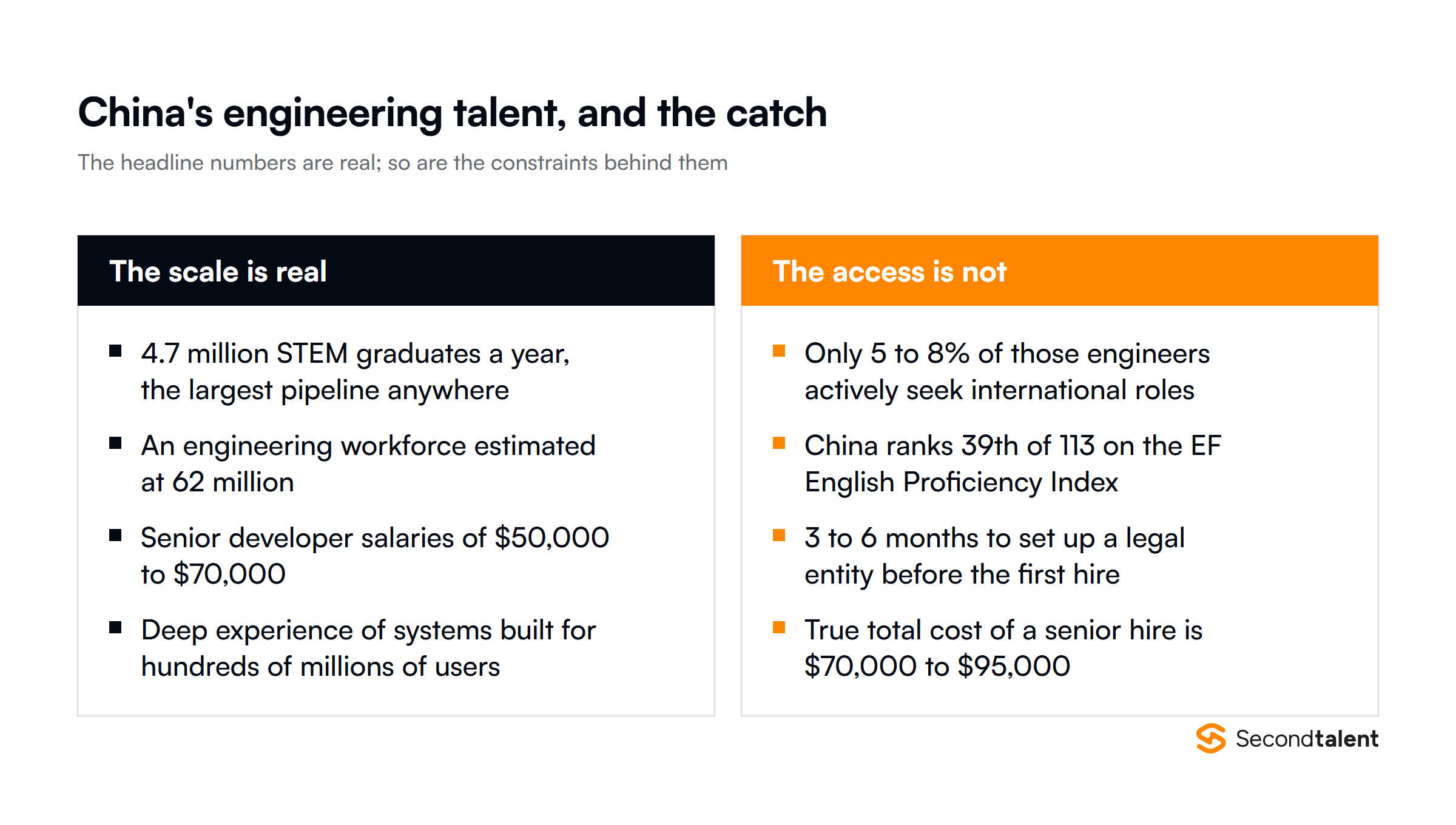
China produces more engineers than any country. According to Fortune, Chinese universities graduated 1.3 million engineers in 2026, versus just 130,000 in the U.S. We need AI to bridge the gap.
The total engineering workforce in China is estimated at 62 million people. This is based on McKinsey research on China’s labor market composition.
But quantity does not equal accessibility. Most of these engineers work for Chinese companies. They focus on the domestic market.
The engineers available for international work are a smaller subset. Based on our experience hiring developers across Asia, we estimate 5-8% of Chinese engineers actively seek international remote roles.
That still means 3-5 million engineers. But the practical pool shrinks further when you add requirements.
English Proficiency Reality
China ranks 39th out of 113 countries on the EF English Proficiency Index. This puts it in the “low proficiency” category.
For comparison, the Philippines ranks 28th. Vietnam ranks 64th but has been improving rapidly.
We worked with a dev tools startup that hired a senior backend engineer from Beijing. His technical skills were excellent. But daily standups took twice as long due to communication gaps. Code comments were minimal.
Documentation was sparse.
The team spent extra hours clarifying requirements. The productivity gain from hiring was offset by communication overhead.
English proficiency varies by city and company background. Engineers from Alibaba, Tencent, or ByteDance often have better English. They worked on international products. But these engineers command premium salaries.
Technical Skill Distribution
Chinese engineers excel in certain areas. Mobile development is strong due to the massive domestic app market. AI and machine learning talent is growing fast, backed by government investment.
According to GitHub’s 2023 State of the Octoverse, China has the second-largest developer community on the platform with 10.3 million users.
But contribution patterns differ. Chinese developers contribute more to domestic projects. International open source participation is lower than India or Southeast Asia.
We see this in candidate profiles. Chinese engineers often have deep experience with local tech stacks. WeChat mini-programs. Alipay integrations. Baidu cloud services.
For startups building global SaaS products, this experience has limited value. You need engineers familiar with AWS, Stripe, Auth0, and similar international tools.
The Real Costs of Hiring Engineering Talent in China
Salary data shows Chinese engineers cost less than US developers. But the total cost of hiring includes many hidden factors.
| Role | China Salary | Vietnam Salary | Philippines Salary | Total China Cost* |
|---|---|---|---|---|
| Junior Developer | $25K-$35K | $18K-$28K | $20K-$30K | $35K-$50K |
| Mid-Level Developer | $35K-$50K | $28K-$40K | $30K-$45K | $50K-$70K |
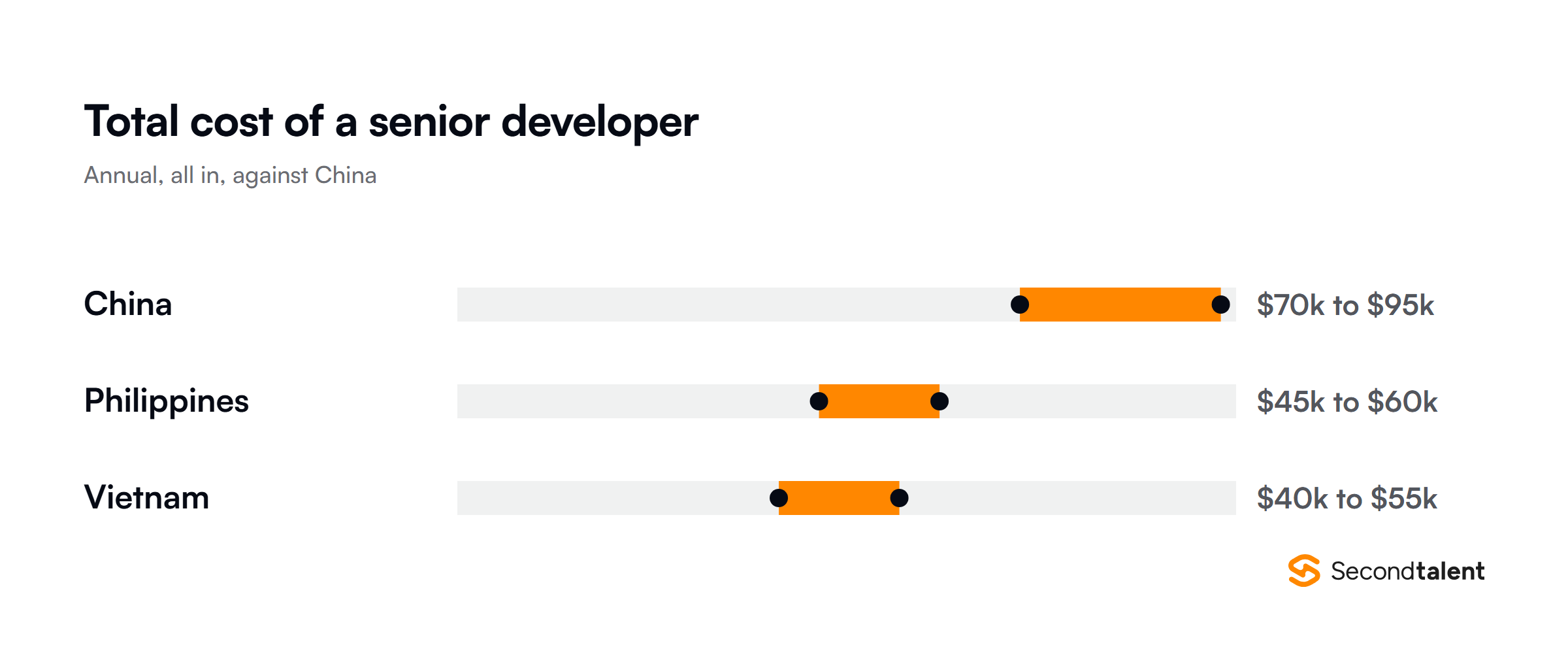
| Senior Developer | $50K-$70K | $40K-$55K | $45K-$60K | $70K-$95K |
| Tech Lead | $70K-$95K | $55K-$75K | $60K-$80K | $95K-$125K |
Entity Setup and Legal Requirements
You cannot hire employees in China without a legal entity. China does not allow simple contractor arrangements for long-term work.
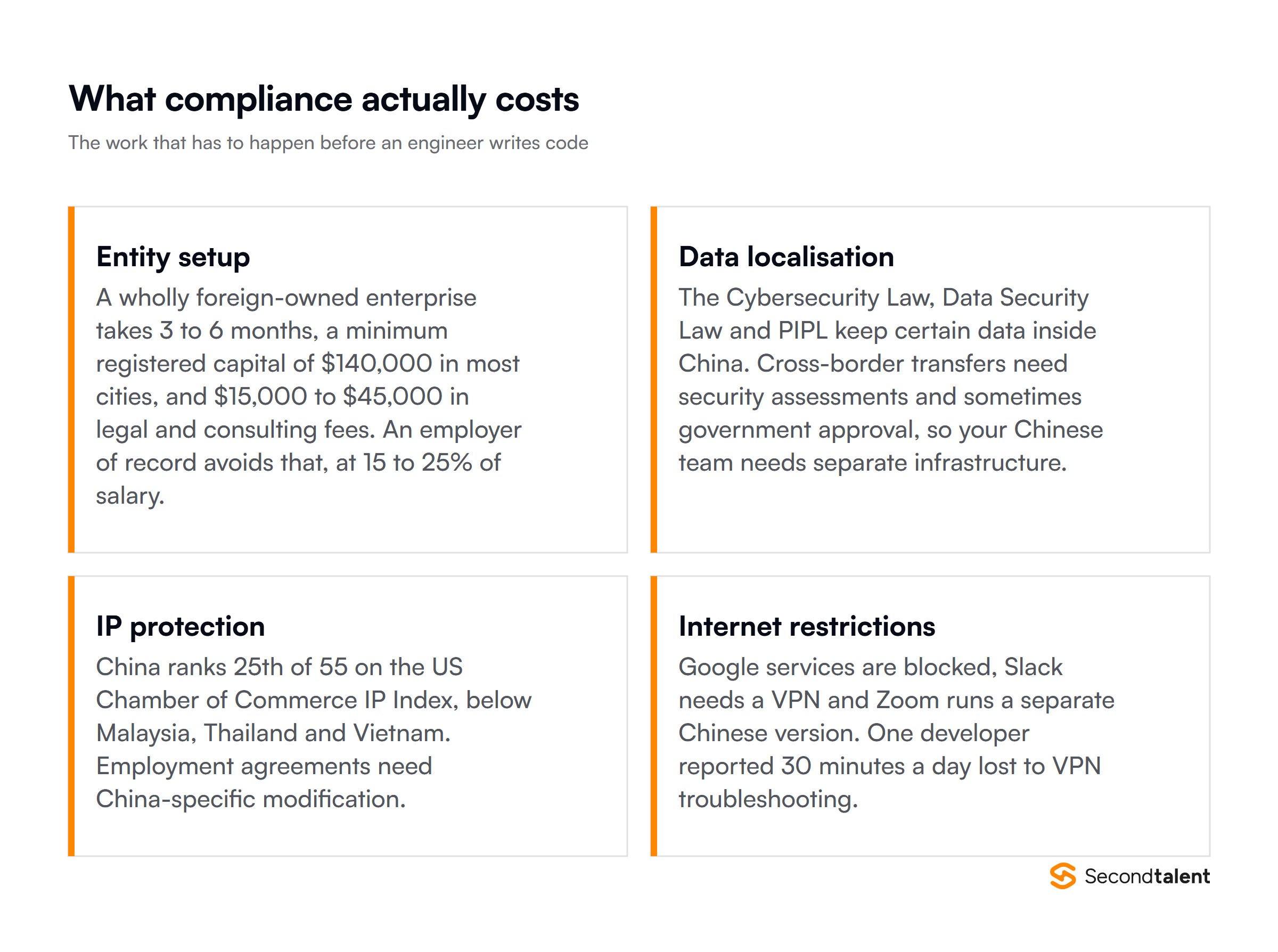
Setting up a Wholly Foreign-Owned Enterprise (WFOE) takes 3-6 months. The process requires:
- Registered capital deposit: Minimum $140,000 in most cities, though requirements vary by industry and location
- Legal and consulting fees: $15,000-$45,000 for setup and first-year compliance
- Office space requirement: Physical office address mandatory, costs vary by city
- Ongoing compliance: Annual audits, tax filings, and reporting requirements
An Employer of Record (EOR) service can bypass entity setup. But EOR fees in China run 15-25% of salary. This is higher than Southeast Asia where EOR fees are typically 8-12%.
One Series A startup we advised wanted to hire three engineers in Shanghai. The EOR quoted $8,500 monthly in fees alone. That was on top of $12,000 in combined salaries.
They switched to hiring in Vietnam. Total monthly cost dropped to $13,200 including EOR fees. They got the same skill level with better English proficiency.
Mandatory Benefits and Social Contributions
Chinese labor law requires comprehensive benefits. Employer social insurance contributions range from 30-40% of base salary.
This includes pension, medical insurance, unemployment insurance, work injury insurance, and maternity insurance. The housing provident fund adds another 5-12%.
Annual leave starts at 5 days and increases with tenure. Sick leave is generous. Severance requirements are strict. Terminating an employee without cause requires one month salary per year of service.
These protections benefit workers. But they increase hiring costs and reduce flexibility for startups.
Regulatory and IP Challenges
China’s regulatory environment creates unique challenges for foreign companies. These go beyond normal hiring complexity.
Data Localization Laws
China’s Cybersecurity Law and Data Security Law require certain data to stay in China. If your Chinese employees handle user data, you may need local servers.
The Personal Information Protection Law (PIPL) adds more requirements. Cross-border data transfers need security assessments. Some transfers require government approval.
For a startup, this creates operational headaches. Your Chinese team cannot access the same systems as your global team. You need separate infrastructure. Data synchronization becomes complex.
We worked with an AI startup that hired ML engineers in Beijing. They spent two months setting up compliant data pipelines. The engineers could not access production data directly. Model training happened on sanitized datasets.
This slowed iteration cycles significantly.
Intellectual Property Risks
IP protection in China has improved. But enforcement remains inconsistent, especially for foreign companies.
According to the US Chamber of Commerce’s 2026 IP Index, China ranks 25th out of 55 countries in IP protection. This is below Malaysia, Thailand, and Vietnam.
The risk is not that your employees will steal code. The risk is structural. If a Chinese employee develops IP, Chinese law may claim jurisdiction. Enforcing your ownership could require Chinese legal proceedings.
Most startups handle this with careful contracts. But it adds legal complexity and cost. Your standard employment agreement needs China-specific modifications.
Internet Restrictions and VPN Requirements
The Great Firewall blocks many services startups use. GitHub works but can be slow. Google services are blocked. Slack requires a VPN. Zoom has a separate Chinese version with different features.
Your Chinese engineers need VPNs for basic work. But VPN use exists in a legal gray area. Corporate VPNs are generally tolerated. But policies can change.
This creates operational friction. Video calls drop. File transfers fail. Collaboration tools behave unpredictably. One developer we placed said he spent 30 minutes daily troubleshooting VPN issues.
Where China’s Engineering Talent Actually Excels
China is not wrong for every startup. Certain use cases make sense.
Building for the Chinese Market
If you are entering China, local engineers are essential. They understand the ecosystem. They know WeChat, Alipay, and local cloud providers. They navigate regulations better.
A fintech startup we know hired a team in Shenzhen to build their China product. The team shipped in half the time their US team estimated. They knew the payment rails. They understood user expectations.
They had relationships with local partners.
For China market entry, local talent is not optional. It is the only way to move fast.
Hardware and Manufacturing Integration
China dominates hardware manufacturing. If your product has hardware components, Chinese engineers offer unique advantages.
They have direct access to suppliers. They can visit factories easily. They understand manufacturing constraints. They speak the same language as factory engineers.
An IoT startup told us their Chinese firmware engineer cut prototype iteration time by 60%. He could walk into a supplier’s office and debug issues on the spot. Remote coordination would have taken weeks.
AI and Machine Learning at Scale
China invests heavily in AI. The talent pool is deep, especially in computer vision and natural language processing for Chinese.
If you need ML engineers with experience in massive-scale systems, China has them. Engineers from Alibaba, Tencent, and ByteDance worked on systems serving hundreds of millions of users.
But this talent commands premium prices. Senior ML engineers from top companies earn $80K-$120K. At that price point, you are competing with US salaries.
Southeast Asia: The Practical Alternative
For most startups, Southeast Asia offers better value. The region has grown into a serious tech hub.
We have placed over 500 developers from Southeast Asia with startups. The results consistently outperform expectations.
Vietnam’s Rising Tech Scene
Vietnam graduates 50,000 IT students yearly. The quality is high. Vietnamese students rank well in international programming competitions.
English proficiency is improving fast. Younger developers speak English well. They grew up learning it in school and online.
The cost advantage is significant. A senior developer in Vietnam costs $40,000-$55,000 fully loaded. This includes all taxes and benefits.
Vietnam has no entity requirement for contractors. You can hire and onboard in two weeks. An EOR service costs 8-10% of salary, much less than China.
One Series A startup we work with built their entire backend team in Hanoi. Five senior engineers cost them $220,000 annually. The same team in China would cost $350,000+ with all fees.
Philippines for Customer-Facing Roles
The Philippines has the highest English proficiency in Asia. Filipino developers communicate as clearly as native speakers.
This makes them ideal for roles requiring customer interaction. DevOps engineers who talk to clients. Solutions engineers who do demos. Technical support engineers.
The Philippines tech talent pool is smaller than Vietnam. But for roles where communication matters most, it is the best choice.
A dev tools startup we work with hired a solutions engineer in Manila. He runs customer onboarding calls independently. No language barriers. No communication overhead. The founder said it feels like hiring locally.
Indonesia and Malaysia for Specific Skills
Indonesia has the largest developer community in Southeast Asia. The talent pool is growing fast, especially in Jakarta and Bandung.
Malaysia offers a good middle ground. English proficiency is high. The legal environment is stable. Costs are slightly higher than Vietnam but still 40% below China’s total cost.
Both countries have strong mobile development talent. If you are building mobile-first products, consider Indonesia or Malaysia.
Making the Decision: China vs Southeast Asia
The choice depends on your specific situation. Here is how to think about it.
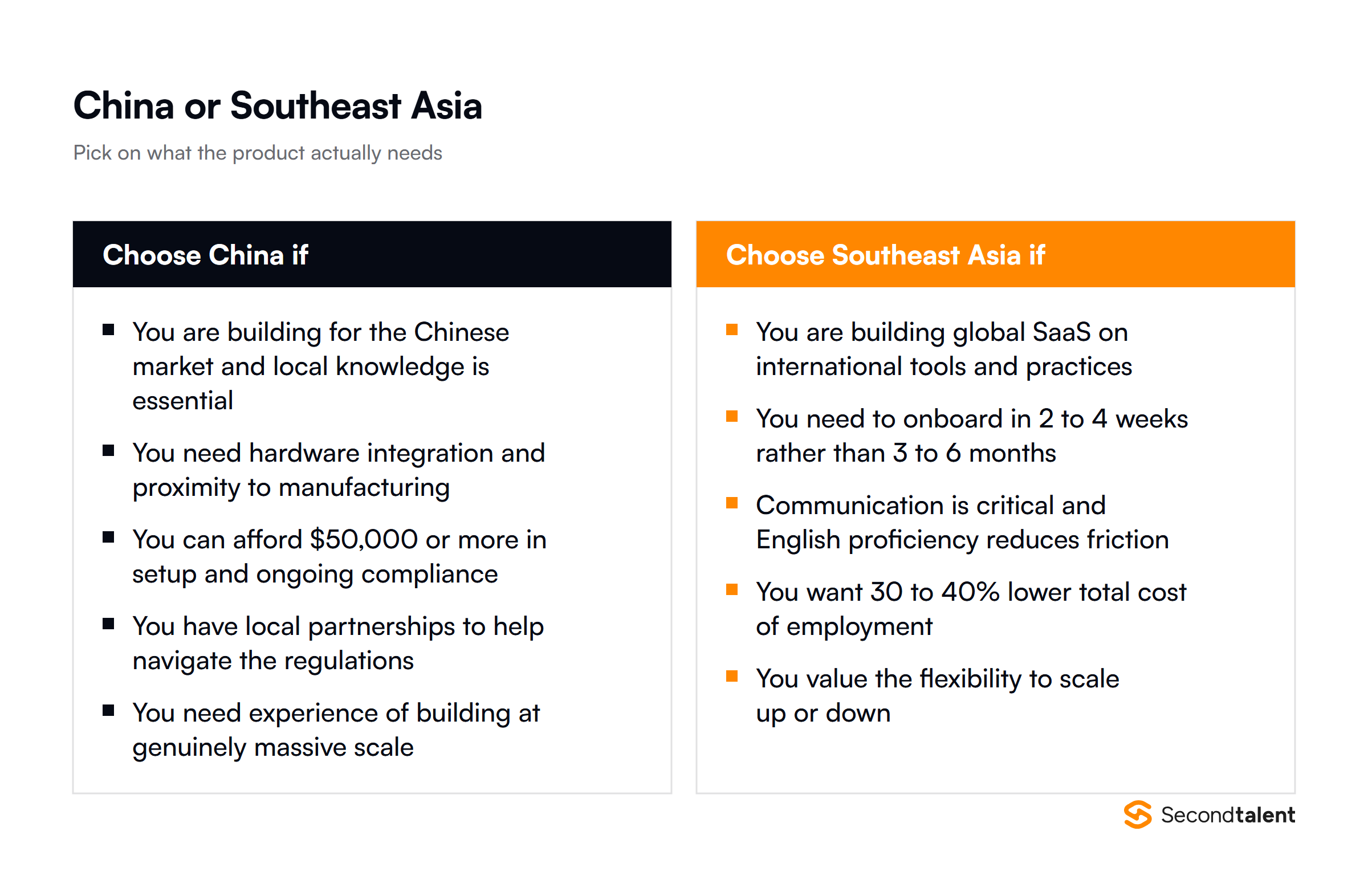
Choose China If:
- You are building for the Chinese market: Local knowledge is essential for success in China
- You need hardware integration: Proximity to manufacturing is a major advantage
- You have budget for complexity: Can afford $50K+ in setup costs and ongoing compliance
- You have local partnerships: Existing relationships help navigate regulations
- You need massive scale experience: Top-tier talent from Chinese tech giants brings unique expertise
Choose Southeast Asia If:
- You are building global SaaS products: Engineers familiar with international tools and practices
- You need fast hiring: Onboard in 2-4 weeks instead of 3-6 months
- Communication is critical: Better English proficiency reduces friction
- You want cost efficiency: 30-40% lower total cost of employment
- You value flexibility: Easier to scale up or down as needs change
The Hybrid Approach
Some startups use both regions strategically. They hire in Southeast Asia for core product development. They add a small China team for market-specific work.
This works if you have the operational capacity to manage two regions. But for most early-stage startups, focus is better. Pick one region and build depth there.
What Our Data Shows
We track performance metrics for all developers we place. The data over 18 months shows clear patterns.
Time to productivity measures how long until a developer ships meaningful code. Southeast Asian developers average 3.2 weeks. This matches or beats developers hired locally in the US.
We do not have enough China placements to compare directly. But the few we tracked took 5-6 weeks due to tooling and communication setup.
Retention rates are similar across regions. After 12 months, 87% of Southeast Asian developers stay with their companies. Industry average for tech is 82% according to LinkedIn data.
Code quality metrics show no significant difference. Senior developers produce similar bug rates and test coverage regardless of location. Junior developers need mentoring everywhere.
The biggest difference is communication efficiency. Teams with Southeast Asian developers report fewer misunderstandings. Requirements are clearer. Documentation is better. Standups are faster.
How to Hire Engineering Talent Effectively
Whether you choose China or Southeast Asia, the hiring process matters.
Start with Clear Requirements
Define the role specifically. List required technologies. Specify experience level. Describe the product and team.
Vague job descriptions attract vague candidates. Be specific about what you need.
One mistake we see often: startups list 15 technologies hoping to find a unicorn. This filters out good candidates who are honest about their skills. Focus on 3-4 core requirements.
Test Communication Early
Do a video call in the first interview round. See how candidates explain technical concepts. Ask them to describe a past project.
Communication matters more than most founders realize. A slightly less experienced developer who communicates well will outperform a senior engineer you cannot understand.
We screen all candidates for English proficiency. This is not about accent. It is about clarity. Can they explain their thinking? Can they ask good questions?
Use Practical Technical Tests
Skip the algorithm puzzles unless you are building algorithms. Test skills relevant to the actual job.
Give candidates a small project similar to real work. A backend developer should build an API. A full-stack developer should build a simple feature.
Pay candidates for their time. A 4-hour project test should include $100-200 compensation. This shows respect and attracts serious candidates.
Check References Thoroughly
Talk to past managers or colleagues. Ask specific questions about work quality, communication, and reliability.
Red flags to watch for: candidate cannot provide references, references are vague, timeline gaps are unexplained.
We do reference checks for all placements. About 15% of candidates fail this stage. Their resumes looked great but references revealed issues.
The Bottom Line on China Engineering Talent
China has engineering talent. The numbers are real. The skills exist.
But for most startups, the practical challenges outweigh the benefits. Setup costs are high. Compliance is complex. Communication can be difficult. Total costs approach or exceed other options.
Southeast Asia offers similar technical skills with fewer barriers. Faster hiring. Better communication. Lower total cost. Easier operations.
Our advice: start with Southeast Asia unless you have a specific reason to choose China. You will hire faster, spend less, and face fewer complications. If your needs change later, you can always expand to other regions.
The question is not whether China has talent. It does. The question is whether you can access it effectively at your stage. For most Seed to Series A startups, the answer is no.
Hire vetted remote developers from Southeast Asia with Second Talent to build your team faster with lower costs and less complexity.