TL;DR: Most developers now use AI coding assistants, but many do not trust what they write. In the 2025 Stack Overflow survey, 84% of developers used or planned to use AI tools, while 46% distrusted the accuracy of the output. GitHub Copilot is still the most used coding tool at work, at 29% of developers in JetBrains' January 2026 survey.
About 3% of developers used Claude Code at work in mid-2025. By January 2026, JetBrains measured it at 18%, level with Cursor, and a month later Anthropic said the tool had passed $2.5 billion in run-rate revenue. Since then GitHub has moved every Copilot plan to metered credits, and SpaceX has bought Cursor.
- 1Google says 75% of its new code is now generated by AI and approved by engineers, up from more than a quarter in October 2024.
- 2Google Antigravity had more than 2.4 million weekly active users in July 2026, about eight months after launch.
- 3One in three pull requests on GitHub now involves an AI agent, Microsoft said in July 2026.
- 4In METR’s 2025 trial, experienced developers took 19% longer with AI tools, yet believed afterwards that AI had made them faster.
How Many Developers Use AI Coding Assistants?
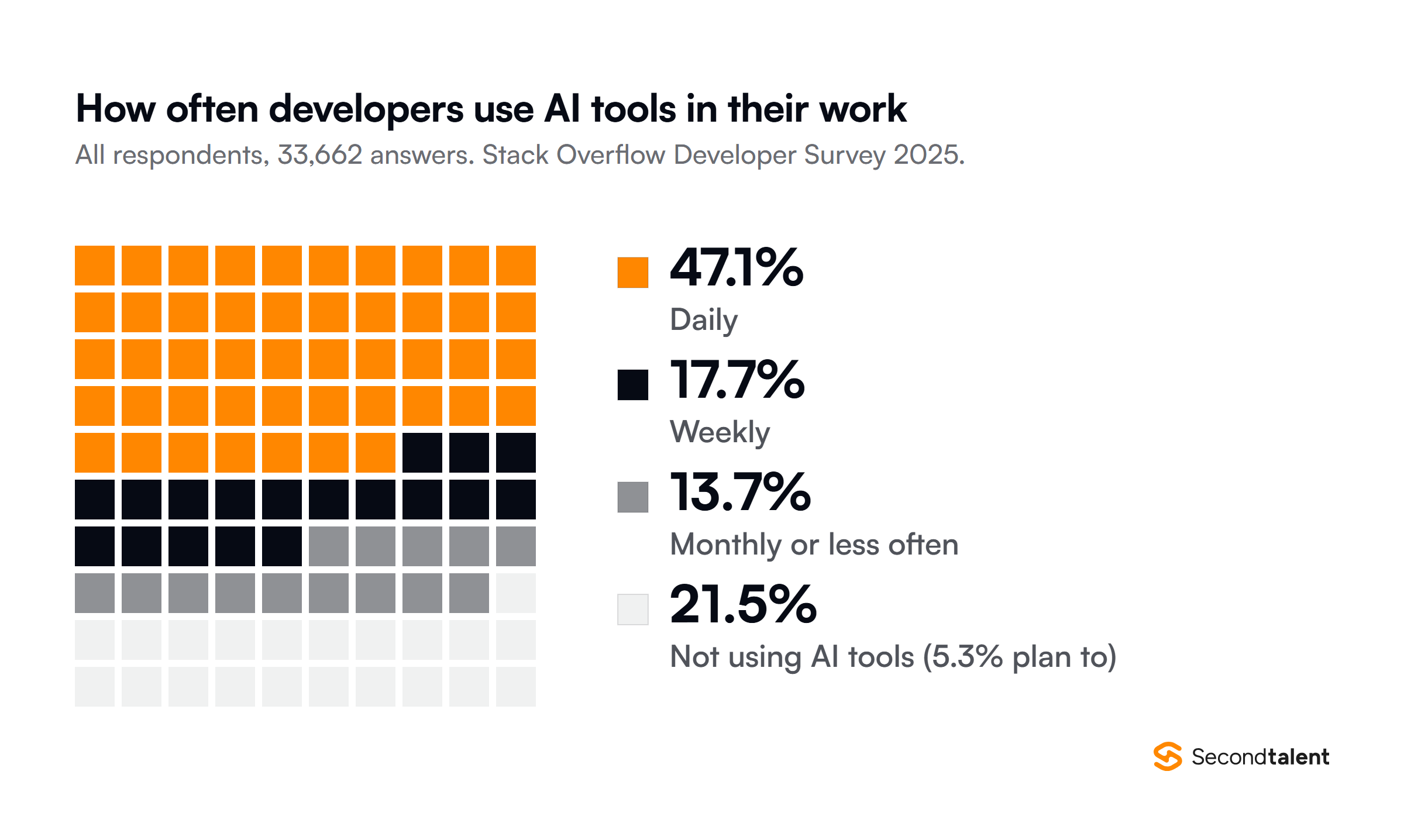
About half of all developers use AI tools every day. In the 2025 Stack Overflow Developer Survey, 47.1% of respondents used them daily and 17.7% weekly. Among professional developers the daily share was 51%. The share using or planning to use AI tools rose from 76% in 2024 to 84%.
Agents have spread less far than chat and autocomplete. In the same survey, 14.1% of respondents used AI agents at work every day, and 37.9% had no plans to use them at all.
Google’s 2025 DORA report surveyed almost 5,000 technology professionals and found AI use up on the year before. 65% said they rely on AI at least a moderate amount for software development, and 8% “a great deal”.
The JetBrains Developer Ecosystem Survey 2025 counted 24,534 developers in 194 countries. 85% used AI tools for coding and development on a regular basis, and 15% had not yet adopted AI tools in their daily work.
Which AI Coding Tools Do Developers Use Most?
GitHub Copilot leads at work, though its growth has stalled. JetBrains’ AI Pulse survey of more than 10,000 professional developers found 29% using Copilot at work in January 2026. JetBrains said its awareness and adoption had not grown since the year before. Cursor and Claude Code tied for second at 18%.
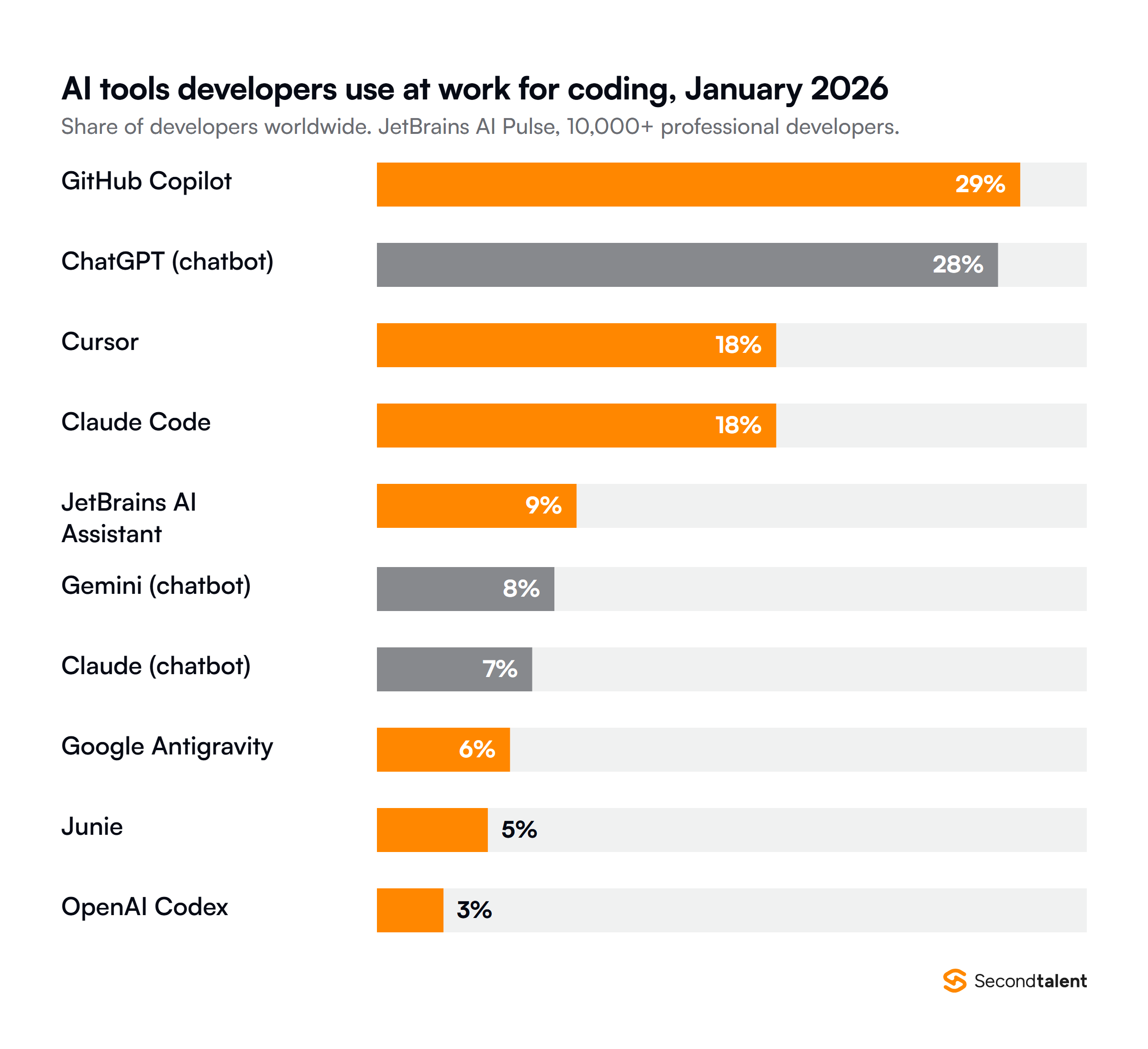
Chatbots still do a lot of coding work. 28% of developers used the ChatGPT chatbot for coding tasks at work, more than used Cursor or Claude Code. OpenAI’s coding agent, Codex, sat at 3%, but JetBrains notes that its data came before the Codex desktop app launched.
Claude Code grew the fastest
Awareness of Claude Code rose from 31% in April to June 2025 to 49% in September and 57% in January 2026. It also scored the highest loyalty JetBrains measured on the market: 91% satisfaction and a net promoter score of 54, on a scale from minus 100 to 100.
Awareness against use at work
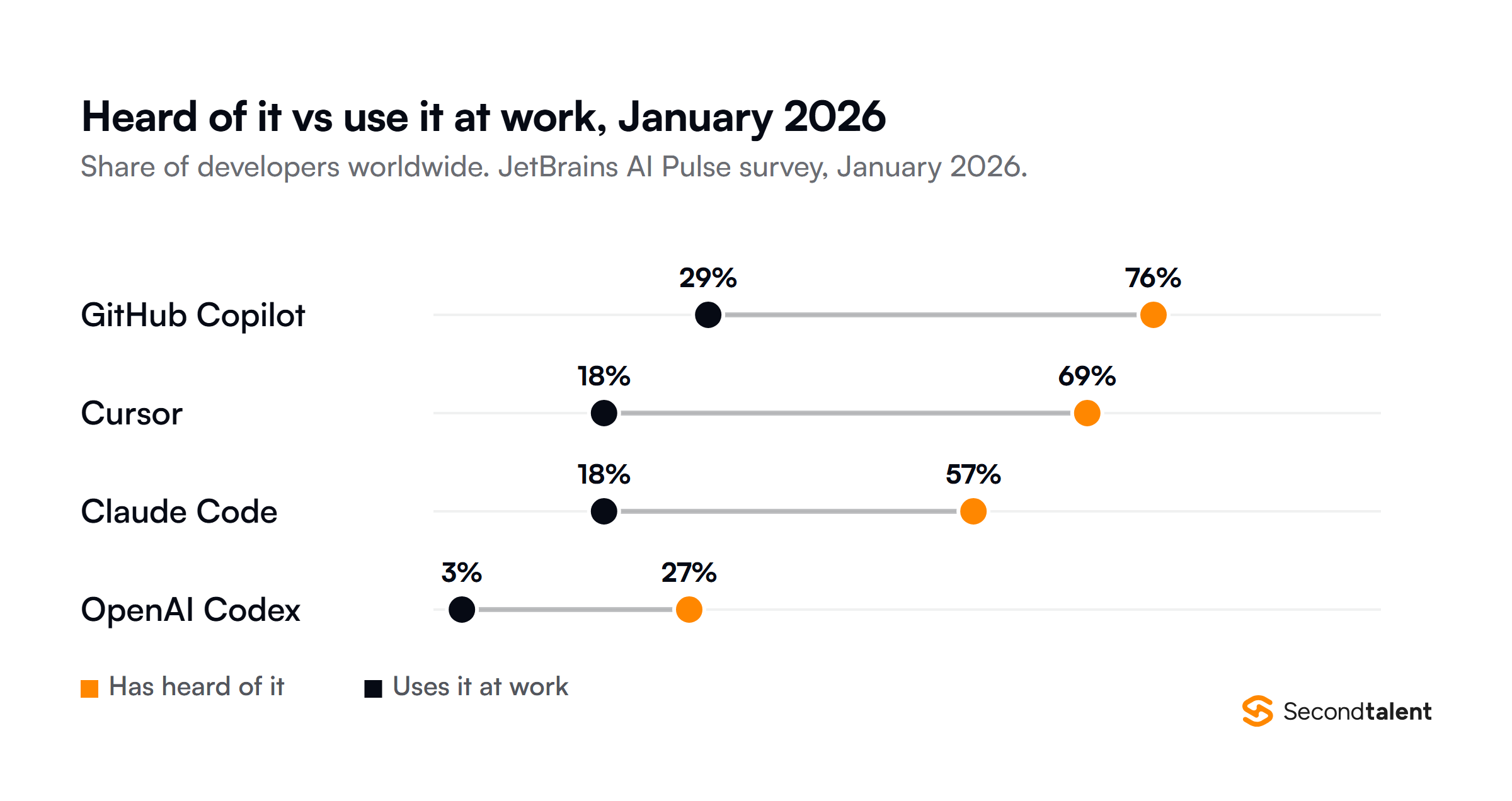
76% of developers had heard of Copilot, 69% of Cursor, 57% of Claude Code and 27% of Codex. On JetBrains’ figures, Cursor has the widest gap between the developers who know it and those who use it at work: 51 points.
Copilot does best in big companies. In companies with more than 5,000 employees, 40% of developers use it at work. For a head-to-head on features and prices, see our Cursor vs GitHub Copilot comparison.
Stack Overflow asked a narrower group, the 8,323 respondents who use or build AI agents, which ready-made assistants they had used. ChatGPT came first at 81.7%, then GitHub Copilot at 67.9%, Google Gemini at 47.4% and Claude Code at 40.8%. Tabnine had 5% and Devin 2.7%.
What businesses pay for
Spending data gives a second view. Ramp’s data shows 16.9% of businesses paying for a tool in its AI coding tools category in September 2026, up 0.4 points in a month. Cursor was the most used vendor in the category, followed by CodeRabbit and Windsurf.
How Fast Are the Leading AI Coding Tools Growing?
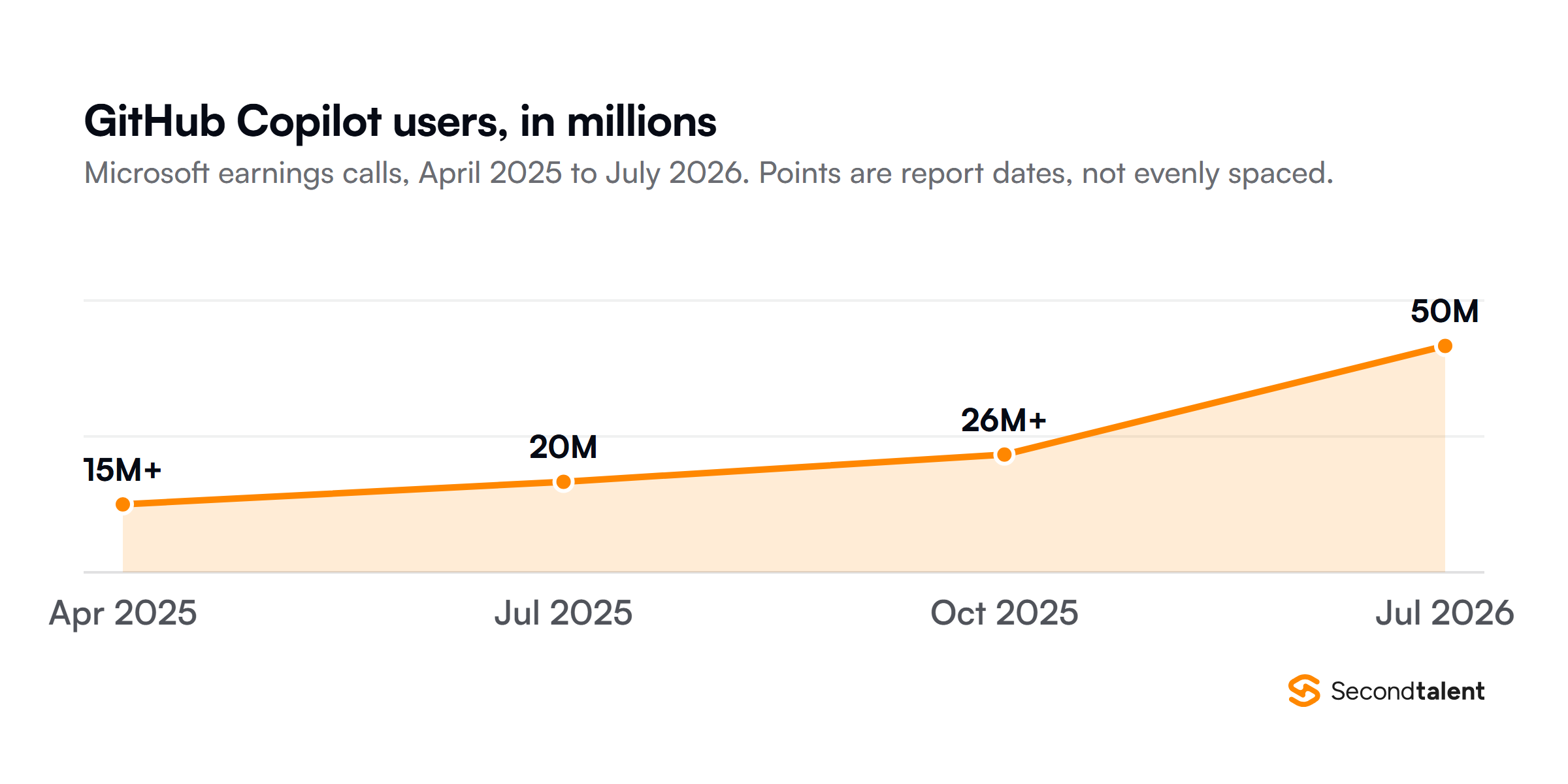
Copilot’s user count more than tripled in 15 months. Microsoft reported over 15 million GitHub Copilot users on its April 30, 2025 earnings call and 50 million on July 29, 2026. On its January 2026 call it put paid Copilot subscribers at over 4.7 million, up 75% on the year.
Heavy use has a cost. In July Microsoft said growing Copilot usage had weighed on its cloud segment’s gross margin, and that margins improved through the quarter after the June switch to usage-based pricing. GitHub itself had 225 million users. Our GitHub Copilot statistics cover its plans, studies and security record.
Claude Code
Anthropic opened Claude Code to the public in May 2025. In September 2025 it said the tool was already earning over $500 million in run-rate revenue, with usage up more than 10 times in three months. By February 2026 that figure had passed $2.5 billion.
Business subscriptions to Claude Code quadrupled between January 1 and mid-February, and enterprises supplied over half of its revenue, Anthropic said. Weekly active users doubled over the same weeks. Our Claude statistics cover the rest of Anthropic’s business.
Google Antigravity and Gemini CLI
Google launched Antigravity in November 2025. Alphabet reported more than 1.5 million weekly active users on its February 4, 2026 call and more than 2.4 million on its July 22 call. On the same call it said over 9 million developers build with its models each month.
Google is folding Gemini CLI into it. At Google I/O on May 19, 2026, Google launched the Antigravity CLI and encouraged Gemini CLI users to move to it.
Cursor
Cursor crossed $1 billion in annualized revenue by November 2025, when it raised $2.3 billion at a $29.3 billion valuation. In May 2026 it said over 70% of the Fortune 500 use it. Our Cursor statistics track the later revenue reports and the SpaceX deal.
How Much Code Do AI Coding Assistants Write?
Google has published the clearest series. On Alphabet’s October 2024 earnings call, Sundar Pichai said more than a quarter of all new code at Google was generated by AI, then reviewed and accepted by engineers. Eighteen months later he put the share at three quarters.
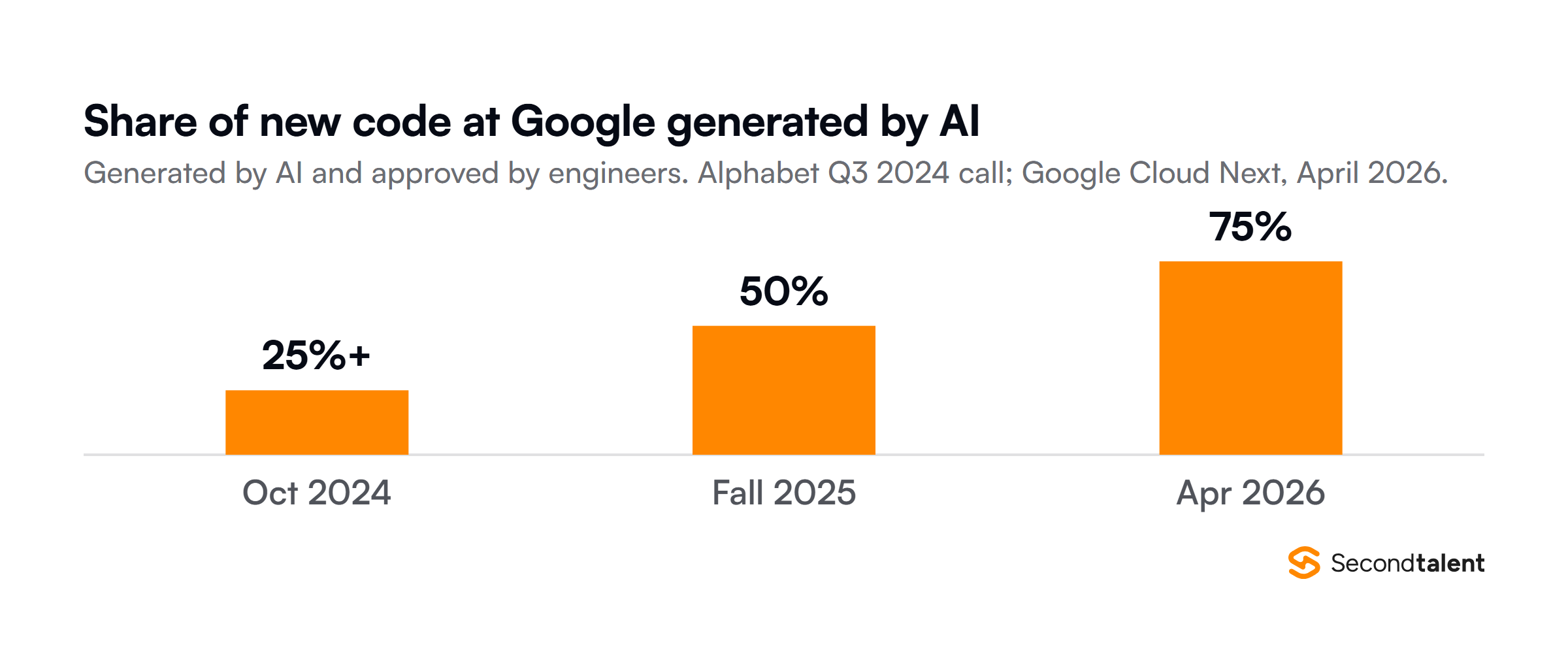
“Today, 75% of all new code at Google is now AI-generated and approved by engineers, up from 50% last fall.”
Sundar Pichai, Google Cloud Next, April 22, 2026
The figure is Google’s own, self-reported and limited to new code, so it cannot be set against outside counts of commits. GitHub reports on agents instead: one in three pull requests on the platform now involves one, Microsoft said in July.
Our analysis of how much software AI writes compares the other estimates, and our AI in software development statistics follow AI through testing, review and deployment.
Do Developers Trust AI Coding Assistants?
Trust fell while use rose. Stack Overflow found favorable sentiment toward AI tools dropped from above 70% in 2023 and 2024 to 60% in 2025. On accuracy, 33% of developers trusted the output and only 3.1% trusted it highly, against 19.6% who highly distrusted it.
Experienced developers were the most careful: 2.6% of them highly trusted AI output and 20% highly distrusted it. Asked when they would still turn to a person if AI could do most coding tasks, 75.3% chose “When I don’t trust AI’s answers”.
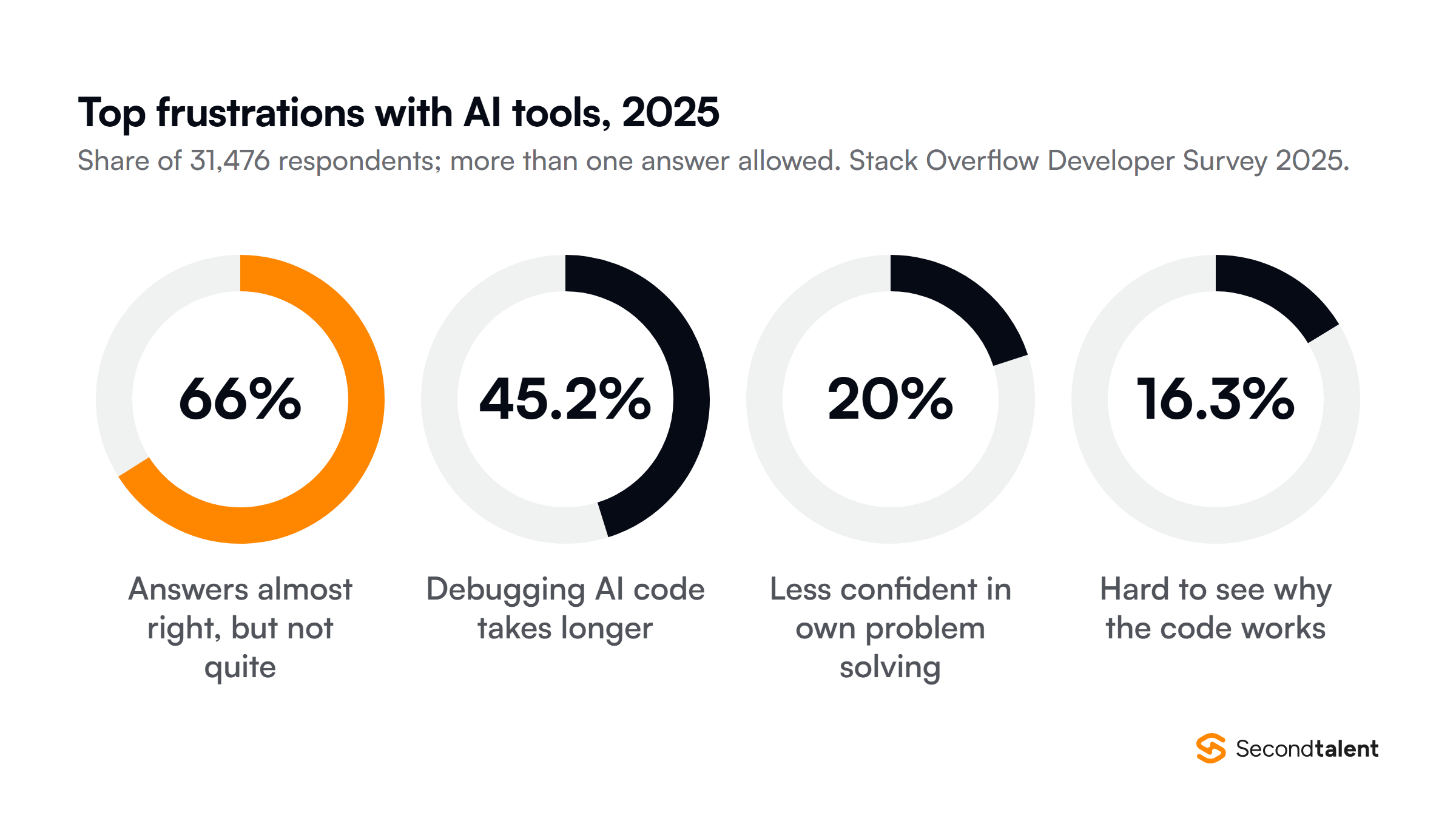
The top complaint is about near misses. 66% of respondents named “AI solutions that are almost right, but not quite”, and 45.2% said debugging AI-generated code takes more time. One in five said they had become less confident in their own problem solving.
DORA found the same split. 24% of its respondents trusted AI “a great deal” or “a lot”, and 30% trusted it “a little” or “not at all”, even though over 80% said AI had made them more productive.
Agents raise the stakes
Stack Overflow found 87% of respondents concerned about the accuracy of AI agents and 81% worried about data security and privacy. Agent users felt the gain in their own work, not their team’s: 69% agreed agents increased their productivity, and 17% agreed agents improved collaboration within the team.
Do AI Coding Assistants Make Developers Faster?
In the best-known controlled trial, they made experienced developers slower. METR’s 2025 study gave 16 open-source maintainers 246 real issues from their own projects and randomized whether AI was allowed on each. With AI allowed, the main tools were Cursor Pro with Claude 3.5 and 3.7 Sonnet, and tasks took 19% longer.
- Over 80% say AI raised their productivity (DORA 2025)
- Almost 9 in 10 save at least an hour a week (JetBrains 2025)
- 1 in 5 save eight hours or more a week (JetBrains 2025)
- Developers expected AI to speed them up by 24%
- Tasks took 19% longer with AI allowed
- Afterwards they still believed they were 20% faster
METR tried to repeat the study from August 2025 with 10 of the original developers and 47 new ones. In February 2026 it called the new data unreliable. More developers declined to take part rather than work without AI, and 30% to 50% said they held back tasks they did not want to do without it.
Its raw estimates now point the other way: an 18% speed-up for returning developers and 4% for new ones. Both confidence intervals still include a slowdown, and METR says the true speed-up could be much higher among the developers and tasks that dropped out.
Telemetry avoids both problems by reading timestamps from pull requests and tickets, much as process mining software rebuilds a workflow from event logs. METR now plans to add observational data of this kind to its research, alongside new trial designs.
How Much Do AI Coding Assistants Cost in 2026?
$20 a month is the most common entry price. Cursor Pro, Claude Pro, ChatGPT Plus, Kiro Pro and Devin Pro all cost $20 when billed monthly. GitHub Copilot Pro costs $10, and ChatGPT’s Go plan costs $8 with Codex for lighter tasks.
| Tool | Free option | Entry paid plan | Top individual plan | Business seat, a month |
|---|---|---|---|---|
| GitHub Copilot | Free, 2,000 completions a month | Pro $10 | Max $100 | Business $19, Enterprise $39 |
| Cursor | Hobby | Pro $20 | Ultra $200 | Teams $40, Premium $120 |
| Claude (Claude Code) | Free, no Claude Code | Pro $20 | Max from $100 | Team $25, Premium $125 |
| ChatGPT (Codex) | Free | Go $8 | Pro 20x $200 | Business $25, or $20 billed yearly |
| Kiro | Free, 50 credits | Pro $20 | Power $200 | Enterprise on request |
| Devin | Free | Pro $20 | Max $200 | Teams, $80 minimum |
| Google Antigravity | Free for individuals | Google AI Pro | Google AI Ultra, from $100 | Through Google Cloud |
| Tabnine | None listed | None listed | None listed | $39 or $59, billed yearly |
Prices were read off each vendor’s pricing page on September 14, 2026, in US dollars before tax. Monthly billing unless stated.
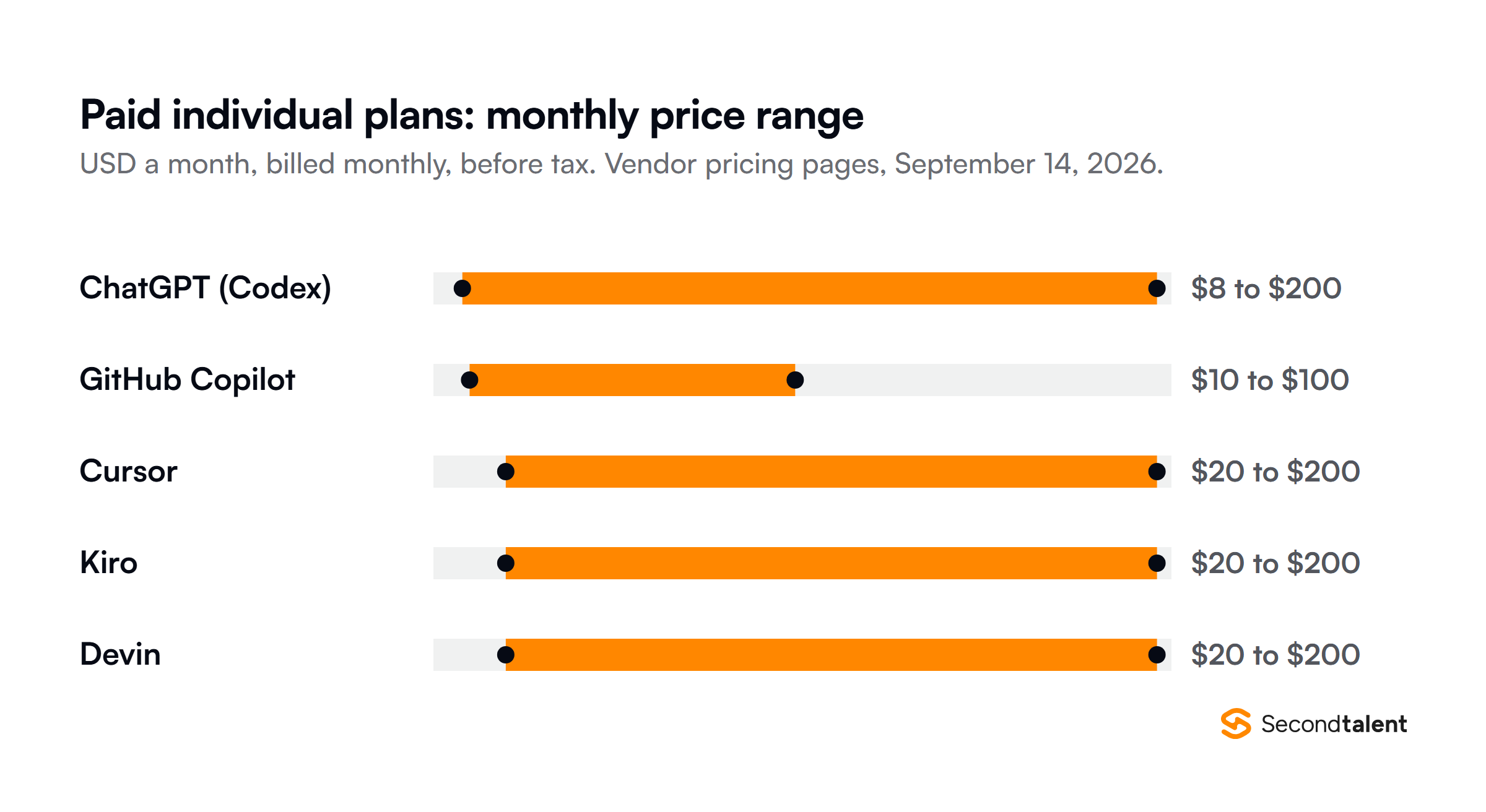
The seat price is only the floor. Since June 1, 2026, GitHub bills Copilot in AI credits charged at model token rates. Kiro sells extra credits at $0.04 each, and Cursor Teams adds a fee of $0.25 per million tokens on third-party models.
Vendors had plenty of rival moves to follow, the kind a competitive intelligence program is set up to catch. GitHub announced metered billing on April 27, and at I/O on May 19 Google added a $100 AI Ultra plan with five times Google AI Pro’s Antigravity limits.
Who Owns the AI Coding Tools Now?
Windsurf, Cursor and Tabnine all changed owners between July 2025 and August 2026, and Amazon has set an end date for its Q Developer IDE plugins.
Cursor’s announcement says the deal gives it access to “the largest fleet of GPUs in the world”. It released Grok 4.6, built with SpaceX, two days before the acquisition closed.
Windsurf lives on inside Devin Desktop, which makes Cognition’s agent command center the default screen. Tabnine now belongs to Tricentis, a quality engineering company, and its pricing page lists only per-seat plans on annual terms. Our guide to the best AI coding agents compares the current lineup.
Hiring Engineers Who Work With AI Coding Tools
A Copilot or Claude Code seat says little about how well an engineer uses it. We test AI tool use during vetting, and we match companies with pre-vetted Claude Code developers and Cursor developers from nine Asian markets within 24 hours.
Our developer rate card shows what each role costs by country. Tell us what you are building and we will send matching profiles.
Frequently Asked Questions
What is the difference between an AI coding assistant and an AI coding agent?
An assistant suggests code as you type or answers in a chat, and you apply the change. An agent takes a task, edits files and runs commands on its own, then hands back the result for review. In 2025, 13.8% of Stack Overflow respondents used AI only in copilot or autocomplete mode.
Is there a free AI coding assistant?
Yes. GitHub Copilot Free includes 2,000 code completions a month, and Google Antigravity is free for individual developers with basic weekly rate limits. Cursor, Kiro, Devin and ChatGPT also have free plans with limited use.
Will AI coding assistants replace developers?
Developers do not expect to work alone with AI. In the 2025 Stack Overflow survey, 4.3% said they would no longer need help from people if AI could do most coding tasks. JetBrains found 68% expect employers to require skill with AI tools in the near future.




![Singapore AI Companies Leading Southeast Asia. Top 10 Singapore AI Companies Leading Southeast Asia [2026], by Second Talent.](https://www.secondtalent.com/wp-content/uploads/2026/09/singapore-ai-companies-featured-v2-768x403.jpg)
![AI Recruiting Tools. Top 7 AI Recruiting Tools in 2026 [Tried & Tested], by Second Talent.](https://www.secondtalent.com/wp-content/uploads/2026/09/top-ai-recruiting-tools-featured-v2-768x403.jpg)