TL;DR: Cursor's annualized revenue grew from over $100 million in January 2025 to more than $4 billion by early June 2026. SpaceX bought the company for $60 billion in stock and closed the deal on August 14, 2026. About one professional developer in five uses it.
SpaceX valued Cursor at $60 billion, more than double the $29.3 billion valuation its Series D set nine months before the deal closed. Revenue climbed, but budget share fell. Ramp data reported by CNBC shows Cursor’s share of business spending on AI coding tools dropping from 41% in June 2025 to about 26% in May 2026, and Anthropic took half.
- 1Cursor’s own posts stop at $1 billion in annualized revenue, in November 2025. Every later figure comes from reporters’ sources.
- 2Cursor says over 70% of the Fortune 500 use it, but it has never published a total user count.
- 3Daily agent users run up $60 to $100 a month in usage by Cursor’s own guide, against a $20 Pro seat.
- 4The top 10% of Cursor users account for almost two thirds of all tokens.
How Much Revenue Does Cursor Make?
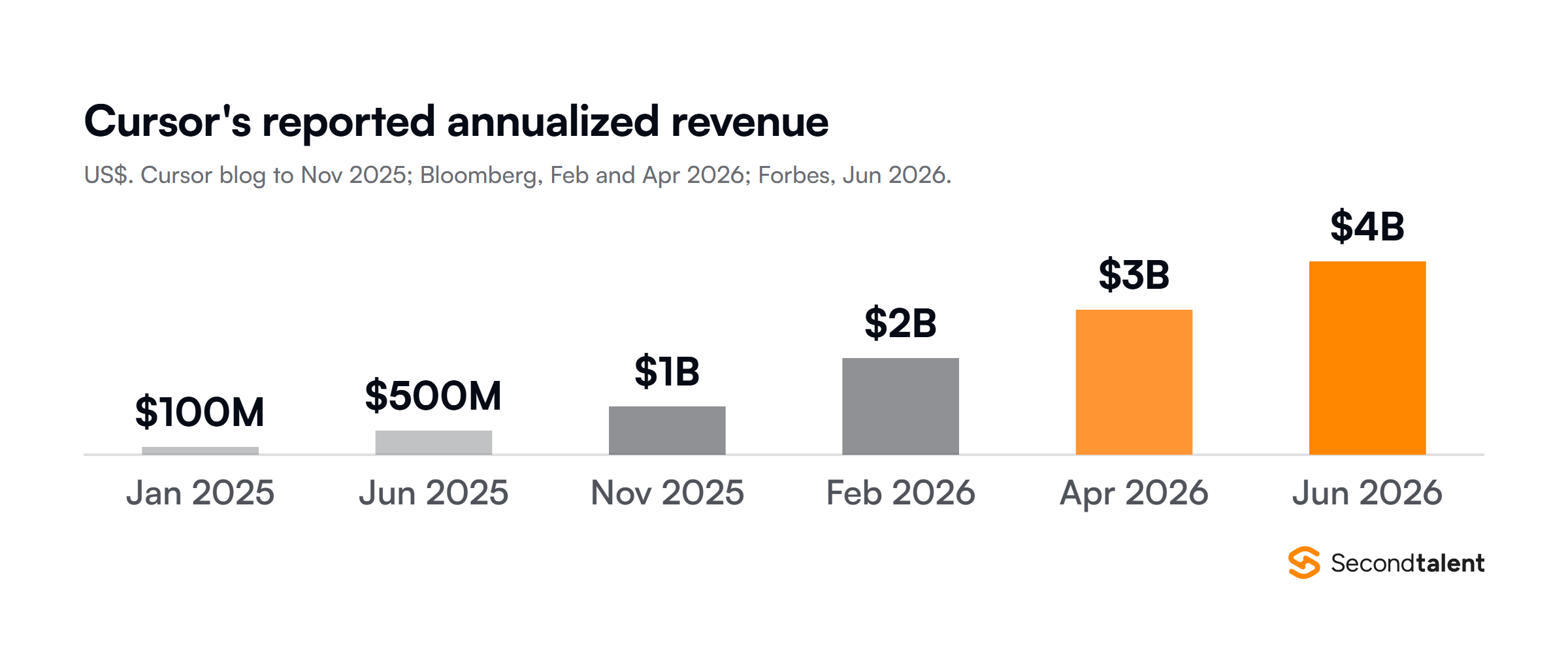
Cursor’s annualized revenue passed $4 billion in early June 2026, Forbes reported. Cursor had announced over $100 million with its Series B in January 2025, and Bloomberg put the run rate at $2 billion in February 2026 and $3 billion in late April.
Enterprise accounts carry the margin. TechCrunch reported on April 17, from four sources, that Cursor made positive gross margins on large enterprise accounts and still lost money on individual developers. The company forecast an annualized run rate above $6 billion by the end of 2026, the report said.
CNBC reported on June 16, the day SpaceX agreed the deal, that SpaceX had not given its own investors details on Cursor’s customers or revenue.
Cursor Funding Rounds and Valuation
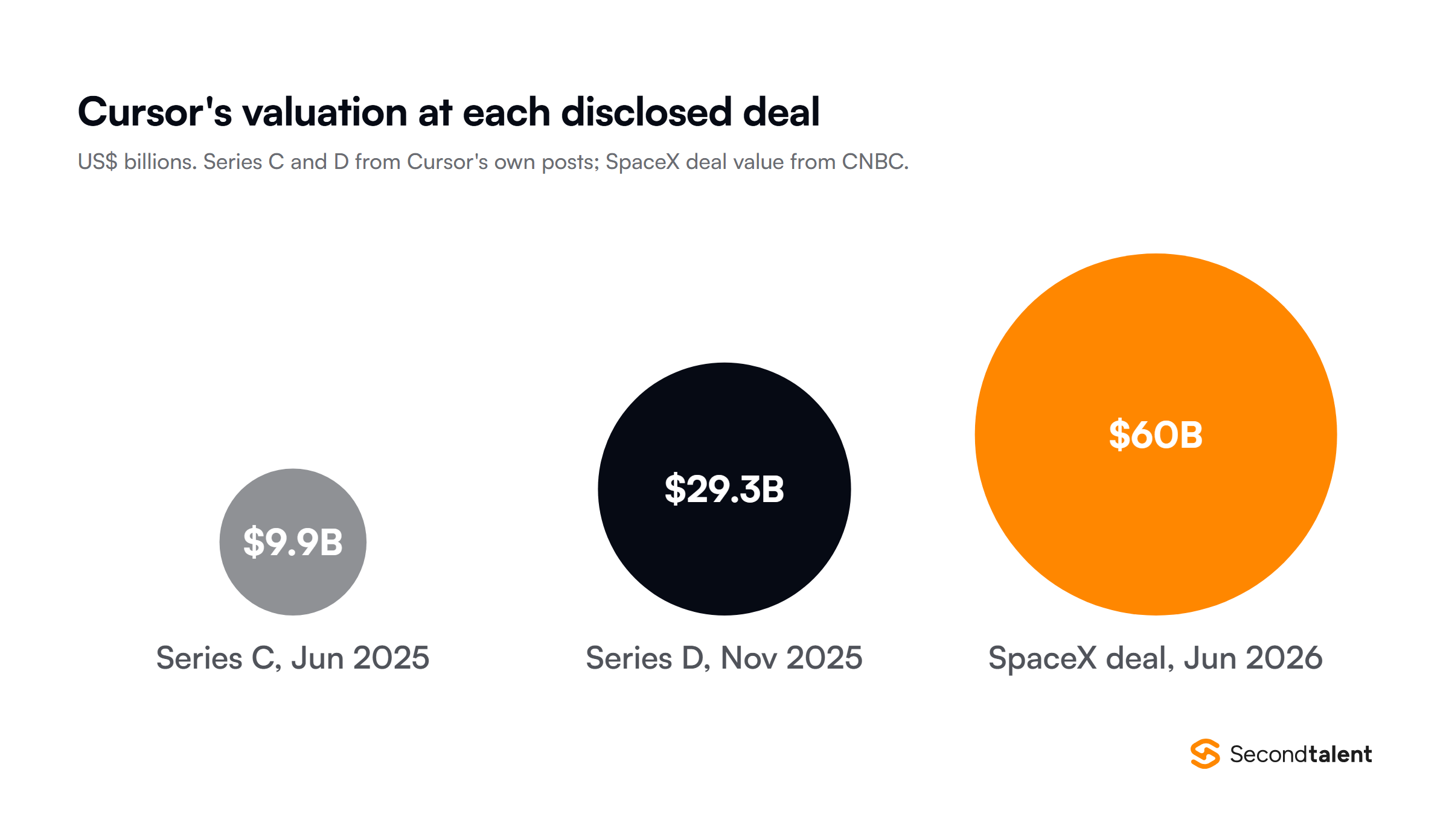
Cursor’s five private rounds ran from an $8 million seed to a $2.3 billion Series D, which set a $29.3 billion post-money valuation in November 2025. SpaceX then bought it for $60 billion in stock.
The SpaceX deal came while Cursor was raising again. TechCrunch reported on April 17 that Cursor was in talks to raise at least $2 billion at a $50 billion pre-money valuation, led by Thrive and Andreessen Horowitz.
Four days later SpaceX said on X that it could buy Cursor for $60 billion later in the year or pay $10 billion for their work together, CNBC reported.
Cursor’s April 21 post described the same arrangement as a model training partnership on SpaceXAI’s Colossus cluster. SpaceX’s IPO filings, as CNBC read them, split the $10 billion alternative into a $1.5 billion termination fee and $8.5 billion of computing. The $60 billion in class A stock came to 3.4% dilution at SpaceX’s IPO valuation.
How Many People Use Cursor?
Cursor has not published a total user count. It discloses customer counts, Fortune 500 shares and one country figure instead.
The Fortune 500 share has climbed fast. Cursor put it at over half, naming NVIDIA, Uber and Adobe, in June 2025, and at over 70% in May 2026, when Gartner named it a Leader in the 2026 Magic Quadrant for Enterprise AI Coding Agents. Its enterprise page still said 64% on September 10, 2026.
By November 2025 Cursor described its customers as “millions of developers” and its own team as more than 300 people. Its security page, updated August 25, 2026, lists AIUC-1, ISO/IEC 27001:2022 and ISO/IEC 42001:2023 certifications and a SOC 2 Type II attestation. It also says Cursor runs no infrastructure in China.
India gets its own plan. Cursor says developers there run more agent requests per developer than in any other market, and the India developer count tripled in a year.
Cursor Start costs ₹649 a month, tax inclusive and payable by UPI. It covers Cursor’s own Grok and Composer models, with Grok fixed at medium effort, and leaves out third-party models and Bugbot.
How Much Does Cursor Cost?
Cursor Pro costs $20 a month, Pro Plus $60 and Ultra $200, according to Cursor’s pricing docs on September 10, 2026. Teams seats cost $40 or $120 per user per month, and yearly billing takes 20% off. The paid tiers differ in how much agent use they include.
Heavy users pay well above the seat. Cursor’s usage guide puts daily agent users at $60 to $100 a month in total usage, and power users running several agents at $200 or more. Past the included amount, usage continues at the same API rates, and Cursor says it does not downgrade requests in quality or speed.
- Two usage pools. Paid individual plans include a Cursor Models pool (Grok 4.6, Grok 4.5 and Composer 2.5) and an Other Models pool for third-party models, billed at each model’s API price.
- A fee on outside models. On Teams and Enterprise, third-party model requests add a Cursor Token Rate of $0.25 per million tokens, per the Teams pricing docs. Cursor’s own Grok and Composer models are exempt.
- In-house models cost less. Composer 2.5 lists at $0.50 per million input tokens and $2.50 per million output tokens, against $2 and $6 for Grok 4.6.
Cursor Product Milestones
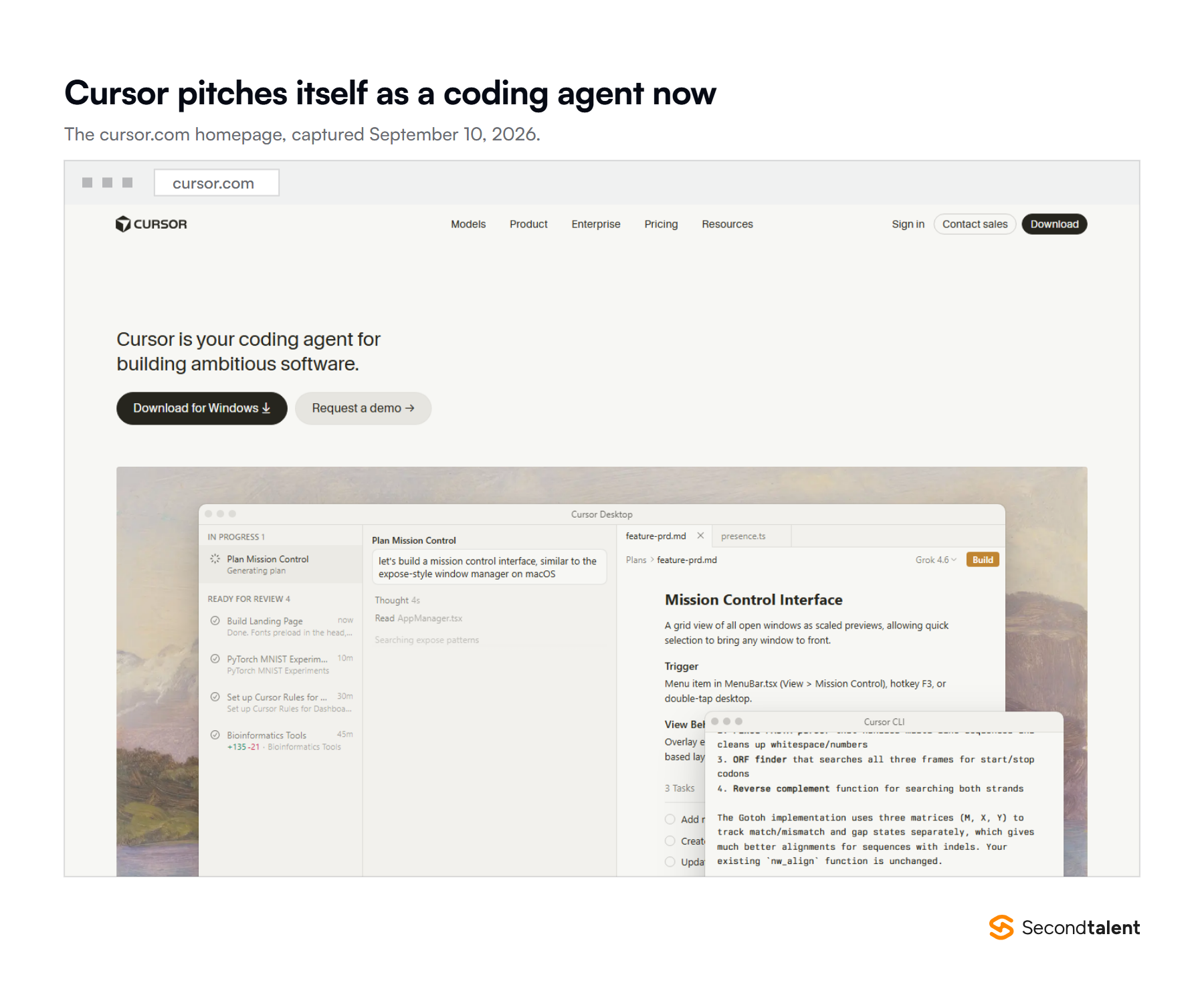
Cursor began in 2023 as a fork of VS Code with AI built in, as TechCrunch described it at the seed round. Its releases since mid-2025 are about agents: several running at once, agents in the cloud, a code review agent, and models Cursor trains itself.
- Nov 12, 2024: Supermaven joins Cursor, bringing the creator of Tabnine.
- Jul 24, 2025: Bugbot, the code review agent, leaves beta.
- Oct 29, 2025: Cursor 2.0 and Composer, its first in-house agent model, with up to eight agents running in parallel on one prompt.
- Oct 30, 2025: Cloud Agents launch.
- Dec 19, 2025: Graphite, a code review platform, agrees to be acquired.
- Mar to May 2026: Composer 2, then Composer 2.5, with a plan to train a larger model from scratch with SpaceXAI.
- Aug 12 to 14, 2026: Grok 4.6 released with SpaceXAI, the Firetiger team joins, and the SpaceX acquisition closes.
Cursor’s own model pool now runs SpaceXAI’s Grok 4.6 and Grok 4.5 alongside Composer 2.5. Claude, Gemini and GPT models sit in the separate pool, billed at API rates.
Cursor Adoption in Developer Surveys
About one developer in five uses Cursor. The 2025 Stack Overflow Developer Survey puts it at 17.9% of 26,143 respondents, and 19.3% of professional developers. Visual Studio Code led the same question at 75.9%, with Claude Code at 9.7% and Windsurf at 4.9%.
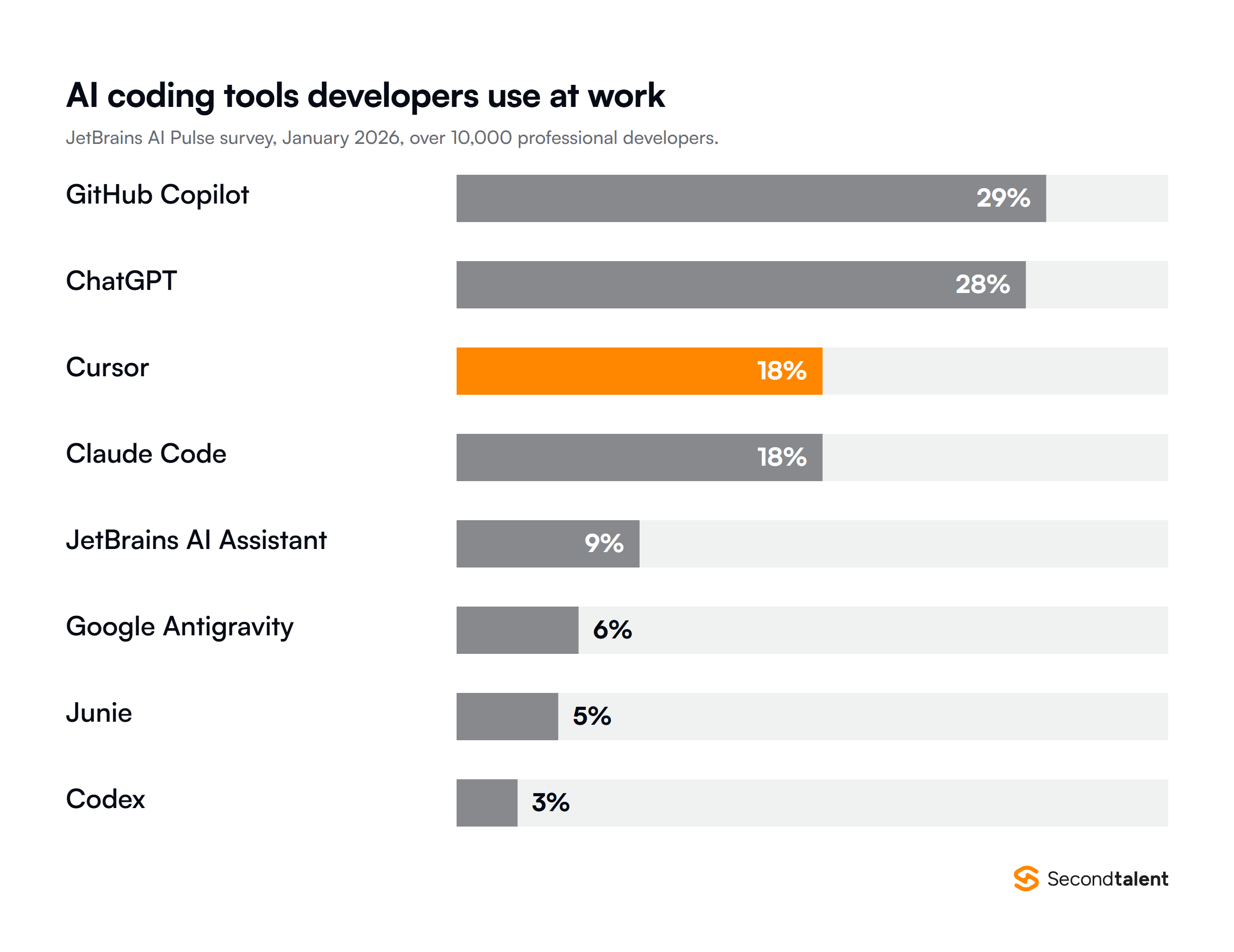
By early 2026, Claude Code had caught up at work. JetBrains’ AI Pulse survey of over 10,000 professional developers found the two tied at 18% in January 2026, behind GitHub Copilot at 29%. Claude Code’s share had grown 1.5 times since September 2025.
“Cursor’s growth has slowed down, both in terms of awareness and adoption at work.”
JetBrains Research, April 2026
Awareness is still high: 69% of developers had heard of Cursor, second only to Copilot. For the wider editor picture, see our IDE statistics and AI coding assistant statistics.
Ramp’s category page still ranks Cursor as the most-used AI coding vendor in September 2026, with 16.8% of businesses paying for a tool in the category. That fits with Cursor’s falling spend share: a company paying for Cursor and Claude Code counts once for each vendor’s adoption but splits one budget between them.
Cursor vs GitHub Copilot
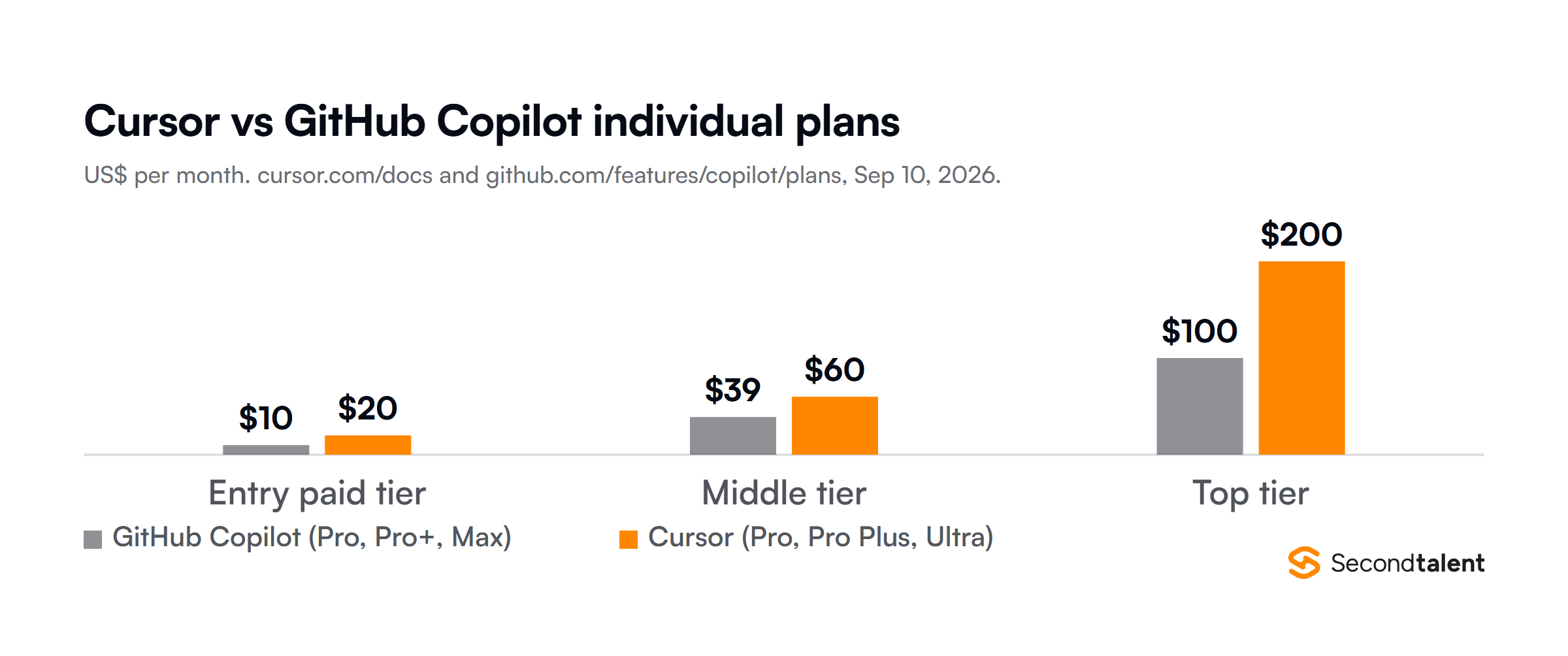
GitHub Copilot has more users, and Cursor charges more at each matching tier. Microsoft reported over 4.7 million paid Copilot subscribers, up 75% year over year, on its January 2026 earnings call, and 50 million Copilot users on its fiscal fourth-quarter 2026 call.
- Owned by Microsoft
- 50 million users; 4.7 million paid subscribers in January 2026
- 29% of developers use it at work (JetBrains)
- Usage-based pricing since June 2026
- Owned by SpaceX since August 14, 2026
- No total published; over 70% of the Fortune 500
- 18% of developers use it at work (JetBrains)
- Seat plus two usage pools
On GitHub’s plans page, Copilot Pro costs $10 a month, Pro+ $39 and Max $100, each with a monthly allowance of GitHub AI credits. Cursor’s matching tiers cost $20, $60 and $200. Both products now bill heavy agent use on top of the seat.
Our Cursor vs GitHub Copilot comparison for enterprise teams covers the feature gap, and our GitHub Copilot statistics track Microsoft’s side.
Does Cursor Make Developers More Productive?
Cursor’s own data says yes at the company level. The one controlled trial of experienced developers found the opposite. A study of tens of thousands of Cursor users by University of Chicago professor Suproteem Sarkar, published on Cursor’s blog, found companies merged 39% more pull requests after Cursor’s agent became the default.
METR’s trial gave 16 experienced open-source developers 246 tasks, with Cursor Pro and Claude 3.5 or 3.7 Sonnet as the main tools. Tasks took 19% longer with AI tools. The developers had expected a 24% speed-up, and afterwards still believed they had gained 20%. The models were early-2025 versions.
The gains are also uneven. In its July 2026 CFO Council post, Cursor said p99 developers produced 46 times more AI-assisted lines per day than the median active user and merged 15 times more pull requests per week. Its Insights page says the top 10% of users account for almost two thirds of all tokens.
The usage figures are Cursor’s own and the trial had 16 developers, so neither shows cause. For outside measures of what the output is worth, see our AI-generated code quality statistics and how much software AI now writes.
Hire Engineers Who Already Work With Coding Agents
A Cursor licence says little about the engineer holding it, so we test AI-tool use across Cursor, Claude Code and Copilot during vetting rather than reading it off a CV. See what we check for Cursor developers and Claude Code developers.
Read how Second Talent works, then tell us what you are building. We match vetted engineers from nine Asian markets within 24 hours.
FAQs
Is Cursor free?
Yes, on the Hobby plan. It needs no credit card and includes a limited number of agent requests and access to Composer, per cursor.com/pricing.
Does Cursor train on your code?
Not with Privacy Mode on. Cursor’s security page says Privacy Mode is available on free and paid plans, team admins can enforce it, and with it enabled Cursor will not train on your data.
Who makes Cursor?
Anysphere, Inc., which SpaceX agreed to buy for $60 billion in stock on June 16, 2026. The deal closed on August 14, 2026, so Cursor is now part of SpaceX.




![Singapore AI Companies Leading Southeast Asia. Top 10 Singapore AI Companies Leading Southeast Asia [2026], by Second Talent.](https://www.secondtalent.com/wp-content/uploads/2026/09/singapore-ai-companies-featured-v2-768x403.jpg)
![AI Recruiting Tools. Top 7 AI Recruiting Tools in 2026 [Tried & Tested], by Second Talent.](https://www.secondtalent.com/wp-content/uploads/2026/09/top-ai-recruiting-tools-featured-v2-768x403.jpg)