
TL;DR: Choose GitHub Copilot if your developers work across several IDEs or your code lives in GitHub: Enterprise costs $39 a user a month with $39 of AI credits included. Choose Cursor for agent-heavy work, at $40 a seat on Teams or $120 for Premium seats with five times the usage. Both now bill heavy agent use on top of the seat, so pilot on usage rather than seat price.
SpaceX closed its $60 billion all-stock purchase of Cursor on August 14, 2026, so the two tools in this comparison now belong to SpaceX and Microsoft.
Gartner named both Leaders in its 2026 Magic Quadrant for Enterprise AI Coding Agents in May, with GitHub placed highest on ability to execute and Cursor furthest on completeness of vision.
- 1Cursor’s agent has run inside IntelliJ IDEA, PyCharm and other JetBrains IDEs since March 4, 2026.
- 2GitHub’s launch allowance ended in August: Enterprise seats fell from $70 to $39 of monthly AI credits.
- 3On Teams and Enterprise, Cursor adds $0.25 per million tokens to every Claude, GPT and Gemini request.
- 4Since April 24, 2026, GitHub may train on personal Free, Pro and Pro+ data unless the developer switches it off; Business and Enterprise are excluded.
Cursor vs GitHub Copilot at a Glance
| Cursor | GitHub Copilot | |
|---|---|---|
| Owner | SpaceX, since August 14, 2026 | Microsoft, through GitHub |
| Team price | $40 a seat; $120 Premium seat with 5x the usage | Business $19, Enterprise $39 a seat |
| Included usage | Agent allowance per seat; pooled on Enterprise | AI credits equal to the seat price |
| Editors | Cursor’s own editor, JetBrains IDEs (agent), CLI | VS Code, Visual Studio, JetBrains, Eclipse, Xcode, Neovim |
| Agents | Up to eight in parallel, cloud agents, Bugbot review | Cloud agent from issue to pull request, third-party agents |
| Models | Composer 2.5 and Grok, plus Claude, GPT and Gemini | 28 models from six providers |
| Training on your code | Not with Privacy Mode on | Barred by contract on Business and Enterprise |
What Changed for Both Tools in 2026?
Almost everything an enterprise buyer weighs, from price to ownership to editor support. The line most older comparisons draw, “Cursor locks you into its VS Code fork”, stopped being true in March:
The ownership change reaches the product. Cursor’s own model pool now runs Grok 4.6 and Grok 4.5 from SpaceXAI beside its in-house Composer 2.5. Our Cursor statistics track the deal and the revenue behind it.
How Much Do Cursor and Copilot Cost for a Team?
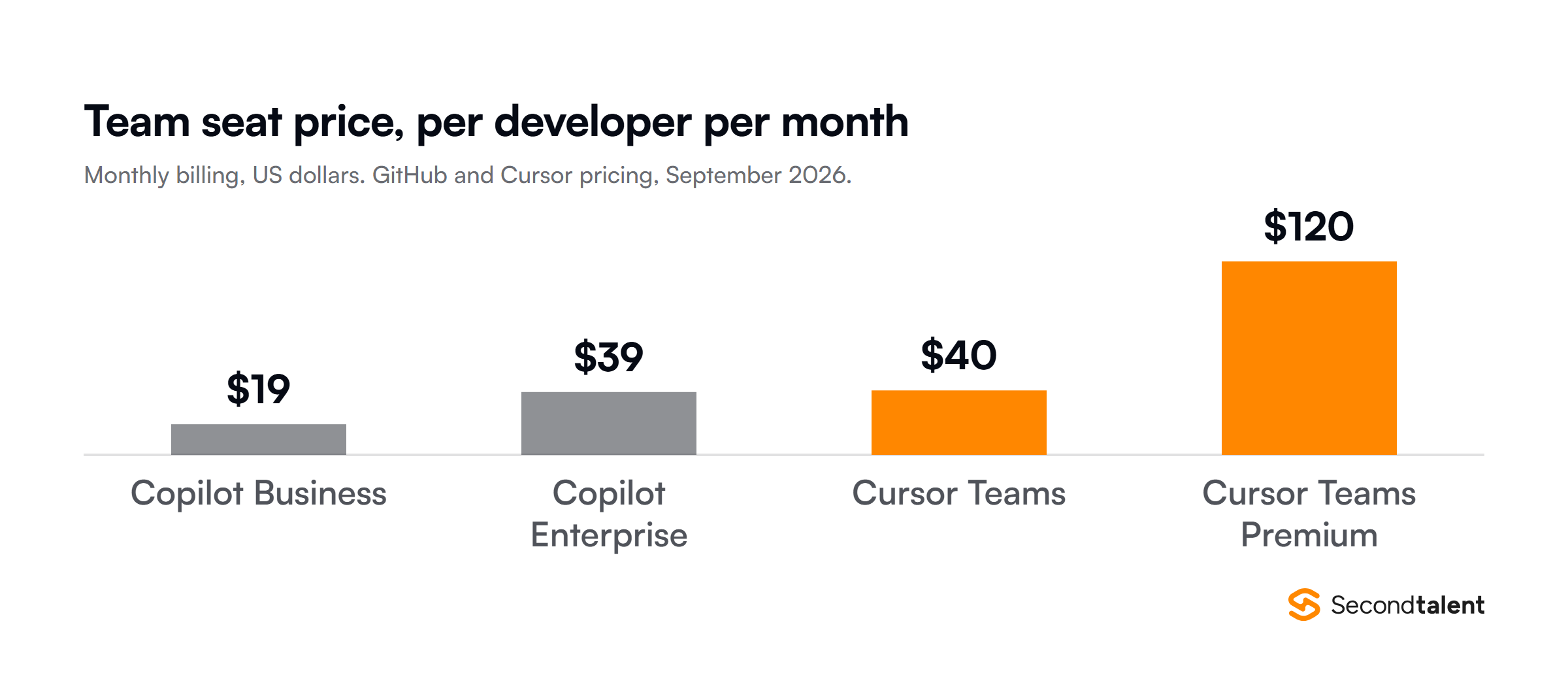
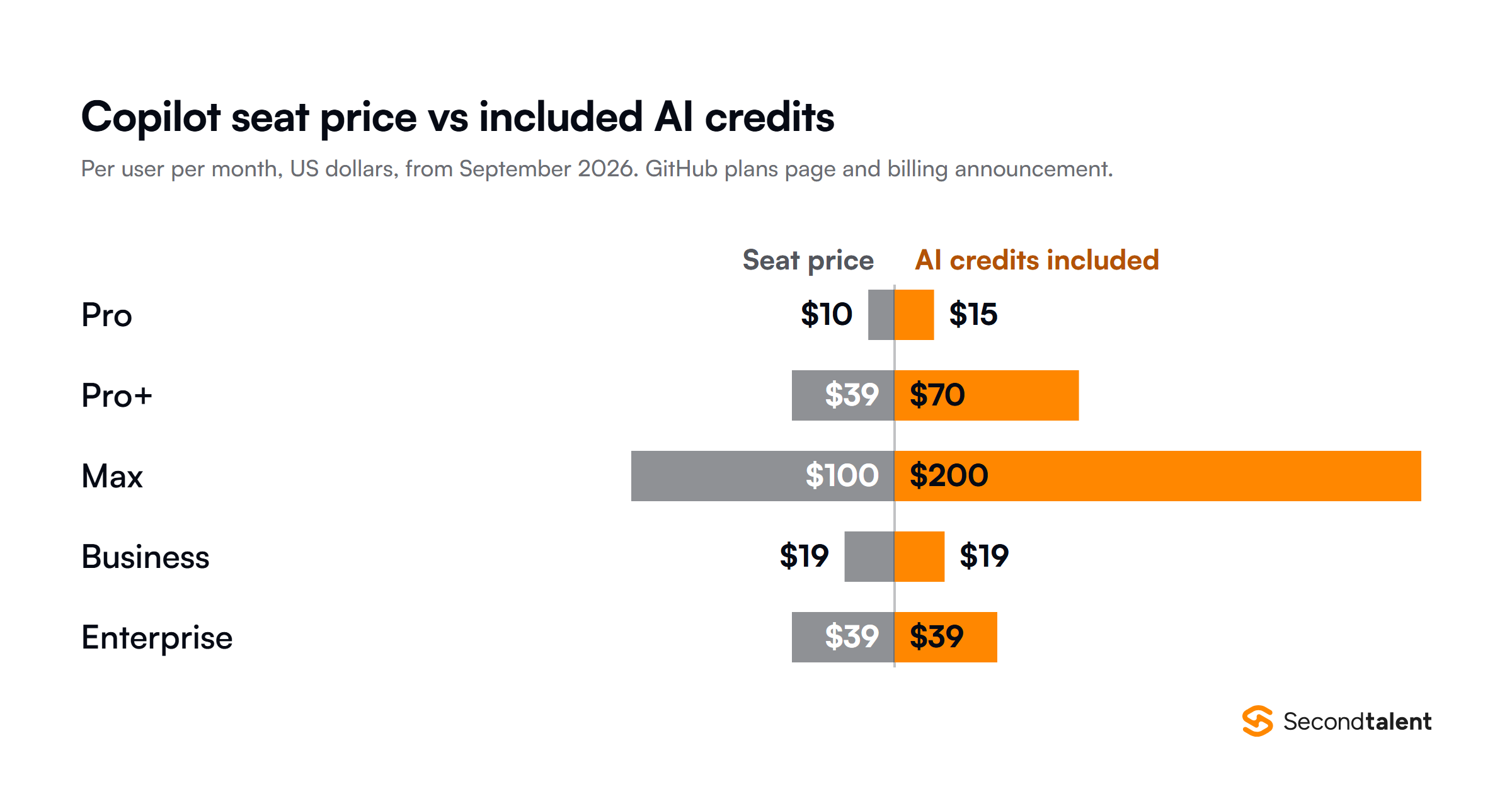
Copilot is cheaper per seat. Since June 1, Copilot Business costs $19 a user a month and Enterprise $39, each including the same dollar amount in monthly AI credits, GitHub announced.
Cursor’s Teams plan costs $40 a seat, or $120 for a Premium seat with five times the usage, and admins who never code can take an unpaid seat:
The seat is only the entry fee now. Copilot’s credits pay for chat, agent mode, code review, the cloud agent and the CLI at each model’s published API rates, while code completions and next edit suggestions stay free of charge.
Admins can set budgets for the enterprise, a cost center or a single user, and either cap spend or allow overage.
A launch allowance hid the real rate for three months. From June to August, existing Business seats got $30 of credits and Enterprise seats $70.
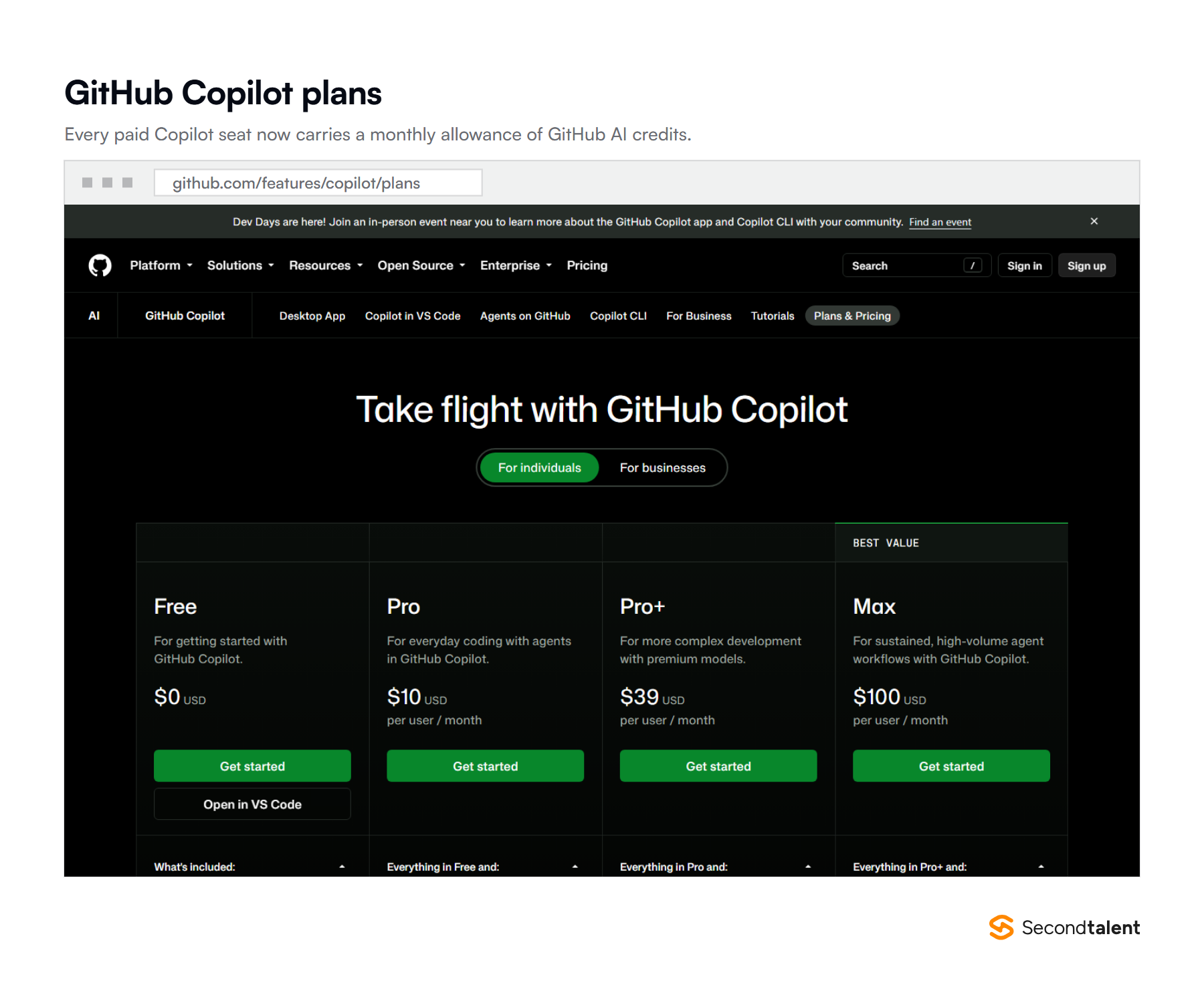
From September the allowance matches the seat price, which is less generous than GitHub’s individual plans:
Cursor meters usage another way. Each seat carries an agent allowance; Enterprise pools it across the company and adds invoicing and SCIM.
Requests to third-party models on Teams and Enterprise carry a Cursor Token Rate of $0.25 per million tokens on top of the model’s own price. Yearly billing takes 20% off Cursor’s plans.
Which Editors Do They Work In?
Copilot installs as an extension. GitHub’s feature matrix covers VS Code, Visual Studio, JetBrains IDEs, Eclipse, Xcode and Neovim, with agent mode in every one except Neovim.
Copilot Chat also runs on github.com, in GitHub Mobile and in Windows Terminal.
Cursor is still, first, its own editor built on VS Code.
Since March, though, its agent also runs inside IntelliJ IDEA, PyCharm, WebStorm and other JetBrains IDEs through the Agent Client Protocol, with the same choice of models, at no extra cost on paid plans.
Cursor’s announcement describes the agent and does not mention its Tab completions, so test autocomplete before a JetBrains rollout. Cursor also ships a CLI for terminal work.
For a company split between VS Code and JetBrains, the choice is no longer forced by the editor alone. Our IDE statistics show how that split looks across the industry.
How Do Their Coding Agents Compare?
Cursor’s design centers on running several agents at once. Cursor 2.0 runs up to eight in parallel from one prompt, cloud agents keep working away from the laptop, and Bugbot reviews pull requests on usage-based billing.
On Enterprise, admins control which models and MCP servers agents can reach, set system-level agent rules and allow or block repositories, per Cursor’s enterprise page.
Copilot’s agent works from GitHub itself. Assign an issue and the cloud agent researches the repository, plans, changes code on a branch and opens a pull request for review.
GitHub counted more than one million pull requests created by its coding agent between May and September 2025, according to Octoverse.
Paid plans can also hand a task to a third-party agent instead of Copilot’s own, and GitHub said in May that Copilot CLI usage was nearly doubling month over month.
The difference is where review happens. Cursor keeps the agent’s diff in the editor; Copilot turns the agent’s work into a pull request that goes through your existing review rules.
Which AI Models Can Each Use?
Copilot offers more. Its supported models list names 28 models from OpenAI, Anthropic, Google, Microsoft, Moonshot AI and xAI, including GPT-5.5, Claude Opus 5, Claude Fable 5.1, Gemini 3.8 Flash and Grok 4.6.
Availability depends on the plan and the client.
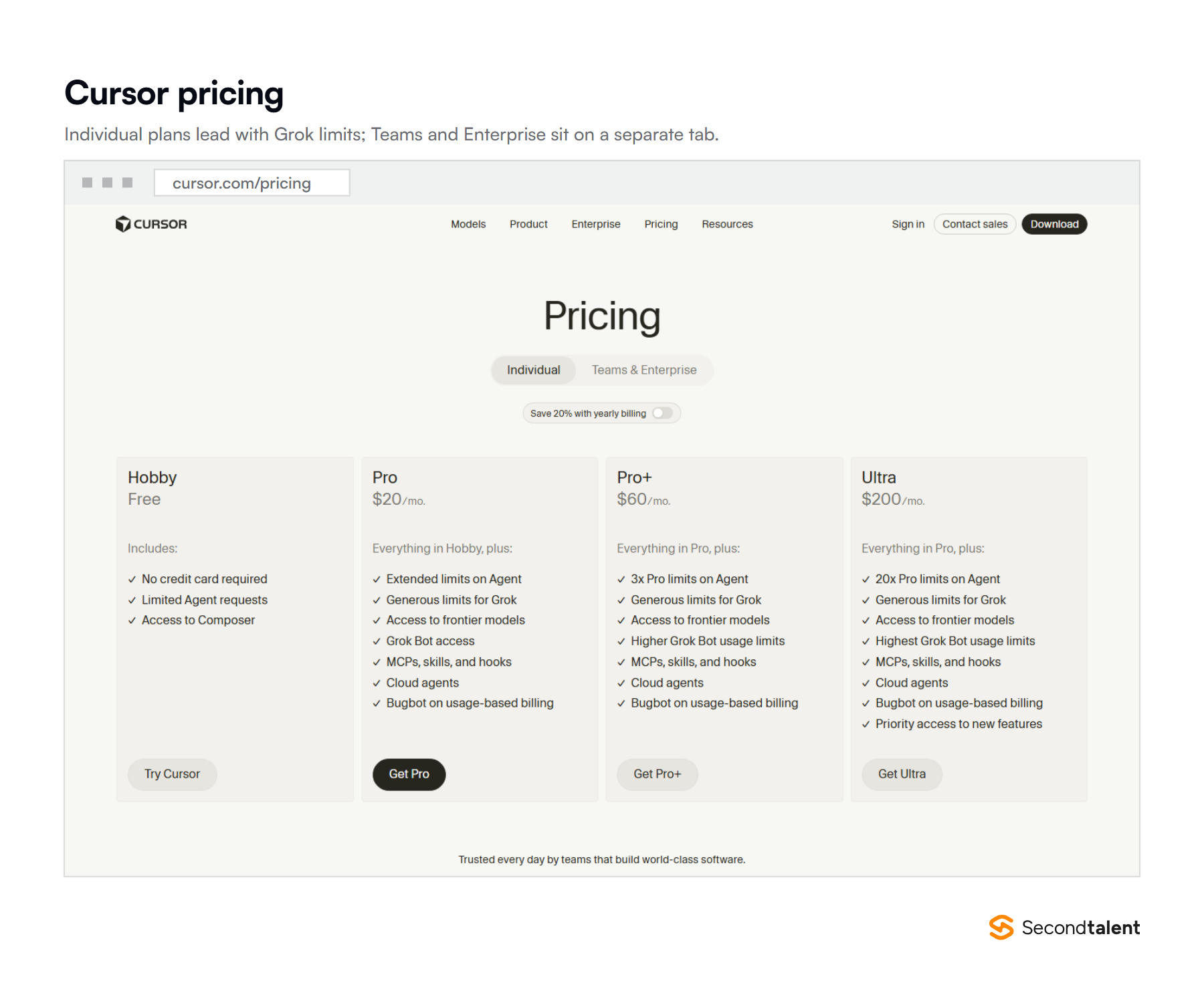
Cursor splits models into two pools. Its own pool holds Composer 2.5, Grok 4.6 and Grok 4.5; a second pool covers Claude, GPT and Gemini, billed at each model’s API price.
The in-house models cost less: Composer 2.5 lists at $0.50 per million input tokens and $2.50 per million output tokens, against $2 and $6 for Grok 4.6.
How Do They Handle Security and Compliance?
Both clear the standard enterprise checklist. They differ on how much they document and on who else sees the code:
- SOC 2 Type II, ISO 27001:2022, ISO 42001:2023 and AIUC-1, per its security page, updated August 25, 2026
- Privacy Mode stops training on your data; new team members inherit the team setting
- Runs on AWS only, with no on-premises option and no infrastructure in China
- SAML SSO, SCIM, role permissions and an API for AI-code analytics on Enterprise
- Business and Enterprise agreements prohibit training on Copilot interaction data
- License and policy management, IP indemnity and audit logs on organization plans
- File exclusions keep chosen files away from Copilot
- Enterprise adds organization codebase indexing and custom private models
One gap sits outside both contracts. From April 24, 2026, GitHub may use interaction data from Free, Pro and Pro+ accounts to train models unless the developer turns the setting off, per GitHub’s announcement.
A developer who uses a personal seat on company code is not covered by the Business terms. Cursor’s certifications and data policy are on its security page.
Which One Do Developers Actually Use?
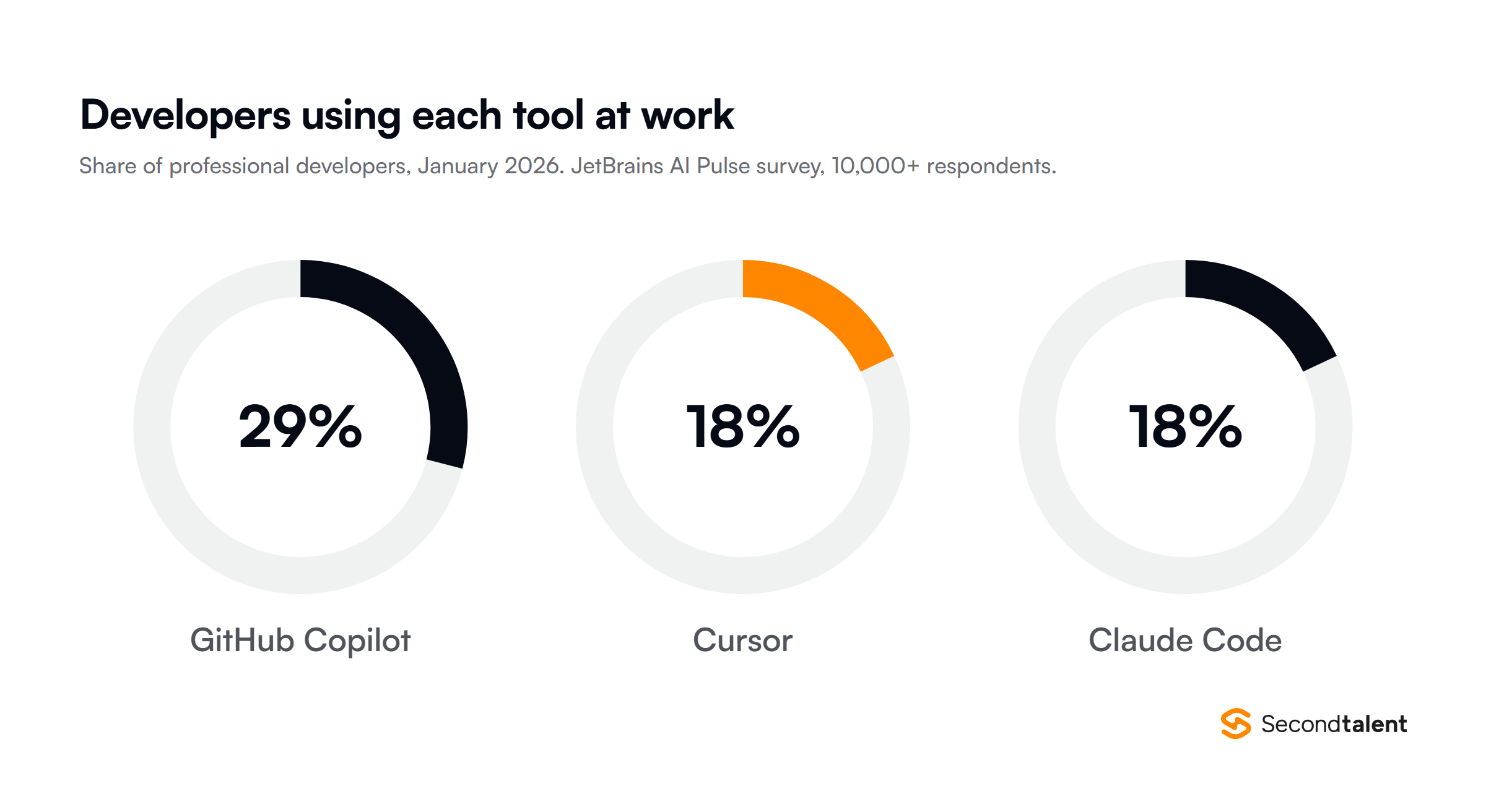
Copilot, by a wide margin. In JetBrains’ AI Pulse survey of more than 10,000 professional developers, 29% used Copilot at work in January 2026, and Cursor tied with Claude Code:
Microsoft reported 50 million Copilot users on its fiscal fourth-quarter 2026 call, and GitHub says 140,000 organizations use it, nearly triple a year earlier.
Cursor has not published a user total but says more than 70% of the Fortune 500 use it. In Stack Overflow’s 2025 survey, 17.9% of developers used Cursor, against 75.9% for VS Code, the editor Cursor is built on.
JetBrains found Cursor’s growth at work had slowed while Claude Code’s share grew 1.5 times from September 2025. Our GitHub Copilot statistics cover Microsoft’s side in detail.
Does Either Make Teams Faster?
Studies disagree. A study of tens of thousands of Cursor users, published on Cursor’s blog, found companies merged 39% more pull requests after Cursor’s agent became the default.
METR’s controlled trial found experienced developers 19% slower with early-2025 tools, then reported in February 2026 that they were likely sped up by early 2026, an estimated 18%, with a wide margin of error.
Neither result compares Cursor with Copilot directly, which is why a pilot on your own repositories beats either number. Our AI coding assistant statistics collect the wider research.
Which Should Your Team Choose?
- Most of the team works in VS Code or will move to Cursor’s editor
- Parallel and cloud agents matter more than editor choice
- You want a usage pool shared across the company
- Developers are split across JetBrains, Visual Studio, Xcode and VS Code
- Work already runs through GitHub issues and pull requests
- You need IP indemnity and the lowest per-seat price
Our guide to the best AI coding agents compares both with Claude Code, Codex and five other tools.
Hire Engineers Who Already Work With AI Agents
We test Cursor, Copilot and Claude Code use during vetting rather than reading it off a CV. See what we check for Cursor developers, or tell us the role and we will match vetted engineers from nine Asian markets within 24 hours.
FAQs
Is Cursor safe for enterprise code now that SpaceX owns it?
Its certifications, Privacy Mode and no-China infrastructure policy all appear on a security page updated August 25, 2026, after the deal closed.
Teams that want to avoid the SpaceXAI Grok models can restrict model access in Cursor’s enterprise admin controls.
Can you use Claude in both?
Yes. Copilot lists Claude Opus 5, Sonnet 5 and Fable 5.1 among its models, and Cursor offers Claude in its third-party pool at API rates, plus the $0.25 Cursor Token Rate on Teams and Enterprise.