TL;DR: A senior engineer owns hard technical work inside a team; a lead engineer is accountable for how the whole team builds, from architecture calls to code review standards. At some companies "lead" is a pay grade above senior, and at others it is a role a senior or staff engineer takes on. Hire a senior engineer for more output, and a lead engineer once coordination is what slows the team down.
At Capital One, Lead Software Engineer is a grade above Senior Software Engineer, and Levels.fyi puts its median total pay $46,000 higher. At Databricks the title on a comparable job is Staff Software Engineer, Technical Lead, and the posting calls it "a hands-on individual-contributor role" beside an engineering manager.
Same word, two different jobs, and the version a company means decides who it should hire.
- 1Will Larson's StaffEng guide estimates a company needs roughly one tech lead for every eight engineers.
- 2Databricks posts its Bellevue tech lead range about 15% above its Bellevue senior engineer range, at both ends.
- 3The experience bar rises from 5+ years for the Databricks senior role to 8+ years for its tech lead.
- 4Only 14.7% of developers in the 2025 Stack Overflow survey said they manage staff.
What is the difference between a lead engineer and a senior engineer?
The difference between a lead engineer and a senior engineer is scope. Companies measure a senior engineer by the systems they design and ship. They measure a lead engineer by what the whole team ships: the technical direction, the quality bar and the order of the work.
Both still write code. The lead writes less of it and spends the difference on other engineers.
Will Larson's Staff archetypes guide describes the job. A tech lead "guides the approach and execution of a particular team" and partners with one manager, sometimes two or three. Earlier in their career they built the team's hardest projects. Now they "default to delegating such projects across the team."
Titles muddy this. Larson notes that "some companies use Tech Lead as a title, and others use it as a role." Capital One treats lead as a pay grade. Databricks folds the lead job into a staff engineer title.
So read the duties in a posting, not the title. The same rule applies to the newer splits in our AI-native vs traditional engineers and deployment strategist vs forward deployed engineer comparisons.
Responsibilities: what each role owns
Two Databricks postings in the same Bellevue office show the split. The Senior Software Engineer, Backend posting describes building "infrastructure and products for the Databricks platform at scale". The Staff Software Engineer, Technical Lead posting adds the team around that work.
- Build serverless, container and networking systems
- Improve performance and efficiency of workloads
- Improve security and reliability across the fleet
- Work with the team on its projects
- Set the technical direction for the team
- Write code on the hardest, highest-risk parts
- Mentor engineers and run design and code review
- Lead cross-team initiatives and unblock dependencies
- Shape the long-term roadmap with product leadership
The tech lead's limits matter as much as the duties. The Databricks posting says the lead "partner[s] with the team's engineering manager", who handles line management and delivery planning.
Capital One draws the line further toward management. Its Lead Software Engineer, Full Stack posting opens with "Lead a portfolio of diverse technology projects and a team of developers", and lists a year of managing direct reports among its preferred qualifications. So before hiring a lead engineer, decide whether the job includes direct reports. That one decision changes the profile, the interview and the pay.
Skills and experience
The technical bar is close at both levels. The gap is in experience and in whether the engineer has led a team without formal authority.
For a senior engineer, test depth. Can they design a system for the load you expect next year, debug it in production and explain the trade-offs to a peer? Our guide to evaluating engineering talent remotely covers how to run that assessment.
For a lead engineer, test the same depth plus judgment about others' work. Ask how they settled a design disagreement, how they broke a large project into tasks, and how they raised the quality of a weaker engineer's pull requests. Communication counts for more. A lead writes the design docs and decision records the rest of the team builds from.
Leadership experience is scarcer than coding skill. In the 2025 Stack Overflow survey, 85.3% of 33,154 respondents described themselves as individual contributors, up against 14.7% who manage staff (2025 results, Work section). Candidates who have led a team are a minority of any applicant pool.
A typical day for each role
The same meetings fill both calendars. The role in each meeting is what changes.
| Activity | Senior engineer | Lead engineer |
|---|---|---|
| Morning stand-up | Reports progress and blockers | Runs it and clears blockers for others |
| Sprint planning | Estimates their own tasks | Sequences the sprint and assigns work |
| Code review | Reviews peers, gets reviewed | Sets the review standard, reviews the riskiest changes |
| Technical decisions | Decides within their area | Decides across the team and writes it down |
| Production incident | Debugs and fixes | Coordinates the response and reports status |
| Hiring | Runs technical interviews | Sets the hiring bar with the manager |
Coding time is where the two diverge most. The McKinsey study on developer productivity separates an "inner loop" of coding, building and unit testing from an "outer loop" of integration, release and deployment. It says top tech companies aim for developers to spend up to 70 percent of their time in the inner loop.
A senior engineer should sit near that mark. A lead gives part of it up to reviews, planning and unblocking others, which is the reason to hire one.
Distributed teams widen the gap. A senior engineer can do most of the job through pull requests, design docs and tickets.
A lead needs live overlap with the team for stand-ups, design reviews and incidents, so time zone matters more for the lead hire. On a team split between the US and Asia, the lead should sit where most of the engineers sit, or keep hours that overlap with them.
Written communication carries more weight for a remote lead too. Decisions that an office team settles at a desk need a short written record, or engineers in the other time zone rebuild them from chat history. Ask lead candidates for a design doc or decision record they wrote, and read it before the interview.
For a closer look at measuring output once either role is in place, see our list of engineering productivity metrics.
Pay: what the postings and data say
Lead engineers earn more, but less than the title suggests. The posted ranges overlap with senior pay at every source checked.
The BLS Occupational Outlook Handbook does not split developers by seniority. Its $135,980 median for May 2025 covers every level, and the top 10% earned more than $214,670. Senior and lead pay sits in the upper half of that spread.
| Source | Senior engineer | Lead engineer |
|---|---|---|
| Databricks, Bellevue (posted base range) | $157,700 to $213,800 | $182,400 to $247,000 |
| Capital One, McLean (posted base range) | Not posted | $197,300 to $225,100 |
| Capital One, Richmond and Plano (posted base range) | Not posted | $179,400 to $204,700 |
| Capital One, Levels.fyi median (base / total) | $171K / $178K | $206K / $224K |
The Levels.fyi Capital One page shows where the extra money goes. Median base rises about 20% from senior to lead, and the bonus more than doubles, from $6,800 to $15,800. Capital One's lead postings also mention incentive pay, which may include cash bonuses and long-term incentives. The second Capital One lead posting covers Richmond and Plano.
Base ranges understate the gap at companies that pay in stock. Both Databricks postings say the total package may also include an annual performance bonus and equity, and neither posts those amounts. Location moves the numbers as much as level does: Capital One posts its McLean lead range about 10% above the Richmond and Plano range for the same title.
Outside the US the gap holds in shape but not in dollars. Our Asia Tech Salary Index tracks senior engineering pay across 15 Asian hubs. The backend developer cost guide and the country pages for Vietnam and the Philippines break down the full employer cost.
Career paths
On a graded ladder, lead is the next rung. Levels.fyi lists seven Capital One engineering levels: Associate, Software Engineer, Senior, Lead, Senior Lead, Distinguished and Senior Distinguished. A senior engineer there moves up into lead, and a lead into Senior Lead.
On a role-based ladder, the path forks after senior. One branch stays technical: staff engineer, then principal, with tech lead as the most common staff shape in Larson's guide. The other branch is management: engineering manager, then director.
Larson also notes some companies run a "Tech Lead Manager" role, which sits on the manager ladder and adds line management to the tech lead job.
Promoting a senior engineer from inside the team works best in stages:
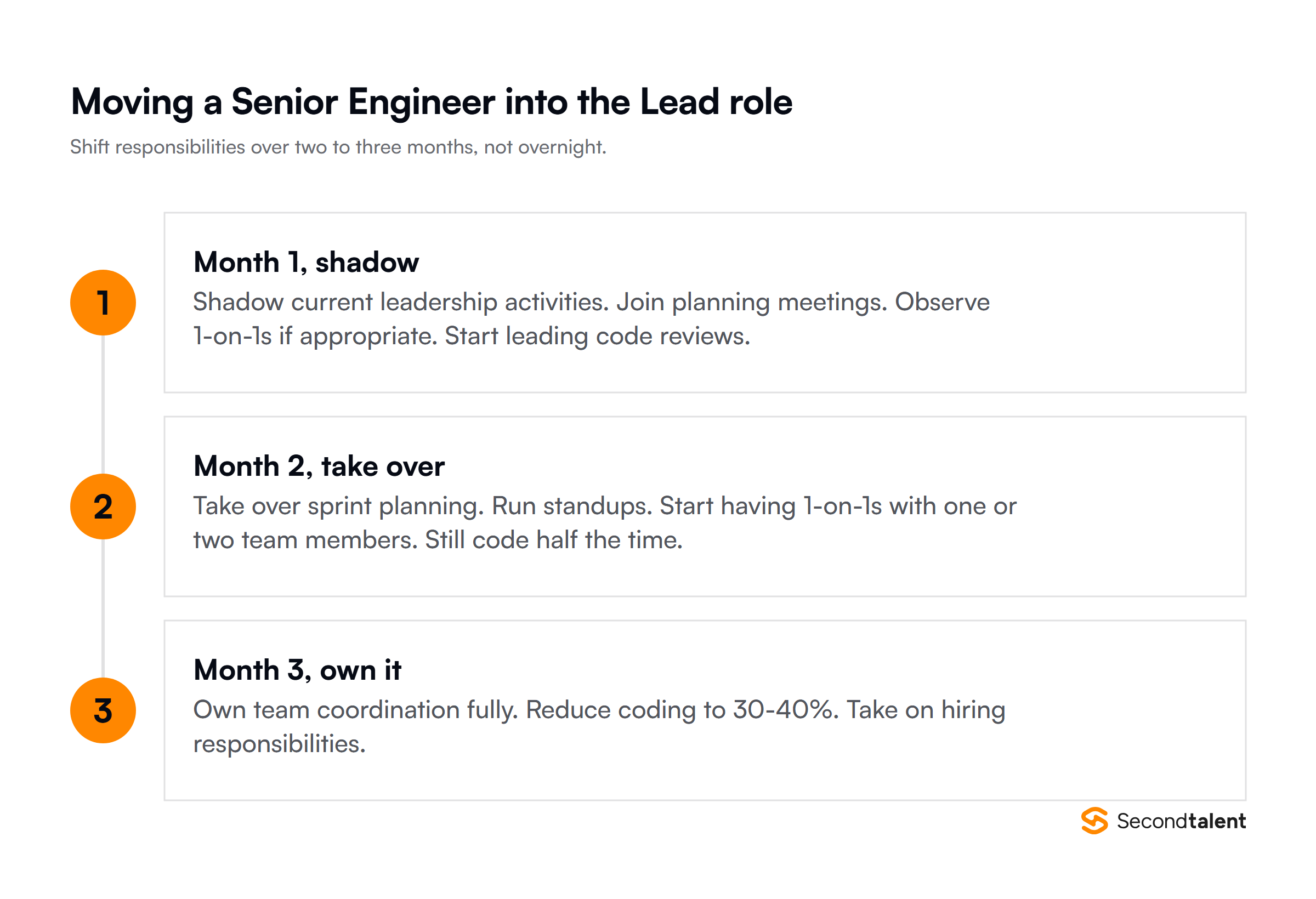
Plan the backfill before the move. A senior engineer promoted to lead takes their coding hours with them, and a team that cannot absorb that work leaves the new lead doing two jobs. Our post on when to hire a senior developer vs promote internally covers that trade-off.
When to hire a lead engineer vs a senior engineer
Team size is the best first signal. Larson's one-lead-per-eight-engineers ratio fits most teams, and a team below five seldom has enough coordination work to fill a lead's week.
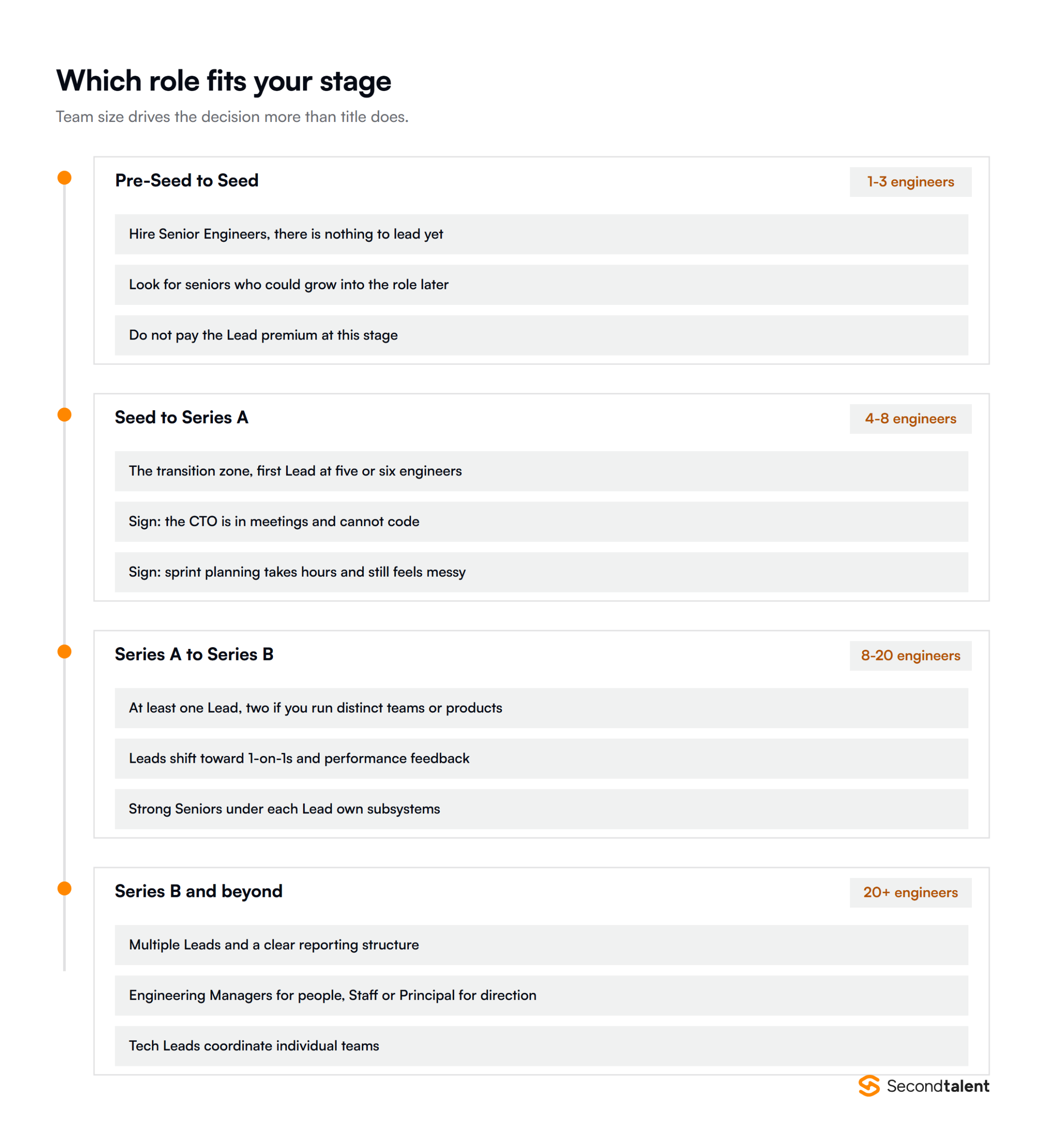
Hire a senior engineer when the backlog grows faster than the team can ship, or when code quality is slipping in one area. Hire a lead engineer when the symptoms are about coordination:
- Two engineers build competing fixes for the same problem
- Design decisions wait days for someone to make the call
- No one owns the overall architecture
- The CTO spends the week in engineering meetings instead of on the product
- Juniors have no one reviewing their work closely
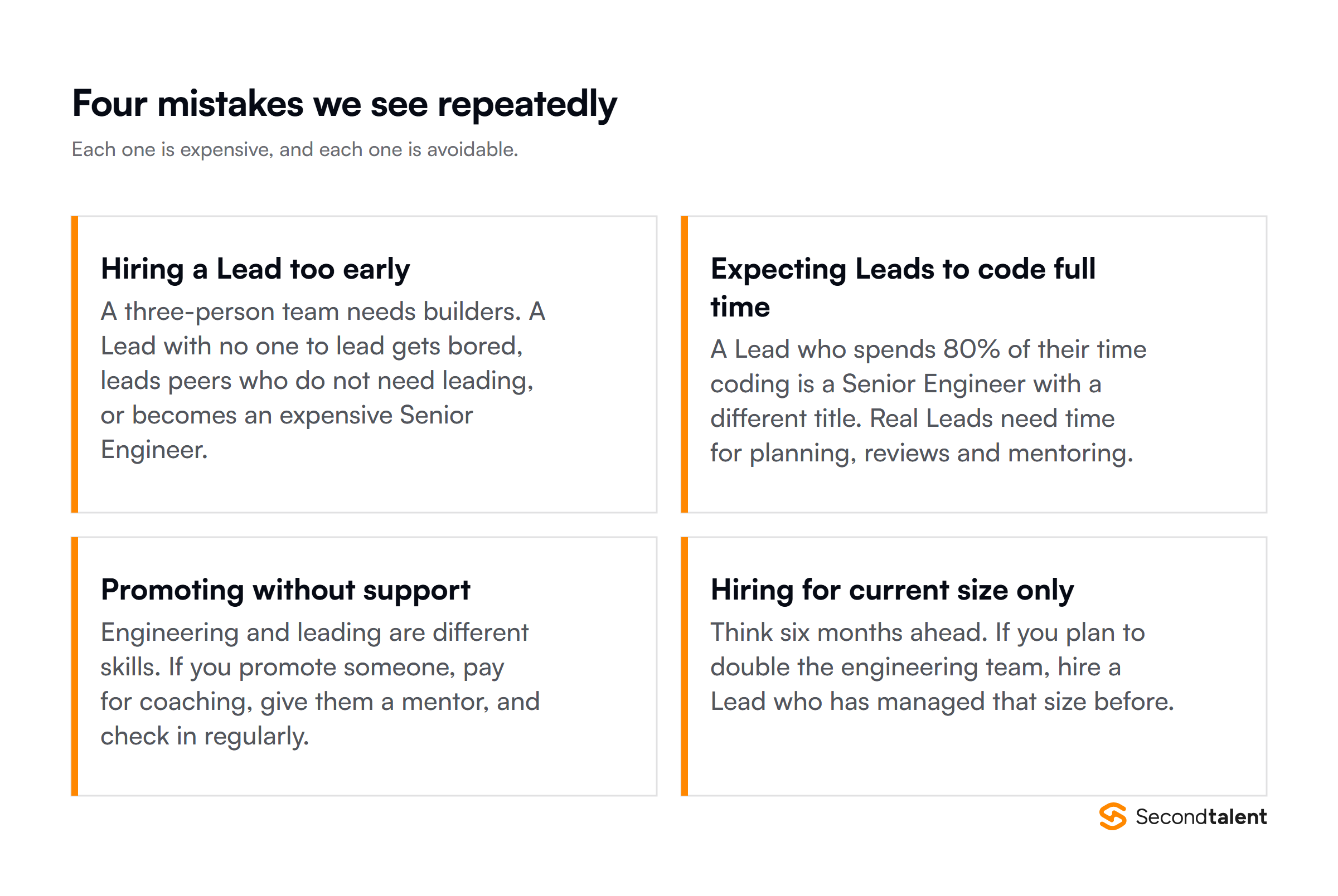
If unsure, hire a senior engineer with lead potential. Adding leadership duties later is easier than taking them away. The opposite mistakes cost more:
Specialist teams follow the same logic. An ML platform group still needs one engineer setting direction, as our ML infrastructure engineer vs MLOps engineer comparison shows. Once a senior engineer signs, the first-90-days onboarding plan decides how fast they deliver.
Hire senior and lead engineers from Asia
Second Talent matches companies with vetted backend, full-stack and AI engineers at 50-70% below US cost. We employ them through our own entities and EOR in 9 Asian markets, including Vietnam, the Philippines, Malaysia and Indonesia. Every hire carries a 90-day, one-time replacement guarantee.
The Second Talent Monthly plan is $4,999 a month all-inclusive for a senior engineer, with the first month at $2,999. Tell us the team you are building and we will send a shortlist.
Frequently Asked Questions
Is a lead engineer higher than a senior engineer?
Usually. At Capital One, lead is a grade directly above senior. At companies that treat it as a role, a senior or staff engineer takes it on, and the title may not change at all.
Is a lead engineer a manager?
Not always. Databricks' tech lead has no direct reports and partners with an engineering manager. Capital One's lead posting prefers candidates with a year of managing direct reports. Check the posting before assuming either way.
Is a lead engineer the same as a staff engineer?
They overlap. Larson's guide treats tech lead as the most common staff archetype, next to architect, solver and right hand. A staff engineer can also work across teams without leading any single one.