Every business is now drowning in repetitive AI-shaped tasks. Triaging support tickets with an LLM, generating personalized outreach at scale, extracting structured data from PDFs, routing leads based on intent, syncing AI-generated content across systems. None of these fit a single AI agent, and none of them fit a traditional Zapier flow either. They sit in between.
AI Workflow Automation Specialists are the engineers who build that in-between. They design and ship multi-step, AI-augmented workflows that connect large language models to the rest of the business stack, with guardrails, observability, and the kind of error handling that survives production.
What is an AI Workflow Automation Specialist?
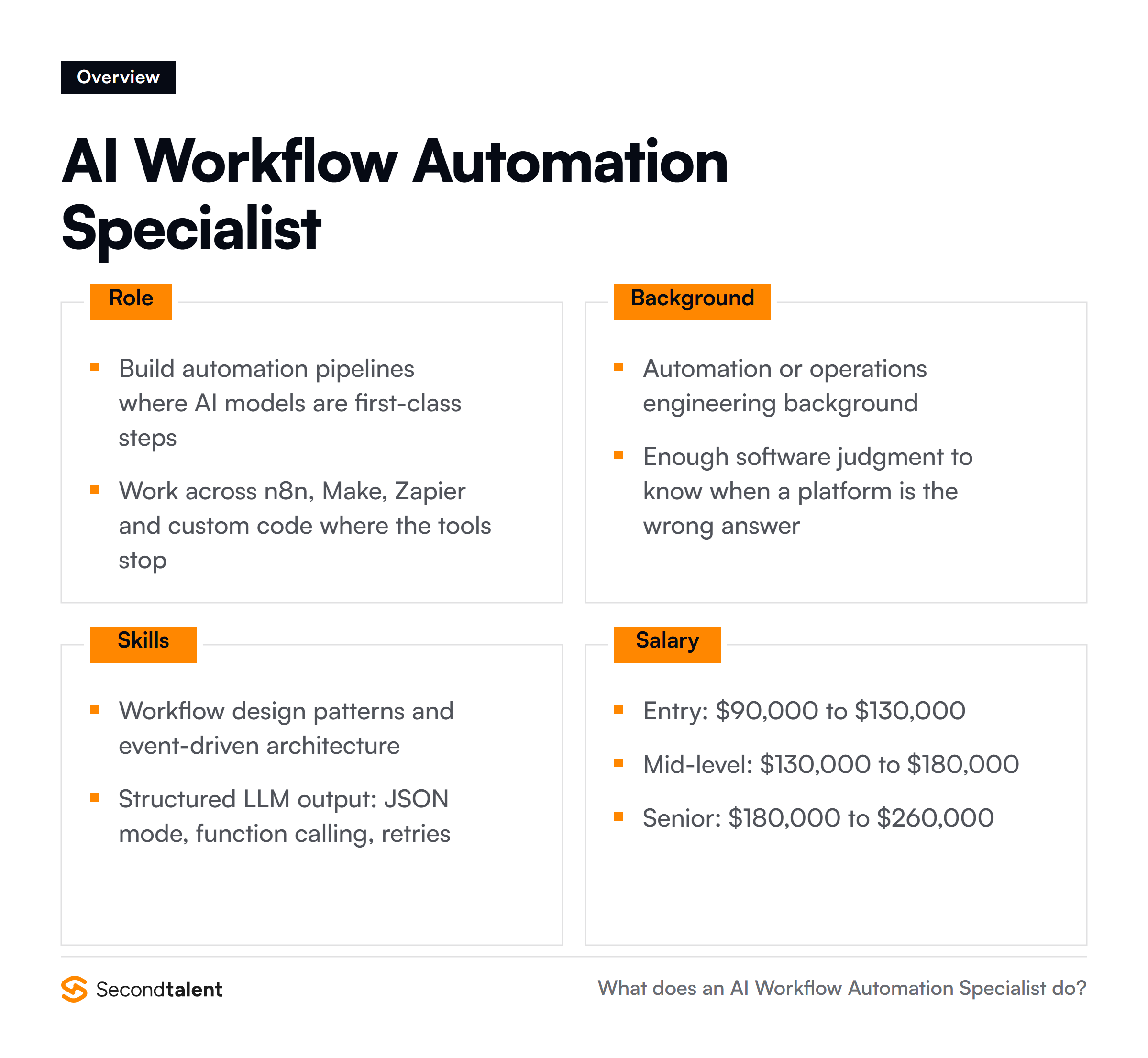
An AI Workflow Automation Specialist is the hybrid engineer who designs, builds, and operates automation pipelines where one or more AI models are first-class steps in the flow. They work fluently across workflow platforms like n8n, Make, Zapier, Pipedream, and Power Automate, and they know when to drop those and write a custom orchestration layer in Python or TypeScript instead.
The role sits at a specific intersection. RPA engineers automate clicks but rarely touch AI. Prompt engineers craft model behavior but rarely wire it into business systems. AI agent developers build autonomous loops but rarely sit inside a controlled workflow. AI Workflow Automation Specialists own the middle ground, the place where most of the real, recurring AI value in a business actually lives.
AI Workflow Automation Specialist Job Market and Career Opportunities
The category has exploded over the past 18 months. Workflow automation tools have added native LLM nodes, n8n has crossed 100,000 self-hosted instances, and almost every operations team in SaaS is hiring for the role under one title or another. The intelligent automation market is projected to reach $30 billion by 2030, and AI-augmented workflows are the fastest-growing segment inside it.
Average Salary Ranges (US-equivalent):
- Entry-level AI Workflow Automation Specialist: $90,000 – $130,000
- Mid-level AI Workflow Automation Specialist: $130,000 – $180,000
- Senior AI Workflow Automation Specialist: $180,000 – $260,000
- Principal AI Workflow Automation Specialist: $260,000 – $350,000+
The biggest demand sits in SaaS operations teams, ecommerce ops, customer support orgs running large ticket volumes, marketing and revenue ops teams, finance ops, and AI-native startups whose entire product depends on a chain of model calls plus system integrations. Consulting firms and managed service providers are also hiring specialists for client-facing builds.
Essential AI Workflow Automation Skills and Qualifications
Core Knowledge Areas:
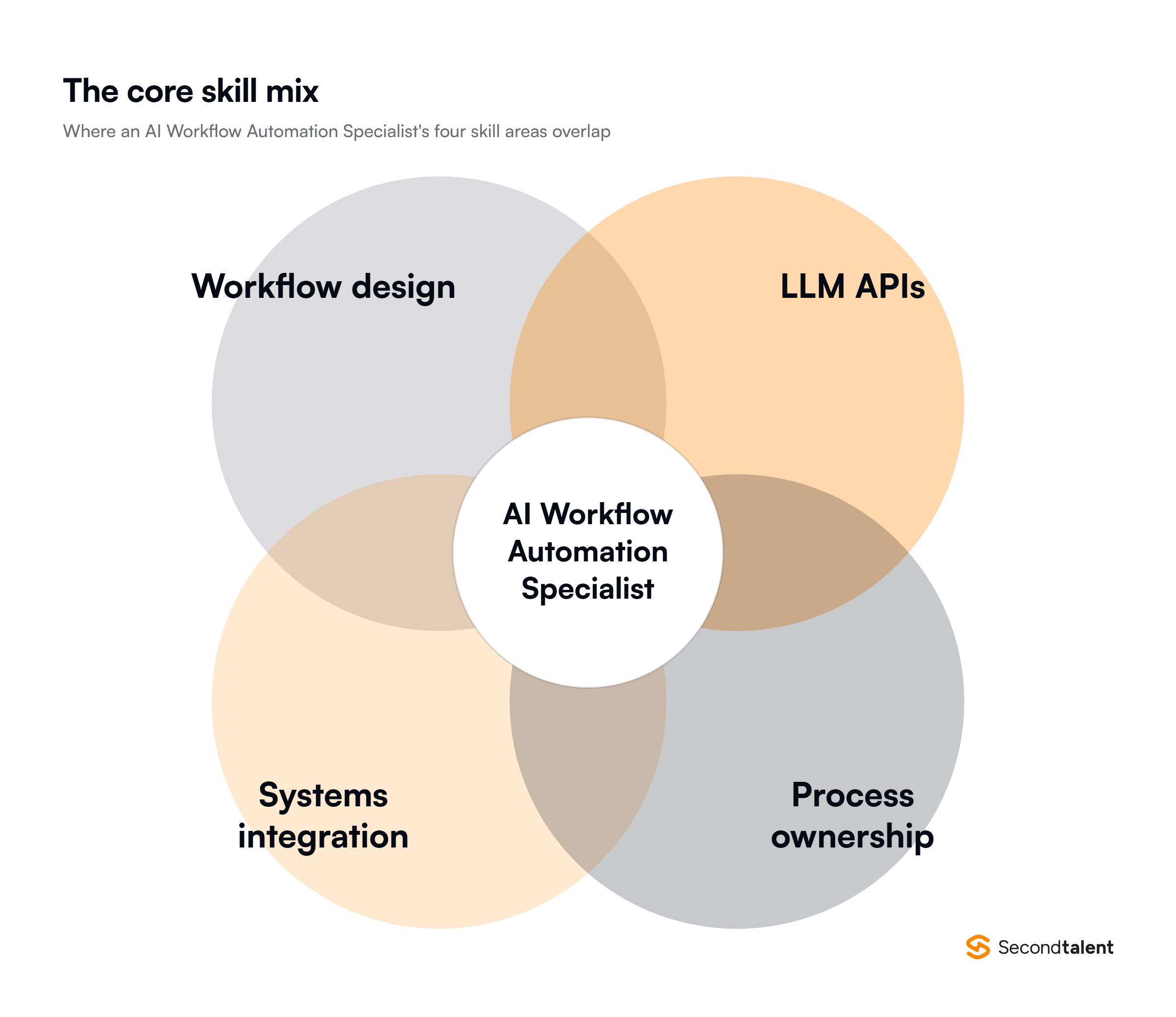
- Workflow design patterns and event-driven architecture
- Large language model APIs, parameters, and pricing models
- Prompt engineering with structured output (JSON mode, function calling)
- Retrieval-augmented generation and vector search basics
- REST APIs, webhooks, OAuth 2.0, and rate-limit handling
- Error handling, retry logic, idempotency, and dead-letter queues
- Cost control and observability for LLM calls
Technical Competencies:
- Hands-on fluency with at least two workflow platforms (n8n, Make, Zapier, Pipedream, Power Automate, Workato)
- Python or TypeScript for custom logic, API glue, and prompt orchestration
- Working knowledge of LangChain, LangGraph, or comparable orchestration frameworks
- SQL and basic data modeling for staging tables and lookups
- Git, version control, and environment promotion (dev to staging to prod)
- Monitoring and logging tools (Langfuse, Helicone, Datadog, or cloud-native equivalents)
- Authentication patterns for connecting third-party SaaS APIs
Soft Skills:
- Ability to translate fuzzy operational asks into concrete, testable workflow specs
- Strong written communication for cross-team handoffs and runbooks
- Comfort partnering with non-technical stakeholders in ops, marketing, and support
- Pragmatic judgment on when to use AI and when to use rule-based logic
AI Workflow Automation Career Paths and Specializations
The role branches by domain more than by seniority. Most specialists pick a vertical inside the first year and go deep.
Marketing and Revenue Ops Automation: Lead scoring with LLM enrichment, personalized outreach generation, content versioning across channels, multi-touch attribution stitching.
Customer Support Automation: Ticket triage and routing, automated response drafting with human review, knowledge base retrieval, deflection workflows, and quality-assurance sampling on AI replies.
Sales Operations Automation: CRM data hygiene with AI enrichment, meeting summarization to Salesforce or HubSpot, automated proposal generation, and pipeline-stage automation.
Finance and Back-Office Automation: Invoice extraction, expense categorization, reconciliation flows with AI exception handling, and reporting pipelines.
Product and Internal Tools Automation: User onboarding flows, internal AI assistants on top of company knowledge, automated QA on user-generated content, and growth experiment tooling.
Agentic Workflow Engineering: The senior end of the discipline, where specialists combine traditional workflow primitives with AI agent loops, planning steps, and tool use to handle longer-running, less deterministic processes.
AI Workflow Automation Tools and Technologies
Workflow Platforms:
- n8n for self-hosted, code-friendly automation with native LLM nodes
- Make (formerly Integromat) for visual flows with deep app coverage
- Zapier for breadth of integrations and quick prototypes
- Pipedream for code-first serverless workflows
- Microsoft Power Automate for enterprise Microsoft 365 environments
- Workato and Tray.io for enterprise-grade orchestration
AI Providers and Models:
- OpenAI GPT-5 and structured output APIs
- Anthropic Claude (Opus, Sonnet, Haiku) for long-context and tool use
- Google Gemini for multimodal inputs
- Mistral and Cohere for cost-sensitive workflows
- Local models via Ollama or vLLM for data-residency requirements
Orchestration and Frameworks:
- LangChain and LangGraph for stateful agent and workflow logic
- CrewAI and AutoGen for multi-agent collaboration patterns
- Custom Python or TypeScript orchestration for production reliability
- Inngest and Temporal for durable execution outside the no-code platforms
Vector Databases and Retrieval:
- Pinecone, Weaviate, Qdrant for managed vector search
- pgvector and SQLite-VSS for embedded retrieval
- Hybrid search patterns combining BM25 and embeddings
Observability and Cost Management:
- Langfuse and Helicone for LLM call tracing and cost dashboards
- Datadog, Grafana, and OpenTelemetry for cross-system observability
- Budget alerts at the workflow level, not just the API key level
Building Your AI Workflow Automation Portfolio
Hiring managers screen specialists on portfolio depth, not certifications. Three or four real, end-to-end workflows beat a dozen tutorial copies.
Project ideas that signal seriousness:
- A self-hosted n8n flow that ingests inbound emails, classifies intent with an LLM, drafts a reply, and routes to a CRM with full retry and idempotency logic
- A retrieval-augmented internal assistant built on top of a real document corpus, with citation tracking and a feedback loop that flags hallucinations
- A batch enrichment pipeline that processes thousands of records, with cost telemetry, partial-failure handling, and the ability to resume from the last successful row
- A multi-step agentic workflow that combines deterministic steps with one or two agent decision points, instrumented end to end
- A monitoring dashboard that surfaces per-workflow LLM spend, error rates, and average response times
For each project, write a short readme that explains the trade-offs you made. Choosing managed Pinecone over self-hosted Qdrant, choosing Claude over GPT-5 for long-context tasks, choosing a retry queue over an in-process try-except. The reasoning is the signal.
AI Workflow Automation Methodology and Best Practices
Design with failure in mind first. LLM calls fail, third-party APIs rate-limit, and webhooks fire twice. Build retry, idempotency, and dead-letter handling into every workflow before you ship it.
Force structured output from models. Use JSON mode, function calling, or schema-constrained decoding wherever possible. Parsing free-form text from an LLM in production is a future bug.
Add a human-in-the-loop step early. The cheapest way to ship an AI workflow safely is to keep a human reviewing the output for the first weeks, with the goal of removing that step once accuracy is proven, not skipping it on day one.
Instrument cost and latency per step. A workflow that costs $0.12 per run looks cheap until it runs 100,000 times a month. Build dashboards that show spend by workflow, by step, and by model.
Separate prompts from code. Store prompts in a versioned config or prompt registry, not inline. This makes A/B testing and rollback trivial.
Test on real failure cases. Build a regression set from real production failures. Run every prompt change against it before promoting.
Set spend guards at the workflow level. A runaway loop on an LLM API can rack up thousands of dollars in minutes. Per-workflow daily caps with circuit breakers are non-negotiable.
Future of AI Workflow Automation Careers
The discipline is moving fast in three directions at once.
Agentic workflows are eating linear ones. The clean step-by-step flows of 2023 are giving way to workflows that include short agent loops for the parts of the process that cannot be hardcoded. Specialists who can blend deterministic and agentic patterns will be the most valuable hires for the next three years.
Multimodal workflows are now table stakes. Voice in, voice out, image understanding, document extraction with vision models. Workflows that only handle text are starting to look as dated as ones that do not touch AI at all.
Self-improving workflows are the frontier. Specialists are starting to build flows that automatically log failures, generate fix proposals, run them against test cases, and submit pull requests for human review. The feedback loop is getting tighter.
Underlying all three: the cost per token keeps falling, the context windows keep growing, and the integrations keep deepening. The role gets more leveraged every quarter.
Getting Started as an AI Workflow Automation Specialist
Start with one platform, end-to-end. Pick n8n or Make and build five real workflows. Do not skip the deployment, monitoring, or failure-handling steps. The breadth comes later; the depth comes first.
Learn the LLM API mechanics, not just the prompts. Token counting, structured output, function calling, streaming, rate limits. Most workflow bugs in production are mechanics, not prompts.
Read other people’s workflows. The n8n community templates, Make’s blueprint library, and open-source LangGraph examples are full of patterns that take years to invent on your own.
Build a small portfolio with one strong signature piece. A single deep workflow with cost telemetry, regression tests, and a thoughtful readme is worth ten shallow ones.
Join the communities. n8n’s forum and Discord, the LangChain Discord, and the various ops-automation subreddits are where the current state of the art actually gets discussed. Tutorials are six months behind.
Hire a mentor or take on contract work. The fastest path to senior-level fluency is shipping production workflows for someone else’s business, with real consequences, real budgets, and real ops teams asking hard questions about edge cases.
The role is one of the highest-leverage in modern software engineering. Every business has a backlog of repetitive, AI-shaped work that needs someone who can wire models, systems, and guardrails together. Specialists who get fluent now will spend the next decade shipping the workflows that quietly run companies.