By Eric Cheng, Head of International Business
14 min read
TL;DR: For developers, the platforms that beat Upwork are the vetted ones: Toptal and Arc.dev for senior contractors, Lemon.io and CloudDevs for startups that need someone this week. Fiverr, Freelancer.com and Guru are cheaper open marketplaces where you still do the screening. For a full-time engineer, Second Talent costs $25 to $39 USD an hour, billed monthly, with employment included.
Upwork ended 2025 with 785,000 active clients, down from 832,000 a year earlier, even as spend per remaining client rose 7%.
One reason buyers leave is on its own help center: clients on the free Basic plan now pay a marketplace fee of up to 7.99% on every payment, on top of the freelancer’s rate.
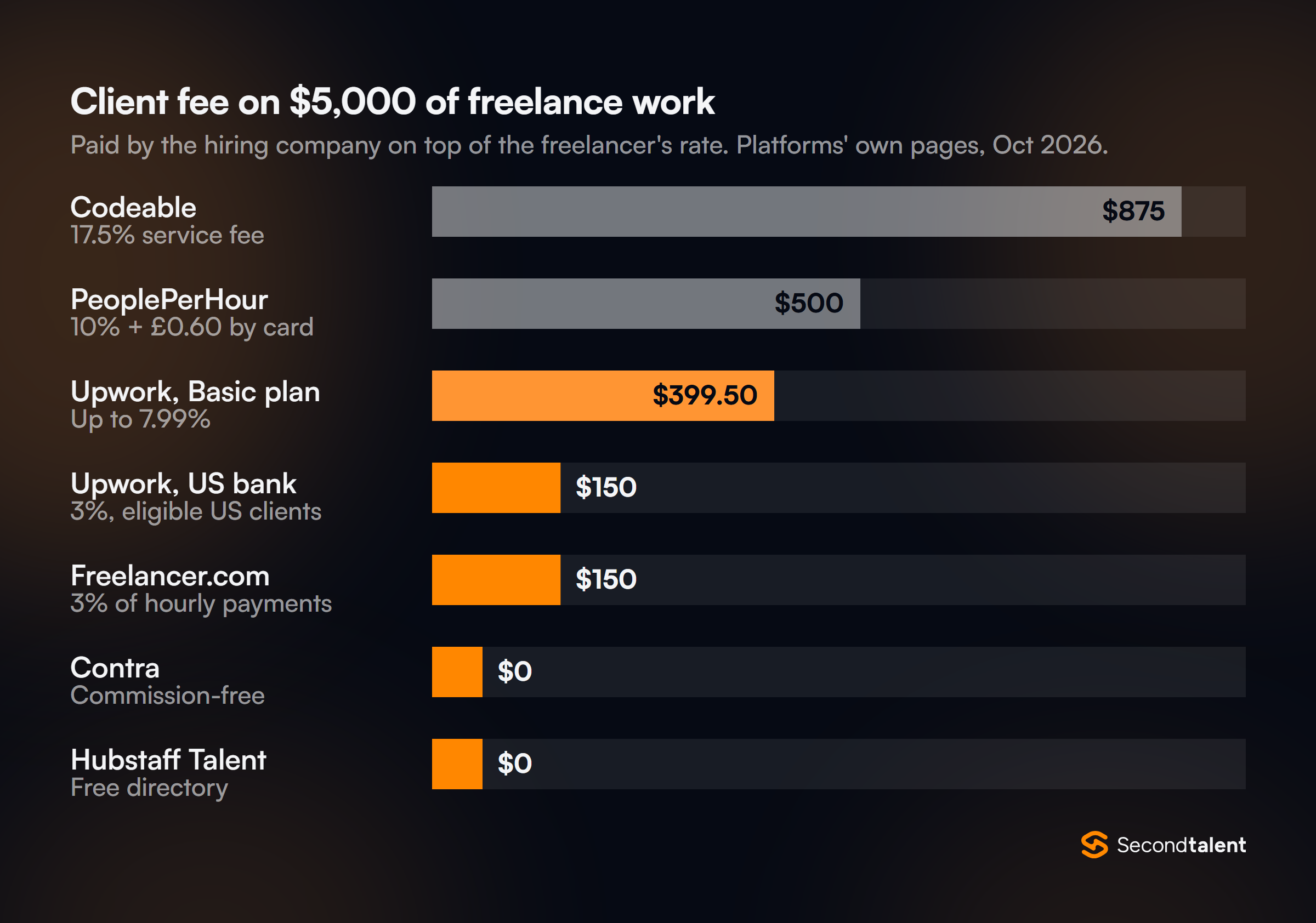
1US clients who pay Upwork from a bank account get the client fee cut to 3%, the same rate Freelancer.com charges on hourly work.
2Contra and Hubstaff Talent charge the hiring company nothing; Codeable charges the most, a 17.5% service fee.
3Only Arc.dev, CloudDevs, Codeable and Second Talent publish an hourly range you can budget against before a call.
4Toptal says 90% of its clients hire the first candidate it introduces.
1. Toptal
$79 a monthCandidates in 24 hoursTrial up to 2 weeks
Toptal is for companies that want a senior contractor working within days and will pay for someone else to do the screening.
Upwork shows you a list of proposals; Toptal sends a short list of people it has already tested, and its FAQ says 90% of clients hire the first candidate introduced.
The published terms are a flat $79 monthly subscription once matching starts, invoices twice a month on Net 10, and a trial of up to two weeks in which you are not billed if you are unhappy.
If no one in the network fits, finding and screening a new expert takes one to three weeks. The hourly rate itself is quoted per engagement after you describe the role, so you cannot price a hire from the website.
Best for: Short, senior contracts where speed matters more than price.
Watch out: No public rates, and the subscription runs on top of them.
Published scale: Developers, designers, finance and product experts in one network.
2. Arc.dev
$15 to $110+ an hour20% of salary full-time3-month free re-match
Arc.dev suits teams that like Upwork’s visible pricing but want the screening done for them.
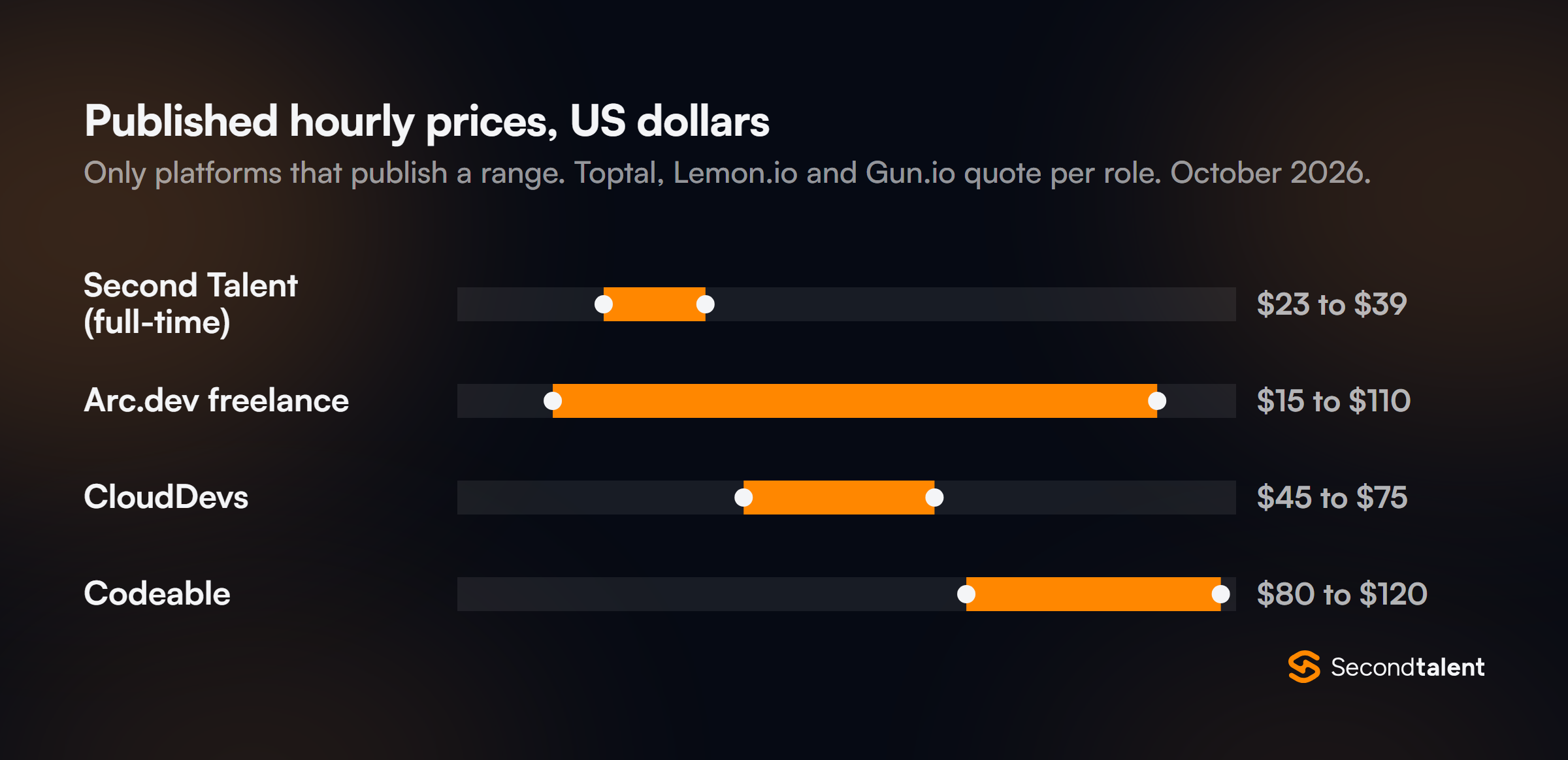
Its pricing page lists freelancers at $15 to $110+ an hour with a risk-free trial of up to two weeks, and full-time hires at a one-off 20% of annual salary.
The screening funnel is published too: 55% of applicants pass the profile review, 14% the communication assessment and 2% the technical interview.
A permanent hire takes about 14 days on average, and for the first three months Arc will match you with another engineer free of charge. Against Upwork, you give up the cheapest end of the market and get a pre-tested shortlist.
Best for: Teams hiring freelance and permanent developers from one place.
Watch out: The 20% full-time fee is due on placement, on top of salary and payroll.
Published scale: 2% of applicants pass all interviews.
3. Fiverr
3.1 million active buyers$342 spend per buyerFixed-price gigs
Fiverr is for buyers who know exactly what they want and would rather pick a packaged service than run a hiring process.
Freelancers list “gigs” with a fixed scope and price, so a landing page, a bug fix or an API integration can be bought like a product, with a buyer service fee added at checkout.
The numbers in its full-year 2025 results show the model: 3.1 million annual active buyers spending $342 each on average, and a marketplace take rate of 27.7% across both sides. That spend per buyer is small next to an engineering contract.
Fiverr Pro adds a higher tier of sellers, but most of the platform rewards short, well-defined jobs. Our Fiverr alternatives page covers the vetted options.
Best for: One-off tasks with a scope you can write in a paragraph.
Watch out: Little continuity; a gig ends when the deliverable ships.
Published scale: 3.1 million active buyers at the end of 2025.
4. Freelancer.com
3% client feeBids in 60 secondsFree contests
Freelancer.com is the closest like-for-like swap for Upwork, built for buyers who want many bids fast and are happy to sort them.
You post a project, freelancers bid on price, and the homepage says 80% of jobs receive bids within 60 seconds from a talent pool it puts at 90.4 million professionals.
Its fee page is simpler than Upwork’s: employers pay 3% of an awarded fixed-price bid or $3, whichever is greater, and 3% of each hourly payment. Contests cost nothing to post or award. Freelancers pay 10%.
The catch is the same as Upwork’s: anyone can bid, so a cheap quote and a senior engineer rarely arrive in the same proposal, and the screening is yours.
Best for: Price-led projects with a written spec.
Watch out: Bid volume is high and quality varies widely.
Published scale: A pool it puts at 90.4 million professionals.
5. Contra
0% commissionPost a job freeCreative-first
Contra is for teams hiring independent designers, web developers and AI builders who want the whole rate to reach the freelancer.
It calls itself a “commission-free creative network”: you post a job for free, creatives apply directly, and neither side pays a platform cut on the work.
The network leans toward brand, product and motion design, with web developers and AI developers as browsable categories and independent studios listed alongside individuals.
That makes it a strong Upwork alternative for a marketing site or a product redesign, and a thinner one for backend or infrastructure roles. On the same $5,000 of work, the client fee ranges from nothing to $875:
Best for: Design-led and web projects with independent pros.
Watch out: Vetting is light; portfolios do most of the work.
Published scale: Tens of thousands of contributors in its top community topics.
6. Guru
800,000 employers$250M paid outSafePay escrow
Guru is for buyers who pay for work in milestones and want the money held until each one is approved. Its SafePay escrow holds the money for a milestone and releases it when you sign off the work.
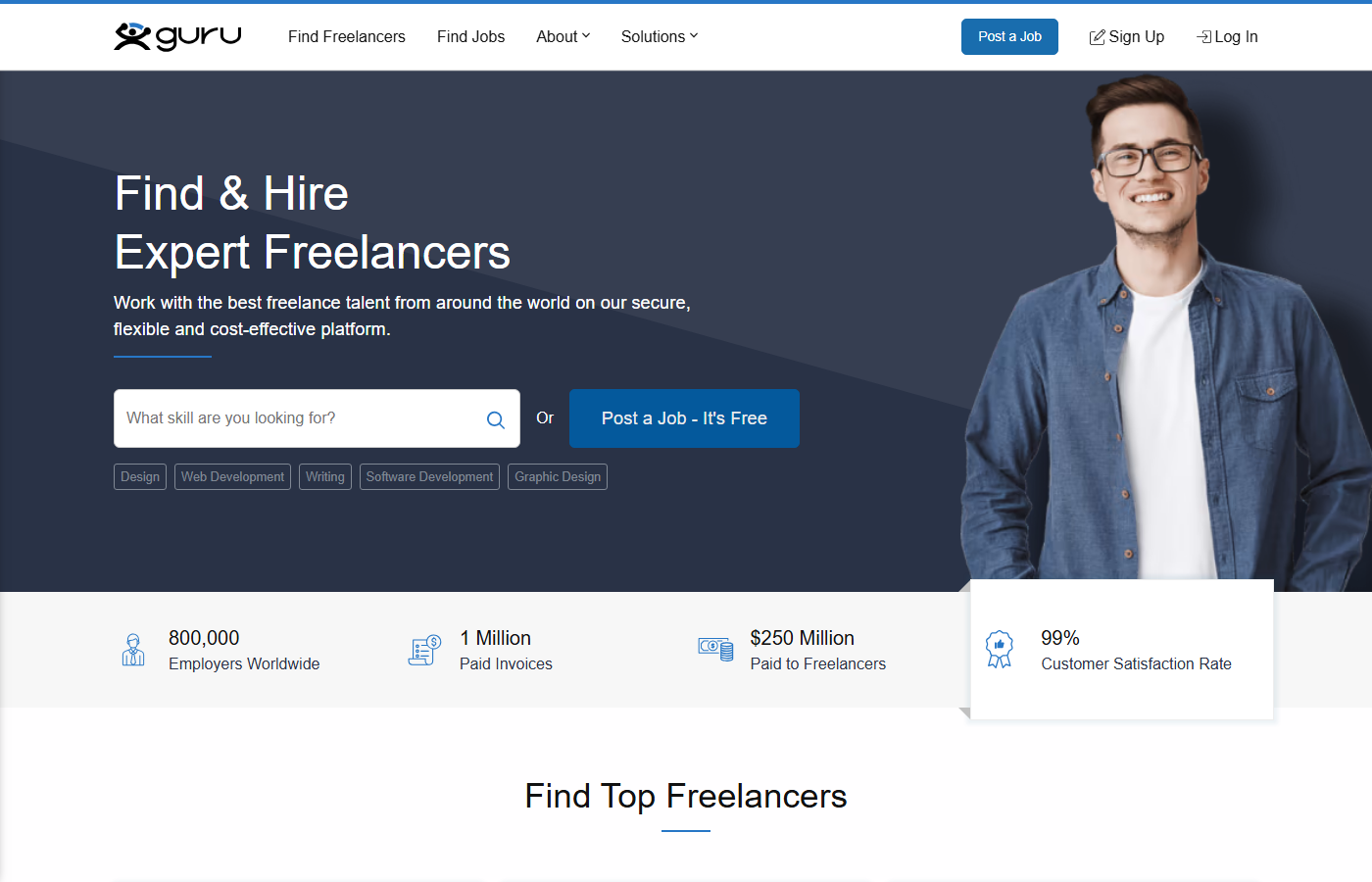
The stats strip on its homepage counts 800,000 employers, one million paid invoices and $250 million paid to freelancers.
That is a smaller marketplace than Upwork, and it feels like one: fewer proposals per job, more mid-level generalists, and senior engineers you will mostly have to find and approach yourself.
Fees depend on payment method and the freelancer’s membership tier, so check the figure at checkout. Guru blocked our attempts to read its fee page, so we have left its rate off the chart above.
Best for: Fixed-scope projects paid in milestones.
Watch out: A thin senior engineering pool; screening is on you.
Published scale: 800,000 employers and $250 million paid, per its homepage.
7. PeoplePerHour
10% + £0.60 buyer fee0% by bank for GoldFixed-price offers
PeoplePerHour is a UK-based marketplace that suits British and European buyers, and it is the platform most often weighed directly against Upwork for that market.
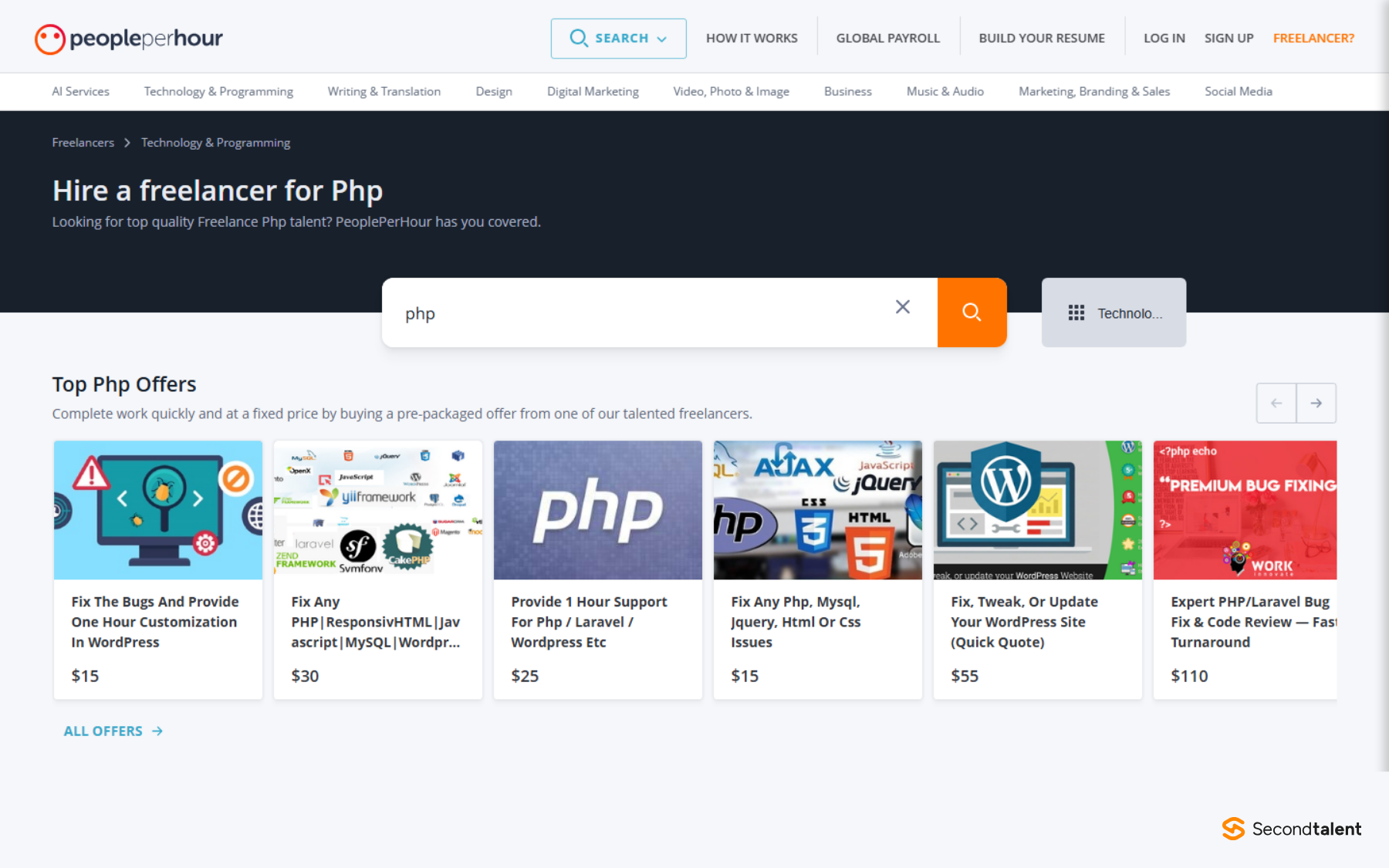
Like Fiverr, it sells pre-packaged “offers” at fixed prices, such as a $15 bug fix or a $55 WordPress update, next to the usual post-a-project route.
Its terms (section 8.1) set the buyer fee at £0.60 plus 10% by card, PayPal and most wallets, falling to 2.5% by bank transfer for Silver members and 0% for Gold.
Freelancers pay 20% until they bill a client £250, then 7.5%, then 3.5% past £5,000. On card payments that makes it dearer for the buyer than Upwork’s Basic plan. Our PeoplePerHour alternatives page goes further.
Best for: UK and EU buyers who want packaged offers.
Watch out: The 10% buyer fee by card is one of the highest here.
Published scale: Freelancers across tech, design, writing and marketing.
8. Lemon.io
1.2% acceptanceMatched in ~24 hours160-hour minimum
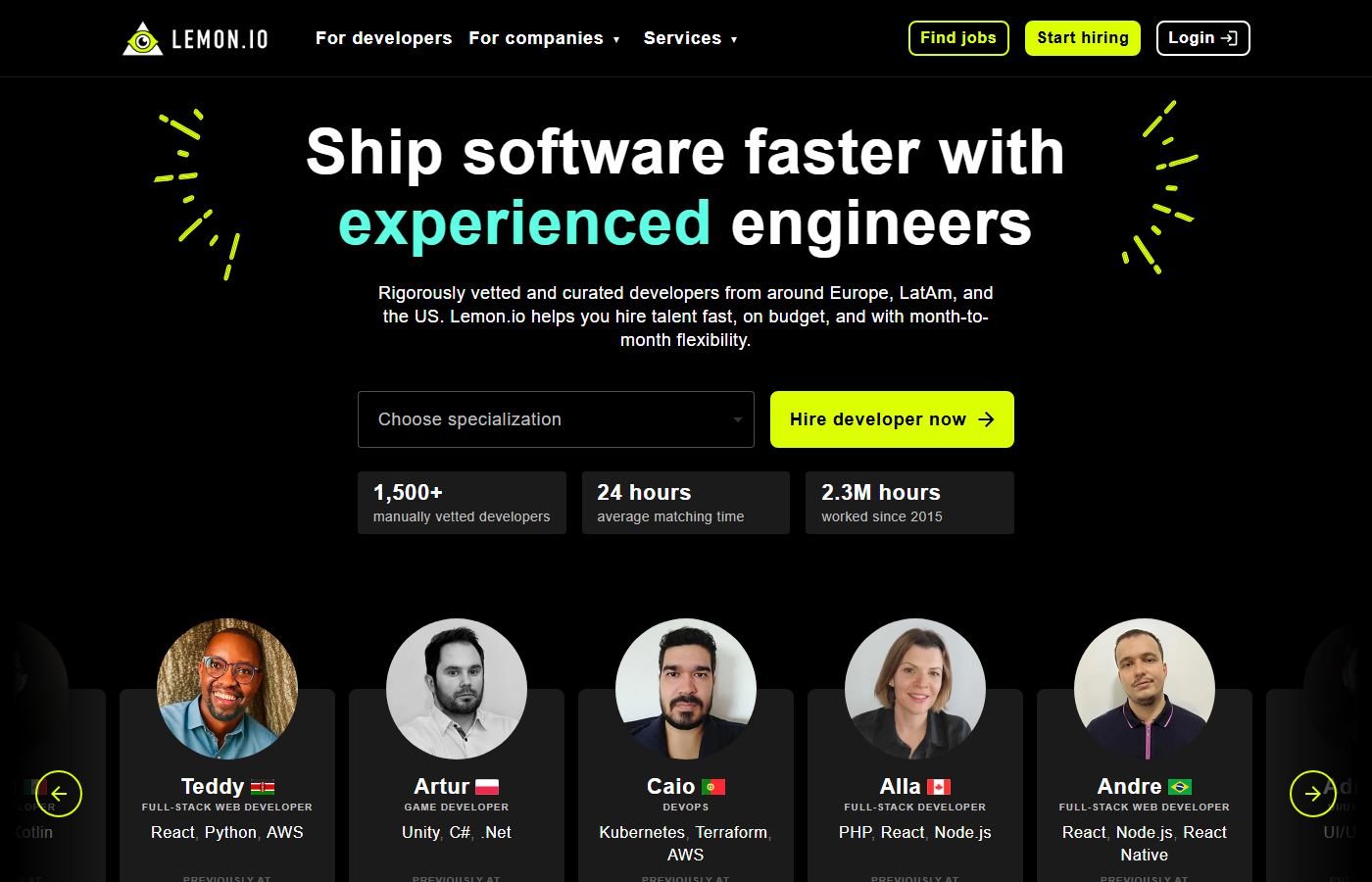
Lemon.io is for startups that want a vetted freelance developer this week without reading fifty proposals. Its pricing page puts the acceptance rate at 1.2% and matching at about 24 hours, with no upfront recruitment or setup fees.
Billing works differently from Upwork. Lemon.io runs a prepaid subscription, usually charged a month in advance, and the minimum engagement is 160 hours: one month full-time or two months part-time.
Developers are hired from Europe, Latin America, the US and Canada, and the company says it has made 2,000+ hires over ten years. Rates are quoted per developer rather than listed, so you learn the price after the match.
Best for: Seed and Series A teams that need one vetted developer fast.
Watch out: No public rates, and a one-month minimum.
Published scale: 2,000+ hires since it launched.
9. CloudDevs
$45 to $75 an hour7-day risk-freeLatin America
CloudDevs is for US teams that want developers in their own time zones at a rate they can see up front.
It now runs at hiredevelopers.com and places developers from Mexico, Brazil, Argentina, Colombia and Peru at $45 to $75 an hour, or as low as $25 for long engagements.
Screening has three stages: a video call on communication, a technical assessment by a senior engineer and a monitored live coding challenge.
Talent is assigned within 24 hours, and a seven-day risk-free guarantee covers a replacement or refund. Next to Upwork, CloudDevs trades the global price floor for overlap with a US workday.
Among the platforms that publish an hourly range, here is where it sits:
Best for: US teams hiring in overlapping hours on a known budget.
Watch out: Latin America only, and a short guarantee window.
Published scale: A pool it puts at 500,000+ developers.
10. Gun.io
100+ countriesEnterprise focusRates on request
Gun.io is for larger companies that want a managed engineering engagement, not a marketplace login.
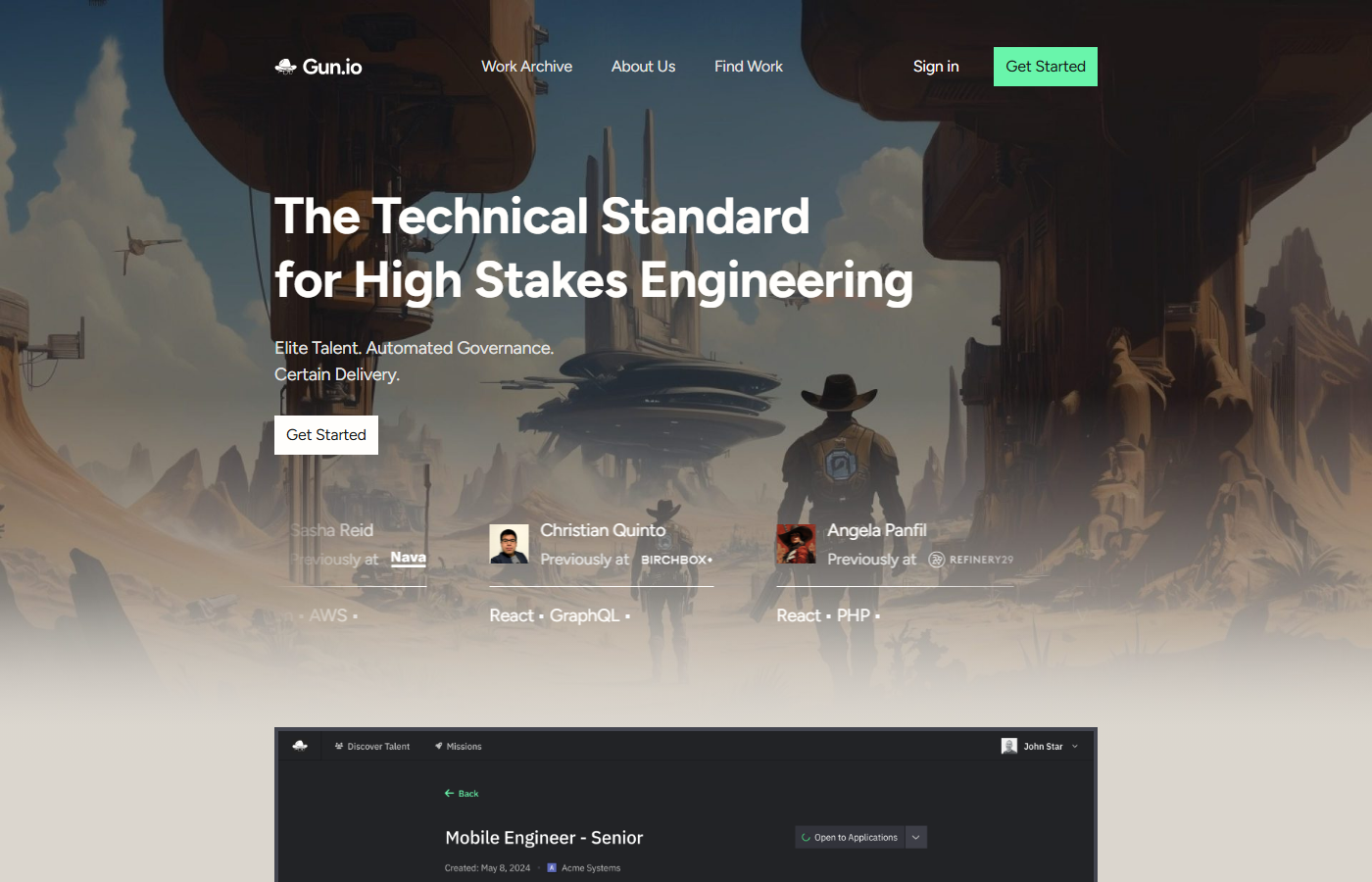
Its homepage pitches “the technical standard for high stakes engineering”: elite talent, automated governance and “certain delivery”, with vetted engineers matched to your stack.
It lists engineers by skill, among them 3,950 JavaScript, 3,412 React and 2,820 Python developers across 100+ countries, and shows each one’s previous employers on the profile.
Pricing, trials and guarantees are not published; you get them in a sales conversation. Against Upwork, Gun.io removes the screening and the bidding, and adds a process that a five-person startup may find heavier than it needs.
Best for: Enterprises that want governed, managed engagements.
Watch out: No published pricing, trial or guarantee.
Published scale: Thousands of engineers by skill in 100+ countries.
11. Codeable
$80 to $120 an hour17.5% service fee28-day bug warranty
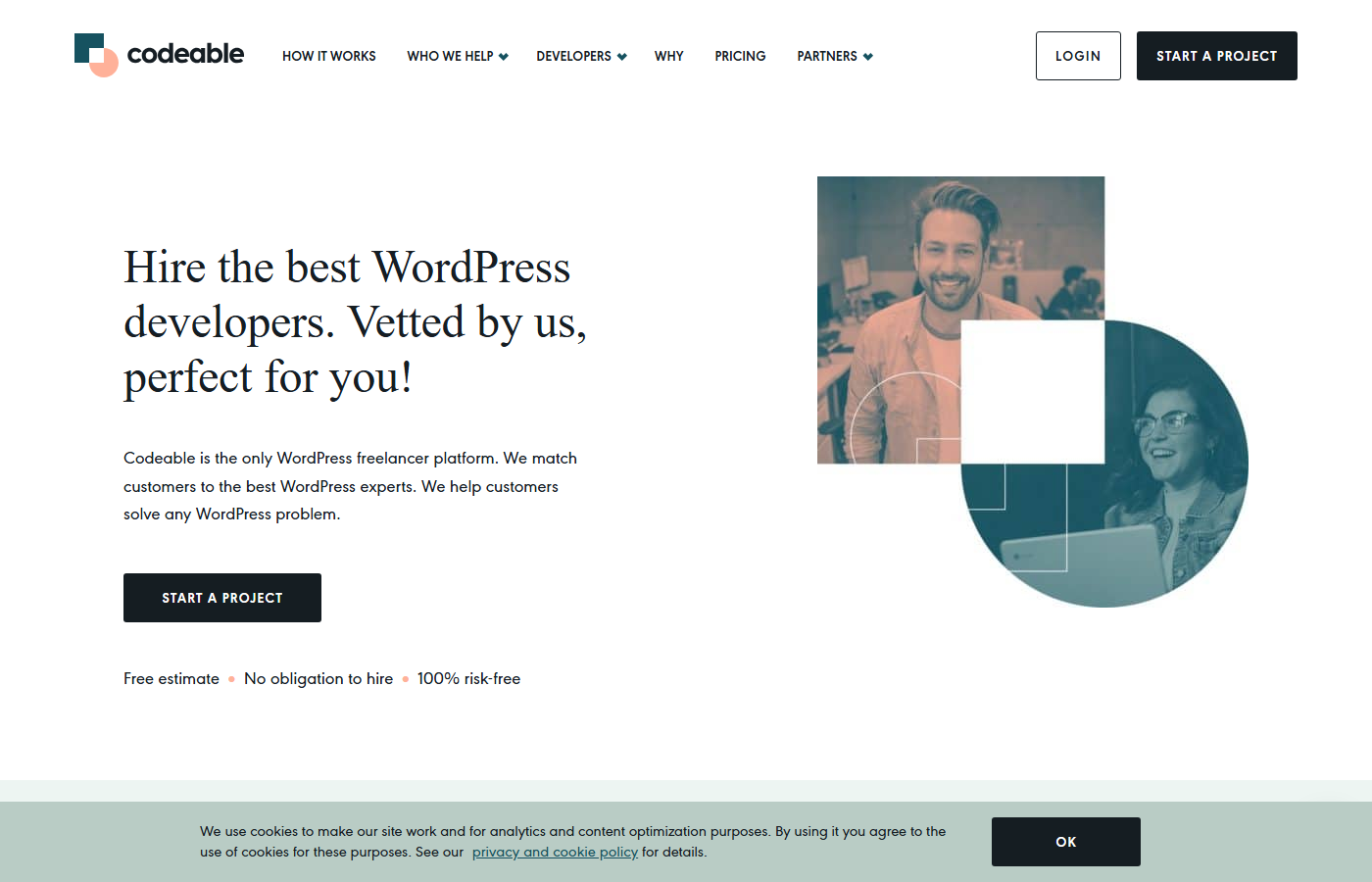
Codeable is for WordPress work and nothing else, and that narrowness is the point.
Instead of competing bids, you describe the job and get one estimate, the average of the offers from interested experts, at a rate its pricing page sets at $80 to $120 an hour.
A fixed 17.5% service fee covers vetting, support and the platform, and the full project cost goes into escrow before work starts.
Every project carries a 28-day bug-fixing warranty, and refunds are available if the agreed scope is not delivered, though Codeable’s fee is never refunded.
Starting prices run from $420 for speed and security work to $3,200 for an e-commerce build. Compared with Upwork, you pay more per hour and skip the hunt through generalists who list WordPress among twenty skills.
Best for: Agencies and companies with WordPress or WooCommerce work.
Watch out: WordPress only, and the highest client fee on this list.
Published scale: 500+ vetted WordPress developers.
12. Hubstaff Talent
$0 feesFree job postsDirectory only
Hubstaff Talent is for hiring managers who can already vet engineers and just want a free place to find them.
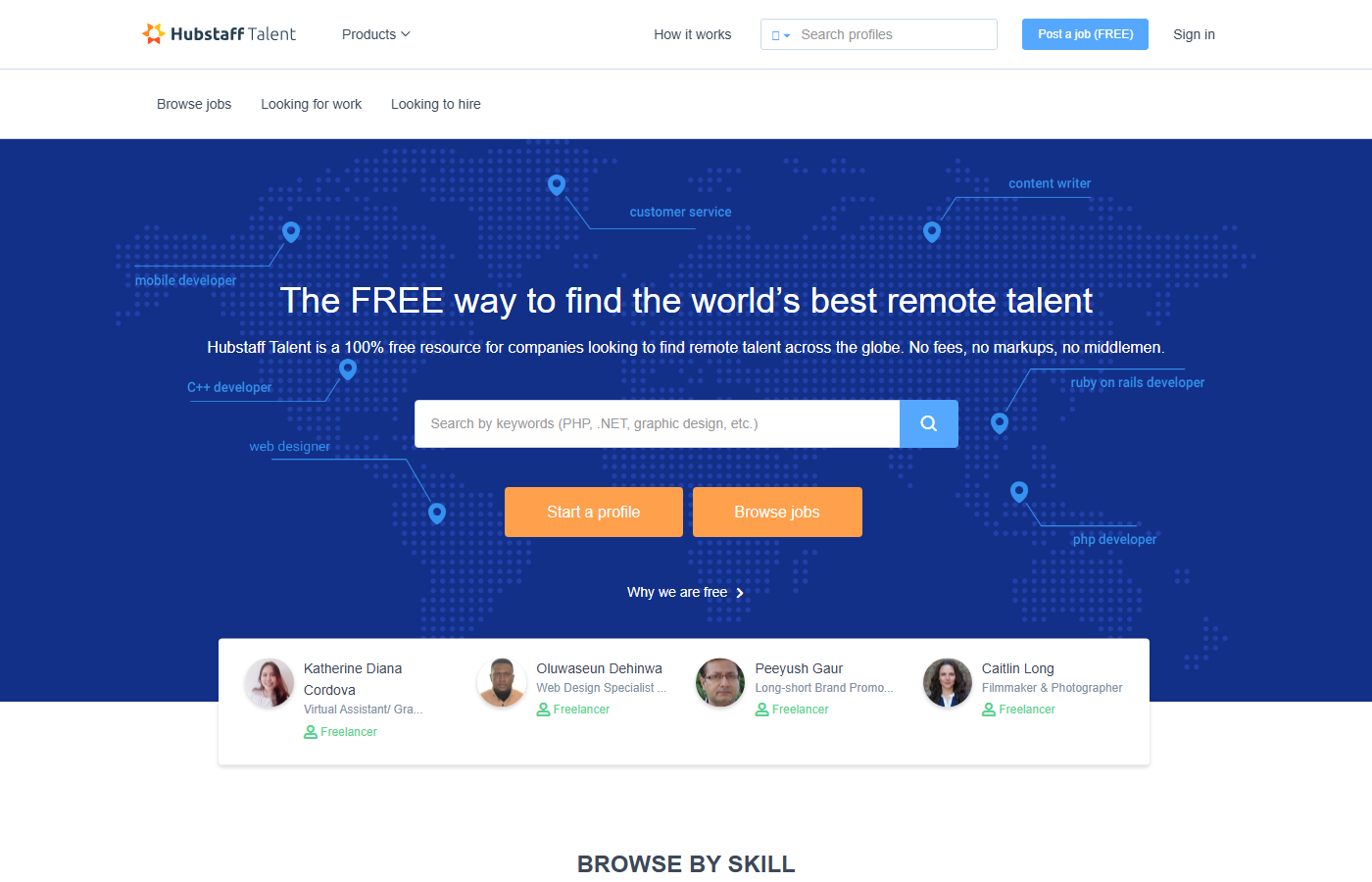
The directory, from the makers of the Hubstaff time tracker, describes itself as a “100% free resource” with “no fees, no markups, no middlemen”.
You search profiles by skill or post a job at no cost, then agree terms and pay the freelancer directly. With no middleman there is also no screening and no payment protection from the directory, which is why there is no fee.
Against Upwork, that saves the full client fee and hands you every risk the fee was paying to manage, from payment protection to contractor classification.
Best for: Teams with their own technical interview process.
Watch out: No vetting or payment protection.
Published scale: Not stated on its site.
13. Second Talent
$25 to $39 USD/hr billed monthly24 hours to a shortlist90-day replacement
Second Talent is for companies that have outgrown hourly contracts and want a full-time engineer on their own team at a price set before the first call.
It places pre-vetted engineers from nine Asian markets, including Vietnam, the Philippines, Indonesia and Singapore, at $25 to $39 USD an hour, billed monthly: $3,999 to $5,999 for 160 hours.
That covers sourcing, vetting and employment through our own employer of record, so payroll, tax and benefits are handled.
Screening runs in four stages: a technical assessment, a check of how the engineer works with AI tools such as Claude Code and Cursor, English at C1 or above, and a behavioral interview.
You can search vetted profiles yourself or hand over a brief and get 6 to 8 profiles within 24 hours. Upwork bills hour by hour with a fee on top.
Second Talent sells a dedicated hire, typically 50 to 70% below a US salary for the same seniority, with 4 to 6 hours of overlap with US working hours.
Best for: Long-term, full-time engineers at a monthly price you can budget.
Watch out: Talent comes from Asia only; it is not a freelance marketplace.
Published scale: 200+ client companies and 92% talent retention, on our own figures.
How we checked. Fees, rates and terms come from each company’s own pages, read on October 22, 2026, and Upwork and Fiverr figures from their 2025 annual results. Acceptance rates are the companies’ own claims.
Upwork vs Fiverr vs Guru for hiring developers
All three are open marketplaces, so the difference is in how work is bought rather than who is vetted.
Hiring a…
Upwork
Fiverr
Guru
Back-end or software engineer
Best of the three: hourly contracts and a deep pool
Only for a tightly scoped gig
Workable for milestone builds
DevOps engineer
Best for ongoing hourly support
Fine for a one-off setup task
Thin pool
AI developer
Widest choice, heavy screening
Good for a prototype or chatbot gig
Limited
Client fee
Up to 7.99% (3% US bank)
Buyer fee at checkout
Handling fee by payment method
For anything longer than a few weeks, a vetted platform or a full-time hire usually beats all three. The freelance developer rate index shows what each role costs by region before you post.
Upwork vs Second Talent: what a US startup pays
For a US startup
Upwork
Second Talent
Published price
The freelancer’s rate plus a client fee of up to 7.99% (3% for eligible US clients paying by bank)
$25 to $39 an hour, billed monthly; $0 until you hire
One developer at 160 hours a month
At $50 an hour: $8,000 plus $240 to $639 in client fees
$3,999 to $5,999
Who screens
You do, from proposals and profiles
Four-stage vetting before you see a profile
If the hire does not work out
No guarantee; you end the contract and start again
90-day, one-time replacement
Employment and payroll
Contractor; you handle classification
Included, through our EOR in 9 Asian markets
Upwork is hard to beat for a small, scoped task. For ongoing work, a dedicated engineer at a fixed monthly price removes the screening and the fee.
Want an engineer without the marketplace fee?
Second Talent sends a shortlist of vetted engineers from nine Asian markets within 24 hours, from full-stack developers to AI agent developers, at $25 to $39 USD/hr, billed monthly, all-in, with a 90-day replacement guarantee. See pricing or how it works.
What freelance platforms are better than Upwork for developers?
Vetted networks: Toptal and Arc.dev for senior contractors, Lemon.io and CloudDevs for startups, Codeable for WordPress. They screen candidates before you see them, which Upwork leaves to you.
What are the cheapest sites like Upwork?
Contra and Hubstaff Talent charge the hiring company no fee, and Freelancer.com charges 3%. Cheaper platforms move the screening and payment risk onto you.
What is the best Upwork alternative for freelancers?
Contra, because it takes no commission. Freelancer.com charges freelancers 10%, and PeoplePerHour 20% falling to 3.5% as billing with one client grows.
Who are Upwork’s biggest competitors?
Fiverr and Freelancer.com among open marketplaces; Toptal, Arc.dev and Lemon.io among vetted networks. Each is compared above.
As the Head of International Business at Second Talent, Eric help companies build, manage, and scale their teams across Hong Kong, Southeast Asia, and Taiwan. He leverage my skills in business growth, business development strategy, and new business development to create and execute effective crossborder hiring, EOR and payroll solutions for clients in various industries, such as e-commerce, fintech, and edtech.