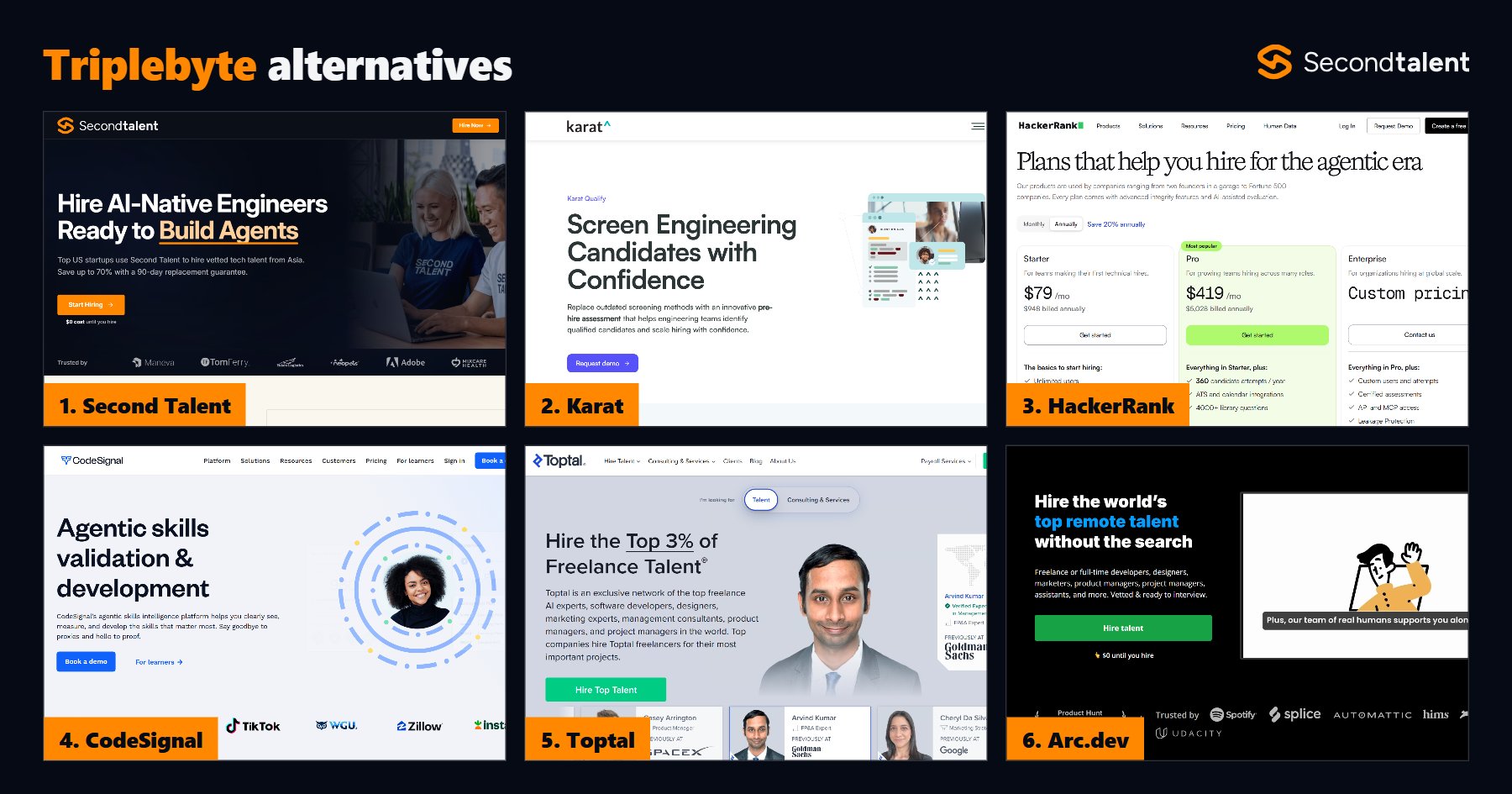
TL;DR: Triplebyte did two jobs: it screened engineers and it introduced the ones who passed to companies. To replace the screen, Karat, HackerRank and CodeSignal sell assessments, with HackerRank and CodeSignal from $79 a month on annual billing. To replace the introductions, Second Talent, Toptal and Arc.dev send pre-vetted engineers, at published prices ranging from hourly rates to a 20% placement fee.
Triplebyte came out of Y Combinator in 2015 and, by its $35 million Series B in 2019, said more than 500 companies were hiring through it. Engineers took one technical assessment, and those who passed went straight to onsite interviews.
That service no longer exists, so the right replacement depends on which half you miss: the screening signal or the shortlist of engineers who had already passed it.
Triplebyte alternatives compared
| Platform | Replaces | Published price |
|---|---|---|
| Karat | The screen, run by human interviewers | Not published; demo first |
| HackerRank | The screen, self-serve | $79 a month (annual), 60 attempts a year |
| CodeSignal | The screen, self-serve | $79 a month (annual), 60 credits a year |
| Second Talent | The shortlist, plus employment | $23 to $39 USD/hr, billed monthly |
| Toptal | The shortlist, freelance | $79 a month subscription, rates quoted |
| Arc.dev | The shortlist, freelance or full-time | $15 to $110+/hr, or 20% of salary |
- 1No single company replaced Triplebyte. Assessment tools give you the signal; vetted talent platforms give you the candidates.
- 2An assessment tool only helps if you already have applicants. With an empty pipeline, start with a talent platform.
- 3HackerRank and CodeSignal both meter usage: 60 attempts or credits a year on the entry plan, so count your candidates before you buy.
- 4Ask every vendor how it tests AI-assisted coding. Engineers now ship with Claude Code and Cursor, and a test that bans them measures a different job.
What happened to Triplebyte
In March 2023, TechCrunch reported that Karat was acquiring Triplebyte’s core assessment products and content library, while Triplebyte’s Magnet talent network would be wound down at the end of that month.
The same report put Triplebyte’s total funding at just under $50 million. The candidate marketplace did not move to Karat, which is why companies that hired through it now need two kinds of tool.
1. Karat
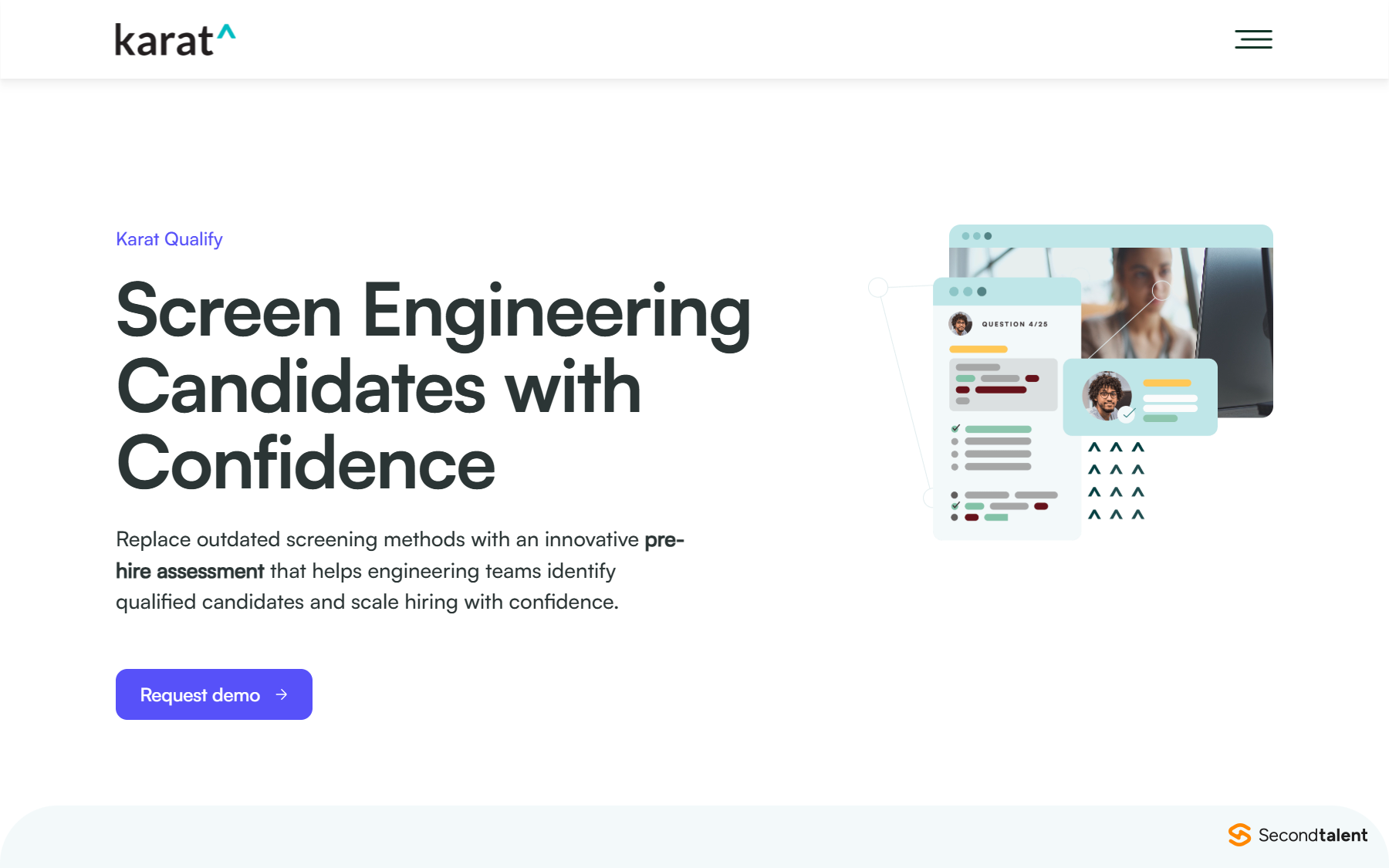
Karat is the natural first call for teams that miss Triplebyte’s screen, since it bought Triplebyte’s assessment products in 2023. It sells two layers.
Karat Qualify is a top-of-funnel screen: an on-demand, 15-question multiple-choice exercise whose questions adjust in real time to each answer, an approach Karat compares to the GMAT and GRE.
Most candidates finish in 15 to 30 minutes, and you pick from more than 20 topic areas drawn from a bank of 1,500+ questions.
Karat says Qualify is intentionally not a code test, which suits companies tired of take-home assignments.
Candidates who pass move on to the Karat Interview, a live technical interview run by one of Karat’s 500+ trained interview engineers.
Interviews can be scheduled around the clock, cover more than 100 languages and frameworks, and have been held in over 70 countries.
The appeal is engineering time. Your own engineers stop running first-round interviews, and every candidate gets the same structured rubric, which makes results comparable across roles and locations.
Karat’s homepage cites more than 600,000 technical interviews conducted.
Karat does not publish prices. Every product page leads to a demo request, so expect a sales cycle and a contract sized to your hiring volume.
- Best for: Companies with steady applicant volume that want human-led first rounds off their engineers’ calendars.
- Watch out: It does not source candidates; you still need a pipeline.
- Published price: Not published; quoted after a demo.
2. HackerRank
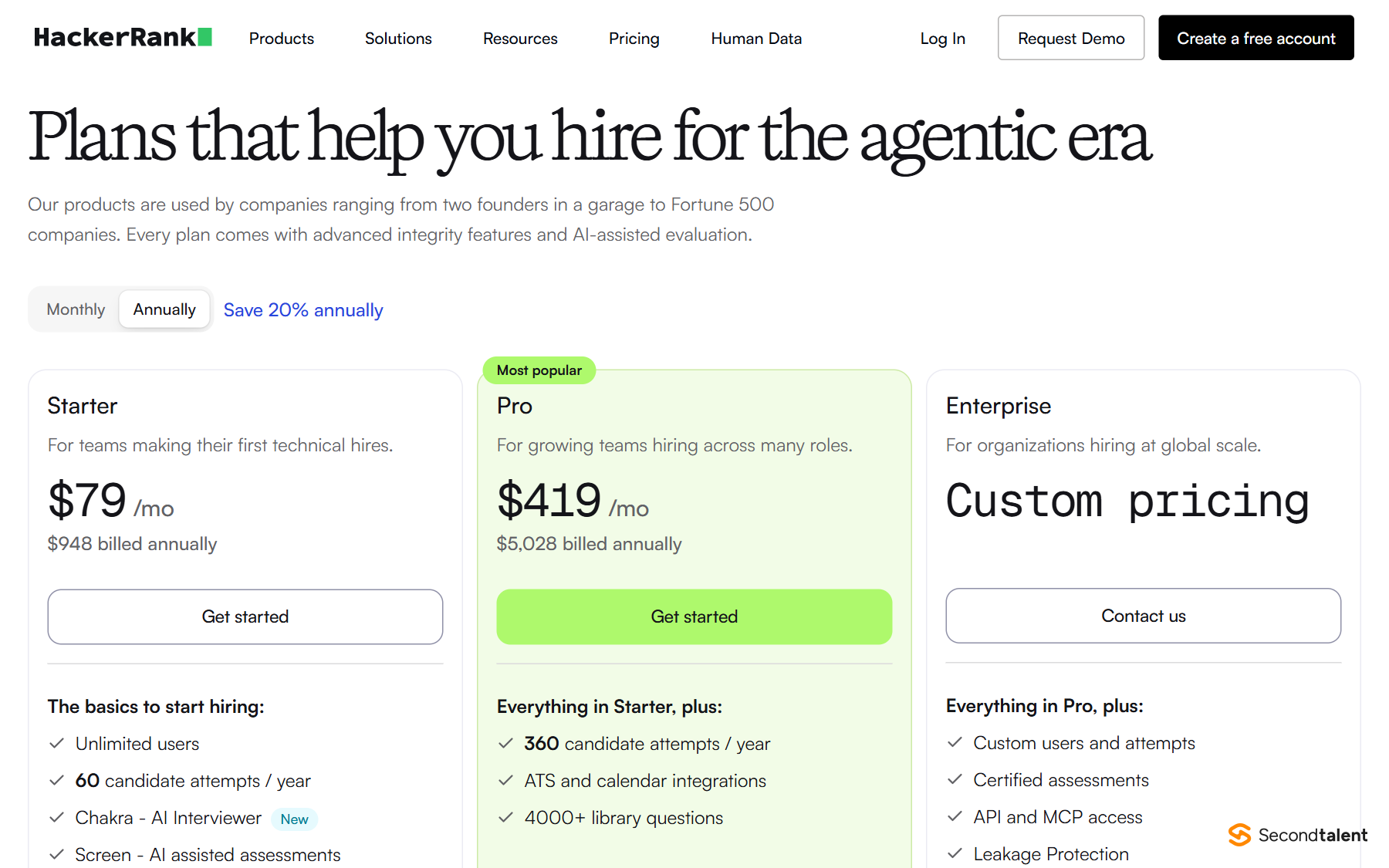
HackerRank is the self-serve way to rebuild Triplebyte’s technical screen. You choose questions from its library, send candidates a timed assessment, and run pair-programming interviews in the same account.
Unlike Karat, you can buy it with a card and start the same day.
The Starter plan costs $79 a month on annual billing, or $948 a year.
It includes unlimited users, 60 candidate attempts a year, AI-assisted assessments, pair-programming interviews, Chakra (its AI interviewer), advanced proctoring, an agentic IDE and 2,000+ library questions.
Pro, at $419 a month billed annually ($5,028 a year), raises the allowance to 360 attempts and adds ATS and calendar integrations and 4,000+ questions.
Attempts are the number to watch. Each candidate who takes a test uses one, extra attempts cost $20 each, and annual customers can pre-purchase them at $15.
A startup screening 15 applicants for each of four roles uses the whole Starter year. Enterprise plans add certified assessments, API and MCP access, leaked-question protection and 7,500+ questions, at custom prices.
The agentic IDE matters if you want to watch candidates work with AI tools rather than ban them, which is closer to how engineers ship today.
- Best for: Teams with their own applicant flow that want a self-serve coding screen.
- Watch out: Usage is metered; heavy screening pushes you onto Pro or extra attempts.
- Published price: $79 a month (Starter) or $419 (Pro), billed annually; Enterprise quoted.
3. CodeSignal
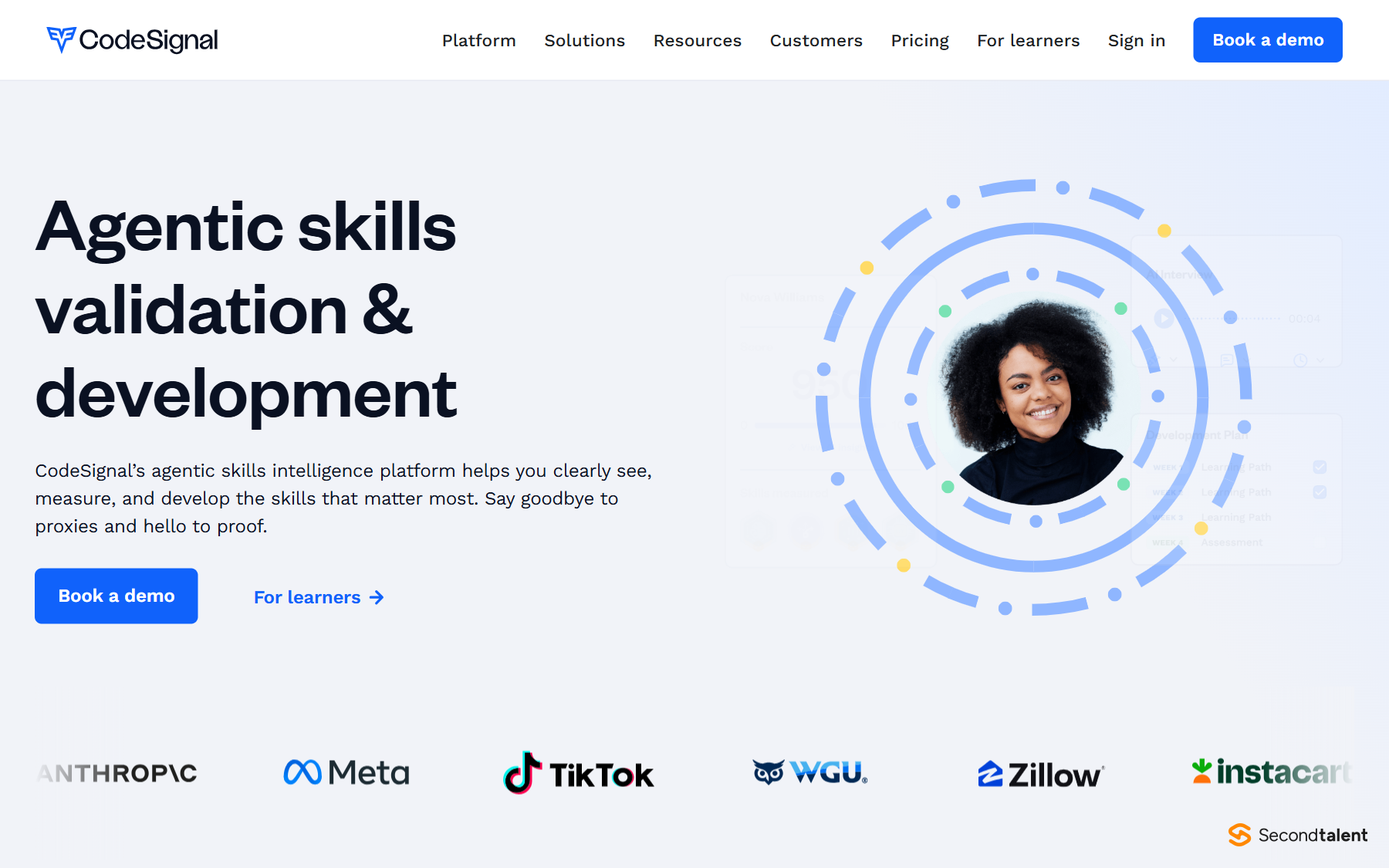
CodeSignal is the other self-serve option, and it has leaned furthest into testing how engineers work with AI.
Its entry Build plan includes agentic assessments that run with Claude and Codex, so a candidate can be scored on directing an AI agent through a task instead of writing every line unaided.
Build costs $79 a month on annual billing and comes with 60 annual credits, shared between assessments and interviews.
It covers universal and core tech assessments, AI interviewers for product, design and engineering roles, access to 2,000 questions, and AI proctoring with ID verification.
Grow, at $479 a month billed annually, raises that to 420 credits and adds more agentic assessments, go-to-market assessments, AI interviewers for sales and marketing roles, and basic ATS integrations. The top Pro tier is custom.
Live technical interviews are part of the platform too, so one tool can carry a candidate from the first screen to the final technical round. Annual billing saves 20% against monthly.
Compare it with HackerRank on two points before you choose: how each counts a credit or attempt against your expected volume, and whether its AI-assisted tests match the tools your team actually uses.
Our guide to AI candidate screening tools covers more options.
- Best for: Teams that want to test AI-assisted engineering, not only unaided coding.
- Watch out: Credits are shared between assessments and interviews, so they run out faster than they look.
- Published price: $79 a month (Build) or $479 (Grow), billed annually; Pro quoted.
4. Second Talent
Second Talent is the closest match to what Triplebyte’s client side felt like: you describe the role, and engineers who have already passed a technical screen arrive ready to interview.
The difference is what happens after the offer.
Triplebyte handed you a candidate to hire yourself; Second Talent places the engineer full-time on your team and employs them through its own employer of record in nine Asian markets, so payroll, tax and benefits are handled.
Vetting has four stages: a technical assessment, an AI-native tooling assessment, English at C1 or above, and a behavioral interview.
The tooling stage checks how an engineer works with Claude Code, Cursor and Copilot rather than taking it from a CV, which is the gap most older coding tests leave open.
You get a shortlist of 6 to 8 vetted profiles within 24 hours, with 4 to 6 hours of overlap with US working days. You can search the candidate directory yourself or hand the brief to the team.
Pricing is $23 to $39 USD an hour, billed monthly, which comes to $3,599 to $5,999 for a 160-hour month, and nothing is charged until you hire.
If a hire does not work out in the first 90 days, Second Talent replaces them once at no cost. Our how it works page shows each step.
- Best for: US startups that want a vetted, full-time engineer without running the screen themselves.
- Watch out: Engineers are based in Asia, so plan for a 4 to 6 hour overlap rather than full US hours.
- Published price: $23 to $39 USD/hr, billed monthly, all-in; $0 until you hire.
5. Toptal
Toptal replaces the other half of Triplebyte: the pool of engineers who have already been screened.
Its own screening runs in five stages, and it publishes the pass rate at each one: 26.4% clear language and personality, 7.4% the in-depth skill review, 3.6% the live screening, 3.2% the test projects, and 3% stay in the network.
The model is freelance. Toptal’s FAQ says it charges a flat $79 monthly subscription once you proceed with talent matching, which you can cancel at any time.
In almost all cases it introduces candidates within 24 hours, and each engagement starts with a trial of up to two weeks, with no bill if you are not completely satisfied.
Toptal does not publish hourly rates; you get them per candidate. Clients are typically invoiced twice a month on Net 10 terms.
Its experts are spread across more than 100 countries, and the network now covers designers, finance experts, product managers and project managers as well as developers.
That breadth suits a company hiring several kinds of specialist through one account. A startup that wants a full-time engineer on its team for years should weigh the rate against a placement model.
See our Toptal alternatives and Arc.dev vs Toptal for the detail.
- Best for: Senior freelance engineers on short notice, with a trial before you commit.
- Watch out: Rates are quoted per candidate, so budget only after you see profiles.
- Published price: $79 a month subscription; talent rates not published.
6. Arc.dev
Arc.dev is the closest to Triplebyte’s full-time hiring model, because it lets you hire either freelance or permanent and charges a placement fee for permanent hires.
Its vetting is published as a funnel: 55% of applicants pass profile screening, 14% the communication assessment, and 2% the technical interview, which is an hour with an expert or a pair-programming session.
Freelance hires cost $15 to $110+ an hour, paid hourly, and Arc says it can fill a freelance role in 72 hours. Full-time hires cost 20% of the engineer’s annual salary, paid once you hire, with an average of about 14 days to fill.
Both come with a risk-free trial of up to two weeks, and for full-time hires Arc matches you with another candidate free of charge during the first three months if you are dissatisfied.
Arc says its network holds 450,000 candidates in 190 countries and that it has made 800+ hires. Full-time hires abroad are employed through EOR partners rather than Arc itself.
At a $120,000 salary, the 20% fee is $24,000 up front, so compare it with an hourly model over the first year. Our Arc.dev alternatives page breaks down its pricing.
- Best for: Companies that want to choose between freelance and permanent per role.
- Watch out: The full-time fee is due at hire, and employment abroad sits with a third-party EOR.
- Published price: $15 to $110+ an hour freelance; 20% of annual salary full-time.
Which kind of Triplebyte alternative you need
Count your qualified applicants for the last role you filled. If you had dozens and the problem was screening them, an assessment tool restores Triplebyte’s signal at a known yearly cost.
If you had few, a test will not fix it, and a vetted talent platform is the faster route. Many teams use both: a talent platform for the next hire and an assessment tool for inbound applicants.
Frequently asked questions
Does Triplebyte still exist?
No. Karat acquired its assessment products in March 2023, and the Magnet talent network was wound down at the end of that month.
What is the closest alternative to Triplebyte’s quiz?
Karat Qualify, an adaptive multiple-choice screen that most candidates finish in 15 to 30 minutes. HackerRank and CodeSignal offer self-serve coding tests instead.
Where can I find engineers who are already vetted?
Second Talent, Toptal and Arc.dev all screen engineers before you meet them; they differ on price model and on whether the hire is freelance or full-time.
Related comparisons: Toptal alternatives · Arc.dev alternatives · Arc.dev vs Toptal · AI-native talent platforms · Talent assessment solutions for remote teams