TL;DR: Toptal screens its own network, introduces candidates within 24 hours and lets you trial a hire for up to two weeks without paying if it fails. Upwork is an open marketplace where clients pay a 5% fee (10% on Business Plus) plus a contract initiation fee, and freelancers pay 0% to 15%. Pick Toptal to hand off the screening, and Upwork to choose on price and read the profiles yourself.
Upwork’s Business Plus plan now sells what Toptal sells: a vetted top 1% of talent and a shortlist in under six hours. Its gross services volume (GSV) rose 174% year on year in Q2 2026, while Upwork’s total GSV fell 4%. Toptal spent 2026 buying other vetted networks: QO Collective, Adeva, No Single Individual and Graphite.
Toptal or Upwork: which should you use?
Use Toptal when you need one senior contractor soon and cannot spend a week reading proposals. Its matchers pick the candidates, and a failed trial costs nothing.
Use Upwork when you have a defined task, a tight budget, or a freelancer already in mind. You do the screening, and in return you see each rate before you talk to anyone.
The table sets the two side by side on the terms each company publishes. A cell reads “not published” when neither the website nor the help pages give a figure. For the wider field, see our Toptal alternatives and Upwork alternatives pages.
- 1Toptal says 90% of its clients hire the first candidate it introduces.
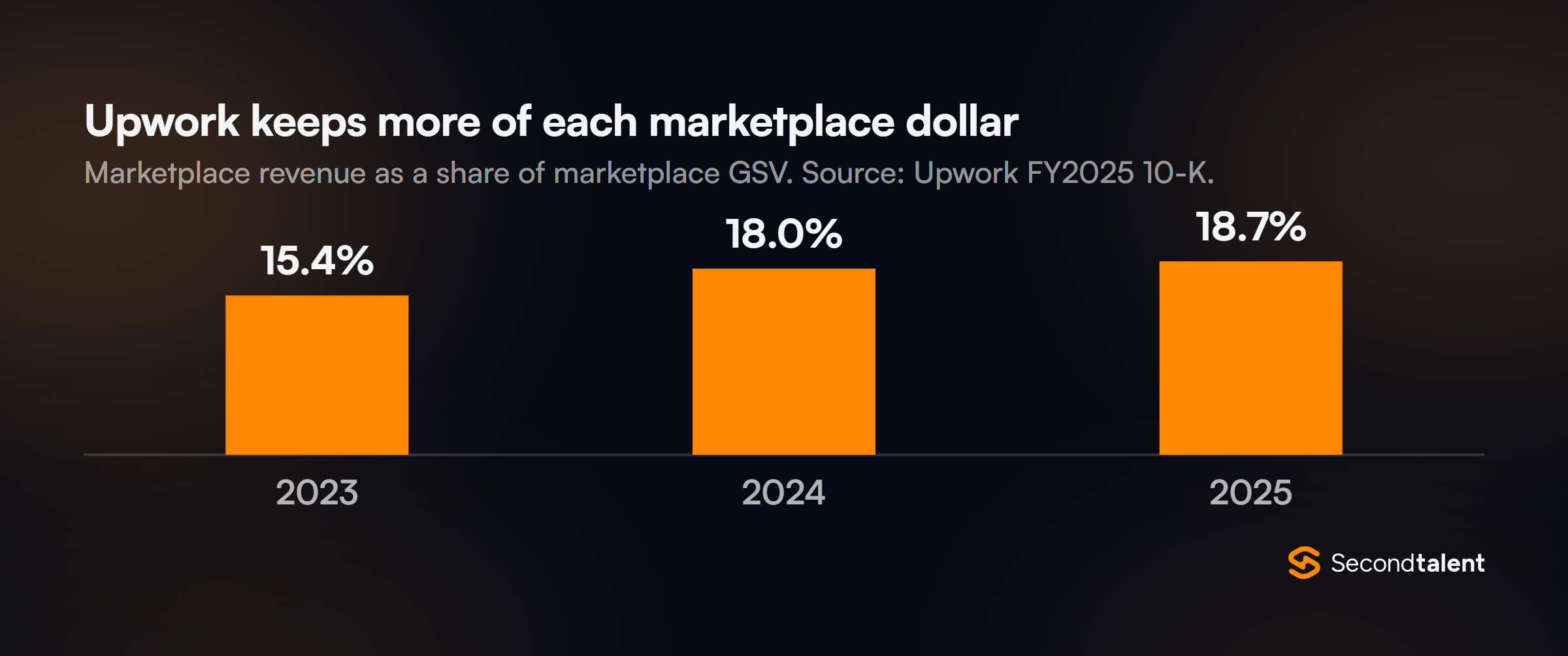
- 2Upwork kept 18.7% of marketplace spend as revenue in 2025, up from 15.4% in 2023.
- 3Toptal publishes no hourly rates. You get a quote on a call, and a $79 monthly subscription starts once you go ahead.
- 4Both now sell employment as well as contracts: Toptal through HireGlobal, Upwork through Lifted, whose EOR volume grew 29% in Q2 2026.
| Toptal | Upwork | |
|---|---|---|
| Model | Curated network of contractors | Open marketplace, plus a vetted top 1% tier |
| Who screens | Toptal, in five stages | You, using reviews, badges and Uma, Upwork’s AI hiring agent |
| Who gets in | Fewer than 3% of applicants | Anyone who passes an ID and location check |
| Speed claim | Candidates within 24 hours; a hire in about 48 hours | Most clients hire within three days; Business Plus shortlist in under 6 hours |
| Trial | Up to two weeks, not billed if you are unhappy | No trial; escrow and payment protection |
| Client fees | $79 a month subscription | 5% on Basic or 10% on Business Plus, plus a contract initiation fee |
| Freelancer fees | Not published | 0% to 15% per contract |
| Rates | Not published; quoted on a call | Set by each freelancer |
| Size | 35,000+ clients served since 2010 | 763,000 active clients (June 2026) |
| Employment option | HireGlobal employer of record | Lifted, for enterprise clients |
How Toptal screens: fewer than 3% get in
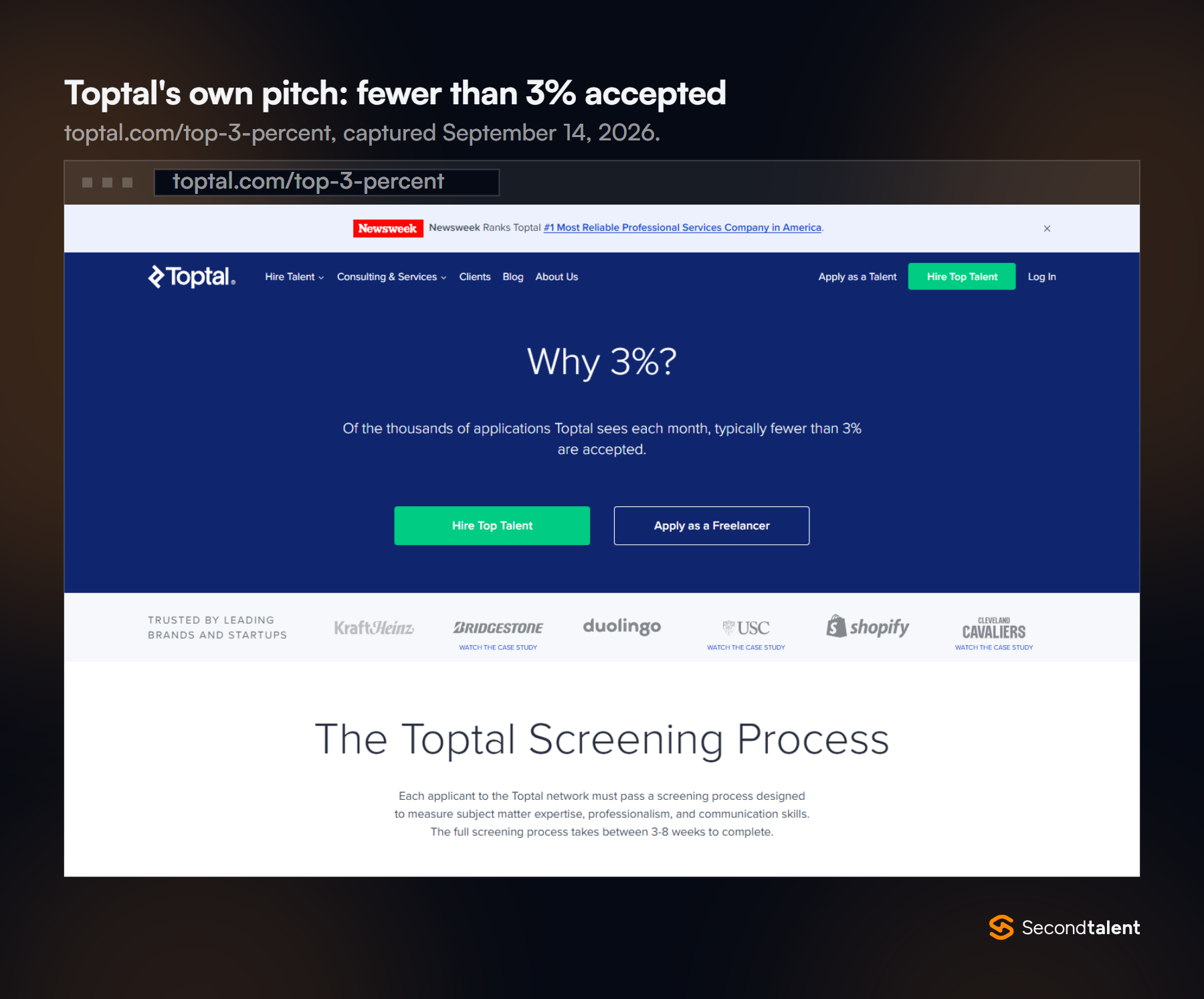
Toptal says more than 200,000 people apply to its network each year, and fewer than 3% are accepted. The biggest cut comes first. Only 26.4% of applicants pass the English and personality interview, and only 7.4% clear the skill review that follows. Those rates come from Toptal’s screening process page.
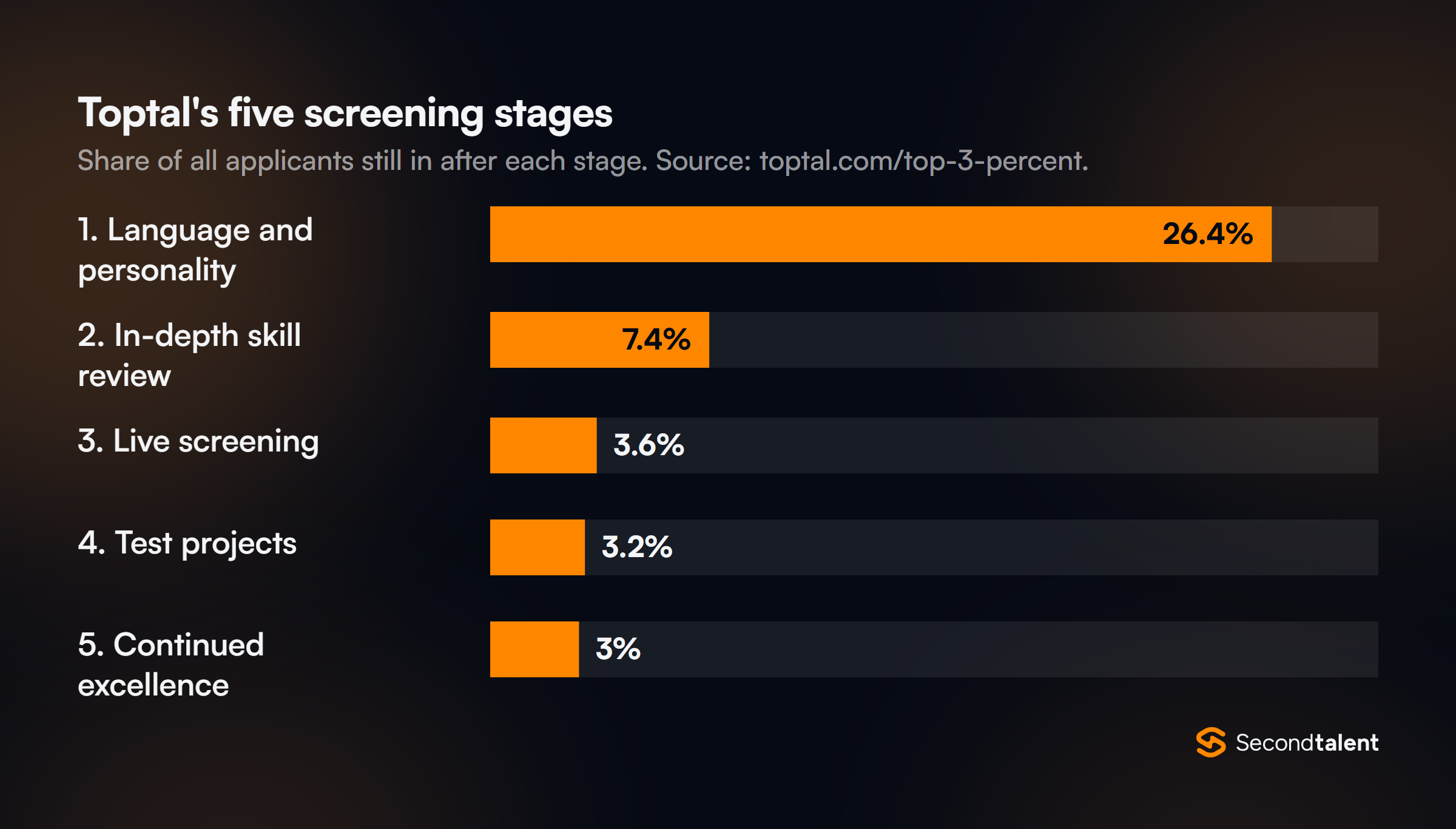
After the skill review, the drop is small. Stage three is a live interview with a screener from the candidate’s own field, and 3.6% of all applicants get through it. Stage four is a test project built on a real scenario, which takes one to three weeks.
The fifth stage has no end date. Members stay in the network only while their client work holds up.
For a client, the screening shows up as speed. Toptal’s client FAQ and developer hiring page make four claims about matching:
How Upwork filters: ID checks, badges and Expert-Vetted
Anyone can sell on Upwork once it has verified their identity and location. After that, quality signals come from the work: client reviews, work history and badges. Upwork’s pricing page counts 18+ million freelancers across 180 countries, so filtering is the real job.
The badges run from Rising Talent to Top Rated and Top Rated Plus, which marks a record on large and long-term contracts. Expert-Vetted is the closest thing Upwork has to Toptal. Upwork says those freelancers passed its own pre-screening and sit in its top 1%, but it does not publish a pass rate.
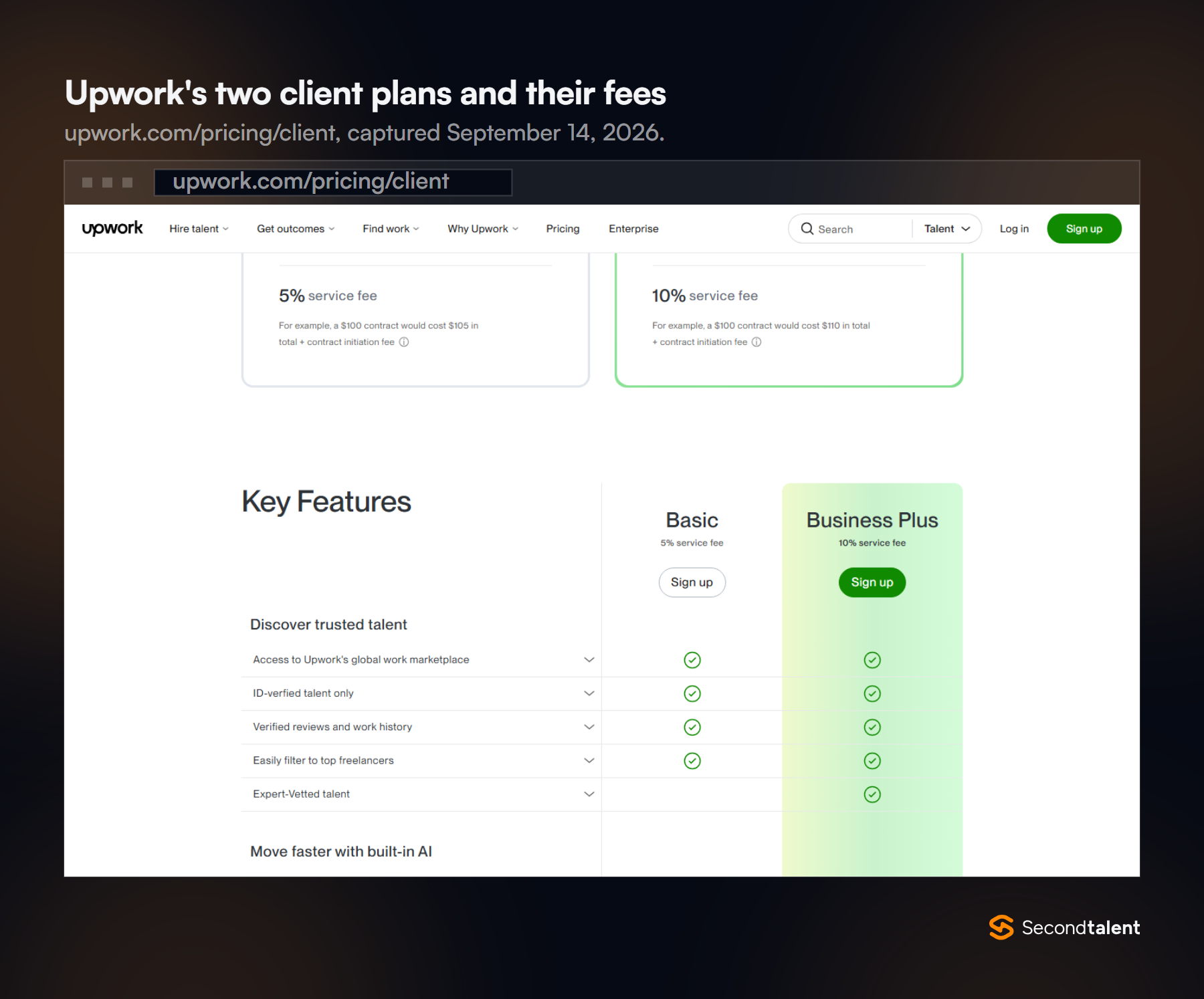
Upwork sells access to that tier through Business Plus. The plan has no subscription fee. It adds the Expert-Vetted filter, a shortlist from Uma in under six hours, and 60 invites per job instead of 30. In return, the client fee doubles to 10% of each payment.
The open marketplace is not slow either. Upwork’s client guide says most clients hire within three days of posting a job. That figure leaves out the hours you spend reading proposals.
What each platform charges
The two companies price in opposite ways. Toptal shows you almost nothing before a call. Its pricing overview says clients pay a fixed weekly price for hourly, part-time or full-time work. Upwork publishes its fees but not what the work will cost, because each freelancer sets a rate.
- $79 a month subscription, charged once you go ahead with matching
- Cancel any time; you can ask for a refund if Toptal cannot provide talent
- Rates quoted per engagement, not published
- Invoices twice a month, on Net 10 terms
- 5% client fee on Basic, 3% for eligible US bank payments
- 10% on Business Plus, 8% for eligible US bank payments
- Contract initiation fee on every new Basic contract; on Business Plus, only fixed-price contracts of $100 or less
- Freelancer fee of 0% to 15%, fixed for the life of the contract
The Upwork client fee is simple to model. Upwork’s own pricing page says a $100 contract costs $105 on Basic and $110 on Business Plus, before the initiation fee. The 3% bank rate needs a US account, $1,000 of spend in the past 12 months and on-time payments.
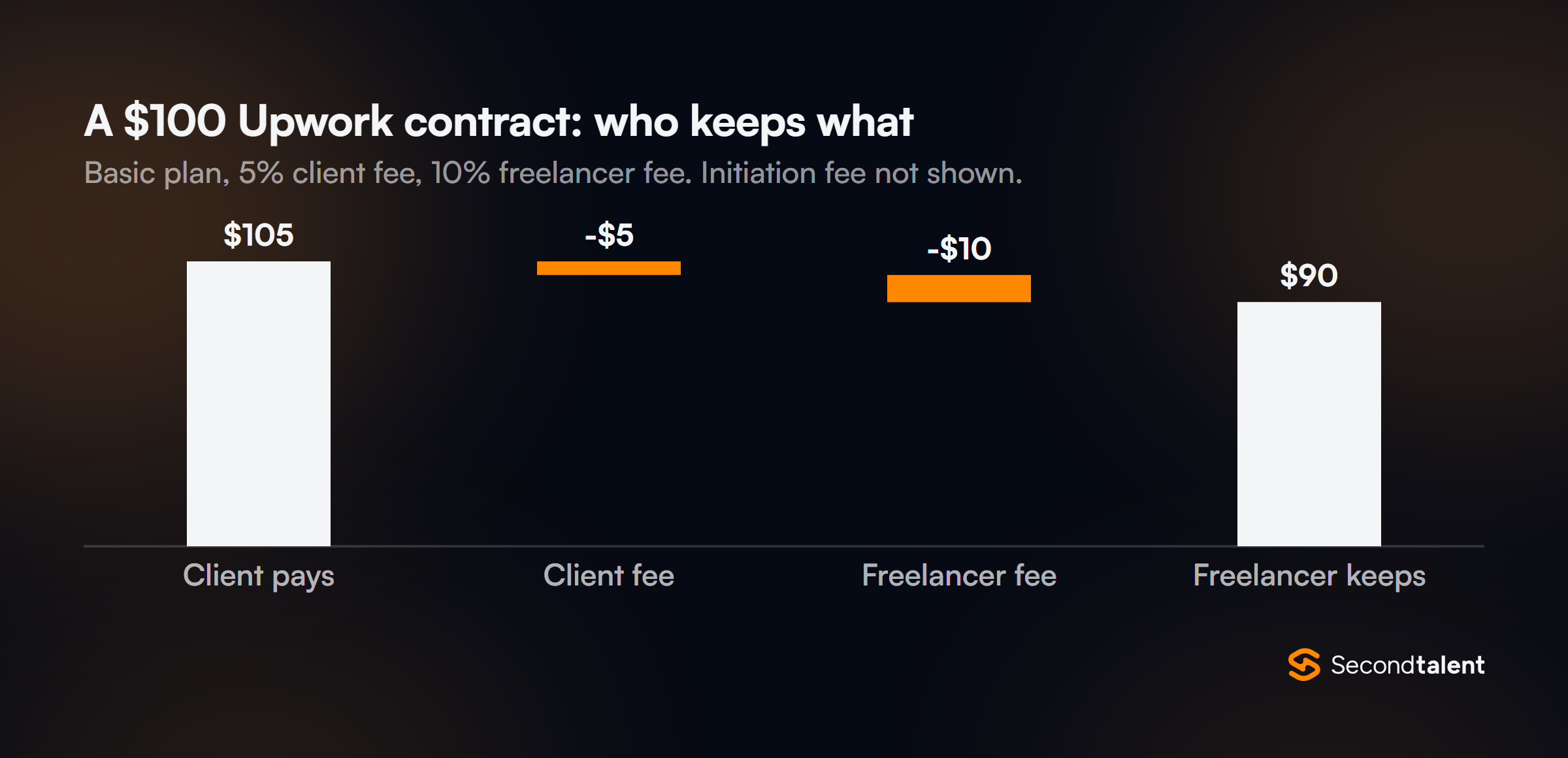
The freelancer fee matters to you as well, because freelancers price it in. Upwork’s help article gives the example: to take home $20 an hour after a 10% fee, a freelancer bills $22.22. Upwork sets the fee per contract, “based on factors that help support a balanced and competitive environment”.
That variable fee is new. Upwork moved from tiered freelancer fees to a flat 10% in 2023, then switched new contracts to a 0% to 15% range in May 2025. Contracts signed before May 2025 keep the flat 10%, according to Upwork’s FY2025 annual report.
Neither company publishes what a developer costs per hour. For market rates by role and region, our freelance developer rate index gives hourly rates for 61 stacks and roles across nine regions, set against US rates.
What happens when a hire does not work out
Toptal takes the first two weeks of risk. Each engagement starts with a trial of up to two weeks. If you are not satisfied, Toptal does not bill you, and it can start a second no-risk trial with another expert. You can trial up to three people for the same position.
Upwork has no trial. Its protection is about payment, not fit. On fixed-price work, money sits in escrow and releases at milestones you approve. Upwork bills hourly work to the client weekly. If a client gets a refund, Upwork returns the freelancer’s service fee on that amount. Ending a contract that is not working is up to you.
That changes who pays for a bad first week. On Toptal, a poor match during the trial costs you time but no invoice. On Upwork, you pay for approved work until you end the contract.
Upwork’s business: fewer clients, more spend each
Upwork is public and reports to the SEC. In 2025 it handled $4.03 billion of GSV and booked $787.8 million of revenue. Active clients fell 6% to 785,000, while GSV per active client rose 7% to $5,129, according to its FY2025 Form 10-K. The filing notes that client counts come from Upwork’s internal tools and no third party verifies them.
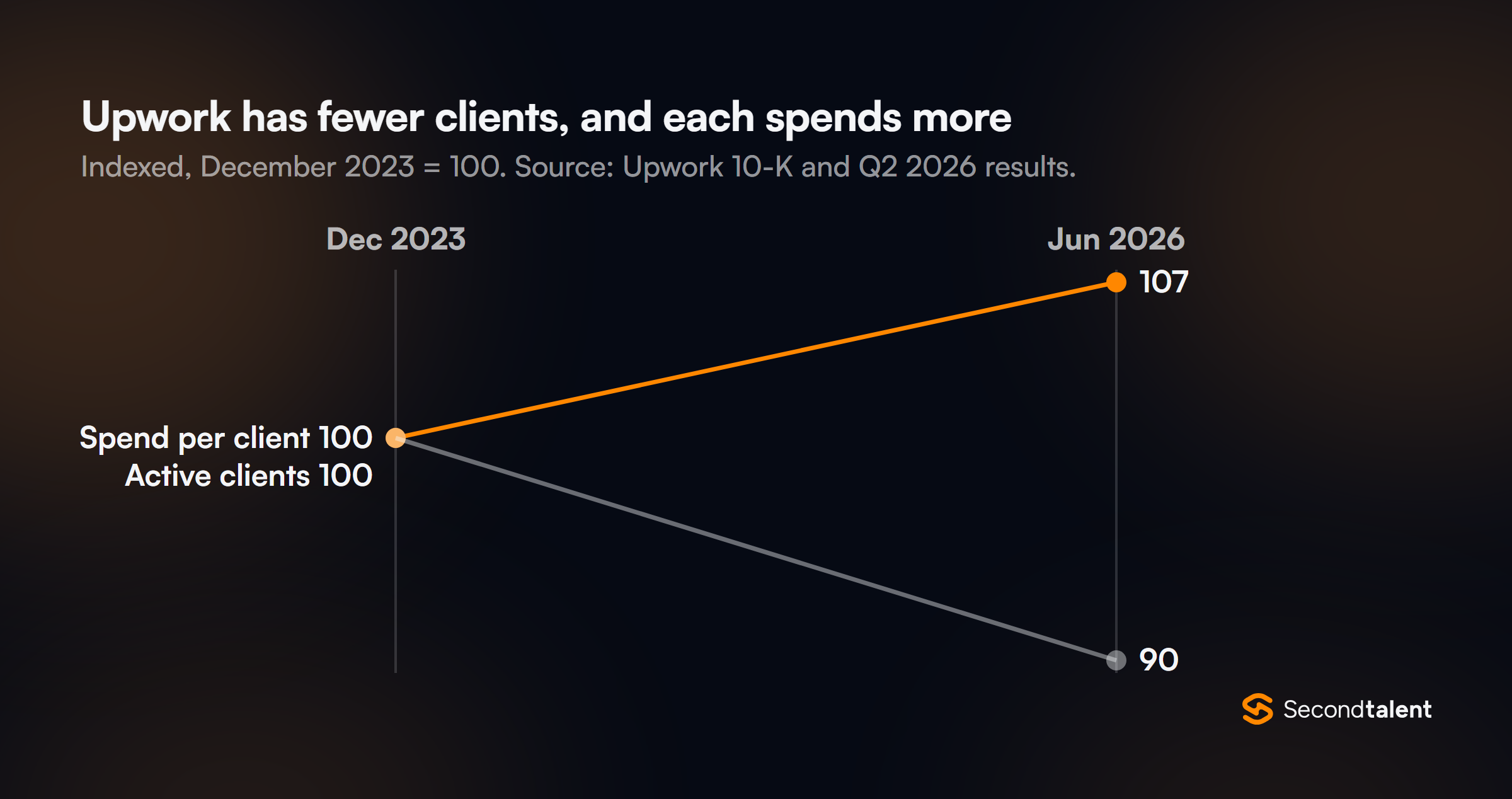
The pattern held into 2026. By June 30, active clients were down to 763,000, and GSV per active client hit a record $5,230. Upwork’s Q2 2026 results guide full-year revenue to $730 million to $750 million, below the 2025 total. Its CEO described the shift in the same release:
“While lower-complexity work continues to shift toward automation, we are increasingly seeing what is emerging in its place: growing demand for high-value AI talent, more complex projects, and new categories of work across SMB and Enterprise.”
Hayden Brown, CEO of Upwork, Q2 2026 results, August 10, 2026
Upwork also keeps more of each dollar that passes through the marketplace. The 10-K credits growth in ads and monetization products, which include Connects, the tokens freelancers buy to send proposals. GSV from AI-related work grew more than 22% in Q2 2026.
Business Plus is also where Upwork now finds new buyers. In Q2 2026, 38% of Business Plus active clients had made their first Upwork purchase on the plan.
Toptal’s business: private, and buying networks
Toptal LLC dates from November 2010, and Taso Du Val is its CEO. It publishes no revenue. Its about page gives running totals instead, all as of 2025:
These counts are cumulative, so they only rise. Do not set them against Upwork’s active client number. Upwork counts a client who spent anything in the past 12 months. Toptal counts all clients since 2010.
Toptal is growing by acquisition. In 2026 it bought QO Collective for management consultants, Adeva for developers, No Single Individual for branding and creative work, and Graphite for finance and strategy consultants. In 2025 it added sales experts and launched HireGlobal for global payroll and compliance.
Contractor or employee: both now sell both
Freelancers on Toptal and Upwork work as contractors. Both companies now also sell the employment layer. HireGlobal offers employer of record contracts and says Toptal has processed more than $5 billion in payroll and payments across 180+ countries. Its “virtual employer of record” model carries $1 million of indemnification per worker.
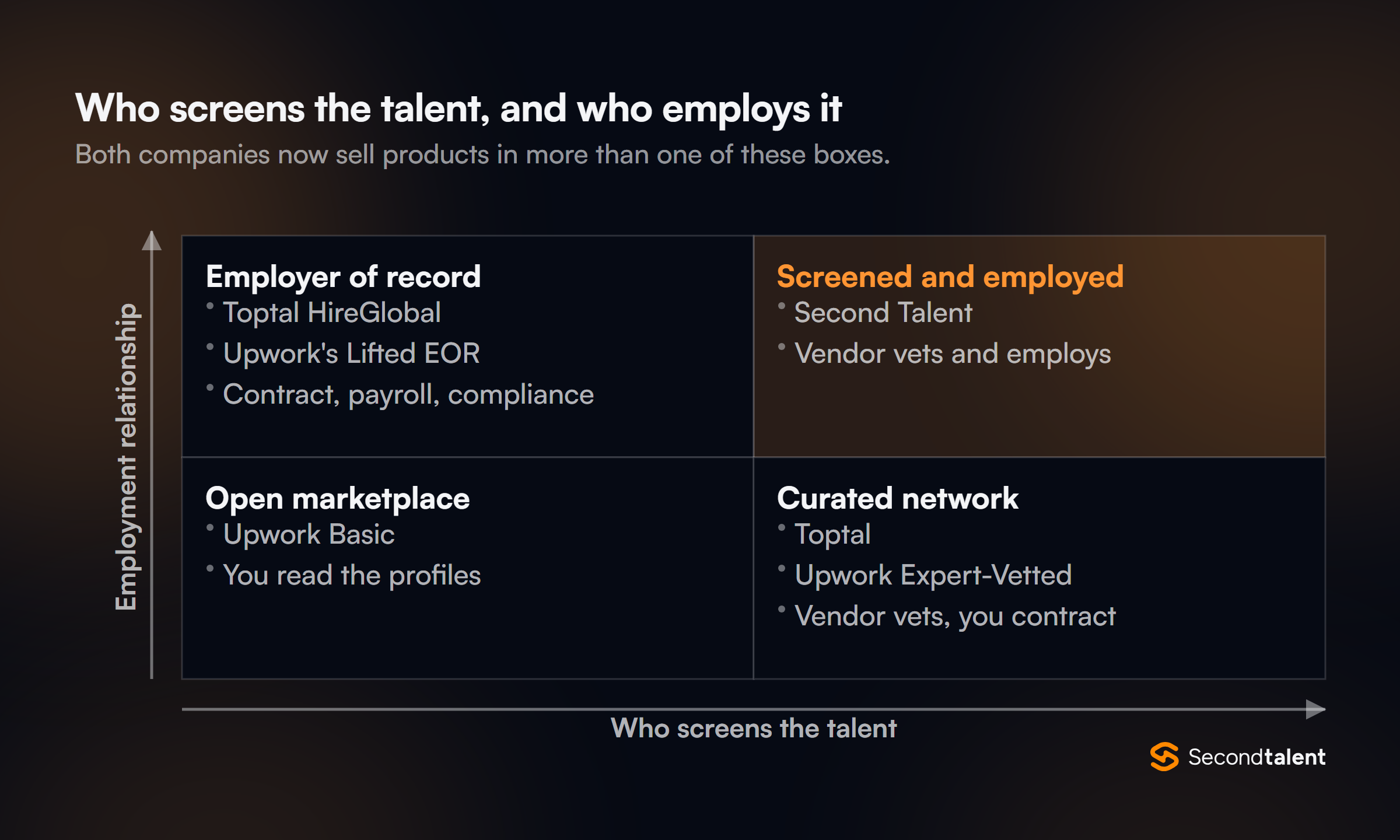
Upwork does it through Lifted, its enterprise arm. Lifted bought Ascen in 2025 to strengthen its employer of record offering, and GSV from that offering rose 29% year on year in Q2 2026. If you are weighing a contractor against an employee in a specific country, our employer of record guides cover the rules market by market.
Full-time engineers in Asia with Second Talent
Toptal and Upwork both leave you with a contractor, or an EOR you set up yourself. Second Talent vets engineers and employs them for you in nine Asian markets: Vietnam, the Philippines, Indonesia, Singapore, Malaysia, Thailand, Hong Kong, Taiwan and China.
The price is a flat $3,000 to $6,000 a month per engineer, all-in, covering sourcing, vetting and our managed EOR.
Our engineers pass four vetting stages: a technical assessment, an AI-native tooling check covering Claude Code, Cursor and Copilot, English at C1 or above, and a behavioural interview.
Search the talent directory yourself or send us a brief. We are engineering first, with a limited non-technical bench in design, sales development, data annotation and operations. Full terms are on our pricing page.
Frequently asked questions
How long does Toptal’s screening take?
Toptal says the full process takes 3 to 8 weeks, and the test project alone runs one to three weeks. That time falls on the applicant, before you see anyone.
How does Toptal bill clients?
Toptal invoices twice a month on Net 10 terms. It accepts major credit cards, ACH, bank wires and PayPal.
Can I pay a freelancer I found elsewhere through Upwork?
Yes. On Business Plus, a direct contract with a freelancer you sourced off Upwork costs $49 a month per active contract.
Related comparisons: Toptal vs Turing · Arc.dev vs Toptal · Revelo vs Toptal