TL;DR: As of July 2026, Chinese AI coding assistants no longer trail Western tools — they trade blows with them. Moonshot's Kimi K3 leads on agentic coding, DeepSeek V4-Pro delivers frontier-class results at roughly a fifth of the price, and four of the five tools here ship open weights you can self-host.
China‘s AI market is projected to grow from $28.18 billion in 2025 to $202 billion by 2032, with coding assistants leading the charge. For CTOs and engineering leads at startups, this means access to frontier-grade AI tooling without frontier-grade budgets.
The gap closed fast. In January 2026 the honest framing was “good enough, much cheaper.” Six months later, Moonshot’s Kimi K3 scores 88.3% on Terminal-Bench 2.1 against GPT-5.6 Sol’s 88.8%, and DeepSeek V4-Pro ties the strongest open-weights entry on SWE-bench Verified. The interesting question is no longer whether these tools are competitive — it is which one fits your stack, your compliance posture, and your budget.
This guide breaks down the top five Chinese AI coding assistants, refreshed with July 2026 benchmark data. You will learn where each one actually leads, what the published numbers do and do not prove, and how licensing and data-residency terms differ between them.
What’s your AI coding priority?
Select your situation below.
DeepSeek V4-Pro runs $0.435 per million input tokens and $0.87 per million output — against $3.00 and $15.00 for Kimi K3, and far below Western frontier rates. Coding-plan seats start at $18-19/month. Our Southeast Asian developers already work in these tools daily. See developer rates →
Your startup needs developers already fluent in Kimi Code, Qoder, and DeepSeek. Vietnam‘s tech talent pool grew 25% in 2024, with engineers trained on these exact tools. Get senior devs at $3,500-5,500/month who hit the ground running. Hire Vietnam developers →
Kimi K3, DeepSeek V4, Qwen3.6-Plus, and GLM-5.2 all ship 1M-token context windows — enough to hold an entire service in memory while refactoring Python, Java, or Go. Pair that with developers who understand your architecture. Find backend specialists →
Kimi K3 tops the Frontend Code Arena, and Qoder handles frontend-backend integration end to end — exactly what full-stack developers need. Philippines full-stack engineers at $3,000-4,500/month already use these tools to ship features faster. Check full-stack costs →
Quick Comparison: Top 5 Chinese AI Coding Assistants
| Tool | Developer | Flagship model (July 2026) | Context | Best for | Pricing |
|---|---|---|---|---|---|
| 1. Kimi Code | Moonshot AI | Kimi K3 / K2.7-Code | 1M | Agentic AI, long-horizon coding | Plans from $19/mo; API $3.00 / $15.00 per 1M |
| 2. DeepSeek | DeepSeek | V4-Pro / V4-Flash | 1M | Frontier results on the lowest budget | API $0.435 / $0.87 per 1M |
| 3. Qoder (ex-Tongyi Lingma) | Alibaba Cloud | Qwen3.6-Plus | 1M | Enterprise IDE, repo-scale agents | Free tier; enterprise plans |
| 4. CodeGeeX / ZCode | Z.ai (ex-Zhipu) | GLM-5.2 | 1M | Open weights, private deployment | Free ZCode app; plans from $18/mo |
| 5. Baidu Comate | Baidu | ERNIE 5.1 | 128K | Multimodal AI IDE, China enterprise | Free basic tier; enterprise licensing |
The July 2026 Benchmark Scoreboard
Two benchmarks matter most for the way engineering teams actually use these tools. SWE-bench Verified measures single-attempt patches against real GitHub issues. Terminal-Bench measures whether a model can drive a real shell through a multi-step task without losing the plot — closer to how an agentic assistant behaves in your repo.
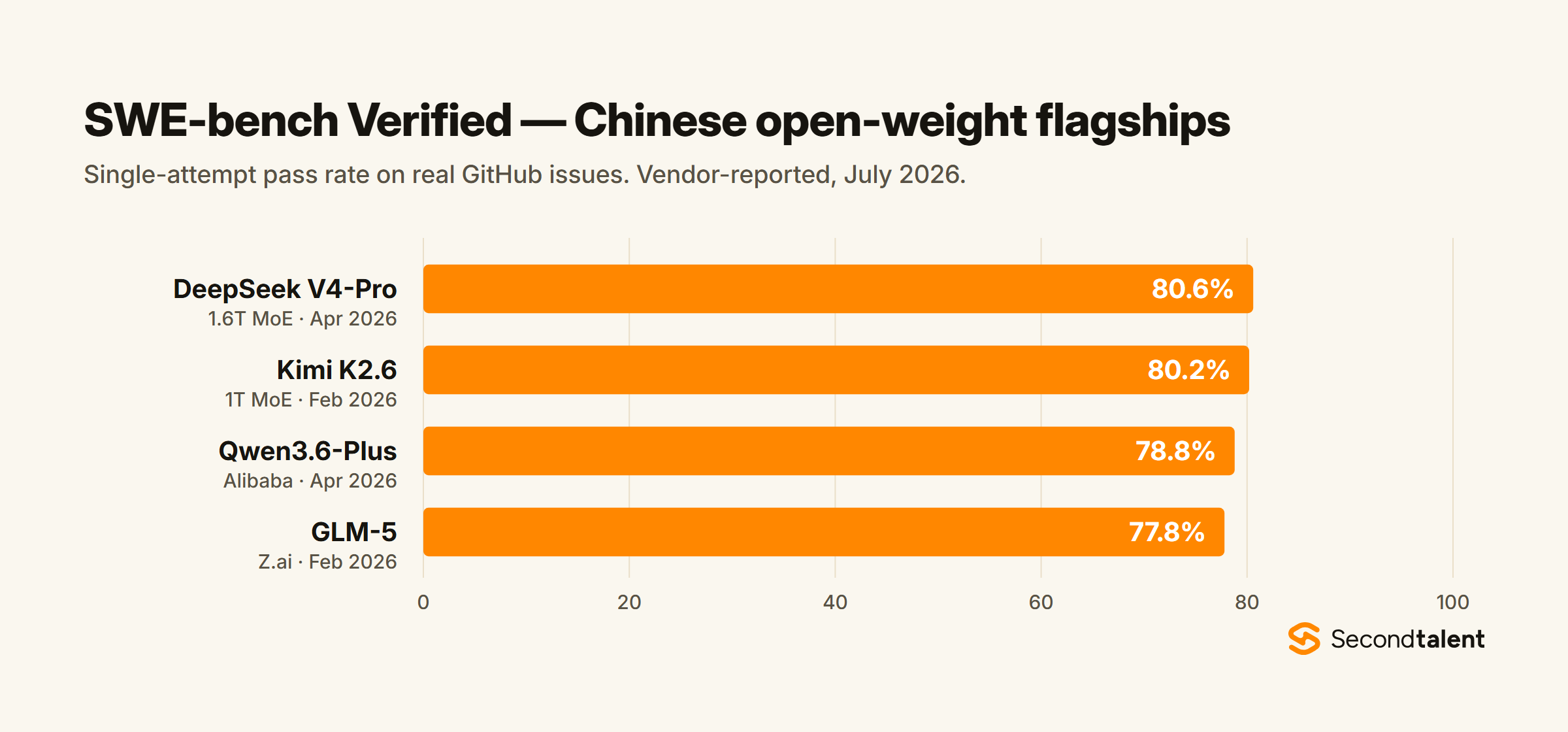
On SWE-bench Verified the four Chinese flagships land within three points of each other, and all four sit within striking distance of Western frontier models. That clustering is the story: code repair is no longer where these tools differentiate.
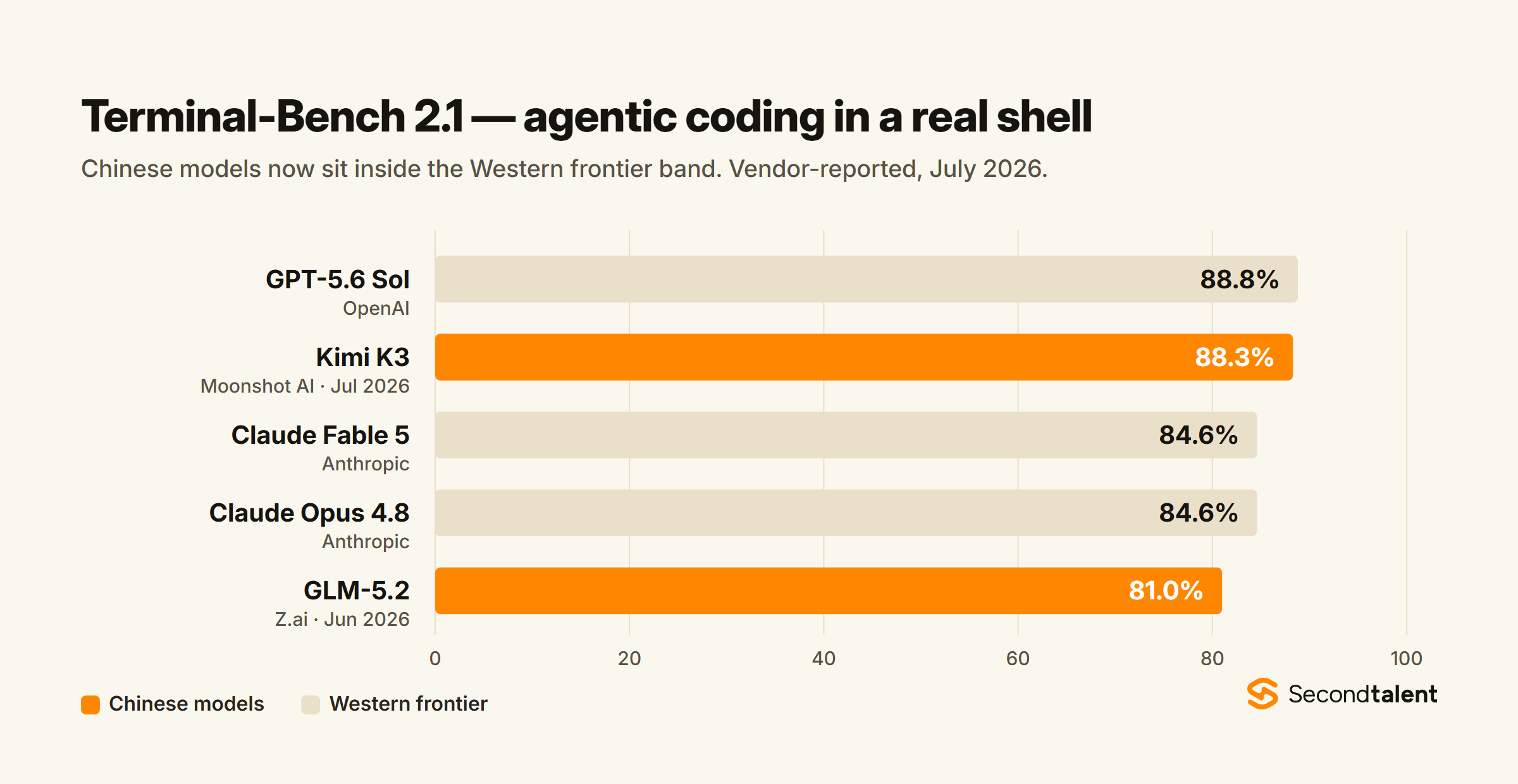
Agentic coding is where the ranking separates. Kimi K3 posts 88.3% on Terminal-Bench 2.1 — half a point behind GPT-5.6 Sol, and ahead of both Claude Fable 5 and Claude Opus 4.8 on the same benchmark. GLM-5.2 follows at 81.0%.
| Model | SWE-bench Verified | SWE-bench Pro | Terminal-Bench | LiveCodeBench |
|---|---|---|---|---|
| Kimi K3 | Not reported | — | 88.3 (v2.1) | — |
| Kimi K2.6 | 80.2 | 58.6 | 66.7 (v2.0) | 89.6 (v6) |
| DeepSeek V4-Pro | 80.6 | — | 67.9 (v2.0) | 93.5 |
| Qwen3.6-Plus | 78.8 | — | 61.6 (v2.0) | — |
| GLM-5.2 | — | 62.1 | 81.0 (v2.1) | — |
| GLM-5 | 77.8 | — | — | — |
| ERNIE 5.1 | Not reported | — | — | — |
Read these numbers with one caveat
An agentic benchmark scores a system, not a model — the prompt, tools, retry logic, timeouts and context management all count. Moonshot reports K3’s 88.3% using its own Kimi Code harness; a rival measured through Claude Code or Codex is not running the same scaffolding. Independent evaluation of K3 on Artificial Analysis’ harness came in around 85% on the same benchmark, a 3.3-point gap from the identical model. Treat every vendor-reported figure as an upper bound and pilot on your own repo before committing.
1. Kimi Code: The Agentic Leader
Moonshot AI, one of the top Chinese AI startups to watch, spent 2026 shipping three consecutive coding-relevant releases — and ended the first half of the year with the strongest agentic coding results of any Chinese lab.

Kimi K3 launched on 16 July 2026: a 2.8-trillion-parameter mixture-of-experts model with 104 billion parameters activated per token, a 1,048,576-token context window, and native text, image and video input. On 27 July, Moonshot released the weights — 96 shards and roughly 1.56 TB on Hugging Face, the largest open-weight release to date.
Coding Benchmarks
- 88.3% on Terminal-Bench 2.1 — ahead of Claude Fable 5 (84.6%) and Claude Opus 4.8 (84.6%)
- 81.2 on FrontierSWE and 77.8 on Program Bench
- 42.0 on SWE Marathon, a multi-hour whole-project engineering benchmark — the highest of any model tested
- #1 on the Frontend Code Arena at 1,679 Elo
- Predecessor Kimi K2.6 holds 80.2% on SWE-bench Verified, 76.7% on SWE-bench Multilingual and 89.6% on LiveCodeBench v6
K3’s weakness is worth naming: it trails on deep repository analysis and the hardest reasoning sets, scoring 67.5 on DeepSWE against GPT-5.6 Sol’s 73.0, and 43.5 on HLE-Full against Claude Fable 5’s 53.3. It is a better agent than it is a reasoner.
K2.7-Code: The Open-Weight Specialist
Released 12 June 2026 under a Modified MIT license, K2.7-Code is the coding-focused sibling built on K2.6’s 1T-parameter architecture with a 256K context window. Moonshot reports a 21.8% jump on its Kimi Code Bench v2 (50.9 → 62.0) and roughly 30% lower reasoning-token usage than K2.6 — a direct cost saving on long agentic runs, where overthinking is expensive. On the third-party MCPMark Verified suite it scores 81.1%, ahead of Claude Opus 4.8’s 76.4%.
Pricing and Access
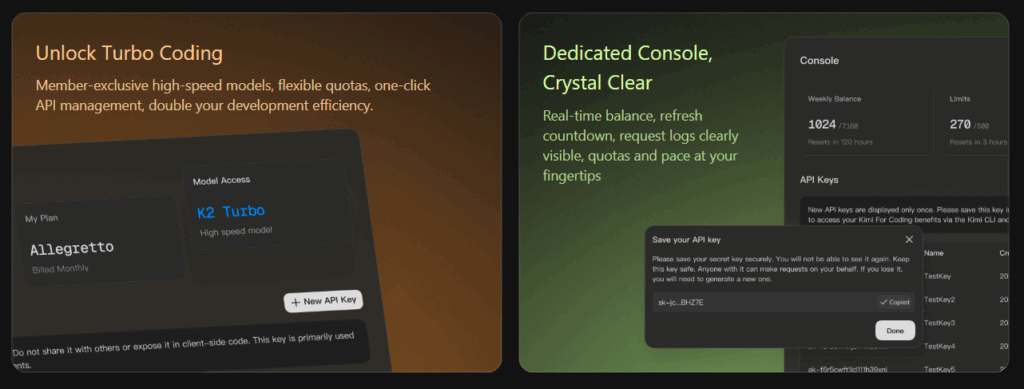
K3’s API runs $3.00 per million input tokens, $0.30 for cached input, and $15.00 per million output — the most expensive option in this guide, and roughly in line with Claude Sonnet 5’s standard rates. The Kimi Code CLI, an open-source TypeScript tool distributed via npm, is bundled with membership tiers: Moderato at $19/month, Allegretto at $39, Allegro at $99, and Vivace at $199 with up to 300-sub-agent parallelism.
Check the K3 license before you ship
Unlike K2.6 and K2.7-Code, which ship under a Modified MIT license, K3’s weights carry a custom Kimi K3 License. It permits use, modification, distribution and commercial sale — but a model-as-a-service business earning over $20 million in any 12-month period needs a separate agreement, and products with more than 100 million monthly users must credit Kimi K3 on screen. For most teams this is a non-issue; for anyone reselling inference, it is a legal review item.
2. DeepSeek: Frontier Results, Lowest Cost
DeepSeek remains the value leader among Chinese open-source LLMs. DeepSeek V4, released 24 April 2026, comes in two sizes: V4-Pro at 1.6 trillion total parameters with 49 billion active per token, and V4-Flash at 284 billion total with 13 billion active.
Key Features
- 80.6% on SWE-bench Verified — the joint-highest open-weights result
- 93.5% on LiveCodeBench, the strongest figure in this guide
- 67.9% on Terminal-Bench 2.0, and a 3,206 Codeforces rating
- 1M-token input context with up to 384K tokens of output
- Open weights on Hugging Face under a permissive license allowing self-hosting, fine-tuning and commercial use
- Trained on Huawei Ascend 950 chips and Cambricon accelerators rather than Nvidia GPUs
The earlier DeepSeek-Coder line, still MIT-licensed and still in wide use, supports 338 programming languages — expanded from the original 86 — and remains a sensible lightweight option for teams that only need completion and explanation rather than a full agent.
Pricing Structure
DeepSeek continues to set the floor on price. V4 costs $0.435 per million input tokens, $0.87 per million output, and $0.003625 per million on a cache hit — rates DeepSeek made permanent on 22 May 2026. That is roughly one-seventh of Kimi K3’s input price and a small fraction of Western frontier rates, for a model within a point of the best open-weights SWE-bench score. According to DeepSeek’s official documentation, the free web interface at chat.deepseek.com remains unlimited for individual use.
IDE Integration
DeepSeek ships no first-party IDE. It integrates through third-party extensions such as ContinueDev, Cline and Roo Code, and its OpenAI-compatible API makes custom setups straightforward. That is the trade: the lowest cost per token in exchange for assembling your own harness.
3. Qoder (formerly Tongyi Lingma): The Enterprise IDE
Alibaba Cloud made headlines by inducting Tongyi Lingma as the company’s first AI employee, complete with an official employee ID (AI001). That assistant has since grown into Qoder, a full agentic IDE built on a Visual Studio Code fork. It drew over 100,000 users in its first five days and passed 5 million users globally by mid-2026, making it one of the fastest-growing agentic coding tools anywhere.
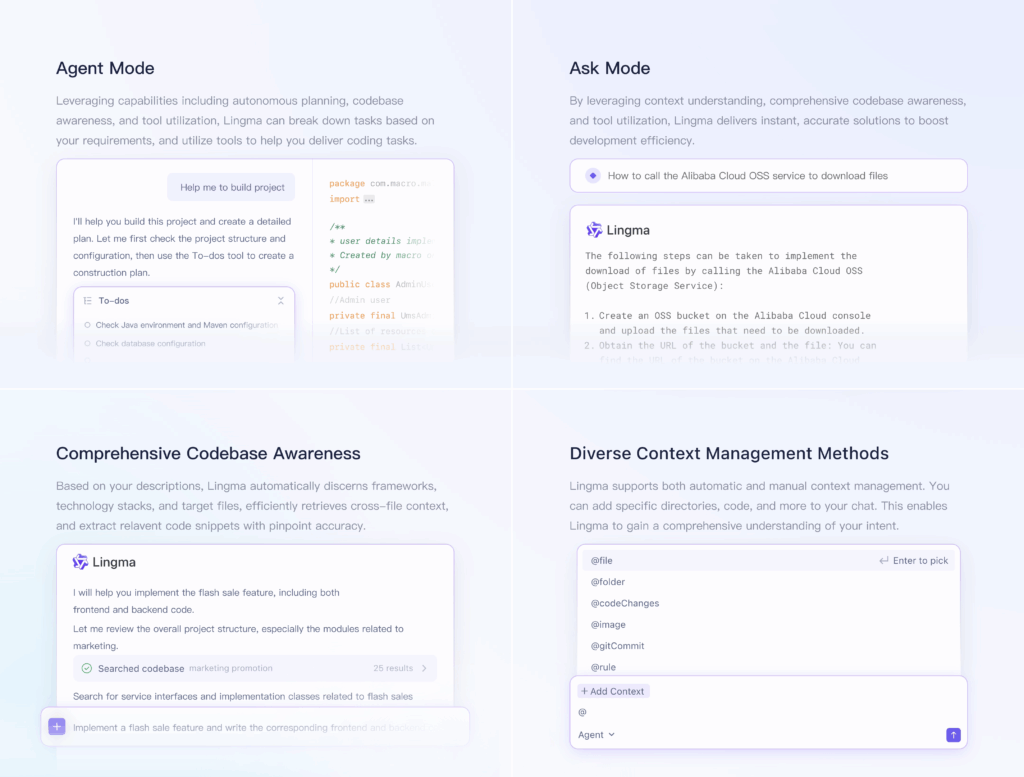
The engine is Qwen3.6-Plus, released April 2026 with a 1-million-token context window by default and multimodal vision input, built specifically for repository-scale agent workflows.
Benchmarks and Agentic Capabilities
- 78.8% on SWE-bench Verified, within roughly two points of Claude Opus 4.5
- 61.6 on Terminal-Bench 2.0, ahead of Claude Opus 4.5’s 59.3 on the same version
- Autonomous planning: it sets objectives, decomposes them into tasks, edits across files, and adjusts as execution results come back
- Comprehensive codebase awareness with both automatic and manual context management
For teams that want to run locally, Qwen3.6-35B-A3B — released 16 April 2026 — scores 73.4 on SWE-bench Verified and runs on a 24GB Mac with GGUF quantization. The wider Qwen ecosystem passed 200,000 derivative models by January 2026, and Qwen-based coding models have surpassed 20 million downloads.
Teams already on Alibaba Cloud infrastructure get the tightest integration, and the original Lingma VS Code extension remains available for those who prefer not to switch editors.
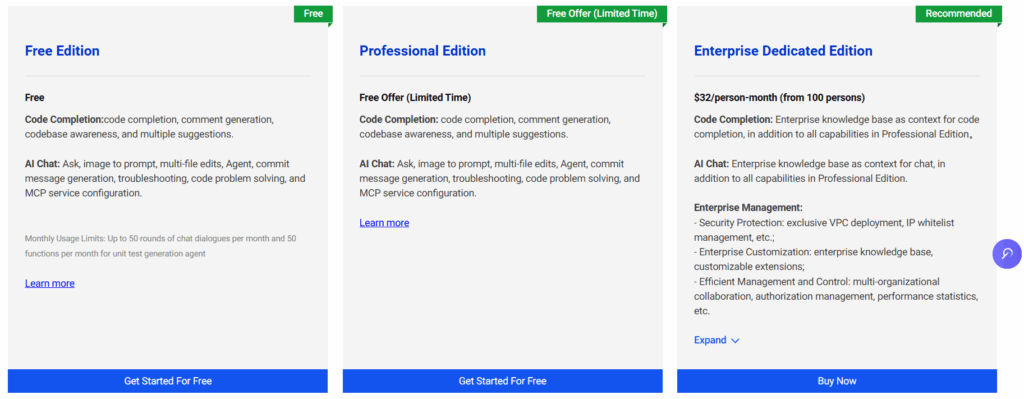
Pricing Structure:
4. CodeGeeX and ZCode: Open Weights, Self-Hosted
Zhipu AI now trades as Z.ai, and its coding story has three layers: the long-running CodeGeeX editor extension, the new ZCode desktop app, and the GLM model family underneath both.
GLM-5.2, released 13 June 2026, is a 753-billion-parameter mixture-of-experts model with roughly 40 billion active per token, a 1M-token context window, up to 131,072 tokens of output, and MIT-licensed weights on Hugging Face. It is the strongest open-weights model on standard coding benchmarks.
- 62.1 on SWE-bench Pro, beating GPT-5.5’s 58.6
- 81.0 on Terminal-Bench 2.1, second only to Kimi K3 among Chinese models
- 77.0 on MCP-Atlas for tool use; 51 on the Artificial Analysis Intelligence Index v4.1, leading all open-weights entries
- Predecessor GLM-5 scored 77.8% on SWE-bench Verified, trained on 28.5 trillion tokens using a domestic cluster of 100,000 Huawei Ascend chips
ZCode and the CodeGeeX Extension
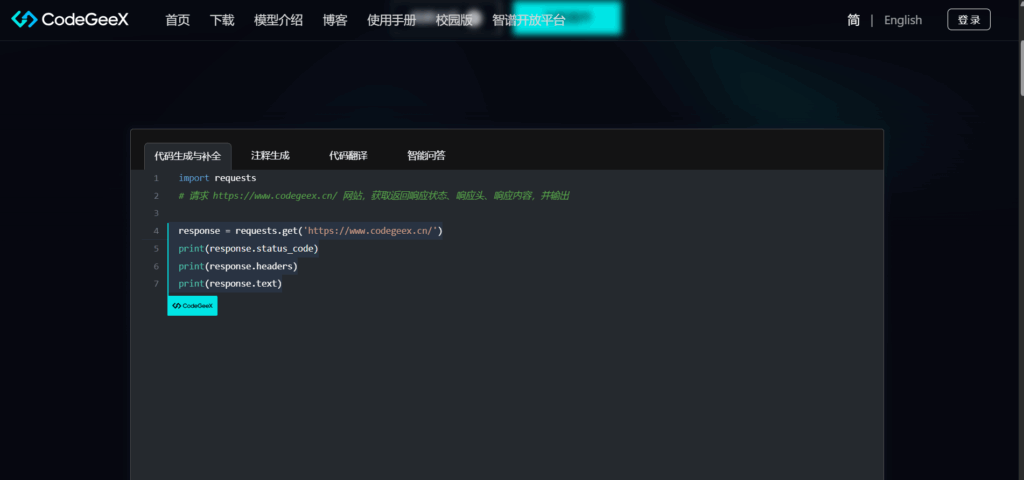
On 2 July 2026, Z.ai launched ZCode, a free desktop “agentic development environment” built around GLM-5.2. The older CodeGeeX VS Code extension remains the lightweight entry point, offering several interaction modes:
- Stealth Mode: Automatic code generation when you stop typing
- Interactive Mode: Press Ctrl+Enter to generate multiple candidates in a side panel
- Translation Mode: Select code and press Ctrl+Alt+T to translate between programming languages
- Prompt Mode: Use predefined or custom templates for specialized code generation
GLM-5.2 also works out of the box with eight third-party coding agents including Claude Code, Cline, Roo Code, OpenCode, Goose, Crush and Kilo Code — so you can keep your existing workflow and swap only the model.

Pricing and Private Deployment
The GLM Coding Plan runs from $18/month for Lite, $72 for Pro and $160 for Max, with a Team tier above that. Metered API access is $1.40 per million input tokens, $4.40 per million output and $0.26 cached. Because the weights are MIT-licensed, security-conscious organisations can skip the API entirely and self-host — the clearest path to data sovereignty of any tool in this guide.
5. Baidu Comate: The Multimodal AI IDE
Baidu was first in China to launch a large language model and led the way with its AI coding tool Comate in June 2023. Today, over 43% of Baidu’s internal code is generated by Comate, with nearly 90% of its programmers actively using the tool — and roughly a third less development time on key services.

Comate now runs on ERNIE 5.1, announced 8 May 2026 and rolled out at Baidu’s Create 2026 conference. It is a sparse mixture-of-experts model with roughly one-third the total parameters and half the active parameters of ERNIE 5.0, a 128K context window and up to 65,536 tokens of output. It ranked #4 globally on the LMArena Search Arena at 1,223 — first among Chinese models — and hit 99.6% on AIME26 with tools. API pricing through Qianfan is $0.59 per million input tokens and $2.65 per million output.
Be clear-eyed about the trade-off: Baidu does not publish competitive SWE-bench or Terminal-Bench results, and ERNIE 5.1 is optimised for search-augmented, bilingual and reasoning workloads rather than coding leaderboards. Comate earns its place on product breadth and China-market enterprise fit, not benchmark position.
Comate AI IDE Features
- Design-to-code conversion with one click
- Multimodal input — text, voice, images and diagrams
- MCP (Model Context Protocol) support for enhanced integrations
- A swarm of specialised agents that plan, write, test and document code collaboratively
- Support for 100+ programming languages, optimised for Go, Java, Python, JavaScript, C/C++ and TypeScript
The Zulu Agent
Comate’s most forward-looking capability is Zulu, an intelligent agent designed to automate programming. Zulu performs autonomous task planning, invokes tools like code search and command line execution, and adjusts based on execution results.
IDE Support
Comate supports Visual Studio Code (1.70+), all JetBrains IDEs (2021.1+) including IntelliJ IDEA, PyCharm, GoLand, WebStorm, CLion, PhpStorm and Android Studio, plus Xcode and Visual Studio. That coverage is the widest here, and for startups hiring AI developers, familiarity with tools like Comate is increasingly valuable.
Feature Comparison
| Feature | Kimi Code | DeepSeek | Qoder | CodeGeeX / ZCode | Baidu Comate |
|---|---|---|---|---|---|
| Context Window | 1M (K3) | 1M | 1M | 1M | 128K |
| Open Weights | Yes (K3 custom license; K2.7 Modified MIT) | Yes (permissive) | Yes (Qwen open models) | Yes (MIT) | No |
| Agentic Mode | Yes (Kimi Code CLI) | Via third-party agents | Yes (Qoder IDE) | Yes (ZCode) | Yes (Zulu) |
| Multimodal | Yes (text, image, video) | No | Yes (vision) | Limited | Yes |
| Private Deploy | Yes | Yes | Enterprise / open models | Yes | Enterprise only |
| Free Tier | Yes | Yes | Yes | Yes | Yes |
| First-party IDE / CLI | Kimi Code CLI | None | Qoder IDE | ZCode + CodeGeeX ext | Comate AI IDE |
| JetBrains Support | Via API | Via third-party | Yes | Yes | Official |
How to Choose the Right Tool for Your Team
Choose Kimi If:
- Long-horizon agentic tasks are your primary use case — multi-hour refactors, not autocomplete
- You want the strongest terminal-agent and frontend results available from a Chinese lab
- You can absorb the highest per-token price in this guide, or you prefer a flat monthly plan
- You are not reselling inference at scale (check the K3 license terms first)
Choose DeepSeek If:
- Cost per token is the binding constraint and you want frontier-class quality anyway
- Your workload is code repair and generation more than multi-step agent runs
- You are comfortable assembling your own harness from third-party extensions
- You want reasoning explanations alongside code fixes
Choose Qoder If:
- You want a finished agentic IDE rather than an extension plus a model
- Your organisation already runs on Alibaba Cloud infrastructure
- You need enterprise support and SLAs behind the tooling
- A locally-runnable fallback model matters to you
Choose CodeGeeX / ZCode If:
- Data sovereignty and private deployment are non-negotiable — MIT weights, no strings
- You want the strongest open-weights coding model without licence review
- You would rather keep Claude Code or Cline and swap only the model underneath
- Your team needs code translation between programming languages
Choose Baidu Comate If:
- Multimodal capabilities like design-to-code matter more than benchmark position
- Your workflow spans JetBrains, VS Code, Xcode and Visual Studio
- You operate primarily in the China market and want the deepest local enterprise support
- Autonomous task planning appeals to your development process
One compliance question to settle first
Calling any of these models through their vendor API means your prompts — and therefore your source code — transit servers governed by Chinese data law. For most side projects that is irrelevant; for regulated workloads or customer code it is a blocker. Four of the five tools here publish open weights precisely so you can avoid the question: self-host DeepSeek V4, GLM-5.2, Kimi K2.7-Code or a Qwen model on your own infrastructure and nothing leaves your network. Decide which side of that line your codebase sits on before you pick a tool.
The Future of Chinese AI Coding Tools
The competitive dynamics in China’s AI market have produced remarkable innovation. According to Gartner, by 2028, 75% of enterprise software engineers will use AI code assistants, up from less than 10% in early 2023.
Four trends shaped the first half of 2026, and all four look set to continue:
- Open weights reached parity. GLM-5.2 leads open-weights coding benchmarks outright, and Kimi K3’s 1.56 TB release is the largest open-weight drop in history. The best model you can self-host is now within a few points of the best model you can rent.
- Context windows standardised at 1M. Kimi K3, DeepSeek V4, Qwen3.6-Plus and GLM-5.2 all ship million-token windows — repository-scale context is table stakes, not a differentiator.
- Benchmarks moved to agents. SWE-bench Verified is saturating around 80%. The labs now compete on Terminal-Bench, SWE Marathon and MCP tool-use suites — which also makes results harder to compare, since the harness counts as much as the model.
- Domestic silicon matured. DeepSeek V4 trained on Huawei Ascend 950 and Cambricon accelerators; GLM-5 on a 100,000-chip Ascend cluster. Export controls have stopped being the ceiling everyone assumed they would be.
For technical leaders evaluating their AI strategy, Chinese coding assistants have moved from “worth watching” to “worth benchmarking against your incumbent.” The combination of competitive pricing, genuinely open weights and rapid iteration makes a pilot low-risk.
Getting Started
Every tool in this guide offers a free tier or free entry point, making evaluation straightforward:
- Kimi: Chat free at kimi.com, or get API access at platform.moonshot.ai; the Kimi Code CLI installs from npm
- DeepSeek: Visit chat.deepseek.com for free web access, or pull the weights from Hugging Face
- Qoder: Download the IDE from qoder.com, or install the Lingma VS Code extension
- ZCode / CodeGeeX: Get the free ZCode app at z.ai, or the extension from the VS Code Marketplace
- Baidu Comate: Download from comate.baidu.com
Start with a pilot on a repository you know well — vendor benchmarks will not tell you how a model handles your conventions. Most teams find different tools excel at different tasks, and a multi-tool strategy often proves optimal.
Conclusion
Chinese AI coding assistants have matured from cheap alternatives into genuine contenders. Kimi leads on agentic, long-horizon coding and now ships the largest open-weight model in existence. DeepSeek delivers near-identical code-repair accuracy at a fraction of the price. Qoder packages Alibaba’s models into the most complete enterprise IDE. Z.ai’s GLM-5.2 is the strongest model you can self-host under MIT. Baidu Comate covers the widest range of editors and leads on multimodal, design-to-code workflows.
For startups and scaling companies, these tools represent an opportunity to accelerate development without proportional budget increases — provided you settle the data-residency question first and pilot on your own code rather than trusting a vendor’s harness.
Hire vetted remote AI developers with Second Talent to build AI-powered applications and integrate cutting-edge coding assistants into your development workflow.

![Singapore AI Companies Leading Southeast Asia. Top 10 Singapore AI Companies Leading Southeast Asia [2026], by Second Talent.](https://www.secondtalent.com/wp-content/uploads/2026/09/singapore-ai-companies-featured-v2-768x403.jpg)
![AI Recruiting Tools. Top 7 AI Recruiting Tools in 2026 [Tried & Tested], by Second Talent.](https://www.secondtalent.com/wp-content/uploads/2026/09/top-ai-recruiting-tools-featured-v2-768x403.jpg)