TL;DR: Toptal is still a talent network: it accepts fewer than 3% of applicants, introduces candidates within 24 hours and does not bill a trial of up to two weeks if you are unhappy. Turing’s website now leads with training data and domain experts for AI labs, plus agents for enterprises, while its older hiring pages still promise engineers in 4 days. Pick Toptal to hire a vetted contractor, and Turing when the work is AI training or an embedded AI team.
Turing’s main menu no longer mentions hiring developers. It reads Frontier AI, Enterprise AI, Research, Resources and Experts, and its services page claims work for 9 of 9 frontier labs.
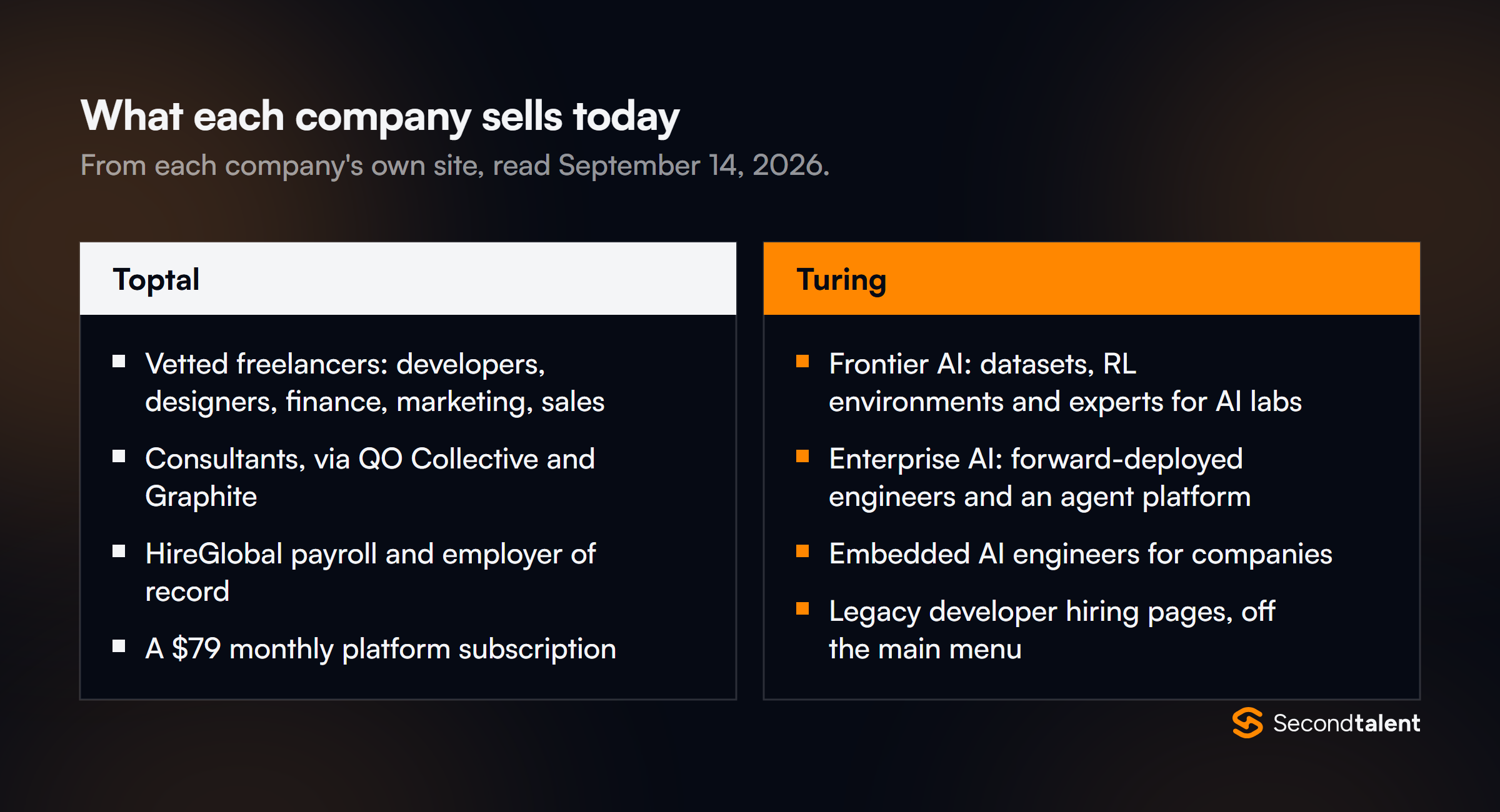
Toptal went the other way in 2026, buying four vetted talent networks: QO Collective, Adeva, No Single Individual and Graphite. Both still place talent, but they now chase different budgets.
- 1Turing raised a $111 million Series E at a $2.2 billion valuation in March 2025, bringing its total funding to $225 million.
- 2Toptal says 90% of its clients hire the first candidate it introduces. Turing’s hiring pages claim a 97% engagement success rate.
- 3Neither company publishes hourly rates. Toptal adds a $79 monthly subscription once you go ahead with matching.
- 4Turing’s own pages disagree on its trial: 21 days in its page titles, 14 days in the FAQ of its Python hiring page.
Toptal or Turing: which fits your hire?
Choose Toptal for one senior contractor in a common software, design or finance role. Screening and matching are its whole business, and its trial terms sit in one public FAQ.
Choose Turing when the work is AI itself: post-training data, model evaluation, or agents built by engineers who have done that work for AI labs. Turing still takes requests for developers, but its site treats that as a side door.
The figures below come from the companies’ own websites, and neither lists a rate card. For the wider field, see our Toptal alternatives and Turing alternatives pages.
| Toptal | Turing | |
|---|---|---|
| Main business | Curated network of freelance talent | Training data and experts for AI labs; agents for enterprises |
| Who gets in | Fewer than 3% of 200,000+ yearly applicants | “The top 1% of 3 million+ engineers who have applied” |
| Speed claim | Candidates within 24 hours; a developer hired in about 48 hours | 4 days to fill most roles; profiles “in as little as 72 hours” |
| Trial | Up to two weeks, not billed if you are unhappy | 21 days on its hiring page titles; 14 days in one FAQ |
| Success claim | 98% trial-to-hire rate | 97% engagement success rate |
| Published fees | $79 a month subscription; rates quoted on a call | None |
| Network claim | 3,600,000+ applications since 2010 | 5M+ expert pool |
| Funding disclosed | Not published | $225 million raised; $2.2 billion valuation in 2025 |
| Employment option | HireGlobal employer of record | None listed on its site |
What Turing sells now: data for AI labs first
Turing calls itself “an AGI infrastructure company specializing in post-training large language models” in the FAQ on its jobs page. Its services page splits the business in two.
- Frontier AI sells datasets, reinforcement learning (RL) environments and domain experts to AI labs, for software engineering, knowledge work and science.
- Enterprise AI sells forward-deployed engineers plus the Turing Intelligence Platform, which Turing’s enterprise page calls “the AI control plane for enterprise agents”.
Toptal’s product list reads like a staffing company that keeps adding job families. Turing’s reads like a data vendor that also staffs.
The open roles on Turing’s expert sign-up page show where the work is. They include a Chemistry Domain Reviewer, a Cardiology Clinical Reviewer and a Senior Software Engineer for LLM evaluation, and each job rates or corrects AI output.
In April 2026 Turing launched Turing Frontier to connect AI labs with those experts.
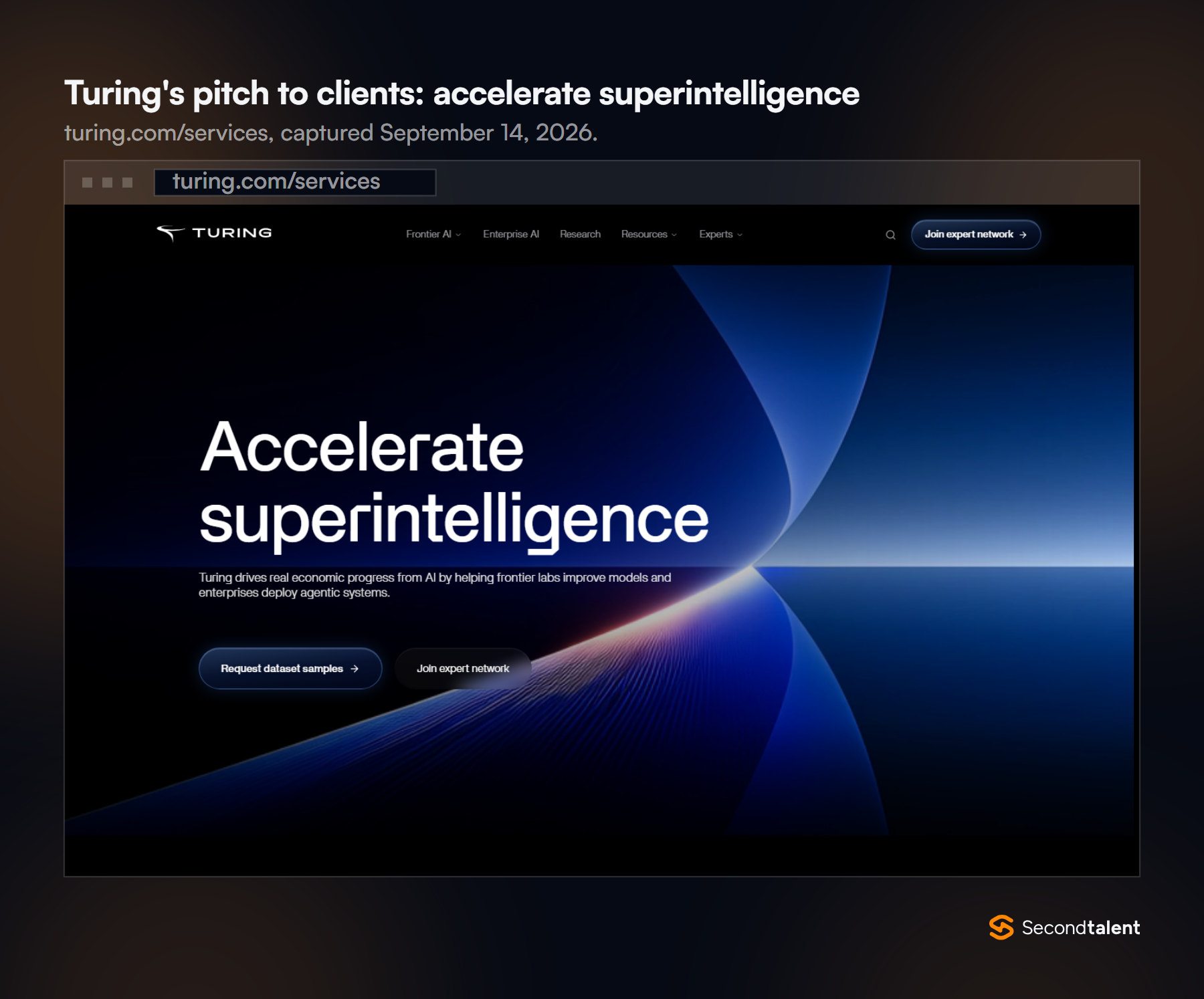
The old turing.com/hire-developers address now opens that homepage. Developer hiring has moved off the menu rather than closed. Turing’s AI engineer hiring page is still live, and none of the main menu headings points to it.
Its “Hire AI engineers now” button leads to a talent request page. That page promises “pre-vetted engineer profiles in as little as 72 hours” and “a no-risk trial to ensure fit”, for engineers who join your team.
Toptal vetting: five stages, fewer than 3% accepted
Toptal says more than 200,000 people apply to its network each year. The first stage cuts hardest: only 26.4% of applicants pass the English and personality interview, according to Toptal’s screening process page.
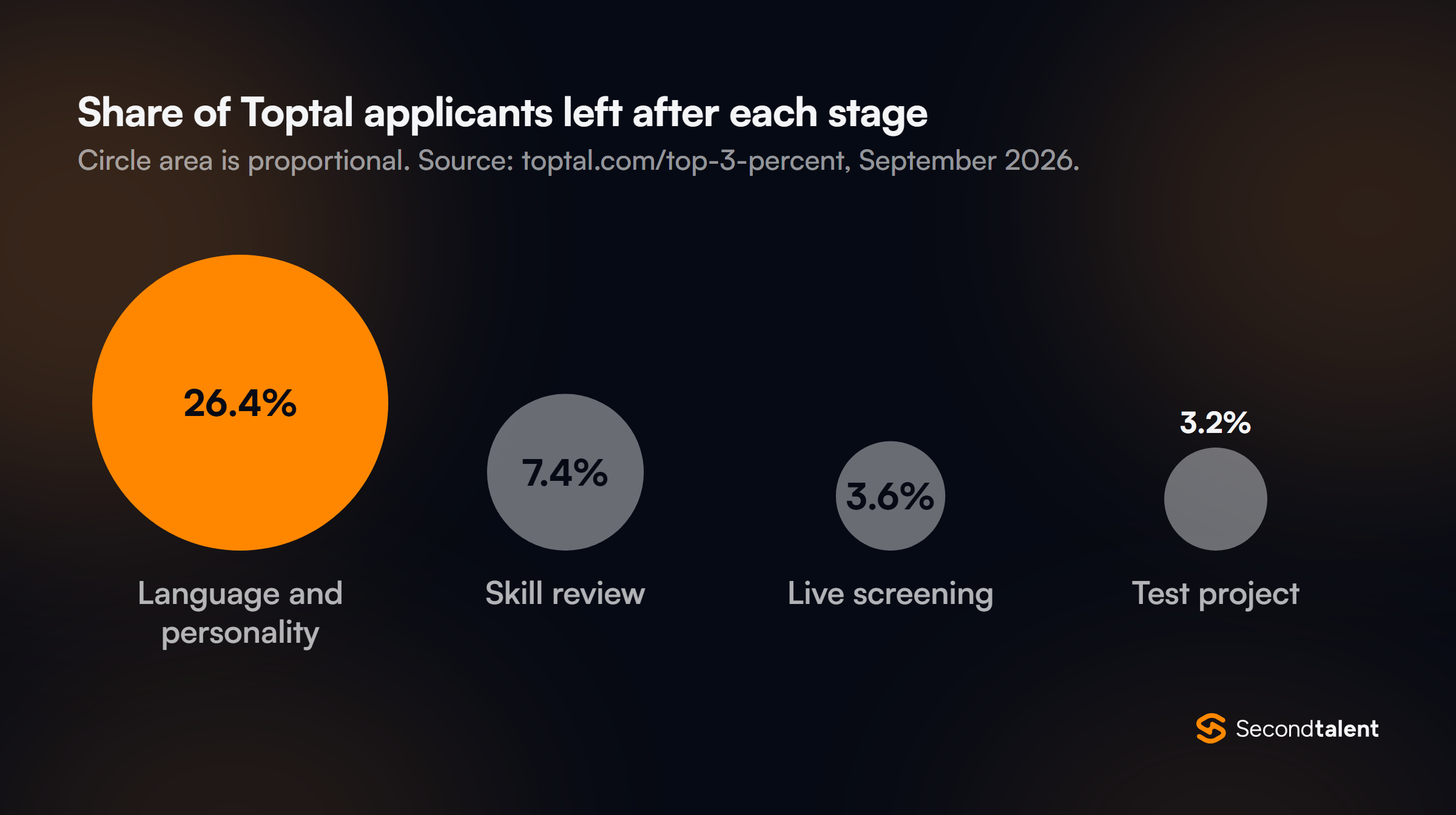
The skill review leaves 7.4%. A live interview with a screener from the candidate’s own field leaves 3.6%, and a test project of one to three weeks leaves 3.2%.
The fifth stage has no end date: members stay only while their client work holds up.
For clients, the screening shows up as speed. Toptal’s client FAQ and developer hiring page make four claims about matching:
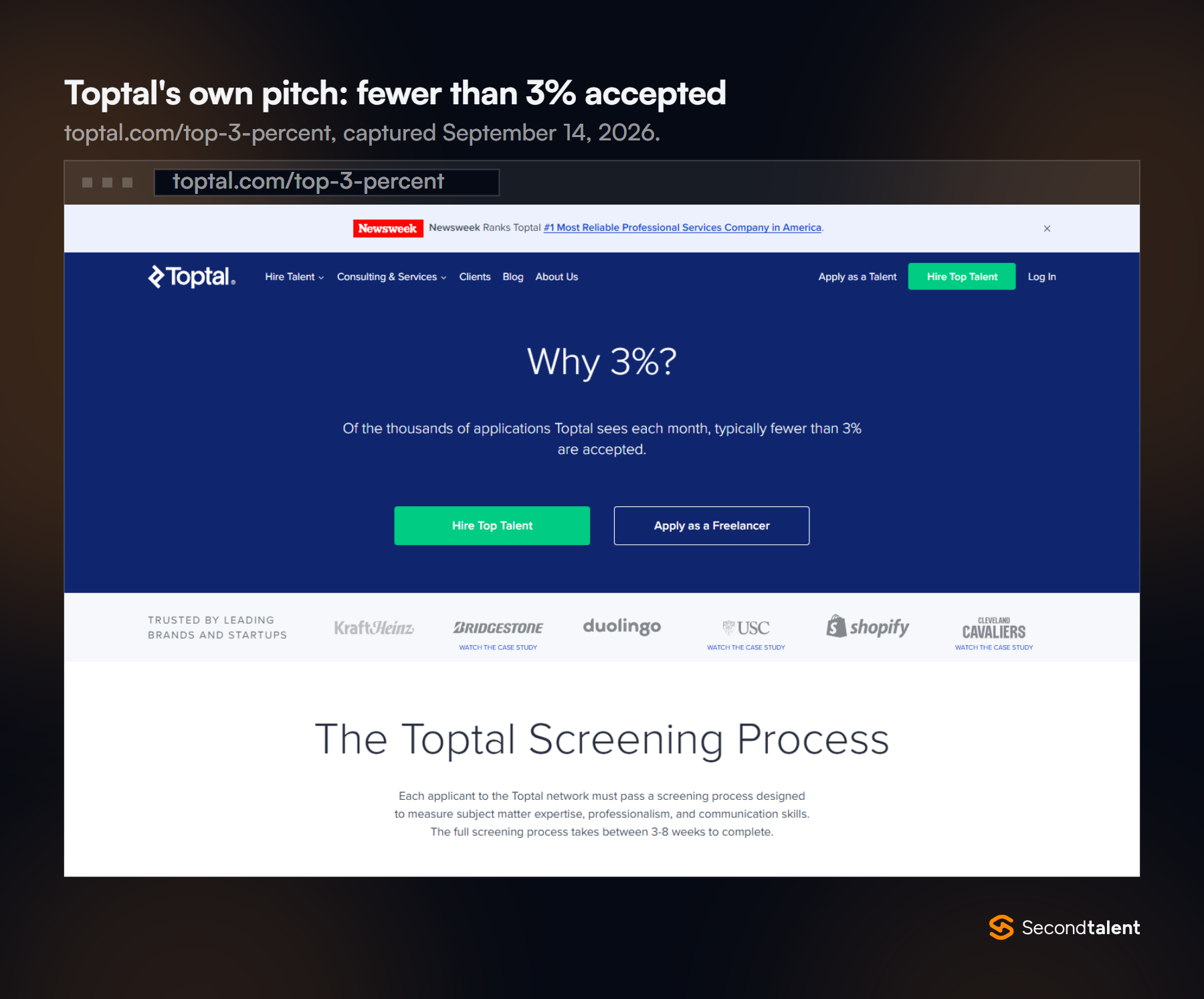
Toptal is privately held, so no outside auditor checks the pass rates or the trial-to-hire rate. Its pitch page puts the headline claim in one line:
How Turing vets engineers and domain experts
Turing runs two screens. For embedded AI talent, “every candidate is screened via technical challenges, peer interviews, and proprietary AI models”, per its AI talent page. It publishes no pass rate for any stage.
Domain experts for lab projects go through a different gate. Each one clears an adaptive AI video interview built around their background, plus identity, KYC and anti-money-laundering checks, according to Turing’s experts page.
Speed is the selling point there. In the case study on that page, a frontier lab asked for experts across more than 30 domains. Turing says it delivered 1,700+ vetted experts in under 48 hours, from a Wednesday afternoon request to Friday.
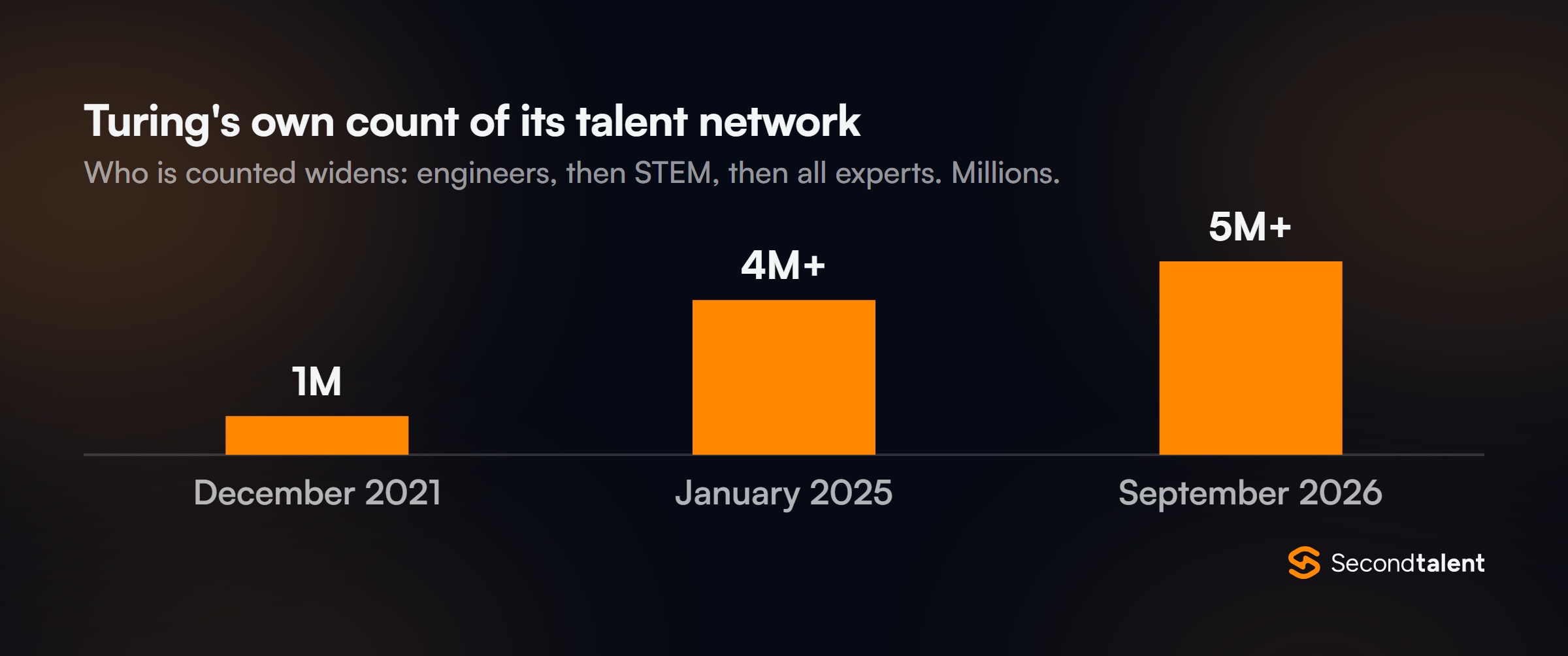
The count keeps rising, and so does the range of people it covers. In December 2021 Turing told TechCrunch its pool had reached 1 million engineers and developers.
A January 2025 release counted 4 million+ developers, data scientists, STEM and math professionals. The experts page now says 5M+, across 250+ domains.
Trials, speed and success rates side by side
Toptal spells out what its no-risk trial means. If you are not completely satisfied, it does not bill you, and it can start a second no-risk trial with another expert.
Turing’s hiring pages promise a risk-free trial but, on the pages we read, do not say how billing works when one fails.
- Trial of up to two weeks, not billed if you are not satisfied
- Up to three people trialled per position
- 98% of trials turn into a hire
- 90% of clients hire the first candidate
- 3-week risk-free trial in the page hero; 14-day in one FAQ
- 4 days to fill most roles
- 97% engagement success rate, undefined
- 50+ hours of interviewing saved per developer
The length of Turing’s trial is unclear too. The AI engineers page offers a 3-week trial at the top and 21 days in its page title.
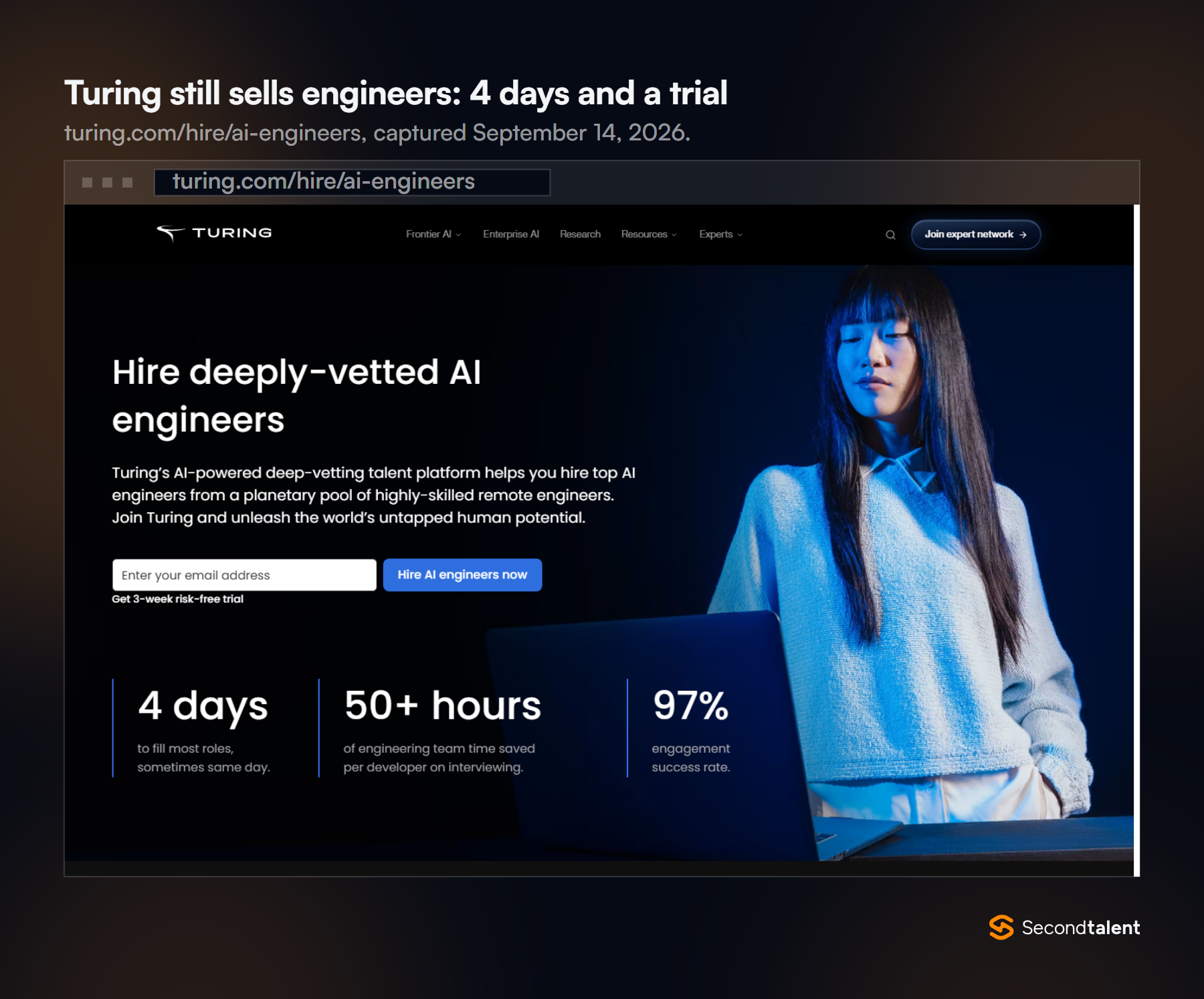
The Python developers page shows the same 3 weeks in its hero, then offers “a 14-day, risk-free trial period” in its FAQ. Get the trial length and the refund terms in writing before a contract starts.
The two success rates measure different things: Toptal’s 98% counts trials that become hires, while Turing does not define its 97%.
Pricing: neither company publishes a rate
Toptal’s pricing overview says clients work with talent “hourly, part-, or full- time for a fixed price on a weekly basis”. You get that price on a call.
The one published fee is a $79 monthly subscription, charged once you go ahead with matching.
You can cancel the subscription at any time and ask for a refund if Toptal cannot find you talent. Toptal invoices twice a month on Net 10 terms.
Turing publishes less: its AI engineers page says it offers engineers “at half the price” without saying half of what, and the Python page promises “unbeatable prices”.
Enterprise AI work starts with a scoping call with a forward-deployed engineering lead. Frontier AI work starts with a request for dataset samples.
Neither company gives you a number to budget with. For hourly market rates by stack and region, use our freelance developer rate index. For full-time AI hires in Asia, see our page on hiring AI engineers.
Turing the business: funded for AI data
CEO Jonathan Siddharth launched Turing in 2018, and it is now based in San Francisco. Its newsroom shows the money following the AI work:
A SAFE turns into shares later, so the 2021 SAFE valuation of $4 billion is not a priced round like the $2.2 billion Series E. TechCrunch reported that investors priced the Series E when the run rate stood at $167 million.
Turing’s Series E post puts total funding at $225 million.
The same post named three uses for the money: AI lab work, enterprise AI systems and talent. On talent, Turing wrote:
“We’re reinvesting in a core pillar of Turing’s origins: connecting world-class engineering talent with the AI companies and enterprise businesses shaping the future.”
Turing, Series E announcement
One figure conflicts with that total. Turing’s expert sign-up page says “$300M+ raised from top VCs”. Its newsroom lists no funding release after the Series E, so the gap has no public explanation.
Toptal the business: private and buying networks
Toptal publishes no revenue and no funding figures. Its about page gives running totals instead, all as of 2025: 35,000+ clients served, 91,000+ engagements and talent in 155+ countries.
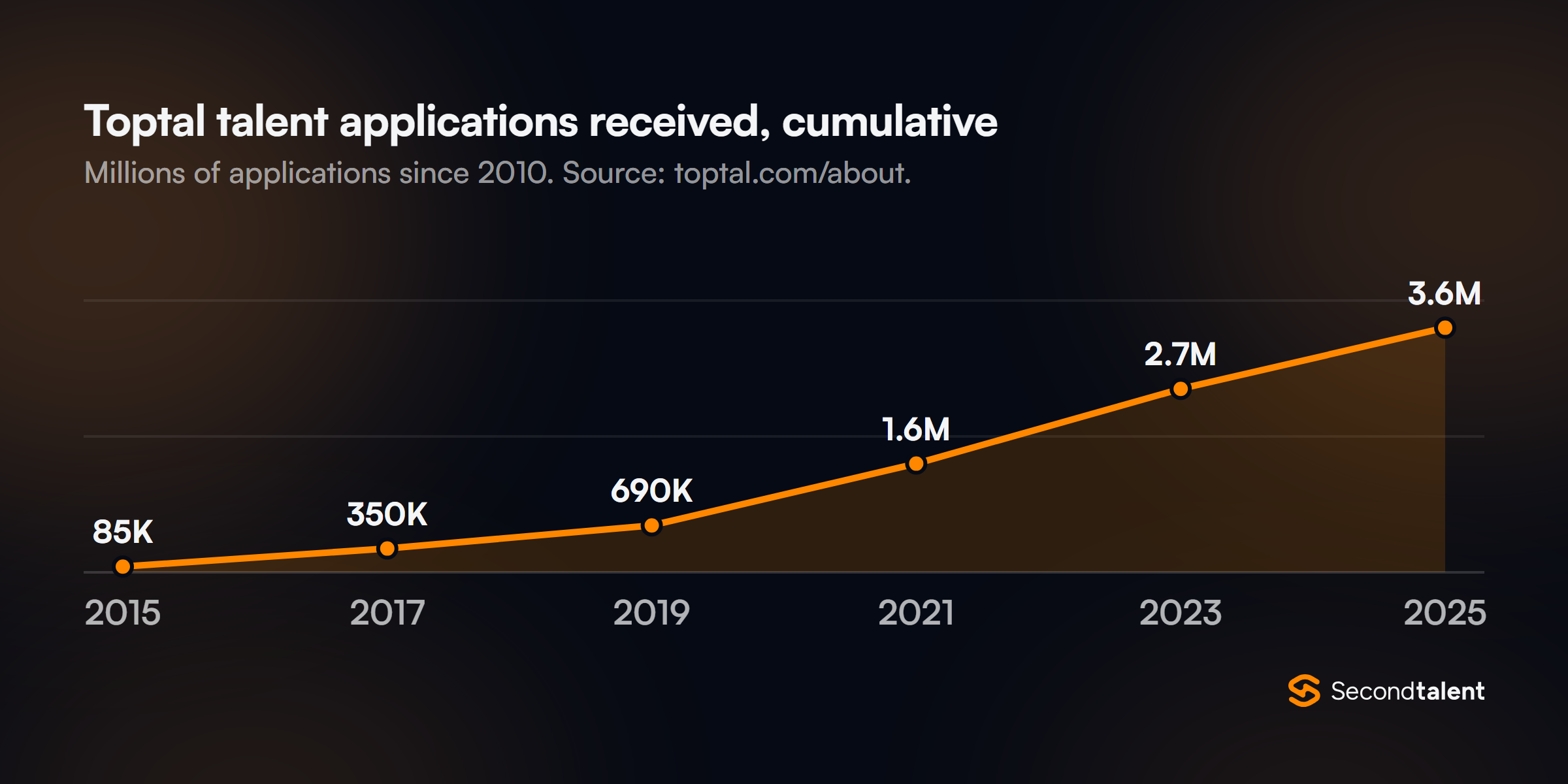
On Toptal’s own totals, cumulative applications more than doubled between 2021 and 2025. Clients served rose from 18,000+ to 35,000+ over the same years.
Growth also comes from buying. In 2026 Toptal bought QO Collective for management consultants, Adeva for developers, No Single Individual for branding and creative work, and Graphite for finance and strategy consultants.
In 2025 it added sales experts and launched HireGlobal.
HireGlobal runs payroll and employer of record contracts. Toptal says it has processed more than $5 billion in payroll and payments across 180+ countries since 2010.
Its “virtual employer of record” model carries $1 million of indemnification per worker. Turing lists no employment product. For country rules, our employer of record guides go market by market.
Full-time engineers in Asia with Second Talent
Toptal and Turing both hand you a contractor or a project team. Second Talent vets engineers and employs them for you in nine Asian markets: Vietnam, the Philippines, Indonesia, Singapore, Malaysia, Thailand, Hong Kong, Taiwan and China.
One flat price of $3,000 to $6,000 a month per engineer covers sourcing, vetting and our managed EOR.
Our engineers pass four vetting stages: a technical assessment, an AI-native tooling check on Claude Code, Cursor and Copilot, English at C1 or above, and a behavioural interview.
Search the talent directory yourself or send us a brief. We are engineering first, with a limited non-technical bench in design, sales development, data annotation and operations.
For work closer to Turing’s lab projects, see our AI training specialists. Terms are on our pricing page.
Frequently asked questions
How long does Toptal’s screening take?
Toptal says the full process takes 3 to 8 weeks. That time falls on the applicant, before any client sees them.
Who runs Turing?
Jonathan Siddharth, who launched Turing in 2018, is CEO. Turing’s newsroom also names Ece Kamar as Chief Technology Officer and Robin Bordoli as President and Global Chief Revenue Officer.
What payment methods does Toptal accept?
Toptal accepts all major credit cards, ACH, bank wires and PayPal.
Related comparisons: Toptal vs Upwork · Turing vs Arc.dev · Arc.dev vs Toptal · Revelo vs Toptal · Toptal alternatives · Turing alternatives