
TL;DR: Taiwan runs four separate employer contributions across three different salary ceilings, which is why a single percentage never describes it well. Budget 17.7% on top of gross at a mid-level salary and about 13.7% on a senior one. The labour pension at 6% is the largest single line and caps highest, so the burden falls less here than in most of the region. The minimum wage rose to NT$29,500 a month on 1 January 2026, and a supplementary health premium on bonuses catches employers who model salary alone.
We employ staff in Taiwan through our own entity, so these are the numbers we run every month. This guide covers what you owe across all four schemes, what your employee takes home, and the two costs that sit outside a simple percentage of salary.
Key takeaways
- Budget 17.7% at mid-level pay and about 13.7% on senior packages. Four schemes, three different ceilings.
- The 6% labour pension is the largest line and caps at NT$150,000, so the burden falls less here than elsewhere in the region.
- Bonuses above four times monthly insured salary attract a supplementary health premium of about 2.11%.
- Severance is capped at six months, a regional outlier, because the pension is funded monthly instead.
- The minimum wage rose to NT$29,500 on 1 January 2026, which also lifts the lowest insured salary bands.
What Employing Someone in Taiwan Costs
Budget about 17.7% on top of gross salary at mid-level pay. That covers labour insurance, employment insurance, national health insurance and the labour pension, plus two small levies.
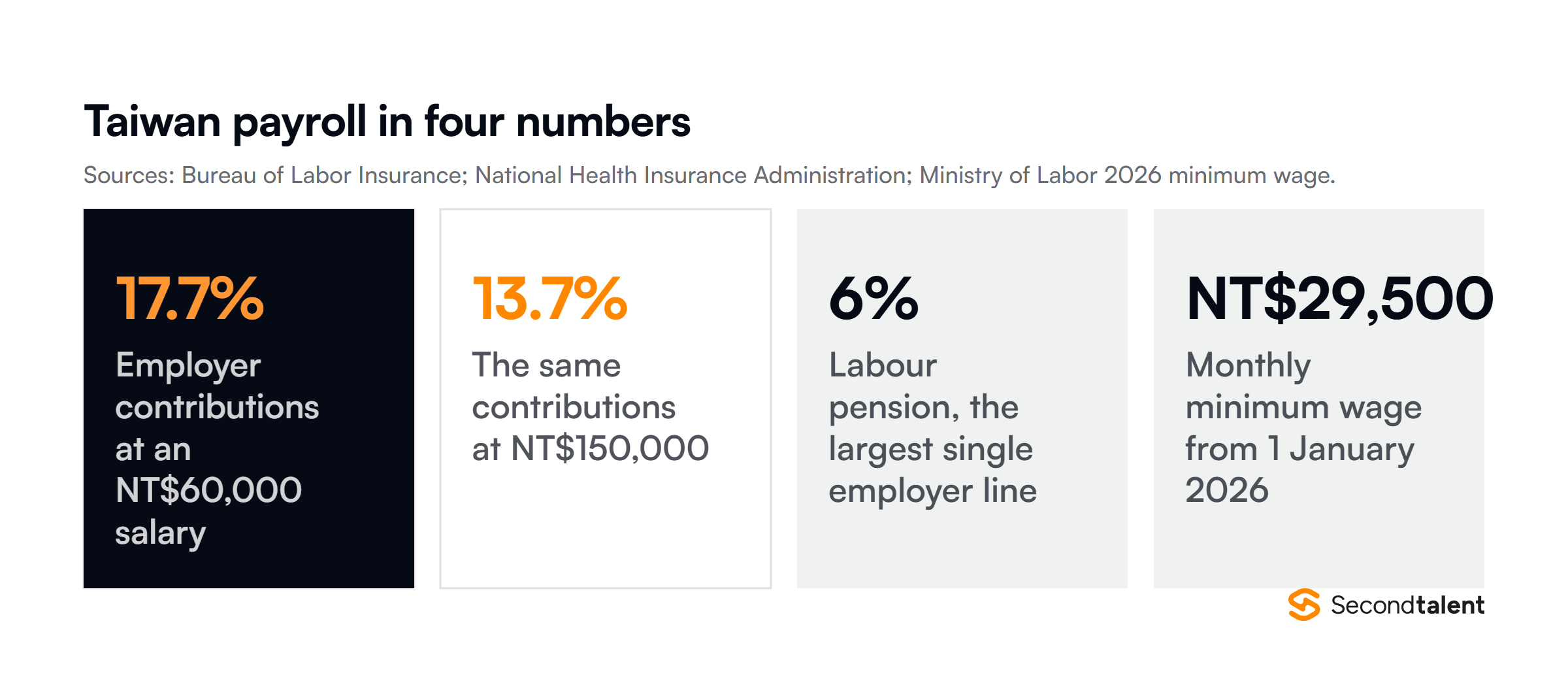
The reason a single figure misleads is that each scheme uses a different ceiling. Labour insurance stops at NT$45,800 of insured salary, the pension at NT$150,000 and health insurance far higher again.
So the mix shifts as salary rises rather than the total simply collapsing. The pension becomes the dominant line, and because it caps high it keeps growing where labour insurance stopped long ago.
Four Schemes, Three Ceilings
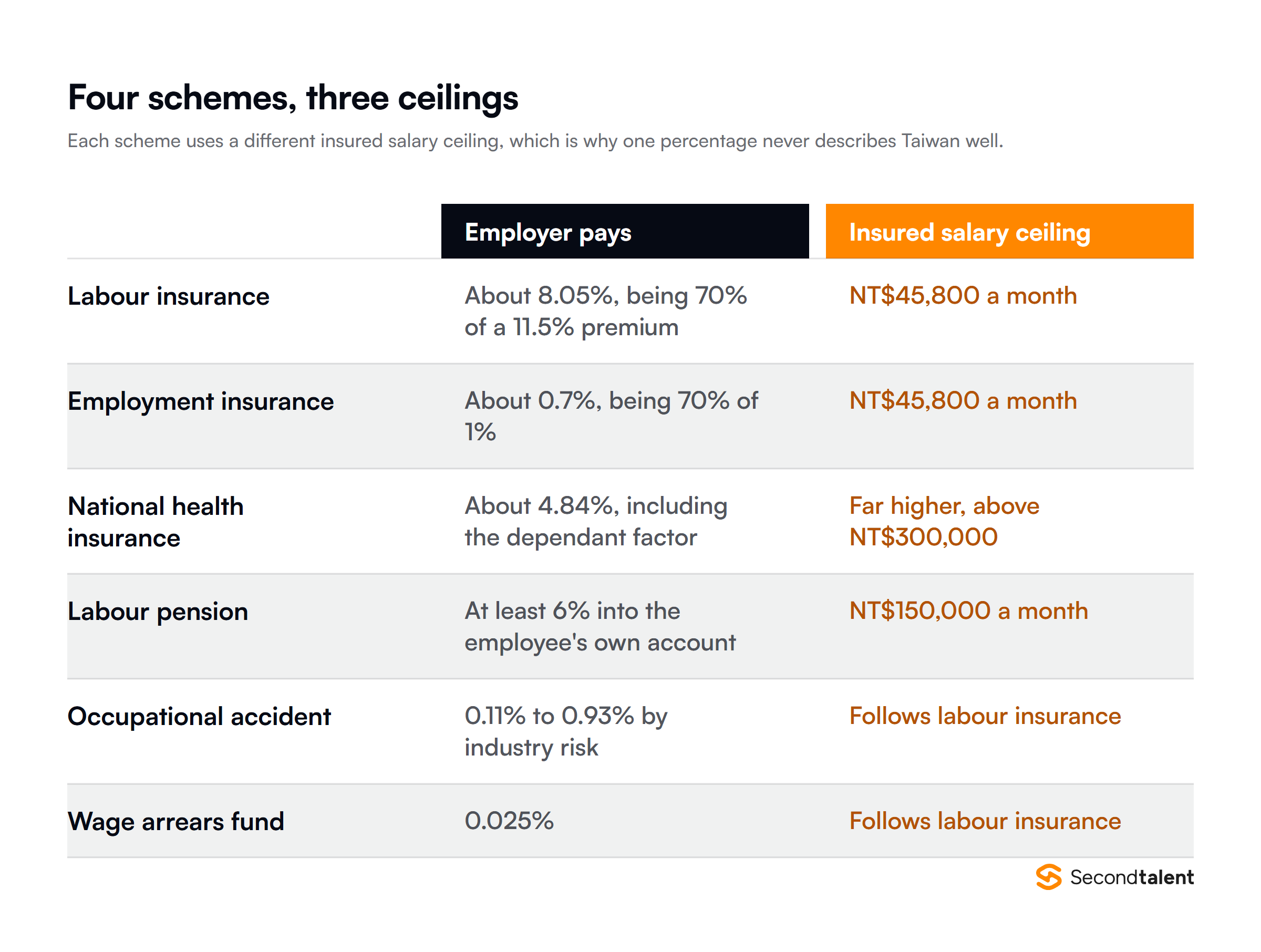
Labour insurance and employment insurance are split three ways: the employer pays 70%, the employee 20% and the government 10%. Health insurance splits 60%, 30% and 10% on the same principle.
The employer’s health insurance figure includes an average dependant factor, which is why it lands near 4.84% rather than the 60% share of the 5.17% headline rate. The premium rate held at 5.17% for 2026.
The labour pension is different in kind. It is a defined contribution of at least 6% into the employee’s individual account, and the employee may add up to 6% voluntarily from their own pay.
Bonuses attract a supplementary health premium
Where bonuses in a year exceed four times the employee’s monthly insured salary, a supplementary national health insurance premium of about 2.11% applies to the excess. A model built on twelve monthly salaries will understate the cost of any package with a meaningful bonus component.
What a Hire Actually Costs
Two worked examples for a single employed resident taking the standard deductions, at a low-risk employer, excluding bonuses.
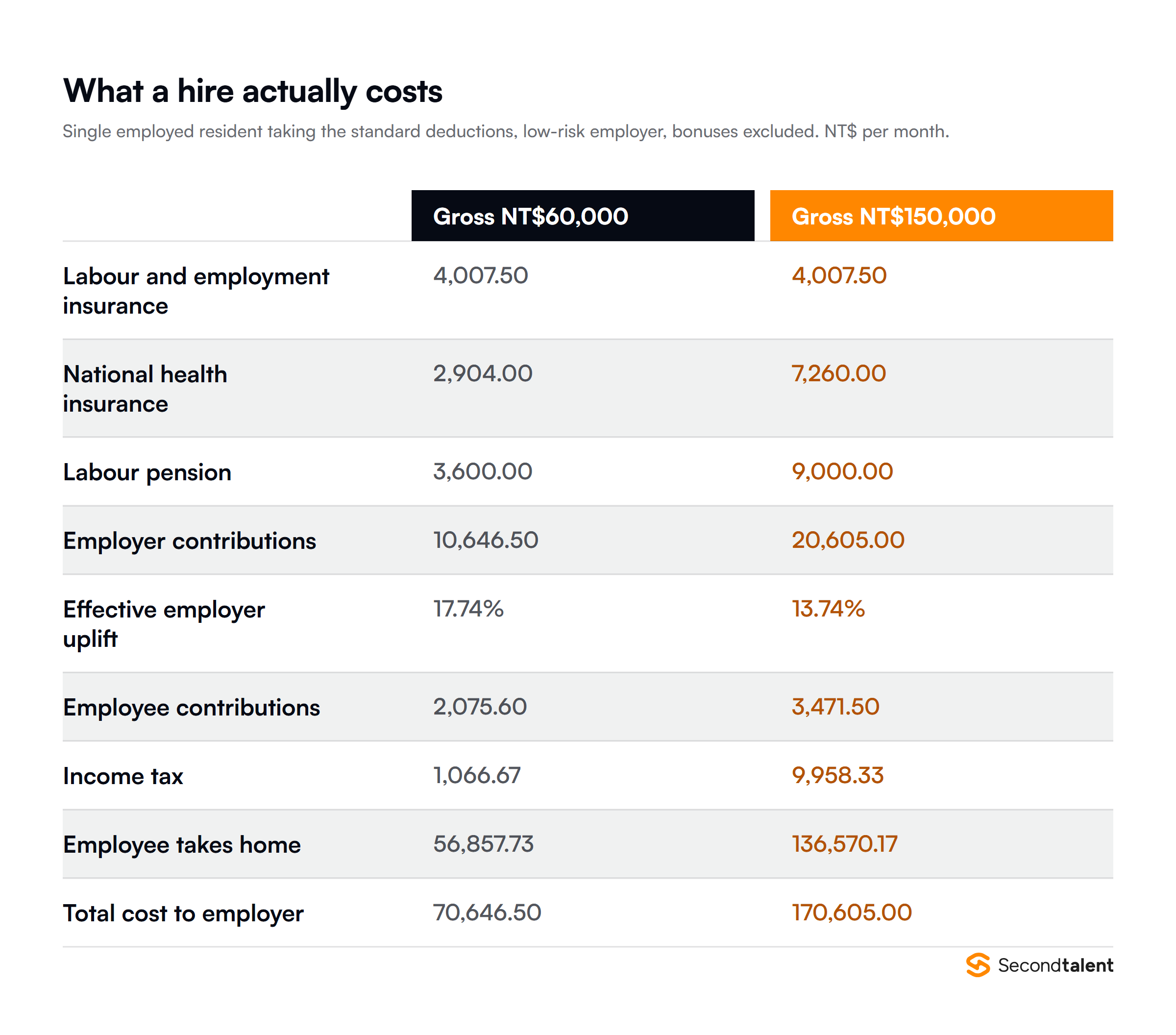
The employer uplift falls from 17.74% to 13.74% across a salary that more than doubles. That is a modest decline by regional standards, and the pension is why.
At NT$60,000 the pension is NT$3,600 of a NT$10,647 employer bill. At NT$150,000 it is NT$9,000 of NT$20,605, so it grows from a third of the total to nearly half.
Our EOR cost calculator models the full stack, and the Taiwan EOR guide covers what we handle on your behalf.
Income Tax
Residents pay progressive consolidated income tax from 5% to 40%. Deductions are generous by regional standards, and a single employed resident subtracts NT$464,000 before any tax is due.
| Net taxable income (NT$) | Rate |
|---|---|
| Up to 590,000 | 5% |
| 590,001 to 1,330,000 | 12% |
| 1,330,001 to 2,660,000 | 20% |
| 2,660,001 to 4,980,000 | 30% |
| Over 4,980,000 | 40% |
The 183-day threshold is the one to watch for new arrivals. A hire who lands late in the year is taxed at the flat 18% for that year, which is usually worse than the resident schedule for anyone on a normal professional salary.
Employers withhold monthly using the official tables or a flat 5% election, and the employee files an annual return in May to reconcile.
What Changed for 2026
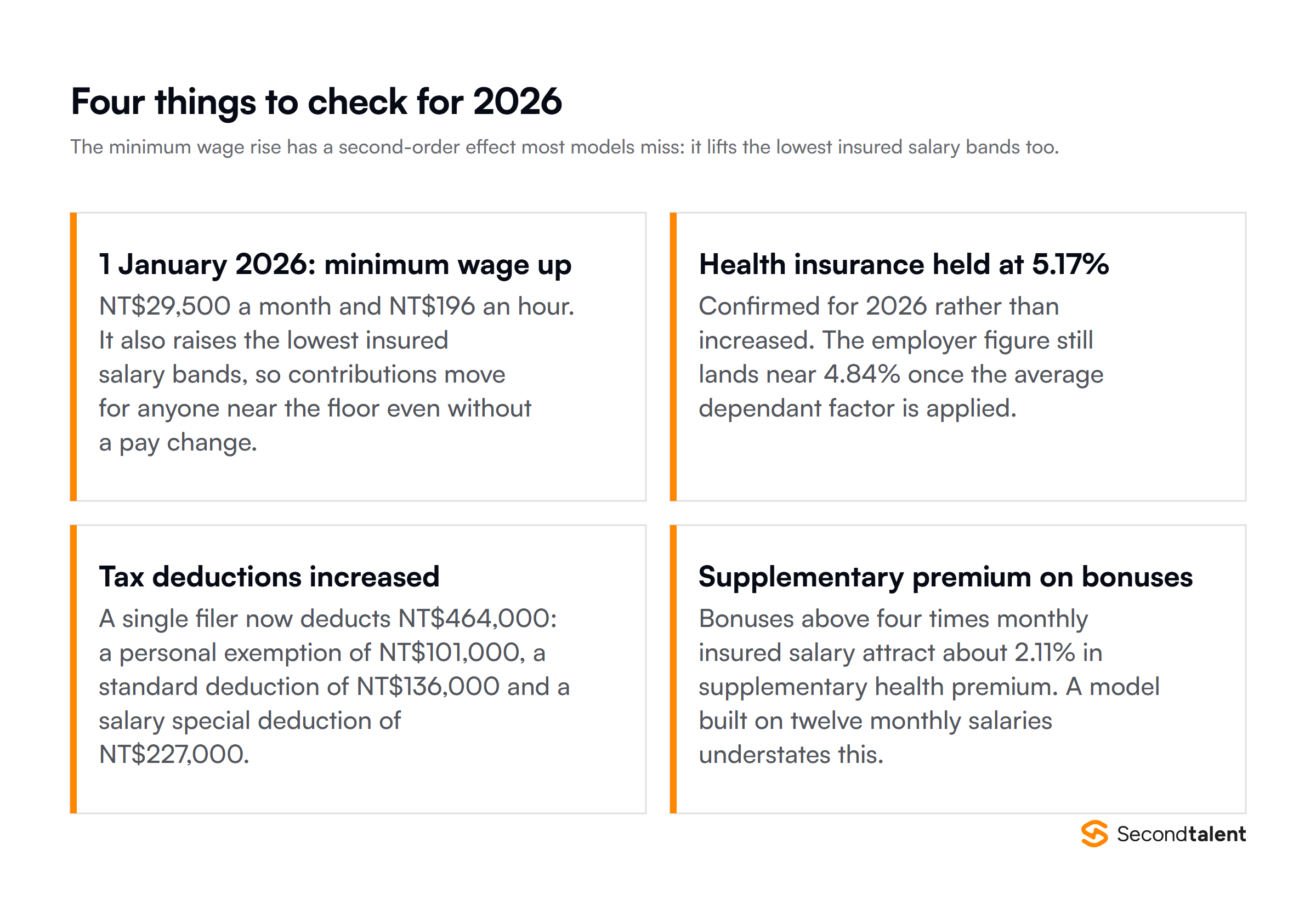
The minimum wage rise is the one with an immediate payroll effect. It also lifts the lowest insured salary bands, so contributions move for anyone near the floor even if you did not change their pay.
Annual Leave Scales Steeply
Taiwan’s leave ladder is one of the more generous in the region and starts before the first anniversary, at six months of service.
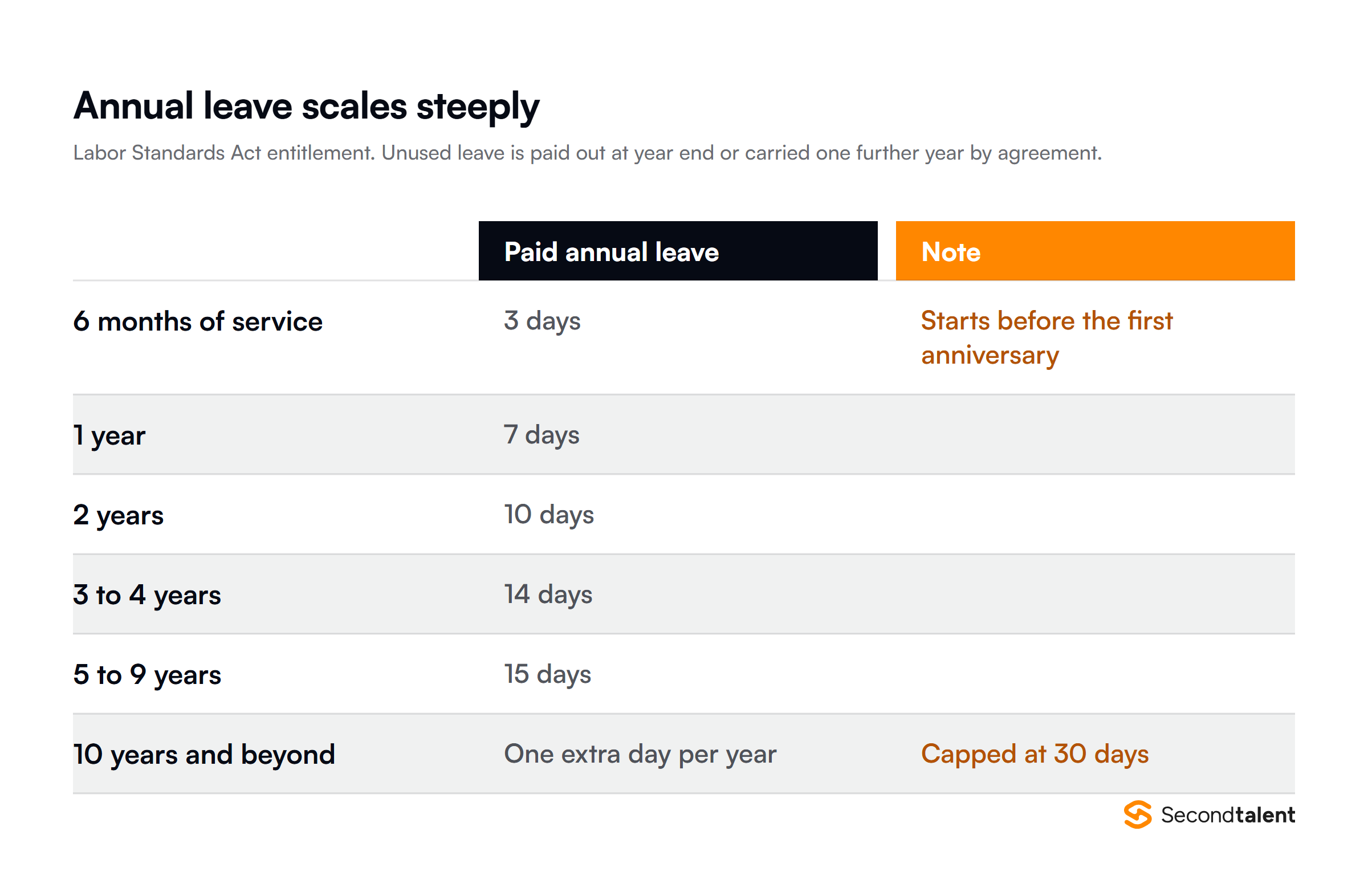
Unused leave must be paid out at year end or carried for one further year by agreement. It is a real accrual rather than a use-it-or-lose-it entitlement, so track it as a liability.
- Working hours: 8 a day and 40 a week, with overtime capped at 46 hours a month, extendable to 54 in a month and 138 a quarter by agreement.
- Overtime pay: a premium on the hourly rate that steps up with the hours worked, and a higher rate again on rest days.
- Sick leave: up to 30 days a year of ordinary sick leave at half pay, with longer unpaid provision for hospitalisation.
- Maternity leave: 8 weeks, paid in full where the employee has six months of service.
- Paternity leave: 7 days of paid leave for accompanying prenatal checks and childbirth.
The public holiday calendar was expanded by 2025 legislation, so confirm the current year’s schedule with the labour ministry rather than reusing an older list.
Severance is Capped, Unlike Most of the Region
Under the current labour pension system, severance is half a month of average wages for each year of service, capped at six months in total. That is a genuine outlier in a region where ladders run to twenty months and beyond.
The cap exists because the pension is already funded monthly into the employee’s own account. You are paying the retirement provision as you go rather than settling it at exit.
- Notice: 10 days for 3 months to under 1 year of service, 20 days for 1 to under 3 years, and 30 days beyond 3 years.
- Statutory grounds: termination requires a listed ground such as business contraction, restructuring or demonstrated incapability. There is no at-will employment.
- Reporting: mass redundancy triggers advance notification and a consultation process.
- Employees on the old pension scheme retain the uncapped severance formula, so check which scheme any long-tenured employee sits on.
That last point matters for acquisitions. An employee who never transferred to the new system in 2005 carries a materially larger severance entitlement than a recent hire on identical pay.
The capped severance is the reason Taiwan reads as a moderate-cost market overall despite a mid-teens employer percentage. You pay more monthly than in Thailand or Hong Kong and far less on the way out than in Indonesia or Thailand, so the total cost of a five-year employment is closer to the regional middle than either headline suggests.
Employing Foreign Nationals
A foreign professional needs an employer-sponsored work permit, then a resident visa and an Alien Resident Certificate. Specialist permits carry a minimum monthly salary requirement that is reviewed periodically.
The Employment Gold Card is the alternative worth knowing. It combines work permit, residence and re-entry in one document, is valid for one to three years and does not need an employer sponsor, so a Gold Card holder arrives already permitted to work.
Foreign employees join labour insurance and health insurance on the same basis as locals once they hold an ARC, so there is no nationality split in contributions of the kind Singapore applies.
Benefits Beyond the Statutory Minimum
National health insurance is genuinely comprehensive, so private medical cover matters less here than anywhere else in the region. What candidates weigh instead is the bonus.
- Year-end bonus: not statutory, but deeply embedded. One to two months paid before Lunar New Year is the norm, and candidates quote total annual package rather than monthly salary because of it.
- Meal allowance: exempt from income tax up to NT$2,400 a month, which makes it one of the more efficient ways to raise net pay.
- Group insurance: commonly added on top of national health insurance for accident and hospitalisation cover rather than primary care.
- Voluntary pension matching: the employee can contribute up to 6% themselves, and some employers add above the statutory 6% as a retention tool.
Quote offers as an annual figure including the expected bonus. A monthly number will read as materially below market to a Taiwanese candidate comparing it against packages that assume fourteen months.
Registering As An Employer
Taiwan is administratively straightforward once the entity exists, but the entity itself takes longer than Singapore or Hong Kong because of investment approval for foreign shareholders.
- Investment approval from the Investment Commission for a foreign-invested company, before incorporation proper.
- Company registration with the Ministry of Economic Affairs, including capital verification by an accountant.
- Tax registration for business and withholding purposes.
- Insured unit registration with the Bureau of Labor Insurance and the National Health Insurance Administration, so employees can be enrolled from day one.
- Labour pension account setup, which is separate from the insurance registrations.
The sequencing matters because employees must be enrolled on their first day. You cannot hire and then register, so the insured unit has to exist before the start date rather than alongside it.
Running Payroll Each Month
- Enrol each employee in labour insurance, employment insurance and health insurance on their first day, and open a labour pension account.
- Pay wages at least monthly, on the date fixed in the contract.
- Withhold income tax and the employee share of labour, employment and health insurance at source.
- Remit insurance premiums to the Bureau of Labor Insurance and the National Health Insurance Administration on their monthly cycles.
- Remit the 6% labour pension to the Bureau of Labor Insurance, which credits the employee’s individual account.
- Report the supplementary health premium where bonuses exceed four times monthly insured salary.
- Issue withholding statements in January and file the annual employer return.
Same-day enrolment is stricter than most of the region. Late enrolment carries a penalty and leaves the employer liable for benefits the employee would otherwise have claimed.
Frequently Asked Questions
What is the total employer cost of hiring in Taiwan?
About 17.7% on top of gross salary at mid-level pay, falling to about 13.7% on a senior package. That covers labour insurance, employment insurance, health insurance and the 6% labour pension, plus occupational accident cover and a wage arrears levy.
How much is the labour pension in Taiwan?
At least 6% of monthly wages from the employer, paid into the employee’s individual account, on an insured salary capped at NT$150,000. Employees may contribute up to a further 6% voluntarily from their own pay.
What is the minimum wage in Taiwan in 2026?
NT$29,500 a month and NT$196 an hour from 1 January 2026. The rise also lifts the lowest insured salary bands, so contributions move for employees near the floor even without a pay change.
Do foreign employees pay into Taiwan’s schemes?
Yes, on the same basis as locals once they hold an Alien Resident Certificate. Taiwan applies no nationality split of the kind Singapore uses for CPF, so a foreign hire costs the employer the same as a local on identical pay.
Can I pay a Taiwan employee without a local entity?
Not directly. Enrolment in all four schemes and tax withholding require a registered local employer, and only a Taiwan entity can sponsor a work permit. An employer of record in Taiwan holds the contract on its own entity and handles the filings.
Our EOR versus entity calculator models the crossover, and our guide to EOR across APAC compares the statutory position market by market.
Download this guide as a PDF
The full Taiwan payroll, benefits and tax guide, including all four contribution schemes and their ceilings, the income tax schedule, the leave ladder, severance and work permit routes, with both worked examples, formatted for sharing with your finance team.
Hiring in Taiwan?
Second Talent employs staff in Taiwan on our own entity and handles contracts, enrolment in all four schemes, the labour pension and withholding, so the rules above become our problem rather than yours. We also source the candidates. Tell us the role and we will come back with candidates and a full employment cost.
This guide is general information, current as at the date of publication, and is not tax or legal advice. Insured salary bands, premium rates and the minimum wage are all reviewed annually. Confirm your position with a qualified adviser before acting.

![How to Hire Developers in Asia Remotely. How to Hire Developers in Asia Remotely from the USA [2026], by Second Talent.](https://www.secondtalent.com/wp-content/uploads/2026/09/hire-developers-in-asia-remotely-featured-v2-768x403.jpg)
![AI Outsourcing in Singapore. Top 10 AI Outsourcing Companies in Singapore [2026], by Second Talent.](https://www.secondtalent.com/wp-content/uploads/2026/09/ai-outsourcing-companies-singapore-featured-v2-768x403.jpg)
![AI Outsourcing in India. Top 10 AI Outsourcing Companies in India [2026], by Second Talent.](https://www.secondtalent.com/wp-content/uploads/2026/09/ai-outsourcing-companies-india-featured-v2-768x403.jpg)
![AI Outsourcing in the Philippines. Top 10 AI Outsourcing Companies in the Philippines [2026], by Second Talent.](https://www.secondtalent.com/wp-content/uploads/2026/09/ai-outsourcing-companies-philippines-featured-v2-768x403.jpg)

![Software Development Outsourcing in Vietnam. Top 10 Software Development Outsourcing Companies in Vietnam [2026], by Second Talent.](https://www.secondtalent.com/wp-content/uploads/2026/09/software-development-outsourcing-companies-vietnam-featured-v2-768x403.jpg)