TL;DR: A mid-level developer in the Philippines costs $3,100-$4,500/month. The same hire in Western Europe costs $6,500-$14,000/month depending on the country. Savings: 50-78%.
Western Europe has some of the highest developer salaries in the world. Switzerland pays more than the US. The UK, Netherlands, and Germany are not far behind. Even Spain and France cost 3-4x more than the Philippines for the same skill set.
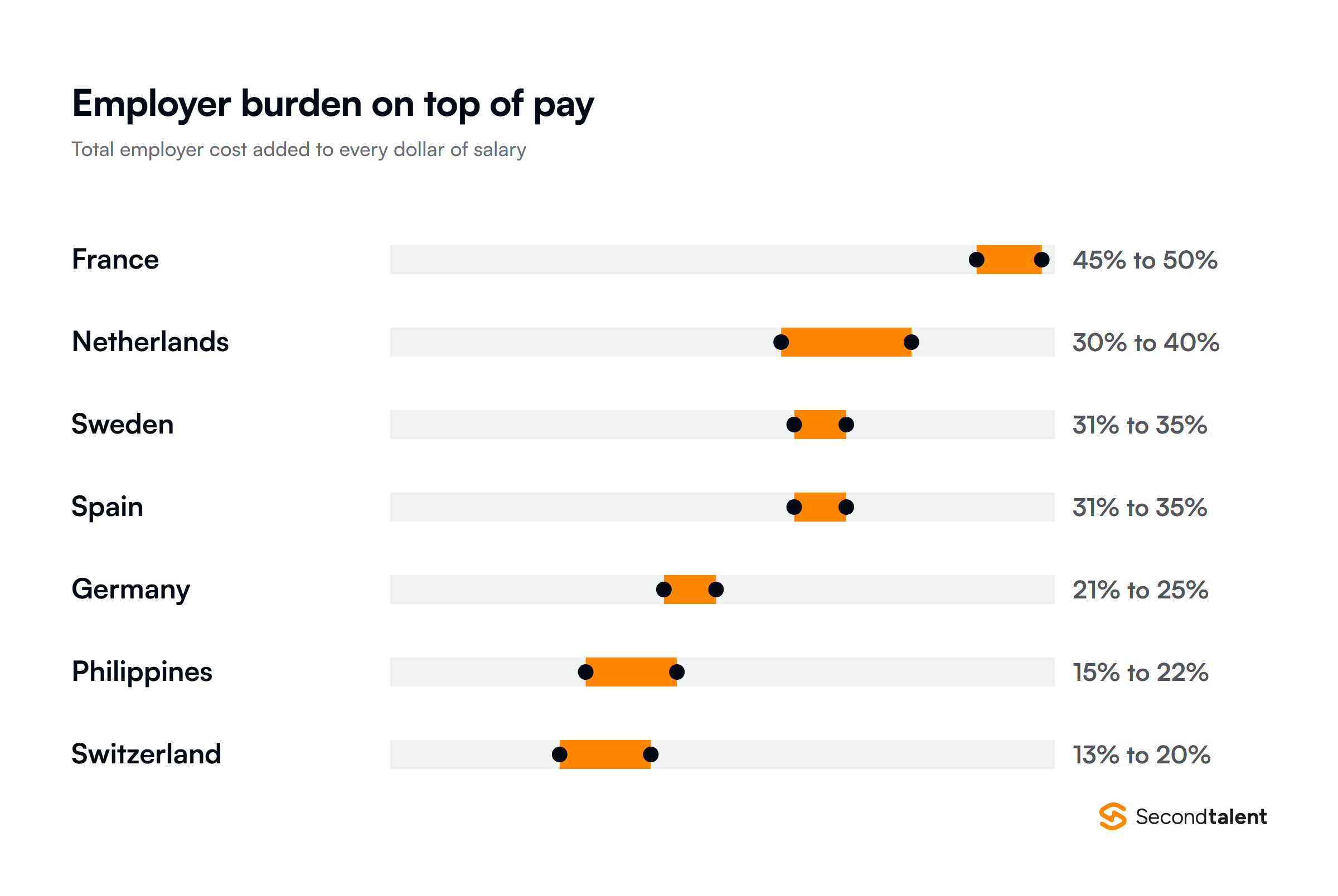
But Western Europe also has some of the heaviest employer costs on the planet. France adds 45-50% on top of salary in mandatory social charges. Sweden adds 31%. Germany adds 23%. These are not optional. They are law.
The Philippines adds 15-22% in employer costs. Salaries are 50-80% lower. English proficiency is the highest in Asia. The math is hard to argue with.
We help European startups and scale-ups hire remote developers from the Philippines and Southeast Asia. This guide breaks down what you will actually pay for a developer in the Philippines vs. eight Western European countries. By role. By experience level. By total employer cost. Country by country.
What’s your hiring priority right now?
Select your situation below.
You’re paying $8,000-$14,000/month for European developers. Philippines mid-level devs cost $3,100-$4,500/month with 15-22% employer burden vs. Europe’s 23-50%. A 5-person team saves you $300,000-$500,000 annually. Compare Philippines rates →
Your European team is too expensive to scale. Philippines developers have the highest English proficiency in Asia, work in your timezone overlap, and cost 50-80% less than UK, Netherlands, or German hires. No compromise on communication quality. Hire Philippines developers →
France’s 45-50% social charges and Sweden’s 31% employer costs are killing your budget. Our EOR service handles Philippines compliance at 15-22% burden—legally compliant, zero entity setup, and you keep full control of your team. Get EOR pricing →
You need real numbers before making a hiring decision. Our rate card shows junior to lead developer costs across Philippines, Vietnam, and Indonesia—plus employer burden calculations. Updated monthly with 2026 market data. View developer rate card →
Cost Overview: Philippines vs. Western Europe (Mid-Level Developer)
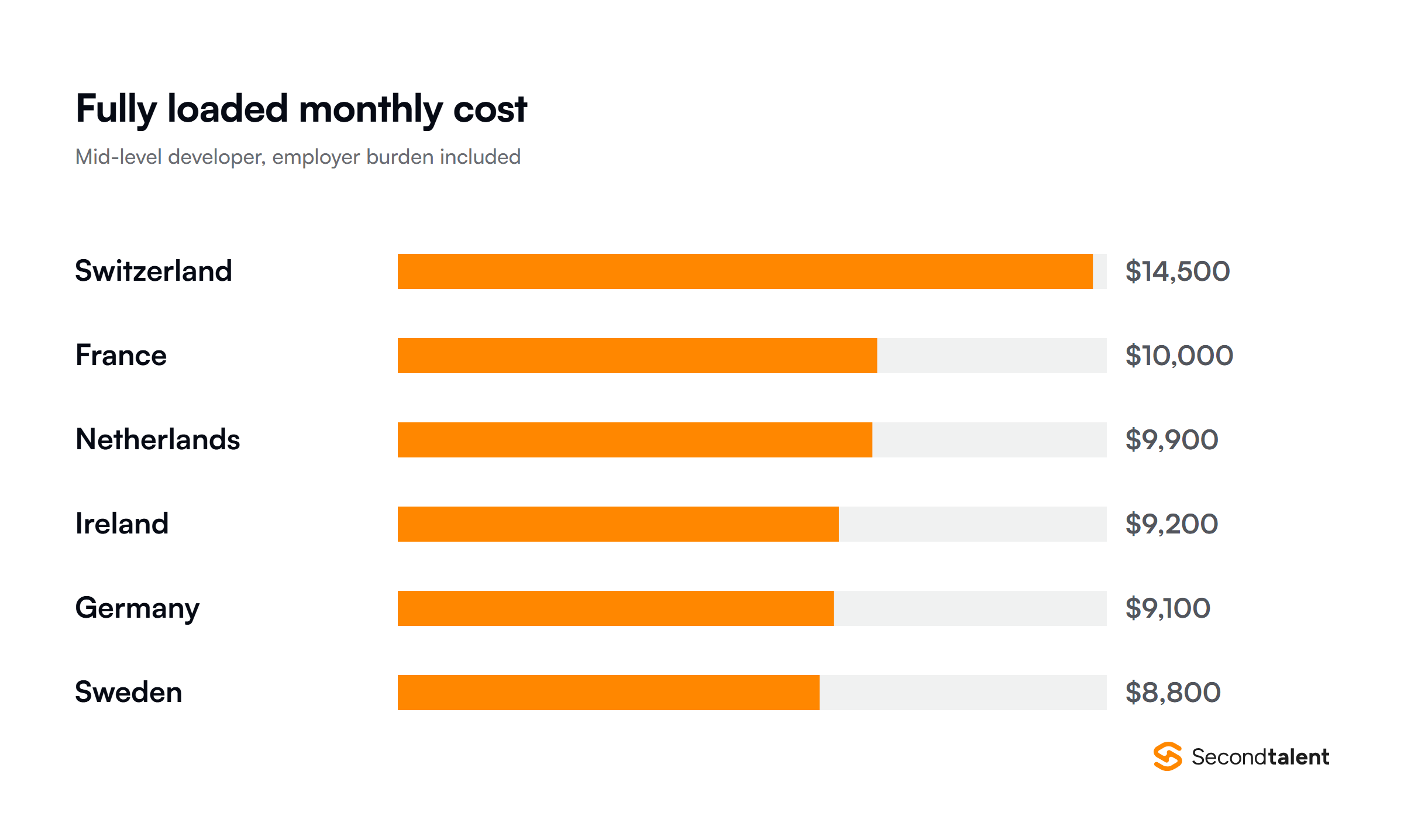
This table shows the fully loaded annual cost for a mid-level full-stack developer (3-5 years experience) in each market. “Fully loaded” means base salary plus all employer contributions, social charges, mandatory benefits, and pension.
| Country | Base Salary (Annual) | Employer Burden | Fully Loaded Annual | Monthly Cost | vs. Philippines |
|---|---|---|---|---|---|
| Switzerland | $151,000 | ~15% | $174,000 | $14,500 | Baseline (highest) |
| Netherlands | $88,000 | ~35% | $119,000 | $9,900 | +125% |
| France | $82,000 | ~47% | $120,500 | $10,000 | +128% |
| Ireland | $97,000 | ~13% | $110,000 | $9,200 | +109% |
| Germany | $89,000 | ~23% | $109,500 | $9,100 | +107% |
| Sweden | $80,000 | ~33% | $106,000 | $8,800 | +100% |
| Spain | $55,000 | ~33% | $73,000 | $6,100 | +39% |
| Philippines (Remote) | $44,000 | ~18% | $52,800 | $4,400 | Baseline |
France is a surprise for many founders. The base salary looks lower than the UK. But employer charges of 45-50% push the total cost above Germany and close to the Netherlands. A developer earning $82,000 in France costs you $120,500. The same developer in the Philippines costs $52,800. That is 56% less.
Country-by-Country Breakdown: Monthly Developer Rates
Germany
| Role (Mid-Level, 3-5 yrs) | Germany Monthly | Philippines Monthly | Savings |
|---|---|---|---|
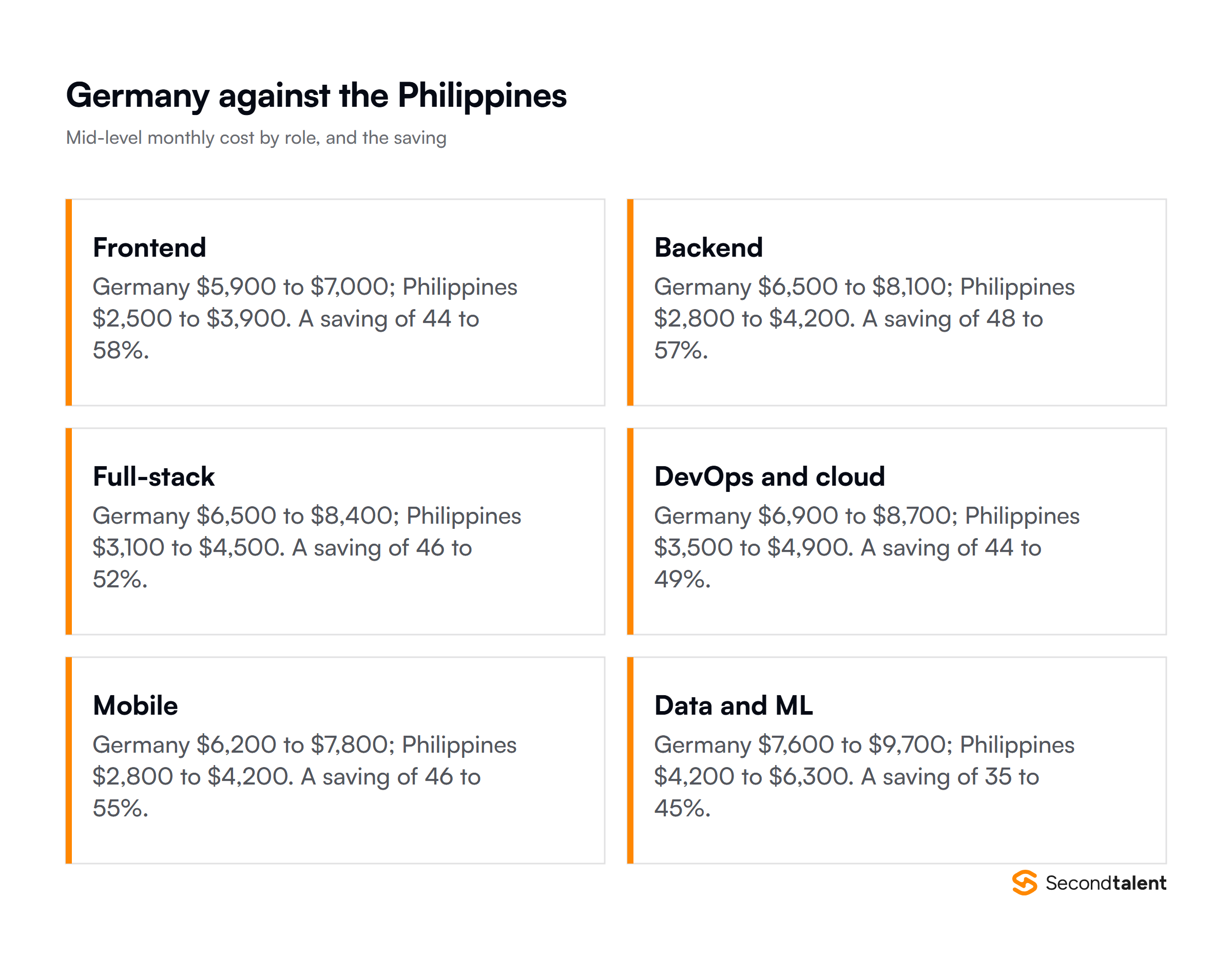
| Frontend (React, Vue, Angular) | $5,900-$7,000 | $2,500-$3,900 | 44-58% |
| Backend (Node.js, Python, Java) | $6,500-$8,100 | $2,800-$4,200 | 48-57% |
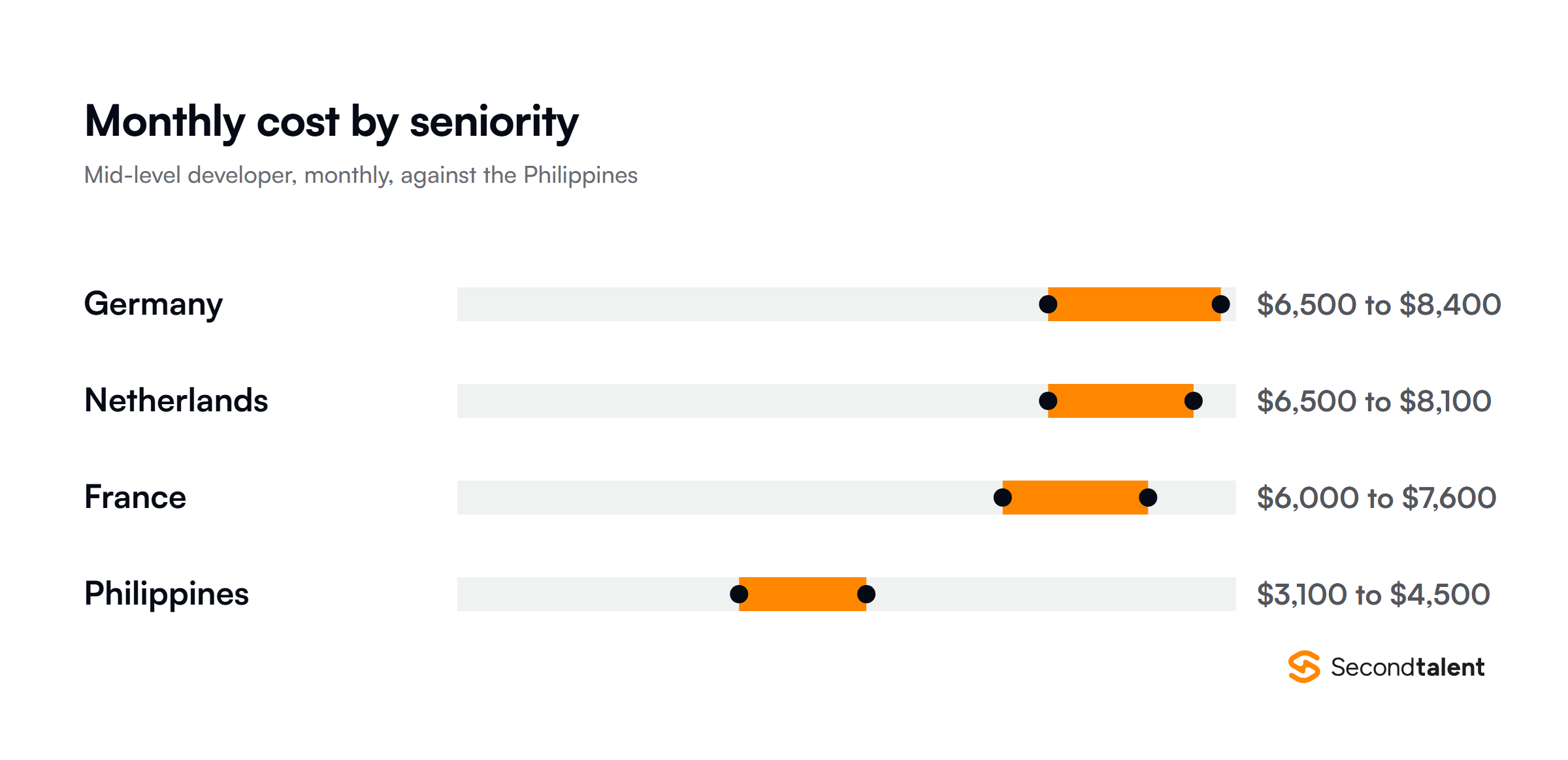
| Full-Stack | $6,500-$8,400 | $3,100-$4,500 | 46-52% |
| Mobile (iOS, Android, RN) | $6,200-$7,800 | $2,800-$4,200 | 46-55% |
| DevOps / Cloud | $6,900-$8,700 | $3,500-$4,900 | 44-49% |
| Data / ML Engineer | $7,600-$9,700 | $4,200-$6,300 | 35-45% |
| QA Engineer | $5,700-$7,300 | $2,100-$3,500 | 52-63% |
| UI/UX Designer | $5,400-$6,800 | $2,200-$3,900 | 43-59% |
Germany has 900,000 developers. The largest talent pool in Europe. Java, C/C++, and Python dominate. The SAP ecosystem and automotive sector drive demand for enterprise skills. Employer social contributions add roughly 21-25% on top of salary. Pension (9.3%), health insurance (7.3%), unemployment (1.3%), and long-term care (1.7%) are all mandatory.
Germany also has strict labor laws. Termination is difficult. Works councils exist in larger companies. Notice periods increase with tenure and can reach 7 months after 20 years. These protections raise the effective cost of a bad hire. In the Philippines, notice periods are 30 days.
France
| Role (Mid-Level, 3-5 yrs) | France Monthly | Philippines Monthly | Savings |
|---|---|---|---|
| Frontend (React, Vue, Angular) | $4,800-$6,200 | $2,500-$3,900 | 37-48% |
| Backend (Node.js, Python, Java) | $5,400-$7,000 | $2,800-$4,200 | 40-48% |
| Full-Stack | $6,000-$7,600 | $3,100-$4,500 | 41-48% |
| Mobile (iOS, Android, RN) | $5,100-$6,500 | $2,800-$4,200 | 35-45% |
| DevOps / Cloud | $5,700-$7,600 | $3,500-$4,900 | 36-39% |
| Data / ML Engineer | $6,700-$8,600 | $4,200-$6,300 | 27-37% |
| QA Engineer | $4,300-$5,400 | $2,100-$3,500 | 35-51% |
| UI/UX Designer | $5,100-$6,500 | $2,200-$3,900 | 40-57% |
France has the highest employer charges in Western Europe. The “charges patronales” add 42-50% on top of gross salary. That includes supplementary pension (up to 21.59%), family allowances (5.25%), basic social security (8.55%), and a dozen smaller contributions. A developer earning $6,000/month costs you $8,700-$9,000 fully loaded.
France also has a legally mandated 35-hour work week. Paris commands a 15-25% salary premium over the rest of the country. The talent pool is 500,000 developers. Python, Java, and C++ are the dominant languages. Notice periods are typically 3 months for managers and technical staff.
The salary gap with the Philippines looks smaller in France than in the UK. But the employer burden gap is massive. A French developer at $6,000/month costs $9,000 fully loaded. A Filipino developer at $3,500/month costs $4,100 fully loaded. The real savings is 54%.
Netherlands
| Role (Mid-Level, 3-5 yrs) | Netherlands Monthly | Philippines Monthly | Savings |
|---|---|---|---|
| Frontend (React, Vue, Angular) | $5,900-$7,600 | $2,500-$3,900 | 49-58% |
| Backend (Node.js, Python, Java) | $6,500-$8,100 | $2,800-$4,200 | 48-57% |
| Full-Stack | $6,500-$8,100 | $3,100-$4,500 | 44-52% |
| Mobile (iOS, Android, RN) | $5,900-$7,600 | $2,800-$4,200 | 45-53% |
| DevOps / Cloud | $7,600-$9,700 | $3,500-$4,900 | 49-54% |
| Data / ML Engineer | $7,600-$9,700 | $4,200-$6,300 | 35-45% |
| QA Engineer | $5,400-$7,000 | $2,100-$3,500 | 50-61% |
| UI/UX Designer | $5,700-$7,300 | $2,200-$3,900 | 47-61% |
The Netherlands has a hidden cost that surprises many founders. An 8% mandatory holiday allowance is paid on top of salary every May. That alone adds $5,000-$7,000 per year for a mid-level developer. Employer social contributions add another 18-22%. Pension contributions add 10-20%. The total employer burden reaches 30-40% on top of gross salary.
The Netherlands also introduced new legislation in 2025. Anyone earning below EUR 33/hour is legally presumed to be an employee, not a contractor. This impacts freelancer relationships and pushes companies toward full employment. Amsterdam salaries run 15-20% above the rest of the country. The 30% ruling gives tax advantages to international hires but does not reduce employer costs.
Switzerland
| Role (Mid-Level, 3-5 yrs) | Switzerland Monthly | Philippines Monthly | Savings |
|---|---|---|---|
| Frontend (React, Vue, Angular) | $11,200-$13,100 | $2,500-$3,900 | 70-78% |
| Backend (Node.js, Python, Java) | $11,200-$13,700 | $2,800-$4,200 | 69-75% |
| Full-Stack | $11,200-$14,000 | $3,100-$4,500 | 68-72% |
| Mobile (iOS, Android, RN) | $10,800-$13,100 | $2,800-$4,200 | 68-74% |
| DevOps / Cloud | $11,800-$14,500 | $3,500-$4,900 | 66-70% |
| Data / ML Engineer | $12,300-$15,400 | $4,200-$6,300 | 59-66% |
| QA Engineer | $9,500-$11,800 | $2,100-$3,500 | 70-78% |
| UI/UX Designer | $10,100-$12,600 | $2,200-$3,900 | 69-78% |
Switzerland pays the highest developer salaries in Europe. Higher than the US for many roles. Zurich and Geneva are the hubs. The top 10% of Swiss developers earn over $360,000 per year. Even mid-level developers earn $130,000-$168,000.
The employer burden is relatively low at 13-20%. AHV/IV/EO (social insurance) is 5.3%. Unemployment insurance is 1.1%. Pension (BVG) varies from 3.5-9% depending on employee age. Compared to France or Sweden, Swiss employer costs are light. But the base salary is so high that total costs still dwarf every other European country.
The Philippines saves 59-78% compared to Switzerland. For a Swiss startup paying CHF 140,000 for a mid-level full-stack developer, the same hire in the Philippines costs $44,000-$54,000. That is enough to hire three Filipino developers for the price of one Swiss developer.
Sweden
| Role (Mid-Level, 3-5 yrs) | Sweden Monthly | Philippines Monthly | Savings |
|---|---|---|---|
| Frontend (React, Vue, Angular) | $5,700-$7,100 | $2,500-$3,900 | 45-56% |
| Backend (Node.js, Python, Java) | $6,200-$7,600 | $2,800-$4,200 | 45-55% |
| Full-Stack | $5,700-$7,600 | $3,100-$4,500 | 41-46% |
| DevOps / Cloud | $6,700-$8,100 | $3,500-$4,900 | 40-48% |
| Data / ML Engineer | $7,100-$9,500 | $4,200-$6,300 | 34-41% |
| QA Engineer | $4,800-$6,200 | $2,100-$3,500 | 44-56% |
Sweden has the strongest salary growth in Western Europe. Mid-level developer salaries grew 5.5% in 2025. Senior salaries grew 6.8%. The employer contribution (arbetsgivaravgifter) is 31.42%. That is the second-highest in this list after France.
Stockholm is the tech hub. Spotify, Klarna, and Ericsson shaped the ecosystem. Go, Python, and C# are popular. 56-65% of Swedish enterprises report difficulty finding experienced developers. The talent shortage pushes salaries up every year. The Philippines talent pool offers relief at 40-56% lower cost.
Ireland
| Role (Mid-Level, 3-5 yrs) | Ireland Monthly | Philippines Monthly | Savings |
|---|---|---|---|
| Frontend (React, Vue, Angular) | $6,200-$8,100 | $2,500-$3,900 | 52-60% |
| Backend (Node.js, Python, Java) | $7,000-$9,200 | $2,800-$4,200 | 54-60% |
| Full-Stack | $7,000-$9,200 | $3,100-$4,500 | 51-56% |
| DevOps / Cloud | $7,600-$9,700 | $3,500-$4,900 | 49-54% |
| Data / ML Engineer | $7,800-$10,300 | $4,200-$6,300 | 39-46% |
| QA Engineer | $5,400-$7,300 | $2,100-$3,500 | 52-61% |
Ireland has the lowest employer burden in Western Europe at 11-15%. Employer PRSI is 11.25% (increasing to 11.45% in October 2025). No mandatory holiday allowance. No mandatory pension beyond auto-enrollment. Base salaries are high because Google, Meta, Amazon, Microsoft, and Stripe have their EMEA headquarters in Dublin.
The Dublin housing crisis makes relocation expensive. A one-bedroom apartment in Dublin costs $2,000-$2,400/month. That pushes compensation packages up even further. Hiring Filipino developers remotely eliminates this problem entirely.
Spain
| Role (Mid-Level, 3-5 yrs) | Spain Monthly | Philippines Monthly | Savings |
|---|---|---|---|
| Frontend (React, Vue, Angular) | $3,500-$4,600 | $2,500-$3,900 | 15-29% |
| Backend (Node.js, Python, Java) | $3,800-$5,100 | $2,800-$4,200 | 18-26% |
| Full-Stack | $3,800-$5,400 | $3,100-$4,500 | 17-18% |
| DevOps / Cloud | $4,300-$5,700 | $3,500-$4,900 | 14-19% |
| Data / ML Engineer | $4,900-$6,500 | $4,200-$6,300 | 3-14% |
| QA Engineer | $3,000-$4,100 | $2,100-$3,500 | 15-30% |
Spain is the cheapest Western European market for developers. Barcelona and Madrid salaries are 40-50% below London. But employer social security contributions add 30.6% on top of salary. That closes the gap with other countries on a fully loaded basis.
The salary gap between Spain and the Philippines is the smallest in this comparison. For basic frontend and backend roles, the savings is 15-30%. For DevOps and ML roles, it narrows to 3-19%. Spain makes more sense as a hiring market if you need timezone overlap with European clients. The Philippines makes sense if cost is the priority and you can work async.
Employer Burden: The Hidden Cost That Changes Everything
Base salary comparisons are misleading. What matters is the total cost of employment. Employer charges vary wildly across Europe. Here is what you pay on top of every dollar of salary.
| Country | Employer Contributions | Key Components | Total Burden |
|---|---|---|---|
| France | 42-45% | Supplementary pension (up to 21.59%), family allowances (5.25%), basic social security (8.55%) | 45-50% |
| Sweden | 31.42% | Health, parental, pension, unemployment, survivor benefits | 31-35% |
| Spain | 30.6% | Social security (23.6%), unemployment (5.5%), FOGASA (0.2%), training (0.6%) | 31-35% |
| Netherlands | 18-22% + 8% holiday | Social contributions, mandatory 8% holiday allowance, pension (10-20%) | 30-40% |
| Germany | 20.7% | Pension (9.3%), health (7.3%), unemployment (1.3%), long-term care (1.7%) | 21-25% |
| Switzerland | 6.4% + pension | AHV/IV/EO (5.3%), unemployment (1.1%), BVG pension (3.5-9%) | 13-20% |
| Ireland | 11.25% PRSI | Employer PRSI covers all social insurance. Lowest in Western Europe | 11-15% |
| Philippines | 14.5% + 13th month | SSS (10%), PhilHealth (2.5%), Pag-IBIG (2%), 13th month pay (8.33%) | 15-22% |
France stands out. A developer with a $70,000 base salary costs $101,500-$105,000 fully loaded. In the Philippines, a developer with a $35,000 base salary costs $40,250-$42,700 fully loaded. You save $60,000 per developer per year. For a 5-person team, that is $300,000.
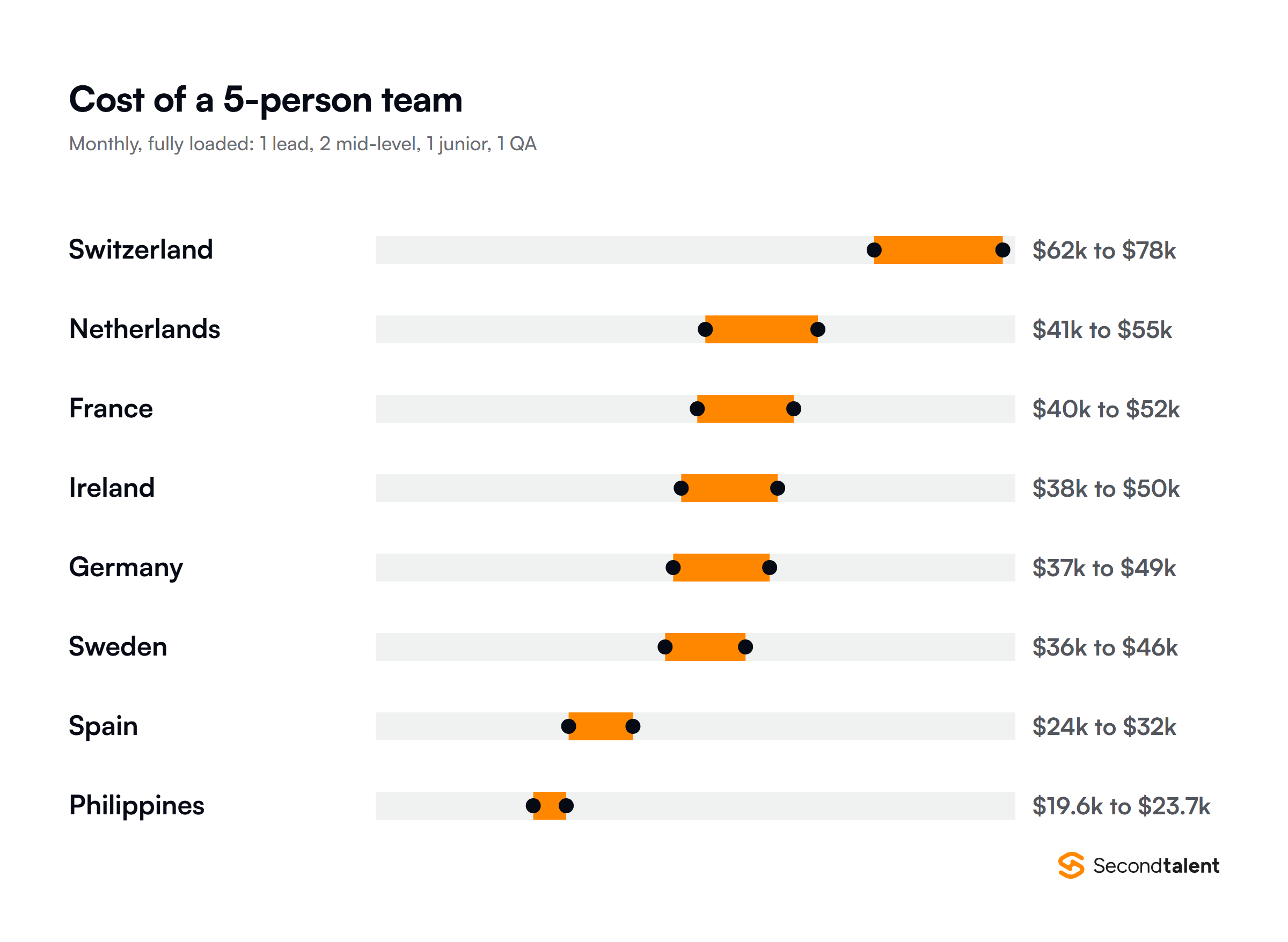
5-Person Team Comparison: Philippines vs. Key European Markets
Here is what a typical 5-person engineering team costs in each market. Team composition: 1 Tech Lead (Senior), 2 Mid-Level Engineers, 1 Junior Engineer, 1 QA Engineer. All figures are monthly, fully loaded.
| Country | Monthly Team Cost (Fully Loaded) | Annual Team Cost | vs. Philippines |
|---|---|---|---|
| Switzerland | $62,000-$78,000 | $744,000-$936,000 | +215% to +230% |
| Netherlands | $41,000-$55,000 | $492,000-$660,000 | +109% to +132% |
| France | $40,000-$52,000 | $480,000-$624,000 | +104% to +120% |
| Ireland | $38,000-$50,000 | $456,000-$600,000 | +94% to +111% |
| Germany | $37,000-$49,000 | $444,000-$588,000 | +89% to +107% |
| Sweden | $36,000-$46,000 | $432,000-$552,000 | +84% to +94% |
| Spain | $24,000-$32,000 | $288,000-$384,000 | +23% to +35% |
| Philippines | $19,600-$23,700 | $235,200-$284,400 | Baseline |
A UK-based team costs $504,000-$648,000 per year. The same team in the Philippines costs $235,200-$284,400. That is a $269,000-$364,000 annual saving. Enough to fund an entire product team, extend your runway by 12 months, or invest in infrastructure.
One fintech startup in London came to us spending $45,000/month on a 4-person UK team. We helped them build a 6-person team in the Philippines for $22,000/month. They got two more engineers and saved $23,000 per month. They used the savings to hire a senior product designer and a dedicated DevOps engineer.
Why the Philippines Over Other Low-Cost Markets
India is cheaper. Eastern Europe has closer timezones. Why choose the Philippines for a European company?
English proficiency. The Philippines ranks 28th globally in the EF English Proficiency Index with a score of 569 (High Proficiency). That is 2nd in Asia behind Malaysia. India ranks 61st. Filipino developers write clear PRs, participate in code reviews, and communicate on Slack without translation friction. For European companies where English is the business language, this matters.
1.9 million IT-BPM professionals. The Philippine IT-BPM industry generated $40 billion in revenue in 2025. It is projected to reach $42 billion in 2026 and $59 billion by 2028. This is not a freelance marketplace. It is a scaled, mature talent ecosystem with 200,000+ dedicated software developers.
Cultural alignment with Western work culture. The Philippines has deep ties to American and Western business practices. Filipino professionals understand direct feedback, agile workflows, and async communication. The cultural adjustment for European companies is minimal compared to other Asian markets.
Timezone overlap with Europe. The Philippines is UTC+8. That is 6-8 hours ahead of Western Europe. A Filipino developer starting at 3 PM Manila overlaps with 9 AM London until end of UK business day. That gives you 4-5 hours of real-time collaboration. More than enough for a daily standup, code review, and async handoff.
Hiring Challenges: Europe vs. Philippines
Cost is not the only reason to look beyond Europe. European labor markets have structural challenges that slow down hiring and increase risk.
| Factor | Western Europe | Philippines |
|---|---|---|
| Notice Period | 1-3 months (up to 7 in Germany) | 30 days |
| Termination Difficulty | High (Germany, France, Netherlands) | Moderate (standard labor code) |
| Employer Burden | 13-50% on top of salary | 15-22% on top of salary |
| Talent Shortage | 56-65% report difficulty hiring (Sweden) | Large and growing talent pool |
| Time to Hire | 4-8 weeks (after notice period) | 2-4 weeks |
| Work Permits | Required for non-EU hires | Not required (remote hire) |
| Mandatory Benefits | 35-hour weeks (France), 8% holiday pay (NL) | 13th month pay, SSS, PhilHealth |
Germany and France are especially rigid. German works councils can slow hiring decisions. French 35-hour work week limits flexibility. Dutch legislation now presumes employment for anyone earning below EUR 33/hour. These protections exist for good reasons. But they add cost, time, and risk to every hire.
The Philippines has a simpler labor code. 30-day notice periods. Standard termination rules. Mandatory benefits are clear and predictable. An EOR provider handles compliance for $300-$700 per employee per month.
Experience Level Comparison: Junior to Lead
Here is how the cost gap changes across experience levels. Using full-stack developers as the benchmark. Monthly salary, before employer burden.
| Experience Level | Germany | France | Netherlands | Philippines |
|---|---|---|---|---|
| Junior (1-3 yrs) | $4,300-$7,000 | $3,900-$6,000 | $4,600-$5,900 | $2,000-$3,100 |
| Mid-Level (3-5 yrs) | $6,500-$8,400 | $6,000-$7,600 | $6,500-$8,100 | $3,100-$4,500 |
| Senior (5-8 yrs) | $8,400-$12,400 | $7,600-$10,700 | $8,100-$10,800 | $4,500-$6,700 |
| Lead/Architect (8+) | $12,400-$16,800 | $10,700-$14,400 | $10,800-$14,400 | $6,700-$9,100 |
The percentage savings is consistent across all levels. Junior hires save 47-61%. Senior hires save 41-50%. Lead-level hires save 38-47%. The gap narrows slightly at the top because senior Filipino developers with 8+ years of experience and strong English command premium rates. But even a Filipino Lead/Architect at $9,100/month is 40-46% cheaper than the same role in the UK or Germany.
The Bottom Line
The Philippines saves 35-78% compared to Western Europe depending on the country and role. The biggest savings come from Switzerland (68-78%), the UK (49-66%), and the Netherlands (44-61%). Even compared to Spain, the cheapest Western European market, the Philippines saves 15-30% on most roles.
The employer burden gap makes the real difference. France charges 45-50% on top of salary. Sweden charges 31%. The Philippines charges 15-22%. When you compare fully loaded costs, the Philippines advantage grows wider than base salary alone suggests.
Western Europe has 6.1 million developers. The Philippines has 200,000+ and growing. The talent pools are different sizes. But for startups hiring 5-20 developers, the Philippines pool is more than deep enough. English proficiency is high. The IT-BPM industry is mature. And the cost savings fund the growth that European salaries would otherwise constrain.
Hire vetted remote developers from the Philippines with Second Talent to build your engineering team at 50-70% lower cost than Western European hires.
Hiring contractors rather than employees changes the arithmetic. The freelance developer rate index prices 14 roles across nine regions, benchmarked against North America and sourced from published wage data.