
TL;DR: Hiring a mobile app developer in 2026 takes seven steps: choose the stack, write a scorecard, source, verify identity, run one realistic build task, review shipped apps, then offer and onboard. Expect about 10 weeks to fill a technical role and more than 300 applications per hire. The two steps most teams still skip are identity checks and a written rule on AI use in interviews.
Since April 28, 2026, Apple rejects any app upload not built with Xcode 26 and the iOS 26 SDK. On August 31, Google Play started requiring new apps and updates to target Android 16. The developer you hire this year ships against both deadlines, and some of the candidates applying for the job are not who their video feed says they are.
The Process at a Glance
| Step | What you decide | What changed for 2026 |
|---|---|---|
| 1. Choose the stack | Native, Flutter, React Native or Kotlin Multiplatform | React Native now runs only on its New Architecture |
| 2. Write the scorecard | The skills and store work the role owns | New Apple SDK and Google Play target rules |
| 3. Source and screen | Where candidates come from, who reviews them | More than 300 applications per hire |
| 4. Verify identity | How you confirm a candidate is real | Deepfake interviews and laptop farms |
| 5. Build task | One realistic task and your AI rule | Teams split on allowing AI |
| 6. Review shipped apps | Which live apps prove the claims | Store compliance is now part of the job |
| 7. Offer and onboard | Pay, contract, access | New state rules on AI hiring tools |
- 1JetBrains says 92% of professional Android developers use Kotlin, so an Android hire without it is rare.
- 2Gartner predicts one in four candidate profiles worldwide will be fake by 2028.
- 3Only about 13% of hires tracked by Ashby included a take-home task.
- 4Colorado's AI hiring law now takes effect January 1, 2027, after Illinois and California went first.
The 7 Steps to Hire a Mobile App Developer
1. Choose the stack before you write the job post
The stack decides the candidate pool, so settle it first. A native team needs Swift for iOS and Kotlin for Android. A cross-platform team picks one of three: Flutter, React Native or Kotlin Multiplatform. Each option now looks different from even two years ago.
On Android, Kotlin has won. At KotlinConf 2026, JetBrains said 92% of professional Android developers use Kotlin. Google says Jetpack Compose now runs in more than 68% of the top 1,000 apps, so ask for Compose, not XML layouts.
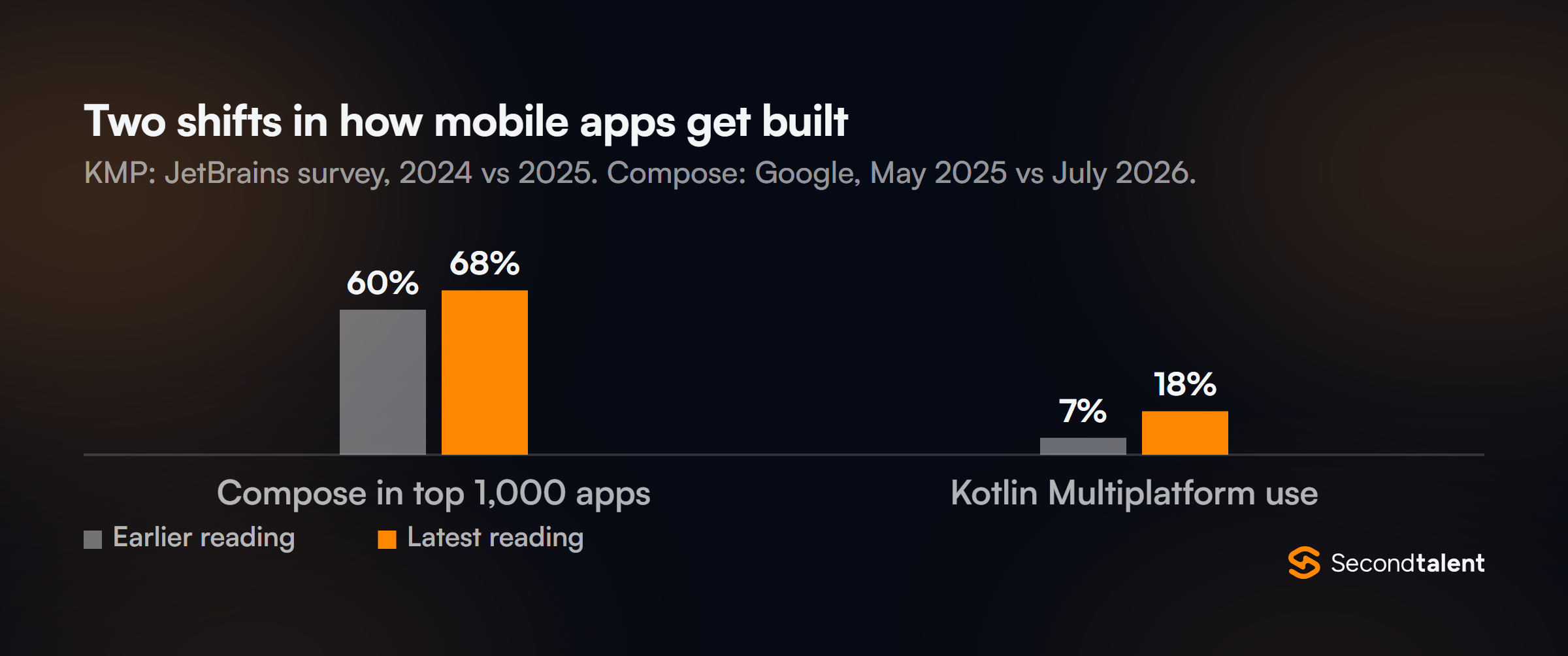
Cross-platform has changed the most. Kotlin Multiplatform use rose from 7% to 18% of developers in JetBrains' survey in a year, and Compose Multiplatform for iOS went stable in May 2025. React Native 0.82 became the first release to run entirely on the New Architecture, so a candidate whose experience stops at the old bridge will need to catch up.
2. Write a scorecard around the store work, not a wish list
A mobile developer's job now includes keeping the app shippable. Both stores changed their rules in 2026, and a missed deadline stops your releases rather than your features. Put these on the scorecard as owned tasks:
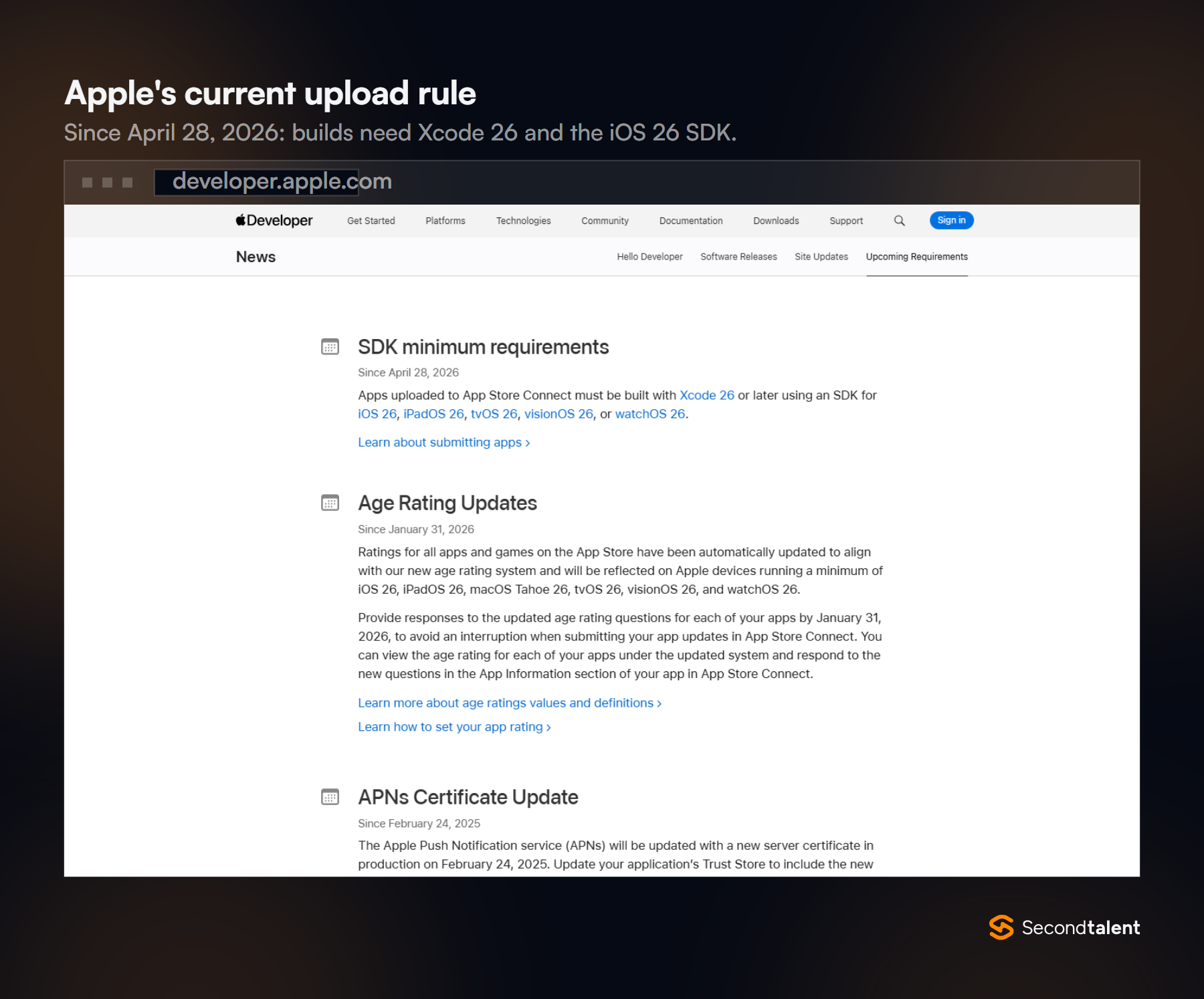
- Apple SDK rule: uploads need Xcode 26 and the iOS 26 SDK now, and the iOS 27 SDK from April 2027.
- Apple age ratings: new 13+, 16+ and 18+ tiers, with answers due in App Store Connect.
- Google Play target API: Android 16 (API 36) for new apps and updates from August 31, 2026.
- 16 KB memory pages: Android updates that do not support them cannot be released from February 1, 2027.
- Android developer verification: required from September 30, 2026 in Brazil, Indonesia, Singapore and Thailand, and worldwide from 2027.
Then add the platform skills that are new. Swift 6.2 added an option to run code on the main actor by default, which changes how concurrency is handled in UI code. Apple's Foundation Models framework gives apps an on-device language model in "as few as three lines of code". If your roadmap has an AI feature, list it.
Keep the scorecard to five or six criteria you can test. Our iOS developer interview questions and Android Kotlin interview questions map to most of them.
3. Source and screen: expect hundreds of applications
Open job posts now bring more applications than a team can read. Ashby's 2026 data shows more than 300 applications per hire, three times the 2021 level. The same data puts time to first fill at about 10 weeks for technical roles.
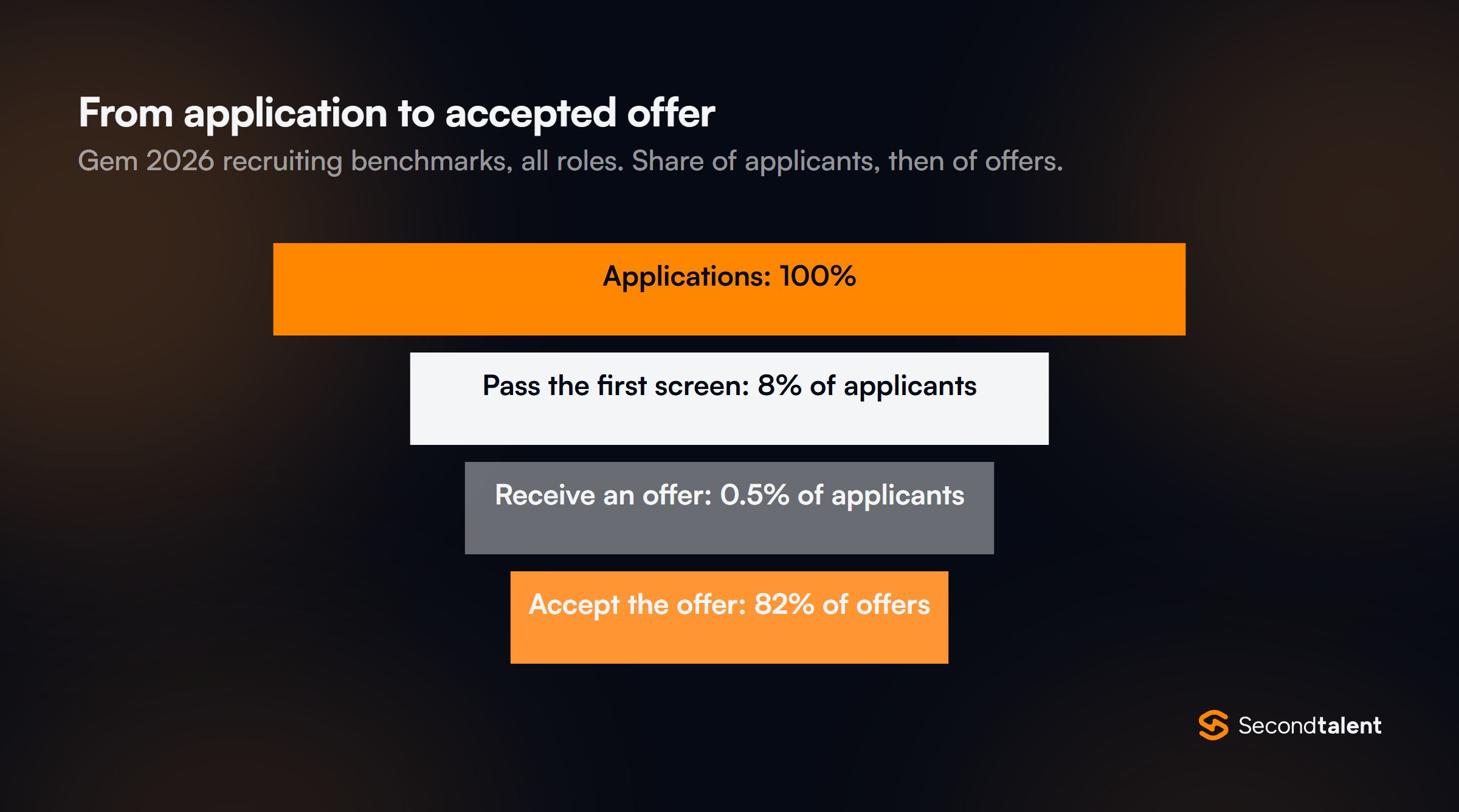
Most of that volume never gets close. In Gem's 2026 benchmarks, 8% of applicants pass the first screen and 0.5% get an offer, roughly one hire per 200 applications. Engineering is slower: Gem's report on 2024 engineering hiring shows 53 days and 39 interviews per hire.
Two ways to cut the load. Source from places where you can see work first: GitHub, store listings and vetted talent platforms. Our list of platforms to hire mobile app developers compares 11 of them. Then screen on the scorecard, not the CV: CoderPad found 69% of recruiters use resume review, but only 16% think it predicts performance.
4. Verify identity before the technical rounds
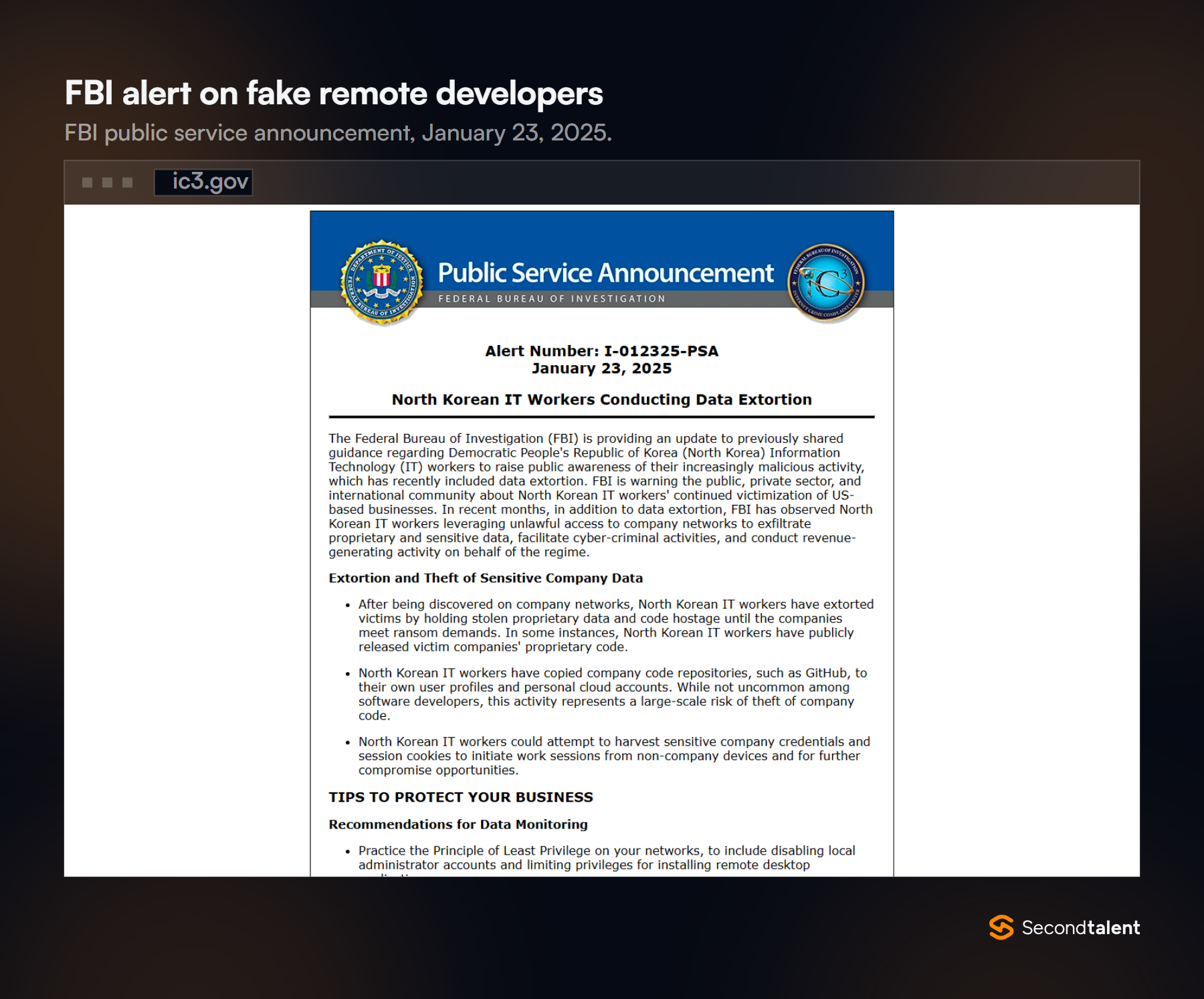
This step did not exist in most hiring plans three years ago. In January 2025 the FBI warned that North Korean IT workers use "artificial intelligence and face-swapping technology during video job interviews".
Sources: the Department of Justice, Gartner, Greenhouse and the U.S. State Department.
Checks that cost little: match a government ID to the person on camera, keep cameras on for every round, and ship equipment only to an address that matches the ID. Pay into an account in the candidate's own name.
An in-person round helps too. Gartner found 62% of candidates are more likely to apply when one is required, so it is unlikely to shrink your pool.
5. Run one realistic build task, and write your AI rule
Developers use AI at work, so the interview has to say whether they can use it here. The Stack Overflow 2025 survey found 84% use or plan to use AI tools, while 46% distrust their accuracy. Xcode 26.3 added Claude Agent and Codex, and Android Studio has Gemini Agent Mode.
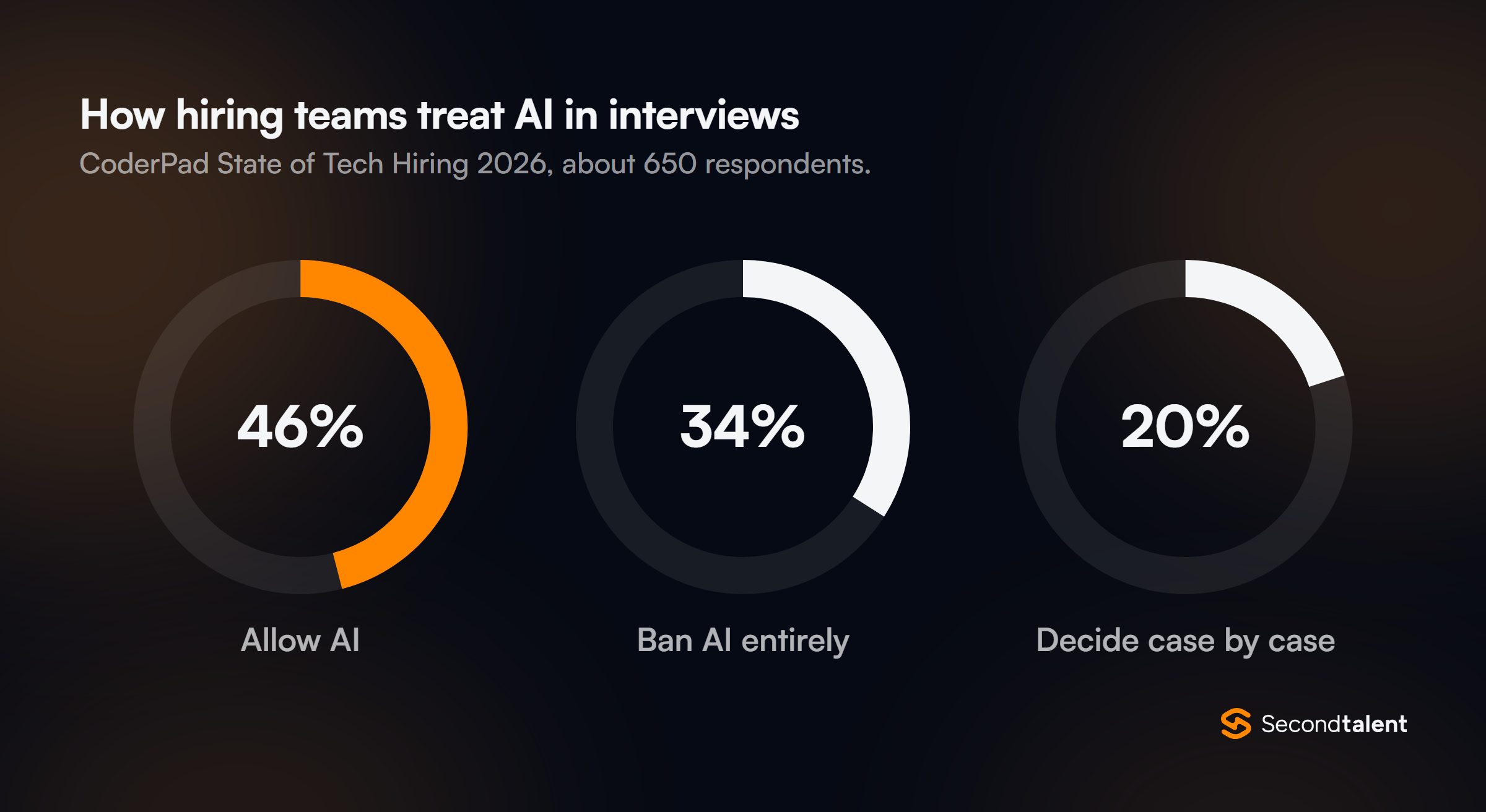
Companies land on both sides. Canva titled its policy "Yes, You Can Use AI in Our Interviews. In fact, we insist." Anthropic tells candidates not to use AI in live interviews unless the interviewer says otherwise. Either works if candidates know the rule in advance.
Since most developers want real-world tests, make the task look like the job. Give candidates a small existing app with a real defect: a list that stutters, a crash on rotation, a screen that breaks with Dynamic Type. Ask for a fix and a short note on trade-offs.
Then walk through it together live. The walkthrough shows how the person reasons, whatever tools they used to write the fix.
Keep it short and pay for anything over two hours. Ashby found take-homes appear in only 10% to 14% of technical hires, so a long unpaid task puts you at odds with most of the market.
6. Review shipped apps and store history
A mobile CV can be checked against the stores. Ask each finalist for two or three apps they shipped and what they owned in each. Then open the listings: release history, recent version notes, ratings trend and whether the app still runs on the current OS.
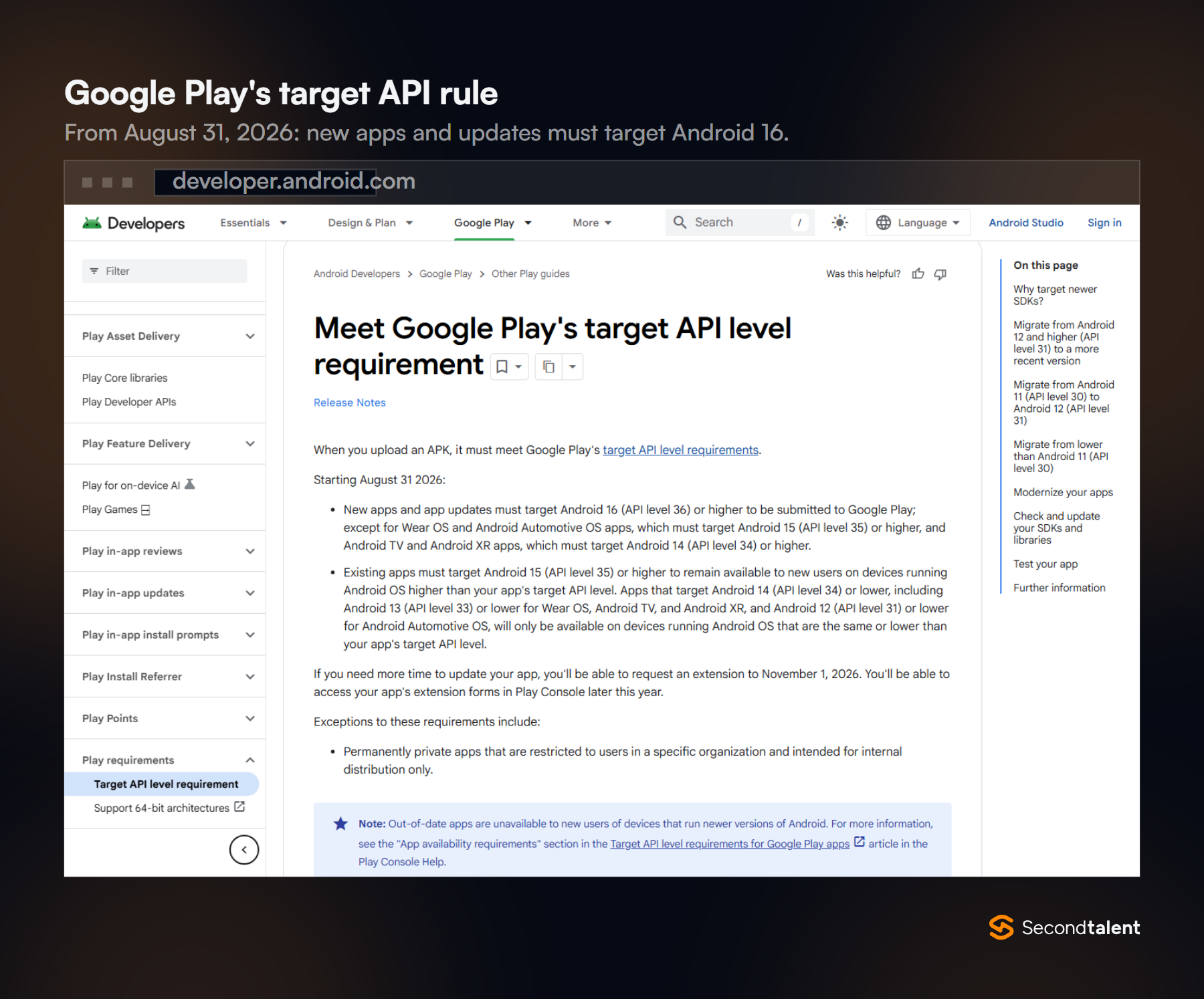
Ask how they handled the last forced upgrade. A developer who moved an app to a new Google Play target API level, or added Apple's required reasons for privacy-sensitive APIs, has done the work your scorecard lists. Apple has required those reasons since May 2024, including for third-party SDKs inside the app.
The stakes are commercial. Sensor Tower counted $167 billion in in-app purchase revenue in 2025, and apps outearned games for the first time. An update blocked by a missed deadline stops that revenue. For a structured way to judge remote candidates at this stage, see how to evaluate developer quality remotely.
7. Make the offer and set up access
Pay is where U.S. mobile hiring gets expensive. The BLS puts the median software developer salary at $135,980 in May 2025. Self-reported total pay for mobile specialists runs far higher.
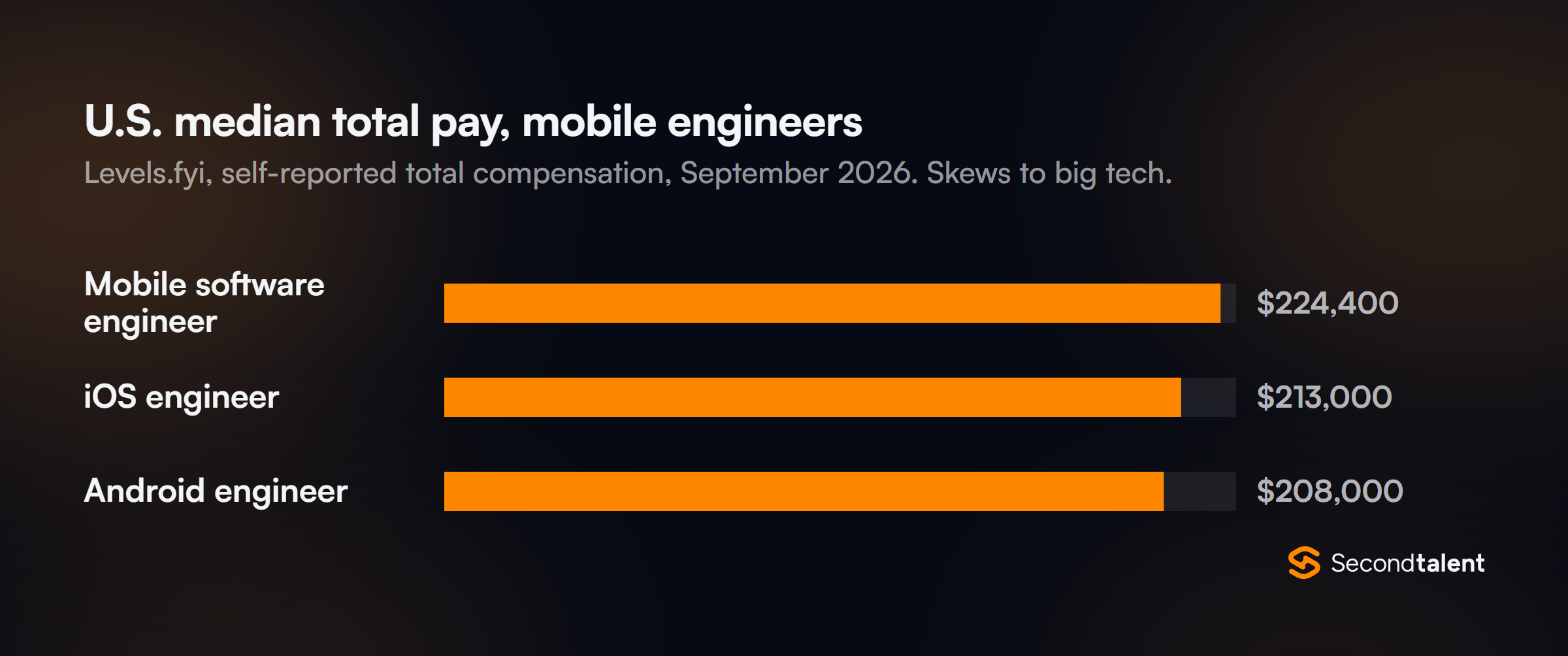
- All software developers, May 2025
- Median $135,980
- Top 10% above $214,670
- Self-reported, includes stock and bonus
- iOS median $213,000
- Android median $208,000
If you screened with AI tools, check the rules before the offer. New York City has required bias audits since 2023. California's rules took effect in October 2025, Illinois's in January 2026, and Colorado's revised law starts January 1, 2027. The EU's rules for hiring AI now apply from December 2, 2027.
Day one needs store access, not just a laptop. Add the hire to your Apple Developer team and Google Play Console with the narrowest role that lets them ship, plus access to signing keys and crash reporting. Gem's 2024 engineering data shows 76% of offers accepted, so line up your second choice before the first answer comes back.
Skip Steps 3 to 5 With Pre-Vetted Mobile Developers
We source mobile app developers across nine Asian markets and do the screening and technical vetting before you meet anyone, including how candidates use AI tools like Claude Code and Cursor. That covers iOS, Android and Flutter developers at $3,000 to $6,000 a month, all in. More than 200 companies hire through us, with 92% talent retention. Tell us the role and profiles follow within 24 hours.
Frequently Asked Questions
How long does it take to hire a mobile app developer?
About 10 weeks to first fill for a technical role, by Ashby's 2026 data, and 53 days to hire in Gem's benchmarks for 2024 engineering roles. The interview loop alone takes about 18 days.
Should I hire native or cross-platform?
Hire native when the app depends on new platform features, such as Apple's on-device models. Pick Flutter, React Native or Kotlin Multiplatform when one team must ship both apps. Our cost to hire a mobile app developer guide compares rates.
Can candidates use AI in a mobile coding interview?
That is your call. In CoderPad's 2026 survey, 46% of hiring teams allow it and 34% ban it. Write the rule into the invitation and test reasoning in a live walkthrough either way.


![Workplace Diversity Statistics. Top 100+ Workplace Diversity Statistics [2026], by Second Talent.](https://www.secondtalent.com/wp-content/uploads/2026/09/workplace-diversity-statistics-featured-v2-768x403.jpg)
![Tech Industry Hiring Statistics. Top 50+ Tech Industry Hiring Statistics: Salaries, Skills Demand [2026], by Second Talent.](https://www.secondtalent.com/wp-content/uploads/2026/09/tech-industry-hiring-statistics-featured-v2-768x403.jpg)