TL;DR: US employees quit at a rate of 1.9% a month in July 2026, tied for the lowest in a decade outside the spring 2020 lockdown, per the BLS. The median worker has been with their employer 3.9 years, the shortest since 2002. Gallup puts the cost of replacing one employee at one-half to two times their annual salary.
Americans quit 38.0 million jobs in 2025, 12.5 million fewer than at the 2022 peak, while layoffs rose to 21.2 million. Many would still leave. In Gallup’s November 2025 survey, 51% of US employees were looking for a new job or watching for one. Only 28% thought it was a good time to find a quality job.
- 1Switching still pays: job-changers’ gross pay grew 7.3% in the year to August, against 4.4% for employees who stayed.
- 2In a randomized trial of 1,612 employees, two days a week at home cut quits by one-third with no effect on performance reviews.
- 342% of US employees who quit say their manager or employer could have kept them, and 45% had no conversation about their job in the three months before.
- 4Infosys cut its attrition from 28.4% to 13.0% between June 2022 and June 2026, the steepest fall among India’s four largest IT firms.
What Is the Employee Turnover Rate in 2026?
US employers lost 3.2% of their employees in July 2026, counting quits, layoffs, retirements and other exits. Quits made up most of it. The BLS Job Openings and Labor Turnover Survey for July, released on September 1, counted 3.1 million quits against 1.7 million layoffs and discharges.
Four years ago quits ran the other way. The monthly quits rate hit 3.0% in November 2021 and again in April 2022, when 4.5 million Americans quit in a single month. It has drifted down since, and in 2025 it averaged 2.0% a month, against 2.8% in 2022.
Over whole years the gap is wide. BLS annual quits levels fell from 50.5 million in 2022 to 38.0 million in 2025. Over the same years, layoffs and discharges climbed from 17.6 million to 21.2 million.
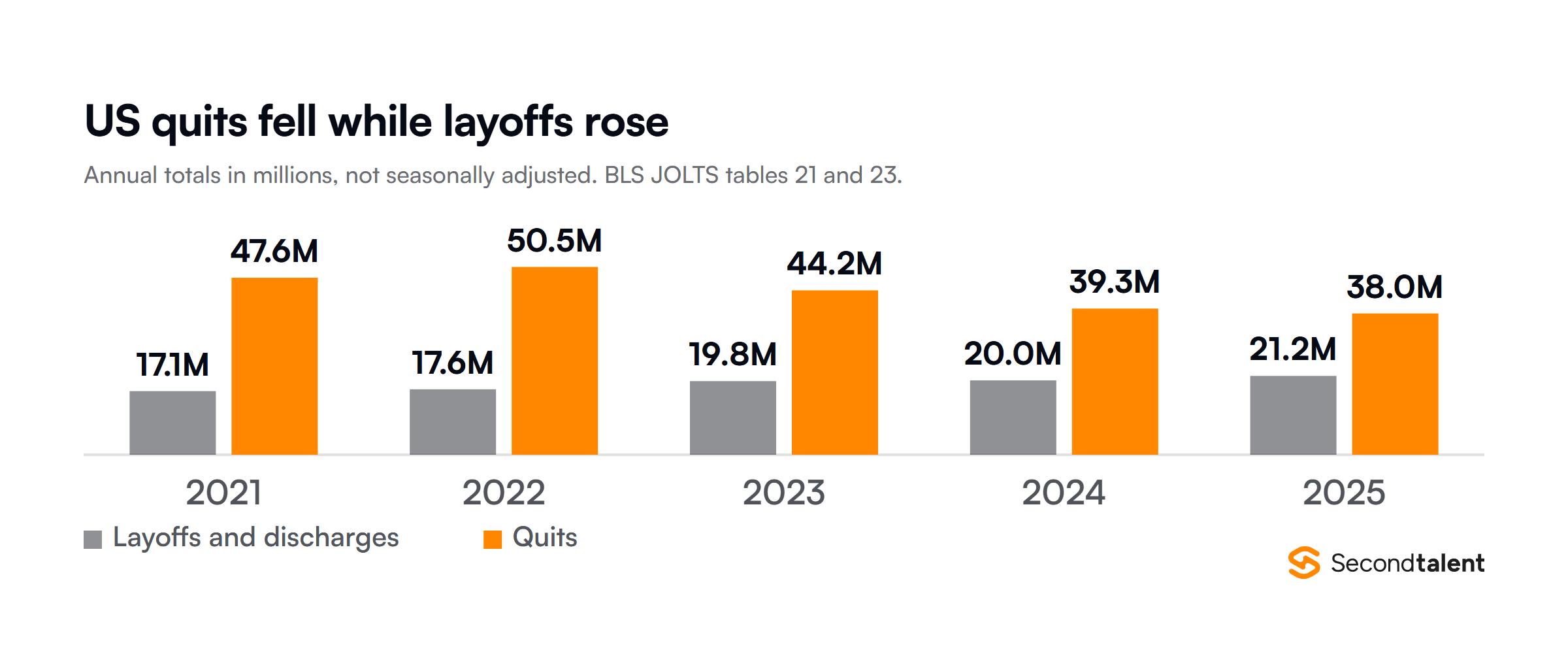
In 2022 there were almost three quits for every layoff. In 2025 there were fewer than two. Our tech layoffs statistics follow the cuts in tech company by company.
Employee Turnover Rates by Industry
Restaurants and hotels lose staff fastest, and they also lose the most. Accommodation and food services averaged a 4.2% monthly quits rate in 2025 and logged 7.2 million quits. Professional and business services logged 6.3 million, and health care 5.6 million. Retail was next on rate, at 2.6%.
The office industries sit at the other end. Information and finance and insurance both averaged 1.3% a month, and government 0.8%. All nine industries in the chart quit less in 2025 than in 2022, according to BLS table 22.
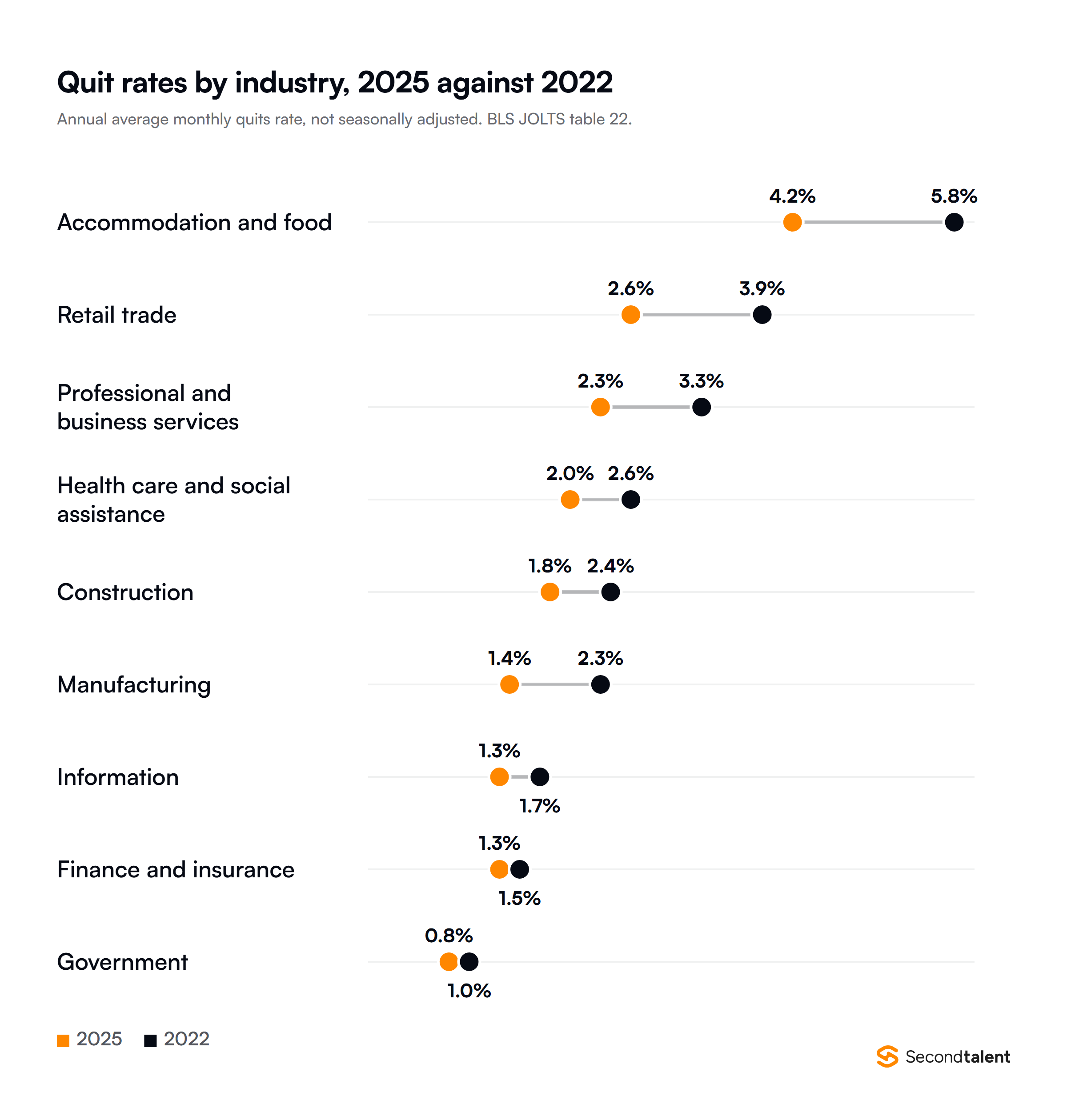
Of the industries in the chart, manufacturing fell furthest in relative terms, from 2.3% to 1.4%. The last year was flatter: from 2024 to 2025 most rates held or edged down, and mining and the federal government rose most, by 0.3 points each.
Region matters less than industry. The South averaged 2.2% a month in 2025 and the Midwest 2.2%, against 1.9% in the West and 1.6% in the Northeast.
How Long Do Employees Stay With One Employer?
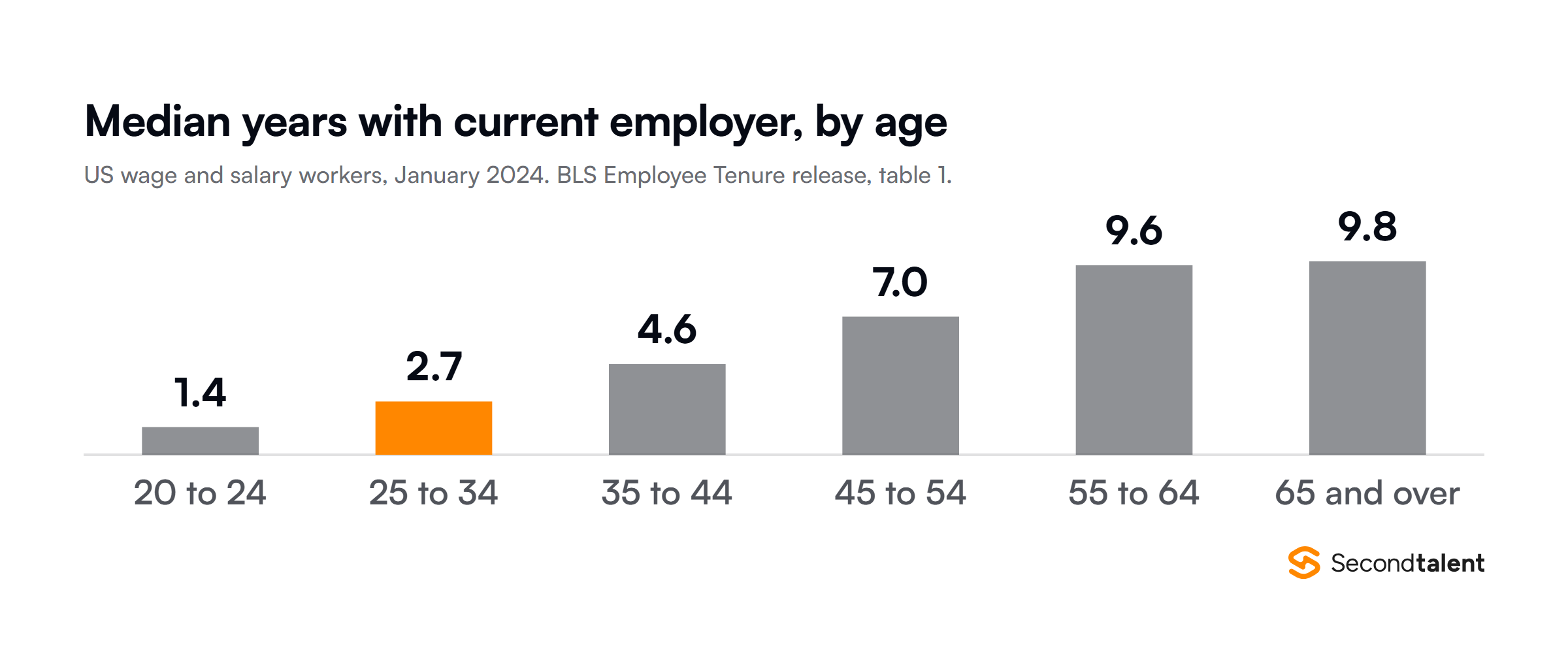
Half of US wage and salary workers had been with their employer 3.9 years or less in January 2024, according to the BLS Employee Tenure release. That median was down from 4.1 years in 2022 and the lowest since January 2002.
Age explains most of the spread. Workers aged 55 to 64 had a median of 9.6 years, more than three times the 2.7 years of workers aged 25 to 34.
- Men 4.2 years, women 3.6. Among men, 28% had 10 or more years with their employer, against 24% of women.
- Public sector 6.2 years, private 3.5. About three in four government workers are 35 or older, against three in five private-sector workers.
- Leisure and hospitality 2.1 years, the lowest of any major industry. Mining and oil and gas led at 5.7, then manufacturing at 4.9.
- Computer and mathematical occupations 4.3 years, up from 3.9 in January 2020.
- 22% of workers had a year or less with their employer, down from 24% in 2022. Among 16 to 19 year olds it was 70%.
Why Employees Leave
Pay and a dead end tie for first. In a Pew Research Center survey of people who quit a job in 2021, 63% named low pay and 63% named no opportunities for advancement. Feeling disrespected at work came third, at 57%.
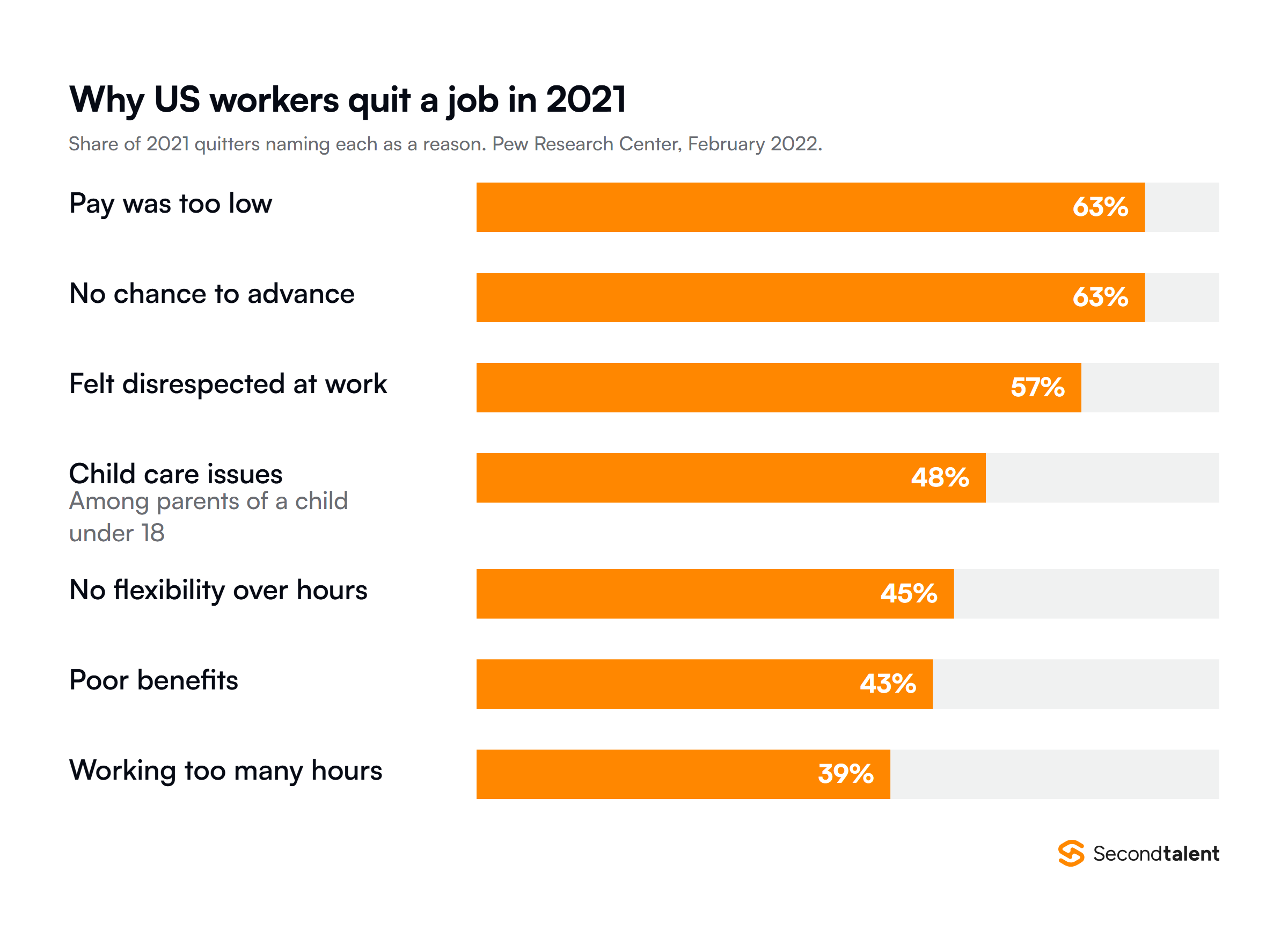
Most of them did better by leaving. Of the 2021 quitters working somewhere else by February 2022, 56% said they now earned more. Another 53% had more chances to advance, and 50% more flexibility over their hours. Only 42% said their benefits were better.
How much turnover is preventable
Gallup asked people who quit whether their employer could have kept them in 2019 and again in 2024. The share saying yes has fallen, and so has the share who had no conversation about their job before they left.
- 52% said their manager or organization could have prevented them leaving
- 51% said no manager or leader spoke with them about job satisfaction in their last three months
- 42% said the same
- 45% said no manager or leader raised their satisfaction, performance or future
- 44% of those who talked about leaving did not talk to their own manager first
The 2024 leavers named what would have changed their minds. Pay or benefits came first at 30%, then better personal interactions with their manager at 21%. Organizational issues followed at 13%, career advancement at 11% and staffing or workload at 9%.
People looking for a new job rank their priorities in a similar order. In Gallup’s study of 10,342 US employees, published in February 2025, 59% rated work-life balance and wellbeing the top grade of importance in a new job. Pay or benefits and stability followed at 54% each, then a job that uses what they do best at 48%.
Managers, Engagement and Intent to Leave
Gallup attributes 70% of the variance in team engagement to the manager alone. That makes manager engagement the number to watch, and its fall is steeper than the headline. Worldwide, manager engagement dropped from 31% in 2022 to 22% in 2025, while all-employee engagement fell to 20%, the lowest since 2020, per Gallup’s State of the Global Workplace 2026.
Engagement shows up in turnover. Gallup’s 2024 meta-analysis of 183,806 business units in 90 countries compared the most and least engaged quarters of teams. The top quarter had 51% lower turnover in organizations where annual turnover runs at 40% or less, and 21% lower where it runs above 40%.
Who is looking
Gallup’s Q4 2025 survey of 22,368 employed US adults split the 51% looking into 11% actively searching and 40% watching. Younger workers lead: 17% of Gen Z were actively looking and 44% watching, against 13% and 44% of millennials. Only 4% of baby boomers were searching.
The market holds them back. The 28% who think now is a good time to find a quality job compares with 70% in mid-2022.
SHRM found intent to leave tracks how employees rate their employer. In its State of the Workplace 2026 research, 51% of workers who called their organization ineffective at meeting workplace needs were at least somewhat likely to leave within a year. Among those who rated it effective, 77% said leaving was at least somewhat unlikely. Our HR industry statistics carry the rest of that survey.
How Much Employee Turnover Costs
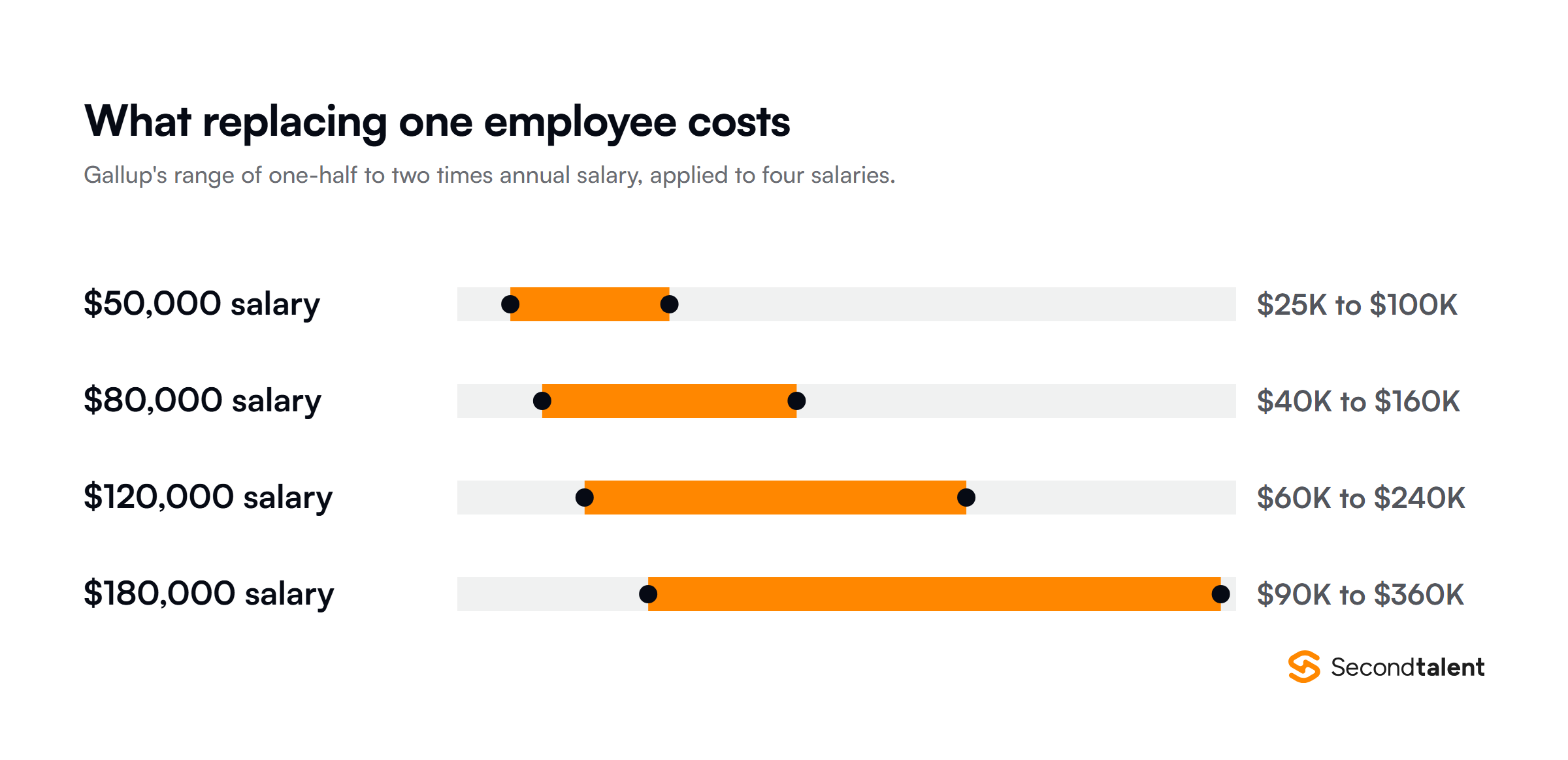
Replacing an employee costs one-half to two times their annual salary, Gallup estimates, and voluntary turnover costs US businesses $1 trillion a year. Its worked example: a 100-person company paying an average of $50,000 loses $660,000 to $2.6 million a year to turnover.
Recruiting is the part of that cost that gets measured most often. SHRM’s 2025 benchmarking, from 2,371 member organizations, puts it at:
On those averages an executive hire costs about six and a half times a nonexecutive one, before counting any output lost while the seat is empty.
Remote Work, Hybrid Work and Return-to-Office Mandates
The strongest evidence on flexibility and retention is a randomized trial. Nicholas Bloom, Ruobing Han and James Liang put 1,612 employees at Trip.com either full-time in the office or on a hybrid schedule with two days at home. The trial ran for six months in 2021 and 2022. Their Nature paper found hybrid working cut quit rates by one-third.
The drop was significant for non-managers, women and people with long commutes. Performance grades over the next two years did not differ, nor did promotions.
“These results indicate that a hybrid schedule with two days a week working from home does not damage performance.”
Bloom, Han and Liang, Nature, June 2024
Mandates run the other way. Yuye Ding, Zhao Jin, Mark Ma, Betty Xing and Yucheng Yang followed more than three million workers through Revelio Labs profile data. All worked at 54 S&P 500 technology and finance firms that ordered staff back between 2020 and 2023. Their study found an average 13 to 14% rise in abnormal turnover after the mandate.
- Quits down one-third
- No change in performance grades or promotions
- 395 managers moved from expecting a 2.6% productivity loss to a 1.0% gain
- Abnormal turnover up 13 to 14%
- Vacancies took 63 days to fill instead of 51
- Hire rates down 17%, even after national trends
Some groups left faster. Turnover among women rose nearly three times as much as among men, and mid-level and senior managers and highly skilled employees left at higher rates than junior staff.
Fully remote work retains less than it engages. Gallup found fully remote workers the most engaged group worldwide in 2025, at 31%, against 23% for hybrid workers. Yet 57% of fully remote workers were looking or watching for a new job, falling to 38% among those who were both engaged and thriving.
Pay Growth for Job-Stayers and Job-Changers
A slow job market has not closed the switching premium. In the ADP National Employment Report for August 2026, median gross pay for employees who changed jobs was up 7.3% on a year earlier, against 4.4% for those who stayed.
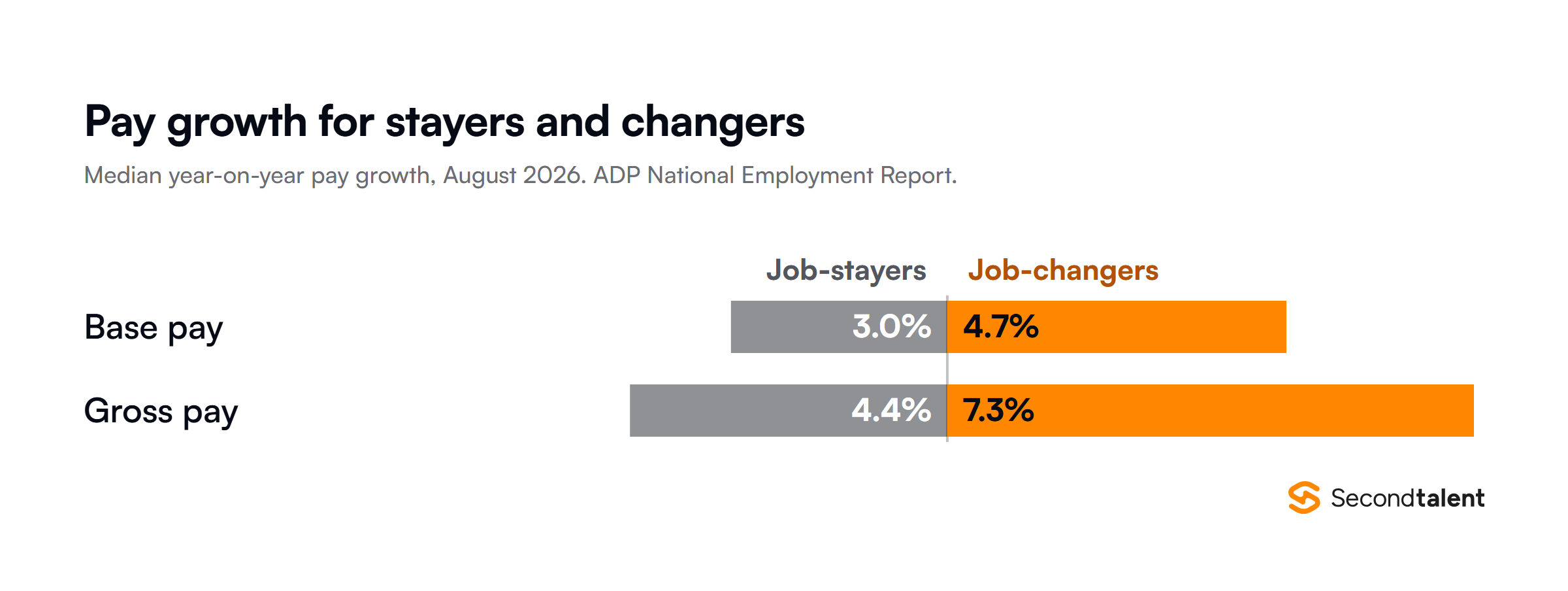
Gross pay adds bonuses, commissions, tips and other earnings to base pay. On base pay alone the gap narrows to 4.7% against 3.0%. Changers’ gross pay growth slowed from 7.5% in July, while stayers held at 4.4%.
Internal moves
A move inside the company can hold on to someone who would otherwise leave for a raise. LinkedIn studied 32 million profiles at companies with more than 500 employees, SHRM reported in 2020. Employees promoted within three years of joining had a 70% chance of staying.
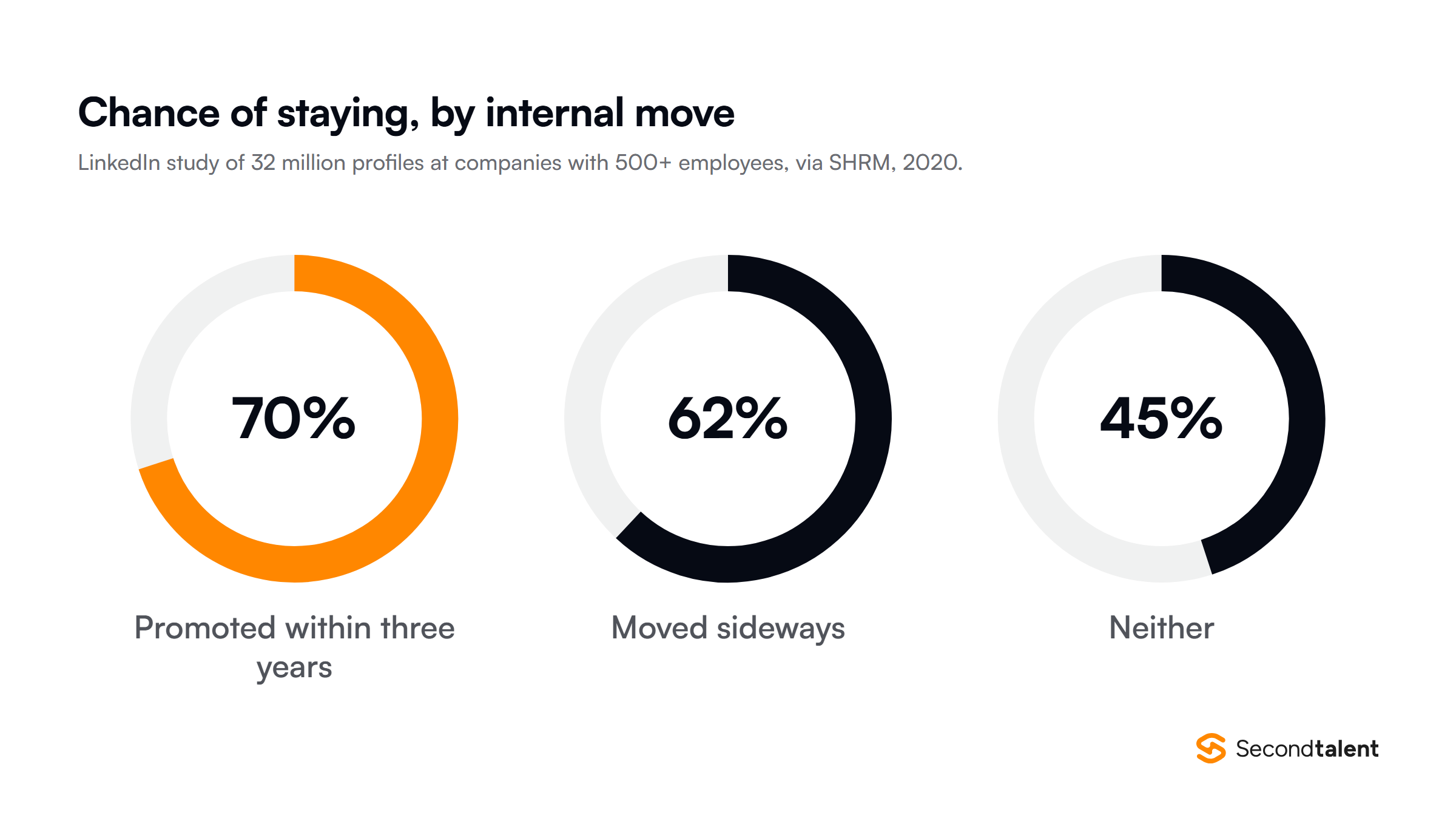
A sideways move still helped: 62% of those who changed roles without a promotion stayed. Employees who did neither had a 45% chance.
Employee Attrition in India’s IT Industry
India’s IT services firms had their own attrition peak in 2022. In June 2022, Infosys reported voluntary attrition of 28.4% over the previous twelve months. By June 2026 its fact sheet showed 13.0%, up from 12.6% in March but below the 14.4% of a year earlier.
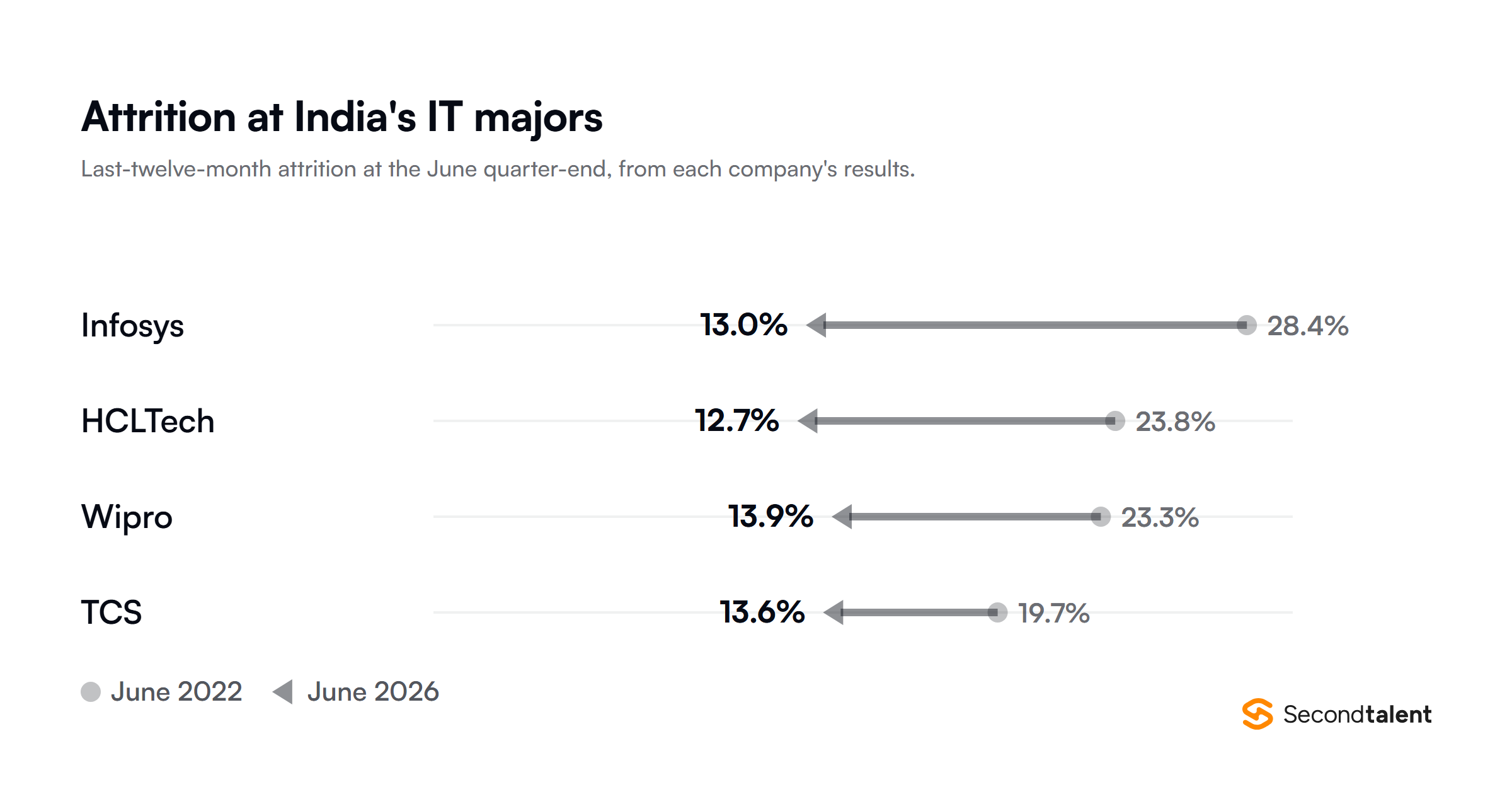
The other three majors now sit in the same band. HCLTech’s June 2026 investor release shows 12.7%, against 23.8% in June 2022. Wipro reported 13.9%, down from 23.3% in its June 2022 data sheet. TCS reported 13.6% for its IT services business, against 19.7%, and ended June with 593,798 employees.
Engagement in the region moved the wrong way over the same period. Gallup recorded the largest regional fall in employee engagement in South Asia in 2025, 5 points, and the largest fall in manager engagement, 8 points. Our comparison of software engineers in the Philippines and India covers what that means for hiring in each market.
Replacing Employees Who Leave
Each departure reopens a role at a cost of at least a recruiting cycle. Second Talent matches you with pre-vetted engineers and operators from nine Asian markets within 24 hours and employs them under employer of record. 92% of the talent we place stays. Our guide to EOR, PEO and contractor models explains how that employment works, and our India hiring rates show what a role costs there.
Tell us the role you need to fill, or see how we hire developers across the region.
FAQs
How do you calculate employee turnover rate?
Divide the number of employees who left during a period by the average headcount for that period, then multiply by 100. Count quits alone for voluntary turnover, or add layoffs, discharges and retirements for total turnover, as the BLS does.
How do you calculate employee retention rate?
Take the employees at the end of a period who were also there at the start, divide by the headcount at the start, and multiply by 100. Leave out anyone hired during the period, or new hires inflate the figure.
When is the next US turnover data released?
The BLS publishes JOLTS figures for August 2026 on September 29, 2026. Its tenure survey runs every two years, so the January 2026 figures are the next release.



![Workplace Diversity Statistics. Top 100+ Workplace Diversity Statistics [2026], by Second Talent.](https://www.secondtalent.com/wp-content/uploads/2026/09/workplace-diversity-statistics-featured-v2-768x403.jpg)

![Tech Industry Hiring Statistics. Top 50+ Tech Industry Hiring Statistics: Salaries, Skills Demand [2026], by Second Talent.](https://www.secondtalent.com/wp-content/uploads/2026/09/tech-industry-hiring-statistics-featured-v2-768x403.jpg)