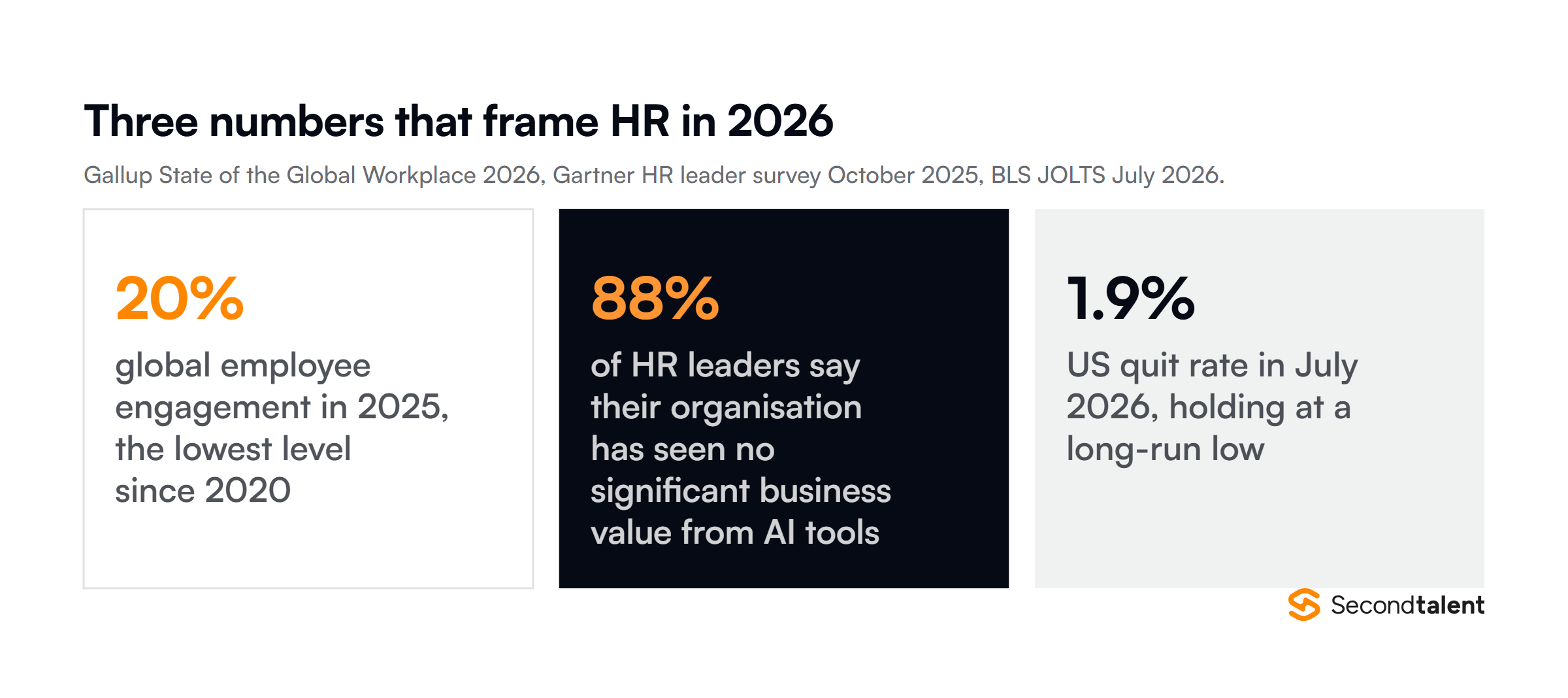
TL;DR. Global employee engagement fell to 20% in 2025, its lowest since 2020. 88% of HR leaders say their organisation has not seen significant business value from AI tools. US quits sit at 1.9%, a long-run low. Salary budgets hold near 3.5%. Every figure below carries the name of the survey, the sample size and a link to the release it came from.
This is a reference set of just over 100 HR figures for 2026, rebuilt from primary releases in September 2026. It covers AI adoption, recruiting, the labour market, hybrid work, engagement, skills, people analytics and pay.
Every number names its survey and sample size. Where two credible sources disagree, both appear. Figures we could not trace to a named study were cut rather than rounded into place.
What to take away
Five things the 2026 data settles
- AI is in the workflow and not yet in the results. 62% of employees say it saved them time, and 88% of HR leaders say the business has not seen significant value from it.
- Managers are the failure point. Manager engagement fell from 31% in 2022 to 22% in 2025, faster than employee engagement.
- Nobody is moving. Quits are stuck at 1.9%, hiring at 3.2%, and salary budgets at roughly 3.5% for a third year.
- Hybrid settled rather than collapsed. 51% of remote-capable US employees work hybrid, averaging 2.3 days a week in the office.
- The gap between intent and progress is the story in every dataset. 85% of leaders call adaptability critical; 7% say they lead on it.
AI in HR: adoption is high, measured value is not
The single most repeated finding of 2026 is a gap between use and payoff. Employees report time saved. Organisations do not report value.
- 88% of HR leaders say their organisations have not realised significant business value from AI tools (Gartner, October 2025).
- 62% of employees say AI has saved them time, and those in AI-relevant roles save an average of 1.5 hours a day (Gartner, July 2025 survey of 2,986 employees).
- 77% of employees take AI training when it is offered, and 65% say they are excited to use AI at work (same survey).
- Only 42% of employees say they know how to identify where AI can improve their work, and 7% report AI has cost them time.
- 46% of managers are experimenting with AI to improve their work, against 26% of individual employees.
- 45% of managers report AI has lived up to their expectations in improving their team’s work (Gartner, March 2026).
- Just 14% of managers say they face no challenges driving effective AI use across their team (Gartner, July 2025 survey of 1,973 managers).
- Only 7% of organisations give employees guidance on how to use the time AI saves them (Gartner, July 2025 survey of 114 HR leaders).
- 55% of HR leaders want a freed-up hour spent on special projects outside the core job. Only 28% of managers would prioritise that.
- 73% of employees say technology has replaced work they were doing five years ago, while 38% have had to create new processes because of technology and 41% work around formal ones.
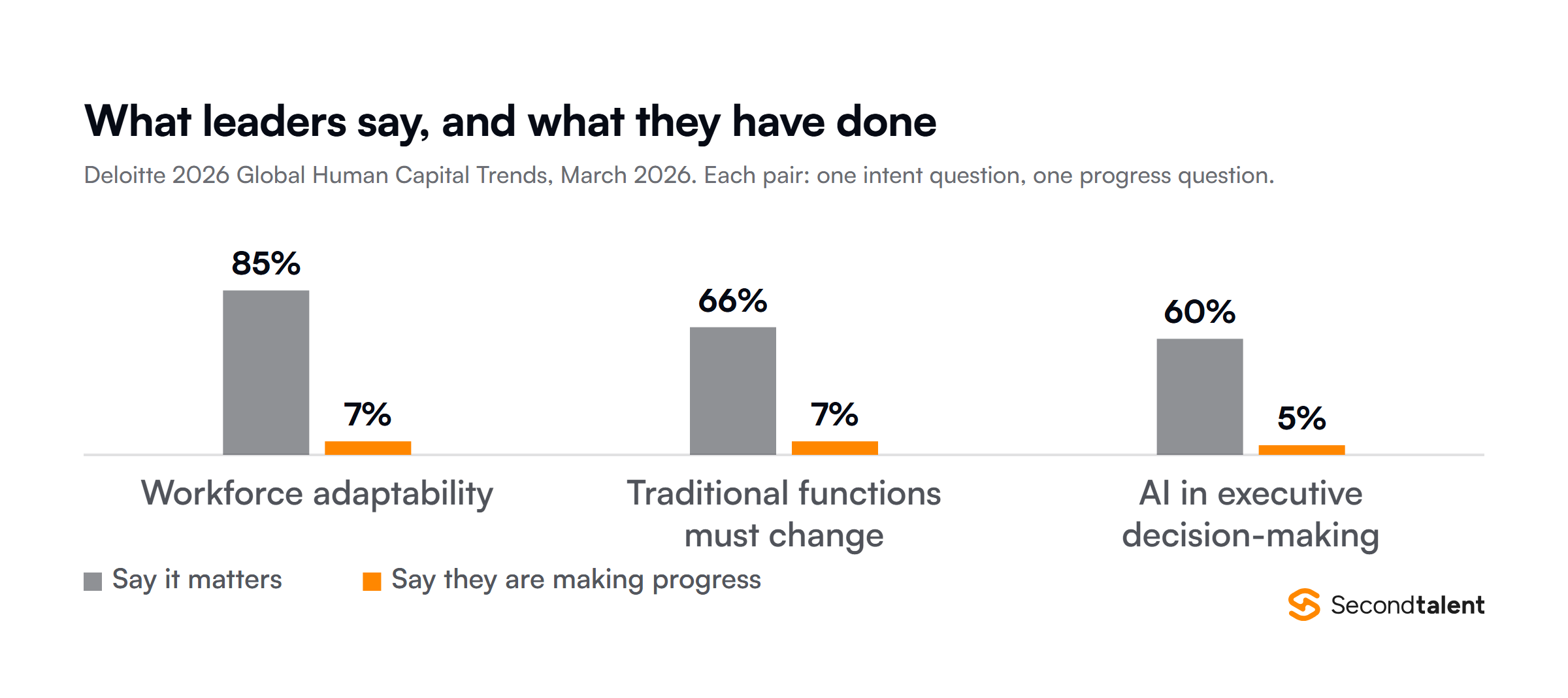
Deloitte’s 2026 trends research frames the same gap as ambition against progress, and its numbers are the starkest in this collection.
- 85% of leaders say building workforce adaptability is critical. 7% say they are leading on it (Deloitte 2026 Global Human Capital Trends, March 2026).
- 66% of C-suite leaders say traditional functions must change. 7% say they are making progress.
- 60% of executives use AI in decision-making. 5% say they manage that well.
- 6% of organisations are making progress on designing human and AI work together.
- 65% believe their culture needs significant change because of AI, and 34% say culture is actively inhibiting AI transformation.
- 56% of leaders design AI solutions for business outcomes alone; 40% design for business and human outcomes together.
- 42% of workers say their organisation is not evaluating AI’s impact on people at all.
- 27% of respondents think their organisation manages change well, while a third of workers went through 15 major changes in a single year.
- 7 in 10 business leaders name being fast and nimble as their main competitive strategy for the next three years.
Recruiting and talent acquisition statistics
Recruiters report more applicants, harder screening and rising AI use, in that order.
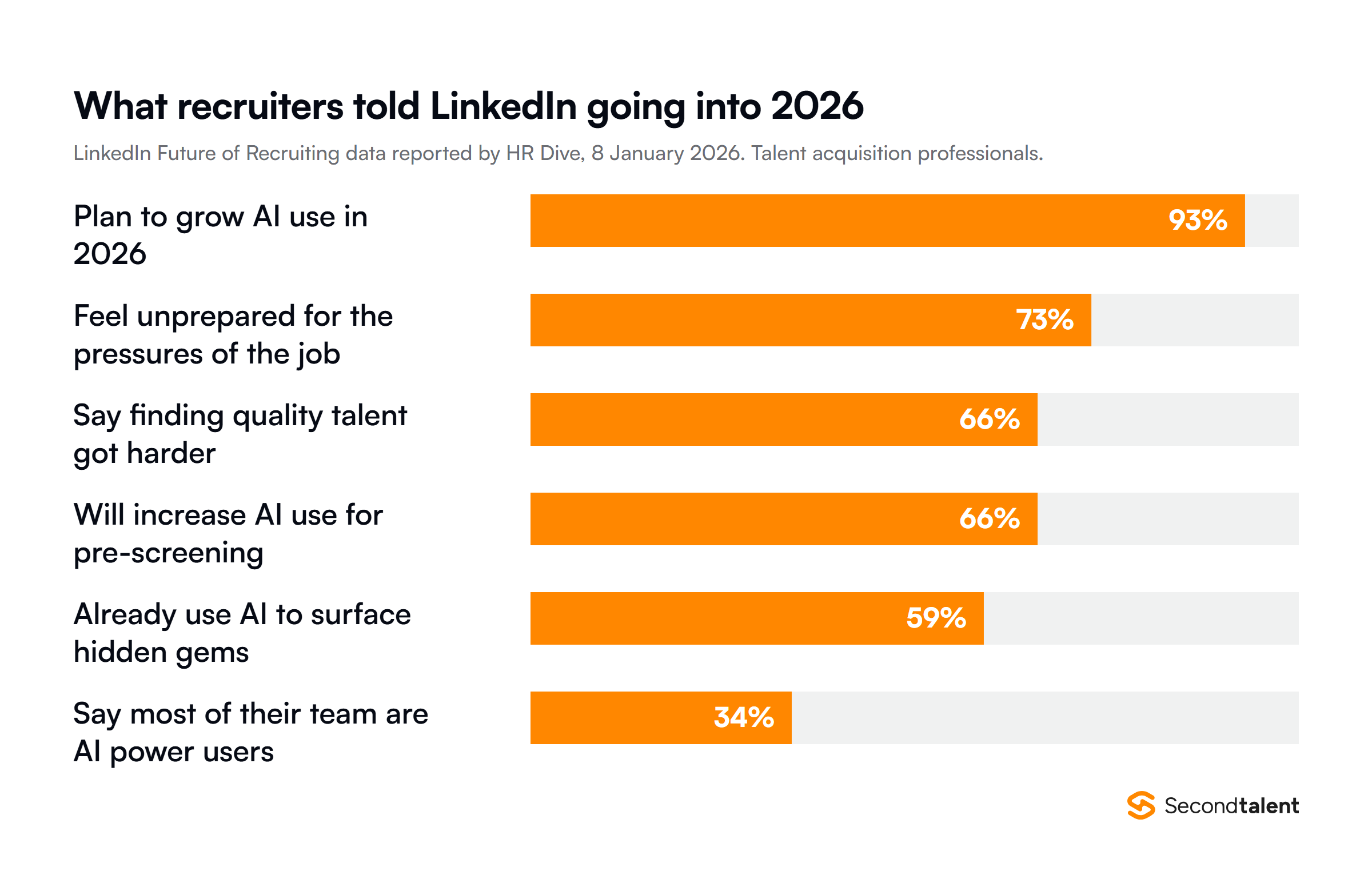
- 93% of talent acquisition professionals plan to grow their AI use in 2026 (LinkedIn, reported by HR Dive, January 2026).
- 66% of recruiters say finding quality talent has got harder.
- 73% say they feel unprepared to manage the pressures of the job.
- 59% already use AI to surface hidden-gem candidates, and 39% are being asked to find them.
- 42% are being asked to fill roles more quickly.
- 66% intend to increase AI use for pre-screening interviews.
- Only 34% say most of their team are AI power users, which is the gap between intent and practice in one number.
- The number of US applicants per open role has doubled since spring 2022.
On the agency side, Bullhorn’s GRID 2026 report surveyed nearly 2,300 recruitment professionals in November and December 2025.
- 55% of firms say AI screening alone lifted their KPIs by more than 25% (Bullhorn GRID 2026).
- 46% say AI cut screening time in half or better.
- Only 10% have AI running across their full workflow.
- 56% of the highest-growth firms report average placement times under 10 days.
- Firms using AI at any stage are 3.5 to 4.5 times more likely to have grown revenue, and top performers are four times as likely to be using it.
- Among firms that grew revenue by more than 25%, 78% use AI embedded in their applicant tracking system.
- 56% reported revenue growth in 2025, up from 40% the year before.
Those correlations are not causal. Firms that can afford AI tooling and firms that grow revenue overlap for reasons the survey does not separate.
Labour market statistics: what the official data says
Survey data measures sentiment. The US Bureau of Labor Statistics measures what actually happened. Its July 2026 Job Openings and Labor Turnover release, published on 1 September 2026, is the current reference point.
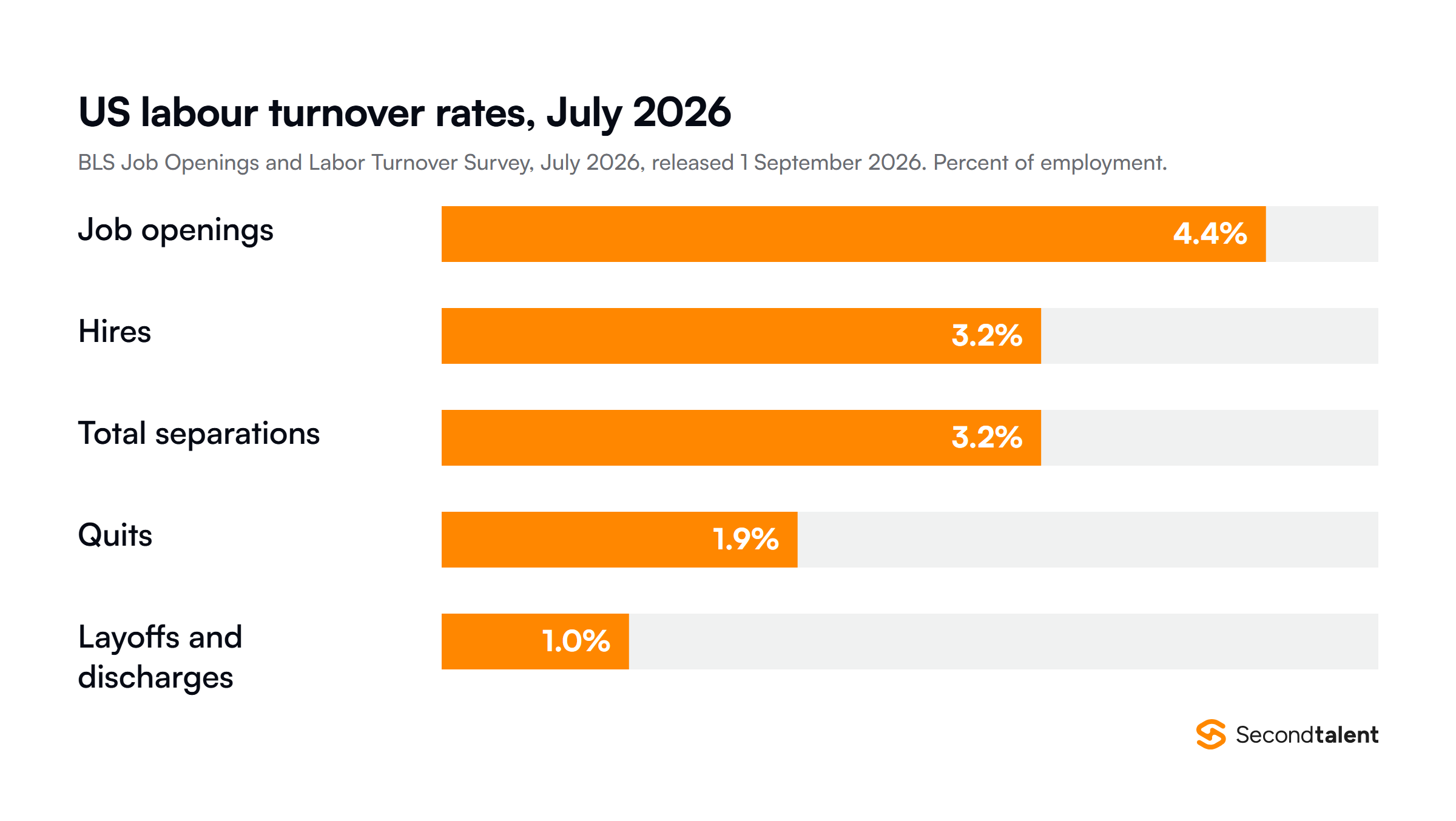
- 7.3 million job openings, a rate of 4.4% (BLS JOLTS, July 2026).
- 5.1 million hires, a rate of 3.2%.
- 5.1 million total separations, a rate of 3.2%. Hiring and leaving are running level.
- 3.1 million quits, a rate of 1.9%, holding at a long-run low.
- 1.7 million layoffs and discharges, a rate of 1.0%.
A 1.9% quit rate is the number to hold onto. Retention statistics quoted from engagement surveys describe how people feel; the quit rate describes what they do, and right now they are staying put.
Remote and hybrid work statistics
Hybrid did not collapse under return-to-office mandates. It settled.
- 51% of remote-capable US employees work hybrid (Gallup, survey fielded 7 to 16 May 2025).
- Hybrid workers spend 46% of the working week in the office, the equivalent of 2.3 days.
- Fully on-site and fully remote work each rose by two percentage points in that quarter, which is movement at both ends rather than a return to the office.
Treat the widely quoted “76% of employees prefer hybrid” style figures with care. Preference numbers come from vendor surveys with self-selecting respondents, and they consistently run above what Gallup measures on a probability sample.
Employee engagement and retention statistics
Gallup’s State of the Global Workplace is the largest continuous dataset here, and its 2026 edition reports the weakest global engagement since 2020.
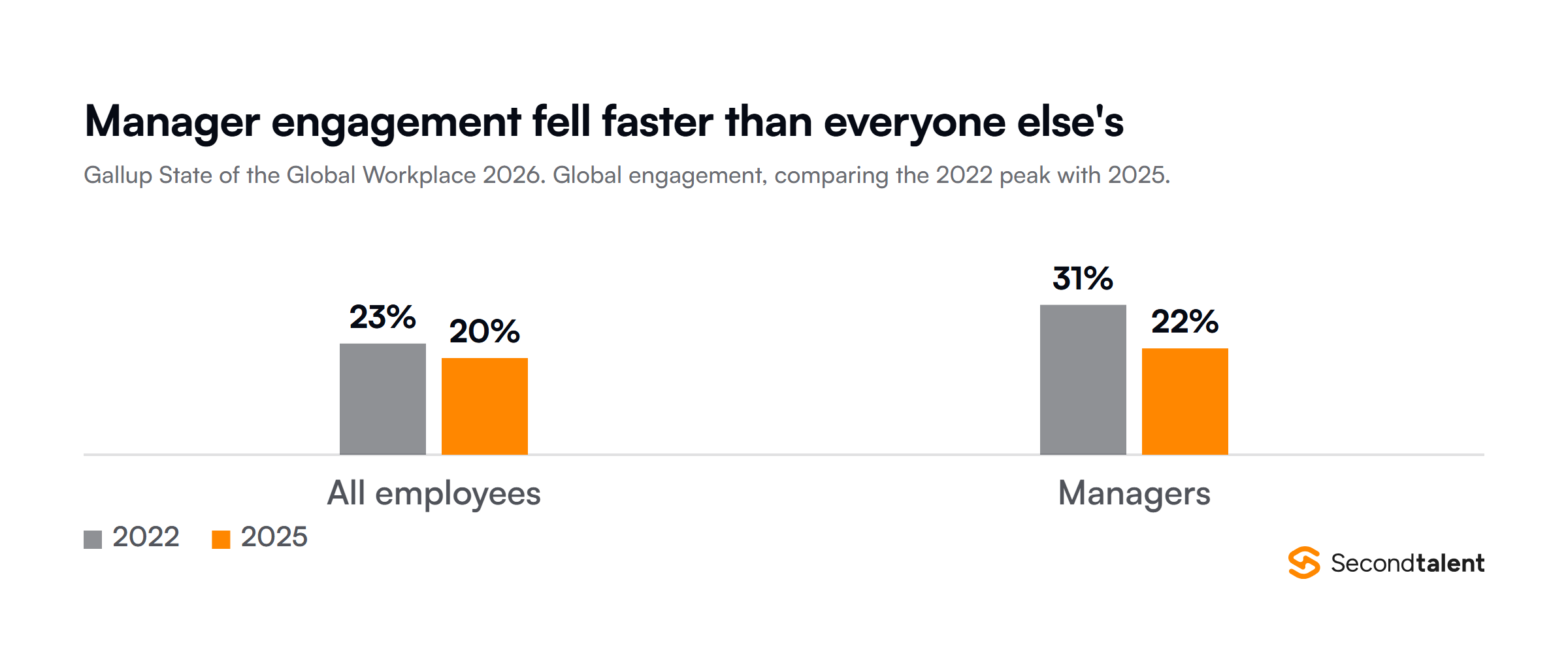
- Global employee engagement fell to 20% in 2025, the lowest since 2020 and down from a 23% peak in 2022 (Gallup State of the Global Workplace 2026).
- Manager engagement fell from 31% in 2022 to 22% in 2025, a steeper slide than the workforce as a whole.
- Low engagement cost the world economy roughly $10 trillion in lost productivity, about 9% of global GDP.
SHRM’s State of the Workplace 2026, fielded across 1,856 HR professionals and 2,079 US workers in late 2025, connects that to intent to leave.
- 72% of HR professionals say workers now hold higher expectations of employers (SHRM, January 2026).
- 91% of workers at organisations they judge effective at addressing workplace needs report job satisfaction, against 44% at organisations they judge ineffective.
- 51% of workers at those ineffective organisations say they are at least somewhat likely to leave within a year.
Read that against the 1.9% quit rate above. Half of one group say they may leave; national data says almost nobody is moving. Intent to leave and leaving have separated, and treating the first as a forecast of the second overstates your turnover risk.
HR leader priorities for 2026
SHRM surveyed 129 CHROs and senior-most HR leaders between 7 October and 5 November 2025.
- 46% name leadership and manager development as a top priority.
- 31% name workplace culture, up from 15% a year earlier, the largest single move in the set.
- 29% name employee experience.
- 92% anticipate greater AI integration and 84% expect more AI-specific upskilling.
- 57% flag reducing bias in AI hiring tools.
- 43% cite rising operational costs and 42% feel pressure to meet financial goals.
- 47% point to managing a multigenerational workforce.
- Separately, 47% of 222 CHROs told Gartner in July 2025 that their culture drives employee performance today (Gartner, October 2025).
People analytics statistics
Insight222’s People Analytics Trends 2025/26 study covers 372 organisations employing more than 20 million people across over 180 countries, published in February 2026.
- People analytics teams have grown 60% since 2020 (Insight222).
- Staffing sits at roughly one practitioner per 2,500 employees.
- 52% of organisations report measurable business improvements from people analytics.
- Among top-performing teams that figure reaches 90%.
- 70% have invested in AI technologies for the function.
Skills and learning statistics
The World Economic Forum’s Future of Jobs Report 2025 remains the reference forecast. It draws on more than 1,000 employers representing over 14 million workers across 22 industry clusters and 55 economies.
- 39% of workers’ key skills are expected to change by 2030, down from 44% in the 2023 edition (WEF Future of Jobs Report 2025).
- 170 million new roles are projected to be created by 2030 and 92 million displaced, a net gain of 78 million.
- That churn equals 22% of the 1.2 billion formal jobs in the dataset.
- Technological skills are forecast to grow in importance faster than any other category, led by AI and big data.
On what learning teams are seeing now, LinkedIn’s 2025 Workplace Learning Report is the most recent edition published.
- 49% of learning and talent professionals agree their executives are concerned employees lack the skills to execute the business strategy (LinkedIn Workplace Learning Report).
- 91% of L&D professionals agree continuous learning matters more than ever for career success.
- 84% of employees agree that learning adds purpose to their work.
Compensation and pay budget statistics
Three independent salary budget surveys landed within a few tenths of a point of each other for 2026, which is unusual and worth noticing.
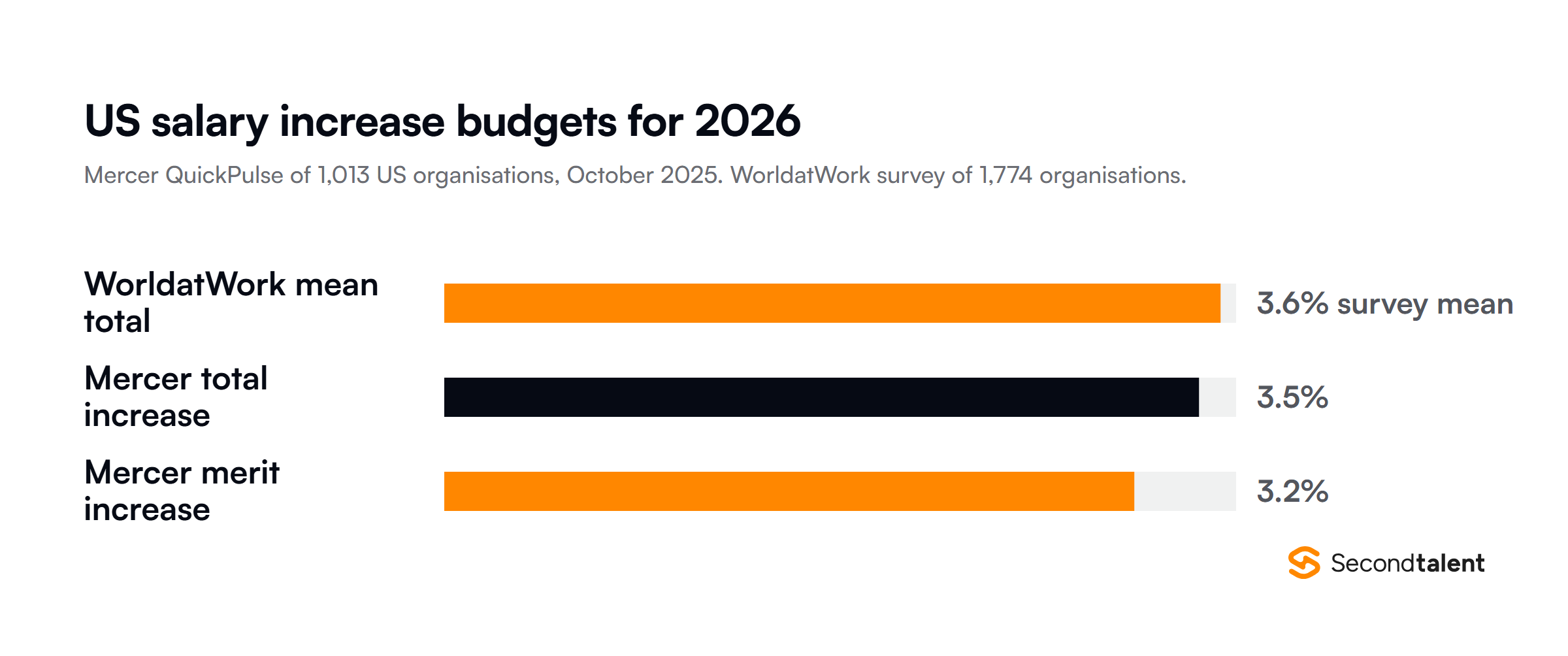
- US employers plan merit increases of 3.2% and total increases of 3.5% for 2026 (Mercer, 1,013 US organisations surveyed 20 to 31 October 2025).
- WorldatWork’s survey of 4,250 rewards and HR leaders at 1,774 organisations puts the US mean at 3.6% (WorldatWork).
- 61% of employers expect the economy to have a moderate to significant effect on their 2026 compensation decisions.
- 83% plan to distribute increase budgets equally across the organisation rather than concentrating them.
- Employers expect to promote about 9% of the workforce in 2026, down from 10% in 2025, at an average promotional increase of 8.7%.
- Only 2% of employers cite AI and automation as a reason for reduced hiring, 57% report stable hiring volumes despite AI adoption, and 9% plan AI-related headcount changes.
- By industry, total increases run from 3.4% in healthcare services to 3.7% in financial services, energy and high tech.
That last cluster is the most quietly useful set of figures in this piece. The story about AI eliminating headcount is not showing up in what employers tell compensation surveyors about their own hiring plans.
How to use these statistics without misusing them
Most HR statistics posts fail in the same four ways. Checking for them takes a minute and saves a wrong decision.
- Check who was asked. “88% of HR leaders” and “62% of employees” answer different questions. Gartner’s HR leader samples here run to 114 and 222 people; its employee sample runs to 2,986. Both are real, and they are not interchangeable.
- Check the date. Several 2026 headline figures come from surveys fielded in mid-2025. That is normal and it is also a year of AI product cycles.
- Do not difference across sources. Subtracting one tracker’s number from another’s produces a figure nobody published. Where sources disagree, both belong on the page with their names attached.
- Separate stated intent from behaviour. The clearest example in this whole set is the 51% who say they might leave against a 1.9% national quit rate.
Anything that could not survive those four checks was left out. That is why some widely circulated figures from earlier versions of this page, including several attributed to research firms with no traceable report behind them, no longer appear.
What this means if you are hiring in 2026
Applicant volume has doubled, quit rates are at a low, and pay budgets are flat. Hiring is slow and crowded rather than competitive, and the constraint has moved from finding people to sorting them.
Second Talent handles that sorting for you. We place pre-vetted engineers, designers and operators across nine Asian markets for a flat monthly fee. If the numbers above are shaping your plan, our AI recruitment tools cost comparison and the guide to evaluating engineering talent remotely cover the tooling and the judgement. Our remote work hiring statistics and employee retention statistics go deeper on two of the sections above. When you are ready to hire, tell us what you need.
Frequently asked questions
What percentage of HR teams use AI in 2026?
There is no single trustworthy number, because surveys measure different things. Gartner found 88% of HR leaders say their organisation has not seen significant business value from AI tools, which implies broad use without measured return. On the employee side, 62% say AI saved them time. Treat any single “X% of HR uses AI” claim as a claim about one survey’s definition.
What is the current employee engagement rate?
Global employee engagement was 20% in 2025, the lowest level since 2020, according to Gallup’s State of the Global Workplace 2026. It peaked at 23% in 2022. Manager engagement fell further and faster, from 31% to 22% over the same period.
What is the current US quit rate?
1.9%, or 3.1 million people, in July 2026, per the BLS Job Openings and Labor Turnover Survey released on 1 September 2026. That rate has held at a long-run low, alongside 7.3 million job openings and 5.1 million hires.
How much are salaries rising in 2026?
US salary increase budgets sit at roughly 3.5%. Mercer puts total increases at 3.5% and merit at 3.2% from 1,013 organisations; WorldatWork puts the mean at 3.6% from 1,774 organisations. This is the third consecutive year of stability after the sharp rises of 2021 to 2023.
Is hybrid work still the norm?
Yes. 51% of remote-capable US employees work hybrid, and hybrid workers average 2.3 days a week in the office, which is 46% of the working week. Gallup measured both in a survey fielded in May 2025, and found fully remote and fully on-site work each rising by two points in the same quarter.
How many jobs will AI displace by 2030?
The World Economic Forum projects 92 million roles displaced and 170 million created by 2030, a net gain of 78 million, across more than 1,000 employers representing 14 million workers in 55 economies. That churn equals 22% of the 1.2 billion formal jobs studied. It is a forecast, not a measurement.



![Workplace Diversity Statistics. Top 100+ Workplace Diversity Statistics [2026], by Second Talent.](https://www.secondtalent.com/wp-content/uploads/2026/09/workplace-diversity-statistics-featured-v2-768x403.jpg)