TL;DR: Yes, DataAnnotation is legit: it is run by Surge AI, charges nothing to join and pays through PayPal. The catch is access, because you get one attempt at the entry assessment, many applicants never hear back, and project work can stop without explanation.
The company behind DataAnnotation, Surge AI, reported $1.2 billion in revenue in 2024, according to Contrary Research, and counts OpenAI and Anthropic among its clients. Its own pages disagree about what it has paid the people doing the work: “over $20 million” since 2020 in the FAQ, and “$150M+” on the About page.
- 1A class action filed in San Francisco names the operator as Surge Labs, Inc. dba DataAnnotation, alongside CEO Edwin Chen.
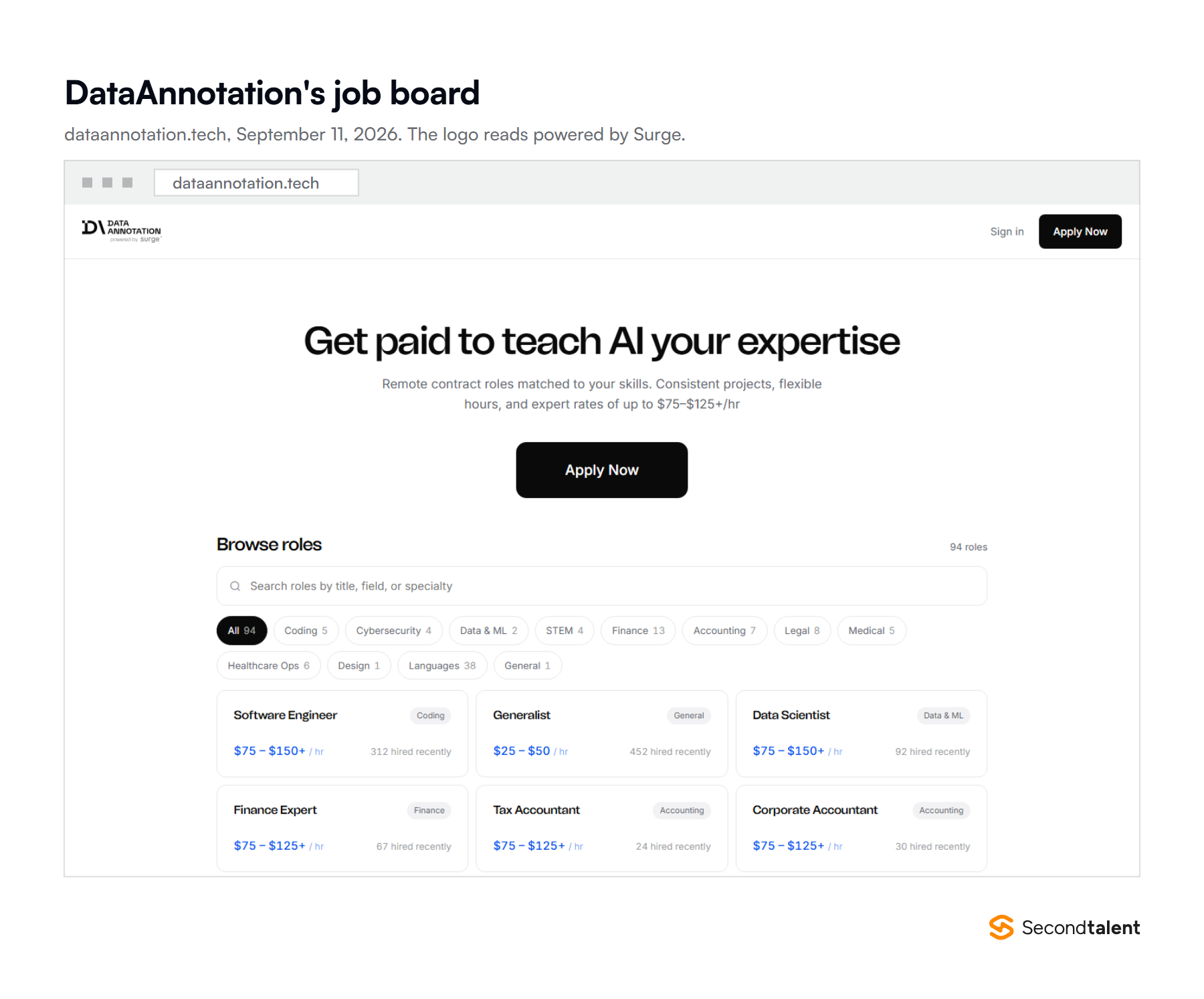
- 239 of the 94 roles on its job board pay $25 to $50 an hour, and they account for 56% of recent hires.
- 3Trustpilot reviewers split into two camps: 55% give five stars and 20% give one, with 6% at two or three.
- 4The company says it accepts 2.6% of applicants, and the Starter Assessment cannot be retaken.
Is DataAnnotation Legit?
Yes. DataAnnotation is a real AI training platform, owned by a company with a known founder, a San Francisco head office and paying clients, and it charges applicants nothing. Workers on Trustpilot and in Time’s reporting say the money arrives. Their complaints are about getting in, staying busy and, in some cases, losing unpaid work when an account is closed. None describe a fake company.
- Run by Surge AI, named in court papers and on its own logo
- No fees to apply, train or verify your identity
- Pay goes out through PayPal, on request
- Published hourly rates for 94 roles
- One attempt at the assessment, often no reply
- Work can dry up with no explanation
- A 2025 class action over contractor status
- Its own pages give conflicting pay and payout figures
DataAnnotation is not a job, though. Everyone on the platform is an independent contractor, paid an hourly rate per project, with no guaranteed hours. That contractor status is what the lawsuit below is about.
Who Owns DataAnnotation?
Surge AI, a San Francisco data-labeling company founded in 2020 by Edwin Chen, who had worked on content moderation and recommendation algorithms at Twitter, Google and Facebook. For its first few years the link was only reported: in April 2024, Time described DataAnnotation as “reportedly a subsidiary of Surge AI”. It is now confirmed three ways.
- Court papers. The May 2025 class action names the defendant as “Surge Labs, Inc. dba DataAnnotation”, a Delaware corporation based in San Francisco.
- The logo. The dataannotation.tech header now reads “powered by surge”.
- Analyst coverage. Contrary Research’s September 2026 report describes Data Annotation as the Surge subsidiary that engages more than 1 million gig workers in 50 countries.
Contrary lists OpenAI, Anthropic, Google, Meta, Microsoft and Mistral AI among Surge’s customers, and says Chen started the company with “a couple million” of his own savings. DataAnnotation’s own privacy notice, updated June 23, 2026, still names no legal entity, only “DataAnnotation.tech and each of its owners and affiliates”.
Surge’s rival Mercor went through a different kind of trust test this year, a large data breach. Our look at whether Mercor is legit covers that one.
What DataAnnotation Says About Itself
Less than it should, and the figures conflict. The company publishes headline figures on several pages, and they do not agree with each other or with outside counts.
The two payout totals cannot both be current, and the About page contradicts itself as well: it lists “120M+ annotations completed” and “13B+ annotations to date” a few scrolls apart. Contrary’s count of more than 1 million workers covers all of Surge, not only the people who passed DataAnnotation’s assessment.
None of this makes the platform fake. It does mean the marketing figures are a poor guide to your odds or your likely earnings. The job board’s per-role counters and pay bands, below, tell you more.
How Much Does DataAnnotation Pay?
Between $25 and $150 an hour, depending on the role. The job board on dataannotation.tech lists 94 roles, each with an hourly band, and the specialist bands start at $60 to $75, against $25 for generalist and language roles.
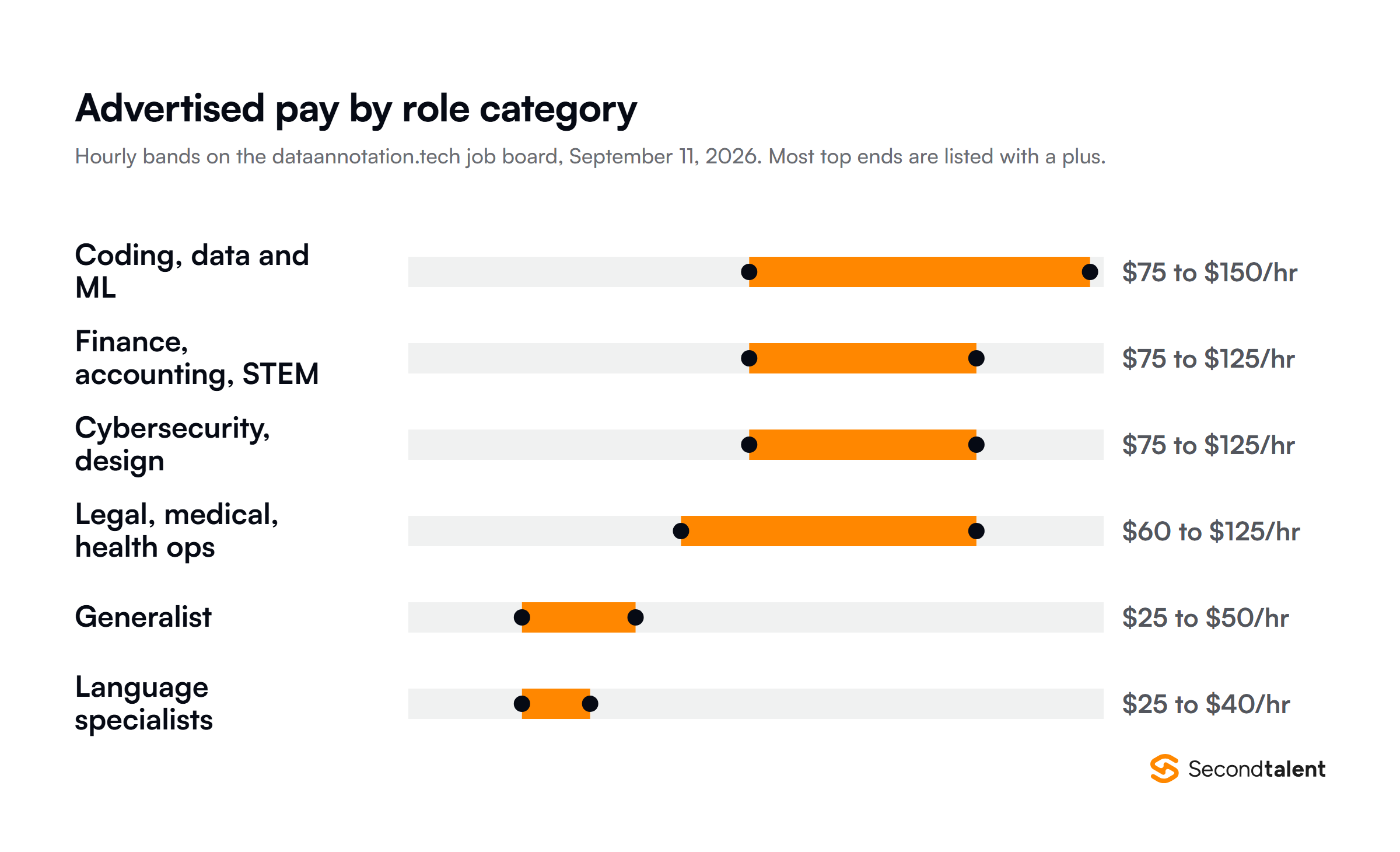
Those bands are higher than the rates in the DataAnnotation FAQ, which still quotes $25 to $30+ for general work, $20+ for multilingual work and $50 to $100+ for coding, STEM and professional projects. In April 2024, Time reported the platform offering $40 an hour for coding tasks.
The headline rate also describes a minority of the people hired. Each role on the board shows a “hired recently” counter. Adding them up, the 39 language and generalist roles account for 3,271 of the 5,867 recent hires, by our count.
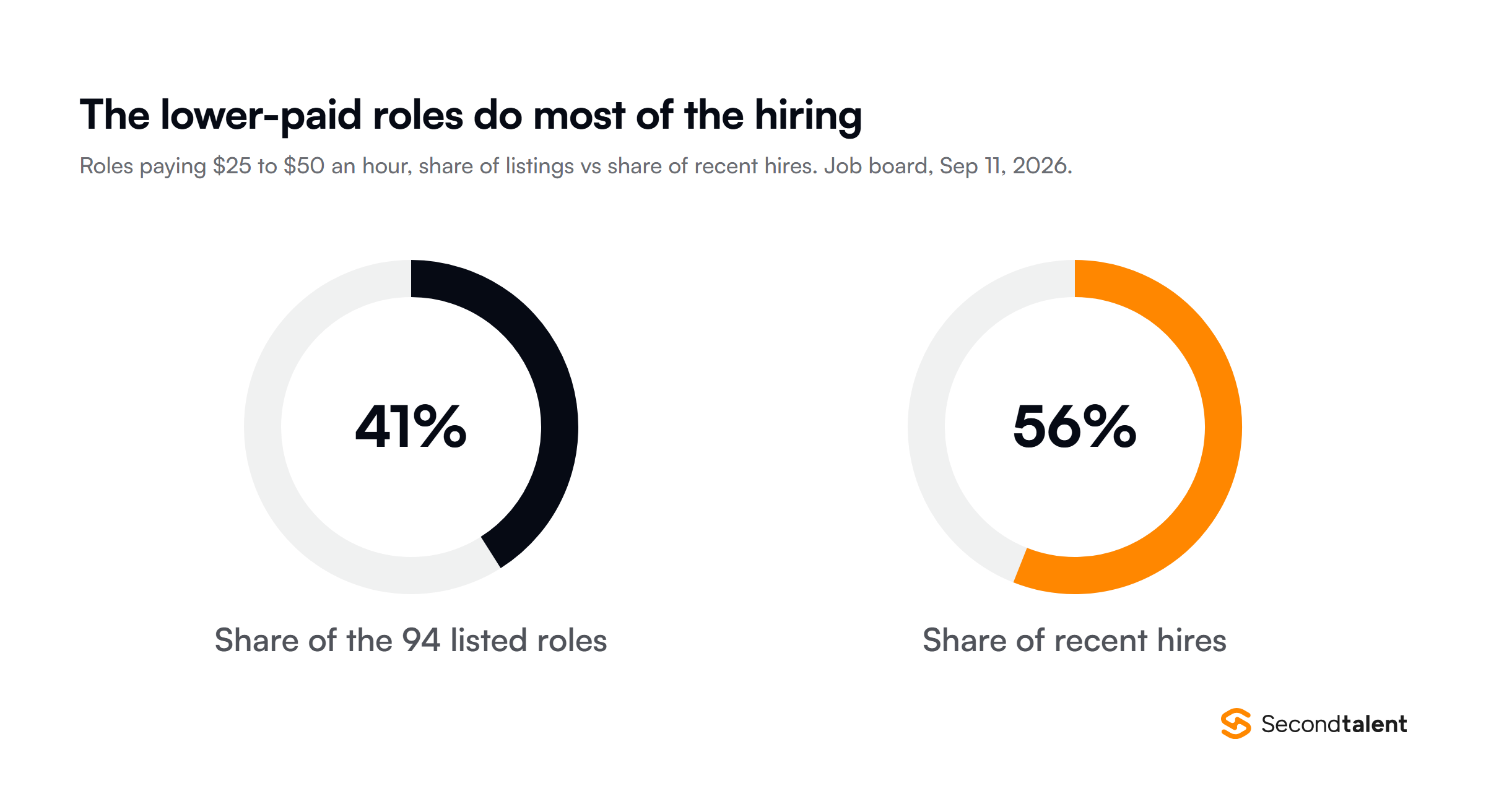
The busiest single roles are Generalist (452 recent hires), Software Engineer and Spanish Specialist (312 each) and Hindi Specialist (288). The board does not say what period “recently” covers.
Payment runs through PayPal. The FAQ says deposits arrive “within a few days” of a withdrawal request, and the About page says the platform pays out after each completed project. For context on how those rates compare with annotation pay in other markets, see our breakdown of data annotation costs by country.
How the DataAnnotation Application Works
You pick a track, sit one Starter Assessment and wait. There is no interview and no recruiter, and the FAQ is blunt that the assessment cannot be retaken: “There are no retakes or second chances.”
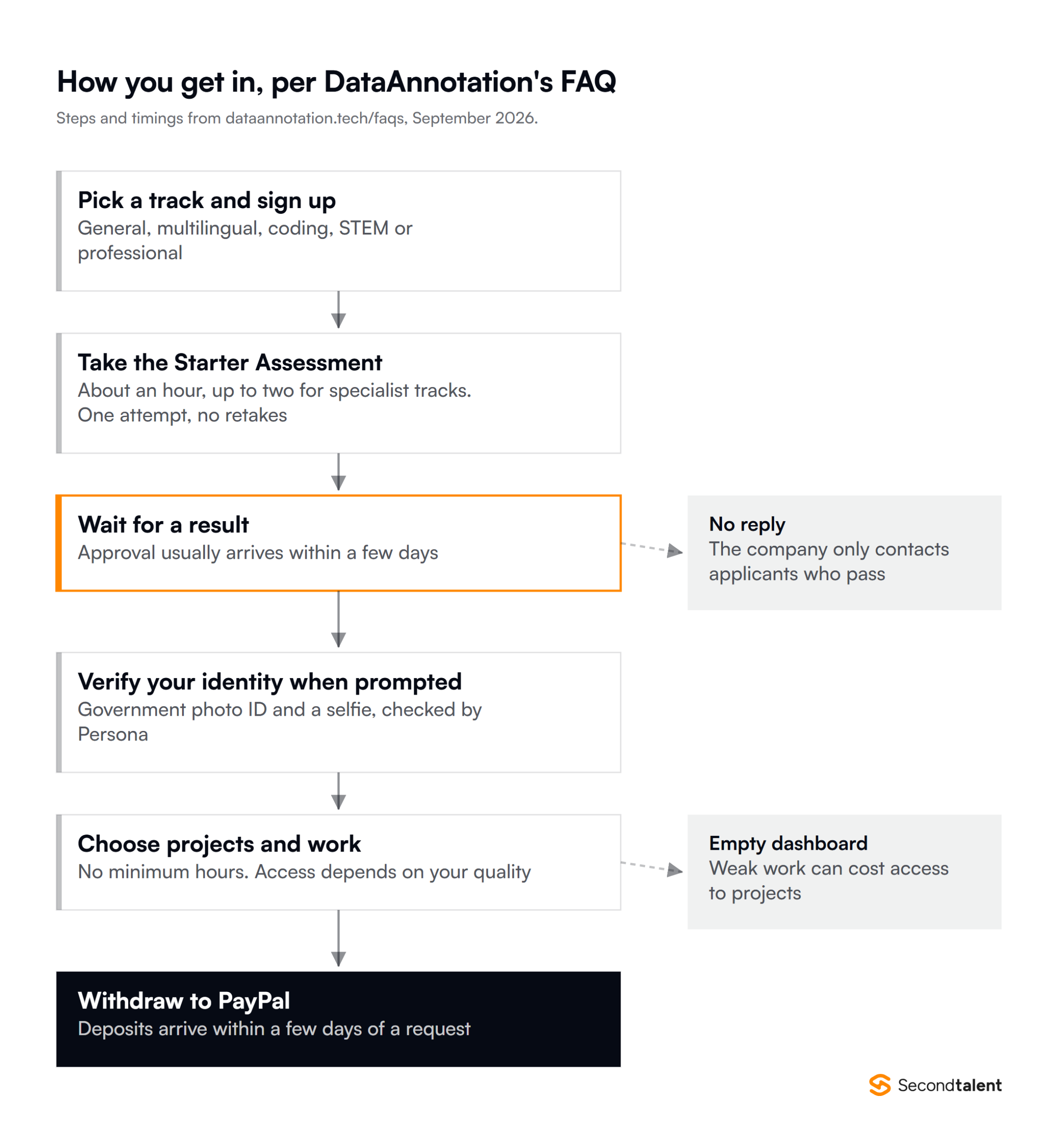
The assessment takes about an hour. Specialist tracks in coding, science, finance, law, medicine and languages take one to two. The coding track expects Python or JavaScript and, in the FAQ’s words, the “ability to solve LeetCode-style problems”. Specialist tracks for STEM ask for a master’s or PhD, or a bachelor’s degree plus 10 years of experience.
The platform later prompts you to verify your identity through Persona with a government photo ID and a selfie, free of charge. If you do not pass the assessment, you may hear nothing. The FAQ says the company “will contact you if your assessment passes our review”, and that it is “unable to provide direct responses for every applicant”.
The company’s April 2026 blog post, titled Is DataAnnotation a Scam?, puts its acceptance rate at 2.6%, so most applicants never get in.
Every worker must be fluent in English and have reliable internet, and the About page says the platform is available in 50+ countries. The job board lists 38 language roles, from Spanish and Hindi to Catalan and Odia, all at $25 to $40 an hour.
Projects, in the FAQ’s words, “run the gamut: from survey-style work, to interacting with chatbots, to creative writing tasks”. General work means rating chatbot answers, comparing two outputs and testing image generation. Coding work means reviewing and debugging AI-written code. Our guide to data annotation for LLM fine-tuning explains how that feedback trains a model.
What Workers Say in Reviews
Three in four reviewers rate it four or five stars, and one in five gives it one. DataAnnotation has a TrustScore of 3.9 from 1,961 reviews on Trustpilot, with few in between.
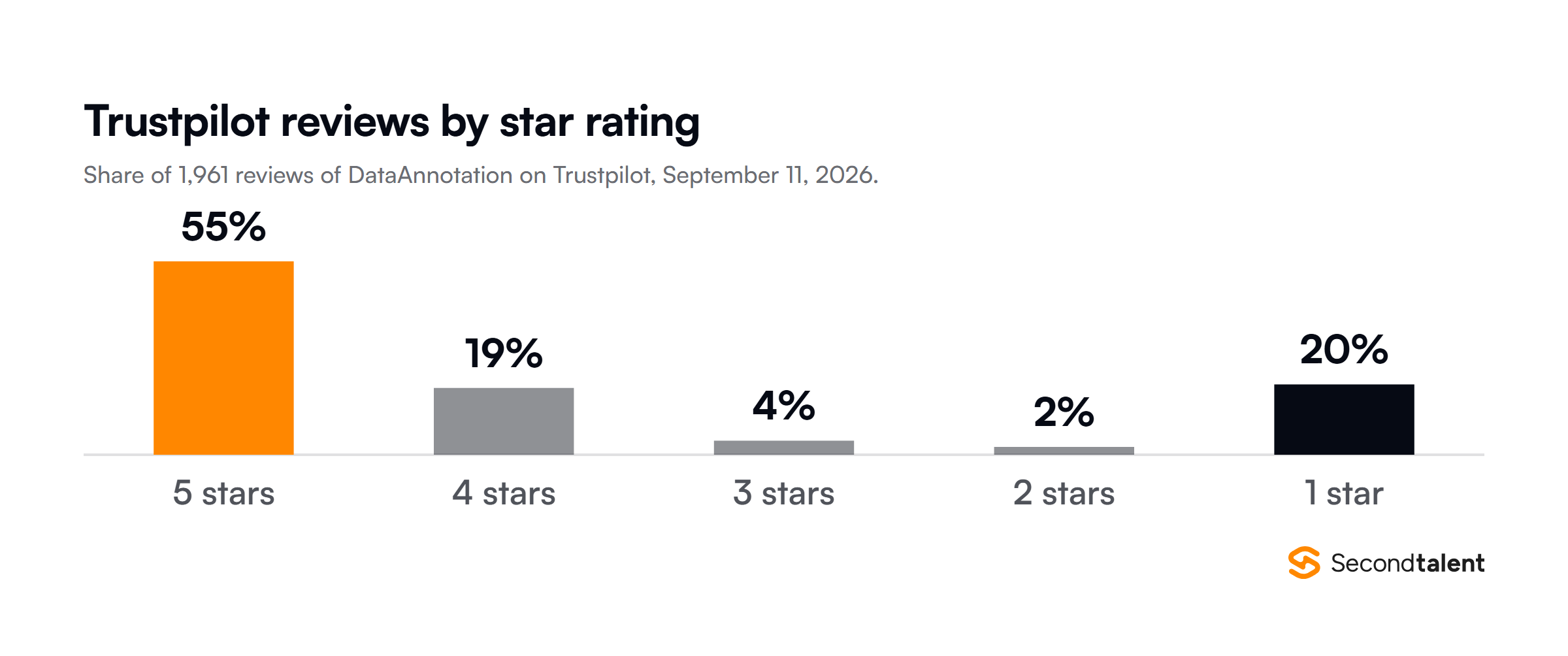
A US reviewer in December 2025 called the platform “simple and direct”. A one-star review from June 2026 describes the problem the FAQ warns about, a dashboard that empties with no message:
“I was hoping to be sent further paid projects, as promised, only to find 0 projects every day for several weeks.”
Trustpilot reviewer, New Zealand, June 2026
The FAQ explains the mechanism without apology: “subpar or problematic contributions may result in loss of access to future projects.” Time’s 2024 report found worse outcomes too, including workers told they had passed who were never offered tasks, and one whose account the platform deactivated with $2,869 of work unpaid.
The Worker Misclassification Lawsuit
On May 20, 2025, a California annotator filed a proposed class action in San Francisco Superior Court, case CGC-25-625502, arguing that DataAnnotation’s contractors should count as employees under California law. The suit, brought by Clarkson Law Firm, lists nine claims: eight under the California Labor Code, from minimum wage to meal and rest breaks, and one for unfair competition.
The complaint makes three allegations that matter to anyone applying:
- Unpaid assessments. Annotators must pass a training assessment “for which Data Annotators are not compensated”, and sit further unpaid qualification exams when moved to new projects.
- Time limits. Workers are paid only for time spent within each task’s limit, “regardless of how long a task actually takes”.
- Access. The company can “revoke a Data Annotator’s access to all projects at any time”.
These are allegations, not findings. We found no ruling or settlement in the court listings and news coverage we checked as of September 2026.
How to Spot a Fake DataAnnotation Offer
The real platform never asks for money. Its FAQ says so: “We will never ask for money from you for anything.” Applications happen only at dataannotation.tech, and its About page promises “No recruiters. No interviews.”
That matters because fake remote-work offers use the same language. In April 2026 the FTC warned about texts offering “online assessor” work that end in task scams, where victims must deposit their own money to unlock earnings. Its advice:
“Ignore generic and unexpected texts, WhatsApp, or Telegram messages about jobs.”
US Federal Trade Commission, consumer alert, April 30, 2026
Three checks catch the common fakes: the domain is exactly dataannotation.tech, nobody asks you to pay or buy anything, and the first contact came from you applying, not from a stranger messaging you.
Hiring AI Trainers or Looking for the Work?
If you are building an AI product and want that kind of evaluator on your own team, we place dedicated, vetted AI training specialists and data annotators from Asia who work on your team, and our list of platforms to hire data annotation experts compares the other options.
Tell us the role and we will send vetted profiles within 24 hours.
FAQs
Is DataAnnotation the same company as Surge AI?
DataAnnotation is the brand Surge AI uses to hire contractors. Court papers name the operator as Surge Labs, Inc. doing business as DataAnnotation.
Can I retake the DataAnnotation assessment?
No. The FAQ says you can only take the Starter Assessment once, so read the instructions and review your answers before you submit.
How is DataAnnotation different from Mercor?
DataAnnotation admits people through a one-time Starter Assessment and pays hourly rates for platform tasks. Mercor screens contractors through recorded AI interviews; our Mercor alternatives page compares it with other platforms.

![Is Micro1 Legit?. Is Micro1 Legit? Pay, Reviews and How It Works [2026], by Second Talent.](https://www.secondtalent.com/wp-content/uploads/2026/09/is-micro1-legit-featured-v2-768x403.jpg)