
TL;DR: The best platforms to hire data annotation experts in 2026 include Second Talent, Scale AI, Labelbox, Appen, Cloudfactory, Sama, and Toloka, each offering unique pricing, quality, and scalability.
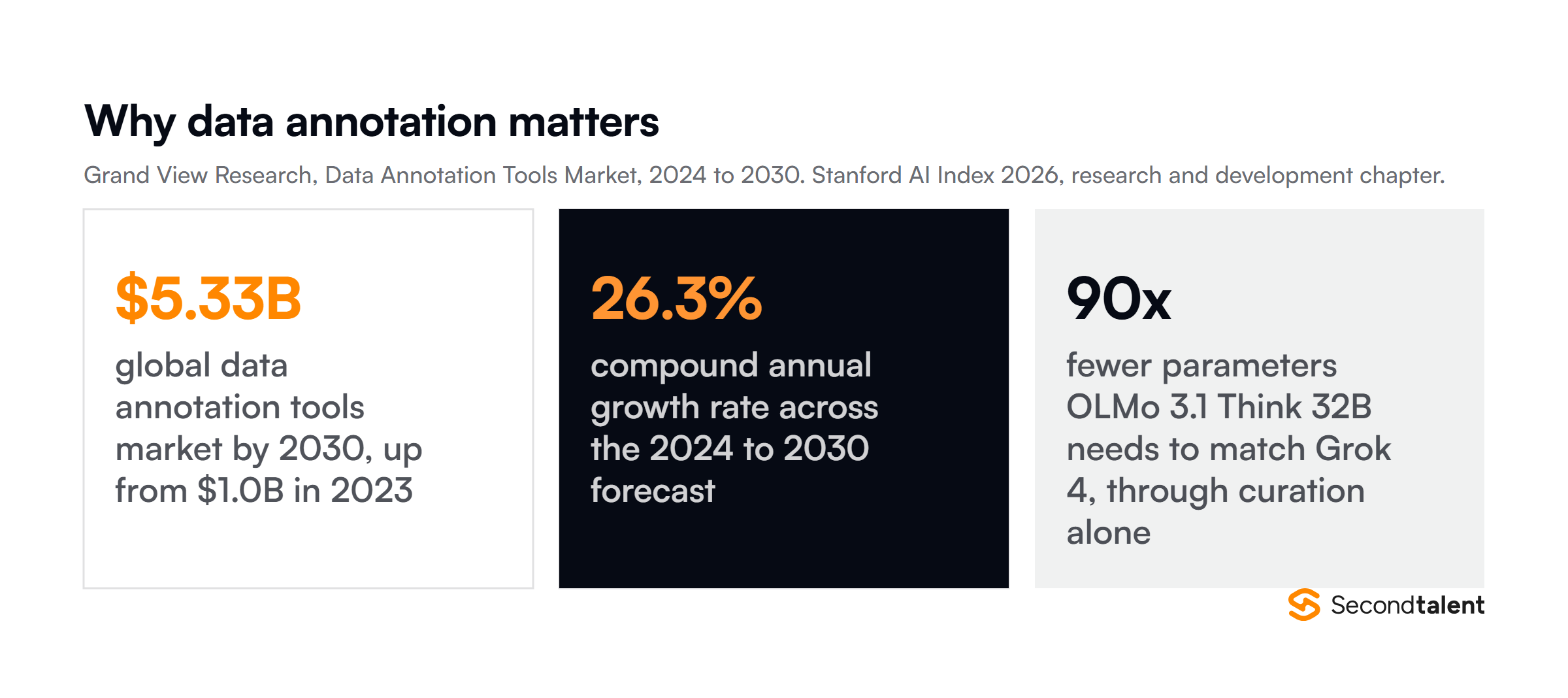
The global data annotation tools market is projected to reach $5.33 billion by 2030, up from $1.0 billion in 2023 and growing at a 26.3% CAGR, according to Grand View Research.
This explosive growth reflects a simple truth: AI is only as good as the data it learns from. Without accurate, high-quality labeled data, machine learning models fail to deliver reliable results.
For business owners, HR leaders, and startup founders building AI-powered products, finding skilled data annotation experts has become a strategic priority.
The challenge lies in knowing where to find qualified professionals who can deliver consistent quality at scale.
This guide covers the top 7 platforms to hire data annotation experts in 2026.
You will learn about each platform’s strengths, pricing models, and ideal use cases, helping you make an informed hiring decision that aligns with your project requirements and budget.
Platform Comparison: Pricing and Fee Models
Understanding pricing structures is essential for budgeting your data annotation projects. Below is a comparison of how each platform structures its fees:
| Platform | Pricing Model | Minimum Commitment | Hidden Fees |
|---|---|---|---|
| Second Talent | Monthly retainer | None | No platform fees |
| Scale AI | Enterprise contracts | $50,000+ | Setup and integration fees may apply |
| Labelbox | Subscription + per-task | Free tier available | Workforce costs separate |
| Appen | Per-task pricing | Project minimum varies | Quality review surcharges |
| CloudFactory | Custom quotes | Volume commitments | Training costs may apply |
| Sama | Project-based | Enterprise focus | Generally transparent |
| Toloka | Pay-per-microtask | No minimum | Quality control costs extra |
When comparing costs, consider the total cost of ownership. A lower per-task rate often comes with trade-offs in quality that require additional review cycles.
Many companies find that hiring dedicated remote talent offers better long-term value than per-task crowdsourcing.
What Is Data Annotation and Why Does It Matter?
Data annotation is the process of labeling raw data (such as images, text, audio, or video) so that machine learning algorithms can understand and learn from it.
Think of it as teaching a computer to recognize patterns by showing it thousands of correctly labeled examples.
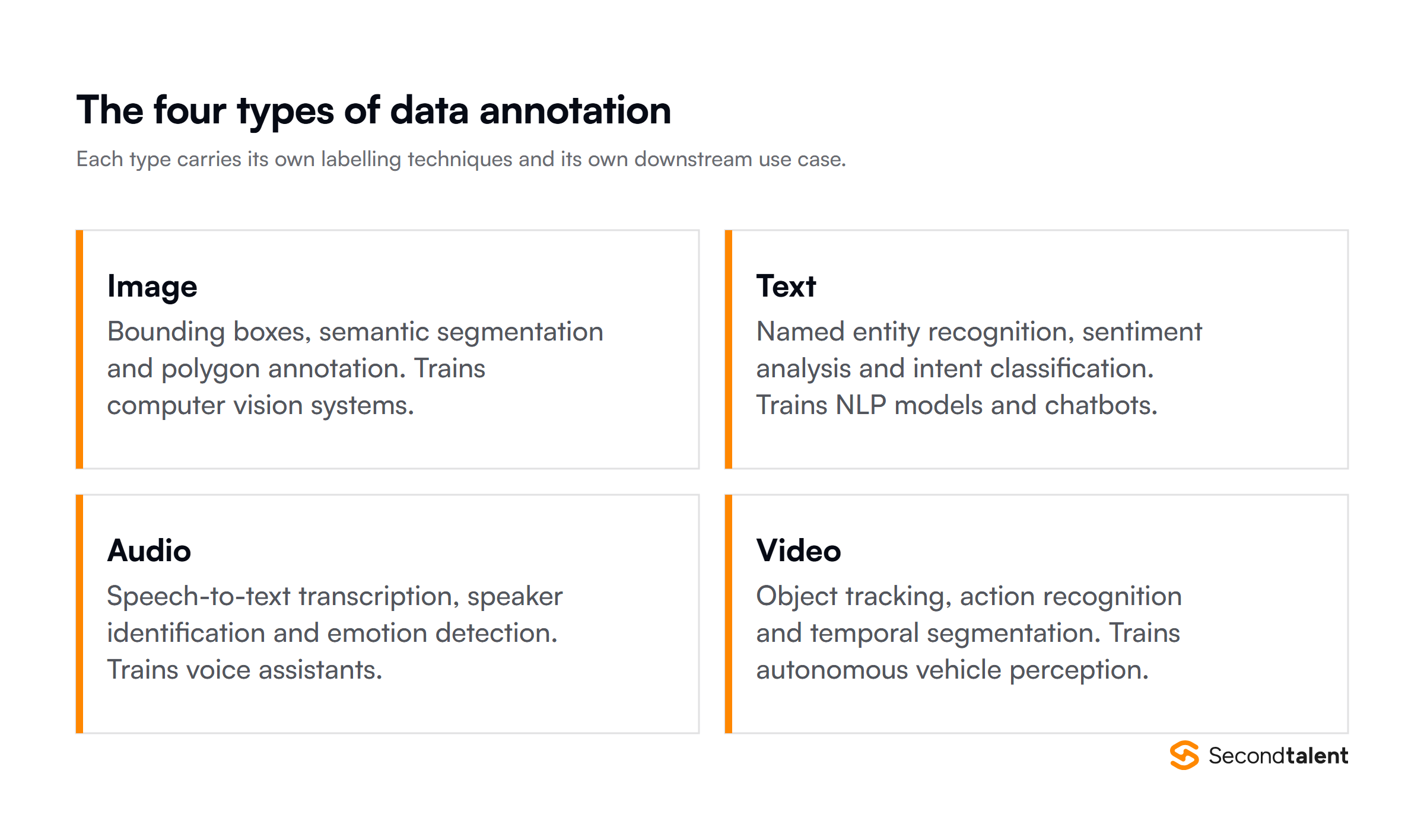
Common types of data annotation include:
- Image annotation: Bounding boxes, semantic segmentation, polygon annotation for computer vision
- Text annotation: Named entity recognition (NER), sentiment analysis, intent classification for NLP
- Audio annotation: Speech-to-text transcription, speaker identification, emotion detection
- Video annotation: Object tracking, action recognition, temporal segmentation
Data quality is now a lever on par with model size. The Stanford AI Index 2026 reports that OLMo 3.1 Think 32B matches Grok 4 on several benchmarks with nearly 90 times fewer parameters, through pruning, deduplication and curation alone.
This directly impacts business outcomes, from more accurate product recommendations to safer autonomous vehicles.
Top 7 Platforms to Hire Data Annotation Experts in 2026
1. Second Talent

Second Talent specializes in connecting businesses with Asia’s top 1% tech talent, including highly skilled data annotation experts.
Unlike crowdsourced platforms, Second Talent provides pre-vetted professionals who integrate directly with your team.
What sets Second Talent apart is its rigorous vetting process. Each candidate undergoes technical assessments, English proficiency tests, and cultural fit evaluations.
This results in annotation specialists who understand complex project requirements and communicate effectively with global teams.
- Best for: Companies needing dedicated annotation specialists for long-term projects
- Pricing: Competitive monthly rates with no platform fees
- Turnaround: Candidates matched within 2-3 weeks
- Key strength: Direct team integration, no middleman communication barriers
2. Scale AI

Scale AI is a leading data annotation platform trusted by major enterprises including OpenAI, Microsoft, and Toyota. The company combines a global workforce with advanced automation tools to deliver high-quality labeled data at scale.
Scale AI excels at complex annotation tasks, particularly for autonomous vehicle development and generative AI training. Their proprietary quality control systems ensure accuracy rates above 95% for most project types.
- Best for: Enterprise-level projects requiring massive scale and complex annotations
- Pricing: Custom enterprise pricing; typically $50,000+ minimum contracts
- Turnaround: Variable based on project complexity
- Key strength: Advanced AI-assisted annotation tools and enterprise security
3. Labelbox

Labelbox provides a comprehensive data labeling platform that combines software tools with access to skilled annotators.
The platform is particularly popular among machine learning teams who want more control over their annotation workflows.
Labelbox’s strength lies in its flexible approach. You can use their workforce, bring your own annotators, or combine both. The intuitive interface makes it easy to manage projects, track quality metrics, and iterate quickly.
- Best for: ML teams wanting platform flexibility and workflow customization
- Pricing: Free tier available; paid plans start at $2,500/month
- Turnaround: Dependent on workforce selection
- Key strength: Powerful annotation interface and model-assisted labeling
4. Appen

Appen operates one of the largest crowdsourced workforces in the data annotation industry, with over 1 million contractors across 170+ countries.
This global reach makes them particularly valuable for multilingual and culturally diverse annotation needs.
The platform has been in the industry for over 25 years, serving major tech companies and government agencies. Appen offers both managed services and self-service options depending on your project requirements.
- Best for: Large-scale projects requiring diverse linguistic and cultural expertise
- Pricing: Project-based; typically $0.01-$0.10 per annotation task
- Turnaround: Fast for simple tasks; weeks for complex projects
- Key strength: Unmatched linguistic diversity and global coverage
5. CloudFactory

CloudFactory takes a different approach by employing a trained, managed workforce rather than relying on crowdsourcing. Their annotators are full-time employees who receive ongoing training and quality coaching.
This model results in higher consistency and lower error rates compared to typical crowdsourced platforms. CloudFactory is particularly strong in industries requiring compliance and data security, such as healthcare and financial services.
- Best for: Regulated industries needing consistent quality and compliance
- Pricing: Premium pricing; custom quotes based on volume
- Turnaround: Predictable timelines with dedicated teams
- Key strength: Managed workforce model with strong quality consistency
6. Sama

Sama (formerly Samasource) combines data annotation services with a social impact mission. The company employs workers in East Africa and provides them with fair wages, training, and career development opportunities.
Beyond the ethical dimension, Sama delivers enterprise-grade quality. They serve clients like Google, Microsoft, and Walmart, handling everything from image segmentation to video annotation for autonomous vehicles.
- Best for: Organizations prioritizing social impact alongside quality
- Pricing: Competitive with enterprise platforms; project-based quotes
- Turnaround: Varies by project scope
- Key strength: Ethical sourcing combined with enterprise-level service
7. Toloka

Toloka is a crowdsourcing platform originally developed by Yandex that has grown into a global data labeling solution. The platform provides access to millions of annotators and offers competitive pricing for high-volume projects.
Toloka stands out for its transparent pricing and flexible quality control mechanisms. Users can set up multi-stage verification, implement golden set testing, and build custom quality rules to meet specific accuracy requirements.
- Best for: Cost-conscious projects with high volume requirements
- Pricing: Pay-per-task; as low as $0.001 per microtask
- Turnaround: Very fast for simple annotation tasks
- Key strength: Cost efficiency and customizable quality controls
Platform Comparison: Pros and Cons
Each platform has distinct advantages and limitations. This comparison will help you quickly identify which options align with your needs:
| Platform | Pros | Cons |
|---|---|---|
| Second Talent | Pre-vetted talent, direct integration, no platform fees, long-term team building | Best suited for ongoing needs vs. one-time projects |
| Scale AI | Enterprise-grade, AI-assisted tools, proven at scale | High minimum investment, enterprise focus only |
| Labelbox | Flexible platform, good for ML teams, model-assisted labeling | Workforce quality varies, learning curve for platform |
| Appen | Global reach, linguistic diversity, established reputation | Quality inconsistency in crowdsourced work |
| CloudFactory | Managed workforce, consistent quality, compliance-ready | Premium pricing, less flexibility |
| Sama | Social impact, ethical sourcing, enterprise quality | Limited geographic coverage |
| Toloka | Low cost, high volume capacity, flexible quality controls | Requires active quality management |
Key Factors When Choosing a Data Annotation Platform
Before diving into specific platforms, it is important to understand what separates an excellent data annotation partner from an average one. Consider these critical factors:
- Quality assurance processes: Look for multi-tier review systems, consensus mechanisms, and accuracy guarantees
- Scalability: Can the platform handle your project as it grows from hundreds to millions of data points?
- Domain expertise: Does the platform have annotators experienced in your specific industry (healthcare, automotive, finance)?
- Turnaround time: How quickly can they deliver labeled data without sacrificing quality?
- Data security: What measures are in place to protect sensitive information?
- Pricing transparency: Are costs predictable, or do hidden fees emerge later?
Understanding these factors will help you evaluate each platform more effectively. Many companies find that staff augmentation services offer the best balance of quality, cost, and control for data annotation projects.
How to Choose the Right Platform for Your Needs
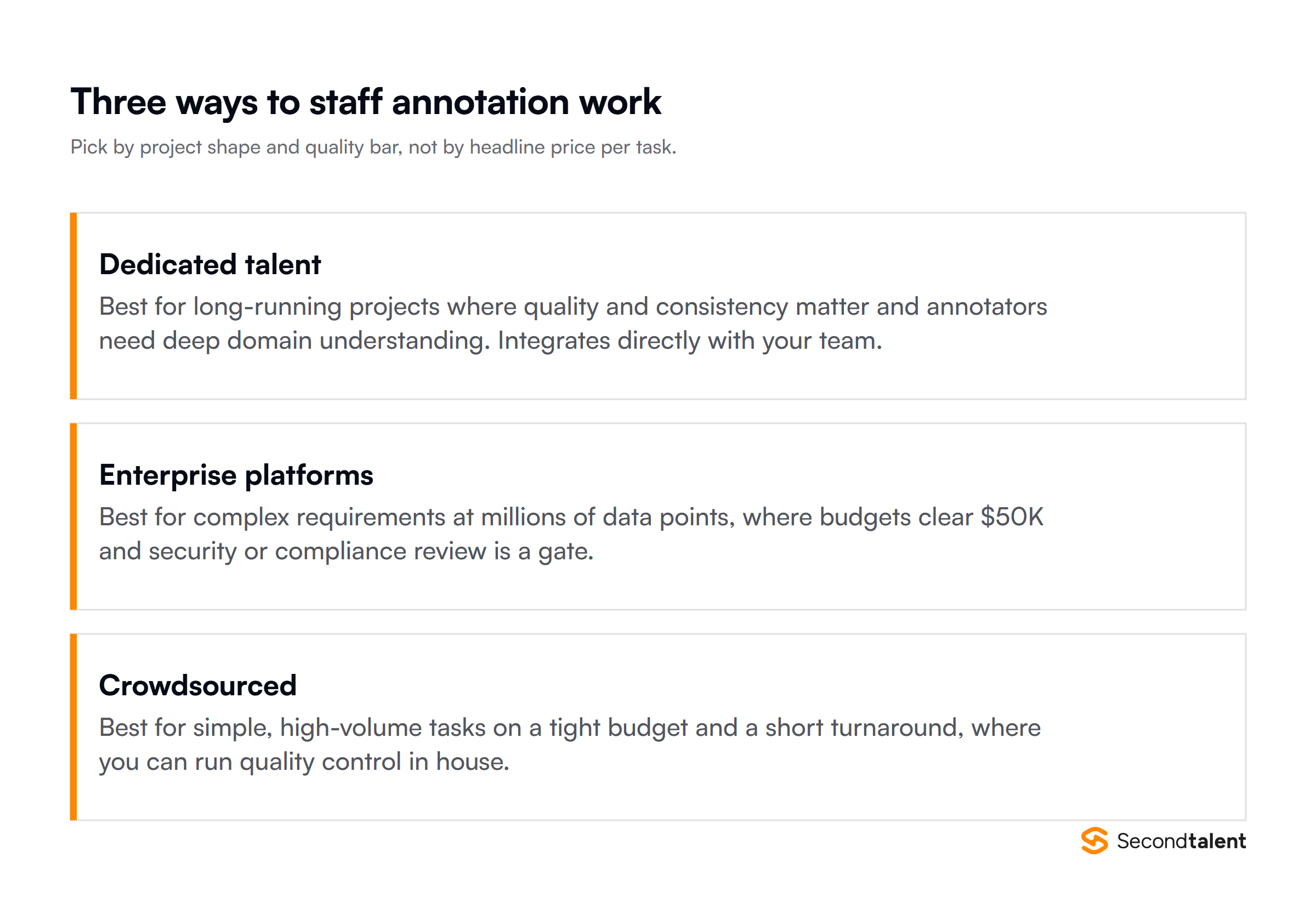
Selecting the best data annotation platform depends on your specific circumstances. Here is a decision framework to guide your choice:
Choose dedicated talent (Second Talent) if:
- You need annotation specialists for ongoing or long-term projects
- Quality and consistency are top priorities
- You want annotators who understand your domain deeply
- Direct team integration and communication matter to you
Choose enterprise platforms (Scale AI, Sama) if:
- You have large budgets and complex annotation requirements
- You need proven enterprise security and compliance
- Your project involves millions of data points
Choose crowdsourced platforms (Appen, Toloka) if:
- You need quick turnaround on simple annotation tasks
- Budget constraints are significant
- You have internal resources to manage quality control
Output quality is the single most cited blocker to putting AI into production, named by 32% of teams and ranked ahead of latency and cost in LangChain’s State of Agent Engineering.
Annotation quality sits upstream of that number, which is why a dedicated team pays back more than a cheaper per-task rate.
Building Your Data Annotation Team: Best Practices
Regardless of which platform you choose, follow these best practices to maximize annotation quality:
- Create detailed annotation guidelines: Document every labeling decision with examples and edge cases
- Start with pilot projects: Test platform quality with small batches before committing to large volumes
- Implement quality metrics: Track inter-annotator agreement, accuracy rates, and consistency scores
- Establish feedback loops: Regular communication between annotators and ML engineers improves results
- Invest in annotator training: Domain knowledge significantly impacts output quality
Many successful AI companies hire AI engineers who work closely with annotation teams to ensure data quality aligns with model requirements.
Conclusion:
The quality of your training data directly determines the success of your AI initiatives. Each of the seven platforms covered in this guide offers distinct advantages depending on your project scope, budget, and quality requirements.
For businesses seeking long-term partnerships with dedicated annotation specialists, Second Talent provides access to pre-vetted experts who integrate seamlessly with your team.
For enterprise-scale projects, platforms like Scale AI and Sama deliver proven quality at massive scale. For budget-conscious projects with simpler requirements, crowdsourced options like Toloka offer cost-effective solutions.
Ready to Build Your Data Annotation Team?
Hire vetted remote data annotation experts with Second Talent to build high-quality training datasets faster. Our pre-screened specialists integrate directly with your team, delivering consistent quality without the overhead of managing crowdsourced workers.
Get started with Second Talent today and scale your AI projects with confidence.

![Is Micro1 Legit?. Is Micro1 Legit? Pay, Reviews and How It Works [2026], by Second Talent.](https://www.secondtalent.com/wp-content/uploads/2026/09/is-micro1-legit-featured-v2-768x403.jpg)