TL;DR: Visual Studio Code is the most used IDE in 2026. In Stack Overflow's 2025 survey, 75.9% of developers used it, against 29% for Visual Studio. Cursor, a VS Code fork with AI built in, is the most used AI-first editor at 17.9%.
JetBrains launched Fleet in 2021 as a lighter rival to VS Code, and stopped offering it for download on December 22, 2025. Its work now lives on in Air, a JetBrains app that runs several AI coding agents side by side. Eclipse, still used by 28% of Java developers, has the lowest admired score of any IDE on Stack Overflow’s list.
- 1Neovim is the most admired IDE: 74.4% of its users want to keep using it, though only 14% of developers use it.
- 2Among Java developers, IntelliJ IDEA’s share rose from 71% to 84% in a year.
- 3Visual Studio and VS Code together had 50 million monthly active developers in May 2025.
- 4Google paid $2.4 billion in licence fees and pay to hire Windsurf’s CEO in July 2025, and Cognition bought what was left.
What Are the Most Used IDEs in 2026?
VS Code, by a wide margin. The 2025 Stack Overflow Developer Survey is still the newest large count, since the 2026 results were not online in mid-September 2026. VS Code has been the most used IDE for five years in a row, and three tools sit in a pack behind it between 27% and 29%.
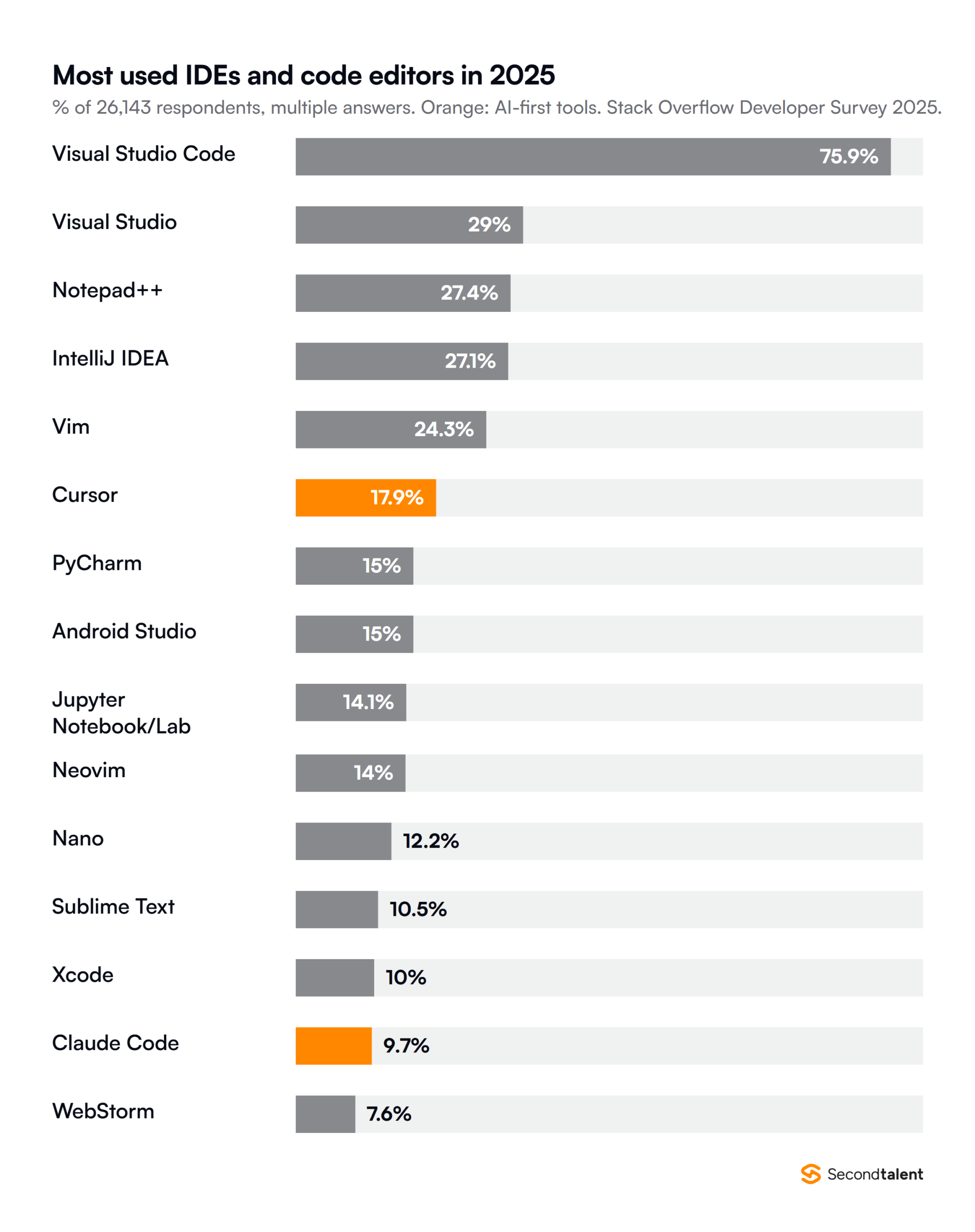
Notepad++, at 27.4%, edges out IntelliJ IDEA at 27.1%. Among professional developers the order flips, with IntelliJ IDEA on 28.4% and Notepad++ on 26.9%. Cursor climbs to 19.3% with professionals. Claude Code, a terminal agent more than an editor, reaches 10%.
“Subscription-based, AI-enabled IDEs weren’t able to topple the dominance of Visual Studio and Visual Studio Code this year.”
Stack Overflow Developer Survey 2025
What changed since 2024
Eclipse lost the most ground, falling from 9.4% to 7.1% of all respondents. JetBrains Fleet, used by 1.7% in the 2024 survey, was not on the 2025 list at all.
| IDE | 2024 | 2025 |
|---|---|---|
| Visual Studio Code | 73.6% | 75.9% |
| Visual Studio | 29.3% | 29% |
| Notepad++ | 23.9% | 27.4% |
| IntelliJ IDEA | 26.8% | 27.1% |
| Vim | 21.6% | 24.3% |
| Android Studio | 16.1% | 15% |
| Neovim | 12.5% | 14% |
| Sublime Text | 10.9% | 10.5% |
| Xcode | 9.3% | 10% |
| Eclipse | 9.4% | 7.1% |
Learners start on different tools
The 1,960 people learning to code use VS Code at almost the same rate as professionals, 78%. Below that the lists split: learners lean on terminal editors and notebooks, and use Cursor less.
- IntelliJ IDEA 28.4%
- Cursor 19.3%
- Neovim 13.6%
- Jupyter 12%
- IntelliJ IDEA 31.9%
- Cursor 11.3%
- Neovim 23.7%
- Jupyter 22.9%
Notepad++ and its hijacked updater
More than a quarter of developers run Notepad++, which made its update channel a target. From June to December 2, 2025, attackers broke into the project’s former hosting provider and sent selected users to malicious update files, the Notepad++ developer wrote.
The post names a likely Chinese state-sponsored group. Version 8.8.9 added certificate and signature checks to the updater, and the developer recommends installing 8.9.1 or later by hand.
Which IDEs Do Developers Admire and Want Most?
Neovim has the most loyal users, and VS Code has the longest waiting list. Stack Overflow counts a tool as admired when people who used it want to keep using it, and desired when any respondent wants to use it next year. VS Code scores 48.9% desired and 62.6% admired.
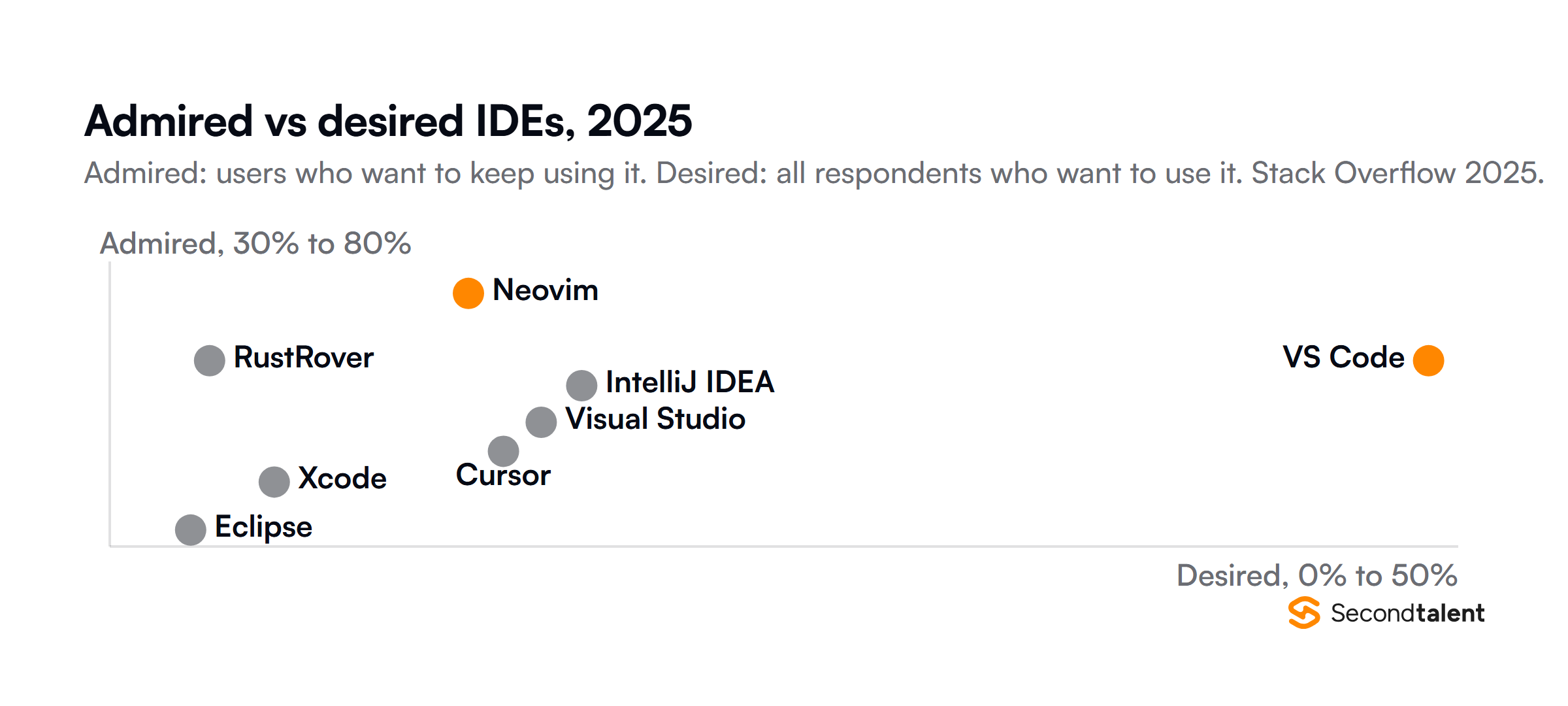
Eclipse has the lowest admired score of the 27 tools, 32.9%, below the app builders Lovable.dev at 36.6% and Bolt at 36.4%. JetBrains’ language-specific IDEs do well with their users: RustRover 62.6%, Rider 60.8% and WebStorm 59.1%.
Cursor sits at 46.7% admired, below VS Code, the editor Cursor forked. Claude Code scores 52.5% admired and 10.3% desired, and Zed 57% and 7.5%. Windsurf has 41.8% admired and 4.3% desired.
Both leaders scored higher a year earlier. In 2024, Stack Overflow found Neovim 83% admired and VS Code 59% desired, from a larger sample and a list without AI tools.
How Many Developers Use VS Code?
Microsoft does not publish a VS Code-only user count. Its latest figure covers both products: 50 million developers use Visual Studio and VS Code each month, Amanda Silver, head of product, wrote in May 2025, the year VS Code turned 10.
Copilot is how Microsoft sells AI inside the editor, and part of it is now open source. On June 30, 2025, the VS Code team released the GitHub Copilot Chat extension under the MIT licence. The older inline completions extension stayed closed at the time.
GitHub’s plans page lists Copilot Free with 2,000 completions a month, Pro at $10, Pro+ at $39 and Max at $100. Each paid plan includes monthly AI credits of $15, $70 and $200. The same page lists Copilot for Visual Studio, Xcode, JetBrains IDEs and Neovim as well as VS Code.
Microsoft reported 50 million Copilot users on its fiscal fourth-quarter 2026 earnings call. Our GitHub Copilot statistics track paid subscribers and pricing in more detail.
How Many Developers Use JetBrains IDEs?
JetBrains counted 12.5 million recurring active users in 2025, in its 2026 annual highlights. The figure counts unique users who engage with any JetBrains product regularly over a calendar year, so it is not an IDE-only number.
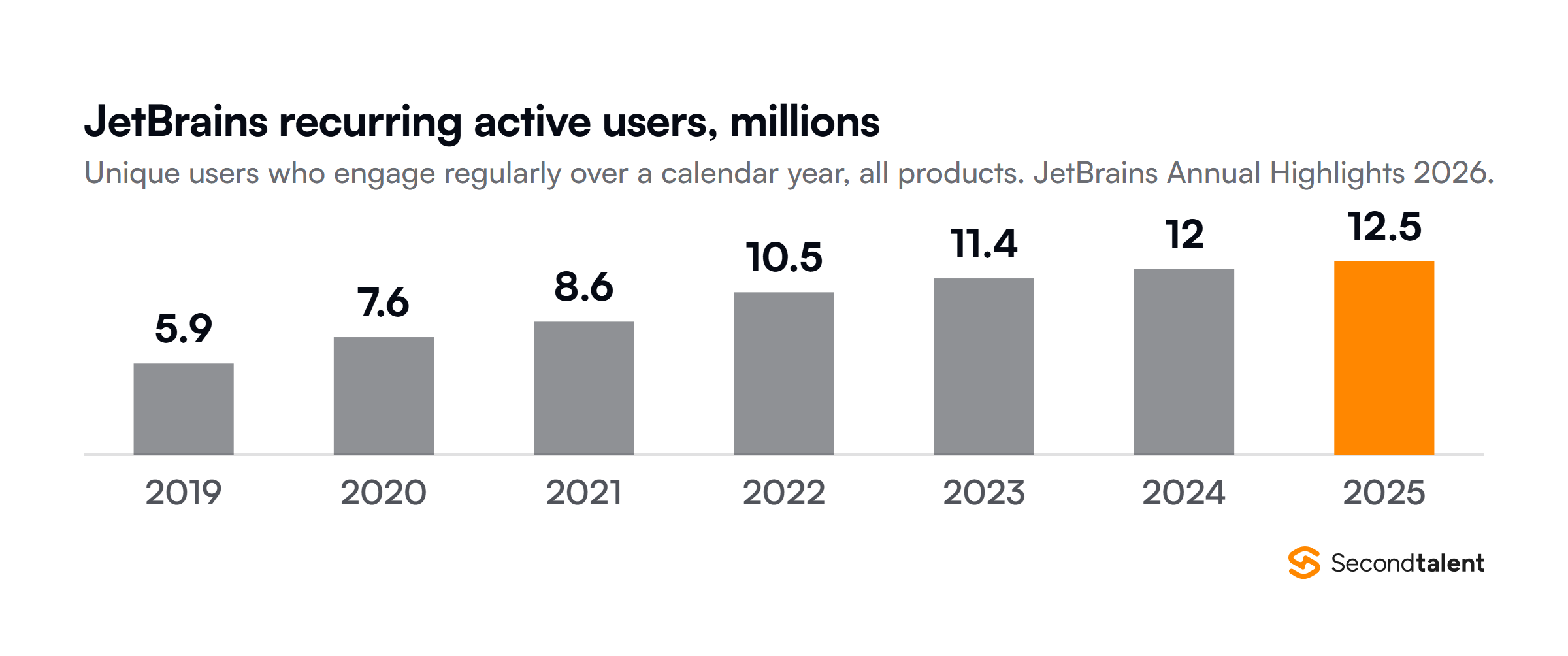
The 2025 gain of half a million was the smallest year-on-year rise in the series, which starts at 5.9 million in 2019. Teams in 88 of the Fortune Global Top 100 use JetBrains tools, and the company reported revenue growth of 25.69% in 2025.
AI is where JetBrains grew fastest. Its AI products passed a six-figure count of active paid users in the fourth quarter of 2025, up 240% on a year earlier. Junie, the coding agent it launched in 2025, had 343,000 users from March 26 to the end of the year.
Java developers: IntelliJ IDEA pulls away
Perforce’s 2025 Java Developer Productivity Report has IntelliJ IDEA used by 84% of Java developers, up from 71%. VS Code passed Eclipse for second place without growing, because Eclipse fell further.
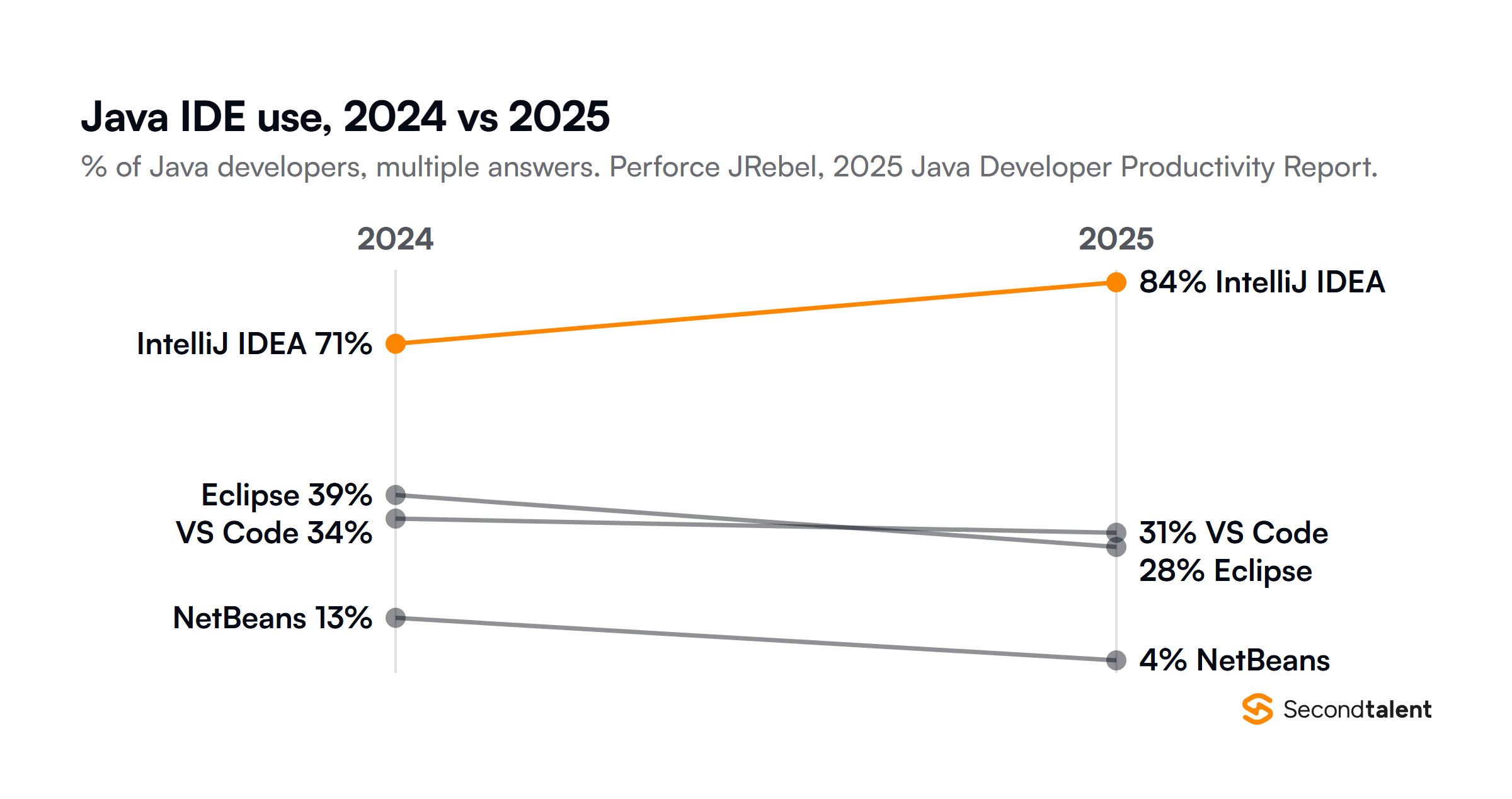
Java developers mix tools: 42% use more than one Java IDE, and 68% of those whose main IDE is IntelliJ IDEA also use VS Code. Fleet had 3% and browser-based IDEs 1%. Our ranking of the most used IDEs breaks the field down by language.
Fleet out, Air and a single IntelliJ IDEA in
JetBrains cut its product line to one IDE family in 2025, then started a separate app built around agents.
“Over time, we learned that having two general-purpose IDE families created confusion and diluted our focus.”
JetBrains, “The Future of Fleet”, December 2025
Community Edition users moved to the unified IntelliJ IDEA through a normal update. JetBrains says it will keep the open-source codebase on GitHub in step with each release.
How Many Developers Use AI Code Editors?
At work, GitHub Copilot still leads, and Claude Code has caught Cursor. JetBrains’ AI Pulse survey of more than 10,000 professional developers found 29% using Copilot at work in January 2026, and 90% using at least one AI tool at work.
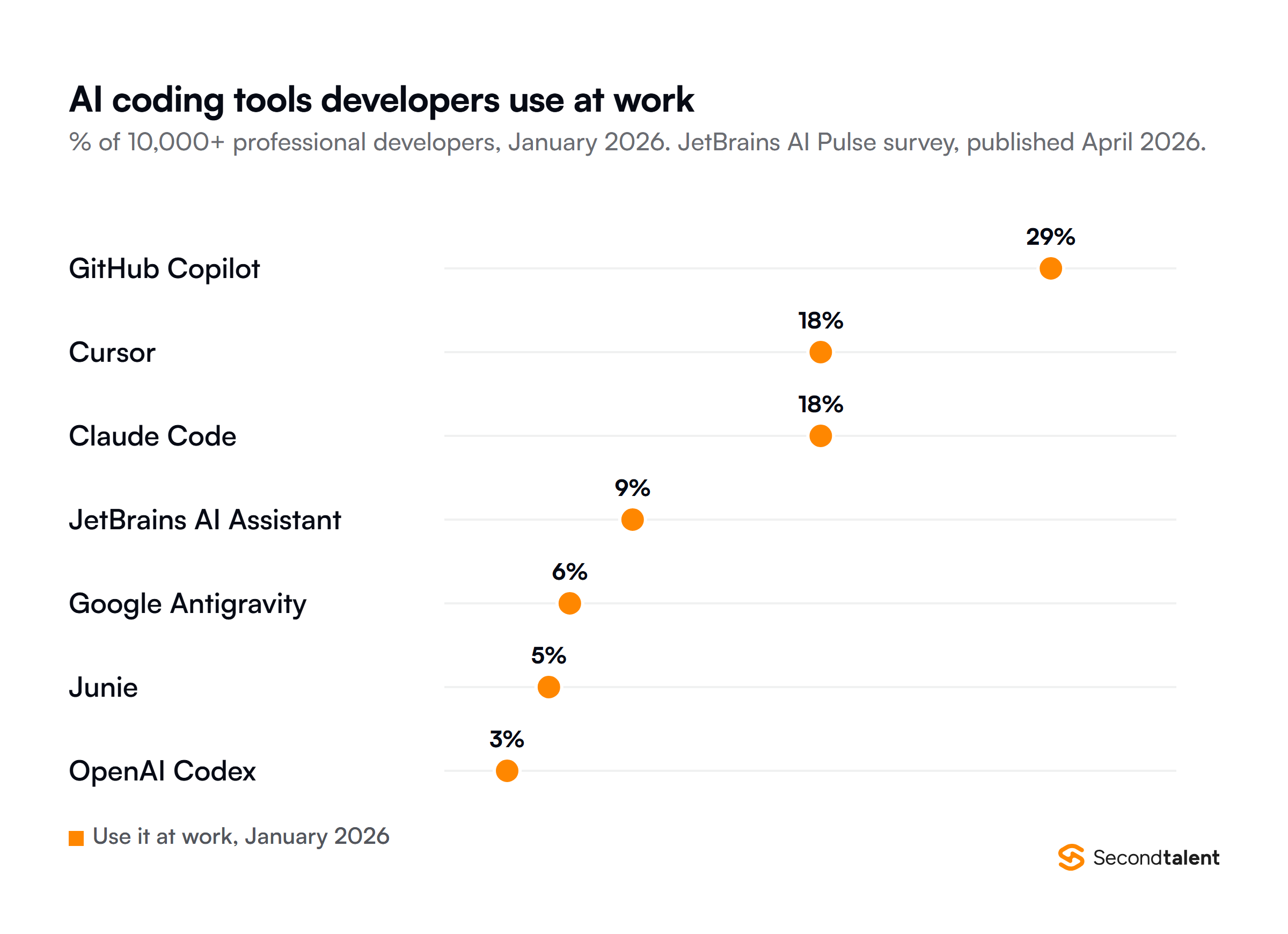
Copilot is strongest in big companies, used by 40% of developers at firms with more than 5,000 employees. Claude Code’s share of developers using it at work grew six times from about 3% in April to June 2025, and reached 24% in the US and Canada. JetBrains wrote that “Cursor’s growth has slowed down”.
The wider picture comes from JetBrains’ State of Developer Ecosystem 2025, which surveyed 24,534 developers from April to June 2025. It found 85% regularly used AI tools for coding, and 62% relied on at least one AI coding assistant, agent or code editor. Our AI coding assistant statistics collect the rest.
Cursor
The best-known VS Code fork now belongs to a rocket company. Cursor says SpaceX completed its acquisition on August 14, 2026, and CNBC reported the price as $60 billion in stock when the two companies agreed the deal in June.
Cursor’s pricing docs list Pro at $20 a month, Pro Plus at $60 and Ultra at $200, with Teams seats at $40 or $120. Our Cursor statistics cover its revenue, and Cursor vs GitHub Copilot compares the two for teams.
Windsurf, Zed, Antigravity and Kiro
Three companies struck deals over Windsurf in 2025. OpenAI had agreed to buy it for $3 billion in May, but the deal collapsed. In July, Google agreed to pay $2.4 billion in licence fees and compensation to bring CEO Varun Mohan and co-founder Douglas Chen to Google DeepMind, taking no stake, Computerworld reported.
On July 14, Cognition, maker of Devin, bought the rest: the Windsurf IDE, brand, IP and its remaining staff. Cognition put Windsurf at $82 million of annual recurring revenue and more than 350 enterprise customers. Our Windsurf review covers the product itself.
Zed’s team wrote it in Rust instead of forking VS Code. It raised a $32 million Series B, taking its funding past $42 million, shipped on Windows on October 15, 2025, and reached 1.0 on April 29, 2026. In the 2025 survey 7.3% of developers used it.
Google launched Antigravity with Gemini 3 Pro and support for Anthropic’s Claude Sonnet 4.5. Our guide to the top IDEs for AI coding compares these editors side by side.
Do Xcode and Android Studio Have AI Agents?
Yes, both now run coding agents. Apple announced Xcode 26.3 on February 3, 2026, with Anthropic’s Claude Agent and OpenAI’s Codex built in. It also exposes Xcode’s tools through the Model Context Protocol, so other compatible agents can connect.
Google rebuilt Gemini’s Agent Mode in Android Studio Quail 2, so a developer can run several agent chats in parallel tabs and pick a model for each.
Their users rate them below most general-purpose editors. In the 2025 Stack Overflow survey, Android Studio had 15% usage and 43.2% admired, and Xcode 10% usage and 41.3% admired. Only Eclipse, Bolt and Lovable.dev score below Xcode.
What Do AI Features in IDEs Cost?
The cheapest paid AI plan costs $10 to $20 a month at the main vendors, and top individual plans reach $200. JetBrains, GitHub, Cursor, Zed and Kiro all meter use with credits or tokens on top of the plan price.
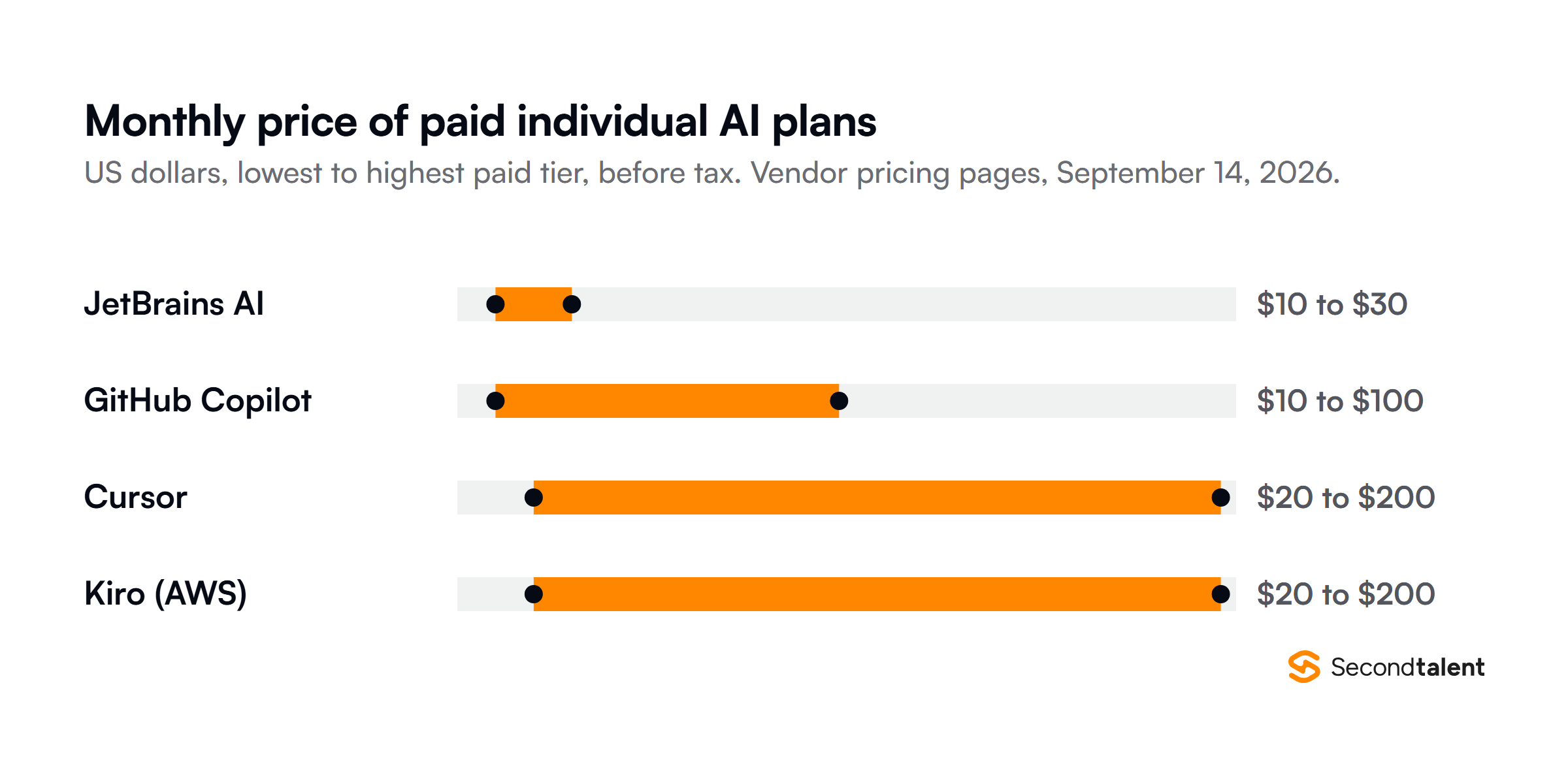
- JetBrains AI: AI Free gives 3 AI Credits per 30 days, AI Pro 10 credits for $10 a month and AI Ultimate 35 credits for $30. AI Enterprise costs $60 a user, billed yearly. The $29.90 All Products Pack includes AI Pro and Air.
- GitHub Copilot: Business costs $19 a user and Enterprise $39, each with the same dollar amount in AI credits, under the usage-based billing that began on June 1, 2026.
- Zed: Pro costs $10 with $5 of tokens, then bills at API list price plus 10%. Business is $30 a seat.
- Kiro: Pro costs $20 for 1,000 credits, Pro+ $40, Pro Max $100 and Power $200 for 10,000.
JetBrains’ pricing page also says its AI licences for organizations “will soon become credits”. Our programming language usage statistics track the languages developers write in these editors.
Hire Developers Who Know Their Tools
An IDE on a CV says little about how an engineer works with it, so we test AI tool use during vetting instead of taking it on trust. See what we check for Cursor developers, Java developers and Android developers.
Tell us the role you are hiring for and we will send matching vetted profiles.
Frequently Asked Questions
Why do the Stack Overflow IDE shares add up to more than 100%?
Respondents could tick all the tools they used regularly in the past year, so each share measures how many developers use a tool, not a market share.
Is IntelliJ IDEA still free?
Yes, for core Java and Kotlin work. Since version 2025.3 there is one IntelliJ IDEA download, with the free features built in and an Ultimate subscription for advanced tools.
Who owns Windsurf now?
Cognition, the company behind the Devin agent. Google licensed Windsurf’s technology and hired its leaders, but Cognition bought the IDE, brand and trademark.
When will the 2026 Stack Overflow survey results come out?
Stack Overflow had not published them by September 14, 2026. The 2025 results remain the latest, so the Stack Overflow figures here describe 2025.



![Programming Languages by Usage Statistics. Top 15 Programming Languages by Usage Statistics [2026], by Second Talent.](https://www.secondtalent.com/wp-content/uploads/2026/09/top-programming-usage-statistics-featured-v2-768x403.jpg)
![How to Download and Install Google's Antigravity. How to Download and Install Google's Antigravity IDE [2026], by Second Talent.](https://www.secondtalent.com/wp-content/uploads/2026/09/how-to-download-and-install-googles-antigravity-ide-featured-v2-768x403.jpg)